

 Free Consultation
 PCI-DSS Compliant
 GDPR Ready
 ISO 27001
 NDA Protected
 AI Services
 AI App Development
 Generative AI Development
 AI Chatbot Development
 AI Integration Services
 AI Consulting Services
 AI For Fintech
 AI Financial Assistant Solution
 AI Insurance Agent Development
 Tech Stack
 OpenAI / GPT-4
 Claude / Anthropic
 Gemini / Google AI
 Llama / Open Source
 LangChain / LlamaIndex
 Pinecone / Pgvector
 AWS / Azure AI


 Fintech Solution
 Core Fintech
 App Development
 Neobank Solutions
 eWallet Solutions
 Lending Software
 Banking Solutions
 BNPL Solutions
 BNPL Solutions
 Insurance App
 Wealth Management
 Crypto & DeFi
 Blockchain Development
  Payroll Software
 DeFi Solutions
 Crypto Wallet
 Crypto On/Off Ramp
 Crypto Exchange
 Trading Platform
 Payments
 Compliance
 Regulations & Compliance
 Fraud Detection
 Lending Ecosystem
 P2P Lending Platform
 Mortgage Software
 Engagement
 Fintech Outsourcing

 Mobile Development
 Mobile App Dev
 iOS App Development
 Android App Development
 React Native
 Flutter Development
 Web Solution
 Node.js Development
 React.js Development
 Angular Development
 App Services
 UI/UX Design
 App Maintenance
 By Stage
 MVP Development
 Industry Solutions
 Healthcare App Dev
 Education App Dev
 Travel App Dev
 Real Estate App Dev
 Logistics Software
 Social Media App

 Hire Mobile Developers
 Hire iPhone Developers
 Hire Android Developers
 Hire React Native Devs
 Hire Flutter Developers
 Hire Web Developers
 Hire Node.js Developers
 Hire Angular Developers
 Hire PHP Developers
 Hire Laravel Developers
 How It Works
 Pre-Vetted Developers
 Ready In 48 Hours
 NDA From Day One
 Replace Guarantee
 Company
 About Us
 Our Work Process
 Portfolio
 Case Studies
 Blog / Insights
 Careers
 Contact Us
 Awards
 Recognition


 Offices



In a Nutshell:
- AI property management software automates tenant operations, reduces maintenance costs, and improves occupancy insights across portfolios.
- AI activates data-driven decisions through predictive maintenance, rent optimization, and real-time portfolio analytics.
- Building scalable AI solutions demands robust data pipelines, security, and governed AI models.
- Development cost and complexity depend on AI features, portfolio size, integrations, and scalability needs.
- Partnering with an experienced AI property management software development company like Nimble AppGenie ensures secure, ROI-focused, and future-ready solutions.
For a long time, property management has been challenging, especially at scale. For proper use of conventional systems, users perform operations manually, use fragmented tools, and make reactive decisions, leading to poor occupancy insights, high maintenance costs, and limited scalability for expanding property management businesses. Resultantly, as the portfolio grows, such inefficiencies directly affect revenue, operational control, and tenant satisfaction.
Here, AI property management software comes to the rescue. How? By harnessing the potential of artificial intelligence, real estate companies and property managers can streamline workflows, anticipate maintenance issues before they arise, gain real-time visibility, and optimize rental pricing. Such AI-driven systems learn constantly from data that helps make smarter and more profitable decisions swiftly.
Property owners, real estate investors, and property management companies should reap the benefits of such solutions. For that, they need a strategic approach to AI property management software development.
This guide will help you explore how to build AI property management software, the AI PMS features list that delivers measurable ROI, real-world use cases, development costs, and how AI property management software works.
Let’s get the ball rolling!
What is AI Property Management Software?
AI-powered property management software is a cognitive, intelligent digital platform that leverages the latest technologies, like artificial intelligence, data analytics, and machine learning, to optimize, streamline, and constantly improve property management operations.
Unlike traditional systems that only record data, an AI property management system vigorously analyzes details from assets, tenants, maintenance logs, payments, and market trends to support faster and smarter decision-making.
AI-Powered Property Management Software vs Traditional PMS
| Aspect | Traditional Property Management System | AI-Powered Property Management Software |
| Core Functionality | It manages records, transactions, and basic workflows | Actively analyze data to optimize processes and outcomes |
| Automation Type | Rule-based automation with fixed logic | Intelligent automation powered by AI and machine learning |
| Decision Making | Reactive and manual | Predictive and data-driven |
| Maintenance Management | Logs service requests after the occurrence of issues | Predictive maintenance needs even before failures happen |
| Tenant Communication | Through manual emails, calls, or basic notifications | AI chatbots and automated help with context-aware communication |
| Rent Pricing | Static or manually adjusted pricing | AI-driven rental optimization based on market trends and demand |
| Occupancy Insights | Limited reporting and historical data | Real-time occupancy forecasting and vacancy prediction |
| Scalability | It requires additional staff and manual effort | Scale efficiently without proportional operational costs |
| Learning Capability | No self-improvement over time | Continuously learns from data and improves precision |
| Business Impact | Supports routine operations | Drive revenue growth, cost reduction, and portfolio scalability |
- Pro Tip: The shift from operational management to smart decision-making is making businesses increasingly invest in custom AI property management software development customized to their growth objectives.
Why Businesses Are Investing in AI Property Management Software
In the fierce real estate market, as your portfolio grows, you will find traditional methods failing to match the steps of technological advancement.
So forth, the property management giants are adopting AI automation in property management to benefit from tenant retention, cost reduction, operational efficiency, and data-driven decision-making.
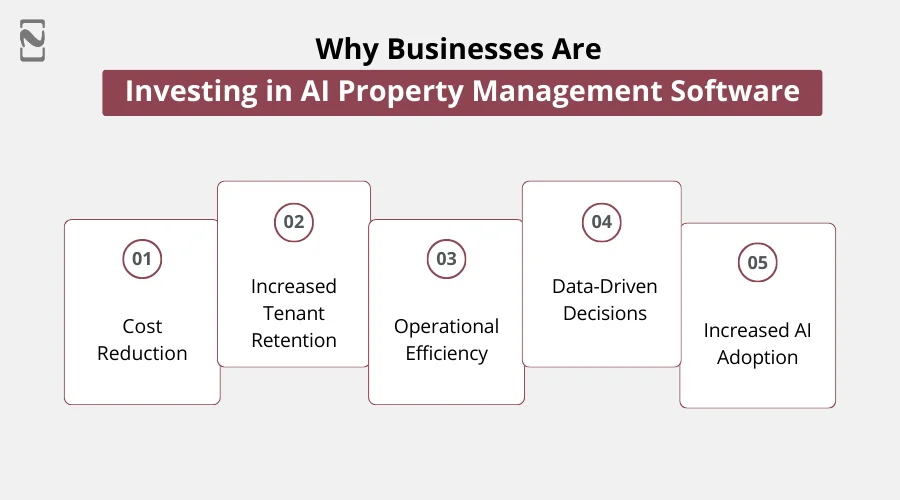
Let’s get deeper into the facts and figures to understand the reasons for the increasing investment in AI property management software for real estate companies.
1. Cost Reduction
- Powered by AI, predictive maintenance reduces maintenance costs by about 20% to 25% yearly.
- AI helps in automated invoice processing that leads to decreased processing costs from $12 per invoice to less than $2.
- Through AI leasing assistants, properties are reporting a drop in cost-per-lead by around 40%.
- Users can opt for real estate investing apps to get access to the property market with low investment.
2. Increased Tenant Retention
- AI automates follow-up, which boosts lead engagement retention by about 60% after the first interaction.
- AI integration in property management has dropped tenant dispute resolution time by about 22%.
3. Operational Efficiency
How does AI improve property management efficiency?
- AI-powered automation reduces 50% of the time spent on administrative jobs for property managers.
- AI holds the caliber to streamline about 90% of the leasing process from inquiry to final lease signing.
4. Data-Driven Decisions
- Analyzing past maintenance data leveraging AI resulted in a 15% yearly reduction in capital expenditure reserves.
- Human pricing decisions were superimposed by AI-driven revenue management software in about 94% of test cases.
- Before connecting with a technician, AI helps diagnose and prioritize about 30% of maintenance requests.
5. Increased AI Adoption
- 80% and more proptech unicorns utilize AI or machine learning as a core solution feature.
- AI in the real estate market is predicted to rise by 2029, reaching $1335.89 billion.
- Over the last two years, 80% of property management companies have increased AI and automation usage.
- North America holds the largest chunk of the AI market, approximately 38%.
- European markets are witnessing a 28% annual growth in the adoption of AI property management software.
These statistics are enough to consider AI property management software development for your real estate business. It’s the right time to act and take advantage of the favorable figures.
Key Features of AI Property Management Software
Our ultra-modern AI property management software features help automate impactful operational workflows while enhancing precision, speed, and tenant experience.
| Features | What It Does | Business Impact |
| AI Tenant Screening | It analyzes credit history, rental behavior, income patterns, and risk indicators using AI models | Faster tenant onboarding, reduced default risk, and better tenant quality |
| Automated Rent Collection | The feature automates invoicing, reminders, payment tracking, and reconciliation | Improved cash flow, fewer late payments, and reduced manual follow-ups |
| Smart Lease Management | It digitizes lease creation, renewals, alerts, and compliance checks | Lower administrative overhead and reduced legal risks |
| Predictive Maintenance | Uses historical data and sensor inputs to predict maintenance needs | Reduced emergency repairs, lower maintenance costs, and increased asset lifespan |
| AI Chatbots for Tenants | The feature provides 24/7 automated support for queries, service requests, and updates | Improved tenant satisfaction and reduced support workload |
| Work Order Automation | It automatically assigns and prioritizes maintenance tasks | Increased operational efficiency and reduced downtime |
| Automated Tenant Onboarding | Digitizes applications, verification, approvals, and move-in workflows | Faster occupancy and a smoother onboarding experience |
| Smart Notifications & Alerts | It sends automated alerts for rent, renewals, maintenance, and compliance | Reduced missed deadlines and improved communication |
| Document Management with AI Search | The core feature uses AI to classify, store, and retrieve leases and documents | Time savings and improved compliance audits |
| Multi-Property Dashboard | Centralized view of occupancy, revenue, and maintenance across properties | Better operational control at scale |
| CRM & Construction Integration | Integrates with Real Estate CRM software and construction management software | Centralized operations and improved cross-team efficiency |
Incorporating advanced AI capabilities activates portfolio-level optimization and data-driven AI capabilities that are ideal for leading property managers and enterprises.
Advanced AI-Powered Features of AI Property Management Software
| Features | How AI Is Used | Strategic Value for Businesses |
| Rent Price Optimization (ML) | Machine learning models analyze market demand, seasonality, and competitor pricing | Maximized rental revenue and improved occupancy rates |
| Vacancy Prediction | AI predicts potential vacancies based on tenant behavior and historical trends | Proactive retention strategies and reduced vacancy loss |
| Fraud Detection | AI identifies anomalies in applications, payments, and transactions | Reduced financial risk and improved compliance |
| Portfolio Performance Analytics | AI aggregates data across properties to deliver real-time insights and forecasts | Better investment decisions and portfolio scalability |
| Tenant Lifetime Value (TLV) Prediction | It predicts tenant profitability and retention probability | Better tenant targeting and leasing strategies |
| Predictive Cash Flow Forecasting | AI forecasts rental income, expenses, and ROI | Improved financial planning and budgeting |
| Dynamic Maintenance Optimization | It optimizes maintenance schedules based on cost, urgency, and asset health | Lower lifecycle costs and improved asset performance |
| Energy Consumption Optimization | AI analyzes energy usage patterns to reduce wastage | Lower utility costs and sustainability compliance |
| AI-Based Demand Forecasting | The feature predicts demand trends by location and property type | Data-driven portfolio expansion decisions |
| Anomaly Detection in Financials | Detects unusual expenses or revenue leaks | Early issue detection and financial control |
Real-World Use Cases of AI in Property Management
Businesses are already utilizing AI in property management across distinct segments of the real estate industry.
Here, we’ll go deeper into common segments where AI is transforming how real estate property managers optimize portfolios, interact with tenants, and make data-driven decisions.
1. Residential Property Firms
Leveraging AI, residential property managers are automating tenant onboarding, maintenance management, and rent collection.
- AI chatbots address tenant inquiries round-the-clock, mitigating staffing costs.
- Machine learning optimizes rent pricing according to real estate technology trends, demand, and seasonal patterns.
- Predictive maintenance models anticipate facility failure or appliance failure, reducing emergency repair expenditures.
2. Property Management Startups
Startups stepping into the property management landscape depend on AI to compete with giants without maintaining large teams.
AI applications include:
- Real-time portfolio dashboards that help small teams manage several properties effectively.
- AI tenant screening for rapid approvals.
- Automated property listings and marketing optimization.
3. Commercial Real Estate Firms
Commercial real estate companies have to manage complex portfolios across various buildings, also usually with mixed-use spaces.
AI-powered PMS for commercial real estate helps:
- Leverage smart building analytics to optimize energy consumption.
- Predict vacancies and forecast occupancy trends.
- Automatically identify financial anomalies or leasing fraud.
With these strengths, companies can make data-backed investment and operational decisions while boosting tenant satisfaction.
4. Multi-Location Portfolios
Property management brands across regions or cities benefit from the power of AI to aggregate data across distinct locations.
- Portfolio-level dashboards offer centralized regulations, allowing rapid and smarter business decisions.
- Predictive analytics recognizes trends in maintenance, occupancy, and rent optimization across every property.
- AI-driven reporting leads to consistent performance monitoring and compliance.
Opting for AI real estate software across distinct sectors, from residential firms to multi-location portfolios, you can improve property management, transforming it from reactive operations into revenue-generating systems.
Quick Review of the Benefits of AI in Property Management
Artificial intelligence is reshaping property management operations, scalability, and competence.
Below, we will take a swift review of the business benefits of AI in property management:
| Benefits | What It Means for Your Business |
| Operational Efficiency | It’s best for automating tenant screening, rent collection, lease management, and maintenance workflows that save time and reduce manual effort. |
| Cost Reduction | Predictive maintenance and optimized operations diminish emergency repairs and operational overhead |
| Tenant Satisfaction & Retention | AI chatbots and proactive service improve communication, support, and tenant experience |
| Data-Driven Decisions | Real-time insights on rent pricing, occupancy, and portfolio performance for smarter decisions |
| Scalable Growth | It helps manage larger property portfolios without proportional increases in staff or complexity |
| Revenue Optimization | AI-driven rent pricing and vacancy prediction maximize rental income and portfolio ROI |
How to Build AI Property Management Software – Step-by-Step Development Process
Custom AI property management software development mandates following a strategic process aligning with your business goals.
Below, we will unveil a structured approach through which you can attain tenant satisfaction, measurable efficiency, and ROI through AI property management app development.
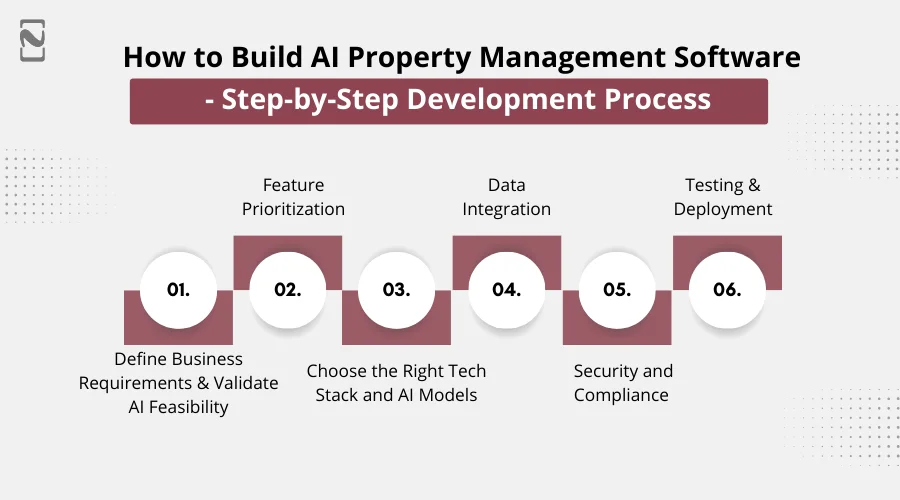
1. Define Business Requirements and Validate AI Feasibility
First, you should understand your business pain points that you are seeking to resolve. Ahead, check which operation can help you with predictive analytics and AI automation.
Ask yourself:
- Which tasks are manual or repetitive?
- Where is data already available for AI training?
- What KPIs will AI improve?
Outcome: A clear plan that aligns AI potential with your property management targets, ensuring the investment provides tangible results.
2. Feature Prioritization
Obviously, not all the AI features impact equally. You should prioritize features, depending on your business complexity, value, and scalability.
Outcome: A Minimum Viable Product (MVP) that balances immediate ROI with scalability ahead.
3. Choose the Right Tech Stack and AI Models
Here, you will choose the appropriate technology stack for AI property management system development, considering integration, scalability, and performance.
To know what tech stack you should pick, check the next section.
Outcome: A robust tech foundation that supports smooth cross-platform performance and real-time AI insights.
4. Data Integration
As you know, AI depends on top-quality, centralized data. So, you need to integrate data from:
- Financial records
- Lease contracts
- Maintenance logs
- Tenant management systems
Besides, leveraging AI-ready data warehouses and ETL pipelines to ensure structured, clean, and usable data.
Outcome: A single source of data that empowers accurate AI predictions and analytics.
5. Security and Compliance
AI-powered real estate platforms handle sensitive financial records and tenant data. Here, you are required to implement powerful security measures:
- Role-based access control
- End-to-end encryption
- GDPR, CCPA, or regional compliance adherence
AI model governance will also help to keep away biases in tenant screening or pricing.
Outcome: Trustworthy and scalable AI software that reduces legal risk and fosters tenant confidence.
6. Testing & Deployment
Before you launch your smart property management software, let it undergo rigorous testing.
- Unit and integration testing for functionality
- Load testing for scalability
Also, perform AI validation to get accurate and unbiased predictions.
Next, deploy your AI real estate property management software using CI/CD pipelines for flawless updates and consistent improvement. Post-launch, constantly monitor performance metrics and user feedback for iterative improvements.
Outcome: A powerful and scalable AI property management solution that improves procedures from day one.
- Pro Tip: Obviously, AI software development is not a one-size-fits-all thing. Custom solutions provide higher ROI than off-the-shelf tools, aligning with your business processes, strategic objectives, and portfolio size.
At Nimble AppGenie, the team of dedicated AI developers specializes in custom AI property management app development, helping clients from conception to deployment and ongoing support.
Tech Stack Required for AI Property Management Software Development
To build AI property management platform, you need to skillfully select a tech stack that balances performance, AI capabilities, security, and scalability.
The right combination of tools and technologies ensures your solution is adaptable, future-ready, and capable of providing predictive analytics, insights, and automation.
| Category | Technology / Framework | Purpose |
| Frontend | React.js / Angular / Vue.js | Web application development |
| Flutter / React Native | Mobile app development | |
| Bootstrap / Tailwind CSS | UI styling | |
| Backend | Node.js / Django / Spring Boot | Server-side logic & API |
| Python / Java | AI model integration | |
| GraphQL / REST APIs | Data exchange | |
| AI & Machine Learning | TensorFlow / PyTorch | Predictive maintenance, rent optimization, vacancy forecasting |
| scikit-learn | Tenant scoring, anomaly detection | |
| Keras | Neural network design | |
| Databases & Storage | PostgreSQL / MySQL | Tenant, lease, and financial data |
| MongoDB / Cassandra | Unstructured logs, maintenance data | |
| Snowflake / BigQuery | Analytics & reporting | |
| Cloud & DevOps | AWS / Azure / Google Cloud | Cloud hosting & compute |
| Docker / Kubernetes | Containerization & orchestration | |
| CI/CD Pipelines (Jenkins / GitHub Actions) | Continuous integration & deployment | |
| Security & Compliance | OAuth / JWT | Authentication & authorization |
| AES / RSA Encryption | Data encryption | |
| GDPR / CCPA frameworks | Regulatory compliance |
AI Property Management Software Development Cost
How much does it cost to build AI property management software?
Understanding the AI property management software development cost is essential for businesses to plan budgets, choose the right features, and evaluate ROI.
MVP vs Enterprise Cost
| Type | Typical Cost Range (USD) |
| Minimum Viable Product (MVP) | $30,000 – $70,000 |
| Enterprise-Grade Solution | $120,000 – $350,000+ |
Key Cost Factors Affecting AI Property Management Software Pricing
Feature complexity, integration requirements, portfolio size & scalability, AI model complexity, UI/UX customization, security & compliance, and maintenance & scaling impact the AI property management software development cost.
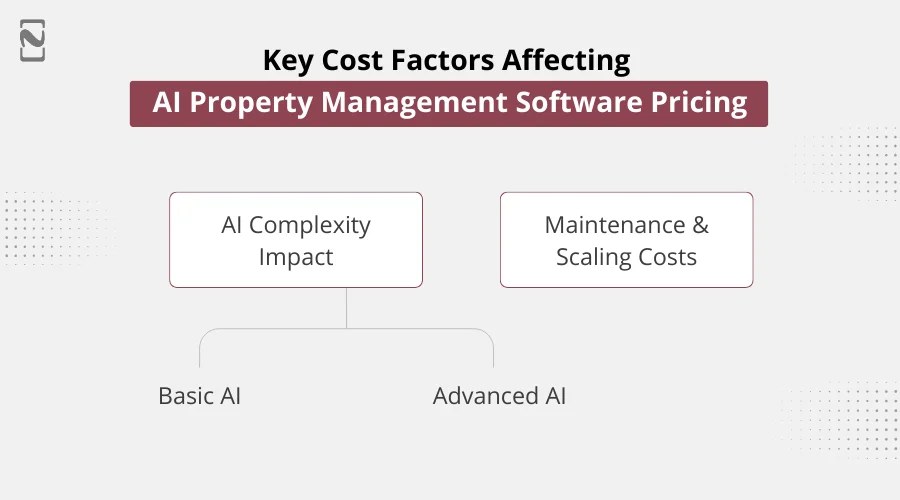
AI Complexity Impact
- Basic AI: Tenant screening and simple predictive maintenance will result in a moderate cost increase.
- Advanced AI: Portfolio-wide analytics, dynamic pricing, anomaly detection, and vacancy prediction lead to high costs but benefit with increased ROI.
So, businesses should balance AI sophistication with operational requirements to ensure ROI.
Maintenance & Scaling Costs
After deploying AI-powered property management software, you need to invest in ongoing maintenance.
It demands about 15-20% of the initial development cost, based on the user base and complexity.
Investing in a custom AI property management system from an experienced software-based company like Nimble AppGenie ensures the product is secure and scalable to deliver maximum revenue growth and operational efficiency.
How to Monetize AI Property Management Software
Founders, investors, and product owners should know how to best monetize their AI property management software to deliver ultimate revenue growth.
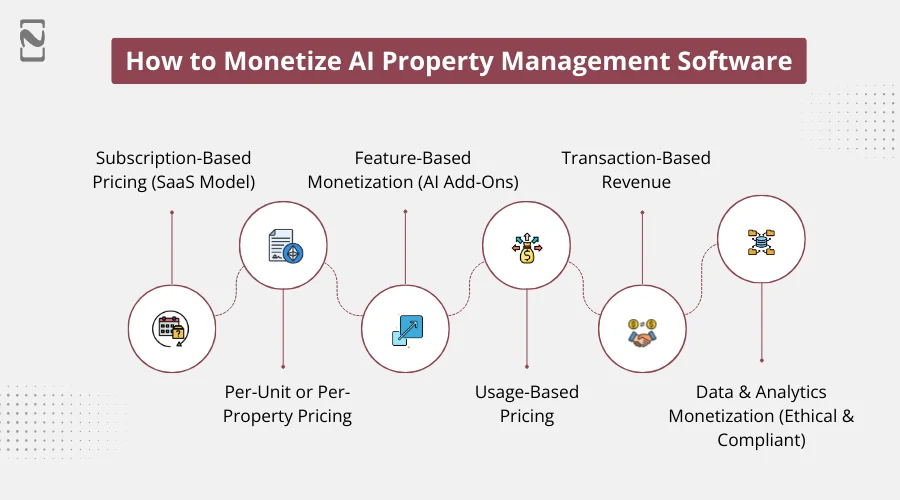
1. Subscription-Based Pricing (SaaS Model)
It is the most common monetization approach holds the caliber to scale with the business.
All you need to do is offer monthly or annual subscription plans. Or you can provide tiered pricing based on the number of units, features, or portfolio size.
Why it works:
- Predictable recurring revenue
- Simplify upselling to higher tiers with advanced AI features
Best for: Property management companies, residential firms, and startups.
2. Per-Unit or Per-Property Pricing
AI property management software for landlords operating with this model charges an amount based on the units managed or the number of properties.
You fix the cost per property or unit per month, and the pricing scales with the growing customer’s portfolio.
Why it works:
- Fair and transparent pricing
- Aligns software costs with customer growth
Best for: Landlords, mid-sized property managers, and multi-location portfolios.
3. Feature-Based Monetization (AI Add-Ons)
AI property management software for enterprises chooses this model and provides Advanced AI capabilities as paid add-ons.
Examples of premium AI features:
- Rent price optimization (ML)
- Fraud detection
- Vacancy prediction
- Advanced portfolio analytics
Why it works:
- Strong upsell opportunities
- Customers pay only for the AI features they need
Best for: Enterprise and commercial real estate clients.
4. Usage-Based Pricing
Users of AI property management software for startups pay for the actual system usage. You pay for fees based on AI predictions, API calls, data volume processed, and chatbot interactions.
Why it works:
- Attractive for startups and small teams
- Flexible pricing aligned with usage
Best for: AI-heavy platforms and API-driven property management systems.
5. Transaction-Based Revenue
Business owners earn revenue from service and financial transactions accomplished using their software.
Examples:
- Fees for maintenance service bookings
- Commission on rent payments
- Processing fees for background checks or verifications
Why it works:
- Monetizes routine property operations
- Generates passive revenue as platform usage increases
6. Data & Analytics Monetization (Ethical & Compliant)
Users can leverage anonymized and aggregated data insights.
Examples:
- Market Trend Reports
- Rental Demand Analytics
- Portfolio Benchmarking Dashboards
Why it works:
- Adds value without affecting core functionality
- Best for investors and large enterprises
Premium add-ons may include blockchain in property management for secure transactions or modules to create a real estate virtual tour app for enhanced tenant engagement.
Challenges in AI Property Management Software Development & Solutions
AI property management software development is best for meeting the needs for automation and insights.
But you need to be prepared to encounter operational, technical, or compliance challenges.
Businesses should understand these risks beforehand to build reliable AI systems.
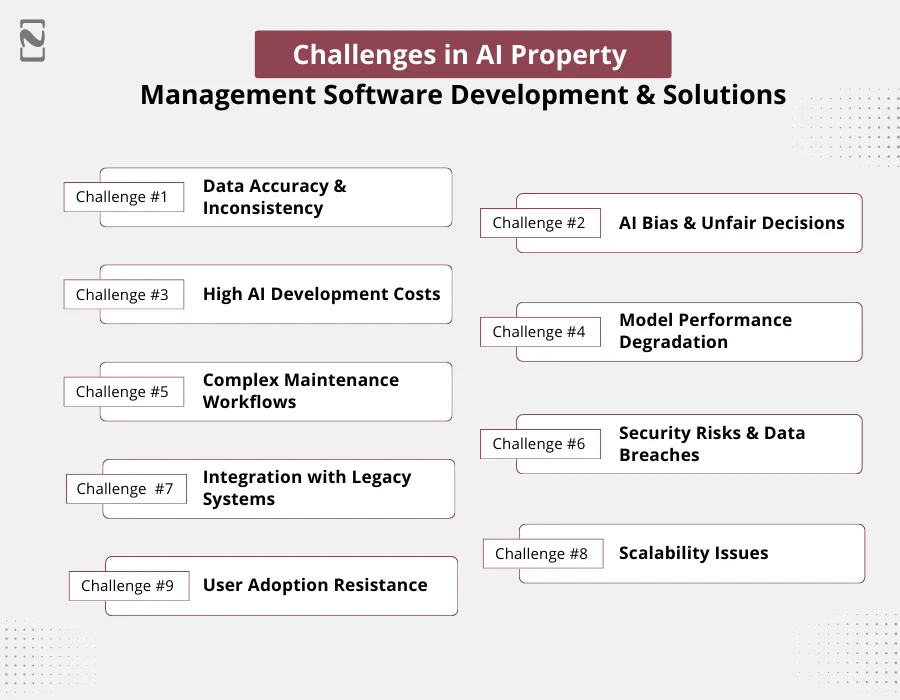
Let’s have a walkthrough to key challenges in property management software development with possible solutions.
-
Data Accuracy & Inconsistency
Solution: Create structured AI data pipelines with normalization, validation, and real-time syncing from IoT devices, PMS, and financial systems.
-
AI Bias & Unfair Decisions
Solution: Businesses should apply model governance frameworks, diverse datasets, bias testing, and explainable AI for clear decisions.
-
High AI Development Costs
Solution: You should start with an MVP development, prioritize impactful AI features, and gradually scale advanced models.
-
Model Performance Degradation
Solution: Here, you can perform continuous model, performance alerts, and automated retraining.
-
Complex Maintenance Workflows
Solution: Realtors can implement automated ticket prioritization and predictive maintenance models.
-
Security Risks & Data Breaches
Solution: You should implement role-based access control, end-to-end encryption, compliance with GDPR, local regulations, and CCPA, and secure APIs.
-
Integration with Legacy Systems
Solution: Leverage API-first architecture, microservices, and middleware to integrate with current property management and ERP systems.
-
Scalability Issues
Solution: Businesses can adopt cloud-native infrastructure with containerization, auto-scaling, and distributed AI workloads.
-
User Adoption Resistance
Solution: Investors should focus on user-focused UI/UX, onboarding support for property managers, and explainable AI outputs.
Collaborating with Nimble AppGenie will help you deploy trusted AI property management platforms without facing any challenges, following a solution-first AI development approach.
Why Choose Nimble AppGenie for AI Property Management Software Development
When you plan to build an ROI-driven platform, you need to choose the right AI property management software development company.
Yes, it’s a challenging job, but it’s crucial.
Don’t fret, you can go for Nimble AppGenie, a trusted real estate AI software development company with a proven track record of helping real estate enterprises, startups, and project managers in intelligent solutions deployment that automate operations and maximize portfolio performance.
What Makes Nimble AppGenie Different?
- Specialized AI Expertise in Real Estate
- Provide End-to-End AI Property Management Software Development Services
- Showcase Enterprise-Grade Solutions for Large Portfolios
Hire AI property management software developers that the company maintains, whom you can trust with transparent communication, domain expertise, and agile & milestone-based delivery.
Moreover, we help businesses create real estate apps with AI-driven property management, CRM integration, predictive analytics, and scalable cloud architecture.
Real-World Case Study: AI-Powered Property Management Platform
Client: A mid-to-large, multi-location residential property management firm managing around 20,000+ units across multiple cities.
Challenges They are Facing:
- Poor visibility into occupancy and rent optimization
- Manual tenant screening and lease workflows
- Difficulty scaling operations across locations
- High maintenance costs due to reactive servicing
Solutions We Offered:
We created a custom AI property management platform featuring:
- AI tenant screening using ML risk scoring
- Predictive maintenance powered by IoT and historical data
- Rent price optimization engine based on demand forecasting
- AI chatbots for tenant support and service requests
- Portfolio analytics dashboard for real-time insights
Results Obtained:
- 30% drop in maintenance costs
- 22% improvement in occupancy rates
- 40% faster tenant onboarding & lease processing
Nimble AppGenie is an ideal technology partner for those looking for a bespoke AI property management software development company that understands challenges and delivers measurable business outcomes.
Conclusion
AI property management software lowers costs, reduces manual jobs, enables data-backed decisions, and improves tenant retention.
Thus, enabling digital transformation in real estate and how realtors and businesses operate.
AI & ML can help in business growth, including real estate enterprises and property managers. Besides, enthusiasts are planning for real estate agent website development to integrate relevant services like AI property management. You can also build a DX Real Estate Website.
The key to creating scalable and secure solutions that can maximize ROI is choosing the right AI software development company.
Nimble AppGenie is a trusted real estate AI software development company that delivers custom AI property management software development services designed for startups, growing firms, and large portfolios.
Ready to build or scale your AI property management platform? Partner with Nimble AppGenie to turn AI innovation into real business results.
FAQs
$30,000–$70,000 for an MVP and $120,000–$350,000+ for an enterprise-grade solution.
Costs depend on AI complexity, features, integrations, and portfolio size.

Niketan Sharma, CTO, Nimble AppGenie, is a tech enthusiast with more than a decade of experience in delivering high-value solutions that allow a brand to penetrate the market easily. With a strong hold on mobile app development, he is actively working to help businesses identify the potential of digital transformation by sharing insightful statistics, guides & blogs.
Table of Contents




No Comments
Comments are closed.