


In a Nutshell:
- The cost to build an app like AfterPay can range between $25,000 to $250,000 or more based on the app complexity, features, and project requirements.
- A BNPL app makes money through merchant fees, interest on payments, premium subscriptions, and insights that help retailers improve sales.
- Must-have BNPL app features include instant credit checks, secure KYC onboarding, AI-driven fraud prevention, virtual cards, and intuitive merchant dashboards.
- The right tech stack for BNPL apps ensures speed, security, and scalability by combining React Native or Flutter for mobile, Node.js or Python for backend.
- Nimble AppGenie provides custom BNPL app solutions that align with your project requirements and budget.
Afterpay, a secure Buy Now, Pay Later (BNPL) platform, allows users to split purchases into interest-free installments; on the other hand, merchants are paid upfront. It is one of the leading BNPL apps and is touching international markets, experiencing a 17% increase in spending to over $9 billion.
In the coming years, the Buy Now Pay Later market will grow at a staggering rate that will boost sales conversion rates by around 10-30% and increase average order value (AOV) as consumers spend more choosing flexible installments.
| According to Allied Market Research, the BNPL market is expected to expand and reach $3.98 trillion by 2030, at a CAGR of 45.7%. |
Why you should build an app like Afterpay?
Whether you are a merchant, retailer, BNPL service provider, payment gateway provider, or bank & financial institution, you should also create an app like Afterpay to capitalize on this increasing BNPL market.
Companies are not just following the trend by investing in such apps; they are creating such a bnpl solution for retailers to deliver quantifiable business outcomes across revenue and customer experience.
How to build an app like Afterpay?
This guide explains how to create a buy now pay later app, like Afterpay, how buy now pay later works, BNPL app features, and how much it costs to build a BNPL app. By the end of this blog, you will emerge with a profitable plan to launch a scalable BNPL app with confidence.
Let’s accentuate this!
What is the Afterpay App?
The Afterpay app was established back in 2014 by Nick Molnar and Anthony Eisen in Australia. While the app started as an Australia-only platform, today it is also available in the United Kingdom, the United States of America, and New Zealand.
The app has over 43,000 global retailers. Out of these, over 9,000 retailers are in the United States of America alone, which shows the impact that the app has made over the years.
Keep in mind that this number is growing by the hour, making Afterpay more and more relevant for the user.
The ease of access that it provides, along with access to different retailers, makes it a great app to use.
Another thing that goes in favor of Afterpay is the user interface and experience that it offers. A user can simply finish the transaction from the application directly in a matter of seconds.
How Does the Afterpay App Work?
Apps like Afterpay allow customers to purchase an item or service online and pay for it after a specific interval of time. Users can pay back in easy EMIs over a decided period. This is why it is also known as a pay-in-installments online shopping platform.
Afterpay is generally integrated with different platforms and allows a user to choose it as a mode of payment for the purchases a consumer makes.
After selecting the application, you can simply select the tenure of payment and finish the transaction on the platform instantly.
Keep in mind that to complete the transaction through Afterpay, you need to provide your information so that your credit eligibility can be checked.
This means your creditworthiness is always essential when you want to use the Afterpay app.
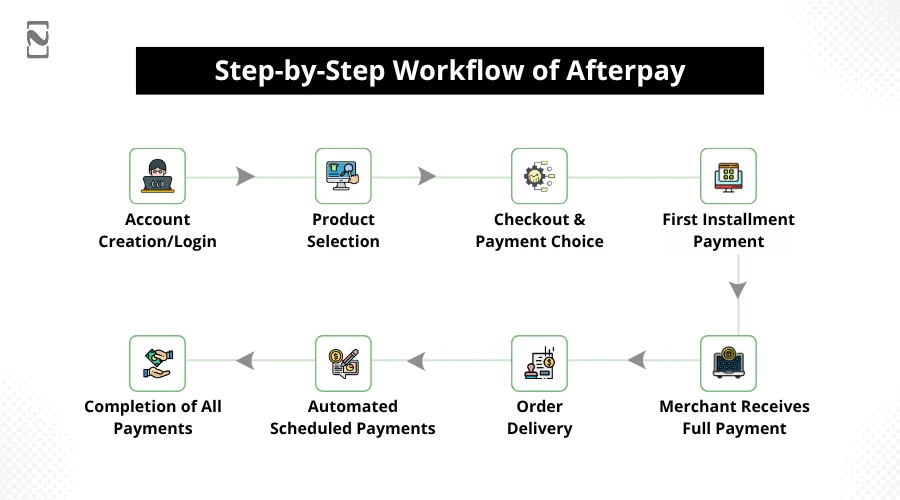
The best course of action to ensure your credit score is not hurt and your Afterpay limit is to pay back within the defined timeline. This way, your Afterpay stays active and you can use it further for more purchases.
Why Businesses Are Building Apps Like Afterpay
As we discussed earlier (with statistics), the Buy Now, Pay Later (BNPL) trend is surging rapidly, and eyeing this, more companies are investing in fintech BNPL app development, like Afterpay.
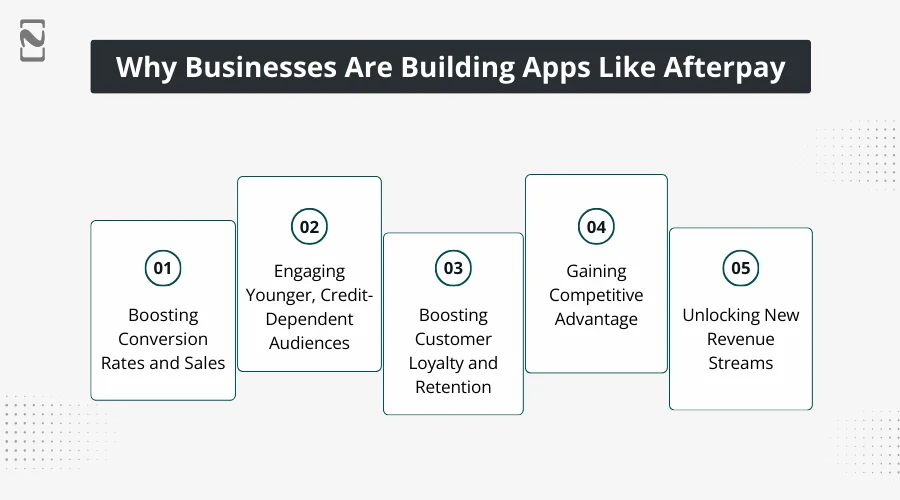
Let’s delve deeper to understand why you should build an app like Afterpay.
1. Boosting Conversion Rates and Sales
By reducing friction at checkout, BNPL options offer customers the flexibility of choosing a suitable payment option.
This leads to:
- Higher conversion rates
- Lower cart abandonment
- Increased average order value (AOV)
2. Engaging Younger, Credit-Dependent Audiences
An increasing number of Millennials and Gen Z prefer alternatives to traditional credit cards.
Under-40 shoppers are becoming major contributors to the economy, accounting for about 36% of retail spend in Australia, a figure expected to rise to 48% by 2030.
This results in:
- Simple user experience
- No interest (when paid on time)
- Fast approval with minimal credit checks
3. Boosting Customer Loyalty and Retention
By offering BNPL services, businesses encourage customers to return, as:
- They feel convenient,
- They enjoy flexible payments,
4. Gaining a Competitive Advantage
With BNPL as a mainstream, you can stay ahead of your competitors and:
- Offer improved customer experiences,
- Create deeper customer relationships,
- Grab more sales,
5. Unlocking New Revenue Streams
Besides charging an amount as fees to merchants, BNPL platforms may also append:
- Fees for speedy services,
- Interest-based models
- Premium subscription.
Core Features Required to Create an App Like Afterpay
Knowing exactly how the Afterpay application works, you now have an idea of what you are getting yourself into.
In order to build an app similar to Afterpay, you need to identify the features it offers. Generally, users are inclined towards using an app that offers the convenience of making purchases.
If it were only about borrowing money, there are several loan offering platforms in the market that a user can turn to.
However, the entire concept of the Afterpay app depends on two things: ease of repayment and ease of access.
To start your app, you need to focus on the features you integrate.
Some of the core and advanced features to have in your Afterpay-like app include –
| Features | User Panel | Admin Panel |
| 1. Account Management |
|
|
| 2. Transactions |
|
|
| 3. Loan Management |
|
|
| 4. Security & Compliance |
|
|
| 5. Notifications & Messaging |
|
|
| 6. Additional Features |
|
|
While these features define the basic identity of a buy now, pay later application, what makes Afterpay special is the advanced features and functionalities that it offers to the users.
The list below is a combination of existing features and potential features that you can add to your list while building an app like Afterpay.
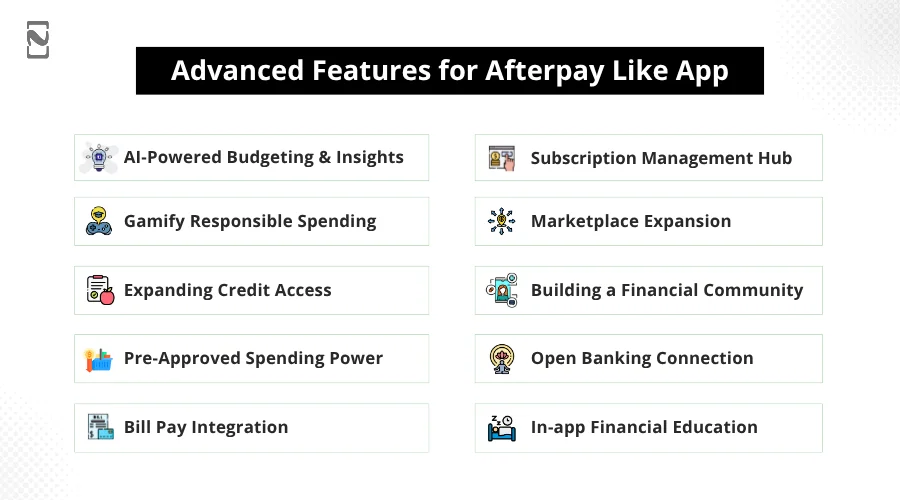
Advanced Features for Afterpay Like App:-
- AI-Powered Budgeting & Insights
- Gamify Responsible Spending
- Expanding Credit Access
- Pre-Approved Spending Power
- Bill Pay Integration
- Subscription Management Hub
- Marketplace Expansion
- Building a Financial Community
- Open Banking Connection
- In-app Financial Education
With all these features backing your application, you can surely take over the market and provide a better quality of experience for the user.
As they say, you have to be the best to beat the best, and certainly, if you plan to create an app like Afterpay, you need features that overpower the competition.
How to Build an App Like Afterpay: Step-by-Step Process
Identifying the features and choosing what you need to integrate is just the beginning. The next crucial step you need to take is developing the app.
Integrating all the features and building an infrastructure as robust as that of Afterpay.
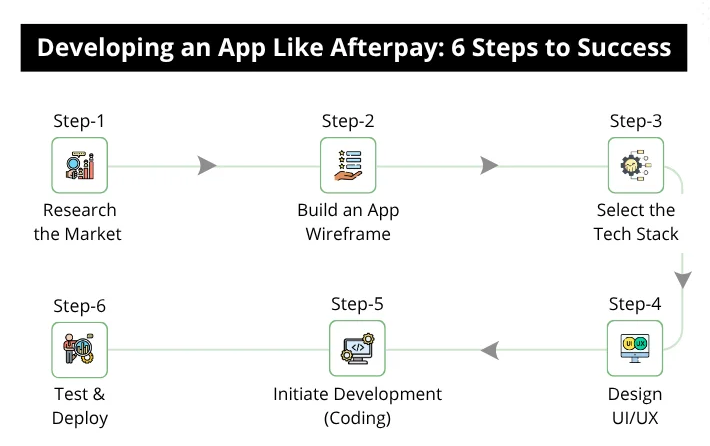
To develop an app like Afterpay, you need to follow a series of steps. These steps include –
Step 1: Research the Market
The first thing to do is identify the market opportunities and how you plan to enter them. Studying the BNPL market stats can be a great way to start your research.
Look at the competition in the market and examine where exactly they are going wrong. To create an app like Afterpay, proper market research lays the foundation of your application; hence, it is a crucial step you cannot skip.
Step 2: Build an App Wireframe
A wireframe of an app is the core groundwork that you do for the design of your app. The idea is to sketch out how your app will look and what features it will have.
This step helps you decide on the workflow of the application, giving you clarity on whether the vision you have is viable or not.
To take this a step further, you can even plan MVP development for your app, like Afterpay, as it will help you understand the vision better.
Step 3: Select the Tech Stack
After you have identified the features and the flow of the application, it is time to choose the right fintech tech stack to power them.
The tech stack is the soul of your application, as one wrong move in deciding the tech, and the app’s performance will suffer. Find an ideal balance between technology and performance.
| Components | Technology Options | Pros | Cons |
| 1. Frontend | React Native, Flutter | Cross-platform, flexible UI, large community | Requires more development effort for a native look and feel |
| 2. Backend | Node.js, Python (Django/Flask) | Scalable, mature frameworks, large developer pool | It can be complex for beginners |
| 3. Database | PostgreSQL, MongoDB | Robust, ACID-compliant (PostgreSQL), flexible schema (MongoDB) | Choosing the right one depends on specific needs |
| 4. Payment Gateway | Stripe, Braintree, Adyen | Secure, integrated payment processing solutions | Fees associated with transactions |
| 5. Fraud Detection | Sift, Riskified, FraudLabs Pro | Reduce fraudulent transactions and ensure financial security | Requires ongoing monitoring and configuration |
| 6. Credit Scoring | Plaid, LexisNexis Risk Solutions | Assess the creditworthiness of borrowers and make informed lending decisions | may require additional compliance measures |
| 7. Notifications | Twilio, Pushwoosh | Send real-time updates to users and improve engagement | Cost associated with sending notifications |
| 8. Analytics | Google Analytics, Firebase Analytics | Track user behavior and measure app performance | Requires integration and data analysis expertise |
With all these technologies, you are now ready to start building the app.
Step 4: Design UI/UX
The next step is to define the app’s user interface and experience. This is where all your application starts to take shape. Build the UI and UX with the necessary tools from the tech stack.
The user interface and experience should be unique but simplified, such that a user finds it easier to use than any other present app.
Even if your idea is to create an app like Afterpay, you need to create a distinguished user experience to make the app more preferable.
Step 5: Initiate Development (Coding)
This is the step where you start writing code for your app. Studying the functionalities of Afterpay can be beneficial for you, considering you plan to build a similar app.
However, we recommend you let a professional developer define the functionalities from a fresh perspective. This way, you not only are able to develop an app like Afterpay, but can easily surpass it with innovation and better functionalities.
Step 6: Test & Deploy
Once the code is written, simply prepare your application for deployment. To make it ready for deployment, you need to test the functionalities for different test cases and accordingly find bugs and resolve them.
Let the quality assurance professionals work on your application so they can perform multiple tests that can easily define the ability of your application and give it a clean chit for deployment.
With all these steps, you have a solid app like Afterpay ready for the market. All you need now is a team to help you keep the application afloat with proper maintenance and regular updates.
How Much Does It Cost to Create an App Like Afterpay?
Looking at the process, you may be wondering how much it would cost to develop an app like Afterpay. The query is valid considering it is not cheap to enter the BNPL market without having a development solution.
The cost associated with developing a mobile application isn’t accurately predictable. The reason is that each project is unique, and so are its requirements. Therefore, the cost associated with them is also unique.
These are some of the factors that can affect the development cost. However, if we talk about the average cost to build a BNPL app, you can expect anything between $25,000 and $150,000, with additional features taking the final investment to more than $250,000.
For a development estimate for a applike Afterpay, it is recommended that you consult a mobile app development company, as they can give you a better quote based on your specifications.
Compliance & Legal Requirements for BNPL Apps
If secure payment app development is your major concern, consider fintech mobile app development.
Here, Buy Now, Pay Later (BNPL) platforms manage sensitive financial data, payments, and credit decisions. This uplifts the need for strict legal and regulatory requirements across different regions.
| Compliance Area | What It Covers | Why It’s Required |
| KYC & AML | User identity verification, transaction monitoring, and fraud prevention | Prevents money laundering, identity fraud, and regulatory violations |
| PCI-DSS | Secure storage and processing of cardholder payment data | Mandatory for integrating payment gateways and protecting financial data |
| Data Protection Laws | GDPR, CCPA, and regional privacy regulations | Ensures user data privacy, consent management, and secure data handling |
| Consumer Credit Regulations | Credit checks, repayment disclosures, and lending transparency | Protects consumers and ensures fair BNPL lending practices |
| Fee & Interest Disclosure | Clear display of installment terms, late fees, and penalties | Builds user trust and avoids legal disputes |
| Fraud & Risk Management | Credit risk scoring, behavioral analysis, and anomaly detection | Reduces defaults, chargebacks, and financial losses |
| Regional Licensing | Financial licenses or bank partnerships | Required to legally operate BNPL services in specific regions |
Challenges in BNPL App Development and Solutions
As you know, payment installment app development comes with different sorts of challenges, be it financial, technical, or any.
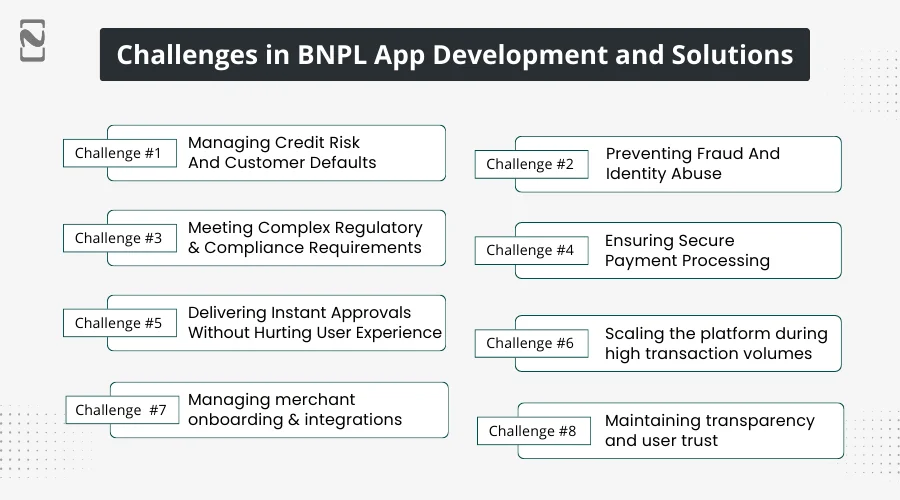
Here, we will talk about them with possible solutions to address them.
-
Challenge #1: Managing Credit Risk and Customer Defaults
Solution: Businesses should leverage the potential of an AI-driven credit scoring system for BNPL, dynamic spending limits, and real-time transaction analysis to minimize defaults and assess user risk.
-
Challenge #2: Preventing Fraud and Identity Abuse
Solution: You should implement robust KYC, device fingerprinting, AML checks, continuous transaction monitoring, and behavioral analytics.
-
Challenge #3: Meeting Complex Regulatory and Compliance Requirements
Solution: Online merchants can craft a modular compliance framework that backs regional regulations, audit logs, automated reporting, and clear disclosures.
-
Challenge #4: Ensuring Secure Payment Processing
Solution: You should encrypt sensitive data, integrate PCI-DSS-compliant payment gateways, and implement multi-factor authentication for transactions.
-
Challenge #5: Delivering Instant Approvals Without Hurting the User Experience
Solution: Leveraging APIs and machine learning, businesses should automate approvals and credit eligibility checks while maintaining minimal onboarding friction.
-
Challenge #6: Scaling the platform during high transaction volumes
Solution: Retailers must create solutions on a cloud-native infrastructure with auto-scaling, microservices, and load balancing to guarantee consistent performance.
-
Challenge #7: Managing merchant onboarding and integrations
Solution: You should offer plug-and-play SDKs, standardized APIs, and a self-service merchant dashboard for rapid integrations.
-
Challenge #8: Maintaining transparency and user trust
Solution: Merchants should transparently showcase repayment schedules, notifications, and fees, and provide proactive reminders to users to be safe from missed payments.
How Can Nimble AppGenie Help to Create an App like AfterPay?
If you are looking for a trusted financial software development company, you should consider checking their records, testimonials, portfolio, and other factors that impact custom BNPL app development.
We are here to reduce your worries and load with a name for a widely-recognized firm that can help create a BNPL app for startups.
Nimble AppGenie, a bespoke fintech app development company, assists businesses in creating an app like Afterpay by fusing the power of their fintech expertise, user-centric design, and powerful architecture.
From conception and security planning to development, testing, and roll-out, we deliver custom Afterpay-like apps tailored to your business objectives and market demands.
Key Highlights of Why Hire Nimble AppGenie for BNPL App Development?
- Proven experience in fintech and payment app development
- Scalable cloud-based BNPL platforms
- Secure, PCI-DSS and KYC/AML-compliant architecture
- Custom buy now pay later app features
- Dedicated post-launch support and optimization
- Transparent development process and bnpl app pricing
Real-Time Case Study Accomplished by Nimble AppGenie
Project: Custom BNPL App for a Retail Fintech Startup
Challenges: High cart abandonment and limited payment flexibility
Solution We Offered:
Nimble AppGenie built a custom Afterpay-like BNPL app with secure payment integrations, automated installment management, and instant credit checks.
Results Obtained:
- 30% increase in checkout conversions
- Rapid merchant onboarding
- Scalable BNPL platform ready for multi-region expansion
Conclusion
When creating an app like Afterpay, you opt to make a strategic move for businesses looking to make the most of the growing Buy Now, Pay Later (BNPL) market and deliver a user-focused payment experience.
From defining key features and choosing the right technology stack to guaranteeing security, scalability, and compliance, successful BNPL app development demands meticulous planning and fintech proficiency.
By investing in a custom Afterpay-like app, businesses can foster customer loyalty, boost conversions, and catch up with complete regulation over their payment ecosystem.
Partnering with an experienced BNPL app development company like Nimble AppGenie, you can build a compliant solution suiting your business objectives, all set to compete and rule the fierce fintech landscape.
FAQs

Niketan Sharma, CTO, Nimble AppGenie, is a tech enthusiast with more than a decade of experience in delivering high-value solutions that allow a brand to penetrate the market easily. With a strong hold on mobile app development, he is actively working to help businesses identify the potential of digital transformation by sharing insightful statistics, guides & blogs.
Table of Contents
No Comments
Comments are closed.