


In a Nutshell:
- The prominence of living a healthy life fuels the market growth of fitness apps, which is predicted to reach $25.9 bn by 2033.
- The cost to make a fitness app typically ranges between $25,000 to $250,000 or can be more, depending on various prominent factors.
- The cost to develop a fitness app depends on several crucial factors that shape the whole app, including platform choice, tech stack, API integration, and others.
- Focus on MVP development, user experience, be clear about requirements, and plan for outsourcing to cut the cost to build a fitness app.
- Before deciding on the cost to make a fitness app, choose your type and verify the cost of different types of fitness apps.
- Explore the famous fitness apps and their development costs, which inspire people to decide on the cost to create a fitness app.
- From conceptualization to test and launch, the best fitness app development company, Nimble AppGenie, does it all for its clients.
If you are planning to develop a fitness app, the first thing you probably want to know is the actual development cost before deciding on features or technology.
Budget uncertainty is one of the biggest challenges for founders entering the digital fitness market, because pricing can vary based on app functionality, platform, and development approach.
On average, the cost to make a fitness app ranges from $25,000 to $200,000+, but it can change based on many factors. Understanding these cost ranges helps you define project scope, prioritize features, and avoid budget overruns.
In this blog, we break down fitness app development cost by features, development stages, and technology choices so you can estimate your investment more accurately before starting app development.
So, let’s begin!
How Much Does it Cost to Develop a Fitness App?
The cost to make a fitness app typically ranges between $25,000 for MVPs to over $200,000 for advanced apps. This is just a rough estimate. The actual fitness app development cost depends on factors like app complexity, platform size, features, app type, tech stack, etc.
The table below showcases the fitness mobile app development cost as per complexity.
| App Complexity | Cost Breakdown |
| MVP fitness app | $25,000-$40,000 |
| Standard fitness app | $50,000-$120,000 |
| Full-featured + AI fitness app | $200,000+ |
You see how the complexity changes the cost. Each of them is capable of affecting the fitness app development budget. For that reason, it is not possible to give you a correct estimation of your fitness app project without knowing about the factors.
Factors Affecting the Fitness App Development Cost
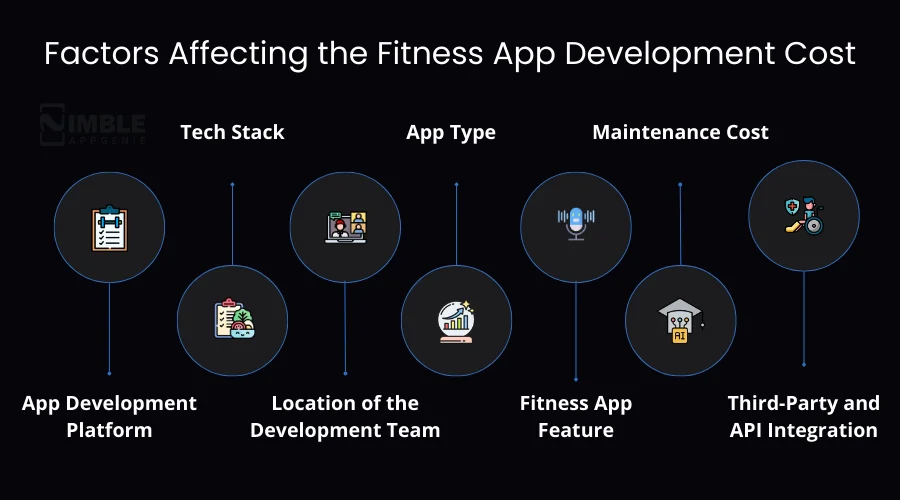
The factors that influence the cost to create a fitness app are app type, app features, tech stack, development team’s location, app maintenance, API integration, and so on. Let’s deeply understand these factors in detail.
1. App Development Platform
To develop an app, you have to choose a platform. You get to pick from two types of platforms.
- Native App Platform
- Hybrid App Platform
As you can see, Native and hybrid app development have their benefits & costs. On one hand, Native offers amazing mobile app performance but might be a costly affair; on the other hand, Hybrid apps are right for people who want to have the best of both worlds.
Now, at the end of the day, it depends on your project needs and preferences. As far as cost is concerned, a Hybrid might be a good option for you.
| Platform | Estimated Cost |
| iOS only | $30,000-$100,000 |
| Android only | $40,000-$120,000 |
| Hybrid platform | $25,000-$200,000 |
Note: Choosing the right platform impacts fitness app development budget and future scalability.
2. Tech Stack
Tech Stack plays an effective role in deciding your cost to create a fitness app. The app tech stack is the foundation, or you can call it a data ecosystem.
It refers to a set of technologies, frameworks, databases, and toolkits that go in. One such example of a popular tech stack is MEAN stack development. It is a JavaScript-based tech stack that is widely used today.
Let’s look at some other app tech stacks used in a fitness app solution:
| Basic | Technology Used | Price |
| Front-end Development | Kotlin, React Native & Swift | $10,000-$50,000 |
| Back-end Development | Node.js, Django, & Flask | $10,000-$50,000 |
| API Integrations | Open API/GraphQL | $10,000-$20,000 |
| Cloud Platform | AWS, Google Cloud, or Azure. | $5,000-$10,000 |
| Analytics & Monitoring | Firebase and Google Analytics | 2% to 5% total budget |
| Payment Gateway | Stripe, PayPal, or Braintree | $5,000-$10,000 |
| Push notification | Firebase Cloud Messaging & OneSignal | $4,000-$10,000 |
| DevOps/Deployment | Docker, Kubernetes, & AWS | 1%-3% of the total budget |
Through this table, you must have gained knowledge and an idea of the average cost to develop a fitness app. Besides, you can discuss the same with your development partner.
3. Location of the Development Team
Location is another key factor that affects the cost of developing a fitness app.
The reason is that different regions of the world have different currencies, different average wages, demand, number of development companies, and so on. Based on all of this, the cost to hire a mobile app developer in that area is different.
So, let’s look at hourly rates and how much it costs to develop a fitness app in different parts of the world.
| Region | Hourly cost of developers | Development Cost |
| USA | $120-$150 | $50,000-$200,000 |
| UK | $100-$120 | $45,000-$150,000 |
| Australia | $100-$130 | $40,000-$120,000 |
| Eastern Europe | $70-$100 | $40,000-$100,000 |
| Asia | $15-$30 | $20,000-$70,000 |
4. App Type
The fitness app development price also depends on the type of app you are creating. Different fitness mobile apps need different backend systems, tracking capabilities, and content management features.
For example, calorie counter apps need database-heavy functionality, while a personal trainer app may require video streaming and scheduling features. Let’s check out this table of app types.
| App Type | Estimated Cost |
| Workout tracking app | $20,000 – $40,000 |
| Personal trainer app | $30,000 – $55,000 |
| Yoga and meditation app | $25,000 – $50,000 |
| Diet and calorie tracking app | $30,000 – $60,000 |
| Wearable fitness app | $50,000 – $100,000+ |
This comparison helps you understand the fitness mobile app development cost based on their business model.
5. Fitness App Feature
Features play the biggest role in determining the cost to build a fitness app. The more advanced the features, the higher the development time and cost. If you add the basic fitness app features like login and user profiles, they are relatively simple and cost-effective.
However, AI recommendations and wearable integrations need more development effort and increased cost. The table below showcases the cost to develop a fitness app.
| Features | Estimated Cost |
| User registration & profile | $1,000 – $2,000 |
| Activity tracking | $3,000 – $6,000 |
| Push notifications | $1,000 – $2,500 |
| Payment integration | $2,500 – $5,000 |
| Video streaming workouts | $5,000 – $10,000 |
| Wearable device integration | $6,000 – $12,000 |
| AI recommendations | $8,000 – $15,000 |
If you add multiple advanced features, it increases the cost to make a fitness app significantly because they require backend logic, APIs, and testing.
6. Maintenance Cost
A fitness app isn’t enough; if you want it to be successful, you need to maintain it. And this is where app maintenance & support services come in.
Needless to say, it doesn’t come without a cost. The cost of maintenance of an app depends on various things, but it is somewhere between 15%-20% of the initial development cost.
Ongoing maintenance is vital to keep the app running smoothly. It includes updates, bug fixes, server costs, and adding minor features. The table depicts the cost to maintain a fitness app.
| Maintenance Activity | Estimated Costs |
| Bug fixes and updates | $2,500-$5,000 |
| Server hosting and cloud storage | $1,500-$3,000 |
| Feature upgrades | $3,000-$7,000 |
| Security and performance monitoring | $1,000-$2,500 |
7. Third-Party and API Integration
The complexity of the API and the number you integrate can increase costs. For instance, connecting your fitness app with wearable technology might require special APIs, and that can have fees associated with it, leading to a growing cost of developing a feature-rich fitness app.
Integrating APIs and third-party services improves app functionality but adds to the cost of fitness app development. If you add more integrations, it increases development time and cost but improves user experience.
| API / Integration | Purpose | Estimated Cost |
| Payment gateway | Handles subscriptions & in-app payments | $2,500 – $5,000 |
| Wearable devices | Connect apps with FitBit, Apple Watch, etc. | $5,000 – $12,000 |
| Video streaming API | For workout video streaming | $5,000 – $10,000 |
| Cloud hosting & storage | Stores user data and workout logs | $1,500 – $3,000 |
| Authentication services | Ensures secure login & signup | $1,000 – $2,000 |
How Much Does an MVP Fitness App Development Cost?
Many startups build an MVP app to launch quickly and reduce the cost of fitness app development. An MVP includes only core features that let users start using the app while keeping development simple and cost-effective. This approach helps validate the idea before adding advanced functionality.
| Feature | Description | Estimated Cost |
| User registration & login | Authentication, profile creation | $1,000 – $2,000 |
| Workout tracking | Log exercises, track repetitions, basic metrics | $3,000 – $5,000 |
| Dashboard | Displays progress, basic analytics, and simple charts | $2,000 – $4,000 |
| Push notifications | Reminders for workouts, motivational messages | $1,000 – $2,500 |
| Basic analytics | Tracks user engagement and activity | $1,500 – $3,000 |
| Admin panel | Manage users and content | $2,500 – $4,500 |
| Content management | Upload workout plans, images, videos | $2,000 – $4,000 |
Total estimated MVP cost: $25,000 – $40,000
Development time: 2–3 months
Why MVP matters: Launching an MVP helps startups gather real user feedback, refine features, and plan advanced functionality. It also ensures a cost-effective fitness app development process while minimizing risk, making it the ideal first step for most fitness apps.
How to Reduce the Fitness App Development Cost? Tips to follow
When it comes to fitness apps, several factors can increase the cost if you don’t take care of them on time.
Therefore, it’s necessary to recognize some tips that can be useful to reduce the cost of building a fitness app. Here are some cost-cutting techniques to help you in times of need.
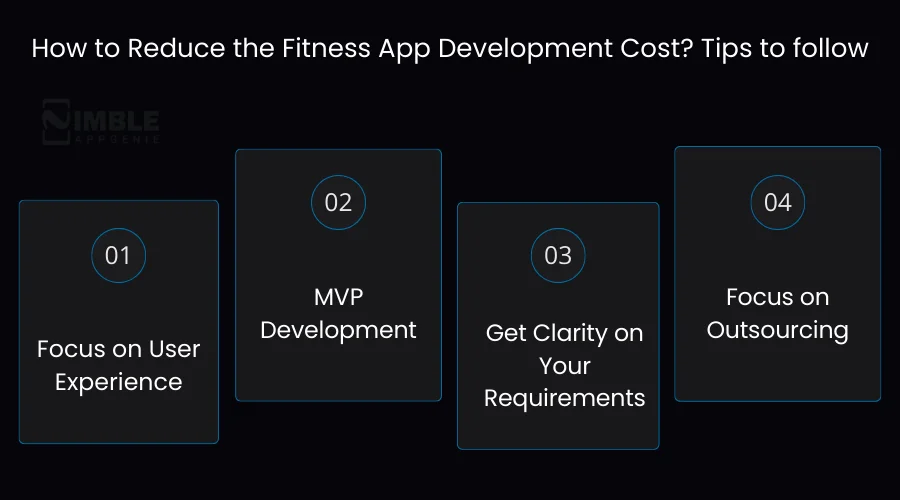
Tip 1: Focus on User Experience
Instead of filling your fitness app with bells and whistles, try something simple. If you try something complex, it will require more time and resources, leading to increased costs.
Therefore, you should try to work on something modest that is easy to navigate and helps people achieve their fitness goals. This way, you will be able to enhance their user experience while keeping the app costs under your budget.
Tip 2: MVP Development
Although MVP development might not be necessary, it is useful to reduce the cost of developing fitness apps.
See, MVP helps to know about any issues likely to occur by providing a basic understanding of the app. This way, an MVP can help validate your concept with real users and provide feedback for development stages, all at a lower cost.
Tip 3: Get Clarity on Your Requirements
Having an understanding of your requirements allows conveying your requirements more & to your development team.
Knowing about those features that you must integrate into your app will solve many problems and let you focus on requirements; this can save you from the wrong estimate and aid you in putting your budget to the right use.
Tip 4: Focus on Outsourcing
Yes, this is a great technique to save some bucks on the cost of building a fitness app.
Outsourcing to an experienced company from a region with a lower cost of living can be a good, cost-effective technique. This way, you can get the same work done within your budget.
If you are planning to outsource, make sure to communicate throughout the app development process for quality work.
Our next section is about the app development company.
What are the Different Types of Fitness Apps & Their Development Cost
To know about the cost of developing a fitness app, first, you need to decide what kind of fitness app you want to invest in; there are various options available for it:
| Types of Fitness Apps | Cost | Description | Features included |
|
1. Workout Apps |
$25,000-$70,000 | Aims to provide exercise routines, sets, reps & more. | Includes features like workout plans & progress charts. |
|
2. Nutrition Apps |
$5,000-$30,000 | Let users track their daily food intake, calories, macros, and more. | Covers meal suggestions and nutritional advice. |
| $20,000-$40,000 | Offers personalized workout and nutrition plans. | Features like breathing exercises and stress relief tips. | |
|
4. Yoga & Meditation Apps |
$20,000-$60,000 | Provides guided yoga sessions, meditation exercises, and relaxation techniques. | Includes features like breathing exercises and stress-relief tips. |
|
5. Running & Cycling Apps |
$20,000-$40,000 | Tracks Indoor activities such as running & cycling, including distance and speed. | Can include features like goal setting and training plans. |
|
6. Group Fitness Apps |
$50,000-$120,000 | Connects users with live or pre-recorded group fitness classes. | Includes features like scheduling, class reminders, and social interaction. |
|
7. Health Monitoring Apps |
$40,000-$70,000 | Monitors health metrics like heart rate, blood pressure, and sleep patterns. | Real-time tracking of health and analysis. |
|
8. Workout Game Apps |
$20,000-$30,000 | Gamifies workouts with challenges, rewards, and virtual competitions. | From basic to advanced challenges and games for all fitness levels. |
|
9. Diet Planner Apps |
$5,000-$40,000 | Helps users to plan and manage meals as per their preferences. | Includes features like meal planning, grocery shopping, and recipe suggestions. |
|
10. Fitness Social Network |
$40,000-$90,000 | Connect with fitness enthusiasts worldwide, get progress updates, and get motivated. | Includes features like creating communities, following influencers, and organizing events. |
You see, with so many options, you will never run out of fitness app ideas.
But here is the catch, as we shared, every app is different and costs differently. Once you make up your mind, we will get a closer estimate of the cost to build a fitness app for your project.
Or, you can also take inspiration from top fitness apps and enter the fitness market with their clone. Let’s look at these apps and find out the cost to develop them.
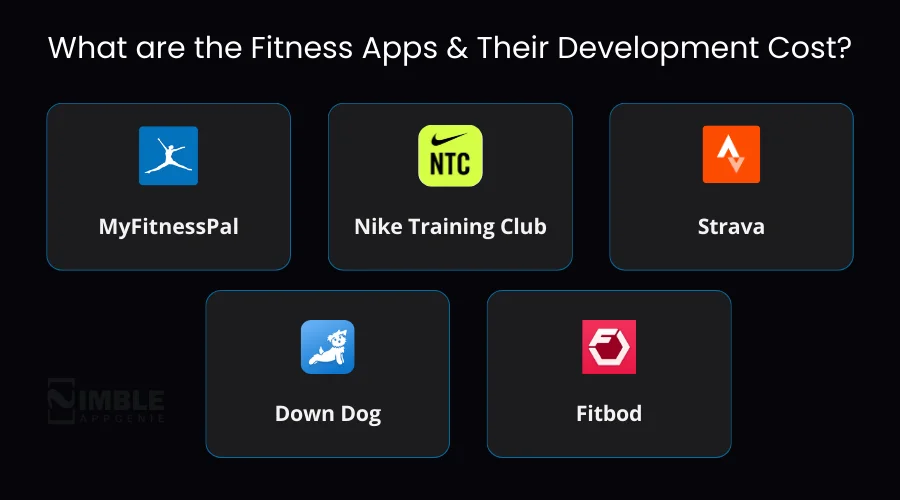
What are the Fitness Apps and Their Development Cost?
Investors often see a popular app and get inspired to build something similar. We get it, if this is the case for you, the section below will take you to the best fitness apps and their cost.
1] MyFitnessPal
Let’s start with the top name among fitness apps ‘’MyFitnessPal’’. The app focuses on diet and nutrition tracking, calorie counting, a recipe database, and more. As a result, a user gets everything in one app, which makes it famous.
And, this has inspired many investors to create an app like MyFitnessPal. If you are wondering about the cost to build a similar app, then it will be somewhere between $20,000-$50,000+.
2] Nike Training Club
Another name among the best fitness apps is Nike Training Club.
The app lays its emphasis on workout routines with video demonstrations and customized training plans. The cost to make an app like Nike Training Club is somewhere between $40,000-$70,000+.
3] Strava
Strava is a great fitness app, and you can try using it as an inspiration to build a similar app.
The app focuses on activity tracking for running, cycling, and other sports with social features and route sharing. The development cost of a Strava-like fitness app can vary from $30,000 to $60,000.
4] Down Dog
If you want to experience studio-style yoga from the comfort of your home, then Down Dog is for you.
You can explore different types of beginner-friendly to advanced and strengthen your body & mind.
Since Down Dog’s success, investors are now taking yoga app development more seriously, recognizing the market’s potential. The cost to make a fitness app like Down Dog can be $25,000-$40,000.
5] Fitbod
Fitbod is one of those apps that has harnessed the power of AI.
The app focuses on customized strength training programs, AI-powered workouts, and detailed exercise instructions. Due to AI integrations, the cost to make an app like Fitbod ranges from $40,000-$70,000.
So, these are some of the famous fitness apps that often inspire people to mobile app development. Now, with that, we will look at the development costs and factors affecting those costs.

How Nimble AppGenie Can Help You Build a Fitness App?
If you want to plan your fitness app and don’t know where to start, we will help from conceptualization to launch & beyond. Nimble AppGenie is the best fitness app development company and might be the one you are looking for.
Our approach involves understanding your requirements, market trends, target audience, and user behavior, and then developing an app that. This way, we avoid common development mistakes & budget overruns. If you are ready to talk about your idea, contact us.
Conclusion
To be on the right track, it is necessary to do proper planning and budgeting, among which cost is the topmost consideration.
By understanding the cost and different factors affecting the cost of developing a fitness app, you can take a step ahead in planning your idea into a digital solution.
To follow the trend and be the best, choose Nimble AppGenie, which not only works with your vision but prioritizes quality work.
Frequently Asked Questions
An MVP fitness app usually costs $25,000–$40,000. This covers basic features like login, workout tracking, and simple progress monitoring. It is simply just to test your fitness app idea with the real users.
Yes, you can start with an MVP, use cross-platform development, limit advanced features, and plan requirements clearly before development begins.
Yes, the platform you choose can change the total cost. Developing separate native apps for iOS and Android can cost more than developing a single cross-platform app. If you launch on one platform first and expand later, you can manage the budget more easily while testing your app idea.

Niketan Sharma, CTO, Nimble AppGenie, is a tech enthusiast with more than a decade of experience in delivering high-value solutions that allow a brand to penetrate the market easily. With a strong hold on mobile app development, he is actively working to help businesses identify the potential of digital transformation by sharing insightful statistics, guides & blogs.
Table of Contents
No Comments
Comments are closed.