

 Free Consultation
 PCI-DSS Compliant
 GDPR Ready
 ISO 27001
 NDA Protected
 AI Services
 AI App Development
 Generative AI Development
 AI Chatbot Development
 AI Integration Services
 AI Consulting Services
 AI For Fintech
 AI Financial Assistant Solution
 AI Insurance Agent Development
 Tech Stack
 OpenAI / GPT-4
 Claude / Anthropic
 Gemini / Google AI
 Llama / Open Source
 LangChain / LlamaIndex
 Pinecone / Pgvector
 AWS / Azure AI


 Fintech Solution
 Core Fintech
 Fintech App Development
 Neobank App Development
 eWallet App Development
 Lending Software
 Banking Software Development
 BNPL Solution
 BNPL App Development
 Insurance App
 Wealth Management App
 Blockchain Development
 Payroll Software Development
 DeFi App Development
 Crypto Wallet Dev
 Crypto On Ramp Off Ramp
 Crypto Exchange Dev
 Trading Platform Dev
 Payments
 Compliance
 Fintech & Digital Regulations
 Fraud Detection
 Lending Ecosystem
 P2P Lending Platform
 Mortgage Software
 Engagement
 Outsourcing Dev

 Mobile Development
 Mobile App Dev
 iOS App Development
 Android App Development
 React Native
 Flutter Development
 Web Solution
 Node.js Development
 React.js Development
 Angular Development
 App Services
 UI/UX Design
 App Maintenance
 By Stage
 MVP Development
 Industry Solutions
 Healthcare App Dev
 Education App Dev
 Travel App Dev
 Real Estate App Dev
 Logistics Software
 Social Media App

 Hire Mobile Developers
 Hire iPhone Developers
 Hire Android Developers
 Hire React Native Devs
 Hire Flutter Developers
 Hire Web Developers
 Hire Node.js Developers
 Hire Angular Developers
 Hire PHP Developers
 Hire Laravel Developers
 How It Works
 Pre-Vetted Developers
 Ready In 48 Hours
 NDA From Day One
 Replace Guarantee
 Company
 About Us
 Our Work Process
 Portfolio
 Case Studies
 Blog / Insights
 Careers
 Contact Us
 Awards
 Recognition


 Offices



TL;DR
- The talent gap is enormous – The U.S. alone faces a shortage of 1.2 million software developers in 2026, making quality hiring harder than ever. This is widely acknowledged as the biggest challenge of hiring mobile app developers in 2026.
- AI skills are a must-have now – Most businesses need developers who understand AI integration, but such talent is in short supply.
- Developer salaries are rising fast – Compensation costs have jumped significantly, straining budgets, especially for startups.
- Hiring takes longer than you think – The average time to hire a mobile app developer can stretch to 95 days through traditional methods.
- Remote teams bring communication challenges – Time zone mismatches and unclear processes can derail projects.
- IP and legal risks are often overlooked – Many businesses skip contracts around code ownership and data privacy.
- High turnover is common – Developers often leave after short engagements, wasting onboarding time and money.
- Nimble AppGenie removes the guesswork – With a vetted team of mobile app specialists across iOS, Android, Flutter, and React Native, Nimble AppGenie gives you skilled, AI-ready developers without the hiring headache.
Okay, so you have an amazing app idea, the right budget, and even a rough plan. And now, you are up to hiring the right app developer for your project, but things are getting complicated faster than expected.
Maybe you posted different jobs and received 200 applications, but none felt appropriate. Or perhaps you are confused about what questions to ask in an interview. Or maybe already hired someone who looked impressive on paper but left mid-project.
Hiring mobile app developers in 2026 is actually one of the toughest challenges for businesses of all sizes – from first-time founders to experienced CTOs.
The mobile app development talent gap is widening. Why? AI has changed the definition of ‘good’; we now look for more advanced developers, costs are rising, and the situation is critical, with unprecedented risk, because a poorly developed app can kill your idea before it can surface.
This guide discusses the challenges of hiring mobile app developers and what you can genuinely do about them.
What Makes Hiring Mobile App Developers So Hard in 2026?
Before getting into specific challenges, let’s understand the bigger picture. Why are mobile app developers hard to find?
With the expanding mobile app market, users now spend 5+ hours a day on their phones. Businesses across diverse industries are investing in mobile apps, such as healthcare, finance, retail, and logistics; everyone needs a mobile app.
But the mobile app developer shortage in 2026 is still rising, and the supply is not meeting the demand.
Suppose, in the US, universities produce about 65,000 computer science graduates each year. But the market requires 180,000 AI engineers. This gap itself suggests a possible issue with the supply side.
Above all, technology is rapidly moving. What is acknowledged as a ‘skilled developer’ in 2023 is different from what you actually need today. Besides, new frameworks, rigid app store rules, AI integrations, and tighter security needs have significantly elevated standards.
The result? Good mobile app developers are limited, yet expensive. And finding one who is both easy to collaborate with and technically strong is genuinely hard.
Let’s walk through the specific challenges you may likely face.
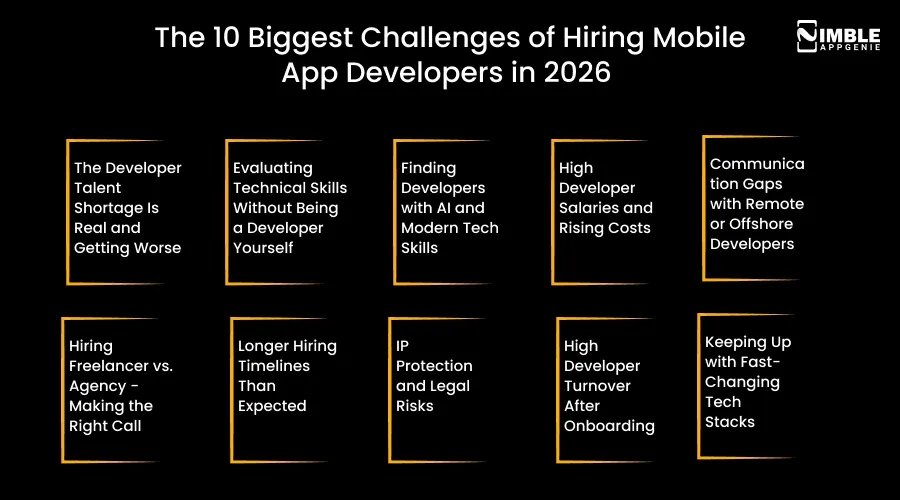
The 10 Biggest Challenges of Hiring Mobile App Developers in 2026
Hiring mobile app developers in 2026 is driven by the need to find talent experts in AI integration, robust security, and cross-platform frameworks, amid intense competition and high wage demands.
Here are the key mobile app developer hiring challenges 2026:
1. The Developer Talent Shortage Is Real and Getting Worse
What it is:
Simply, there are not enough skilled mobile app developers to hire. This is not hyperbole.
- The US is predicted to face a shortage of around 1.2 million software developers by the end of 2026.
- Open developer roles have increased by 43% compared to 2025.
- And worldwide, by 2030, the mobile app development talent gap could reach 85 million proficient workers across tech roles.
Why it happens:
Three things are operating at once. First, demand has increased because of AI, mobile adoption, and cloud computing.
Second, experienced senior developers are retiring more rapidly than new ones are trained. Third, visa policies and immigration in various countries have tightened, lowering the international talent pipeline.
What you can do:
Don’t wait until you actually need someone. Start your process of hiring mobile app developers, ideally 3 to 6 months before you plan to start development.
Consider partnering with a mobile app development company or staff augmentation agency that already has a ready team. This cuts your time-to-hire from months to days
2. Evaluating Technical Skills Without Being a Developer Yourself
What it is:
If you are a business owner or non-technical founder, how do you know if a developer is really good? This is a common pain point for many businesses. An aesthetic portfolio doesn’t always mean powerful skills. Also, a confident interview doesn’t ensure clean code.
Why it happens:
With the surge of AI-assisted coding tools and template-based projects, it has become easier than ever to look impressive on paper without actual depth. AI tools can quickly generate code, but they can’t replace true learning of security, architecture, and scalability.
What you can do:
How to evaluate mobile app developers before hiring? Ask the right question instead of technical ones you might not understand:
- ‘What would you do if the app needed to scale from 1,000 to 100,000 users?’
- ‘Walk me through a problem you solved that wasn’t in the original scope.’
- How have you handled a situation where a client’s requirements changed mid-project?’
Such questions show how a developer thinks, which is more crucial than what they know. Also, always ask for a paid trial project or milestone before committing to a complete engagement.
3. Finding Developers with AI and Modern Tech Skills
What it is:
What to look for when hiring AI skills mobile app developers? In 2026, mobile apps will not only display data, but will also be smart.
Think AI-powered chat support, personalized recommendations, predictive features, and on-device intelligence. This means the developers you hire are expected to understand far more than just coding a screen.
Why it happens:
AI skills are new. Even three years ago, developers who had graduated didn’t learn LLM integration, machine learning, or on-device AI as part of their core training.
The AI skills gap is so extreme that companies demand three times as many AI-capabilities engineers as exist in the market today.
Skills that are currently anticipated but hard to find:
- Understanding of on-device LLMs
- Integration with APIs like OpenAI or Gemini
- Experience with CoreML (Apple) or TensorFlow Lite (Android)
- MLOps and model management basics
What you can do:
How to find skilled mobile app developers in 2026? When interviewing mobile app developers, don’t ask about programming languages.
Ask about performance trade-offs and how they have managed AI features in past projects. And if you can’t evaluate this yourself, seek help from a development partner or a technical advisor who is well-versed in these skills.
4. High Developer Salaries and Rising Costs
What it is:
Hiring a mobile app developer in 2026 is costly. In the US, senior developers can command between $120 and $250 per hour. Building a medium-complexity mobile app partnering with a US-based agency can cost anywhere from $100,000 to $250,000 or more.
Why it happens:
Competition is high. Leading tech companies like Google, Apple, and Meta pay for packages that most businesses usually can’t match. When these giants compete for the same pool of talent, the price rises for everyone.
What you can do:
There are smart alternatives that don’t mean compromising on quality:
- Fixed-price agency contracts: Instead of per-hour hiring, agree on a fixed scope and budget upfront.
- Nearshore development: Countries like Eastern Europe, India, and Latin America offer experienced developers at 40-60% lower rates with minimal time zone issues.
- MVP-first approach: Create only what’s essential first. Test the market, then invest in the full-fledged development.
Before you set your budget, it helps to know what the market actually looks like right now. Check out our breakdown of the cost to hire an app developer in 2026 with numbers by region, experience level, and engagement model.
5. Communication Gaps with Remote or Offshore Developers
What it is:
Suppose you found the right developer in another country, the rates are reasonable, and the portfolio looks solid. But, in three months, you experience irregular updates, unclear deliverables, and you feel out of the loop, which is a very common tale.
Why it happens:
Language is not always the exact concern; it can also be the process. When you hire remote software developers, they don’t usually have a clear communication structure, defined check-in schedules, or project management practices. Things fall apart without these.
What you can do:
- Before signing any contract, ask about:
- What project management tool do they use (Trello, Jira, or Asana)
- Who are your main points of contact
- How often will you get progress updates
- What happens if a deadline slips
Also, test the communication during the proposal phase. If they delay in responding or are unclear before starting the project, it will just get worse during mobile app development.
6. Hiring Freelancer vs. Agency – Making the Right Call
What it is:
The decision of hiring freelancer vs. agency usually trips up many businesses. Freelancers are less expensive but come with risks.
Mobile app development agencies cost more but bring a team, accountability, and process. Avoid making the wrong choice, as it can cost you money and time.
Why it happens:
Most people consider their budget alone, without giving a second thought to what happens when something goes wrong – a bug in production, a missed deadline, or a developer disappearing mid-project.
What you can do:
Here is a simple rule: if your app is a core business product demanding to scale, hire a mobile app development agency. If you want a small feature to be added to your existing app, a freelancer can be the right choice.
If your app is a long-term product, a dedicated development team model gives you the consistency, accountability, and institutional knowledge that freelancers simply cannot match.
Ask agencies about:
- What post-launch support includes
- How they manage scope changes
- Who exactly will work on your project
7. Longer Hiring Timelines Than Expected
What it is:
The average time to hire a mobile app developer using traditional methods is about 95 days. That’s over three months, and the best developers are usually off the market within 10 days of becoming available.
Why it happens:
Traditional hiring is slow. Job posting, interviewing, screening, technical assessments, notice periods, and negotiations – it all adds up. And while you are conducting this process, your competitors may already be developing.
What you can do:
- Define your needs clearly before you start looking
- Use platforms and agencies that pre-vet developers
- Shortlist based on particular skills, not generic resumes
- Combine a technical interview with a small paid test task instead of long multi-step assessments.
8. IP Protection and Legal Risks
What it is:
Who owns the code that your app developers write? If you are not careful, the answer might be someone else. Unclear contracts, intellectual property (IP) issues, and data privacy concerns can make your app prone to legal risk.
Why it happens:
Various businesses, specifically first-time founders, rush the contract phase. They stay excited to initiate building and skip the legal details. This is a huge mistake that can be very costly to fix later, specifically if the developer is in another country.
What you can do:
Always prioritize a written contract that clearly states:
- What happens to the code if the engagement ends early?
- Data handling practices comply with CCPA, GDPR, or HIPAA as relevant
- The developer can’t reuse your code for other clients.
- You own 100% of the code written for your project.
9. High Developer Turnover After Onboarding
What it is:
You invest time in onboarding a developer. They understand your product, codebase, and business objectives. And then they disappear. Now, you are starting all over again from the beginning with a half-built app and lost time.
Why it happens:
The mobile app developer market is fierce. Developers regularly get multiple offers. Without robust retention incentives – whether cultural, financial, or project-based – turnover is high.
What you can do:
If you are developing an in-house team, spend on culture, not only salaries. Offer learning budgets, flexibility, and interesting issues to work on. If you have hired an agency, ask them about their developer retention rate and how long their average team member has been with them.
10. Keeping Up with Fast-Changing Tech Stacks
What it is:
Mobile technology moves fasters. A developer who was an expert in 2023 may be lagging in 2026 if they haven’t kept up with OS updates, new frameworks, and platform requirements.
Why it happens:
The Google Play Store and Apple App Store regularly update their technical requirements and their policies. New frameworks like newer versions of React Native and Flutter release updates consistently. Developers who don’t invest in ongoing learning fall behind quickly.
What can you do:
Ask developers particularly:
- ‘What was the last framework update or new tool you learned?’
- ‘How do you keep your skills current?’
- ‘Have you dealt with an app rejection from the App Store? How did you handle it?
How to Overcome These Hiring Challenges: Quick Checklist
Before you hire a mobile app development team, run through the checklist below:
- Have you clearly defined your app’s scope, features, and target users?
- Have you set a realistic budget that includes post-launch maintenance?
- Have you decided between in-house, freelancer, or agency?
- Have you prepared interview questions that test thinking, not just syntax?
- Do you have a clear contract covering IP ownership and data privacy?
- Do you have a process for project communication and progress tracking?
- Have you checked references from former clients?
How Nimble AppGenie Helps You Hire the Right Mobile App Developers
All the challenges of hiring mobile app developers we listed above have one thing in common: they disappear when you collaborate with the right partner.
Nimble AppGenie is a mobile app development company that has spent years resolving exactly such issues – not only for large enterprises, but for mid-sized businesses, startups, and everything in between.
Below is what working with Nimble AppGenie genuinely looks like:
| Vetted, AI-ready developers | Every developer is selected for their understanding of modern tech stacks — including AI integration, Flutter, React Native, Swift, and Kotlin. |
| No talent gap problem | You do not need to worry about finding developers. Nimble AppGenie already has a ready team matched to your project — often within days. |
| Transparent communication | Regular updates, dedicated project managers, and clear timelines. You always know what is happening with your project. |
| IP protection built in | All contracts clearly state that you own your code. No grey areas, no surprises. |
| Flexible engagement models | Whether you need a full team for a complex app or a small team for an MVP, Nimble AppGenie adapts to your needs and budget. |
| Proven track record | Dozens of successful mobile app projects across healthcare, fintech, retail, and more bring real-world experience — not just theoretical knowledge. |
| Cost-effective without cutting corners | By combining a global team with deep expertise, Nimble AppGenie delivers high-quality apps at rates that make sense for growing businesses. |
Final Thoughts
Hiring mobile app developers in 2026 is hard. The talent shortage is real, the mobile app developer skills gap is growing, costs are rising, and the risks – from IP issues to communication breakdowns – are easy to underestimate.
Whether you are looking to hire app developers for a startup MVP or scale an existing product, the decision you make today will shape your product for years to come.
But it’s tough to overcome these challenges of hiring mobile app developers.
The businesses that attain success are the ones that plan, ask the right questions, and pick their development partner meticulously. They treat hiring as a strategic decision that shapes the future of their product.
If you are planning to build mobile apps in 2026 and want to skip the trial and error, Nimble AppGenie is here to help. From day one, planning to post-launch support, we bring along the 3 P’s – process, people, and proficiency to turn your app idea into a product that actually works.
Schedule a free consultation with Nimble AppGenie. No pressure or jargon. Just a real conversation about your app.
FAQs

Richard Thomas is the Lead Architect at Nimble AppGenie, where he oversees the design and development of scalable, secure, and high-performance digital solutions. With deep expertise in software architecture, cloud infrastructure, and system integration, he plays a key role in transforming complex business requirements into robust technical frameworks. When he’s not architecting systems, he enjoys exploring emerging technologies and staying ahead of industry trends.
Table of Contents




No Comments
Comments are closed.