

 Free Consultation
 PCI-DSS Compliant
 GDPR Ready
 ISO 27001
 NDA Protected
 AI Services
 AI App Development
 Generative AI Development
 AI Chatbot Development
 AI Integration Services
 AI Consulting Services
 AI For Fintech
 AI Financial Assistant Solution
 AI Insurance Agent Development
 Tech Stack
 OpenAI / GPT-4
 Claude / Anthropic
 Gemini / Google AI
 Llama / Open Source
 LangChain / LlamaIndex
 Pinecone / Pgvector
 AWS / Azure AI


 Fintech Solution
 Core Fintech
 App Development
 Neobank Solutions
 eWallet Solutions
 Lending Software
 Banking Solutions
 BNPL Solutions
 BNPL Solutions
 Insurance App
 Wealth Management
 Crypto & DeFi
 Blockchain Development
  Payroll Software
 DeFi Solutions
 Crypto Wallet
 Crypto On/Off Ramp
 Crypto Exchange
 Trading Platform
 Payments
 Compliance
 Regulations & Compliance
 Fraud Detection
 Lending Ecosystem
 P2P Lending Platform
 Mortgage Software
 Engagement
 Fintech Outsourcing

 Mobile Development
 Mobile App Dev
 iOS App Development
 Android App Development
 React Native
 Flutter Development
 Web Solution
 Node.js Development
 React.js Development
 Angular Development
 App Services
 UI/UX Design
 App Maintenance
 By Stage
 MVP Development
 Industry Solutions
 Healthcare App Dev
 Education App Dev
 Travel App Dev
 Real Estate App Dev
 Logistics Software
 Social Media App

 Hire Mobile Developers
 Hire iPhone Developers
 Hire Android Developers
 Hire React Native Devs
 Hire Flutter Developers
 Hire Web Developers
 Hire Node.js Developers
 Hire Angular Developers
 Hire PHP Developers
 Hire Laravel Developers
 How It Works
 Pre-Vetted Developers
 Ready In 48 Hours
 NDA From Day One
 Replace Guarantee
 Company
 About Us
 Our Work Process
 Portfolio
 Case Studies
 Blog / Insights
 Careers
 Contact Us
 Awards
 Recognition


 Offices


Key Takeaways:
- Mobile app development in 2026 is not just about coding; it is about building complete, smart, and secure app experiences, so strong mobile app developer skills now include both technical knowledge and practical thinking.
- Developers must know cross-platform development using Flutter or React Native, because businesses want faster and cost-effective apps that work on both iOS and Android.
- Having a good grip on programming languages like Swift, Kotlin, JavaScript, or Dart is still the base of all mobile app development work.
- Understanding AI in mobile apps is becoming important, as features like chatbots, recommendations, and voice tools are now common in modern apps.
- Basic knowledge of UI/UX design helps developers create apps that are simple, clean, and easy to use, which directly improves user experience and retention.
- Best backend and API knowledge, along with version control tools like Git and basic DevOps, helps in building smooth, scalable, and well-managed apps.
Mobile apps are not just useful anymore; they are the backbone of how people live, work, and shop. And the people who build these apps? They are in higher demand than ever.
But here is the thing: what it takes to become a good mobile app developer has changed dramatically. In 2026, it is not enough to just know how to write code. You need to understand AI, design, security, and a whole lot more.
Thus, if you are a beginner just starting, a developer looking to upgrade your skills, or a business owner trying to understand what makes a good developer, this guide is for you. We have broken down the 10 most important mobile app developer skills in 2026.
Let us get into it.
What Does a Mobile App Developer Do?
A mobile app developer is someone who designs, develops, and maintains apps for smartphones. That covers everything from the apps you see on your iPhone or Android device. There are a few different types of mobile app developers:
- iOS developer: They build apps specifically for Apple devices using Swift or Objective-C.
- Android Developer: They develop apps for Android devices by using Kotlin or Java.
- Cross-platform developer: They create an app that works on both iOS and Android using frameworks like Flutter or React Native.
- Full-Stack mobile developers: They handle both the app itself and the server/data side.
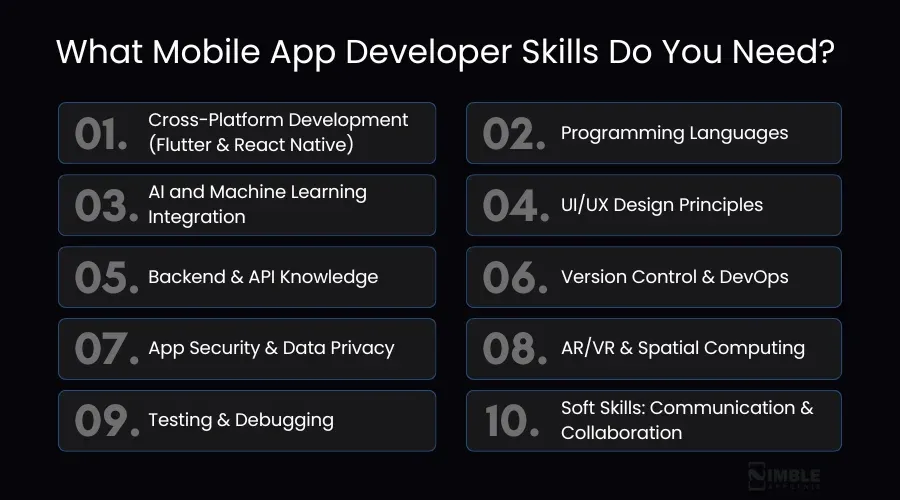
What Mobile App Developer Skills Do You Need?
Now that you know the basics, we will look at the skills that actually matter in 2026. Here are the top skills every mobile app developer should have in 2026.
Skill #1: Cross-Platform Development (Flutter & React Native)
Let’s start with one of the biggest changes in mobile app development in recent years. In the past, if a company wanted an app on both iPhone and Android, they had to develop two completely separate apps.
That was quite expensive and time-consuming. Today, cross-platform development allows developers to write one set of code that works on both. The most popular technologies for this are:
- Flutter is Google’s open-source framework. It is fast and widely adopted.
- React Native is a Facebook’s framework from Facebook, great for developers who already know JavaScript.
- Kotlin Multiplatform allows sharing business logic on iOS, Android, and Web.
This skill is no longer optional. As one industry report noted, cross-platform teams ship features 40 to 60% faster than separate native teams of the same size.
| Why it matters: Companies want to reach iOS and Android users without doubling their budget. Developers who can do that are in serious demand. |
Skill #2: Programming Languages
Every developer needs to know at least one programming language. In mobile app development, the three most vital ones in 2026 are:
- Swift is the official language for iOS and macOS app development. It is really clean, modern, and fast.
- Kotlin is the preferred language for Android development. It has replaced Java for most new projects.
- JavaScript/Dart is used in cross-platform frameworks.
If you are just starting, here is the simple guide:
- Want to create iPhone apps? Start with Swift.
- Want to develop Android apps? Start with Kotlin.
- Want to build for both platforms at once? Start with Flutter or React Native.
There is no single right answer. The best language to learn is the one that matches your objective.
Skill #3: AI and Machine Learning Integration
This mobile app developer’s skills separate the average developer from the best ones in 2026. AI is no longer just a fancy feature you add to an app. It is now a core part of how apps work.
You can think about your daily apps, which recommend content, predict what you want to type, recognize your face to unlock your phone, and filter spam automatically. All of that is AI. For mobile app developers, the key tools are:
- TensorFlow Lite is Google’s lightweight AI framework for running models directly on your phone.
- Core ML is Apple’s framework for running machine learning models on iPhone and iPad.
- PyTorch Mobile is another flexible option for on-device AI.
What makes on-device AI special is that it works without an internet connection and keeps user data private. This is what users and app store reviewers increasingly expect.
The World Economic Forum’s Future of Jobs Report 2025 identified AI and big data as the fastest-growing skills demanded by employers in all industries.
Gartner also forecasted that 40% of enterprise applications will feature task-specific AI agents by the end of 2026. It is up from less than 5% in 2025. That is an eightfold increase in one year.
Skill #4: UI/UX Design Principles
One of the best mobile app developer skills that surprises many beginners is design. Not necessarily to a graphic designer level. But you should understand the difference between a good design experience and a frustrating one.
Users will delete your app in seconds if it is confusing, cluttered, or hard to navigate. The key mobile app design concepts every mobile developer should know:
- Visual hierarchy guides the user’s eye to the most vital information first.
- Responsive layout makes sure your app looks good on all screen sizes, from small phones to large tablets.
- accessibility build apps that can be used by people with visual, hearing, or motor impairments.
- Gesture design means understanding how users swipe, tap, pinch, and scroll.
The best developers are the ones who can implement a design that was handed to them by a designer. It is without losing any of the intended detail. That needs an understanding of why the design looks the way it does.
Skill #5: Backend & API Knowledge
Most mobile apps do not work in isolation. They connect to a server, fetch data, send information, and sync on devices. That connection between the app and the server happens through something called an API.
If you are not a back-end developer, you need to know how APIs work. The most important concepts of backend development are:
- REST APIs: The most common way apps communicate with servers.
- GraphQL: A newer approach that allows apps to request exactly the data they need.
- WebSockets: It is used for real-time features like live chat or stock prices.
- JSON: The data format that almost all APIs use to send and receive information.
Developers who understand both the app side and the server side are called full-stack developers. They are in high demand because they can see the whole picture.
| Why it matters: Mobile developers who understand backend principles build more efficient apps by designing APIs optimised for mobile constraints rather than adapting desktop-oriented services. |
Skill #6: Version Control & DevOps
Just think you are working on an app wth a mobile app development team of four developers. Everyone is writing code at the same time. Without a system to track and manage changes, things would become a chaotic mess very quickly.
That is what version control saves. Git is the industry-standard tool for this, and GitHub or GitLab are the platforms most teams use to collaborate.
As an app developer, you also need basic knowledge of DevOps, the practices that help you ship updates faster and more reliably:
- CI/CD: Automating how code is tested and released.
- Fastlane: A tool specifically for automating iOS and Android app releases.
- Clean mobile app architecture and MVVM: The design patterns that keep your code organized and scalable.
These skills are especially important if you want to work at a professional company rather than just building solo projects.
Skill #7: App Security & Data Privacy
Data breaches make headlines every week. Users are increasingly aware of how their personal information is being handled. And regulators are paying close attention. By 2026, mobile developers are expected to understand how to build secure apps from the ground up. This includes:
- Data encryption: Scrambling sensitive data so it cannot be read if intercepted.
- Secure authentication: Implementing login systems that are difficult to hack.
- HTTPS and certificate pinning: This ensures that data sent between the app and the server cannot be intercepted.
- GDPR and CCPA compliance: This understands the legal requirements around user data in Europe and California.
This is not just about avoiding fines. Users trust apps more when they feel their data is safe. And trust drives downloads, reviews, and long-term retention.
Skill #8: AR/VR & Spatial Computing
This one is for developers who want to get ahead of the curve. AR allows you to overlay digital information on the real world. Virtual Reality places you inside a fully digital environment. In 2026, this space has grown thanks to Apple Vision Pro, Meta Quest 3, and Android XR. The tools you need to know:
- ARKit: Apple’s framework for AR experiences on iPhone and iPad.
- ARCore: Google’s equivalent for Android devices.
- Unity: It is widely used for building 3D and immersive mobile experiences.
Some real-world impact numbers worth knowing: AR-powered field service apps can reduce repair times by up to 50% by overlaying step-by-step instructions on machinery.
VR training simulations cut onboarding time for complex skills by 40%. Retail AR apps that allow users to visualize products in their home reduce returns by 25%. You do not need to master this skill on day one. But keeping an eye on it puts you ahead of 90% of developers.
Skill #9: Testing & Debugging
No app ships without bugs. The difference between an amateur developer and a professional one is not that professionals write perfect code. It is that professionals find and fix problems before users do. The major testing mobile app developer skills include:
- Unit testing: Testing individual pieces of your code to make sure they work correctly.
- UI testing: Checking that the interface works with it.
- Performance testing: Measuring app speed, battery use, and memory consumption.
- Crash monitoring: Tools like Firebase Crashlytics help you track what went wrong when an app crashes in the wild.
A good benchmark that many professional teams aim for is 99% crash-free sessions. That level of reliability does not happen by accident. It comes from a culture of testing built into every stage of development.
Skill #10: Soft Skills: Communication & Collaboration
Here is the skill that almost every job description mentions but very few bootcamps teach: how to work well with other people. Building a mobile app is rarely a solo project. You will work with:
- Designers who hand you mockups and expect you to bring them to life pixel-perfectly
- Product managers who explain what the app needs to do and when it needs to ship
- Back-end engineers who build the servers your app connects to
- Clients who may not understand technical concepts but still need to be kept informed
Being able to explain a technical problem in easy language, give and receive constructive feedback, and flag issues early rather than hiding them. These soft skills are what get developers promoted and recommended.
How Nimble AppGenie Can Help You Build Your Dream App?
Do you have the time, budget, and technical resources to hire and manage a team of developers with all these skills? For most businesses, the answer is no. And that is completely okay. That is exactly what Nimble AppGenie is here for.
We are the trusted full-service mobile app development company with a proven track record of creating high-quality iOS, Android, and cross-platform apps for startups, SMBs, and enterprise clients. Their team brings together:
- Cross-platform specialists fluent in Flutter and React Native
- AI and ML developers who build smart, personalized app experiences
- UI/UX designers who craft interfaces that users love.
- Security-first developers who build GDPR-compliant, privacy-ready apps.
- QA testers who test rigorously before every launch
No matter if you have a detailed app brief or just a rough idea, Nimble AppGenie can take it from concept to a fully launched product on the App Store and Google Play.
Conclusion
Mobile app development is one of the most exciting, high-demand, and well-paying careers in tech today. But the bar has risen significantly.
The developers who will thrive in 2026 are the ones who combine solid coding skills with an understanding of AI, design, security, and collaboration. They are the ones who can create apps that are not just functional, but fast and delightful to use.
Thus, if you are looking to become a developer yourself or you need someone with all of these mobile app developer skills to build an app, the path forward is very clear. Do you have an app idea? Let’s make it real!
FAQs

Madan is the Backend Solutions Architect at Nimble AppGenie, specializing in the design of secure, high-concurrency systems that power complex mobile ecosystems. With deep expertise in server-side logic and database management, he ensures every platform is built with enterprise-grade security. In his free time, he is an avid researcher of emerging technologies; he spends his time deconstructing the latest backend frameworks and reading technical papers to ensure our solutions remain at the absolute forefront of industry innovation.
Table of Contents




No Comments
Comments are closed.