

 Free Consultation
 PCI-DSS Compliant
 GDPR Ready
 ISO 27001
 NDA Protected
 AI Services
 AI App Development
 Generative AI Development
 AI Chatbot Development
 AI Integration Services
 AI Consulting Services
 AI For Fintech
 AI Financial Assistant Solution
 AI Insurance Agent Development
 Tech Stack
 OpenAI / GPT-4
 Claude / Anthropic
 Gemini / Google AI
 Llama / Open Source
 LangChain / LlamaIndex
 Pinecone / Pgvector
 AWS / Azure AI


 Fintech Solution
 Core Fintech
 Fintech App Development
 Neobank App Development
 eWallet App Development
 Lending Software
 Banking Software Development
 BNPL Solution
 BNPL App Development
 Insurance App
 Wealth Management App
 Blockchain Development
 Payroll Software Development
 DeFi App Development
 Crypto Wallet Dev
 Crypto On Ramp Off Ramp
 Crypto Exchange Dev
 Trading Platform Dev
 Payments
 Compliance
 Fintech & Digital Regulations
 Fraud Detection
 Lending Ecosystem
 P2P Lending Platform
 Mortgage Software
 Engagement
 Outsourcing Dev

 Mobile Development
 Mobile App Dev
 iOS App Development
 Android App Development
 React Native
 Flutter Development
 Web Solution
 Node.js Development
 React.js Development
 Angular Development
 App Services
 UI/UX Design
 App Maintenance
 By Stage
 MVP Development
 Industry Solutions
 Healthcare App Dev
 Education App Dev
 Travel App Dev
 Real Estate App Dev
 Logistics Software
 Social Media App

 Hire Mobile Developers
 Hire iPhone Developers
 Hire Android Developers
 Hire React Native Devs
 Hire Flutter Developers
 Hire Web Developers
 Hire Node.js Developers
 Hire Angular Developers
 Hire PHP Developers
 Hire Laravel Developers
 How It Works
 Pre-Vetted Developers
 Ready In 48 Hours
 NDA From Day One
 Replace Guarantee
 Company
 About Us
 Our Work Process
 Portfolio
 Case Studies
 Blog / Insights
 Careers
 Contact Us
 Awards
 Recognition


 Offices



Key Takeaways:
- The cloud native architecture is an approach to deploy the apps on the cloud platform.
- Key models to opt for the cloud native application architecture are basic, multi-cloud, and hybrid cloud architectures.
- The difference between native cloud architecture and cloud-enabled architecture is that one is modern, and one is traditional. Cloud native architecture is designed for building cloud apps from day one. While the other has a monolithic architecture.
- The main components of cloud native architecture are microservices, API, containers, service mesh, and immutable infrastructure.
- The core principles to follow for a cloud native architecture are design for automation, the system is composed of components, latency plays an important part, include transparency, and embrace decentralization.
- Connect with Nimble AppGenie to create your next cloud app. Our experts are specialized in this field and know the best use of cloud native architectures.
Simply, a cloud native architecture is a pattern to deploy applications on the cloud.
The pattern and the way applications are built have changed over their way in years. Now, the businesses seek a highly engaging app. And with cloud native architecture, it’s possible.
Cloud native architecture has moved from pets to cattle.
It has shifted from manual to an automated version and now uses AI in the cloud.
From powering the microservices and containers to a seamless DevOps, cloud native architecture comes into the picture and does it all.
If you are an entrepreneur, beginning a startup, or a developer, this guide will help you understand the fundamentals of cloud native architecture and all about the same.
In this guide to cloud native architecture, we’ll walk you through the definitions, an in-depth learning on cloud architecture, key components of the architecture, and the different types of principles that you need to opt.
Hence, let’s get it all started.
What is a Cloud Native Architecture?
Cloud-native architecture is a modern approach to designing, building, and running applications by taking full advantage of a cloud platform.
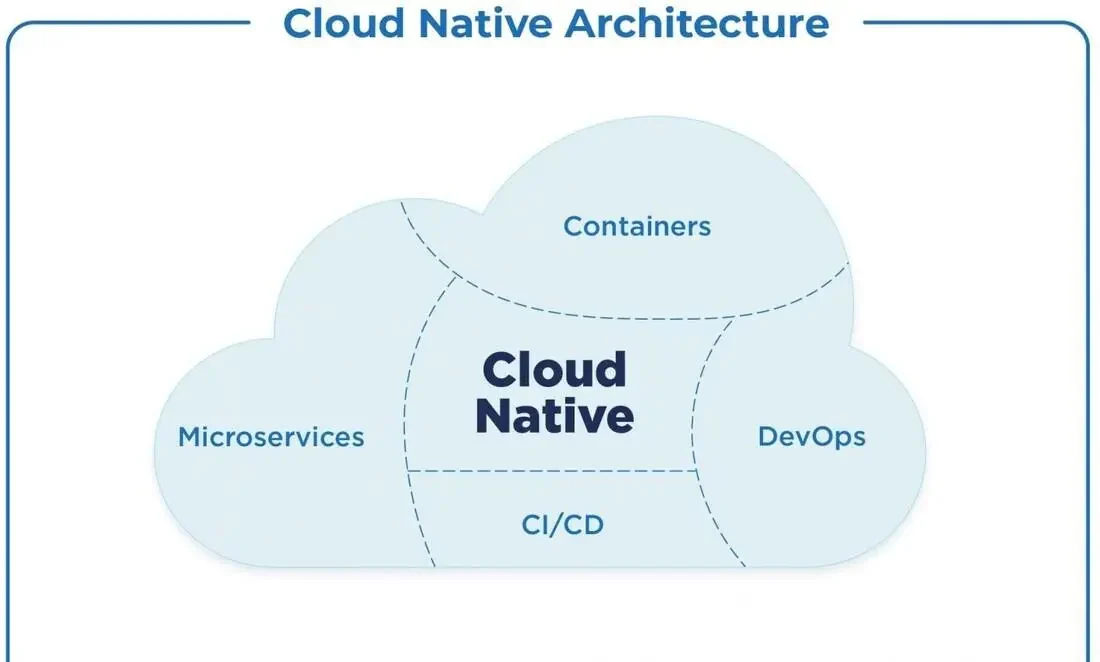
The main pillars of cloud architecture are containers, API-driven communication, orchestration, DevOps & CI/CD. Here, the modern companies are looking forward to creating highly scalable platforms. It combines software development ideas with the DevOps processes and techniques from cloud services.
Cloud Native Architecture is a way to deploy applications on the Cloud.
This platform is engineered to operate as a distributed system and is well optimized for dynamic cloud infrastructure. These cloud native apps integrate deeply with the cloud services, including messaging systems, managed databases, and even autoscaling groups.
If you are still confused, let’s understand it in four simple points:
- It’s like building a house specifically for the cloud.
- The app works in small, independent pieces.
- It lives inside a “digital box” called a container.
- This platform grows and heals on its own.
If you are confused about what a cloud is or what cloud-based apps are, then lets thrive through the mentioned sub-headings, or you can even switch to the next section.
What is a Cloud-Based Application?
The cloud-native applications are the software programs includes multiple, small, and interdependent services called microservices.
With the help of a cloud-native approach, the developers break functionalities into smaller microservices. It further helps to make the cloud-native apps more agile when these microservices work independently and even take minimum resource to run.
For cloud app development, you should follow the right procedure that begins with market study, designing, selecting the tech stack, and then testing and deploying the app successfully.
But now, for a beginner, it can be difficult to understand the cloud.
Well, let’s get into it.
What is Cloud Computing?
Cloud computing is a global network of different remote servers that are housed in data centers and are used to store, manage, and process data as well as applications on the internet. It has a pay-as-you-go pricing model.
The key components of Cloud computing are:
- Remote storage
- On-demand access
- Scability & elasticity
- Pay-as-you-go model
Now, let’s get ahead with understanding the core models of cloud-native architecture.
What are the Cloud- Native Architecture Models?
Basically, as a developer, you have got a several options available to you when you proceed to design the system that works best for your company.
The cloud native application architecture doesn’t remain the same for every business. As a developer, you need to understand that it exists in different deployment models.
Here, the common options comprise:
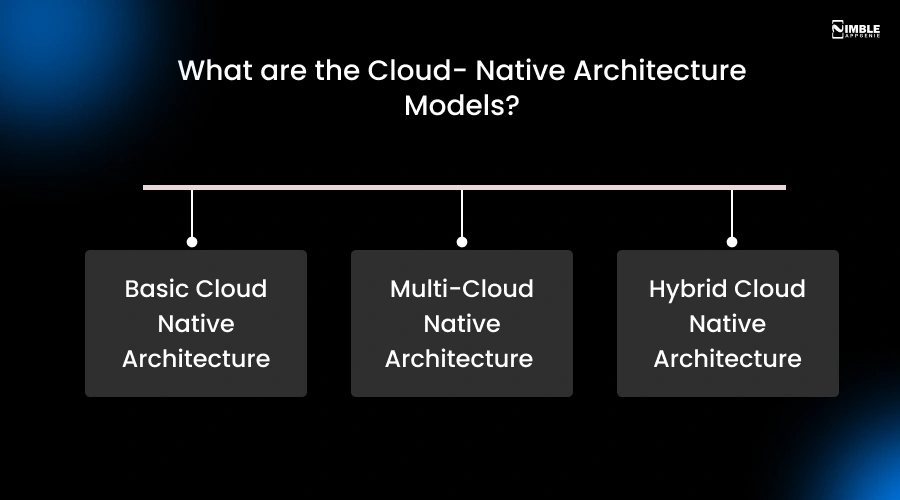
1. Basic Cloud Native Architecture
When your DNS (Domain Name System) is used with the basic cloud-native architecture, it enables developers to build, deploy, and even scale apps faster.
Here, the master database and slave database hold the key data that further communicates with your app. The basic cloud native architecture is backed up by the cloud periodically.
2. Multi-Cloud Native Architecture
As a developer, your DNS can connect with multiple and different cloud platforms via an application component.
It does provide a consistent abstraction layer that decouples application code from the specific proprietary APIs of the individual application.
3. Hybrid Cloud Native Architecture
A hybrid cloud native application architecture integrates the traditional on-premises and even the private cloud systems along with the public cloud services to a simple and integrated network.
Here, these apps are pushed to a master database, while the replication of the data pushes again to a slave database on a different cloud.
Here’s a quick table for the three types of infrastructure:
| Model | Infrastructure | Best For | Key Benefit |
| Basic | Single cloud provider | Startups, small businesses | Simple & cost-effective |
| Multi-Cloud | Two or more cloud providers | Large enterprises | No vendor lock-in |
| Hybrid | Private + Public cloud | Finance, healthcare, government | Security & flexibility |
Among the basic, multi-cloud, and hybrid cloud architectures, the cloud-native architecture is built to adapt to your business needs at every scale. However, if you are misinterpreting the architecture as simply “being your application on the cloud’ as a business, then you should know that there’s a lot more to it.
These models do adopt cloud-based app maintenance services and even help in improving the overall performance of your application.
Hence, in the following section, you will understand the differences between the cloud native architecture and cloud-enabled architecture.
Cloud Native Architecture vs. Cloud-Enabled Architecture
The key difference between the cloud native architecture and Cloud-enabled architecture is that cloud-native architecture prefers a microservices-based structure; however, cloud-enabled architecture focuses on a monolithic structure.
Let’s get through a detailed list of differences below:
| Factor | Cloud Native | Cloud-Enabled |
| Definition | Built specifically for the cloud from scratch | Traditional apps moved or adapted to the cloud |
| Design Approach | Designed for the cloud from day one | Originally designed for on-premise, then shifted |
| Structure | Microservices-based | Monolithic structure |
| Scalability | Auto-scales effortlessly | Limited, manual scaling |
| Deployment | Containers & Kubernetes | Virtual machines or legacy servers |
| Updates | Continuous, zero downtime | Requires downtime for updates |
| Cost Efficiency | Highly optimized | Higher infrastructure costs |
| Flexibility | Highly flexible | Rigid and limited |
| Performance | Built for peak cloud performance | Performance depends on legacy design |
| Best For | New, modern app development | Businesses transitioning to the cloud gradually |
Now, let’s get ahead with learning the architecture of cloud native infrastructure.
Core Components of Cloud Native Architecture
The core components of cloud native application architecture are microservices, containers, orchestration, immutable infrastructure, APIs, service mesh, serverless computing, API gateway, and event-driven architecture.
Let’s learn them all below:
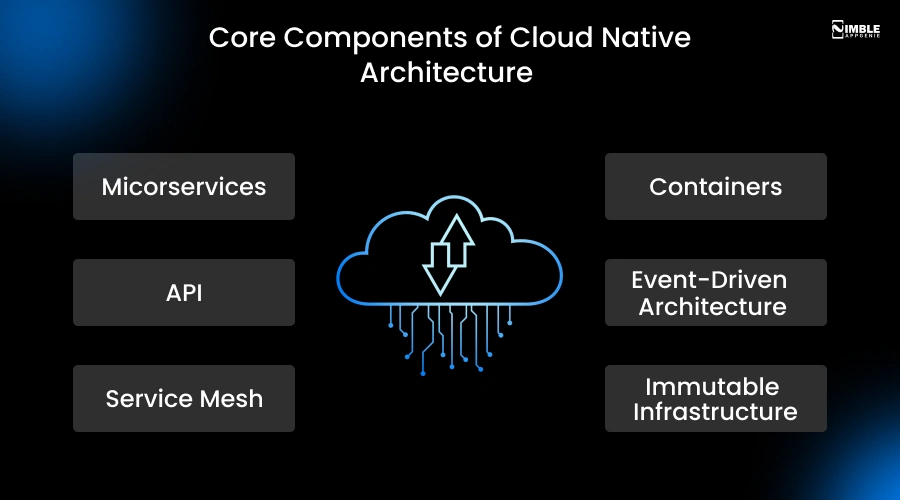
1. Micorservices
The microservices are small, individual software components that collectively perform as a complete cloud-native software. Here, the developers make changes to the application by working on the individual microservices.
2. API
API is an important method that two or more software programs use for exchanging information. It tells you what type of data the microservices want and what type of results they can give you.
3. Service Mesh
Service mesh is an effective software layer in the cloud infrastructure that manages the communication between different microservices. As a developer, you can use the service mesh for introducing additional functions without even writing any new code.
4. Containers
Containerization can be defined as a process that uses platforms like Docker and even Kubernetes to divide the applications and their dependencies into lightweight containers. Additionally, it simplifies the deployment process and is even helpful to optimize the resources.
5. Event-Driven Architecture
The event-driven architecture does allow the applications to respond to the events and triggers asynchronously. This type of pattern enables loose coupling, promoting scalability, and decoupling the systems across apps.
6. Immutable Infrastructure
The immutable infrastructure can be defined as an approach where the different components, including the servers, containers, and virtual machines, cannot be modified when they are deployed.
By avoiding manual upgrades, the immutable infrastructure makes the cloud-native deployment an effective process.
Additionally, the Salesforce cloud service acts as a connectivity tissue that unifies revenue operations, customer experience, and even artificial intelligence into a single operating framework.
Now, let’s get ahead with the complete principles of cloud native architecture in the given section.
What are the Principles of Cloud Native Architecture?
The key principles of native cloud architecture help to overcome failures and provide the right guidance to the developers as well as to the businesses related to their cloud apps.
Let’s get ahead with the list of principles:
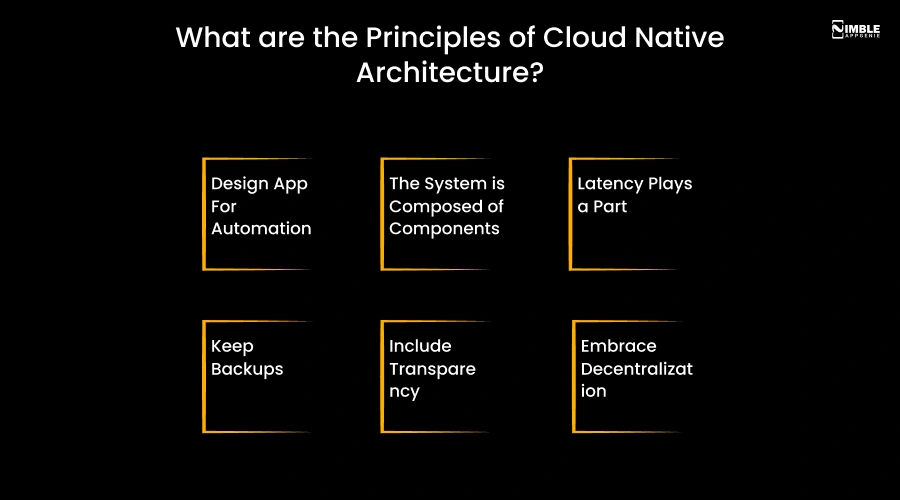
1. Design App For Automation
You need to shift from manual configuration to “infrastructure as a code” and even the automated CI/CD pipelines. The implementation of automated procedures can even repair and scale the systems much faster.
2. The System is Composed of Components
Here, the architecture uses containers to further split the apps into small and even tiny chunks that even work together.
3. Latency Plays a Part
For developers, it is important to keep the latency period as small as possible. Here, the tiny delays between a user’s request and the system’s action are part of a diversified cloud-native system.
4. Keep Backups
Implementing backups for your application can be helpful in keeping data safe. Here, systems are built in parallet so, so nothing is lost even if the cloud system crashes.
5. Include Transparency
Keep the businesses informed about their apps. Along with this, include the features of transparency in cloud native architecture, so that you can observe them and ensure that they’re working properly.
6. Embrace Decentralization
As a developer, you should foster an empowerment culture. Assisting the teams to independently manage and scale microservices. Here, each service should have its own logic as well as data storage, which allows independent scaling and deployment.
Now, let’s get ahead with the key benefits of using the cloud-native architecture in the following section.
What are the Key Benefits of Using Cloud-Native Architecture?
The key benefits of using the cloud-native architecture are low cost, speed, and options.
Let’s learn them all in the following section.
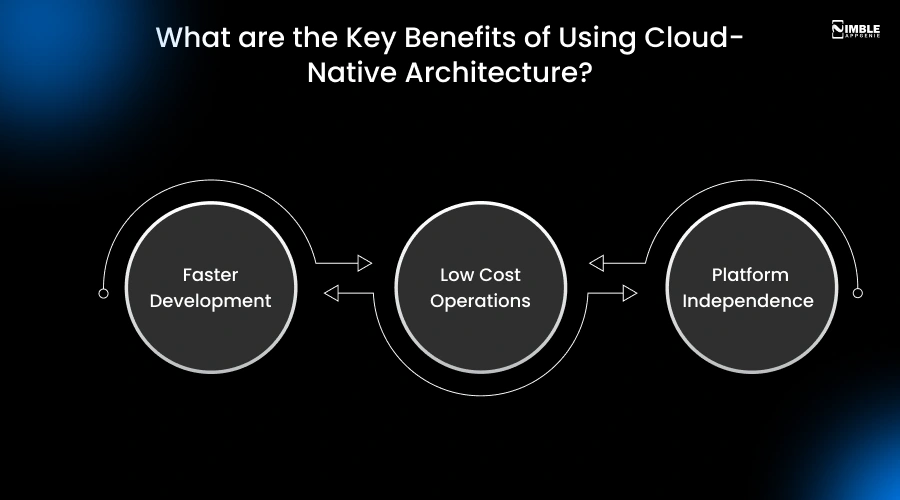
1. Faster Development
As a developer, you can use the cloud-native approach to minimize development time and even achieve better quality applications.
Rather than relying on the hardware infrastructure, the developers can build ready-to-deploy containerized apps. These help respond to changes quickly.
2. Low Cost Operations
Here, as a business, you only pay for the resources that your application actually uses. This architecture reduces the overall operational cost by replacing the manual infrastructure with automated and highly efficient cloud-based services.
Overall, the cloud native architecture is helpful to save money because you do not need to invest in the hardware for your app. Here, the cloud provider does take the overall responsibility, and you pay only for the services you use.
3. Platform Independence
Through building and deploying the apps in the cloud, developers ensure consistency. They do not have to worry about the hardware incompatibility, as here the cloud provider takes care of it.
It is the ability of the software program to run on different architectures and even operating systems without the need for code modification.
Along with the benefits, there are certain drawbacks to consider. Get ahead with the following list of challenges.
Challenges to Build a Cloud-Native Architecture
When you create a cloud native architecture, there are certain challenges that you might go through, such as security and compliance, data management and consistency, and cost management and optimization.
Let’s get ahead with the list of challenges below:
1. Security and Compliance Challenges
When you create a mobile app on a cloud platform, security is one of the most critical challenges. Additionally, one of the major cloud security threats is misconfiguration. When a cloud-based tool or app is not configured, this can lead to a potential data leak.
2. Data Management and Consistency
The data management and consistency challenge can result in fragmented data and even in the complexity of maintaining syncs across different databases. Along with this, ensuring consistency across these separate data stores becomes highly complex.
3. Cost Management and Optimization
In the native infrastructure, the organizations should optimize the cost management systems. The underutilized resources can result in unnecessary costs and high resource usage.
Wait! There’s more on the architecture of cloud native infrastructure. Let’s get ahead with the same.
How do Cloud Native Architecture Benefits Businesses?
Implementing cloud-native architecture offers benefits such as faster time to market, better products, and flexibility to adopt best practices.
Here’s a brief overview of the same:
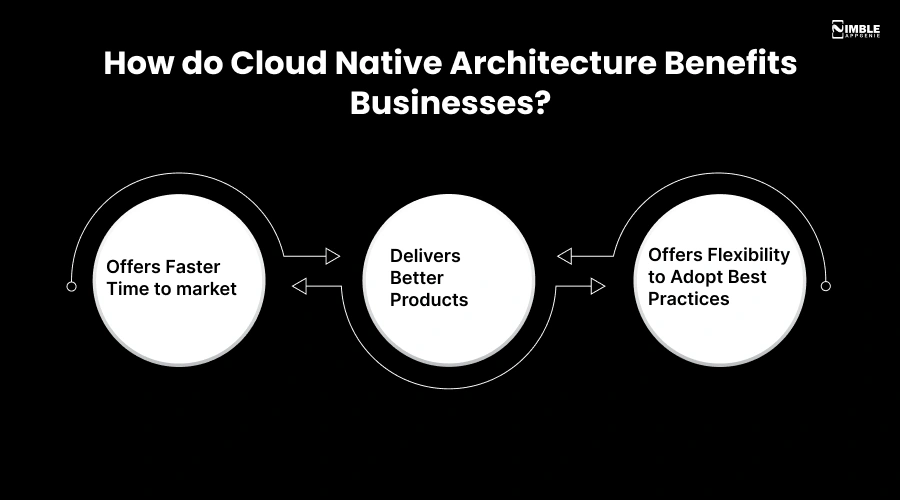
1. Offers Faster Time to market
The native cloud architecture provides a flexible architecture that empowers companies to respond to the rapidly changing market conditions.
With the help of microservices and CI/CD pipelines, teams can update small parts automatically. It further helps to restructure how apps are built and delivered.
2. Delivers Better Products
This architecture delivers better products to market. It does enable the organizations to deliver more features faster for achieving the competitive advantage.
Additionally, it offers self-service automation as well as scalability to the development team to accelerate product development.
3. Offers Flexibility to Adopt Best Practices
The cloud-native application architecture is self-healing, cost-efficient, and easily updated via CI/CD. It enables the developers to break down silos across development and security to deliver a consistent experience.
It offers flexibility via replacing the rigid, centralized systems with loosely coupled components that can be managed and updated significantly.
Connect with the Experts of Nimble AppGenie and Build Your Cloud Native App
You can partner with the experts of Nimble AppGenie, the best mobile app development company, and can build a complete cloud native application. The team delivers customized mobile and web solutions and is specialized in AI-powered, scalable applications.
Our team offers bespoke solutions and is a trusted partner that builds high-performing mobile apps and even cross-platform designs that drive actual business results.
We can even help you to leverage AI for innovative mobile apps. From native iOS and Android to even cross-platform, our team offers customized solutions that are tailored to your business needs.

Conclusion
Cloud Native Architecture is no longer a technological luxury; it’s a business necessity. From microservices and containers to auto-scaling and CI/CD pipelines, every component works together to make your application faster, smarter, and more resilient.
Whether you opt for a Basic, Multi-Cloud, or Hybrid model, cloud native empowers businesses to reduce costs, accelerate development, and deliver better products consistently. Yes, challenges exist, but with the right expertise, they’re highly manageable.
FAQs

Richard Thomas is the Lead Architect at Nimble AppGenie, where he oversees the design and development of scalable, secure, and high-performance digital solutions. With deep expertise in software architecture, cloud infrastructure, and system integration, he plays a key role in transforming complex business requirements into robust technical frameworks. When he’s not architecting systems, he enjoys exploring emerging technologies and staying ahead of industry trends.
Table of Contents




No Comments
Comments are closed.