

 Free Consultation
 PCI-DSS Compliant
 GDPR Ready
 ISO 27001
 NDA Protected
 AI Services
 AI App Development
 Generative AI Development
 AI Chatbot Development
 AI Integration Services
 AI Consulting Services
 AI For Fintech
 AI Financial Assistant Solution
 AI Insurance Agent Development
 Tech Stack
 OpenAI / GPT-4
 Claude / Anthropic
 Gemini / Google AI
 Llama / Open Source
 LangChain / LlamaIndex
 Pinecone / Pgvector
 AWS / Azure AI


 Fintech Solution
 Core Fintech
 App Development
 Neobank Solutions
 eWallet Solutions
 Lending Software
 Banking Solutions
 BNPL Solutions
 BNPL Solutions
 Insurance App
 Wealth Management
 Crypto & DeFi
 Blockchain Development
  Payroll Software
 DeFi Solutions
 Crypto Wallet
 Crypto On/Off Ramp
 Crypto Exchange
 Trading Platform
 Payments
 Compliance
 Regulations & Compliance
 Fraud Detection
 Lending Ecosystem
 P2P Lending Platform
 Mortgage Software
 Engagement
 Fintech Outsourcing

 Mobile Development
 Mobile App Dev
 iOS App Development
 Android App Development
 React Native
 Flutter Development
 Web Solution
 Node.js Development
 React.js Development
 Angular Development
 App Services
 UI/UX Design
 App Maintenance
 By Stage
 MVP Development
 Industry Solutions
 Healthcare App Dev
 Education App Dev
 Travel App Dev
 Real Estate App Dev
 Logistics Software
 Social Media App

 Hire Mobile Developers
 Hire iPhone Developers
 Hire Android Developers
 Hire React Native Devs
 Hire Flutter Developers
 Hire Web Developers
 Hire Node.js Developers
 Hire Angular Developers
 Hire PHP Developers
 Hire Laravel Developers
 How It Works
 Pre-Vetted Developers
 Ready In 48 Hours
 NDA From Day One
 Replace Guarantee
 Company
 About Us
 Our Work Process
 Portfolio
 Case Studies
 Blog / Insights
 Careers
 Contact Us
 Awards
 Recognition


 Offices



TL;DR
- Fintech penetration testing goes beyond standard app security testing by targeting the financial logic unique to fintech products transactions, payments, account balances, and regulated workflows not just generic code-level vulnerabilities.
- What makes it different: a conventional pentest asks, “Is this input sanitized?” A fintech pentest also asks, “Can this transaction be replayed, this balance be manipulated, this authorization step be skipped?”
- The highest-risk surfaces are transaction and payment logic, APIs (especially third-party/partner-bank integrations), authentication and account security, and business logic, the last of which automated scanners routinely miss because the app is behaving “correctly” while still being abused.
- When to test: before launch, after major releases, after any payment/API integration or auth change, after security incidents, and on a recurring cadence, not as a single pre-launch checkbox.
- The bigger picture: penetration testing for fintech validates security that should already be designed into the application. It’s a checkpoint, not a substitute for building securely from the start.
- Nimble AppGenie’s approach: we build authentication, API security, and data protection into fintech app architecture from day one, so penetration testing confirms your security posture instead of scrambling to fix it pre-launch.
A standard web or mobile application penetration test checks whether your code has exploitable bugs, like broken authentication, injection flaws, and exposed endpoints. A fintech application needs all of that, plus something a generic test was never built to find: whether an attacker can bypass a spending limit, manipulate a transaction, exploit how your KYC flow hands off to your lending engine, or chain together well-working features into unauthorized financial gain.
That difference is the whole point of this guide today. Below you will discover what fintech penetration testing should cover, why generic security testing misses the risks that matter in financial software, and where testing fits into a broader security strategy.
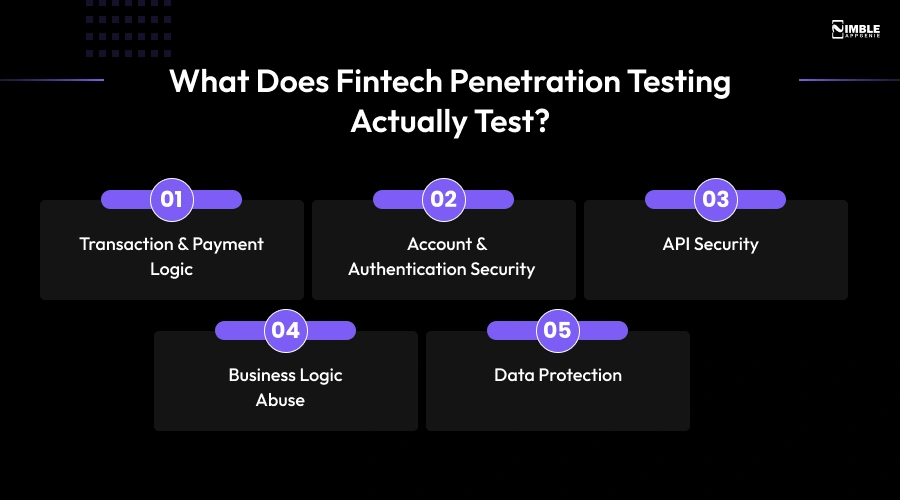
What Does Fintech Penetration Testing Actually Test?
Fintech penetration testing covers five core areas: transaction and payment logic, authentication and account security, API security, data protection, and business logic.
Underneath all five lies one core question: can the intended application’s perfectly functioning behavior be turned against it for financial gain or data exposure?
1. Transaction & Payment Logic
This is the surface with no equivalent in a typical web app, and it’s where the financial stakes are highest.
Testers look for:
- Duplicate or Replayed Transactions: Resubmitting a payment request to see if the system properly recognizes it as already processed.
- Race Conditions: Sending multiple simultaneous requests (a withdrawal, a transfer, and a redemption) faster than the system can lock the underlying balance, possibly allowing the same funds to be spent twice.
- Payment-Flow Manipulation: Skipping steps in a multi-stage payment process, like bypassing a fraud check that only runs on the client side.
- Transaction-Status Manipulation: Intercepting or altering a transaction state (example: forcing a “pending” payment to appear “completed”) before the backend confirms it.
- Authorization Gaps Between Stages: A transaction that is authorized at initiation but never re-verified at settlement, leaving a window to alter the destination or amount in between.
| Pro Tip: Business-logic testing on transaction flows should never be skipped, favoring only running automated scans. A scanner will confirm your payment endpoint accepts and processes a request accurately – it has no logic for whether that request should have been allowed to take place twice. |
2. Account & Authentication Security
A compromised account on a fintech app generally means direct access to money, so authentication weaknesses carry more impact here than in many other software categories.
Testers assess:
- Session Management: Do sessions expire properly, and can a stolen session be reused from a distinct location or device without triggering re-verification?
- MFA Implementation Weaknesses: Is MFA (Multi-Factor Authentication) executed everywhere it should be, or can it be bypassed via a password-reset flow, a “remember this device” feature, or a legacy API version?
- Privilege Escalation: Can a regular user account gain access to admin functions or another tenant’s data through parameter manipulation or role-check gaps?
- Account Takeover Paths: Combinations of weak password-reset logic and SIM-swap-adjacent flows that allow an attacker to penetrate a legitimate account.
3. API Security
Most fintech functionality lives behind APIs – your own, the KYC providers, payment gateways, and banking partners you integrate with. Each connection is a separate trust boundary.
Key Areas:
- Broken Function-level Authorization: Can a standard user call an endpoint meant only for admin or internal tooling?
- BOLA/IDOR (Broken Object-Level Authorization): Can a user change an account ID or transaction reference in a request and pull back someone else’s data or balance?
- Rate-Limit Weakness: Can OTP or transaction endpoints be brute-forced or abused at volume?
- Excessive Data Exposure: Does an endpoint return more fields than the app actually showcases (full card numbers, internal risk scores, and other users’ metadata)?
- Third-Party API Risk: When you integrate a partner bank’s API, whose responsibility is it to test that seam?
- Webhook Security: Are incoming webhooks from payment processors or partners properly authenticated, or can a spoofed webhook trigger a false “payment confirmed” event?
| Pro Tip: After every new banking API, payment provider, or KYC integration, retest the specific endpoints and data flows involved. New integrations are one of the most common areas where new vulnerabilities appear. These are frequently missed because the “core app” was already tested and cleared before the integration existed. |
4. Business Logic Abuse
This category separates a fintech-aware test from a generic one, and it is worth explaining why: automated vulnerability scanners test whether code behaves as written. They can’t test whether what’s written should be allowed.
Fintech-specific Examples:
- Wallet or Balance Manipulation: Exploiting rounding errors, refund handling, or currency-conversion logic to inflate a balance.
- KYC Bypass: Discovering a path through onboarding that weakens or skips identity verification (example an API endpoint that creates an account without triggering the same checks as the UI flow).
- Transaction-Limit Bypass: Splitting a transaction into smaller pieces to remain under a fraud monitoring threshold, or locating an endpoint that doesn’t enforce the same limit as the primary flow.
- Loan or Credit Logic Tampering: Manipulating inputs to a credit-scoring or loan-approval workflow to get a more favorable outcome than the applicant qualifies for.
- Workflow Abuse: Using a feature exactly as designed, but in a sequence or volume the business logic never expected (example: cashback, referral bonuses, or promotional credit systems).
None of this shows up as a “vulnerability” in a scan report. It needs a tester who understands the financial workflows well enough to ask what happens if I do this in the wrong order, or too many times, or with a value the form was not anticipating.
5. Data Protection
Financial applications hold data that is valuable well beyond the app itself – KYC documents, account numbers, PII, and transaction histories that enable fraud or identity theft if exposed.
Coverage should include:
- Secure storage of KYC documents and other identity artifacts.
- Encryption at rest and in transit, checked for actual implementation rather than just presence.
- Data exposure through verbose API responses or error messages.
- Logging practices that avoid capturing sensitive fields (tokens, card numbers, full ID documents) in plaintext logs.
Types of Fintech Penetration Testing
A complete engagement typically spans:
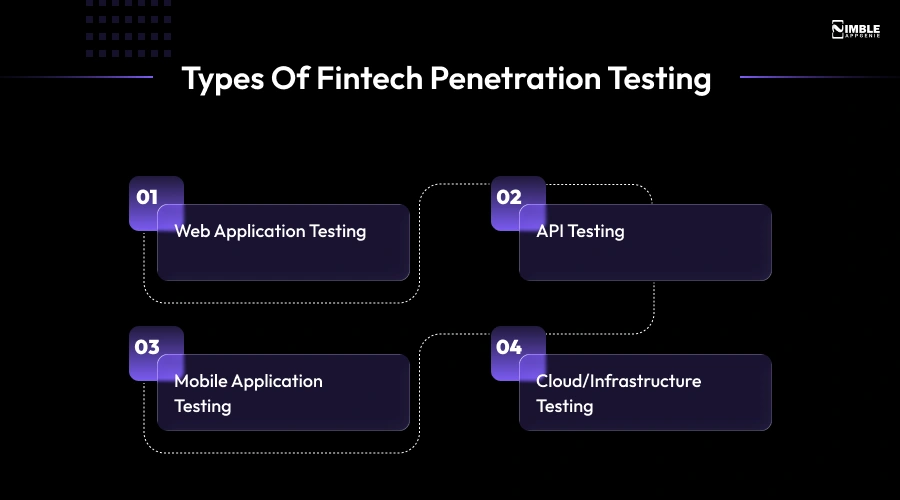
- Web Application Testing: The customer-facing portal and any internal admin panels (which usually carry elevated privileges and get less scrutiny)
- API Testing: The layer most fintech logic actually runs on.
- Mobile Application Testing: Certificate pinning, local data storage, and tamper resistance on Android/iOS.
- Cloud/Infrastructure Testing: Network segmentation, access controls, and configuration of the environment hosting all of the above.
Each of these has its detailed methodology – for a broader look at how these fit into overall QA and app testing, see Nimble AppGenie’s guide to fintech app testing, assurance, and auditing.
How Does Fintech Penetration Testing Support Compliance?
Penetration testing for fintech contributes evidence to frameworks like PCI DSS (which specifically needs periodic testing for any app handling card data), ISO 27001 audits, and SOC 2. A clean pentest report is usually a part of what auditors or enterprise partners expect to see.
That said, passing a penetration test doesn’t mean an application is compliant. Compliance frameworks cover access governance, data handling, organizational controls, and documentation that a pentest doesn’t touch. Testing is one input into a compliance program, not a replacement for it.
For the complete regulatory picture, see Nimble AppGenie’s fintech regulations guide, and for identity-verification-specific requirements, see the KYC and AML compliance guide.
When Should a Fintech Application Be Penetration Tested?
A fintech application should be tested before top production releases and periodically after that, with additional testing triggered by significant architectural, payment, authentication, or third-party integration changes – not only on a fixed annual schedule.
Specific triggers:
- Before initial production launch
- Before any primary release that touches payments, authentication, or core transaction logic.
- After integrating a new payment provider, KYC/AML vendor, or banking API.
- After significant architectural changes (new data stores, new services, new trust boundaries).
- After introducing a new financial workflow (a new wallet feature, a new lending product, a new payout mechanism)
- Following any security incident suspected or confirmed.
- At a recurring cadence appropriate to your risk profile – commonly annually, though high-change environments usually test more frequently.
| Pro Tip: Annual testing alone is not enough if your product ships significant changes more often than that. Treat “significant change” as the real trigger, and allow the calendar to be the backstop, not the primary schedule. |
What Does a Fintech Penetration Test Involve?
At a high level, a credible engagement follows a process like this:
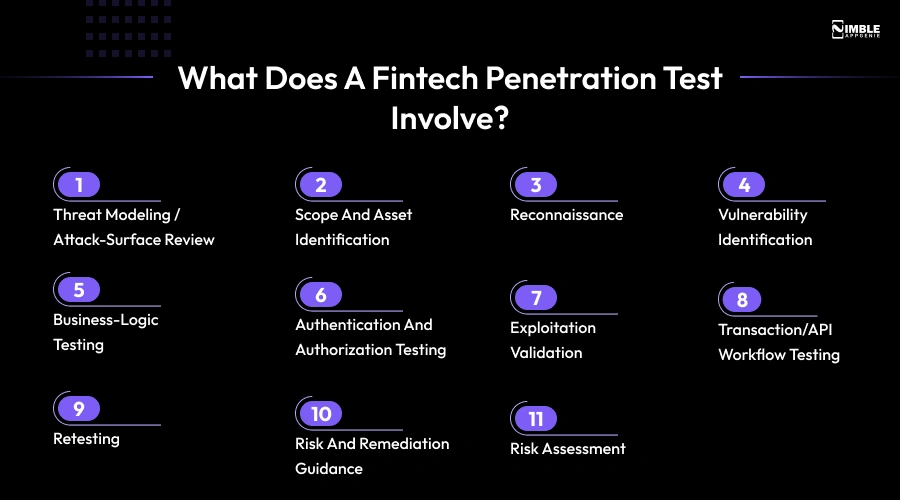
- Threat Modeling / Attack-Surface Review: Mapping the specific financial workflows and trust boundaries unique to your product.
- Scope and Asset Identification: Defining which applications, environments, and APIs are in scope.
- Reconnaissance: Understanding the application’s structure, exposed surfaces, and technology stack.
- Vulnerability Identification: Combining automated scanning with manual review.
- Business-Logic Testing: Manually working through KYC, transaction, and workflow abuse scenarios.
- Authentication and Authorization Testing: Probing login, access-control logic, and sessions.
- Exploitation Validation: Confirming that identified weaknesses are actually exploitable, not theoretical.
- Transaction/API Workflow Testing: Testing payment flows and integration points end-to-end.
- Retesting: Verifying that fixes genuinely close the identified gaps.
- Risk and Remediation Guidance
- Risk Assessment: Rating findings by real-world business and technical impact.
The target is not a long list of findings – it is understanding whether individually minute weaknesses can be chained together into meaningful financial or data impact.
What Should a Fintech Pentest Report Include?
A report worth acting on needs to offer a decision-maker enough to evaluate both the quality and risk of the testing itself.
- Scope and methodology
- Executive summary written for non-technical stakeholders
- Detailed findings with clear reproduction steps
- Evidence (request/response data, screenshots, proof-of-concept detail)
- Business impact and technical impact stated separately
- Severity and risk ratings connected with actual business impact, not only technical severity
- Prioritized remediation recommendations
- Affected components and systems
- Retest/validation results once fixes are applied
If a report jumps straight from “vulnerability found” to a generic severity score without explaining what an attacker could really do with it – a sign the testing didn’t go deep enough into your specific application logic.

How to Choose a Development Partner That Builds Security In From Day One
A penetration test is a checkpoint that tells you where an application currently stands. It doesn’t build the application, and by the time a serious business-logic flaw is caught in a pre-launch pentest, fixing it can mean reworking core transaction or authorization architecture under launch-timeline pressure.
The stronger position is a product built considering security from the start:
- Secure coding practices and code review as a standard part of development, not an afterthought.
- Secure architecture and threat modeling done during design, not after
- Authentication and authorization designed around least privilege from day one.
- Secure payment integration patterns applied constantly across providers
- API security and rate limiting built into every integration, including third-party ones.
- Data protection (access control, encryption, secure storage) treated as a default, not a configuration option.
- Pre-launch validation, including penetration testing, as confirmation – not discovery
This is why evaluating a fintech development partner on security shouldn’t be restricted to “have you built fintech apps before?” The more practical question is whether the partner designs, builds, tests, and continues to improve a product’s security posture as part of how they work – not as a separate service bolted on before launch.
At Nimble AppGenie, fintech application development is approached from an architecture decision: authentication and authorization design, API integration security, and data protection built into the features themselves – whether that’s a lending platform, a neobank, or an eWallet product.
If you are planning or scaling a fintech application, work with a partner that treats security as part of the product architecture, not a final-stage checkbox.
Conclusion
Fintech penetration testing that only checks for generic vulnerabilities is answering the wrong question. The real question is whether an attacker can turn your application’s own correct behavior – an API call, a transaction, a KYC step – against it. That needs testers who understand financial workflows, not just application security generally.
But fintech penetration tests are not a security strategy. They are checkpoints on a product that needs to be already built with security in its architecture, not added at the end. That blend – security engineered into the product from the start, with penetration testing as periodic validation – is what holds up under real-world attack and regulatory scrutiny.
FAQs
A vulnerability scan is automated and identifies known technical weaknesses, outdated libraries, missing headers, and common misconfigurations. A penetration test includes manual testing by a person who actively tries to exploit those weaknesses and probe business logic a scanner has no way to evaluate, such as whether a transaction flow can be manipulated.
It depends on the scope, but a thorough engagement covering web, mobile, API, and business-logic testing for a moderately complex fintech app typically runs two to four weeks, including reporting.
An executive summary, methodology, detailed findings with severity ratings and evidence, business and technical impact for each finding, remediation guidance, and retest results once issues are fixed.
At minimum, annually, plus after any major release touching authentication, payments, or core transaction logic, after new third-party integrations, and after any security incident.
Yes, but only if the testing includes manual, fintech-aware analysis. Automated scans generally cannot detect business-logic abuse, since the application is often behaving exactly as coded; the issue is in what the logic allows, not in a coding error.
No. It’s an important validation layer, but it tests a snapshot in time. Ongoing security comes from how the application is architected, built, and maintained between tests.
Yes. Pre-launch testing is one of the most important checkpoints, since it’s the last opportunity to catch transaction, authentication, or API weaknesses before real users and real money are involved.

Niketan Sharma, CTO, Nimble AppGenie, is a tech enthusiast with more than a decade of experience in delivering high-value solutions that allow a brand to penetrate the market easily. With a strong hold on mobile app development, he is actively working to help businesses identify the potential of digital transformation by sharing insightful statistics, guides & blogs.
Table of Contents




No Comments
Comments are closed.