

 Free Consultation
 PCI-DSS Compliant
 GDPR Ready
 ISO 27001
 NDA Protected
 AI Services
 AI App Development
 Generative AI Development
 AI Chatbot Development
 AI Integration Services
 AI Consulting Services
 AI For Fintech
 AI Financial Assistant Solution
 AI Insurance Agent Development
 Tech Stack
 OpenAI / GPT-4
 Claude / Anthropic
 Gemini / Google AI
 Llama / Open Source
 LangChain / LlamaIndex
 Pinecone / Pgvector
 AWS / Azure AI


 Fintech Solution
 Core Fintech
 App Development
 Neobank Solutions
 eWallet Solutions
 Lending Software
 Banking Solutions
 BNPL Solutions
 BNPL Solutions
 Insurance App
 Wealth Management
 Crypto & DeFi
 Blockchain Development
  Payroll Software
 DeFi Solutions
 Crypto Wallet
 Crypto On/Off Ramp
 Crypto Exchange
 Trading Platform
 Payments
 Compliance
 Regulations & Compliance
 Fraud Detection
 Lending Ecosystem
 P2P Lending Platform
 Mortgage Software
 Engagement
 Fintech Outsourcing

 Mobile Development
 Mobile App Dev
 iOS App Development
 Android App Development
 React Native
 Flutter Development
 Web Solution
 Node.js Development
 React.js Development
 Angular Development
 App Services
 UI/UX Design
 App Maintenance
 By Stage
 MVP Development
 Industry Solutions
 Healthcare App Dev
 Education App Dev
 Travel App Dev
 Real Estate App Dev
 Logistics Software
 Social Media App

 Hire Mobile Developers
 Hire iPhone Developers
 Hire Android Developers
 Hire React Native Devs
 Hire Flutter Developers
 Hire Web Developers
 Hire Node.js Developers
 Hire Angular Developers
 Hire PHP Developers
 Hire Laravel Developers
 How It Works
 Pre-Vetted Developers
 Ready In 48 Hours
 NDA From Day One
 Replace Guarantee
 Company
 About Us
 Our Work Process
 Portfolio
 Case Studies
 Blog / Insights
 Careers
 Contact Us
 Awards
 Recognition


 Offices


TL;DR
- RWA tokenization platform development is the process of building a compliant system with legal structuring, smart contracts, investor onboarding, custody, and reporting that turns ownership of a real-world asset into a tradeable digital token.
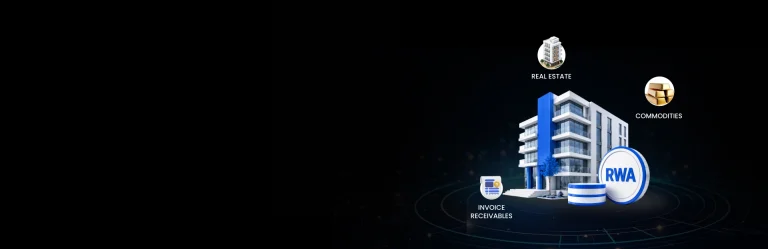
- RWA tokenization turns ownership or economic rights in a real-world asset real estate, credit, funds, commodities into a digital token on a blockchain.
- Businesses build these platforms for fractional ownership, faster settlement, and programmable compliance, not as a shortcut around securities law.
- Development runs through legal structuring, token design, blockchain selection, smart contracts, platform build, KYC/AML integration, security audit, and launch.
- Cost depends far more on compliance scope, custody model, and integrations than on the smart contract itself; there is no single number without knowing your asset class and jurisdictions.
- US tokenized securities are still securities under federal law, regardless of how ownership is recorded, a point the SEC reaffirmed in January 2026.
- Nimble AppGenie‘s fintech and blockchain team designs and builds tokenization infrastructure, including smart-contract development, auditing, and a property-tokenization platform built for a real estate client, with verified capabilities you can review directly.
Turning a real-world asset into a digital, investable product involves more than putting a token on a blockchain. RWA tokenization platform development brings together asset assessment, token design, legal structuring, compliance, technology, and ongoing asset management. That complexity is also why businesses asking how much an RWA tokenization platform costs can get very different answers depending on the asset, investor base, and regulatory structure.
In this guide, Nimble AppGenie’s blockchain development team breaks down the process behind building an RWA tokenization platform, from assessing the asset and defining token rights to selecting the technology, implementing compliance, and preparing the platform for launch. We also explain the factors that influence development cost at each stage.
Below, you will find the real development process, the key platform features, compliance considerations, cost drivers, and what to look for in a fintech development partner that understands the entire chain, not just the smart contracts.
What Is an RWA Tokenization Platform?
An RWA tokenization platform is the software system that allows businesses to showcase ownership or economic rights in a physical or financial asset as a digital token on a blockchain, then manage that token throughout its full lifecycle – issuance, transfer, income distribution, and redemption.
The token is only one piece. The platform around it handles investor identity and eligibility checks, asset records, compliance rules baked into the smart contract (who can hold the token, where, and under what restrictions), and the reporting a business needs for its own operations and for regulators. Blockchain provides the settlement and record-keeping layer; it doesn’t replace the legal work of structuring the offering accurately.
Note: This is distinct from tokenization in financial services used for payment security (replacing card or account numbers with tokens), a different concept that solves a different problem.
Why Are Businesses Investing in RWA Tokenization?
The commercial case is consistent across private credit, real estate, and fund managers experimenting with tokenization:
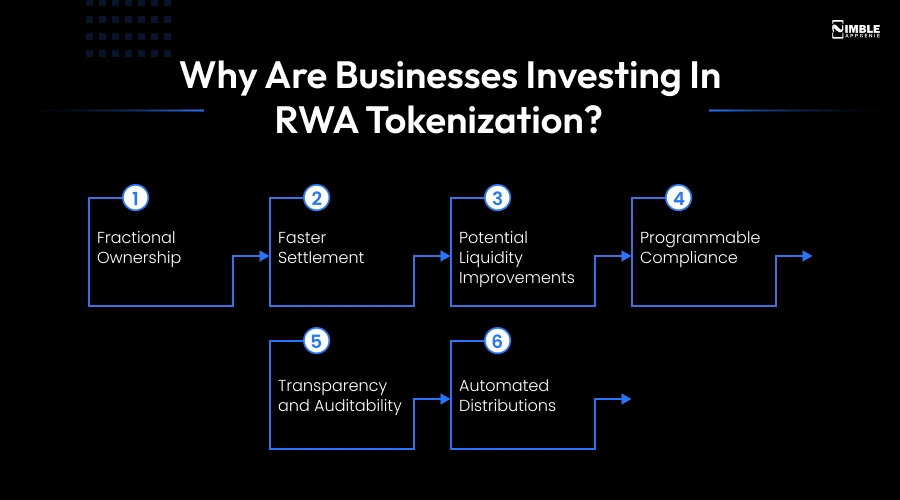
- Fractional Ownership: Assets that once needed a large minimum check can be divided into smaller, more accessible units.
- Faster Settlement: On-chain transfer and record updates can happen in near real time compared with multi-day traditional settlement.
- Potential Liquidity Improvements: Secondary transfer mechanisms, where legally permitted, can shorten the path between wanting to sell and finding a buyer.
- Programmable Compliance: Transfer restrictions and eligibility rules can be enforced at the token level, not only through manual back-office checks.
- Transparency and Auditability: Ownership and transaction history are recorded in a shared, tamper-evident ledger.
- Automated Distributions: Rental income, dividends, or interest can be split and paid out to token holders on a set schedule.
None of this guarantees liquidity, regulatory approval, or return for any specific offering – those outcomes depend on how the asset and offering are structured, not on the technology alone.
What Assets Can Be Tokenized?
Legal treatment, investor eligibility, and transfer restrictions vary by asset type, offering structure, and jurisdiction; the table below is a starting map, not a compliance determination.
Common asset classes for RWA tokenization:
| Asset Class | Typical Use Case | Key Consideration |
| Commercial real estate | Fractional ownership, rental income distribution | Title, property law, and securities treatment vary by state |
| US Treasuries / cash-equivalents | On-chain money-market-style products | Custody and issuer registration requirements |
| Private credit | Fractionalized loan participation | Investor accreditation, servicing rights |
| Private equity/fund interests | Tokenized LP interests | Transfer restrictions, fund documentation alignment |
| Commodities | Tokens backed by physical reserves (e.g., gold) | Custodian verification and audit trail |
| Art and collectibles | Shared ownership of high-value items | Valuation, insurance, physical custody |
How Does RWA Tokenization Platform Development Work?
Each stage answers a business question before it answers a technical one: what happens, why it matters, and what breaks if it’s done badly:
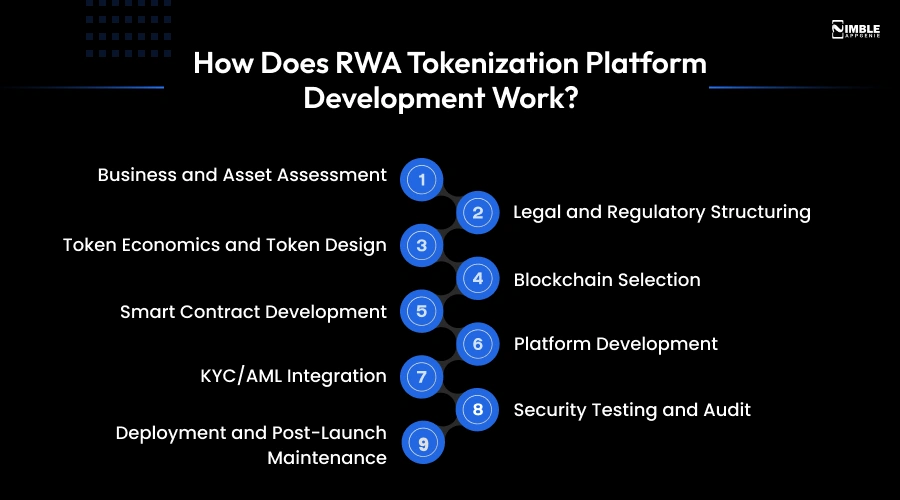
Stage 1: Business and Asset Assessment
Confirms the asset is a real fit for tokenization and that the business model – fees, exit paths, distributions – actually work once digitized. Ignoring this leads to platforms created around assets that were never suited to fractional or on-chain ownership.
Stage 2: Legal and Regulatory Structuring
Determines whether the token is a security, what offering exemption applies, or registration applies, and who can legally hold it. This has to happen before the token design, not after, or the platform is built around rules that need to be re-engineered later at real cost. This step needs to be led by qualified securities counsel, not the development team.
Stage 3: Token Economics and Token Design
Defines supply, fractionalization, distribution mechanics, ownership and economic rights, whitelisting, transfer rules, and redemption. Getting this wrong states either overly rigid tokens that can’t support legitimate transfers, or overly permissive ones that validate transfer restrictions.
Stage 4: Blockchain Selection
No chain is universally “best.” Public EVM chains offer liquidity and ecosystem maturity; permissioned networks, like Hyperledger Fabric or Corda, suit institutions that need rigid access control. The right pick depends on investor type, regulatory context, and transaction volume.
Stage 5: Smart Contract Development
Encodes permissions, distribution logic, and transfer restrictions directly into the token contract. A poorly written or unaudited contract is the single most common source of catastrophic loss in this space.
Stage 6: Platform Development
Builds the investor portal, issuance workflows, asset management tools, dashboards, wallet integration, third-party integrations, and reporting that non-technical staff uses day-to-day.
Stage 7: KYC/AML Integration
Verifies investor identity and eligibility before issuing or transferring any token. Under US law, this obligation usually attaches to the platform operator, not to the blockchain itself.
Stage 8: Security Testing and Audit
An independent, third-party smart contract audit before mainnet deployment – not optional, regardless of timeline pressure. This is where access-control bugs, flash-loan vectors, and integer errors get caught before real money is at risk.
Stage 9: Deployment and Post-Launch Maintenance
Mainnet launch, monitoring, incident response, and ongoing upgrades. Tokenization platforms are not “ship and forget” – regulatory guidance and custody requirements continue to evolve after go-live.
Key RWA Tokenization Platform Features
| MVP Features | Advanced / Enterprise Features |
| Investor onboarding & KYC/AML | Multi-jurisdiction eligibility and accreditation workflows |
| Token issuance and basic transfer restrictions | Secondary-market trading infrastructure (where legally appropriate) |
| Investor dashboard and portfolio view | Corporate actions, complex distribution waterfalls |
| Admin panel and asset onboarding | Multi-chain issuance and interoperability |
| Basic reporting and transaction history | Advanced analytics, compliance dashboards, API ecosystem |
| Wallet integration | Institutional custody integration (HSM/MPC) |
RWA Platform Architecture, in Plain Terms
At a business-readable level, a tokenization platform is layered:
Frontend (investor and admin interfaces) → Application/API layer (business logic, integrations) → Tokenization layer (issuance and lifecycle rules) → Smart contracts (on-chain enforcement) → Blockchain (settlement and record) → Custody/wallet layer (key management) → KYC/AML layer (identity and eligibility) → Asset/data layer (off-chain records) → Banking/payment integrations (fiat on/off ramps, distributions).
Each layer exists because tokenization platforms meet two systems at once – a legal and financial system that expects verifiable identity, recordkeeping, and custody, and a blockchain system that expects immutable, code-enforced rules. A platform that just builds the second half is not a tokenization platform; it is a token with no compliance behind it.
Technology Stack Consideration for RWA Platform Development
Representative technology stack by layer:
| Layer | Common Choices |
| Blockchain | Ethereum, Polygon, Avalanche, Hyperledger Fabric, Corda |
| Smart contracts | Solidity, Rust, Move; OpenZeppelin base libraries |
| Frontend | React.js, Next.js, wallet connectors (ethers.js, WalletConnect) |
| KYC/AML | Third-party identity verification and sanctions-screening providers |
| Custody | HSM- or MPC-based key management, qualified custodians |
| Security | Independent audit firms, automated static analysis tools |
The right stack depends on regulatory footprint, asset class, expected transaction volume, investor type, geography, and budget, not on which chain is trending.
RWA Tokenization Platform Development Cost
There’s no single figure here, and you should be doubtful of any vendor offering one before understanding your compliance scope. What we can offer you is a defensible framework based on scope tier and the cost drivers that move a project between tiers.
Cost framework by platform tier:
| Platform Level | Scope | Relative Complexity |
| MVP | Core issuance, onboarding, compliance | Low–Moderate |
| Mid-level | Integrations, advanced workflows, trading | Moderate–High |
| Enterprise | Multi-asset institutional infrastructure | High |
Why do costs increase between tiers? Moving from MVP to mid-level typically adds secondary-market logic and deeper third-party integrations (custody, data feeds, banking); jumping to enterprise adds multi-asset support, multi-jurisdiction compliance, and institutional-grade custody and uptime requirements.
More broadly, standalone smart contract deployments start in the low five figures, a proof-of-concept generally runs into tens of thousands, and fully compliance-integrated platforms move into six figures and beyond, with legal and regulatory structuring usually the largest single line item once multiple jurisdictions are involved. Treat any quote you receive as tied to a specific, written scope, not a category level.
Development Timeline of RWA Tokenization Platform
Realistic timelines are driven by scope, not by the coding speed. A typical build moves through discovery, architecture, UX/UI, compliance planning, smart contracts, frontend, backend, integrations, audit, security testing, QA, and deployment.
General blockchain development projects, including tokenization work, generally run several months for a full build, with accelerated proof-of-concept tracks available for teams that need to validate an idea before committing to full scope.
RAW-specific projects tend to run longer than a comparable non-tokenized blockchain app because legal structuring and KYC/AML integration add sequential steps that can’t be shortcut.
US Regulatory & Compliance Considerations for RWA Tokenization Platform Development
This is not legal advice, and tokenization treatment relies on the specific assets, token structure, offering, and participants involved; always work with qualified securities counsel before structuring an offering.
The clearest recent signal from US regulators is straightforward: the SEC’s Divisions of Corporation Finance, Investment Management, and Trading and Markets stated in a January 2026 joint statement that changing how ownership is recorded doesn’t change what is being sold – a tokenized security is still a security, and federal securities laws apply the same way they do to traditional book-entry interests.
In March 2026, the SEC and CFTC followed with joint guidance classifying digital assets, including stablecoins, digital commodities, and digital securities, reaffirming that legal treatment turns on economic reality rather than the technology used to represent the asset.
Beyond securities classification, platforms usually need to account for: KYC/AML obligations under the Bank Secrecy Act, possible money-transmitter registration with FinCEN depending on the platform’s role, accredited-investor or eligibility requirements where applicable, transfer restrictions enforced at the token level, custody arrangements, data privacy obligations, and investor disclosures. State-level securities and money-transmission rules add another layer that varies by where investors are located.
Best Practices to Build RWA Tokenization
- Design compliance from day one: Retrofitting it later usually costs several times more than building it in.
- Verify the underlying asset before tokenizing it: A token is only as trustworthy as the asset behind it.
- Define token-holder rights clearly in both the smart contract and the legal documentation.
- Audit every smart contract with an independent third party before mainnet deployment.
- Implement robust access controls across admin functions and custody keys.
- Use secure customer and key management: HSM or MPC for institutional-grade protection.
- Build transfer restrictions where required so tokens can’t move to ineligible holders.
- Maintain accurate on-chain and off-chain records that reconcile
- Design the redemption mechanism clearly so investors understand the exit path
- Plan for interoperability rather than locking into a single chain by default.
- Monitor the platform consistently after launch, not just during the first 30 days.
- Prepare for regulatory change: 2026 alone has brought multiple new SEC and CFTC statements.
Common RWA Tokenization Challenges and Mitigations
| Challenge | Practical Mitigation |
| Regulatory uncertainty | Engage securities counsel early; design for the most conservative applicable framework |
| Asset verification | Independent valuation and custodial attestation before issuance |
| Liquidity | Set realistic expectations; liquidity is not automatic just because a token exists |
| Custody | Use qualified custodians and HSM/MPC key management |
| Smart-contract risk | Mandatory independent audits, modular and upgradable contract design |
| Secondary-market restrictions | Build transfer-restriction logic directly into the token layer |
Build vs. Buy RWA Tokenization
Custom development vs. white-label vs. third-party infrastructure
| Model | Customization & Control | Time to Market | Best Fit |
| Custom development | High – built around your exact compliance and asset model | Longer | Institutions with complex, multi-asset, or long-term platform strategies |
| White-label platform | Moderate – configurable within vendor constraints | Faster | Businesses validating a single asset class quickly |
| Third-party tokenization infrastructure | Lower – you plug into their rails | Fastest | Teams that want to test demand before any platform investment |
Custom development is not automatically the right answer. It’s insightful when long-term ownership, unusual compliance requirements, or deep integration justify the investment, not by default. If secondary trading or liquidity is part of your model, that decision also touches DeFi and secondary-market infrastructure, which comes with its build-vs-buy trade-offs.
How to Choose an RWA Tokenization Development Company
The businesses that get this right evaluate partners on:
- Fintech experience, not just general blockchain work.
- Compliance-aware architecture – KYC/AML and transfer restrictions designed in, not bolted on.
- Smart-contract security practices, including third-party audits on every deployment.
- API and integration capability for banking, custody, and existing systems.
- Multi-chain capability without bias toward whichever chain the vendor happens to know best.
- A relevant, verifiable portfolio: ask to see a real project, not a stock image.
- Whether they understand your business model, not just the code.
- Post-launch support and incident-response commitments.
Why does this matter more than it looks?
A vendor that can write a smart contract but doesn’t understand securities structuring, custody, or KYC obligations will hand you a technically working platform that’s a compliance liability. The development partner conversation should include your legal counsel from the start.
Why Businesses Choose Nimble AppGenie for RWA Tokenization Platform Development
As part of its broader fintech software development practice, Nimble AppGenie’s blockchain development team runs asset tokenization and token development as a core service line, not a side offering, alongside mandatory third-party auditing and smart-contract development on every contract deployed.
The team works across public EVM chains (Polygon, Ethereum, BNB Chain, Avalanche), high-performance non-EVM chains (Aptos/Sui, Solana), and permissioned enterprise networks (Corda, Hyperledger Fabric), choosing the network based on the use case rather than defaulting to one.
On the tokenization side specifically, Nimble AppGenie’s fintech team has built a property tokenization platform enabling fractional ownership of commercial real estate on Polygon, and separately delivered an end-to-end RWA tokenization platform using an ERC-1400-compliant security token with on-chain property title documentation and a secondary trading interface for accredited investors – the kind of compliance-aware architecture this guide has walked through, not a generic token deployment.
The team is ISO 27001 certified and PCI-DSS compliant, and designs for regulatory frameworks including GDPR, MiCA, and SOC 2 from the start rather than retrofitting compliance after launch. Every smart contract goes through an independent security audit before deployment.
If you want to see whether blockchain and tokenization specifically is the right fit for your business case before committing budget, that’s a conversation Nimble AppGenie’s team has with clients directly, including an honest answer if it isn’t.
FAQs
It’s the software system that lets a business represent ownership or economic rights in a real-world asset as a blockchain token and manage that token through issuance, transfer, distribution, and redemption, alongside the compliance and identity checks required to do so legally.
Cost depends on platform tier, asset class, and compliance scope, not on a fixed price. MVP-level platforms sit at the lower end of the range; enterprise, multi-jurisdiction, multi-asset platforms sit considerably higher, with legal and compliance work often the largest single cost driver.
Full builds typically run several months from discovery through mainnet launch, with faster proof-of-concept tracks available. RWA-specific projects usually take longer than comparable non-tokenized blockchain apps because of the added legal structuring and KYC/AML integration steps.
Real estate, US Treasuries and cash equivalents, private credit, private equity and fund interests, commodities, and art or collectibles are common categories. But legal treatment varies by asset, offering structure, and jurisdiction.
Tokenizing assets is legal, but if the token qualifies as a security, it remains subject to federal securities law regardless of how ownership is recorded on-chain, a position the SEC reaffirmed in its January 2026 joint staff statement. Legal structuring should be handled by qualified securities counsel.
There isn’t a universal answer. Public EVM chains offer liquidity and ecosystem maturity; permissioned networks like Hyperledger Fabric or Corda suit institutions needing strict access control. The right choice depends on investor type, volume, and regulatory context.
At minimum: investor onboarding and KYC/AML, token issuance with transfer restrictions, an investor dashboard, an admin panel, and basic reporting. Advanced platforms add secondary-market trading, multi-jurisdiction eligibility workflows, and institutional custody integration.
Custom development suits businesses with complex, long-term, or multi-asset strategies. White-label or third-party infrastructure gets you to market faster if you are validating demand for a single asset class first.

Niketan Sharma, CTO, Nimble AppGenie, is a tech enthusiast with more than a decade of experience in delivering high-value solutions that allow a brand to penetrate the market easily. With a strong hold on mobile app development, he is actively working to help businesses identify the potential of digital transformation by sharing insightful statistics, guides & blogs.
Table of Contents




No Comments
Comments are closed.