

 Free Consultation
 PCI-DSS Compliant
 GDPR Ready
 ISO 27001
 NDA Protected
 AI Services
 AI App Development
 Generative AI Development
 AI Chatbot Development
 AI Integration Services
 AI Consulting Services
 AI For Fintech
 AI Financial Assistant Solution
 AI Insurance Agent Development
 Tech Stack
 OpenAI / GPT-4
 Claude / Anthropic
 Gemini / Google AI
 Llama / Open Source
 LangChain / LlamaIndex
 Pinecone / Pgvector
 AWS / Azure AI


 Fintech Solution
 Core Fintech
 App Development
 Neobank Solutions
 eWallet Solutions
 Lending Software
 Banking Solutions
 BNPL Solutions
 BNPL Solutions
 Insurance App
 Wealth Management
 Crypto & DeFi
 Blockchain Development
  Payroll Software
 DeFi Solutions
 Crypto Wallet
 Crypto On/Off Ramp
 Crypto Exchange
 Trading Platform
 Payments
 Compliance
 Regulations & Compliance
 Fraud Detection
 Lending Ecosystem
 P2P Lending Platform
 Mortgage Software
 Engagement
 Fintech Outsourcing

 Mobile Development
 Mobile App Dev
 iOS App Development
 Android App Development
 React Native
 Flutter Development
 Web Solution
 Node.js Development
 React.js Development
 Angular Development
 App Services
 UI/UX Design
 App Maintenance
 By Stage
 MVP Development
 Industry Solutions
 Healthcare App Dev
 Education App Dev
 Travel App Dev
 Real Estate App Dev
 Logistics Software
 Social Media App

 Hire Mobile Developers
 Hire iPhone Developers
 Hire Android Developers
 Hire React Native Devs
 Hire Flutter Developers
 Hire Web Developers
 Hire Node.js Developers
 Hire Angular Developers
 Hire PHP Developers
 Hire Laravel Developers
 How It Works
 Pre-Vetted Developers
 Ready In 48 Hours
 NDA From Day One
 Replace Guarantee
 Company
 About Us
 Our Work Process
 Portfolio
 Case Studies
 Blog / Insights
 Careers
 Contact Us
 Awards
 Recognition


 Offices



Key Takeaways:
- Stablecoin vs CBDC: A stablecoin is issued by a private company; however, a CBDC is the digital form of a country’s national money that is issued by a central bank.
- CBDC offers unmatched backing and safety because it represents a direct liability of the nation’s central bank, while a stablecoin is backed by reserves.
- CBDC follows strict regulations and operates on a secure and transparent blockchain network. However, a stablecoin gains legal status through federal and state laws.
- CBDC relies on distributed ledger technology blockchain, while stablecoins rely on a multi-layered infrastructure of blockchain networks.
- Enterprises and startups should go with stablecoins because it results in faster payments, offer transparency, offer 24/7 global transactions, and provide revenue from reserves.
- Partner with Nimble AppGenie to build a stablecoin or any fintech platform.
A stablecoin is a cryptocurrency that is volatile and can experience dramatic price fluctuations. While CBDC is a national currency issued and backed by the central bank.
As the differences between stablecoin vs CBDC reveal, a startup or an enterprise cannot issue the central currency. However, they can continue building a stablecoin.
Therefore, in this guide on stablecoin vs CBDC, we will state all the differences in detail and then help you to select one platform.
Without further ado, let’s begin.
What is a Stablecoin?
A stablecoin is a cryptocurrency that is designed to provide stability for transactions. Currently, cryptocurrencies are volatile and can experience dramatic price fluctuations in a short period of time.
It is a cryptocurrency that is designed to keep a relatively stable value, usually by tracking an asset such as the U.S dollar. Stablecoins are not automatically risk-free; their stability depends on the quality of reserves.
Stablecoins can be utilized in different blockchain-based financial services and can even be used to pay for goods and services.
These stablecoins are designed to bridge the gap between the unpredictability of popular cryptocurrencies like Bitcoin. Stablecoins strive to provide an alternative to the high volatility of popular cryptocurrencies, making them potentially more suitable for common transactions.
Stablecoins can be used to buy and sell crypto assets, but they are increasingly used to conduct everyday payments. For making direct stablecoin payments, you hold a stablecoin in a digital wallet, and then transfer it to a recipient’s wallet via the blockchain.
What is a CBDC?
A central bank digital currency (CBDC) is a digital form of a country’s national money that is issued and backed directly by its central bank.
Certain features of a CBDC comprise the digital form of a country’s official fiat money, issued by the central bank and backed directly by its central bank. CBDC has the potential to transform the future of payments; it can be further used to create programmable money that can be spent only on specified things.
CBDC operates on a secure, transparent blockchain network and uses blockchain technology to create an immutable record of all transactions. Furthermore, it means that all transactions are recorded on a decentralized ledger, making it impossible to modify or tamper with the data.
Stablecoin vs CBDC: A Complete Difference
The main difference between Stablecoin and CBDC comes down to who issues the digital money, and what kind of financial liability it represents.
Basically, a CBDC is government-issued digital money, While Stablecoins are privately issued digital money.
Here is the complete table defining the key differences between Stablecoin and CBDC:
| Factor | Stablecoin | CBDC |
| Issuer | Private company/protocol | Central bank only |
| Who can build it | Any startup or enterprise | No one; only a central bank can issue it |
| Backing | Reserve of fiat/crypto assets | Full faith of the government |
| Blockchain type | Public, permissionless | Permissioned/private ledger |
| Access | Open to anyone | Controlled via licensed banks |
| Regulation | Evolving (GENIUS Act, MiCA) | Existing central bank law |
| Settlement | Instant, 24/7 global | Fast domestically; limited cross-border |
| Programmability | Extensive (DeFi, smart contracts) | Emerging, policy-driven use cases |
| Maturity (2026) | Live, trillions in volume | Mostly pilot stage |
| Best for | Payments, remittances, DeFi, treasury | Domestic retail & interbank settlement |
| Examples | USDC, USDT, PYUSD | e-CNY, Digital Rupee, Digital Euro |
Let’s understand the differences in detail:
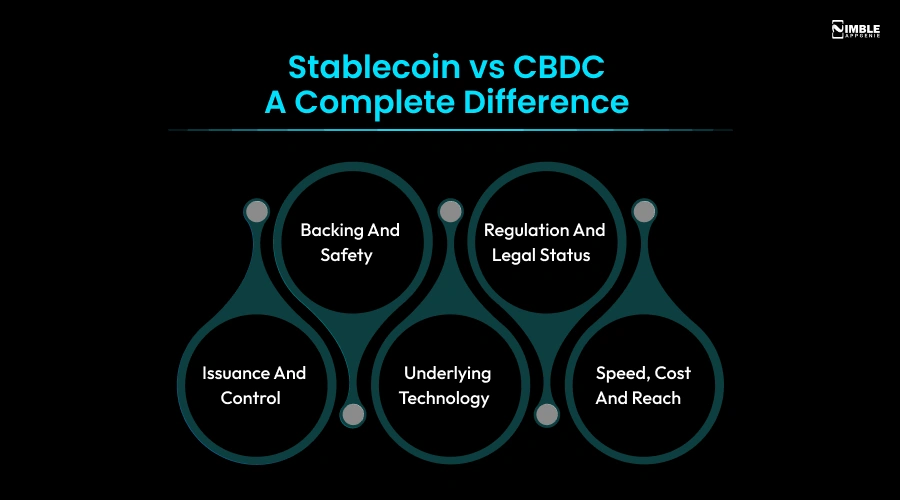
1. Issuance and Control
CBDC: A CBDC is issued by the country’s central bank, which controls how much of it exists and how it reaches the public. It is a digital form of a country’s sovereign currency and a direct claim on the central bank itself.
Stablecoin: A Stablecoin is a digital currency that is issued by private entities and represents a claim on the reserves held by that entity. These stablecoins are the product of market competition that is built on public blockchains such as Ethereum or Solana.
You can build a cryptocurrency platform as a stablecoin by focusing on compliance and legal requirements, architecture, and tech stack.
2. Backing and Safety
CBDC: A CBDC offers unmatched backing and safety because it represents a direct liability of the nation’s central bank rather than a private financial institution. The primary goal of a CBDC is not to compete on a global scale but to modernize a single nation’s payment system.
Stablecoin: Stablecoins offer backing and safety and are backed by reserve assets their issuer holds against the tokens in circulation, typically cash, bank deposits, along with short-dated government securities.
Also Read: Fintech App Security
3. Underlying Technology
CBDC: A CBDC relies on distributed ledger technology blockchain or secure centralized databases to offer a real-time, programmable, and government-backed digital payment infrastructure.
Stablecoin: The Stablecoin relies on a multi-layered infrastructure of blockchain networks, as well as off-chain reserves for maintaining a fixed value and enabling instant digital payments.
4. Regulation and Legal Status
CBDC: A CBDC gains its legal status and regulatory framework through an explicit legislative organization. Additionally, it needs enabling law before a central bank can issue it, and most jurisdictions don’t have that law yet.
Stablecoin: The stablecoin gains formal and legal status through federal and state laws, which officially classify the compliant tokens as payment instruments rather than securities. It follows all the fintech compliance and digital payments regulations.
5. Speed, Cost and Reach
CBDC: CBDC improves speed, reduces cost, and expands reach by removing middlemen from the payment process. It offers instant settlement, with no waiting periods, and cross-border efficiency. This further includes fewer intermediaries and no physical handling.
Stablecoin: Stablecoin offers superior speed, lower cost, and wider reach by replacing legacy banking intermediaries with direct, 24/7 blockchain settlement. A stablecoin moves across borders without any waiting or banking hours, with the real expense sitting where it is bought and cashed out.
Now, let’s discover what enterprises and startups should build next among stablecoins and CBDCs.

What Enterprises and Startups Should Build Next: Stablecoin vs CBDC?
When you think about the difference between Stablecoin vs CBDC, you might be clear that a CBDC is not something that can be created by private companies or businesses. Hence, you can create a stablecoin.
Here is why enterprises and startups should create a stablecoin:
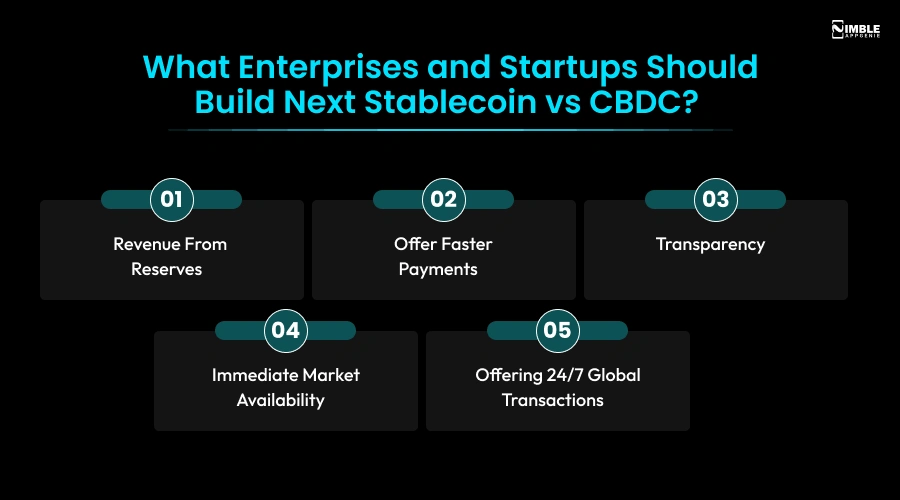
1. Revenue from Reserves
Issuing a proprietary stablecoin lets companies earn yield or revenue directly from the underlying fiat reserves backing the digital tokens.
It gives businesses instant access to payments by lowering transaction costs and optimizing reserve as well as liquidity management.
2. Offer Faster Payments
Enterprises and startups should offer faster payments to instantly improve cash flow, reduce any operational friction, and meet modern customer expectations.
These enterprises should offer faster payments because speed is not just a feature; having faster payments can directly improve the overall efficiency of the business.
3. Transparency
Building stablecoins offers transparency primarily for building user trust, satisfying strict regulatory frameworks, and even eliminating the systemic opacity of traditional finance.
They primarily build them to establish trust, secure regulatory compliance, and mitigate the risk of devastating bank runs. Additionally, Stablecoins bridge the gap between traditional fiat currencies and digital ecosystems.
4. Immediate Market Availability
Enterprises and startups should establish immediate market availability in sectors experiencing an unprecedented gap between exponential growth and structural readiness.
The market is aggressively shifting from theoretical AI tools towards autonomous operations for capturing risk-free yield on cash reserves.
5. Offering 24/7 Global Transactions
Enterprises and startups should create or adopt stablecoin strategies to take control of their financial operations.
Creating a custom stablecoin lets enterprises and startups offer 24/7 global transactions that settle instantly without traditional banking hours and high international wire fees.
If you are ready to create a stablecoin, connecting with the right company can be helpful.
Which is the Best Company to Create a Stablecoin or CBDC?
Nimble AppGenie is the best fintech app development company, offering solutions to build a complete platform, whether for a stablecoin or a CBDC.
The engineers of Nimble AppGenie are prominent fintech and digital wallet software developers, through other specialized blockchain firms handling complex multi-chain token issuance.
1. Offers Fintech Specialization
Nimble AppGenie offers fintech specialization through combining compliance-first development and pre-built financial ecosystem integration. The engineers in the company embed security, regulatory compliance, and modular architecture into the development process from day one.
2. Provides Regulatory Compliance
The engineers at Nimble AppGenie provide regulatory compliance by embedding security, data privacy, and risk-management frameworks directly into the core architecture of an application from day one. Nimble AppGenie is the best crypto wallet development company offering deep blockchain expertise and advanced security standards.
3. Avails Security
Nimble AppGenie builds security directly into the cycle rather than treating security as an afterthought. The key security practices that our team uses are a shift-left approach, along with end-to-end encryption and secure API design.

Conclusion
The key difference between stablecoin vs CBDC is that the issuance of a stablecoin is issued by a private company, while a CBDC is issued by a central bank. A stablecoin is backed by private reserves, while a CBDC acts as official legal tender and a direct liability of the government.
It is hard for enterprises and startups to create a Stablecoin because of the regulatory hurdles, it requires high costs, and compliances as well as reserve maintenance is importance. Connecting with the right company can help you build a Stablecoin.
FAQs
A stablecoin is a type of cryptocurrency that is designed to provide stability for transactions. It is a type of cryptocurrency that is not volatile and does not experience dramatic price fluctuations in a short period of time. It can be seen as a traditional fiat currency like the US dollar.
CBDC is a digital form of a country’s national money that is issued and backed directly by the central bank. Certain features of a CBDC includes digital form of a country’s official money.
The major difference that you will note between a stablecoin and a CBDC is CBDC is a country’s national money, while a stablecoin is a type of cryptocurrency that is volatile and is built by private companies.
Enterprises and startups should build a stablecoin that will offer volatility and can be designed to enable stability for transactions. Here are the major differences that can be observed: a CBDC gains its legal status and regulatory framework via an explicit legislative organization. While stablecoins gain formal and legal status via federal and state laws.
Building a stablecoin is hard for startups and enterprises because it requires high costs, along with compliance requirements, and an adequate amount for reserve maintenance is important.

Niketan Sharma, CTO, Nimble AppGenie, is a tech enthusiast with more than a decade of experience in delivering high-value solutions that allow a brand to penetrate the market easily. With a strong hold on mobile app development, he is actively working to help businesses identify the potential of digital transformation by sharing insightful statistics, guides & blogs.
Table of Contents




No Comments
Comments are closed.