

 Free Consultation
 PCI-DSS Compliant
 GDPR Ready
 ISO 27001
 NDA Protected
 AI Services
 AI App Development
 Generative AI Development
 AI Chatbot Development
 AI Integration Services
 AI Consulting Services
 AI For Fintech
 AI Financial Assistant Solution
 AI Insurance Agent Development
 Tech Stack
 OpenAI / GPT-4
 Claude / Anthropic
 Gemini / Google AI
 Llama / Open Source
 LangChain / LlamaIndex
 Pinecone / Pgvector
 AWS / Azure AI


 Fintech Solution
 Core Fintech
 App Development
 Neobank Solutions
 eWallet Solutions
 Lending Software
 Banking Solutions
 BNPL Solutions
 BNPL Solutions
 Insurance App
 Wealth Management
 Crypto & DeFi
 Blockchain Development
  Payroll Software
 DeFi Solutions
 Crypto Wallet
 Crypto On/Off Ramp
 Crypto Exchange
 Trading Platform
 Payments
 Compliance
 Regulations & Compliance
 Fraud Detection
 Lending Ecosystem
 P2P Lending Platform
 Mortgage Software
 Engagement
 Fintech Outsourcing

 Mobile Development
 Mobile App Dev
 iOS App Development
 Android App Development
 React Native
 Flutter Development
 Web Solution
 Node.js Development
 React.js Development
 Angular Development
 App Services
 UI/UX Design
 App Maintenance
 By Stage
 MVP Development
 Industry Solutions
 Healthcare App Dev
 Education App Dev
 Travel App Dev
 Real Estate App Dev
 Logistics Software
 Social Media App

 Hire Mobile Developers
 Hire iPhone Developers
 Hire Android Developers
 Hire React Native Devs
 Hire Flutter Developers
 Hire Web Developers
 Hire Node.js Developers
 Hire Angular Developers
 Hire PHP Developers
 Hire Laravel Developers
 How It Works
 Pre-Vetted Developers
 Ready In 48 Hours
 NDA From Day One
 Replace Guarantee
 Company
 About Us
 Our Work Process
 Portfolio
 Case Studies
 Blog / Insights
 Careers
 Contact Us
 Awards
 Recognition


 Offices



TL;DR
- A credit scoring model is not the same thing as a credit score, an underwriting platform, or a full loan origination system; it’s the risk-assessment layer that feeds decisions into all of them.
- Traditional data (bureau history, utilization, payment history) is well-validated and easy to integrate, but it excludes an estimated tens of millions of US adults who are credit invisible or thin-file.
- Alternative data (bank transaction data, cash flow, income verification) can extend coverage to thin-file borrowers, but it raises real data-quality, bias, and compliance questions that traditional scoring has already worked through.
- Most fintech lenders in 2026 are moving toward hybrid scoring; traditional data as the backbone, alternative data as a supplement for specific segments, not a wholesale replacement.
- Compliance isn’t a bolt-on: FCRA, ECOA/Regulation B, and CFPB adverse-action guidance shape what data you can use and how you have to explain a decline, from day one of model design.
- Nimble AppGenie builds the data integration, scoring, and decisioning infrastructure that sits between your raw data sources and your lending product, plugging into the credit bureaus, open banking providers, and loan platforms you already use.
Every fintech lender is trying to solve the same three-way challenge: make credit decisions faster, more accurate, and defensible when a regulator or declined applicant asks why.
That is harder than it sounds. Digital lending volumes leave little room for manual review at scale. Meanwhile, gig workers, new-to-credit consumers, and small-business owners with irregular income may not have credit profiles that traditional scoring models fully capture. Automated decisions also need to be explainable, auditable, and supported by reasons lenders can substantiate, particularly when adverse-action and fair-lending requirements apply.
That is pushing fintech companies to rethink how credit scoring works. The question is no longer simply “Which bureau data should we pull?” It is “What data should go into the model, how should those signals work together, and how can we make the resulting decision accurate, explainable, and compliant?”
In this guide, fintech experts at Nimble AppGenie compare traditional and alternative credit data, examine how hybrid scoring models work, explore the technology and integrations behind modern credit scoring, and outline what fintech businesses should consider when building a credit scoring model into their apps.
What Is a Credit Scoring Model in a Fintech App?
A credit scoring model is the statistical or machine-learning logic that turns raw data into a score or a probability of default.
You should know the terms below, which vendors use interchangeably in marketing.
- A credit score is a single number (or grade) – an output.
- A credit decisioning engine takes the score and applies business rules – pricing tiers, approval thresholds, credit limits – to make an actual decision.
- A full underwriting or loan origination system is a broader platform: application intake, decisioning, identity verification, funding, documentation, and servicing, with the scoring model as one component.
You can buy a scoring model and build your own decisioning rules around it. Or you can build a proprietary scoring model and plug it into a third-party origination platform. Mixing both is how projects get under- or over-scoped before you even start coding.
Why Credit Scoring Matters for Fintech Businesses
Credit scoring directly affects a fintech lender’s ability to approve customers quickly, manage risk, price credit appropriately, and scale without depending overly on manual underwriting. It also helps lenders evaluate borrowers not well represented by traditional credit data while creating a more consistent, defensible decisioning process.
The case for investing in credit scoring is not abstract – it shows up on a lender’s P&L.
- Manual underwriting doesn’t scale. Human reviewers can assess only a limited number of applications, while automated scoring systems can evaluate thousands in near real time. For digital lenders, this can diminish processing bottlenecks, lower operational overhead, and shorten decision times.
- Traditional scoring doesn’t capture every borrower. The CFPB’s earlier research predicted that 26 million US adults were credit invisible and another 19 million had credit files too thin to score using traditional models, based on 2010 data. The CFPB later revised its estimates following a methodological correction, underscoring why the underlying figures need meticulous interpretation.
- For fintech lenders, the point stays: borrowers with limited or unconventional credit histories can be hard to access using traditional data alone. Alternative sources like income data, bank transactions, and cash flow can offer additional context, precisely obtained and used.
- Scoring quality also impacts revenue. Moving beyond a simple approve/decline decision can enable more granular risk segmentation, supporting differentiated pricing, credit limits, and repayment terms.
- Risk and compliance matter alongside accuracy. Model explainability, documentation, fraud signals, and monitoring increasingly form part of the exact credit decisioning infrastructure. A scoring system therefore should be more than predictive; it needs to be explainable, reliable, auditable, and best-fit for the lender’s regulatory obligations.
That makes credit scoring a strategic product decision, not only a data-science exercise; fintech should determine which data to use, how to combine it, and how to turn those signals into consistent credit decisions.
Traditional Credit Scoring Models, Explained
Traditional scoring draws on the data nationwide credit bureaus already collect: credit utilization, payment history, account mix, length of credit history, and recent inquiries – the input behind FICO- and VantageScore-style models.
Where it’s strong:
- Familiar to every lender, underwriter, and secondary-market buyer
- Decades of validation across huge borrower populations
- Well-understood compliance posture under FCRA
- Comparatively simple to integrate – mature bureau APIs, established data formats
Where it falls short:
- It says little about a borrower with no credit history, or a recently graduated, immigrated, or historically cash-based consumer.
- Doesn’t capture income volatility, which matters for many small business owners and gig workers.
- Backward-looking – reflects a borrower’s history, not their current cash position.
Traditional data is not obsolete – it’s the backbone most hybrid models still build on. But when used alone, it structurally excludes a segment of applicants that alternative data was built to reach.
What Is Alternative Data in Credit Scoring?
The Federal Reserve and CFPB define alternative data simply: information not usually found in a consumer’s bureau file, or not customarily collected as part of a credit application. In practice, that includes:
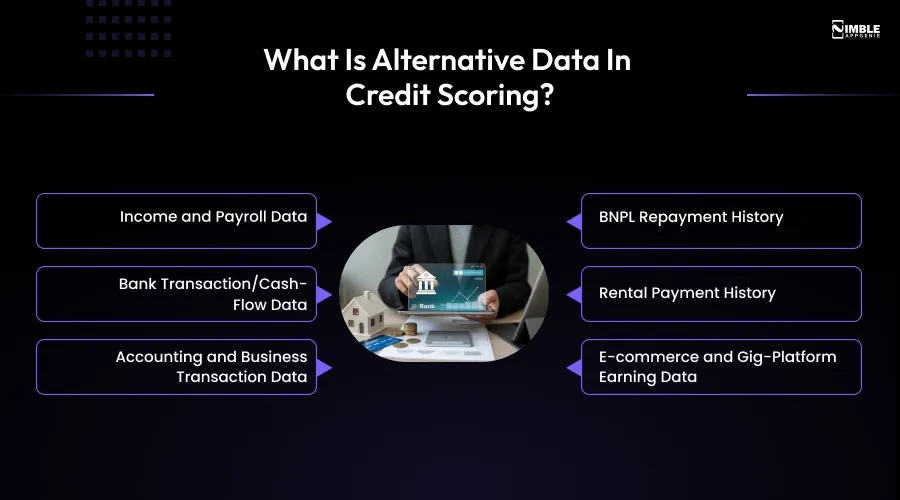
- Income and Payroll Data: Direct verification from payroll providers.
- Bank Transaction/Cash-Flow Data: Via open banking connections, showing spending patterns, income deposits, and account balances over time.
- Accounting and Business Transaction Data: For SME lending, pulled from accounting software or payment processors.
- BNPL Repayment History: An emerging signal as buy-now-pay-later usage has grown.
- Rental Payment History: Where legally reportable and consented to.
- E-commerce and Gig-Platform Earning Data: Relevant to gig-economy borrowers with no W-2 history.
The appeal is direct: cash flow data reflects a borrower’s current financial position, not only their history, and it’s available for people traditional bureaus can’t score.
Traditional vs. Alternative Credit Data: A Side-by-Side View
| Factor | Traditional Data | Alternative Data |
| Depth for established borrowers | Strong | Varies |
| Coverage of thin-file/credit-invisible borrowers | Limited | Potentially strong |
| Reflects current cash flow | Limited (historical) | Stronger |
| Historical validation/industry track record | Extensive | Growing, source-dependent |
| Integration maturity | Established, standardized | Varies significantly by provider |
| Explainability | Well-understood | Requires deliberate model design |
| Regulatory clarity | Established under FCRA | Requires careful fair-lending review |
| Best-fit use case | Established-credit borrower base | Thin-file, gig, and SME segments |
Neither of these is a universal winner. The honest framing: traditional data tells you what a borrower has done; alternative data tells you what a borrower is doing right now. The right model generally needs both signals, weighted differently depending on who you are underwriting.
Why Hybrid Credit Scoring Models Are Gaining Ground
The most common architecture among fintech lenders today is not “alternative data replaces bureau data” – it’s bureau data as the base, alternative data as a supplement for segments where bureau data is not enough or where cash-flow context materially changes the risk image.
The possible upside is real: broader borrower coverage, more granular risk segmentation, better visibility into current financial health, and faster decisions for applicants a traditional model would otherwise auto-decline or route to manual review.
But it comes with a caveat worth saying plainly: adding more data sources doesn’t automatically produce a better model. A hybrid approach outperforms a simpler one when the underlying data is high-quality, the additional signals are genuinely predictive (not just correlated), the combined model stays explainable, and someone is actively monitoring it for bias and drift. Complexity without governance is a liability, not an advantage.
How Credit Scoring Works Inside a Fintech App
For a business audience, it is useful to see the complete flow without the engineering detail:
Application submitted → Identity/KYC verification → Data collection (bureau pull + alternative data, with consent) → Data validation and cleaning → Feature generation (turning raw data into model inputs) → Credit scoring model (produces a score or default probability) → Business rules layer (thresholds, pricing, limits) → Risk decision → Explanation generated for the applicant → Audit trail logged → Ongoing portfolio monitoring.
Four checkpoints in that flow carry more business load than the rest:
- Identity and data collection is where trust is built or lost. An unmanageable flow at this stage is a drop-off point that costs you applicants, not only a data-engineering detail.
- The business rules layer is where product and risk negotiate every day. Pricing, limits, and approval thresholds live here, and it is usually the layer your team wants to tune without retraining the underlying model.
- Feature generation and scoring are where your risk appetite is encoded. This is the step where “why do we lend to, and on what terms” stops being a judgment call and becomes a repeatable, defensive rule – arguably the most strategic decision in the whole build.
- The explanation and audit trail step is not overhead. It is the record that protects the business if a decision is ever challenged by a regulator, a declined applicant, or a secondary-market buyer, and it’s a regulatory requirement under ECOA, covered below.
Underinvesting in data validation is the other common failure point: garbage in, garbage out applies twice to alternative data, which is far less standardized than bureau data.
Data Sources Fintechs Typically Integrate
Rather than an API reference, here’s what each integration category is for:
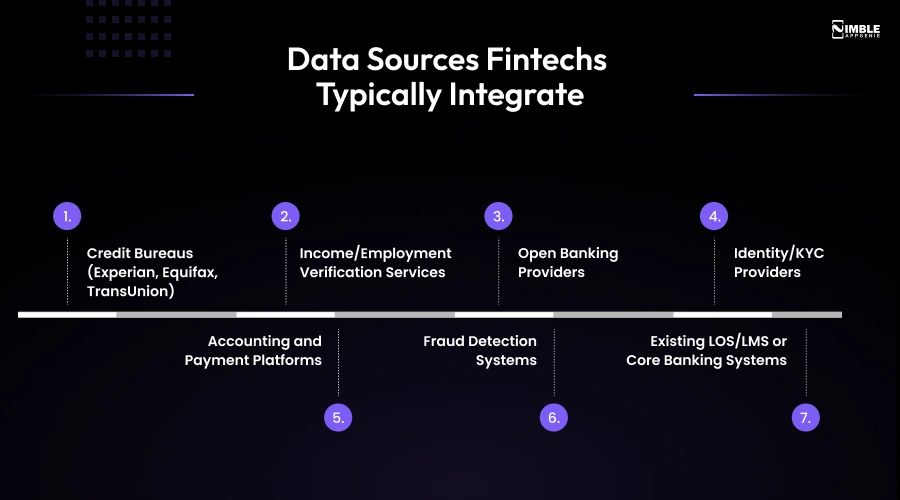
- Credit Bureaus (Experian, Equifax, TransUnion): The traditional-data backbone
- Income/Employment Verification Services: Confirming what an applicant reports about income.
- Open Banking Providers: Real-time bank transaction and cash-flow visibility, with consumer consent.
- Identity/KYC Providers: Confirming the applicant is who they claim to be, before a score means anything.
- Accounting and Payment Platforms: Particularly for SME and business lending.
- Fraud Detection Systems: A related but distinct layer
- Existing LOS/LMS or Core Banking Systems: Where the decision finally has to land and act.
Each of these is a separate vendor relationship, consent-management requirement, and data contract, which usually is the real driver of both cost and timeline, more than the scoring model itself.
AI and Machine Learning in Credit Scoring
Machine learning actually improves what is possible here: pattern recognition across more granular risk segmentation, high-dimensional alternative data, faster model refinement, and cash-flow trend analysis as new data arrives.
It doesn’t remove the underlying requirements. A machine-learning model still needs rigorous validation, clean data, explainability enough to meet ECOA adverse-action requirements, human oversight at key decision points, and active bias monitoring.
“We used AI” is not, on its own, a compliance reply – secondary-market buyers and regulators will ask what is inside the model and why it made a given decision. Build for that answer from the beginning rather than adding explainability after a model is already in production.
Common Credit Scoring Challenges for Fintech Companies
| Challenge | Business Impact | What a Well-Designed System Addresses |
| Poor data quality (especially alt-data) | Inaccurate risk assessment, higher default rates | Validation and cleaning pipeline before data reaches the model |
| Thin/incomplete credit files | Under- or over-declining viable borrowers | Supplementing with vetted alternative sources |
| Model bias | Fair-lending exposure, reputational risk | Ongoing disparate-impact testing across protected classes |
| Explainability | Can’t satisfy adverse-action requirements | Model architecture that supports specific, accurate reason codes |
| Data privacy and consent | Legal exposure, borrower trust erosion | Clear consent flows, especially for open banking data |
| Fraud and synthetic identities | Losses that look like credit risk but aren’t | Identity verification layered before scoring, not after |
| Legacy system integration | Slower rollout, higher cost | API-first architecture from day one |
| Model drift | Degrading accuracy over time | Ongoing monitoring and retraining cadence |
| Regulatory requirements | Compliance risk, enforcement exposure | Compliance built into architecture, not layered on after |
US Compliance Considerations for Credit Scoring
This is not legal advice – talk to counsel for your specific model and jurisdiction; regulatory shape matters for how you architect the system, not just how you operate it afterward.
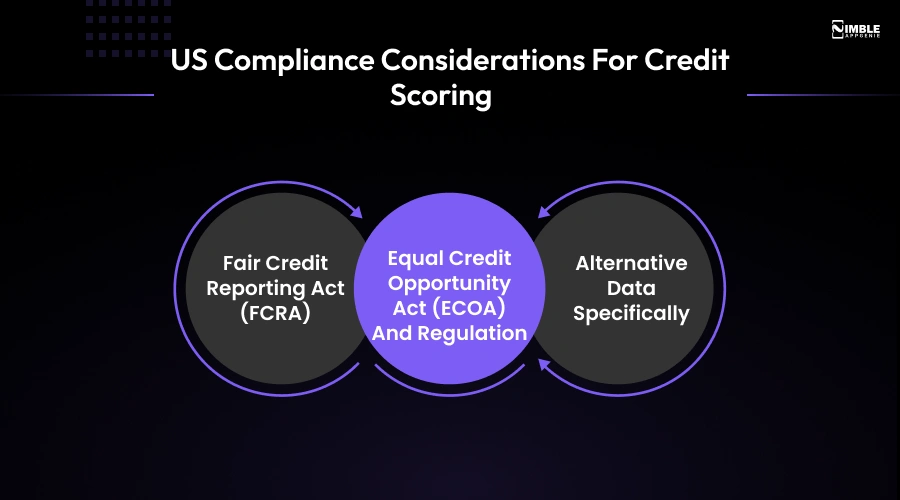
- Fair Credit Reporting Act (FCRA) governs how credit report data can be obtained, disclosed, and used and sets requirements about adverse-action notices when a credit report contributes to a decline.
- Equal Credit Opportunity Act (ECOA) and Regulation B forbid discrimination in credit decisions and require lenders to offer specific, accurate reasons when declining an application – a requirement that becomes materially tougher to satisfy with an opaque model. In CFPB Circular 2023-03, the Bureau made clear that using complex algorithms, including AI, doesn’t excuse a lender from offering specific and accurate adverse-action reasons – the compliance burden doesn’t shrink because the model is more sophisticated.
- Alternative data specifically has its own regulatory throughline: in a joint Interagency Statement on the Use of Alternative Data in Credit Underwriting (Federal Reserve, CFPB, FDIC, OCC, NCUA – December 2019), five federal regulators acknowledged alternative data’s possibility to expand credit access while flagging the need for rigorous data-quality assessment, fair-lending analysis, and model risk management before deployment. That statement is still the clearest signal of what regulators expect from firms using alternative data today.
The throughline: Credit scoring is not entirely a machine-learning problem. It’s a mix of data strategy, product design, risk modeling, and compliance architecture – and treating any one of these as an afterthought appears as rework, or worse, as regulatory exposure.
How to Choose the Right Credit Scoring Approach
You can choose the right credit scoring approach per the scenario you are facing, as explained below.

Traditional data may be sufficient when:
- Your borrower base is primarily established-credit consumers or businesses.
- You are extending an existing, conventional lending product.
- Bureau data already captures the risk signal that matters for your product.
Alternative data earns its complexity when:
- A meaningful share of your target borrowers are thin-file, gig/self-employed, or credit-invisible.
- You can obtain the data with proper consent and a defensible data-quality standard.
- Cash-flow visibility materially changes your risk view (e.g., BNPL, short-term consumer lending, SME lending).
Hybrid scoring is usually the right default when:
- Traditional data alone leaves various viable borrowers unserved or mis-priced.
- Broader borrower coverage is a genuine business priority, not only a marketing claim.
- You have the governance capacity to manage multiple data sources responsibly.
No approach here is universally superior – the right one relies on who you are actually lending to.
Build vs. Buy a Credit Scoring System
Buy or integrate a third-party scoring/data provider when: speed to market is the priority, a standard scoring approach actually fits your risk appetite, and internal data science/engineering capacity is limited.
Build a proprietary system when: credit decisioning is a strategic differentiator for your business, you need custom data sources or proprietary risk logic, or you want complete control over model architecture for compliance or competitive reasons.
A hybrid path is most common in practice: license bureau and alternative-data access from established providers, but build a custom decisioning and scoring layer on top, so the business logic and data combination stays proprietary even where the raw data doesn’t.
Every path trades off distinctly across speed, control, cost, and long-term maintenance burden. There is not a universally correct answer, but an answer for your specific timeline and risk appetite.
What It Takes to Build a Credit Scoring Model for a Fintech App
Each component below is actually a business decision wearing a technical name – here’s what each one determines for the business, not just what it does:
| Component | What It Actually Determines for the Business |
| Data ingestion & normalization | How many data vendors you can realistically add later without a rebuild, your future flexibility |
| Credit bureau integration | The baseline coverage almost every lender still needs, and the layer with the most established compliance posture |
| Alternative-data integration | Where your addressable market actually expands; this is the piece that reaches thin-file borrowers |
| The scoring/model layer | Encodes your risk appetite. Whether statistical or ML-based, this is effectively your underwriting philosophy made executable |
| Business rules engine | Where product and risk teams adjust pricing and limits without retraining the model, your day-to-day tuning lever |
| Decisioning engine | Turns a score into money, moving or not moving the component with the most direct revenue impact |
| Fraud controls | Protects the credit book from losses that look like credit risk but are actually theft or identity fraud |
| Explainability infrastructure | Not optional: this is what lets you legally tell a declined applicant why, under ECOA |
| Audit trails | What you hand a regulator, auditor, or secondary-market buyer after the fact: your paper trail |
| Ongoing monitoring | Protects model accuracy and your loss rate as borrower behavior and the economy shift |
| APIs and dashboards | What your risk and product teams actually touch day to day; poor design here slows every future decision |
| LOS/LMS/core banking integration | Where the decision has to land for money to actually move the piece that makes the model operational, not theoretical |
How Much Does It Cost to Build a Credit Scoring System?
Costs vary widely based on scope, so acknowledge these as directional ranges, not quotes – the real cost driver is almost always the number and complexity of data integration, not the model itself.
| Tier | What’s Typically Included | Realistic Range |
| Focused MVP | Single data source (bureau or one alt-data provider), core scoring logic, basic rules engine | Lower five figures to low six figures |
| Mid-Market Build | Multiple data sources, hybrid scoring, decisioning engine, explainability/audit trail | Mid-to-high six figures |
| Enterprise Build | Multi-bureau, multi-source alternative data, custom ML models, full compliance/monitoring suite, LOS/core banking integration | High six figures and up |
The variables that move the number most are:
- How many data providers you are integrating,
- Whether you need custom ML versus a rule-based scorecard,
- How deep your explainability and compliance requirements are, and
- Whether you are building against a legacy core system or a modern API-first stack.
How Nimble AppGenie Can Help Build Credit Scoring Systems
Credit scoring sits at the intersection of two things that don’t usually live in the same team: data engineering (getting bureau, alternative-data sources, and open-banking talking to each other cleanly) and fintech risk and compliance architecture (making sure what you build actually holds up under FCRA, ECOA, and fair-lending scrutiny).
Nimble AppGenie works across both. For a credit scoring build, that usually means:
- Integrating credit bureau and open banking data sources into a single decisioning pipeline.
- Designing scoring models – traditional, hybrid, or alternative – matched to your actual borrower base.
- Building the decisioning and rules layer that turns a score into an actual approval, limit, decline, or price.
- Architecting for explainability and audit trails from day one, not as a later compliance patch
- Connecting the scoring engine to your existing lending platforms, core banking system, or LOS, rather than forcing a rebuild around a new vendor.
If you are also building or upgrading the platform, this scoring engine will live inside; that’s covered by P2P lending platform development or mortgage software development, depending on your lending model. And because credit risk and transaction fraud are related but separate issues, it is worth reading how fraud detection fits alongside – not instead of – a scoring model in our piece on fintech fraud detection systems.
FAQs
A credit scoring model is the statistical or machine-learning logic that converts borrower data traditional, alternative, or both into a score or probability of default. It’s distinct from the credit score itself (the output), the decisioning engine (which applies business rules to that output), and a full underwriting or loan origination platform (the broader system the model sits inside).
Alternative data is any information used to assess creditworthiness that isn’t part of a standard bureau credit file, commonly bank transaction/cash-flow data, income verification, accounting data, and (where legally permitted and consented to) rental payment history.
Traditional scoring relies on bureau-reported history – payment history, utilization, account age. Alternative scoring draws on data outside the bureau file, often reflecting a borrower’s current financial position rather than their history. Most production systems today combine both rather than choosing one exclusively.
Most commonly as a supplement to traditional scoring for borrowers who are thin-file or credit-invisible, using cash-flow or income data to assess repayment ability where a bureau score alone would be unreliable or unavailable.
AI/ML models can identify predictive patterns across large, high-dimensional alternative datasets that simpler statistical models can’t, enabling more granular risk segmentation. It doesn’t remove the need for data quality controls, explainability, bias monitoring, and human oversight; those remain requirements regardless of model complexity.
At minimum: a reliable traditional data source (bureau access) or a vetted alternative-data source, a clean feature-engineering pipeline, and enough historical outcome data (defaults, repayments) to validate the model before it makes live decisions.
It depends primarily on the number of data integrations and the model’s complexity; a focused MVP with one data source runs meaningfully less than a multi-source hybrid system with full compliance and audit infrastructure. See the cost breakdown above for directional ranges.
The layer that takes a credit scoring model’s output and applies business rules, approval thresholds, pricing tiers, and credit limits to produce an actual lending decision. The scoring model informs the decision; the decisioning engine makes it.

Niketan Sharma, CTO, Nimble AppGenie, is a tech enthusiast with more than a decade of experience in delivering high-value solutions that allow a brand to penetrate the market easily. With a strong hold on mobile app development, he is actively working to help businesses identify the potential of digital transformation by sharing insightful statistics, guides & blogs.
Table of Contents




No Comments
Comments are closed.