

 Free Consultation
 PCI-DSS Compliant
 GDPR Ready
 ISO 27001
 NDA Protected
 AI Services
 AI App Development
 Generative AI Development
 AI Chatbot Development
 AI Integration Services
 AI Consulting Services
 AI For Fintech
 AI Financial Assistant Solution
 AI Insurance Agent Development
 Tech Stack
 OpenAI / GPT-4
 Claude / Anthropic
 Gemini / Google AI
 Llama / Open Source
 LangChain / LlamaIndex
 Pinecone / Pgvector
 AWS / Azure AI


 Fintech Solution
 Core Fintech
 App Development
 Neobank Solutions
 eWallet Solutions
 Lending Software
 Banking Solutions
 BNPL Solutions
 BNPL Solutions
 Insurance App
 Wealth Management
 Crypto & DeFi
 Blockchain Development
  Payroll Software
 DeFi Solutions
 Crypto Wallet
 Crypto On/Off Ramp
 Crypto Exchange
 Trading Platform
 Payments
 Compliance
 Regulations & Compliance
 Fraud Detection
 Lending Ecosystem
 P2P Lending Platform
 Mortgage Software
 Engagement
 Fintech Outsourcing

 Mobile Development
 Mobile App Dev
 iOS App Development
 Android App Development
 React Native
 Flutter Development
 Web Solution
 Node.js Development
 React.js Development
 Angular Development
 App Services
 UI/UX Design
 App Maintenance
 By Stage
 MVP Development
 Industry Solutions
 Healthcare App Dev
 Education App Dev
 Travel App Dev
 Real Estate App Dev
 Logistics Software
 Social Media App

 Hire Mobile Developers
 Hire iPhone Developers
 Hire Android Developers
 Hire React Native Devs
 Hire Flutter Developers
 Hire Web Developers
 Hire Node.js Developers
 Hire Angular Developers
 Hire PHP Developers
 Hire Laravel Developers
 How It Works
 Pre-Vetted Developers
 Ready In 48 Hours
 NDA From Day One
 Replace Guarantee
 Company
 About Us
 Our Work Process
 Portfolio
 Case Studies
 Blog / Insights
 Careers
 Contact Us
 Awards
 Recognition


 Offices



Key Takeaways:
- The rule of thumb: own the workflow engine, dashboards, and reconciliation logic in-house; integrate payment processing, identity verification, banking, and title/escrow data from existing regulated providers.
- Digital closing isn’t just e-signature and RON; it’s the coordination of every dollar that moves through a real-estate transaction, from earnest money to final disbursement.
- Real estate wire fraud losses hit $275.1 million in 2025, up nearly 60% year over year, and email-based payment instructions are the main vulnerability.
- Most PropTech platforms shouldn’t build payment processing, identity verification, or banking infrastructure from scratch; they should own the workflow layer and integrate the rest.
- US compliance depends on your business model, state, and whether you ever hold funds; there’s no one-size-fits-all answer.
- Nimble AppGenie‘s fintech development team helps PropTech companies design and build this exact workflow layer securely, compliantly, and without the guesswork.
“Is digital closing safe?” That’s what PropTech founders and product teams ask when they hear home closing will happen online. Honestly, it’s the wrong question to start with. The real one is: does your platform actually orchestrate the money – from earnest money to seller proceeds or just make paperwork look digital?
Digital closing payment workflows for PropTech platforms are the financial engine most teams underbuild, and it’s costing them deals, trust, and revenue.
The short answer: don’t rebuild what’s already regulated. Build the workflow engine and the rules that connect it to your product; hand the licensed pieces off to specialists in payments, identity, and banking.
This practical, business-focused guide by Fintech experts at Nimble AppGenie breaks down how PropTech platforms build the financial workflow behind digital closings – payment, fraud prevention, compliance, and what it costs to build right.
What is a Digital Closing Payment Workflow, Exactly?
A digital closing payment workflow is the system that coordinates every dollar moving through a real-estate transaction – earnest money, lender funding, cash-to-close, and seller proceeds from the moment payment is requested to its disbursement and reconciliation. It’s distinct from a digital closing document workflow, which just covers e-signature and, where applicable, remote online notarization (RON).
People usually use “digital closing” to refer to “we put the documents online.” That’s only half the picture.
The document workflow answers “how do the parties sign?” The payment workflow answers a challenging question: how does the money move, who verifies it, and how do we prove where every dollar went?
That means coordinating:
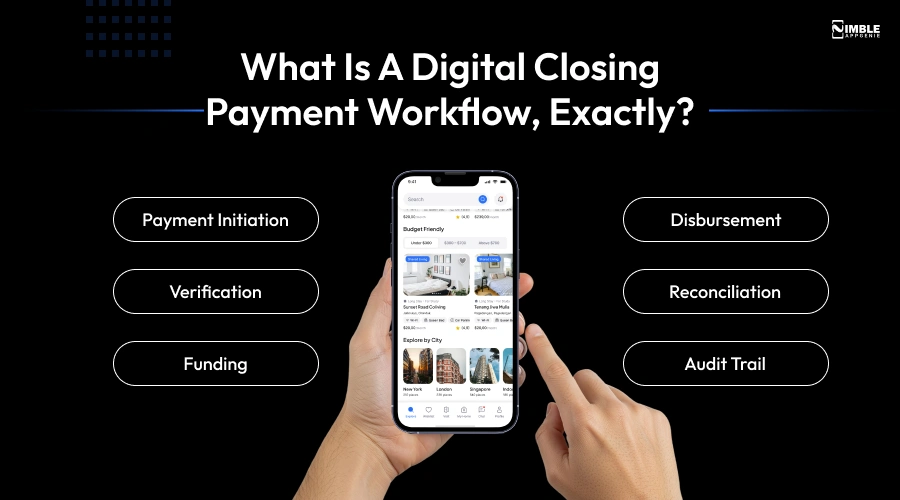
- Payment Initiation: When a party is asked to send funds, and through what channel.
- Verification: Confirming the payer, payee, and bank details are legitimate before anything moves.
- Funding: The lender releasing loan proceeds into the transaction.
- Disbursement: Releasing funds to seller, lienholders, and agents once conditions are met.
- Reconciliation: Matching every payment against the final closing statement.
- Audit Trail: A permanent record of who did what, and when.
A platform can have seamless e-signature and RON and still have zero real payment workflow. Signing a document and moving money are controlled by entirely different logic, risk, and usually different regulatory obligations. This is the layer most PropTech teams underestimate, and it is exactly where a real estate fintech development team provides real value.
Is Digital Closing Safe? Why Wire Fraud is the Real Risk
Yes, of course. The digital closing technology itself is safe, but wire fraud is the real risk, specifically business email compromise (BEC). It targets the transaction’s payment step, not the signing one. This is the question people actually ask AI assistants and search engines before they ever type “PropTech payment integration,” and it’s a fair one as the numbers are getting worse.
According to the FBI’s Internet Crime Complaint Center (IC3), real estate fraud losses increased to $275.1 million across 12,368 complaints in 2025, up from around $173 million in 2024, higher by almost 60% annually. Most of this is business email compromise (BEC): a criminal imitates a title company or lender and sends fake wire instructions at the very moment a buyer is expecting to send cash-to-close.
The pattern is nearly always the same – a fraudster spoofs or intercepts an email thread, sends “updated” wire instructions exactly before closing, and the funds are gone within hours. Behind digital closing itself, email is not the technology; it’s the weak link.
That’s why using secure business email and verified in-app communication channels can help reduce the risk of relying on ordinary email for sensitive payment instructions.
That’s why payment workflows are more significant than document workflows. A platform that routes every payment instruction through a verified, in-app channel, rather than relying on email, removes the single biggest attack surface in the entire transaction. Nimble AppGenie’s AI-powered fraud detection capability was built on the same real-time transaction monitoring and anomaly flagging.
How Does Money Actually Move During a Digital Closing?
Money moves through 13 predictable stages in a digital closing, from transaction initiation through final disbursement and reconciliation, and the payment workflow has to track and gate every one of them:
- Transaction initiated
- Title/escrow information collected
- Parties’ identities verified
- Closing documents prepared
- Signing / RON completed (where applicable)
- Settlement amount finalized
- Funds requested from buyer and/or lender
- Payment and bank details verified
- Funds received and matched
- Closing authorized
- Funds disbursed to seller, agents, lienholders
- Transactions reconciled against the closing statement
- Audit trail retained
The engineering challenge is not any single step but a state machine that enforces the correct order, blocks disbursement until funding conditions are genuinely met, and manages the branch points where things go wrong: funding is delayed, a payment fails verification, a party cancels. That state machine is the real issue here, not the dashboard residing on top of it.
Earnest Money, Cash-to-Close, and Every Other Payment Flow You Need to Handle
Treating every closing-related payment the same way is one of the most common mistakes PropTech teams make. Each flow has different triggers and different risk profiles.
| Payment Flow | What It Involves | Key Risk |
| Earnest money | Collected early, tracked, refunded, or applied later | Early-stage fraud target |
| Cash-to-close | Final buyer payment once fees/credits are locked | #1 wire-fraud target |
| Lender funding | Loan proceeds released into the transaction | Timing/status coordination |
| Seller proceeds | Released only after conditions are met | Premature or unauthorized release |
| Settlement fees | Title, recording, transfer tax charges | Miscalculation, reconciliation errors |
| Disbursement & reconciliation | Every dollar matched to the closing statement | Mismatches, missed audits |
Cash-to-close deserves special attention – it’s the largest, most time-sensitive transfer in the transaction, and it’s the one criminals target hardest. Any workflow you build (or bring in a partner to build) needs independent, out-of-band verification any time bank details change mid-transaction. That single control shuts down the exact mechanism that most real estate wire fraud relies on.

Should You Build or Integrate Payment Infrastructure?
In most cases, people integrate regulated infrastructure, including payment processing, banking, and identity verification, and build the orchestration layer on top, meaning workflow logic, dashboards, and reconciliation rules.
This is generally the most costly decision in the whole project; if you get it wrong, you either waste months rebuilding regulated infrastructure or end up with a shallow product that can’t scale.
| Capability | Build In-House | Integrate With a Partner |
| Closing dashboard & workflow engine | ✓ | |
| Transaction state management | ✓ | |
| Reconciliation logic | ✓ | |
| Payment processing | ✓ | |
| Identity verification (KYC) | ✓ | |
| RON / eNotary | ✓ | |
| Title & escrow data | ✓ | |
| Banking infrastructure | ✓ | |
| Reporting & audit layer | ✓ | ✓ (hybrid) |
The pattern that works is to own the orchestration layer, including the workflow logic, reconciliation rules, and dashboards that showcase your specific product and integrate with regulated infrastructure for identity verification, payment processing, and banking.
Building payment processing or KYC from the ground up means eliminating licensing and compliance burdens that rarely make sense unless that infrastructure is your core product.
Nimble AppGenie’s team constantly handles this decision through its fintech API integration work, connecting PropTech and fintech products to 25+ payment, banking, and identity-verification APIs without forcing clients into needless in-house builds.
Do PropTech Platforms Need a Money Transmitter License? What US Compliance Actually Requires
It depends on custody, not intent: if a platform ever holds funds directly, money-transmitter rules likely apply; if it only orchestrates payments between licensed banks, title companies, and escrow agents, they typically don’t. At this edge, we won’t oversimplify; neither should you, nor any vendor telling you otherwise. The exact determination depends on your state, business model, and legal counsel’s read of your specific payment flow.
A few things worth knowing, none of which apply universally:
- Money transmission status relies on custody, not intent. Whether you are treated as a money transmitter hinges on whether your platform ever holds funds vs. simply orchestrating payments between title/escrow companies and licensed banks. This determination demands a lawyer, not a guess based on what competitors say about their own product.
- RON is now widely legal. As of 2026, 49 states plus Washington, D.C. have enacted permanent remote online notarization laws, with California the notable exception until its permanent authorization takes effect in 2030. Individual states still conflict on approved technology and document types.
- The CFPB constantly revisits electronic-closing rules. It issued a request for information in mid-2026 on the TRID disclosure rule, including questions about guidance on electronic and digital signatures – a reminder that this space keeps moving, not that it’s settled.
- Title, AML/KYC, escrow, and lender requirements vary by partner and by state. There’s no universal checklist.
None of these are legal advice; it’s a map of what to check before you build. Nimble AppGenie’s team covers fintech regulatory frameworks including PCI-DSS, KYC/AML, GDPR, and PSD2 as a baseline for every fintech build. It works with your legal counsel, not in its place.
How Much Does It Cost to Build a Digital Closing Payment Platform?
As a rough range: a narrow MVP covering one or two payment flows, and a single title/escrow integration generally starts in the tens of thousands of dollars, whereas a multi-state platform with its own reconciliation engine and fraud monitoring can run well into six figures. That’s a directional estimate, not a quote – there’s no honest single number without defining scope first, and any article that offers you one without context is guessing.
Cost depends on:
- Number of distinct payment flows (cash-to-close, earnest money, proceeds, funding, fees).
- Whether you are operating in one state or many (compliance surface multiplies fast).
- How many third-party integrations you need (title/escrow, payments, identity, banking).
- Depth of fraud detection and monitoring required.
- Whether you are building a workflow layer on an existing platform or starting from zero.
- Web vs. mobile vs. both.
A barely scoped MVP, a workflow layer connecting an existing transaction platform to a handful of payment flows and one title/escrow integration, is a very different, much more reasonable project than a multi-state platform with its own reconciliation engine and fraud monitoring across dozens of partners. Any credible estimate starts with defining scope first, which is exactly what a discovery call with a fintech development team is for.
How Nimble AppGenie Helps PropTech Platforms Build Digital Closing Payment Workflows
Nimble AppGenie is an ISO 27001-certified, PCI-DSS-compliant fintech software development company with 8+ years of experience and 350+ delivered products across banking, payments, lending, and compliance-heavy financial software. This is the same team and the same standards applied when we build the payment layer underneath a digital closing.
What that looks like in practice:
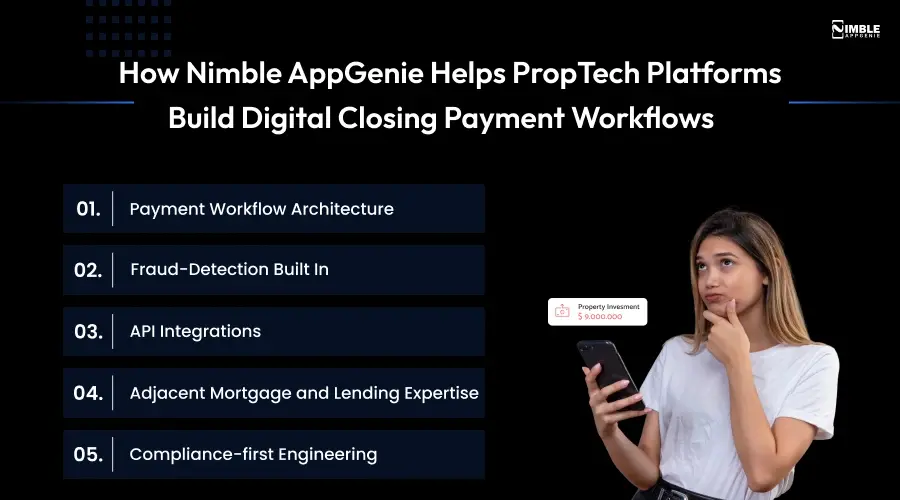
1. Payment Workflow Architecture
Designing the state machine that governs initiation, funding, verification, reconciliation, and disbursement, instead of bolting a payment gateway onto a document tool.
2. Fraud-Detection Built-In
Real-time transaction monitoring and anomaly detection through our AI fraud detection capability, crafted around the exact BEC and wire-fraud patterns covered above.
3. API Integrations
Connecting your platform to payment processors, identity-verification providers, banking rails, and title/escrow systems through our fintech API integration services.
4. Adjacent Mortgage and Lending Expertise
For platforms that also need funding coordination or loan origination, our mortgage software development team covers that ground too.
5. Compliance-First Engineering
Every build is mapped to PCI-DSS, KYC/AML, GDPR, and relevant US regulatory frameworks from day one, not retrofitted later.
We are a software development partner, not a licensed title company, money transmitter, or escrow agent. Our job is to help you architect and build the workflow layer that connects cleanly to the right regulated infrastructure of your specific business model.

Conclusion
Digital closing is a financial-workflow problem before it is a document problem. The platforms winning trust with title companies, buyers, and lenders right now are not the ones with the prettiest e-signature flow – they are the ones that can prove, line by line, where every dollar went, and that make wire fraud materially toughest to pull off.
Getting that right takes more than a payment gateway; it takes a workflow layer designed around real estate-specific risk, real US compliance variables, and a build-vs-integrate strategy that doesn’t burn your runway on infrastructure you don’t need to own.
If your PropTech platform is ready to move past document digitization into real payment orchestration, that’s exactly the kind of build our fintech team works on every week.
FAQs

Niketan Sharma, CTO, Nimble AppGenie, is a tech enthusiast with more than a decade of experience in delivering high-value solutions that allow a brand to penetrate the market easily. With a strong hold on mobile app development, he is actively working to help businesses identify the potential of digital transformation by sharing insightful statistics, guides & blogs.
Table of Contents




No Comments
Comments are closed.