

 Free Consultation
 PCI-DSS Compliant
 GDPR Ready
 ISO 27001
 NDA Protected
 AI Services
 AI App Development
 Generative AI Development
 AI Chatbot Development
 AI Integration Services
 AI Consulting Services
 AI For Fintech
 AI Financial Assistant Solution
 AI Insurance Agent Development
 Tech Stack
 OpenAI / GPT-4
 Claude / Anthropic
 Gemini / Google AI
 Llama / Open Source
 LangChain / LlamaIndex
 Pinecone / Pgvector
 AWS / Azure AI


 Fintech Solution
 Core Fintech
 App Development
 Neobank Solutions
 eWallet Solutions
 Lending Software
 Banking Solutions
 BNPL Solutions
 BNPL Solutions
 Insurance App
 Wealth Management
 Crypto & DeFi
 Blockchain Development
  Payroll Software
 DeFi Solutions
 Crypto Wallet
 Crypto On/Off Ramp
 Crypto Exchange
 Trading Platform
 Payments
 Compliance
 Regulations & Compliance
 Fraud Detection
 Lending Ecosystem
 P2P Lending Platform
 Mortgage Software
 Engagement
 Fintech Outsourcing

 Mobile Development
 Mobile App Dev
 iOS App Development
 Android App Development
 React Native
 Flutter Development
 Web Solution
 Node.js Development
 React.js Development
 Angular Development
 App Services
 UI/UX Design
 App Maintenance
 By Stage
 MVP Development
 Industry Solutions
 Healthcare App Dev
 Education App Dev
 Travel App Dev
 Real Estate App Dev
 Logistics Software
 Social Media App

 Hire Mobile Developers
 Hire iPhone Developers
 Hire Android Developers
 Hire React Native Devs
 Hire Flutter Developers
 Hire Web Developers
 Hire Node.js Developers
 Hire Angular Developers
 Hire PHP Developers
 Hire Laravel Developers
 How It Works
 Pre-Vetted Developers
 Ready In 48 Hours
 NDA From Day One
 Replace Guarantee
 Company
 About Us
 Our Work Process
 Portfolio
 Case Studies
 Blog / Insights
 Careers
 Contact Us
 Awards
 Recognition


 Offices



Key Takeaways:
- A monolith is generally the right starting point for early-stage fintech products – it’s faster to build and easier to keep transactions consistent.
- Microservices pay off once you have multiple teams, need to isolate PCI-DSS or audit scope, or need to scale payment traffic separately from everything else.
- Most fintech teams don’t switch all at once – they extract one high-risk service (usually payment or ledger) first, then decide if more is worth it.
- The safest middle ground is a modular monolith: one deployable app, but with clean internal boundaries around payments, ledger logic, and KYC.
- Nimble AppGenie has helped fintech founders make this exact call for products ranging from digital wallets to lending platforms, and can help you scope which architecture fits your stage, team, and compliance needs.
“Should my fintech startup use microservices or a monolith?” is one of the most common questions fintech founders and CTOs ask before writing backend code.
It’s also one of the most consequential – even a single wrong call here doesn’t just slow down releases; it can widen your PCI-DSS audit scope, complicate transaction consistency, and trap you into a rebuild eighteen months in.
Nimble AppGenie experts have written this guide, breaking down microservices vs monolith for fintech backends using the factors that actually matter for financial products compliance, transaction integrity, team size, and time to market, not only textbook engineering trade-offs.
What Monolith and Microservices Actually Mean For a Fintech Product
Before comparing them, knowing what each term means in practice will help more than learning in theory.
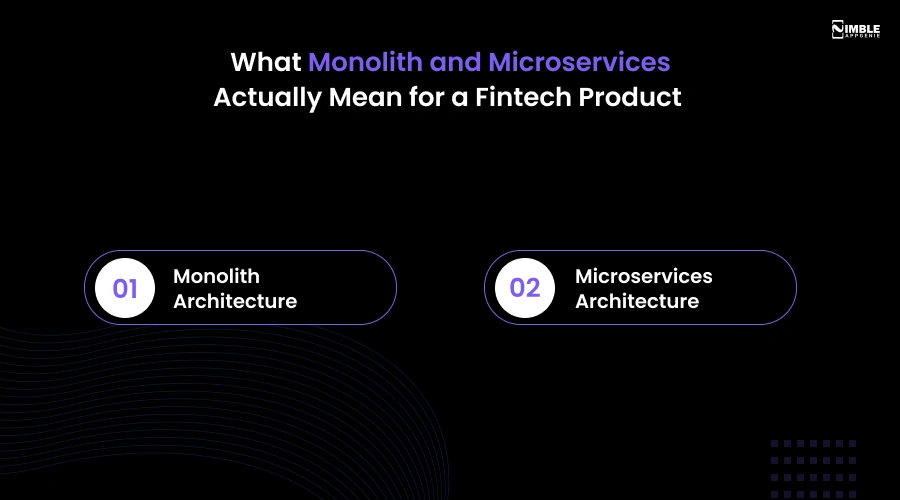
♦ Monolith Architecture
A monolith is a single deployable application. Your user onboarding, payment processing, ledger, KYC checks, and notifications all live in a single codebase, share a database, and are deployed together.
Change one thing, and you rebuild and redeploy the whole app. It sounds restrictive, but for a small team shipping an MVP, that simplicity is a feature, not a limitation.
♦ Microservices Architecture
Microservices break that same product into independent services – a payment service, a ledger service, a KYC service, a notification service – each with its own database, its own codebase, and its own deployment pipeline.
They talk to each other over APIs. This provides you the capability to scale, secure, and update each piece separately, at the cost of more moving parts to build and monitor. For a deeper technical breakdown of how this pattern works beyond fintech, see our microservices architecture guide.
Real question our professionals hear a lot: “Is a monolith bad for a fintech startup?”
No. A monolith is often the correct choice at the MVP stage. The mistake is not choosing a monolith; it’s choosing one without internal module boundaries, which makes it painful to split apart later.
The Fintech-Specific Factors That Should Actually Drive Your Decision
Generic ‘microservices vs monolith’ advice skips the things that make fintech different from a typical SaaS product: regulatory scope, audit trails, and money movement. Here’s what to weigh.
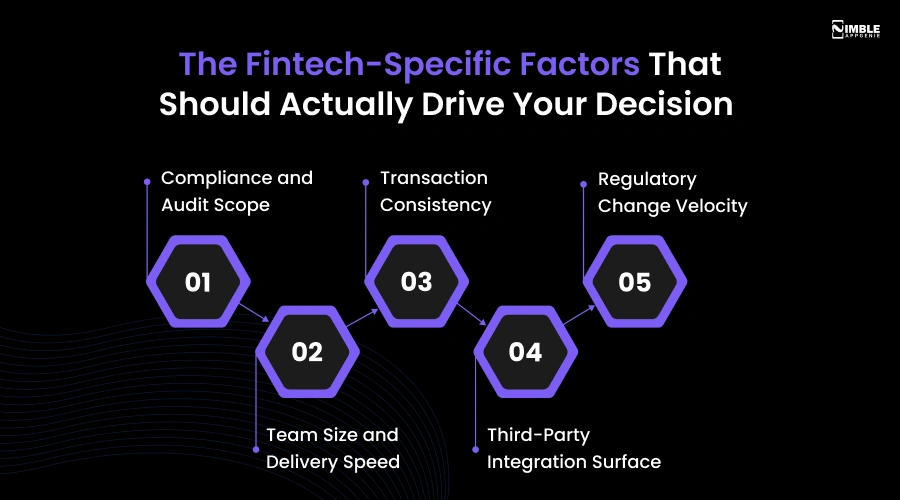
1. Compliance and Audit Scope
If your payment and cardholder data logic resides within a monolith alongside your marketing pages, admin dashboards, and support tooling, your complete application can fall at PCI-DSS audit scope.
Isolating payment processing into its own service, even before you split anything else, shrinks what auditors need to review and diminishes blast radius if something outside payments has a bug.
2. Team Size and Delivery Speed
A team of 3-5 engineers moves faster on a monolith. There’s one thing to build, test, and deploy. Once you have multiple squads working on different domains – onboarding, payments, risk – a monolith becomes a blockage everyone waits on everyone’s release train. This is usually a real trigger for splitting services, more than raw traffic volume.
3. Transaction Consistency
Monoliths make ACID transactions simple: one database, one transaction, done. Microservices split data across services, which means a single “transfer money” action might touch three databases owned by three different services.
You will need patterns like the saga pattern or distributed transactions to keep balances accurate – solvable, but it’s real engineering work you don’t need on day one.
4. Third-Party Integration Surface
Payment gateways, banking rails, KYC providers, and card issuers each have their own APIs, failure modes, and rate limits. Microservices allow you to isolate each integration behind its own service, so a slow KYC provider doesn’t take down your payments flow.
This is one reason fintech backends tend toward service-based designs earlier than typical consumer apps – see our broader take in fintech app architecture.
5. Regulatory Change Velocity
Fintech regulation shifts often – KYC rules, regional licensing requirements, and AML thresholds. If your compliance logic is isolated in its own service, you can patch and redeploy it without touching (or re-testing) the rest of your platform in a monolith; a compliance fix means a full regression pass across everything.
| What the data says: Microservices have become the default architecture for many modern software teams. According to the 2025 InfoQ Technology Adoption Survey, 81% of organizations now use microservices, making them one of the most widely adopted cloud-native architectural patterns. (Source: InfoQ (C4Media)) |
Regulation and compliance complexity is consistently cited as the single biggest operational challenge fintech companies face as they scale – which is exactly why architecture decisions in this space can’t be copied from a generic SaaS playbook. (Source: Emapta, 2026 Fintech Statistics)
Monolith vs Microservices For Fintech: Side-by-Side Comparison
Now, comparing time! Let’s move ahead and see the difference between these two terms.
| Factor | Monolith | Microservices |
| Best for | Pre-seed to early Series A, small teams, MVPs | Scaling teams, multiple product lines, high transaction volume |
| Time to first release | Faster | Slower – more infrastructure to set up first |
| Transaction consistency | Simple (single database, ACID) | Requires distributed transaction patterns |
| PCI-DSS / audit scope | Whole app is typically in scope | Scope can be narrowed to the payment service |
| Scaling | Scale the entire app together | Scale only the services under load, e.g. payments |
| Team coordination | Simple for one team, painful for several | Teams can own and release services independently |
| Operational overhead | Low | Higher – monitoring, service discovery, network reliability |
| Cost at MVP stage | Lower | Higher, often unnecessarily so |

Is a Monolith Good For a Fintech Startup? (Yes, Usually – Here’s When)
This is one of the most common real-world questions founders search for, and the right answer is: yes, for most early-stage fintech products, a monolith is the right call.
You are still validating the business model, your transaction volume is manageable, and you don’t yet have separate teams that need to move independently.
A well-structured monolith – one with clean internal boundaries between payments, KYC, and ledger logic, even though it’s one deployable – gives you speed now and an easier path to split later.
The mistake is not picking a monolith. It’s picking a tangled one, where every module reaches into every other module’s data. That’s what makes migrations costly later.
If you are building from scratch, ask your engineering team (or your development partner) to enforce module boundaries from day one, even if everything ships as a single app.
Explore: Nimble AppGenie’s fintech development services.
When Should a Fintech Company Move From Monolith to Microservices?
There’s no fixed user count or revenue milestone that triggers this. Instead, watch for these signals:
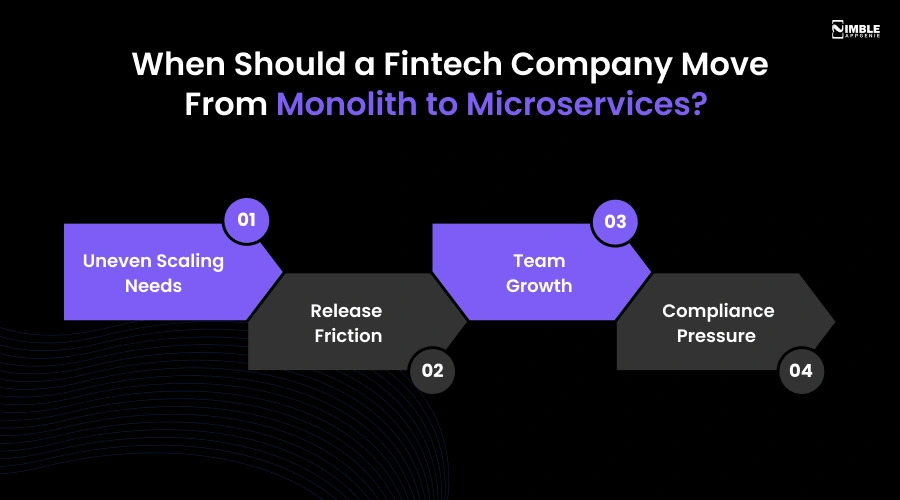
► Uneven Scaling Needs
Your payments endpoint should handle 50x the traffic of your admin dashboard, but you are scaling the whole app to compensate.
► Release Friction
Every deployment requires coordinating multiple teams and carries risk of nonessential features.
► Team Growth
You have gone from one team to three to four, each responsible for a different domain, and they keep blocking each other.
► Compliance Pressure
An auditor or regulator is asking questions that would be easier to answer if payment logic were isolated.
When you see two or more of these at once, it is usually time to extract your highest-risk, highest-value service first – almost always payments or the ledger – rather than attempting a full rewrite.
Our guide on building scalable backend systems covers the broader scaling playbook if you want technical details beyond architecture choice.
The Migration Path: Monolith to Microservices Without Breaking Production
Most successful fintech migrations don’t happen overnight, and they shouldn’t. The pattern that works consistently:
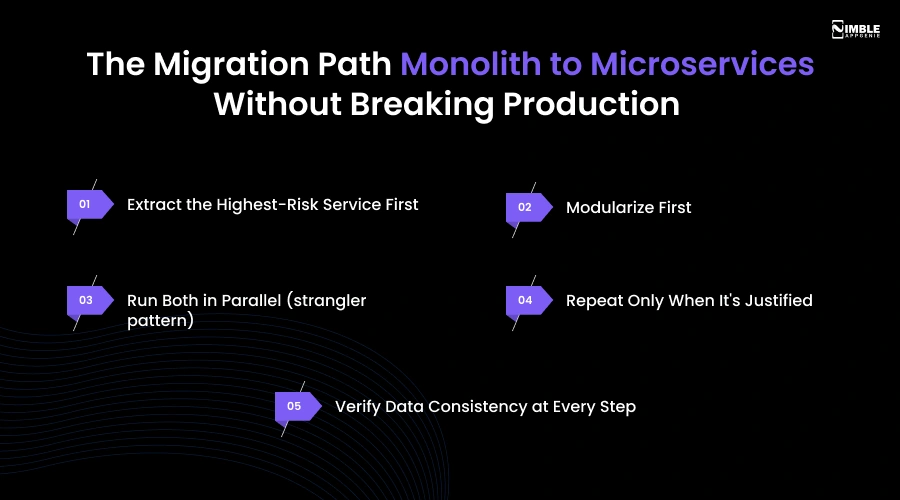
1. Extract the Highest-Risk Service First
Usually payments or the ledger, since that’s where compliance and consistency concerns are sharpest.
2. Modularize First
Before extracting anything, clean up internal boundaries inside the monolith so payments, ledger code, and KYC are not tangled with everything else.
3. Run Both in Parallel (Strangler Pattern)
Route a subset of traffic to the new service while the monolith still handles the rest, and compare results before completely cutting over.
4. Repeat Only When It’s Justified
Not every module needs to become its own service. Extract based on actual bottlenecks, not architectural fashion.
5. Verify Data Consistency at Every Step
Reconcile balances and transaction logs between the old and new paths before decommissioning anything.
| Things to Avoid: Migrating everything at once. A simultaneous, big-bang migration multiplies the risk of data loss and transaction errors in a live financial system. Sequence it, and verify consistency before moving to the next service. |
Common Mistakes Fintech Teams Make With This Decision
Some of the frequent errors fintech teams make with the decision of choosing between these architectures are:
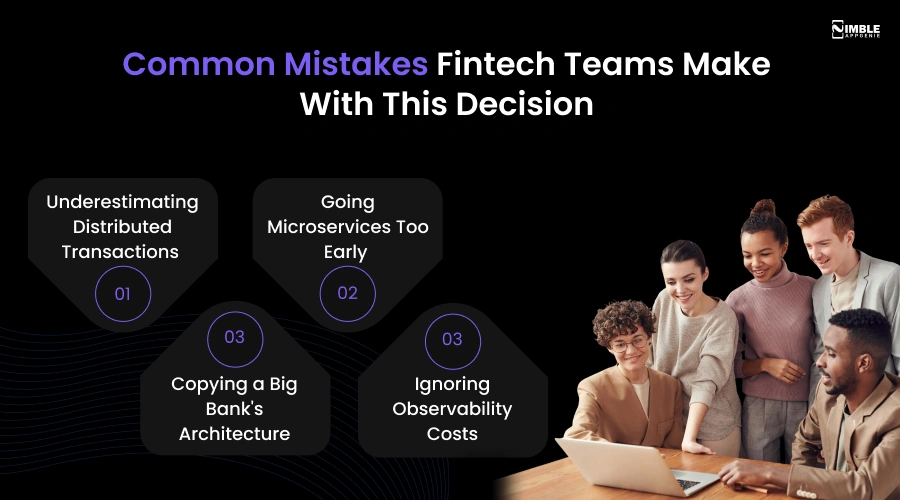
1. Underestimating Distributed Transactions
Moving money across services without a clear consistency strategy is how balance mismatches happen.
2. Going Microservices Too Early
Adding a fully distributed system before you have the team and traffic to justify it slows you down instead of speeding you up.
3. Copying a Big Bank’s Architecture
A 10-person startup doesn’t need the same service topology as a 500-engineer bank. So, build for your current stage, with a clear path to grow.
4. Ignoring Observability Costs
Microservices need proper logging, tracking, and monitoring from day one – bolting it on later, after an incident, is expensive and stressful.
For fintech teams operating in emerging or multi-region markets, architecture choices also intersect with local licensing and compliance timelines.
If that applies to you, our core banking modernization and legacy banking systems guides go more in-depth on staged modernization for regulated environments.
Why Fintech Founders Work With Nimble AppGenie
We build backend systems for fintech products where getting the architecture wrong is not just a technical inconvenience; it’s a compliance and trust risk.
Our team has designed and delivered banking and digital wallet platforms, supported backend development for lending and payments products, and guided founders through the exact monolith-vs-microservices decision this architecture covers – matching architecture to team size, funding stage, and regulatory footprint rather than defaulting to whatever’s trending.
If you are scoping a new fintech backend or evaluating whether it’s time to split your monolith, we will give you a straight answer based on your product, not a one-size-fits-all recommendation.

Conclusion
There’s no universally”correct” answer to microservices vs monolith for fintech backends – only the right answer for your current stage. Start with a modular monolith if you are pre-scale, prioritize speed, and have a small team.
Move toward microservices when release friction, uneven traffic patterns, and compliance scope start costing you more than the added complexity would.
Whatever you choose, decide on your product’s actual constraints – team size, compliance exposure, transaction volume – not on what the biggest players in fintech are running.
FAQs

Niketan Sharma, CTO, Nimble AppGenie, is a tech enthusiast with more than a decade of experience in delivering high-value solutions that allow a brand to penetrate the market easily. With a strong hold on mobile app development, he is actively working to help businesses identify the potential of digital transformation by sharing insightful statistics, guides & blogs.
Table of Contents




No Comments
Comments are closed.