

 Free Consultation
 PCI-DSS Compliant
 GDPR Ready
 ISO 27001
 NDA Protected
 AI Services
 AI App Development
 Generative AI Development
 AI Chatbot Development
 AI Integration Services
 AI Consulting Services
 AI For Fintech
 AI Financial Assistant Solution
 AI Insurance Agent Development
 Tech Stack
 OpenAI / GPT-4
 Claude / Anthropic
 Gemini / Google AI
 Llama / Open Source
 LangChain / LlamaIndex
 Pinecone / Pgvector
 AWS / Azure AI


 Fintech Solution
 Core Fintech
 App Development
 Neobank Solutions
 eWallet Solutions
 Lending Software
 Banking Solutions
 BNPL Solutions
 BNPL Solutions
 Insurance App
 Wealth Management
 Crypto & DeFi
 Blockchain Development
  Payroll Software
 DeFi Solutions
 Crypto Wallet
 Crypto On/Off Ramp
 Crypto Exchange
 Trading Platform
 Payments
 Compliance
 Regulations & Compliance
 Fraud Detection
 Lending Ecosystem
 P2P Lending Platform
 Mortgage Software
 Engagement
 Fintech Outsourcing

 Mobile Development
 Mobile App Dev
 iOS App Development
 Android App Development
 React Native
 Flutter Development
 Web Solution
 Node.js Development
 React.js Development
 Angular Development
 App Services
 UI/UX Design
 App Maintenance
 By Stage
 MVP Development
 Industry Solutions
 Healthcare App Dev
 Education App Dev
 Travel App Dev
 Real Estate App Dev
 Logistics Software
 Social Media App

 Hire Mobile Developers
 Hire iPhone Developers
 Hire Android Developers
 Hire React Native Devs
 Hire Flutter Developers
 Hire Web Developers
 Hire Node.js Developers
 Hire Angular Developers
 Hire PHP Developers
 Hire Laravel Developers
 How It Works
 Pre-Vetted Developers
 Ready In 48 Hours
 NDA From Day One
 Replace Guarantee
 Company
 About Us
 Our Work Process
 Portfolio
 Case Studies
 Blog / Insights
 Careers
 Contact Us
 Awards
 Recognition


 Offices



Key Takeaways:
- A scalable backend system handles more users, data, and transactions without slowing down or breaking.
- The core building blocks are modular architecture, scalable databases, caching, load balancing, async processing, and monitoring.
- Vertical scaling adds power to one server; horizontal scaling adds more servers. Most growing apps eventually need both.
- Fintech backends carry extra weight: compliance, fraud checks, and near-zero tolerance for downtime.
- High-impact outages now cost a median of $2 million per hour, so scalability is a revenue decision, not just an engineering one.
- Nimble AppGenie has architected scalable backend systems for neobanks, lending platforms, and payment apps. This guide distills that field experience into a framework you can apply today.
“How do I make my app’s backend scalable?” It’s one of the most common questions fintech founders and engineering leads type into Google, ChatGPT, and Claude every week. If your app is gaining users, heading into the fintech market, and shipping new features, that question turns urgent fast.
Building scalable backend systems for apps means designing your databases, servers, and APIs so they keep working as demand grows – without breaking, being expensive to fix later, or slowing to a crawl.
In this guide, experts from Nimble AppGenie walk you through exactly how to build a scalable backend, learning lessons from fintech products where downtime simply is not an option.
What is a Scalable Backend System?
A scalable backend system is the part of your app that keeps working fast and stable, no matter how many people use it at once. It’s the databases, servers, business logic, and APIs sitting behind the screen. When your backend is scalable, it can handle more data, more users, and more requests without you having to rewrite the entire thing every few months.
Backend scalability is not one feature you switch on. It’s a sequence of choices: how you structure your code, which database you pick, how you handle traffic spikes, and how you catch issues before users do. Get these right early, and scaling later feels like appending capacity. Get them wrong, and each growth milestone turns into a fire drill.
Signs Your Backend Needs to Scale (Before It Breaks)
Most teams don’t plan for scale; they react to its absence. Watch for these warning signs:
- One slow database query can drag down the whole app.
- Response times increase as your user count grows, even for simple actions.
- Shipping a small fix means redeploying the entire system.
- Your team hesitates to touch the codebase during peak hours.
- Every new feature takes longer to build than the last one.
- Cloud bills surge, but performance doesn’t improve.
These are not only engineering issues – they cost real money. Splunk’s 2026 Hidden Costs of Downtime report states that Global 2000 companies collectively lose $600 billion annually to unplanned downtime, with the average organization losing more than $900,000 per hour through lost revenue, compliance costs, and operational disruption. If your backend can’t keep pace with demand, growth quickly becomes risky.
| Scalability is not just about handling more users; it’s about building an architecture that can evolve. IBM found that 94% of core banking modernization projects exceed planned timelines, often because legacy dependencies, security challenges, and infrastructure complexity make scaling far more difficult than expected. |
Vertical vs. Horizontal Scaling: Which One Do You Need?
Before you touch architectural diagrams, these scaling approaches help you understand the basic ways to scale your backend.
| Approach | What It Means | Best For |
| Vertical scaling | Add more CPU, RAM, or storage to your existing server | Quick fixes, early-stage apps, simple workloads |
| Horizontal scaling | Add more servers and spread traffic across them | Apps expecting real growth, high availability needs |
Vertical scaling is simple, but it has a limitation and creates a single point of failure – if that one server goes down, so does your app.
Horizontal scaling costs more planning upfront, but it has the standard approach once you are serious about scaling a backend for the long run. Most mature systems use both: vertical scaling to get more out of each server, and horizontal scaling to add capacity as demand grows.
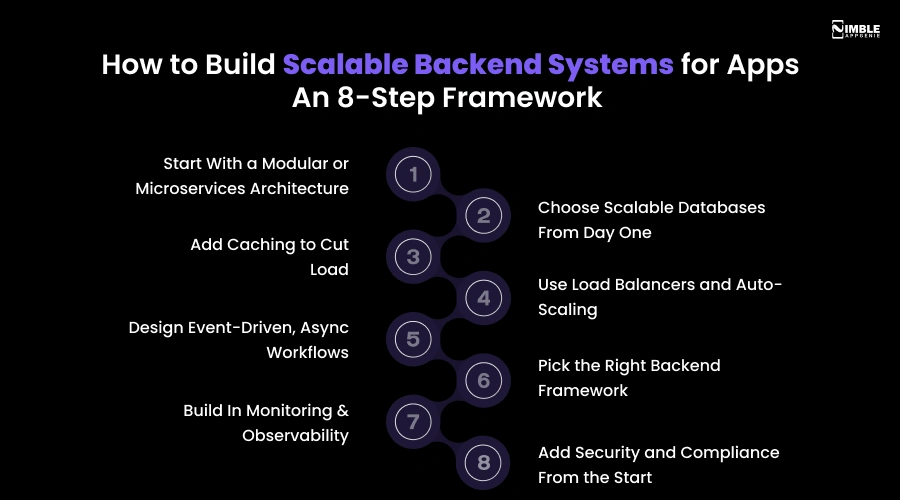
How to Build Scalable Backend Systems For Apps: An 8-Step Framework
Building a scalable backend starts with a structured approach to architecture, infrastructure, and performance optimization. By following the right framework, you can create backend systems that handle growing users, data, and transactions without compromising speed or reliability.
Based on our experience building apps and fintech platforms, here’s the 8-step framework we use at Nimble AppGenie to build backend systems designed for long-term growth.
1. Start With a Modular or Microservices Architecture
Break your backend into independent, focused services instead of one giant codebase. A modular monolith or full microservices architecture means a bug in your notification service will not take down payments.
It also allows your team to ship updates to one part of the system without redeploying everything. Our full breakdown of microservices in mobile app development covers when this approach earns its complexity and when it doesn’t.
2. Choose Scalable Databases From Day One
Your database is usually the first thing to buckle under real traffic. Decide early whether you need a relational database (MySQL, PostgreSQL) for structured, transaction-heavy data, or a NoSQL option (DynamoDB, MongoDB) for flexible, high-volume data.
Add real replicas to spread out read traffic, plan for sharding before you actually require it, and use indexing to speed up queries – retrofitting scalable databases into a live app is painful and expensive.
3. Add Caching to Cut Load
Not every request needs to hit your database. Tools like Memcached or Redis store frequently requested data in memory, so your backend answers in milliseconds instead of making the same costly query over and over. Caching is one of the cheapest, highest-impact upgrades for backend scalability.
4. Use Load Balancers and Auto-Scaling
A load balancer spreads incoming traffic across multiple servers so no single instance gets overwhelmed. Pair it with auto-scaling – new containers or instances spin up automatically as traffic rises, and scale back down when it drops and your infrastructure cost tracks actual demand instead of your worst-case guess.
5. Design Event-Driven, Async Workflows
Not everything needs to happen immediately in the request-response cycle. Sending confirmation emails, generating reports, or processing a webhook can run in the background using a message queue (RabbitMQ, SQS, or Kafka). This keeps your app responsive even when heavier tasks are running behind the scenes.
6. Pick the Right Backend Framework
Node.js, Spring Boot, Django, Ruby on Rails, and Go all handle scale differently. If you want flexibility and no vendor lock-in, an open source backend framework is usually the right call; if you want speed to market, a managed Backend as a Service (BaaS) platform can get you there faster. We compare the trade-offs in detail in our guide to the best backend frameworks for 2026.
7. Build In Monitoring & Observability
You can’t fix what you can’t see. Logging, metrics, and distributed tracing let your fintech team catch a slow endpoint or a failing dependency before users start complaining. Set alerts on the numbers that actually matter – error rate, response time, and queue depth – not just server.
8. Add Security and Compliance From the Start
This step matters for every app, but it’s non-negotiable for fintech. Encrypt data at rest and in transit, enforce least-privilege access, and keep audit logs from day one. Retrofitting compliance into a live system – PCI-DSS, SOC 2, GDPR – is far more expensive than designing for it upfront.
Scalable Backend Architecture For Fintech Apps: What’s Different
A scalable backend architecture for a photo-sharing app and one for a lending platform look nothing alike, even if both are caching and microservices.
Fintech backends carry extra weight:
- Fraud and risk checks that run on every transaction without adding noticeable delay.
- Real-time transaction processing – Payments, balance checks, and transfers cannot lag, even under load.
- Regulatory audits that need every action to be logged, traceable, and reportable.
- Third-party dependencies – KYC providers, credit bureaus, and payment gateways, each with their own uptime and rate limits.
- Zero tolerance for downtime – An outage is not only lost revenue, but it’s also a major compliance and trust event.
This is not a niche concern. According to Juniper Research, digital banking is projected to reach 4.2 billion users worldwide in 2026 – more than half the global population. A backend that can’t scale is not only a technical debt issue anymore; it’s also a growth ceiling.
We saw this firsthand while building Debtica Core, a lending platform for the Polish market. Origination, payments, underwriting, and reporting each needed to scale and update independently, while staying tied to strict KNF compliance requirements. You can read the full story in our Debtica Core Case study.
This section covers the backend layer specifically. If you want the fuller picture – layered design, architectural styles, and how specific fintech apps are built end-to-end- our fintech app architecture guide goes deeper on that. For the serverless-vs-microservices decision specifically, see our serverless architecture in fintech breakdown. If you are deciding on tooling, our finance tech stack guide is a useful companion read.
| Worth Knowing: Whether to run a given piece of fintech logic on always-on servers or event-driven functions is its own decision, separate from the backend architecture choices in the guide. Our serverless architecture in fintech post breaks down exactly when each fits. |
Should You Build From Scratch, Use BaaS, or Hire a Team?
There are three paths to a scalable backend, and the right one depends on your stage and how regulated your industry is.
| Path | Pros | Watch Out For |
| Scalable backend from scratch | Full control, custom-fit architecture, no vendor lock-in | Longer timeline, needs experienced engineers |
| Backend as a Service (BaaS) | Fast to launch, less DevOps overhead | Vendor lock-in, cost scaling, limited customization |
| Hire a specialized team | Speed plus control, compliance expertise built in | Requires the right partner – not every dev shop knows fintech |
Early-stage, low-complexity apps usually do fine on a BaaS platform – our guide to Backend as a Service for business apps covers when that trade-off makes sense.
Regulated fintech products, on the other hand, generally need custom scalable backend development from a team that already understands compliance, not one learning it on your dime.
6 Mistakes That Quietly Break Backend Scalability
- One database doing everything: Transactional data, analytics, and logs all fighting for the same resources.
- No caching strategy: Every request hits the database, even for data that barely changes.
- Monitoring added after an incident: Instead of before one.
- Skipping load testing until real users find the breaking point for you.
- Hardcoded configuration that makes environment changes risky and slow.
- Treating compliance as a launch-week checklist instead of part of the architecture.
How Nimble AppGenie Builds Scalable Backend Systems
We are Nimble AppGenie, a custom software development company that designs and builds scalable backend systems for startups, enterprises, and regulated fintech platforms. Every backend we ship is built around the same principles in this guide – scalable databases, modular architecture, security, and caching bolted in from day one, not later.
Whether you need scalable infrastructure services for a fast-moving MVP or a fully compliant backend for a neobank or lending platform, our team has already solved the problems you are about to run into.
Backend Development Services →
Fintech Software Development →
Lending Software Development →

Conclusion
Building scalable backend systems for apps is not about predicting the future perfectly; it’s making choices today that don’t box you in tomorrow.
Modular architecture, caching, scalable databases, monitoring, and load balancing are not optional extras; they are the difference between a backend that grows with your business and one that forces a rewrite at the worst possible time.
For fintech apps, add compliance and security to that list from day one, because there’s no version of “we fix it later” that works once real money is moving through your system.
If you are ready to scale your backend and want a team that has already built these systems for regulated, high-stakes apps, Nimble AppGenie is here to help.
FAQs

Niketan Sharma, CTO, Nimble AppGenie, is a tech enthusiast with more than a decade of experience in delivering high-value solutions that allow a brand to penetrate the market easily. With a strong hold on mobile app development, he is actively working to help businesses identify the potential of digital transformation by sharing insightful statistics, guides & blogs.
Table of Contents




No Comments
Comments are closed.