

 Free Consultation
 PCI-DSS Compliant
 GDPR Ready
 ISO 27001
 NDA Protected
 AI Services
 AI App Development
 Generative AI Development
 AI Chatbot Development
 AI Integration Services
 AI Consulting Services
 AI For Fintech
 AI Financial Assistant Solution
 AI Insurance Agent Development
 Tech Stack
 OpenAI / GPT-4
 Claude / Anthropic
 Gemini / Google AI
 Llama / Open Source
 LangChain / LlamaIndex
 Pinecone / Pgvector
 AWS / Azure AI


 Fintech Solution
 Core Fintech
 Fintech App Development
 Neobank App Development
 eWallet App Development
 Lending Software
 Banking Software Development
 BNPL Solution
 BNPL App Development
 Insurance App
 Wealth Management App
 Blockchain Development
 Payroll Software Development
 DeFi App Development
 Crypto Wallet Dev
 Crypto On Ramp Off Ramp
 Crypto Exchange Dev
 Trading Platform Dev
 Payments
 Compliance
 Fintech & Digital Regulations
 Fraud Detection
 Lending Ecosystem
 P2P Lending Platform
 Mortgage Software
 Engagement
 Outsourcing Dev

 Mobile Development
 Mobile App Dev
 iOS App Development
 Android App Development
 React Native
 Flutter Development
 Web Solution
 Node.js Development
 React.js Development
 Angular Development
 App Services
 UI/UX Design
 App Maintenance
 By Stage
 MVP Development
 Industry Solutions
 Healthcare App Dev
 Education App Dev
 Travel App Dev
 Real Estate App Dev
 Logistics Software
 Social Media App

 Hire Mobile Developers
 Hire iPhone Developers
 Hire Android Developers
 Hire React Native Devs
 Hire Flutter Developers
 Hire Web Developers
 Hire Node.js Developers
 Hire Angular Developers
 Hire PHP Developers
 Hire Laravel Developers
 How It Works
 Pre-Vetted Developers
 Ready In 48 Hours
 NDA From Day One
 Replace Guarantee
 Company
 About Us
 Our Work Process
 Portfolio
 Case Studies
 Blog / Insights
 Careers
 Contact Us
 Awards
 Recognition


 Offices



Key Takeaways:
- The GenAI market is projected to reach USD 9,870 million by 2030, creating a wide opportunity to invest.
- GenAI in fintech refers to automating operations, improving fraud defense, and even personalizing the customer experience.
- The GenAI use cases for fintech are: it enhances customer experience, offers personalized banking experiences, helps in smarter fraud detection, intelligent creditworthiness analysis, ensures employee productivity, and knowledge management.
- The real-world examples are Bank of America handles, the users’ queries with GenAI, for fintechOS, GenAI has helped to develop hyper-personalized banking and insurance products.
- While implementing GenAI, there can be challenges related to data privacy, ethics and bias, compliance-related issues, and hallucinations.
- Connecting with the right partner, such as Nimble AppGenie, can help to mitigate challenges and improve fintech solutions.
The global generative AI market is projected to reach USD 9,870 million by 2030, growing at a CAGR of 36.1% from 2023 to 2030.
With this growing market of GenAI, investing in it is not an option anymore; it’s a compulsion, and almost every industry is using GenAI to boost its market presence.
And when it comes to fintech, GenAI is changing banking and payments by enhancing fraud defense and personalizing the customer experience.
In this guide, we’ll walk you through the diversified GenAi use cases for fintech, illustrating them with examples, and how GenAi is changing banking and payments.
Let’s get started with.
What is Generative AI in Fintech?
Generative AI is revolutionizing fintech through automating complex processes such as fraud detection, regulatory compliance, and loan underwriting. It enables hyper-personalized financial advisory services and helps to accelerate routine middle-office operations via NLP.
The adoption of generative AI has gone way beyond the automation process; it triggers a massive shift in productivity levels, customer-centricity, and helps in making strategic decisions within the fintech landscape.
Here is the list of benefits generative AI offers in fintech:
- Hyper-personalization in banking
- Offers cost efficiency
- Advanced risk and fraud mitigation
- Automated customer support
- Streamlined regulatory compliance
Now, let’s get ahead with the key generative AI use cases in fintech in the following section.
Key Generative AI Use Cases in Fintech
AI in fintech does focus on analyzing present data for detecting patterns, assessing risks, and automating decisions. However, the generative AI interacts with unstructured data to draft, summarize, and automate workflows.
Here is the list of the use cases related to GenAI in fintech:
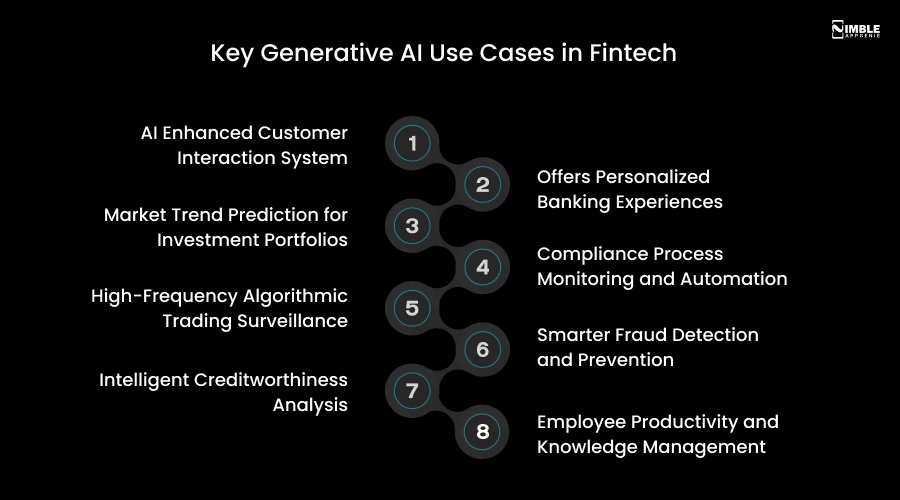
1. AI Enhanced Customer Interaction System
Generative AI transforms the way fintech firms interact with their clients. The chatbots and virtual assistants, embedded with AI, deliver immediate, round-the-clock assistance. These tools do manage queries for boosting user satisfaction.
Gen AI does offer bespoke financial guidance, improving service quality, and simulating new fraud scenarios for improving detection model coverage.
- Enhances accessibility
- Improves service delivery
- Offers tailored experiences
- Enable personalized investment strategies.
For example, FintechOS uses natural language product configuration that allows product managers to configure workflows and pricing. This aligns closely with AI to improve customer interactions, where the agility and personalization go hand-in-hand.
2. Offers Personalized Banking Experiences
GenAI transforms banking from a generic service into the hyper-personalization financial concierge. You can analyze individual transaction histories, income, and spending patterns. GenAI understands individual financial behaviors for delivering bespoke advice.
It is the practice of delivering highly tailored financial experiences to individual customers by leveraging real-time insights from their behavior, financial context, and preferences. With a top banking software development company, the fintech businesses can:
- Proactive financial nudges
- Dynamic product customization
- Conversational AI & virtual assistants
- Context-aware insights & summarization
For example, customers receive tailored credit card offers, budgeting tips, and investment insights based on their spending patterns.
3. Market Trend Prediction for Investment Portfolios
One of the important generative AI use cases for fintech is that it skillfully deciphers complex market data, identifying emerging trends. Its insights guide portfolio managers in ensuring timely responses to fluctuations.
The portfolio managers optimize asset management, mitigating risks while seeking maximized returns following top fintech trends. It does allow them to navigate market complexities confidently, securing the investor’s trust.
- Scenario simulation & stress testing
- Advanced asset allocation & rebalancing
- Prioritizes informed decision-making and profitability
- Helps to navigate market complexities and secures investor trust.
For example, AlphaSense uses GenAI to transform how professionals perform a complete market and investment analysis.
4. Compliance Process Monitoring and Automation
Compliance often becomes the most operationally painful area in financial services. Here, the regulatory requirements keep expanding. The documentation burden keeps growing; thus, GenAI plays an important role, where the compliance teams are asked to do more with the same or fewer people.
GenAI in fintech helps to maintain audit trails with reasoning traces for AI-generated outputs. It even helps to automate suspicious activity reporting, complying with digital payments regulations. Helpful in generating compliance reports based on transactional data and internal records.
- Perform deep research
- Offers smart summaries
- Generating the documentation
- Flags policy gaps
For example, JPMorgan Chase uses GenAI models and vector databases to instantly parse a transaction, scan semantically similar regulations, and score risk.
5. High-Frequency Algorithmic Trading Surveillance
Generative AI in fintech helps in monitoring rapid transaction activities. GenAI swiftly helps to identify the unusual patterns, flagging potential manipulations or irregularities. It automatically synthesizes unstructured data and generates real-time anomaly alerts.
It does allow compliance and regulatory teams to instantly process vast amounts of unstructured text, detect complex, multi-layered market manipulations, and instantly contextualize trading anomalies.
- Real-time market anomaly detection
- Multi-modal market context and sentiment.
- Cross-asset and communication surveillance
- Streamlining investigations and reporting
For example, HSBC implemented GenAI to automate anti-money laundering investigations. This technology achieved a 20% reduction in false positives while preserving the standards via case review.
6. Smarter Fraud Detection and Prevention
GenAI revolutionizes anti-scam measures in financial institutions. The AI systems analyze spending behaviors and transaction histories in real-time. These systems offer a proactive approach that prevents fraud and reduces false positives, improving overall safety.
With the help of GenAI, you can create a rule-based detection system that can catch the patterns they were programmed to catch. The sophisticated fraud takes place when gaps in the system are identified, because the people running it have figured out where the rules are.
- Generates fraud investigation summaries.
- Flags deviations that don’t fit known patterns.
- Minimizes the time compliance teams spend drafting SAR reports from hours to minutes.
- GenAI continuously optimizes reinforcement learning to minimize slippage in milliseconds.
For example, PayPal combines deep machine learning algorithms and generative AI for analyzing over 500 data points in real-time, which successfully blocks millions of fraud attempts through maintaining seamless customer checkout experiences.
7. Intelligent Creditworthiness Analysis
GenAI in fintech does offer a more nuanced evaluation through rapidly parsing massive volumes of unstructured data, automating document-heavy underwriting processes, and evaluating alternative data points.
The GenAI does help both lenders and borrowers. The lenders gain a clear picture of risk and reduce the likelihood of losing money. Borrowers, especially those with limited credit history, get a fairer opportunity for accessing financial products.
- Offers automated document verification
- Regular behavioral monitoring
- Automated document verification
- Alternative data synthesis
For example, Crediture uses generative AI for revolutionizing creditworthiness analysis through transitioning from rigid, manual reviews to multidimensional risk evolution. The platform uses a strategy to transform commercial loans, offering tailored, practical solutions.
8. Employee Productivity and Knowledge Management
GenAI is programmed to boost employee productivity and knowledge management through automating routing tasks, breaking down organizational silos, and facilitating instant information sharing.
Internal AI assistants help employees find policies, procedures, and product information instantly. Through GenAI, banking and payment businesses opt for routine automation, skill expansion, and content generation.
- Offers seamless knowledge capture
- Agile sharing and learning
- Instant knowledge discovery
- Serves as an intelligent digital companion that shrinks learning curves.
For example, the financial advisors can actively retrieve research summaries and client-related insights in seconds.
Now, let’s have a view to the real-world example of how competitive brands are optimizing and have optimized GenAI.

Real-World Example of How Competitive Brands are Using GenAI
The top fintech apps and banks use GenAI to effectively boost their performance in this competitive environment. These fintech apps use GenAI to successfully connect with people and to resolve their queries.
Let’s evaluate the real-world case scenarios:
| Company | How They Used GenAI | Outcome |
| Bank of America (Erica) | Conversational AI assistant handling account inquiries, spending summaries, and budgeting questions in natural language | Instant responses without waiting for human operators |
| Wealthfront | GenAI evaluates risk tolerance and goals to generate personalized portfolio recommendations | More adaptive, tailored investment guidance vs. static templates |
| FintechOS | GenAI used to accelerate the development of hyper-personalized banking and insurance products | Faster time-to-market with tailored customer experiences |
| Ally Financial | Deployed enterprise-wide generative AI to support internal operations | Reported measurable business value from GenAI adoption |
| JPMorgan Chase (COiN) | AI-driven contract intelligence for automated legal/financial document analysis | Document review time cut from hours to seconds |
Well, with this real-world example, you might be wondering about what kind of issues and challenges you might face with GenAI. With the positives, there are certain challenges too that you should be familiar with.
Challenges and Considerations in GenAI
Challenges such as data privacy, security, ethics, and technical constraints, model accuracy, and compliance-related issues.
Here is the list of challenges that you might face:
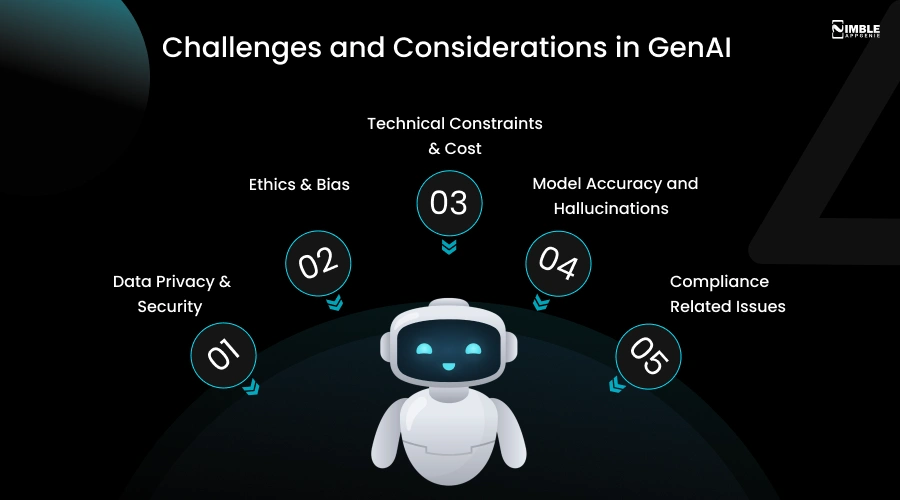
► Data Privacy & Security
GenAI implementation can lead to security, data privacy, and GDPR challenges because the models are trained on massive, often unverified datasets and can unintentionally memorize, leak, or reconstruct sensitive personal information when promoted.
► Ethics & Bias
GenAI gets trained from a vast, unfiltered human-generated dataset. They inherently absorb, amplify, and scale human prejudices, which raises complex concerns related to fairness, discrimination, and accountability.
► Technical Constraints & Cost
Technical constraints create a bottleneck between a prototype’s novelty and an enterprise’s profitability. It creates a challenge by clashing with the industry’s need for strict precision, transparency, and security.
► Model Accuracy and Hallucinations
The model accuracy and hallucinations are critical challenges because GenAI relies on probabilistic text generation rather than deterministic truth or incorrect output. A highly cited wrong fact or hallucination can create challenges to prove an accurate fact correct.
► Compliance Related Issues
GenAI creates compliance-related issues because models are unpredictable and ingest vast, opaque datasets. Here, the key issues comprise data privacy violations, unintentional bias, and intellectual property infringement.
How Nimble AppGenie Helps Banks & Fintechs Implement Generative AI?
Connect with the expert team of Nimble AppGenie, which is the best AI development company, catering to the growing, complex needs of businesses.
Here are reasons to consider Nimble AppGenie:
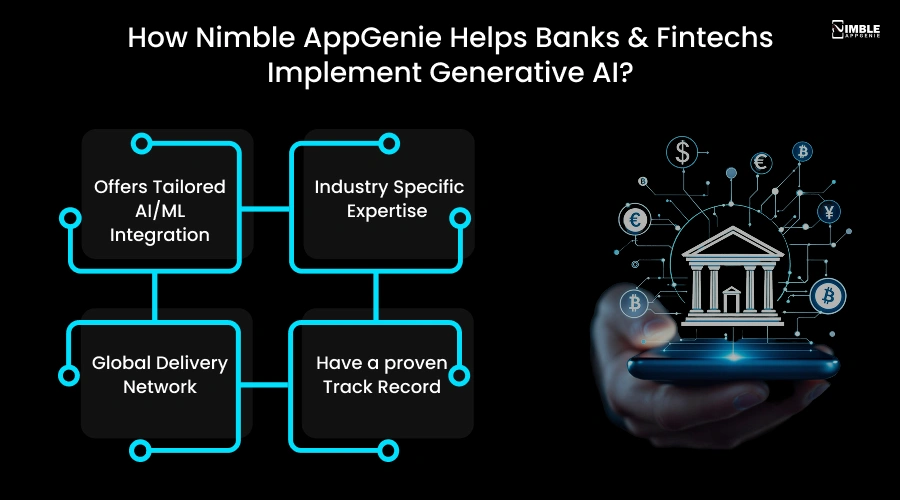
♦ Offers Tailored AI/ML Integration
Nimble AppGenie specializes in creating apps enriched with AI features, improving user experiences, and automating workflows. The company ensures that AI is native and built into the core framework rather than bolted on as an afterthought.
♦ Industry Specific Expertise
The company is a top fintech software development company due to its specialized expertise in creating highly scalable, secure, and compliance-ready financial platforms. It offers bespoke solutions for banks and financial institutions.
♦ Global Delivery Network
The company combines decentralized international development hubs with robust cloud infrastructure, allowing them to deliver specialized apps and fintech software securely worldwide.
♦ Have a Proven Track Record
Nimble AppGenie has a proven track record and has delivered about 350+ fintech solutions. We have completed 50+ AI projects, which makes us an experienced GenAI expert. We have key pillars such as international footprint, agile global project management, and cloud-first global infrastructure.
Conclusion
GenAI is reshaping the fintech industry through enhancing operational efficiency, streamlining compliance processes, and strengthening fraud detection. This technology in fintech helps businesses with intelligent credit assessment and algorithmic trading surveillance, as well as knowledge management.
The platform helps financial institutions to make faster and more reliable decisions. Certain challenges that impact the Gen AI use are data privacy, bias, regulatory compliance, and model accuracy. As fintech continues to evolve, genAI will play a pivotal role in driving innovation and building more secure financial institutions.
FAQs

Niketan Sharma, CTO, Nimble AppGenie, is a tech enthusiast with more than a decade of experience in delivering high-value solutions that allow a brand to penetrate the market easily. With a strong hold on mobile app development, he is actively working to help businesses identify the potential of digital transformation by sharing insightful statistics, guides & blogs.
Table of Contents




No Comments
Comments are closed.