

 Free Consultation
 PCI-DSS Compliant
 GDPR Ready
 ISO 27001
 NDA Protected
 AI Services
 AI App Development
 Generative AI Development
 AI Chatbot Development
 AI Integration Services
 AI Consulting Services
 AI For Fintech
 AI Financial Assistant Solution
 AI Insurance Agent Development
 Tech Stack
 OpenAI / GPT-4
 Claude / Anthropic
 Gemini / Google AI
 Llama / Open Source
 LangChain / LlamaIndex
 Pinecone / Pgvector
 AWS / Azure AI


 Fintech Solution
 Core Fintech
 App Development
 Neobank Solutions
 eWallet Solutions
 Lending Software
 Banking Solutions
 BNPL Solutions
 BNPL Solutions
 Insurance App
 Wealth Management
 Crypto & DeFi
 Blockchain Development
  Payroll Software
 DeFi Solutions
 Crypto Wallet
 Crypto On/Off Ramp
 Crypto Exchange
 Trading Platform
 Payments
 Compliance
 Regulations & Compliance
 Fraud Detection
 Lending Ecosystem
 P2P Lending Platform
 Mortgage Software
 Engagement
 Fintech Outsourcing

 Mobile Development
 Mobile App Dev
 iOS App Development
 Android App Development
 React Native
 Flutter Development
 Web Solution
 Node.js Development
 React.js Development
 Angular Development
 App Services
 UI/UX Design
 App Maintenance
 By Stage
 MVP Development
 Industry Solutions
 Healthcare App Dev
 Education App Dev
 Travel App Dev
 Real Estate App Dev
 Logistics Software
 Social Media App

 Hire Mobile Developers
 Hire iPhone Developers
 Hire Android Developers
 Hire React Native Devs
 Hire Flutter Developers
 Hire Web Developers
 Hire Node.js Developers
 Hire Angular Developers
 Hire PHP Developers
 Hire Laravel Developers
 How It Works
 Pre-Vetted Developers
 Ready In 48 Hours
 NDA From Day One
 Replace Guarantee
 Company
 About Us
 Our Work Process
 Portfolio
 Case Studies
 Blog / Insights
 Careers
 Contact Us
 Awards
 Recognition


 Offices



TL;DR
- Offshore fintech development can cut costs by 60–70%, with developers charging $20–$50/hr vs $100–$175/hr onshore.
- Onshore is best for highly regulated fintech projects requiring local legal compliance, real-time collaboration, and high security control.
- Offshore carries real risks: time zone gaps, communication overhead, and compliance gaps – all manageable with the right partner.
- A hybrid model (onshore strategy + offshore execution) is now the preferred approach for growth-stage fintechs in 2026.
- The real question is not just cost – it’s: which model helps you build faster, safer, and smarter?
- Nimble AppGenie offers fintech startups and scaleups an offshore-first, compliance-ready development approach – ISO-certified, PCI-compliant, and proven across 50+ fintech products worldwide.
Just imagine: You have a fantastic fintech idea. Maybe it’s a payment gateway, an investment app, or a lending platform. You are sure what you want to build. But next comes the big question – where and how do you build it?
Do you partner with a local mobile app development company (onshore) for seamless communication and compliance alignment? Or do you hire a talented offshore team in Eastern Europe, India, or Southeast Asia and potentially save 60% of your development budget?
Offshore vs onshore fintech development is one of the most crucial decisions a company can make. Get it wrong, and you will witness compliance violations, missed deadlines, or ballooning costs. Get it right, and you build faster, launch faster, and scale globally.
In this guide, we will break down everything – hidden risks, real costs, decision frameworks, and compliance factors – so you can confidently choose the model (offshore or onshore) that fits your fintech.
What Is Offshore Fintech Development? (And What It’s NOT)
Offshore fintech development means hiring a software development company or team located in a different country, usually fintech software development outsourcing, where developer salaries can notably be lower than in the US, UK, or Australia.
Top offshore destinations for fintech include:
- Eastern Europe (Romania, Ukraine, Poland) – Excellent for enterprise fintech and compliance-heavy projects
- India – Larger developer pool, robust AI/ML talent, and deep fintech expertise
- Southeast Asia (Philippines, Vietnam) – Expanding fintech hubs with competitive rates
- Latin America (for US companies) – Nearshore option with overlapping time zones
But here’s what offshore is NOT:
- It’s not only ‘cheap labor.’ Today’s offshore developers build for Fortune 500 companies and VC-backed fintechs. Not sure what building a fintech app actually involves? Read our complete guide on how to build a fintech app.
- It’s not one-size-fits-all. The right offshore approach relies on your product, stage, and compliance needs.
- It’s not always high-risk. With the right mobile app development company, offshore can be as compliant and secure as onshore.
| Quick Stat: Offshore development can reduce development costs by up to 60%, according to Verified Market Research. |
What Is Onshore Fintech Development?
Onshore development means working with a team in the same country as your business. If you are a US fintech startup, onshore means US-based developers.
The main benefits of choosing onshore fintech development are clear:
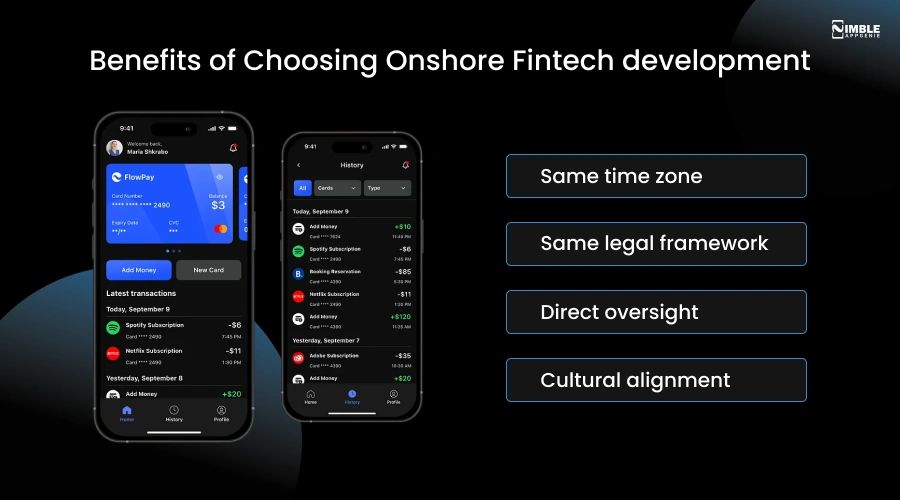
- Same time zone: Faster feedback loops and real-time collaboration
- Same legal framework: Easier IP protection, regulatory alignment, and data compliance
- Direct oversight: See progress in real time and meet in person
- Cultural alignment: Communication styles and shared business norms
Onshore fintech development disadvantages are:
- Hiring takes 3 to 6 months in competitive tech markets
- Onshore developers in the US charge about $100-$175/hour on average
- Limited specialized fintech talent in some local markets
- Challenging to scale quickly without significant cost increases
| Real-World Fact: A European fintech that developed a complex financial compliance system onshore achieved full legal control and faster iteration, but paid 3x as much as comparable offshore builds. The lesson? Onshore works, but the cost premium should be justified by project complexity and compliance requirements. |
The Real Cost Comparison: Offshore vs Onshore Fintech Development
Let’s talk numbers because this is where most fintech founders make assumptions that cost them money.
Developer Hourly Rates in 2026
| Factor | Offshore | Onshore | Hybrid |
| Hourly Cost | $20–$50/hr | $100–$175/hr | $40–$90/hr |
| Cost Savings | Up to 60–70% | Baseline | 30–50% savings |
| Time Zone | 8–12 hrs gap | Same time zone | Manageable overlap |
| Compliance | Needs extra vetting | Best for regulated apps | Balanced |
| Talent Pool | Global & vast | Local, competitive hiring | Best of both |
| Communication | Async-heavy | Real-time, seamless | Structured async+sync |
| Data Security | Needs a strong NDA | Easier legal control | Custom protocols |
| Best For | Well-scoped projects | Regulated, complex builds | Growth-stage fintechs |
What Does a Full Fintech Development Project Cost?
Let’s say you are building a mid-complexity fintech app (user auth, payment processing, compliance module, and dashboard).
To understand the full onshore and offshore fintech development cost, you need to look beyond hourly rates and factor in the complete project scope.
| Cost Element | Offshore (India) | Onshore (USA) |
| Dev Team (6 months) | $30,000–$60,000 | $120,000–$200,000 |
| Project Management | $5,000–$10,000 | $20,000–$40,000 |
| QA & Testing | $5,000–$8,000 | $15,000–$25,000 |
| Compliance Setup | $3,000–$6,000 | $8,000–$15,000 |
| Total Estimate | $43,000–$84,000 | $163,000–$280,000 |
For a detailed breakdown by app type and feature set, see our guide on fintech app development cost.
The Hidden Costs Nobody Talks About
Before you get attracted to offshore savings, be aware of the hidden costs:
- Management Layer: You will need a robust project manager or technical lead to bridge gaps.
- Communication Overhead: Expect 20-30% extra time for revisions, async reviews, and miscommunications.
- Time Zone Delays: A question that takes 5 minutes onshore can take around 24 hours offshore.
- Rework Cycles: Requirements misunderstood early lead to expensive rework later.
The smart move? Budget an extra 30-40% buffer on offshore engagements for QA and management. Even with that, offshore can still deliver strategic savings and scalability advantages over onshore.
Offshore Fintech Development Risks – And How to Beat Them
The fintech industry is one of the most regulated ones in the world. Financial data breaches cost an average of $6.08 million, according to GSB Capital Ltd.
Risk management is not optional; it’s a business survival skill. This is why fintech app security must be non-negotiable regardless of which development model you choose.
Below are the key offshore fintech development risks and how leading companies diminish them:
| Risk | Level | Mitigation Strategy |
| Data Breach / IP Theft | High | Sign NDA, use GDPR/SOC2-compliant vendors, restrict data access |
| Regulatory Non-Compliance | High | Vet vendor’s knowledge of PCI-DSS, GDPR, and local financial laws |
| Time Zone Delays | Medium | Establish overlapping hours; use async-friendly tools (Jira, Slack) |
| Communication Gaps | Medium | Weekly video calls, documented sprints, shared project boards |
| Quality Issues | Medium | Run a 2-week pilot, request fintech-specific references |
| Vendor Dependency | Low–Medium | Keep key architecture knowledge in-house; use phased contracts |
One way to reduce vendor dependency risk is to keep your core fintech app architecture documented in-house.
What About Onshore Risks?
Onshore fintech development risks are what rarely get talked about:
- Cost overruns: Onshore projects with scope creep can become very costly, very fast.
- Talent shortage: Specialized fintech developers are limited in many markets, resulting in long hiring cycles.
- Single point of failure: Over-reliance on a small local team creates operational risk.
- Slow scaling: Adding 5 developers onshore takes months; offshore can be achieved in weeks.
Compliance in Fintech: Offshore vs Onshore
This is where fintech stands apart from other industries. You are dealing with people’s money, their financial data, and heavily regulated systems. Compliance is non-negotiable.
Key Regulatory Frameworks to Consider:
- PCI-DSS: Payment Card Industry Data Security Standard (mandatory for any app handling card payments)
- SOC 2: Security, availability, and confidentiality standard (expected by enterprise clients)
- GDPR: Applies to any fintech serving European users
- HIPAA: If your fintech intersects with healthcare payments
- Local banking regulations: Varies by country (RBI in India, FCA in the UK, and CFPB in the US)
Your fintech tech stack choices directly impact how easily you can meet these compliance standards.
Offshore + Compliance: The Truth
Can offshore development teams handle fintech compliance? Yes – but you need to evaluate them carefully. Understanding KYC and AML compliance for fintech in depth is critical before you brief any offshore or onshore vendor.
Ask any offshore vendor:
- Have they built PCI-DSS-compliant products before?
- Can they provide audit documentation and traceable codebases?
- Do they have ISO 27001 certification (information security)?
- Do they have experience with GDPR data handling?
- Do they use NDAs and secure data sharing protocols?
Not familiar with all the fintech regulations that apply to your product? Start here before you hire anyone.
| Pro tip: Ask for 2-3 references, particularly from fintech clients, not only general software clients. Fintech compliance questions need a financial services context to be vetted meaningfully. |
The Hybrid Model: Why Most Fintechs in 2026 Are Choosing Both
Here’s what smart fintech companies have figured out: it’s not offshore OR onshore. It’s offshore AND onshore – strategically combined.
The hybrid fintech development model works like this:
| Onshore Team Handles | Offshore Team Handles |
| Product strategy & roadmap | Core engineering & development |
| Stakeholder communication | QA and automated testing |
| Compliance oversight | DevOps and CI/CD pipelines |
| UI/UX direction | Backend infrastructure |
| Regulatory liaison | Feature development at scale |
This model is specifically effective for growth-stage fintechs because it balances cost savings with strategic regulation. You get a talent pool of offshore and speed at 40-60% savings, while keeping compliance and high-stakes decisions work close to home.
How to Choose: A Simple Decision Framework for Fintech Leaders
Stop searching ‘offshore vs onshore’ – check the specifications below:
Choose Offshore If:
- Your fintech software development project has well-defined, documented specs and requirements.
- You need to scale the team fast
- Budget optimization is your top priority
- You have a robust internal technical lead who can bridge communication gaps.
- Your product targets markets with moderate compliance complexity
- Budget is your primary constraint.
Fintech software development outsourcing gives you the most leverage at the early stage.
New to outsourcing altogether? Start with our beginner’s guide to outsourcing software development before you evaluate vendors.
Choose Onshore If:
- Your fintech needs daily real-time collaboration and frequent pivot decisions
- Data sovereignty laws in your region do not permit cross-border data sharing
- You are operating in a highly regulated sector (government contracts, banking licenses)
- You are creating a flagship product where UX depends on local market nuance
- Budget is secondary to quality, speed, and compliance control
Choose Hybrid If:
- You are at the growth stage with active compliance needs and budget constraints
- You want to shrink timelines with near-24/7 development cycles
- You are scaling globally and need diverse technical talent
- You need product ownership onshore, but engineering capacity offshore
What to Look For in a Fintech App Development Company (Offshore or Onshore)
The model matters less than a fintech app development company. Here’s what to evaluate before you sign any contract:
Non-Negotiables for Fintech Development Partners
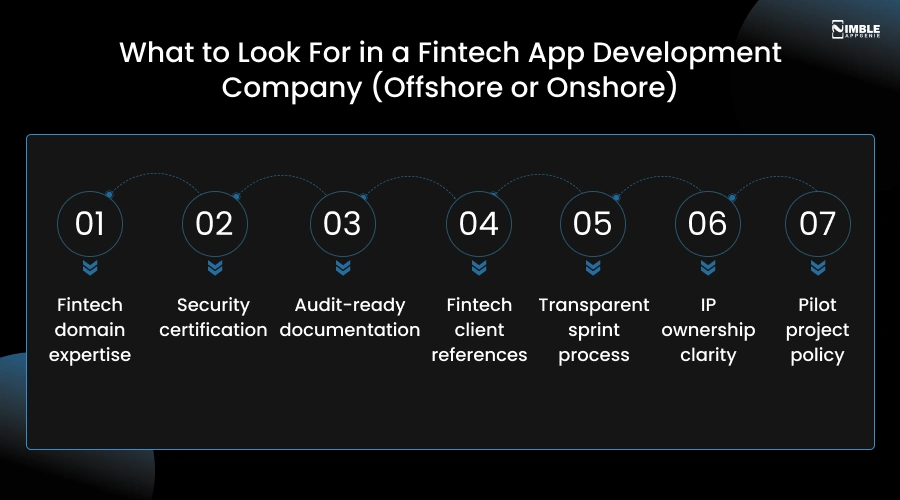
- Fintech domain expertise: Check if they have actually built payment apps, banking solutions, or lending platforms? Not just ‘mobile apps’. A partner who understands how fintech apps make money will build your architecture around revenue, not just features.
- Security certification: SOC 2 compliance, ISO 27001, and PCI-DSS experience are table stakes.
- Audit-ready documentation: Fintech codebases need complete traceability for PCI-DSS audits and SOC 2.
- Fintech client references: Ask for 2-3 fintech-specific references. A healthcare app reference won’t tell you what you need to know.
- Transparent sprint process: Weekly demos, visible progress boards, documented sprints
- IP ownership clarity: Who owns the code? All IP should transfer to you. Get this in the contract.
- Pilot project policy: Any good partner will let you start with a 2-week paid pilot before committing long-term
| Pro Tip from the Industry: One pattern repeated across successful offshore fintech engagements: companies that moved from pure offshore to hybrid arrangements witnessed measurable reductions in ticket rework within a few months, not because engineers changed, but because same-day communication replaced overnight wait times. Structure matters as much as location. |
Offshore Fintech Development Trends to Know in 2026
The offshore vs onshore fintech development debate has surfaced significantly. Here’s what’s shaping the landscape right now, driven by fast-moving IT outsourcing trends that are redefining how fintech teams are built.
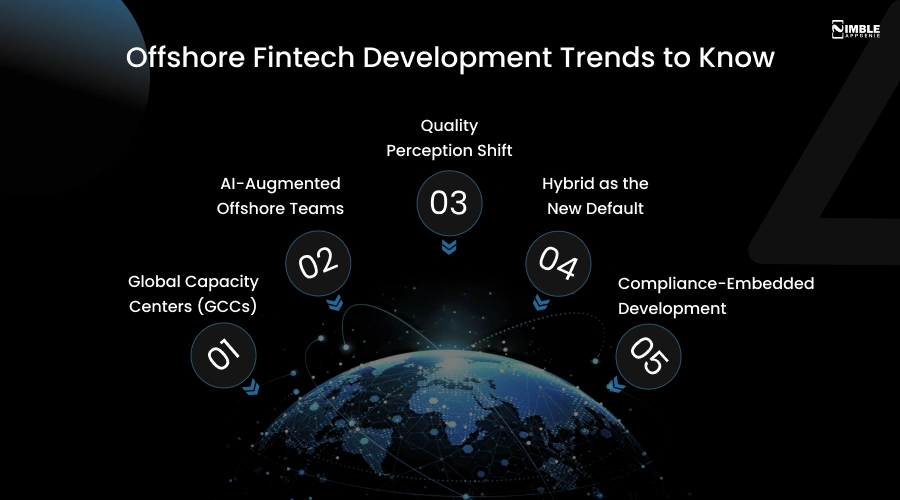
1. Global Capacity Centers (GCCs)
Besides outsourcing, companies are setting up strategic offshore innovation hubs. India alone in 2026 hosts over 2,117 GCCs, accounting for almost 60% of the world’s total. These are no longer just support centers; they are full-fledged product development command centers.
2. AI-Augmented Offshore Teams
With tools like GitHub CoPilot increasing developer output by 55%, offshore teams are delivering more output per hour than ever before. An offshore developer leveraging AI tools now competes directly with onshore developers at a fraction of the cost.
3. Quality Perception Shift
The old narrative of ‘offshore = lower quality’ is dead. In 2026, offshore teams routinely build for regulated industries like healthcare, fintech, and defense. Quality is no longer the primary concern – choosing the right operating model is what matters.
4. Hybrid as the New Default
The IT outsourcing market is expected to reach $638.65 billion globally. Growth is no longer centered around pure onshore or pure offshore models; it is happening in hybrid models that blend the best of both, strategically aligned to compliance requirements and project phase.
If you are a startup deciding how to create a fintech app in today’s market, the hybrid model is worth understanding from day one.
5. Compliance-Embedded Development
The EU’s DORA regulation (Digital Operational Resilience Act) went live in 2025. Combined with the EU AI Act, fintech teams now demand RegTech embedded directly into their development pipeline.
Top offshore vendors have adapted. Vendors who embed AI fraud detection directly into their development pipeline are the ones worth evaluating.
How Nimble AppGenie Approaches Fintech Development
As a fintech app development company, Nimble AppGenie, we have spent years building fintech products that are scalable, secure, and compliant for startups and established financial institutions.
Here is how we think about the offshore vs onshore fintech development question for our clients:
- We begin with your compliance needs, not your budget. Compliance shapes architecture, so we get it right first.
- We offer ISO-certified, PCI-DSS-compliant fintech app development with complete audit-ready documentation.
- We have developed 50+ fintech solutions, including banking platforms, eWallets, payment gateways, and investment apps.
- We structure engagements as hybrid by default – engineering execution managed by our experts and strategic oversight aligned with your team. Curious about how much your fintech app will cost before you decide on a model? Get a realistic estimate here.
- Each engagement starts with a free consultation and a scoped project proposal – no lasting commitment required upfront.
Whether you are deciding between offshore, onshore, or hybrid, we will give you an honest recommendation based on your market, product, and budget.

Conclusion
When it comes to the offshore vs onshore debate, there is no universal winner, and anyone who says otherwise is probably selling something.
What’s important is to align your development model with your compliance requirements, product stage, team capabilities, and budget realities.
If you are an early-stage fintech with a lean budget and a well-scoped product, offshore enables you to build smart and fast. If you are in a heavily regulated market with daily stakeholder collaboration needs and complex compliance requirements, onshore or hybrid is likely the smarter play.
And if you are like most growth-stage fintechs in 2026, you will find that a well-structured hybrid model offers you the best of both worlds: control where it counts, and cost efficiency where it matters.
The key is choosing the right fintech app development company that understands fintech deeply, not just software development.
FAQs

Niketan Sharma, CTO, Nimble AppGenie, is a tech enthusiast with more than a decade of experience in delivering high-value solutions that allow a brand to penetrate the market easily. With a strong hold on mobile app development, he is actively working to help businesses identify the potential of digital transformation by sharing insightful statistics, guides & blogs.
Table of Contents




No Comments
Comments are closed.