

 Free Consultation
 PCI-DSS Compliant
 GDPR Ready
 ISO 27001
 NDA Protected
 AI Services
 AI App Development
 Generative AI Development
 AI Chatbot Development
 AI Integration Services
 AI Consulting Services
 AI For Fintech
 AI Financial Assistant Solution
 AI Insurance Agent Development
 Tech Stack
 OpenAI / GPT-4
 Claude / Anthropic
 Gemini / Google AI
 Llama / Open Source
 LangChain / LlamaIndex
 Pinecone / Pgvector
 AWS / Azure AI


 Fintech Solution
 Core Fintech
 App Development
 Neobank Solutions
 eWallet Solutions
 Lending Software
 Banking Solutions
 BNPL Solutions
 BNPL Solutions
 Insurance App
 Wealth Management
 Crypto & DeFi
 Blockchain Development
  Payroll Software
 DeFi Solutions
 Crypto Wallet
 Crypto On/Off Ramp
 Crypto Exchange
 Trading Platform
 Payments
 Compliance
 Regulations & Compliance
 Fraud Detection
 Lending Ecosystem
 P2P Lending Platform
 Mortgage Software
 Engagement
 Fintech Outsourcing

 Mobile Development
 Mobile App Dev
 iOS App Development
 Android App Development
 React Native
 Flutter Development
 Web Solution
 Node.js Development
 React.js Development
 Angular Development
 App Services
 UI/UX Design
 App Maintenance
 By Stage
 MVP Development
 Industry Solutions
 Healthcare App Dev
 Education App Dev
 Travel App Dev
 Real Estate App Dev
 Logistics Software
 Social Media App

 Hire Mobile Developers
 Hire iPhone Developers
 Hire Android Developers
 Hire React Native Devs
 Hire Flutter Developers
 Hire Web Developers
 Hire Node.js Developers
 Hire Angular Developers
 Hire PHP Developers
 Hire Laravel Developers
 How It Works
 Pre-Vetted Developers
 Ready In 48 Hours
 NDA From Day One
 Replace Guarantee
 Company
 About Us
 Our Work Process
 Portfolio
 Case Studies
 Blog / Insights
 Careers
 Contact Us
 Awards
 Recognition


 Offices



Key Takeaways:
- Super app architecture is a way to build one app that provides many services like chat, payments, shopping, and bookings, so users do not need multiple apps for different tasks.
- A bespoke system uses modular architecture and microservices architecture, where each service works separately to make an app easy to scale and manage.
- It depends on key components like API gateway, service registry, payment system, identity layer, and cloud infrastructure to keep everything connected and smooth.
- Design patterns in super app development, like micro frontend, event-driven architecture, plugin-based architecture, and backend for frontend, help improve speed, flexibility, and user experience.
- Mini apps and third-party integrations are important, allowing businesses to add their services using APIs and SDKs, which also helps increase revenue.
- There are challenges like high traffic, data security, and performance issues, but these can be handled using cloud scaling, encryption, caching, and modular design.
- Choosing the right setup is really crucial because it decides how well your super app can scale, handle millions of users, and support new features in the future.
Do you think building a super app is about adding more features? It is not. It is about super app architecture, the foundation that decides whether all those features actually work together or fall apart.
And this is where most development teams get it wrong. They start creating without a clear architectural plan and end up with a slow, hard-to-scale, and expensive-to-maintain system.
The numbers show how fast this space is moving. The super apps market is expected to grow from $127.46 billion in 2025 to $546.03 billion by 2031 at a CAGR of 27.43%. And the architecture powering these apps is what makes that scale possible.
In fact, monolithic super app architectures are projected to account for around 55% of the market in 2026. Moreover, mini-app platforms are growing the fastest. This tells you architectural choices are already shaping who wins.
So if you are planning to build a super app, the architecture decisions you make at the start, modular vs monolithic, microservices, API design, and data layers, will either give you a platform that scales to millions of users or one that hits a wall early.
This guide breaks down everything you need to know about super app architecture: the core components, design patterns, mini-app integration, common challenges, and how to set it all up the right way from day one.
So, let’s begin!
What is a Super App Architecture?
A super app architecture is the structure or design behind a mobile app that can do many things in one place instead of having separate apps for each task. For example, one super app might let you chat with friends, order food, book a taxi, pay bills, and shop online all within one single app.
The architecture makes this possible by using a core platform that supports many mini-apps or services inside it. Each mini app operates independently but shares data and login information, so the user experience feels smooth and connected.
This kind of design focuses on flexibility, scalability, and easy integration, so you can add new features without breaking the super application.
Key Features of Super Application Architecture:
- Embedded payments
- Mini-program ecosystem
- Single identity layer
- Service independence
What Are the Core Architecture Components?
A super app cannot be developed as a monolith. Instead, it needs a distributed, modular architecture with clear separation of concerns. Below are the core architecture components required for development.
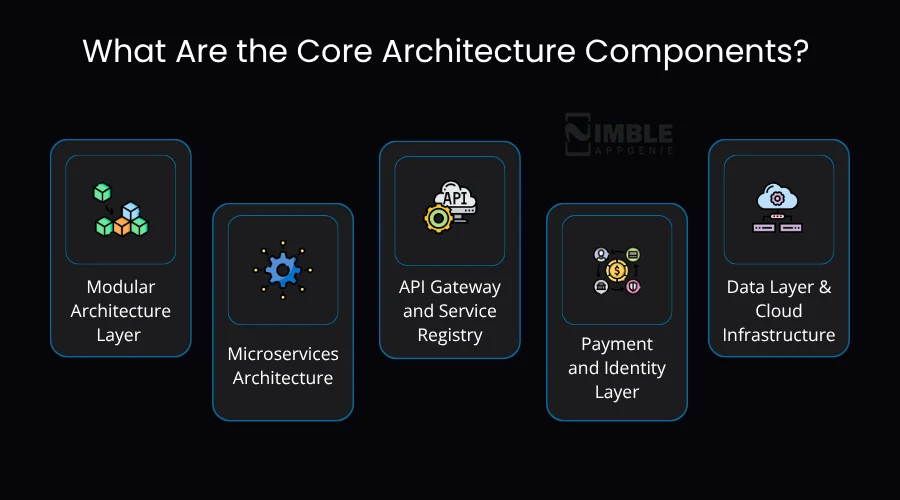
1. Modular Architecture Layer
Do not combine all the features into one single, tightly-coupled monolithic application. You can break down the super app into distinct, independent modules. Each module focuses on a particular function: messaging, payments, shopping, or ride-sharing.
The benefits of a modular architecture layer are:
- Independent scaling: The payments service can scale to 10x load without affecting the messaging service.
- Independent deployment: Update the restaurant discovery service without a full app release.
- Third-party integration: Partners integrate with specific microservices via API without touching core platform code.
2. Microservices Architecture
Microservices architecture breaks the system into multiple independent services. Each handles a particular task like authentication, payments, user profiles, push notifications, or location services.
The advantages of microservices architecture are:
- Independent deployment: Update the authentication service without downtime.
- On-demand scaling: Payment processing can auto-scale based on transaction load.
- Technology flexibility: Use Python for data processing, Node.js for real-time services, and Go for high-throughput systems.
3. API Gateway and Service Registry
An API gateway handles all the incoming traffic, manages authentication, and routes requests to appropriate microservices. A service registry allows dynamic discovery and new services to scale up or down; the system automatically knows where to route requests.
The benefits of the API gateway and service registry are:
- Centralized access: All client requests go through one point for easier management.
- Service discovery: Services automatically find each other without hardcoding addresses.
- Security control: Add authentication and authorization without changing each service.
4. Payment and Identity Layer
These are the non-negotiable version components. The embedded wallet is what makes a fintech super app defensible. Once users have their money in the system, switching costs are enormous. Users benefit from a single payment method and KYC process on all services.
The benefits of the payment and identity layer:
- Seamless transactions: Users can pay without leaving the app.
- Multiple payment methods: Support cards, wallets, bank transfers, and UPI.
- Single sign-on: Users log in once and access all services.
5. Data Layer & Cloud Infrastructure
A super application architecture needs cloud-native infrastructure, distributed databases, and effective data management. WeChat’s development of Kubernetes itself shows the infrastructure foresight needed to manage billions of messages and data transfer without system crashes.
The benefits of the data layer and cloud infrastructure:
- Centralized storage: All app data is stored in a single location for easy access.
- Data consistency: Keeps information accurate across all services.
- On-demand resources: Scale servers and storage up or down as needed.
Super App Architecture Diagram
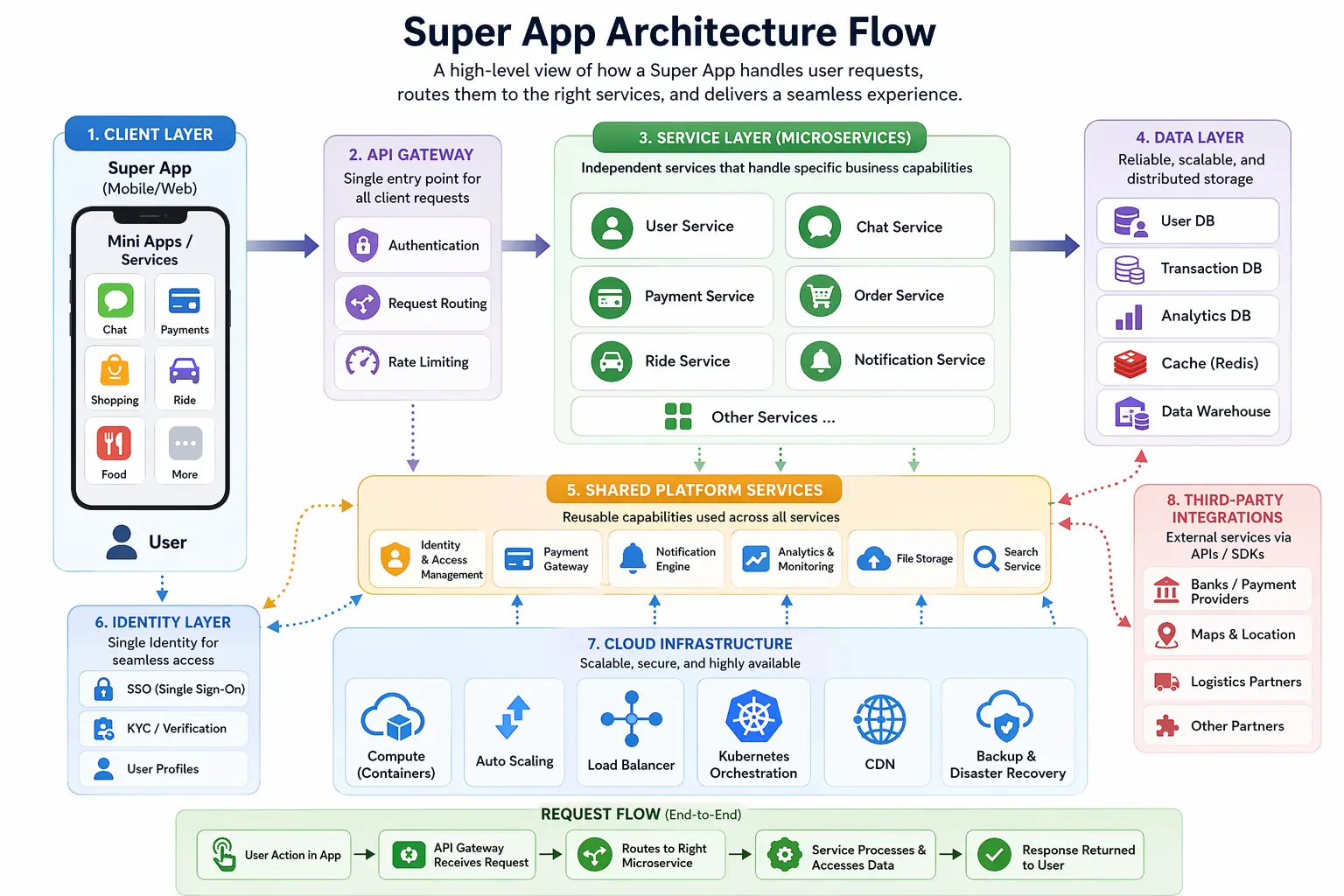
Modular vs. Monolithic Architecture: Which is Right for Super Applications?
To build a super app, you have to choose the right architecture for solid and seamless operation. We have created a comparison table between modular architecture and monolithic architecture for better understanding. Take a look:
| Factor | Modular Architecture | Monolithic Architecture |
| Scalability | Each module can scale independently to manage millions of users. | The entire app scales as one unit and can hit limits faster. |
| Deployment | Modules can be updated or released without affecting the whole app | Any change requires redeploying the full app |
| Third-party Integrations | It is easy to integrate via APIs or microservices. | The integrations are tightly coupled and harder to manage. |
| Development Speed | The development teams can work on different modules in parallel, faster overall. | It is quick at first, but slows as the app grows and becomes complex. |
| Maintenance | Bugs or updates affect only particular modules and are easier to fix. | Its changes can impact the entire system, which makes it harder to maintain. |
| Cost | It has a higher upfront cost for setup, but is cheaper to scale and maintain over time. | It has a lower initial cost, but redesigning later is expensive. |
| Flexibility | It can use different technologies per module, like Python, Node.js, or Go. | It is limited to one tech stack across the application. |
| Reliability | Failure in one module doesn’t crash the whole app. | One failure can affect the entire application. |
The verdict: You should stick to modular architecture if you are developing a super app. The monolithic systems lack the flexibility needed for horizontal expansion and partner integration.
In many popular super app implementations, development follows a transition from monolithic to fully modular, but with MVP app development and progressively adding modules.
What Design Patterns Are Used in Super App Architecture?
Super applications are not just created with different components. They also follow some common design patterns that help everything run smoothly and flexibly as the app scales. Here are the design patterns you can use in the super mobile app architecture.
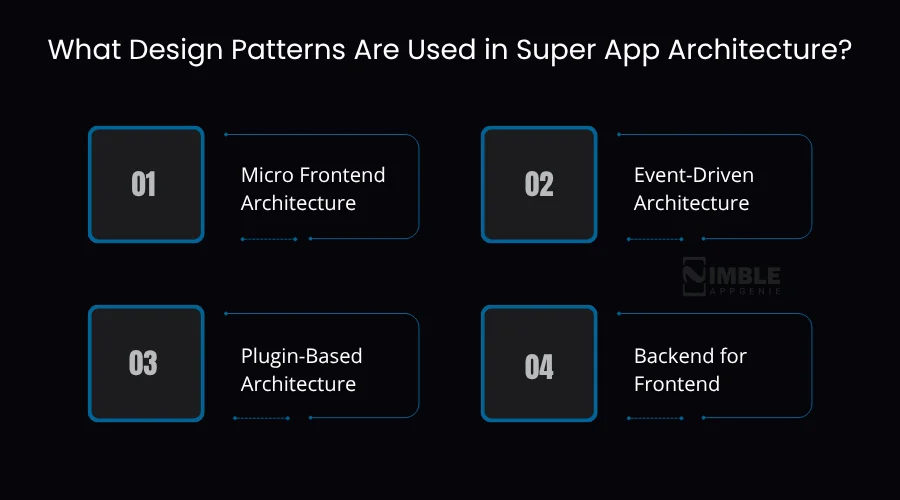
1. Micro Frontend Architecture
In a super app, different services like food delivery or payments can have their own UI. But a micro frontend assists in creating each part separately and then combining them into one single app.
Why it helps:
The mobile app development teams can work on different features without affecting each other. It also makes updates faster and safer.
2. Event-Driven Architecture
In this pattern, services talk to each other using events. For example, when a payment is successful, an event is triggered, and other services like notifications or order updates react to it.
Why it helps:
It allows real-time updates and reduces direct dependency between services, making the system faster and more flexible.
3. Plugin-Based Architecture
This allows new features or services to be added, like plugins, without changing the core system.
Why it helps:
You can easily add or remove services as your app grows. This is very useful for super apps that keep expanding over time.
4. Backend for Frontend
Different platforms like mobile apps and web apps may need different data formats. BFF creates separate backends for each frontend.
Why it helps:
It improves performance and gives a better user experience because each platform gets exactly what it needs.
How Mini Apps and Third-Party Integrations Work?
Mini apps are a key part of any super app. They allow other businesses and developers to offer their services inside your app. Let’s have a look at the working of mini apps and third-party integrations.
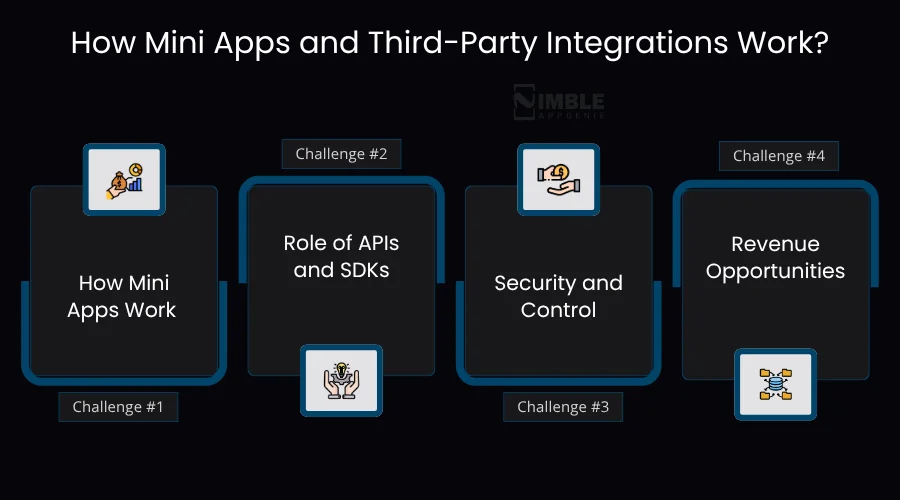
1. How Mini Apps Work
Mini apps run inside the main app but act like separate small applications. For example, a food delivery service inside a super app works like its own app but does not need a separate download.
Why it matters:
Users can access many services in one place without switching apps.
2. Role of APIs and SDKs
APIs allow different services to connect with the super app. SDKs help developers build and integrate their mini apps easily.
Why it matters:
It makes integration faster and ensures all services follow the same system rules.
3. Security and Control
Since third-party services are involved, security becomes very important. Super apps use controlled environments where mini apps can operate safely.
Why it matters:
It protects user data and prevents misuse by external services.
4. Revenue Opportunities
Super apps earn money by allowing third-party services on their platform. This can be through commissions, ads, or subscription models.
Why it matters:
It creates a strong business model while also expanding the range of services for users.
Common Challenges in Super App Architecture Implementation
Building a super app is not as simple as adding many features into one app. When different services come together, things can quickly become hard to manage. You may face issues with speed, security, user experience, and handling too many integrations at once.
These challenges are common, but they can be handled with the right approach. Let’s have a look at the table that showcases the major problems you might face and easy ways to deal with them.
| Challenges | Description | Mitigation Strategies |
| Complex system design | A super app has many services in one place, which makes the system hard to design and manage. |
|
| Integration of multiple services | Different services like payments, chat, delivery, etc, need to work smoothly together, which can be complex. |
|
| Performance issues | As more features are added, the super app can become slow or crash under heavy use. |
|
| Data security and privacy | Handling user data across many services raises the risk of data leaks or misuse. |
|
| User experience complexity | Too many features can confuse users and make the app hard to use. |
|
| High development cost | Building and maintaining a super app needs a lot of time, money, and skilled people. |
|
| Scalability challenges | The app should handle growth in users and services without breaking. |
|
| Third-party dependency risks | Depending on external services can cause issues if they fail or change policies. |
|
| Maintenance and updates | Managing updates across many services can be time-consuming and risky. |
|
| Regulatory compliance | Different services may need to follow different laws (payments, data, etc.). |
|
Why Choose Nimble AppGenie to Build a Super App?
As a trusted mobile app development company, Nimble AppGenie creates custom super apps for clients globally. We know what works and what does not. So instead of starting from scratch, you can begin with something that already works.
You just have to focus on what makes your super app special: your idea, your users, your market. That’s all. Just experience and technologies that save you time and money.
Besides, we assist you in creating a robust super app system design so your app can scale without issues. Instead of creating one big app, we divide it into small parts that work together. This makes it easy to add new features anytime.
Our developers design the architecture with easy login, smooth payments, and fast performance for users. So you do not need to worry about the technical side. Your app stays flexible and ready for future growth while you focus on your idea and potential audience.
Conclusion
You have now understood what super app architecture is. The next step is designing it the right way. Since super apps are already becoming a big part of daily life, millions of people use them every day, and the market is still growing. There is still a gap for new ideas and better solutions.
Therefore, if you want to build something useful and create a super app that solves many user needs, this is the right time to start. With the right dedicated development team, you can turn your idea into a high-performing and scalable super app.
FAQs

Niketan Sharma, CTO, Nimble AppGenie, is a tech enthusiast with more than a decade of experience in delivering high-value solutions that allow a brand to penetrate the market easily. With a strong hold on mobile app development, he is actively working to help businesses identify the potential of digital transformation by sharing insightful statistics, guides & blogs.
Table of Contents




No Comments
Comments are closed.