Free Consultation
 PCI-DSS Compliant
 GDPR Ready
 ISO 27001
 NDA Protected
 AI Services
 AI App Development
 Generative AI Development
 AI Chatbot Development
 AI Integration Services
 AI For Fintech
 AI Financial Assistant Solution
 AI Insurance Agent Development
 Tech Stack
 OpenAI / GPT-4
 Claude / Anthropic
 Gemini / Google AI
 Llama / Open Source
 LangChain / LlamaIndex
 Pinecone / Pgvector
 AWS / Azure AI


 Fintech Solution
 Core Fintech
 Fintech App Development
 Neobank App Development
 eWallet App Development
 Payment Integration
 Lending Software
 BNPL Solution
 BNPL App Development
 Insurance App
 Investment App Dev
 Wealth Management App
 Crypto & DeFi
 DeFi App Development
 Crypto Wallet Dev
 Crypto Exchange Dev
 Trading Platform Dev
 Payments
 Compliance
 RegTech App Dev
 Fraud Detection
 Lending Ecosystem
 P2P Lending Platform
 Mortgage Lending
 Engagement
 Outsourcing Dev


 Mobile Development
 Mobile App Dev
 iOS App Development
 Android App Development
 React Native
 Flutter Development
 Web Development
 Node.js Development
 React.js Development
 Angular Development
 PHP / Laravel
 App Services
 UI/UX Design
 App Maintenance
 By Stage
 MVP Development
 Industry Solutions
 Healthcare App Dev
 Education App Dev
 Travel App Dev
 Real Estate App Dev
 Logistics Software
 Social Media App


 Hire Mobile Developers
 Hire iPhone Developers
 Hire Android Developers
 Hire React Native Devs
 Hire Flutter Developers
 Hire Web Developers
 Hire Node.js Developers
 Hire Angular Developers
 Hire PHP Developers
 Hire Laravel Developers
 How It Works
 Pre-Vetted Developers
 Ready In 48 Hours
 NDA From Day One
 Replace Guarantee

 Company
 About Us
 Portfolio
 Case Studies
 Blog / Insights
 Careers
 Contact Us
 Recognition


 Offices



| Quick Answer: AI in digital payments means using machine learning, predictive models, and behavioral biometrics to personalize offers, detect fraud, and automate decisions across a transaction in real time, not just adding a chatbot on top. |
TL;DR
- Digital wallet users reached 4.5 billion in 2025, per Juniper Research’s latest 2025–2030 forecast, and are projected to reach 6 billion by 2030, a 35% increase.
- 81% of surveyed financial services firms reported adopting AI at some level in 2026, with fintechs ahead of traditional institutions in advanced AI adoption (47% vs. 30%).
- Various widely-cited adoption percentages in this space (bank AI investment, fintech AI adoption rates) lack a traceable primary source – treat single-number claims from aggregator sites with caution until verified against a named survey.
- A realistic AI payments integration runs from $15,000 for basic rule enhancements to $150,000+ for a full personalized, predictive, chatbot-enabled platform.
- Nimble AppGenie builds an AI-powered digital wallet and fraud-detection infrastructure for fintech clients.
As the world becomes increasingly tech-focused for routine tasks, cashless, AI-driven financial services are gaining popularity. Digital payments are a default choice, not a convenience add-on.
Global digital wallet adoption is expected to grow by about 35% over the next five years, surging from 4.5 billion users in 2025 to 6+ billion by 2030, according to Juniper Research.
Legacy rule-based payment systems can’t keep pace with rising transaction volumes and sophisticated fraud techniques, lacking the adaptability required to detect anomalies instantly, analyze real-time behavioral data, or personalize user experiences. Here, AI in fintech steps in to reduce fraud losses while reducing false transaction declines, directly safeguarding revenue and customer trust.
This guide covers how AI empowers digital payments, architecture, verified market data, real use cases, ROI, and cost – with unsourced claims clearly flagged rather than repeated as fact.
What Is AI in Digital Payments?
Artificial intelligence in digital payments uses data-driven systems to analyze, learn, and make real-time decisions across payment flows. AI acts as an intelligent layer across the payment ecosystem, improving fintech security, speed, and personalization across the full transaction lifecycle.
Key Terms
- Artificial Intelligence (AI): The broad concept of systems simulating human decision-making, such as flagging suspicious transactions or recommending offers.
- Machine Learning (ML): A subset of AI where systems learn from data to improve accuracy over time, commonly used for risk scoring and fraud detection.
- Deep Learning: An advanced form of ML using neural networks to process complex patterns, such as facial recognition for KYC or behavioral biometrics.
AI Capabilities in Digital Wallets
Nine capabilities make up most AI-powered wallet architectures: Machine learning (risk scoring, fraud detection), NLP (chatbots, voice payments), behavioral biometrics (continuous authentication via typing speed and navigation patterns), computer vision (KYC document scanning and liveness detection), cloud infrastructure (elastic scaling with compliance controls), blockchain and smart contracts (shared-ledger settlement), MLOps/model governance (bias monitoring and drift detection), and tokenization and encryption (replacing PANs and PII with tokens).
This connects directly to the compliance features covered in our guide on essential eWallet app features, where KYC is non-negotiable.
How Big Is the AI-in-Payments Market?
The facts and figures below will show how big the AI-in-Payments Market is:
- The AI-in-fintech market is expected to grow from about $20.6 billion in 2026 to $76.2 billion by 2033, a 20.5% CAGR.
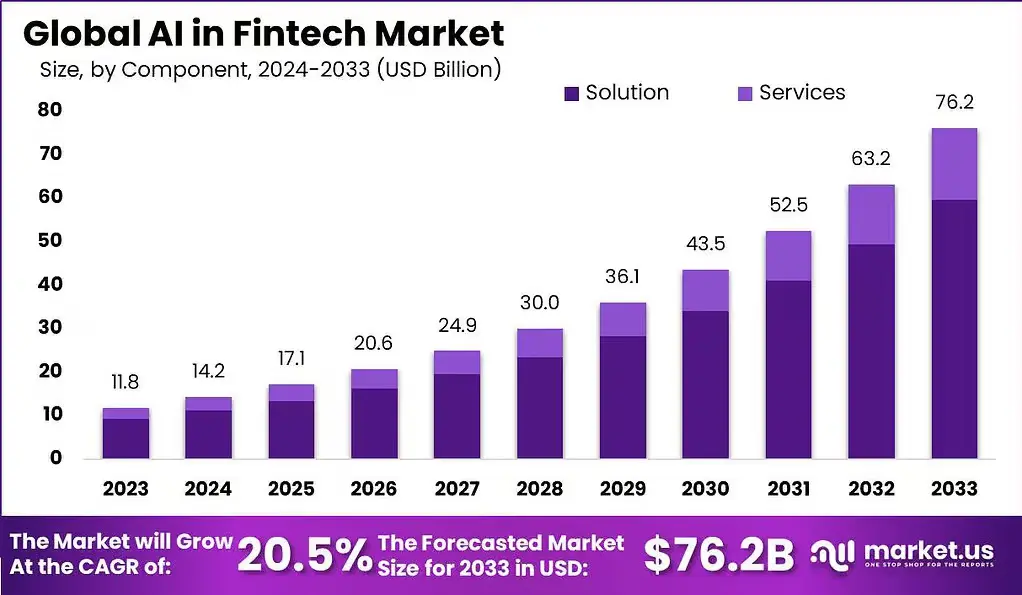
- Payments and remittances are predicted to be the fastest-growing application areas, with a 32.2% CAGR through 2031. (Source: Mordor Intelligence – AI in Fintech Market.)
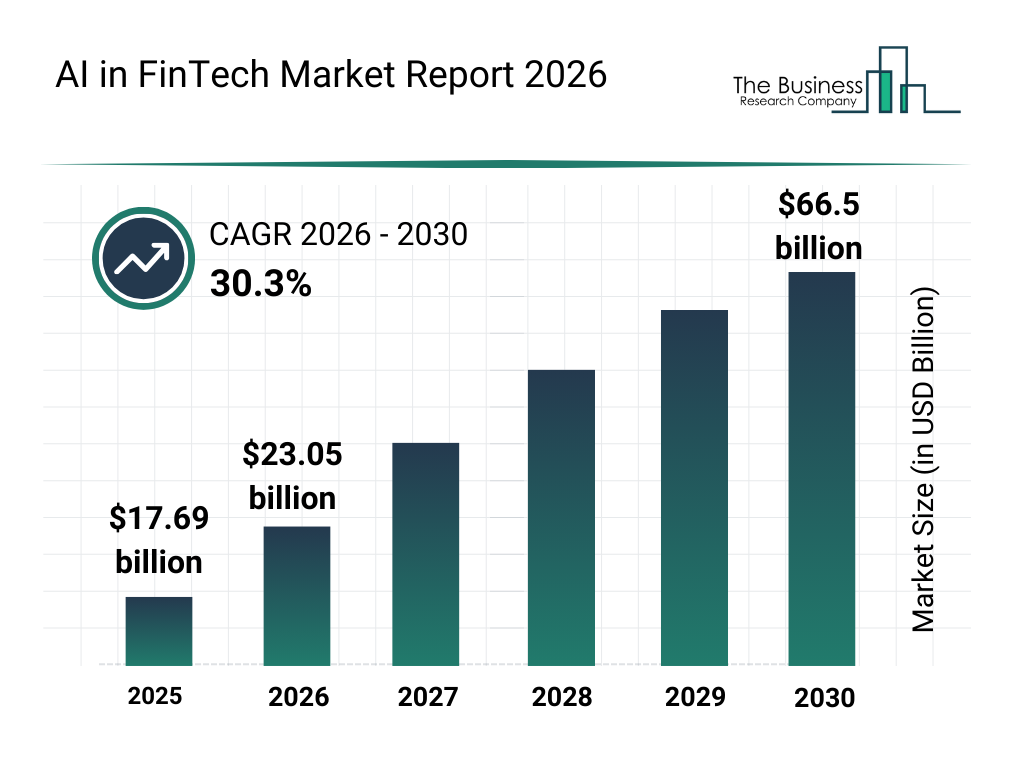
- The Business Research Company’s latest 2026 report shows the market at $23.05 billion in 2026, surging to $66.5 billion by 2030, at a 30.3% CAGR.

How Do Leading Digital Wallets Actually Use AI?
Four examples show how AI influences production, not only in pitch decks:
A real, verified AI/fraud-adoption data point: 78% of global business and tech leaders report that AI has significantly improved risk management and fraud detection, per FIS and Oxford Economics’ 2025 survey of 501 C-suite executives.
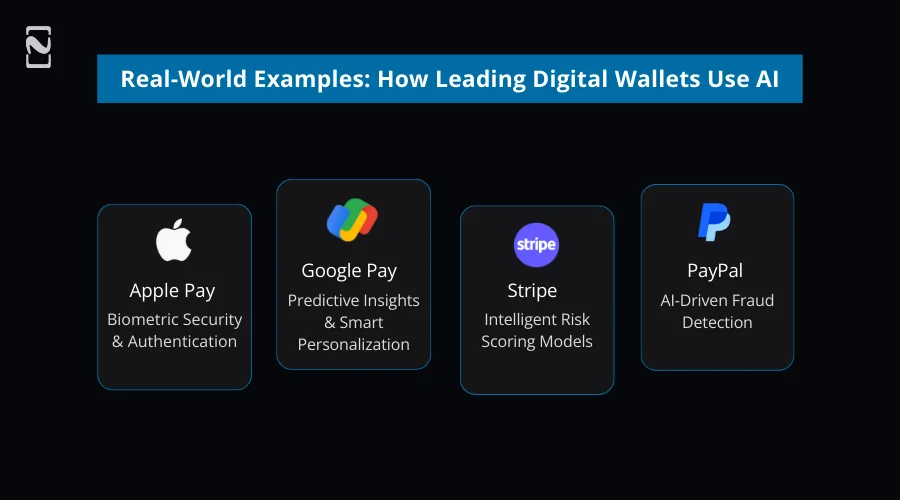
1. Apple Pay – Biometric Security & Authentication
Apple Pay uses AI-powered biometric authentication via Touch ID and Face ID. Machine learning models scan biometric data locally on-device to authenticate identity before validating payments, improving security while keeping checkout effortless.
2. Google Pay – Predictive Insights & Smart Personalization
Google Pay analyzes transaction history and spending patterns to deliver predictive insights – expense categorization, reminders, personalized offers. See our Google Pay vs Apple Pay vs Samsung Pay breakdown for how every platform manages this distinctly.
3. Stripe – Intelligent Risk Scoring Models
Stripe uses AI-based risk scoring to assess fraud probability across its global network, dynamically tuning risk thresholds to increase authorization rates without compromising security.
4. PayPal – AI-Driven Fraud Detection
PayPal leverages machine learning to monitor transactions in real time, analyzing transaction context, device information, and behavioral signals to flag threats early while minimizing false positives.
What Does an AI-Powered Digital Wallet Architecture Look Like?
An AI-powered digital wallet is a layered system, not a standalone app:
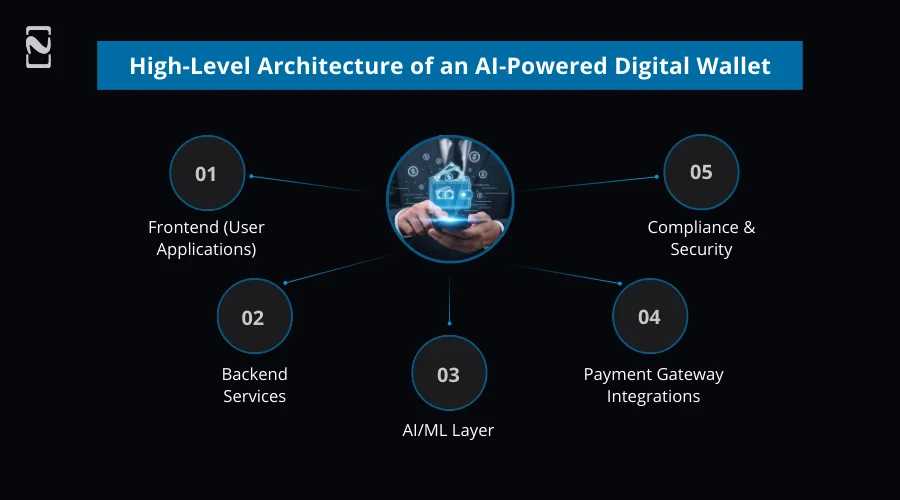
- A frontend layer (web/mobile apps capturing behavioral signals),
- Backend services (microservices handling orchestration and API integration),
- An AI/ML layer (the intelligent engine for fraud scoring and personalization),
- Payment gateway integrations (processors, card networks, UPI, banks), and
- Compliance & Security (PCI-DSS, audit logging, identity verification with AI-backed anomaly detection).
Within that architecture, AI activates at four decision points:
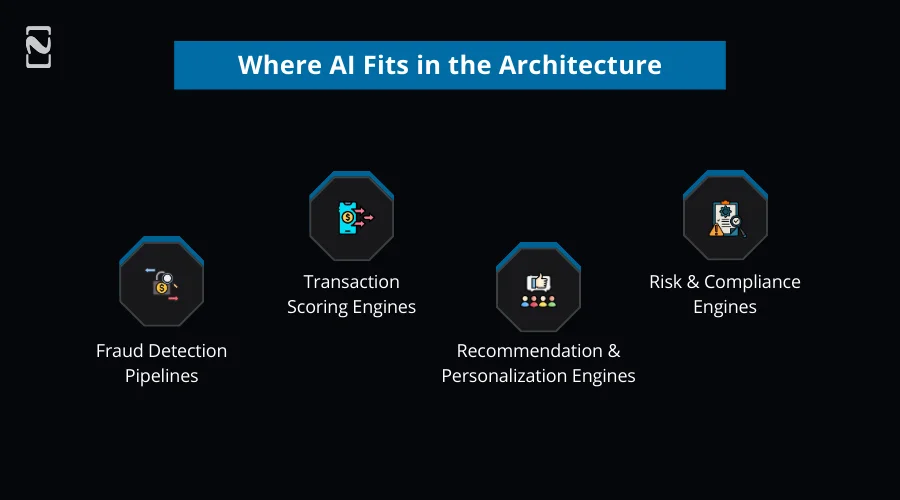
- Fraud detection pipelines (constant stream monitoring),
- Recommendation/personalization engines (offers and insights from engagement data),
- Transaction scoring engines (millisecond risk scores from behavior, location, and device signals), and
- Risk & compliance engines (explainable, audit-ready monitoring).
What Are the Key AI Use Cases in Digital Payments?
AI in digital payments is primarily used for transaction monitoring, fraud detection, personalized offers, risk assessment, payment optimization, predictive analytics, and customer support.
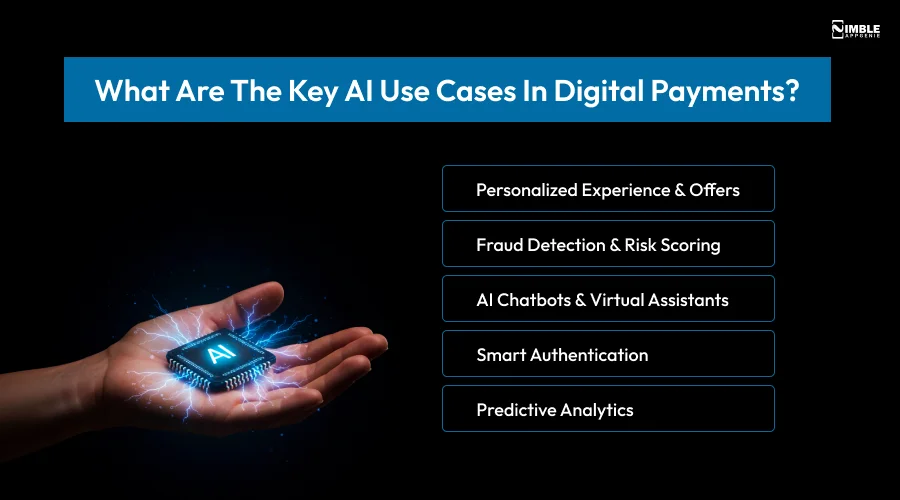
- Personalized Experience & Offers: AI-driven rewards, dynamic UI personalization, and spending pattern analysis.
- Fraud Detection & Risk Scoring: Real-time transaction monitoring, adaptive fraud models, and anomaly detection – one of the most critical layers of eWallet security.
- AI Chatbots & Virtual Assistants: Dispute resolution, voice-based payments, and support automation.
- Smart Authentication: Face/voice recognition, continuous authentication, and behavioral biometrics.
- Predictive Analytics: LTV modeling, transaction forecasting, and churn prediction.

How Can Businesses Adopt AI in Banking and Payments?
Adopting AI is not plug-and-play. The practical sequence: identify your precise pain points first (fraud losses vs. manual review time vs. compliance overhead are different issues), connect with experienced AI partners early, not after an expensive misstep, staff with people who can manage the models once deployed, pilot in one area before scaling, integrate perfectly with existing systems, and build in ongoing evaluation and optimization from day one.
How Do You Integrate AI Into Digital Payments?
Integrate AI into digital payments by connecting AI models to transaction data and payment APIs for risk scoring, real-time fraud detection, predictive analytics, personalization, and automated customer support.
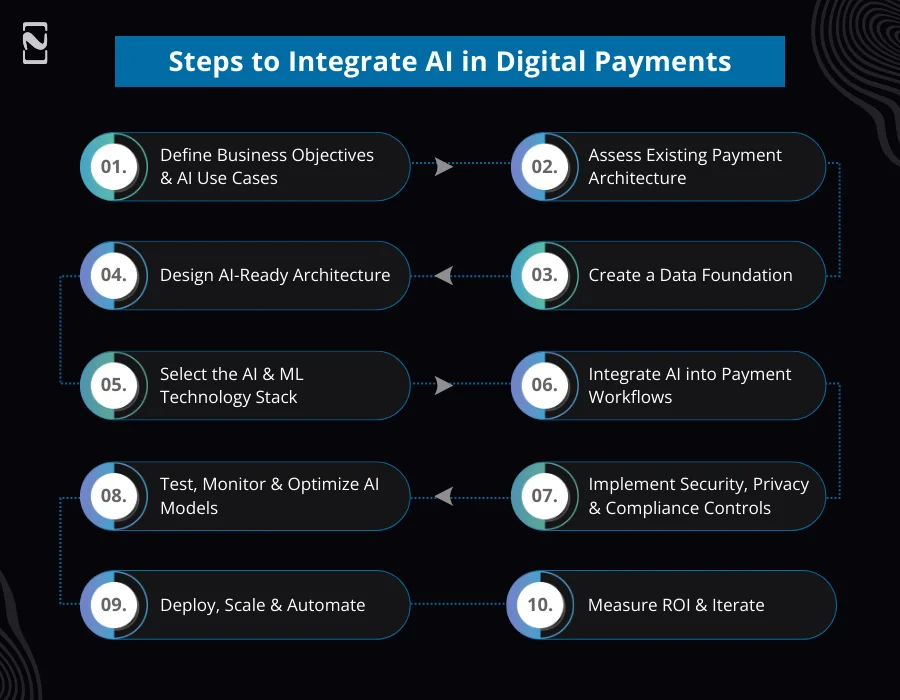
- Define Business Objectives and AI Use Cases: Fraud reduction, approval rates, personalization, compliance automation.
- Assess Existing Payment Architecture: Real-time data availability, API maturity, legacy dependencies.
- Create a Data Foundation: Historical fraud data, device signals, transaction data, behavior data.
- Design AI-ready Architecture: AI/ML as a core layer, not a bolt-on.
- Select the AI/ML Tech Stack: ML frameworks, MLOps tools, streaming platforms, data warehouses.
- Integrate into Payment Workflows: Risk scoring, fraud detection, authentication, personalization.
- Implement Security, Privacy & Compliance Controls: GDPR, PCI-DSS, explainable AI, encryption.
- Test, Monitor & Optimize Models: Performance testing, latency monitoring, drift detection.
- Deploy, Scale & Automate: Continuous retraining, CI/CD pipelines, auto-scaling.
- Measure ROI & Iterate: Cost savings, approval rates, retention growth, fraud reduction.
What Does It Cost to Integrate AI Into Payments?
The cost of integrating AI into payment systems is based on complexity, scope, and scale of implementation.
You should ensure your AI investment is evaluated in terms of lasting ROI, not only the upfront development cost.
Cost of Integrating AI in Digital Payments
| AI Integration Level | Scope / Features | Estimated Cost | Business Impact |
| Basic Integration | Rule-based enhancements, basic ML models, and a limited scope | $15,000 – $30,000 | Minor fraud reduction and small automation gains |
| Mid-Level Integration | Real-time fraud detection, behavioral analytics, and compliance-ready setup | $30,000 – $70,000 | Improved approval rates, moderate fraud reduction, and enhanced compliance |
| Advanced AI Platform | Full AI stack: predictive analytics, personalization, global scalability, and chatbots | $70,000 – $150,000+ | Significant fraud reduction, higher transaction volume, lower operational costs, and higher customer retention |
Note: The costs we listed are estimated ranges and may vary depending on the complexity of AI use cases, compliance needs, security requirements, transaction volumes, and the choice between third-party AI solutions or in-house development.
What Regulatory Requirements Apply to AI in Payments?
With the growing AI adoption in payments, regulatory compliance becomes a core success factor.
Payment platforms you build should ensure AI systems operate smoothly within rigid financial, consumer protection, and data privacy frameworks.
Key Regulatory Considerations
- PCI-DSS: Ensure protected management of cardholder data across AI-driven transaction flows
- PSD2 & Open Banking AI Integration: Robust Customer Authentication (SCA) and secure API access
- GDPR & Data Privacy Laws: Lawful data processing, data minimization, and consent management.
- Local Financial Regulations: Region-specific licensing, audit, and reporting requirements.
What Are the Biggest Challenges in Implementing AI Payments?
Doubtlessly, AI comes up with benefits in digital wallet platforms, but while implementing it, you can expect complicated technical, regulatory, and operational challenges.
You need to address these challenges to create compliant payment systems.
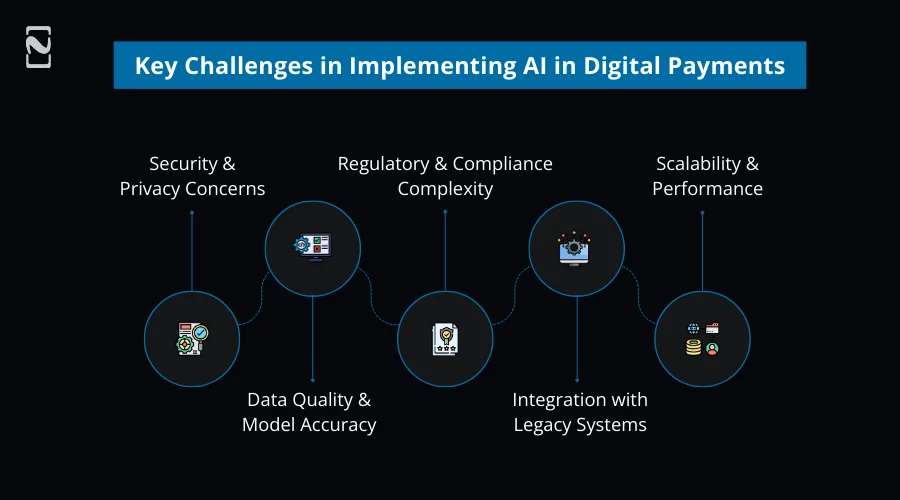
Challenge #1. Security & Privacy Concerns
Solution: Opt for privacy-by-design architecture, end-to-end encryption, and hardened AI models with adversarial protection.
Challenge #2: Data Quality & Model Accuracy
Solution: Financial institutions should implement centralized data governance and persistent model retraining through automated MLOps pipelines.
Challenge #3: Regulatory & Compliance Complexity
Solution: You can embed compliance frameworks like PCI-DSS, PSD2, GDPR, and Local financial regulations, and explainable AI models in your wallet architecture.
Challenge #4: Integration with Legacy Systems
Solution: Leverage API abstraction layers and microservices to modernize integration without disturbing existing systems.
Challenge #5: Scalability & Performance
Solution: Fintech firms should deploy lightweight AI models on auto-scaling infrastructure with event-driven processing.
Tip: Address these challenges to prevent regulatory penalties, increased fraud and revenue loss, limited scalability and innovation, and poor user experience and churn.
What’s Next for AI in Digital Payments?
Invisible, context-aware payments triggered by usage patterns and location; hyper-personalized offers; autonomous AI agents handling recurring payments and subscriptions; self-learning fraud prevention that adapts without manual rule updates; advanced behavioral biometrics replacing one-time verification; voice-first conversational payments; AI-driven open banking data orchestration; explainable, regulation-aware AI; and cross-border, multi-currency fraud and FX intelligence.
| This “autonomous AI payment agents” trend is already materializing faster than most 2026 forecasts expected – see our IoT in digital wallets guide for the specific protocols (Google’s AP2, Mastercard Agent Pay, and Visa’s Intelligent Commerce) already live in production as of 2026. |

What’s the Real ROI of AI in Digital Payments?
When you implement AI strategically, it delivers powerful returns. How?
Let’s go deeper to know!
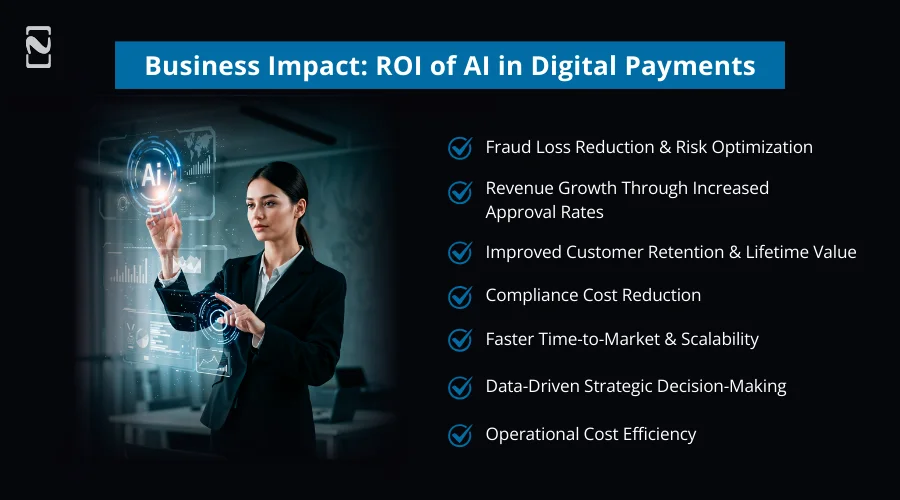
1. Fraud Loss Reduction & Risk Optimization
Compared to traditional rule-based systems, real-time AI fraud detection in digital payments recognizes suspicious activity rapidly and more precisely, notably diminishing financial losses and chargebacks.
ROI Impact: Improved margin safety and lower fraud-related costs.
2. Revenue Growth Through Increased Approval Rates
By distinguishing between fraudulent and legitimate transactions, AI-driven transaction scoring mitigates false declines, directly increasing authorization rates and leading to more successful payments with no higher risk.
ROI Impact: Increased recovered revenue and transaction volume.
3. Improved Customer Retention & Lifetime Value
By delivering tailored offers, rewards, and insights, AI-powered personalization boosts user engagement, which promotes repeat usage and lasting loyalty.
ROI Impact: Increased customer lifetime value (LTV) and higher retention rates.
4. Compliance Cost Reduction
Automated reporting and explainable AI streamline regulatory compliance, diminishing costly audits and penalty risks.
ROI Impact: Reduced regulatory risk and compliance expenses.
5. Faster Time-to-Market & Scalability
Without the need for ongoing manual reconfiguration, AI-enabled platforms quickly adapt to new regulations, market demands, and fraud patterns.
ROI Impact: Lower development costs and rapid innovation cycles.
6. Data-Driven Strategic Decision-Making
Predictive analytics enable smart investment and product decisions, offering insights into user behavior, transaction trends, and growth opportunities.
ROI Impact: Improved resource allocation and forecasting.
7. Operational Cost Efficiency
AI-powered automation, like dispute resolution, compliance monitoring, and chatbots, mitigates operational overhead and manual intervention.
ROI Impact: Lower support and compliance costs.
A Quick Overview of Bottom-Line Impact for Businesses
- Lower operational and compliance costs
- Higher transaction success rates
- Increased customer loyalty
- Reduced fraud and chargebacks
How Does Nimble AppGenie Build AI-Powered Digital Wallets?
As fintech app development increasingly leans on AI for fraud detection and personalization, the technical partner matters as much as the AI model.
Nimble AppGenie builds AI-enhanced eWallet platforms, predictive analytics for personalized user experience, and machine learning-based fraud prevention for fintech clients. Nimble AppGenie’s approach combines end-to-end wallet development, scalable and secure infrastructure, AI-first payment architecture, and regulatory-ready design.
Case Study: Fintech Digital Wallet Provider
Challenges:
- Need for a scalable, compliant infrastructure
- High false declines impacting trust and revenue
- Manual risk assessment and support workflows
- Rising fraud during high-volume transactions.
Nimble AppGenie’s Solution:
- AI-based real-time fraud detection and risk scoring
- PCI-DSS-compliant cloud-native architecture,
- Predictive analytics for churn prevention,
- AI-powered support chatbot, and
- Behavioral biometrics for continuous authentication.
Reported Outcomes:
- 45% drop in fraud-related losses
- 40% reduction in manual support tickets
- 25% increase in active user retention, and
- 30% improvement in transaction approval rates

Conclusion
AI in digital payments is not only about processing transactions; it’s about redefining how businesses gain customer trust and stay competitive.
Leaders should make decisions on whether to adopt AI for eWallet security, go for fintech legacy system modernization, or implement AI in payments.
Today, an increasing number of fintech startups fail without digital wallet AI features. So, enterprise digital wallet solutions powered by AI are essential to transform payments.
Contact Nimble AppGenie and build the future of digital payments with AI.
FAQs

Niketan Sharma, CTO, Nimble AppGenie, is a tech enthusiast with more than a decade of experience in delivering high-value solutions that allow a brand to penetrate the market easily. With a strong hold on mobile app development, he is actively working to help businesses identify the potential of digital transformation by sharing insightful statistics, guides & blogs.