

 Free Consultation
 PCI-DSS Compliant
 GDPR Ready
 ISO 27001
 NDA Protected
 AI Services
 AI App Development
 Generative AI Development
 AI Chatbot Development
 AI Integration Services
 AI Consulting Services
 AI For Fintech
 AI Financial Assistant Solution
 AI Insurance Agent Development
 Tech Stack
 OpenAI / GPT-4
 Claude / Anthropic
 Gemini / Google AI
 Llama / Open Source
 LangChain / LlamaIndex
 Pinecone / Pgvector
 AWS / Azure AI


 Fintech Solution
 Core Fintech
 App Development
 Neobank Solutions
 eWallet Solutions
 Lending Software
 Banking Solutions
 BNPL Solutions
 BNPL Solutions
 Insurance App
 Wealth Management
 Crypto & DeFi
 Blockchain Development
  Payroll Software
 DeFi Solutions
 Crypto Wallet
 Crypto On/Off Ramp
 Crypto Exchange
 Trading Platform
 Payments
 Compliance
 Regulations & Compliance
 Fraud Detection
 Lending Ecosystem
 P2P Lending Platform
 Mortgage Software
 Engagement
 Fintech Outsourcing

 Mobile Development
 Mobile App Dev
 iOS App Development
 Android App Development
 React Native
 Flutter Development
 Web Solution
 Node.js Development
 React.js Development
 Angular Development
 App Services
 UI/UX Design
 App Maintenance
 By Stage
 MVP Development
 Industry Solutions
 Healthcare App Dev
 Education App Dev
 Travel App Dev
 Real Estate App Dev
 Logistics Software
 Social Media App

 Hire Mobile Developers
 Hire iPhone Developers
 Hire Android Developers
 Hire React Native Devs
 Hire Flutter Developers
 Hire Web Developers
 Hire Node.js Developers
 Hire Angular Developers
 Hire PHP Developers
 Hire Laravel Developers
 How It Works
 Pre-Vetted Developers
 Ready In 48 Hours
 NDA From Day One
 Replace Guarantee
 Company
 About Us
 Our Work Process
 Portfolio
 Case Studies
 Blog / Insights
 Careers
 Contact Us
 Awards
 Recognition


 Offices



In a Nutshell
- You can create a social media app by evaluating the right features, learning about the target user, conducting design, selecting a tech stack, including AI, testing it, and then deploying it, considering maintenance and updates.
- The must-have features for your social media app are signing in, creating user profiles, including search and explore, posting content, and adding push notifications.
- An average cost to create a social media app ranges from $30,000 to $350,000, depending on factors such as the complexity of features, design, tech stack, and selection of developers.
- You can monetize the social media app through strategies like in-app purchases, in-app advertising, and a subscription model.
- The overall time taken to create a social media app varies from 6 months to 15 months.
- Connecting with Nimble AppGenie, a team of experts will help you convert the dream app into reality.
To create a social media app, all you need is the right process that begins with identifying the current market, selecting prompt features, designing the app, choosing a tech stack, deploying the app, and then opting for maintenance.
Well, this might seem simple to you, but it is no small feat.
The journey from ideation to app deployment and launch takes resources, and sometimes it can be a challenge, too.
In this era, there will be hardly anyone who does not have at least one social media app on their smartphone.
Thus, if you have an idea of a solid social media app, then it’s the right time to convert it into reality.
How!
Well, in this guide to social media app development, we will walk you through the steps, market research, key features, technology stack, reasons, cost, and even monetization strategies.
So, without any further ado, let’s begin.
What is a Social Media App?
A social media app is a platform that creates interactive digital experiences by allowing users to create, share, and consume content, globally connecting with people.
Whether the user is not at home, or living in a different country, social media has made it possible to get interected and in touch with others just by using the internet.
Yes, we know all are well aware of a social media app, but when it’s about creating one, the basics create your foundation.
Now, let’s not get into the details and learn the current market landscape of a social media app.
An Overview of the Social Media App Market
The size of the social media market cannot step back until there are audiences and consumers like you and me.
Hence, let’s take a glance at social media app statistics:
- The global social media networking app market is estimated at USD 49.09 billion in 2022, and is expected to reach USD 310.37 billion by 2030.
- An average smartphone user spends 2 hours and 20 minutes a day, or 70 hours on social media apps every month.
- Additionally, 55% of the population has social media accounts.
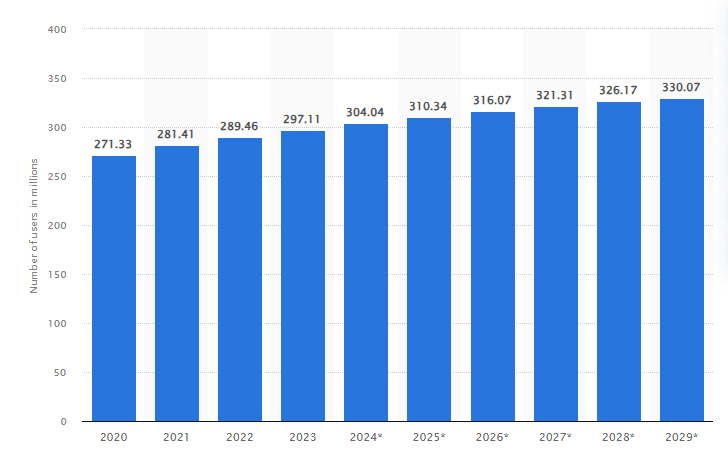
- Even in 2025, Facebook is the leading social media network worldwide with 3,070 million monthly active users, followed by 3000 million on WhatsApp, and 3000 million on Instagram.
- Europe is projected to witness a CAGR of 31.4% from 2023 to 2030.
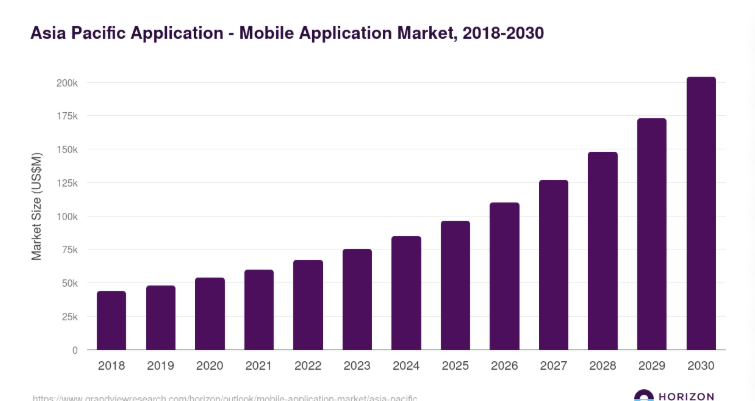
- Additionally, the mobile app market in the Asia Pacific is expected to reach a projected revenue of US $204,021.2 million by 2030.
Well, are you ready to invest in this growing market of social media?
If not, then let’s learn in the following section.
Why Create a Social Media App?
With the growing market share of social media, you can earn a high return on investment. Apart from this, you build user engagement, connect with brands that want to have their global reach, become a source of connecting people, and can be included in an entertainment medium.
Yes, all can be done with building a social media app. How!
Let’s discuss in detail:
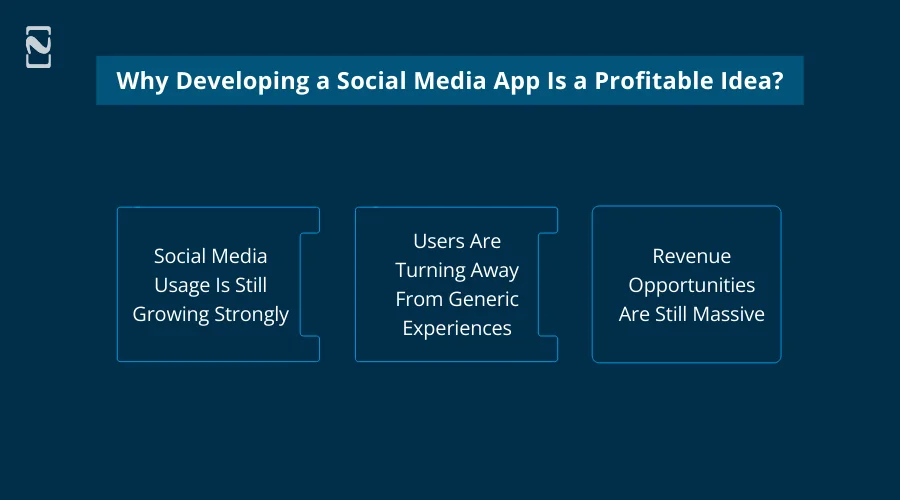
1. Social Media Usage is Still Growing Strongly
As we have already discussed, over 5.2 billion people globally use the top social media platforms. That’s a massive audience, and it’s one that is still growing. Even apps once considered mature, like Facebook and Instagram, continue to attract huge numbers.
Well, the growing market of social media is an important reason to create a social media app. This will not only help you to contribute, but also to engage a large audience.
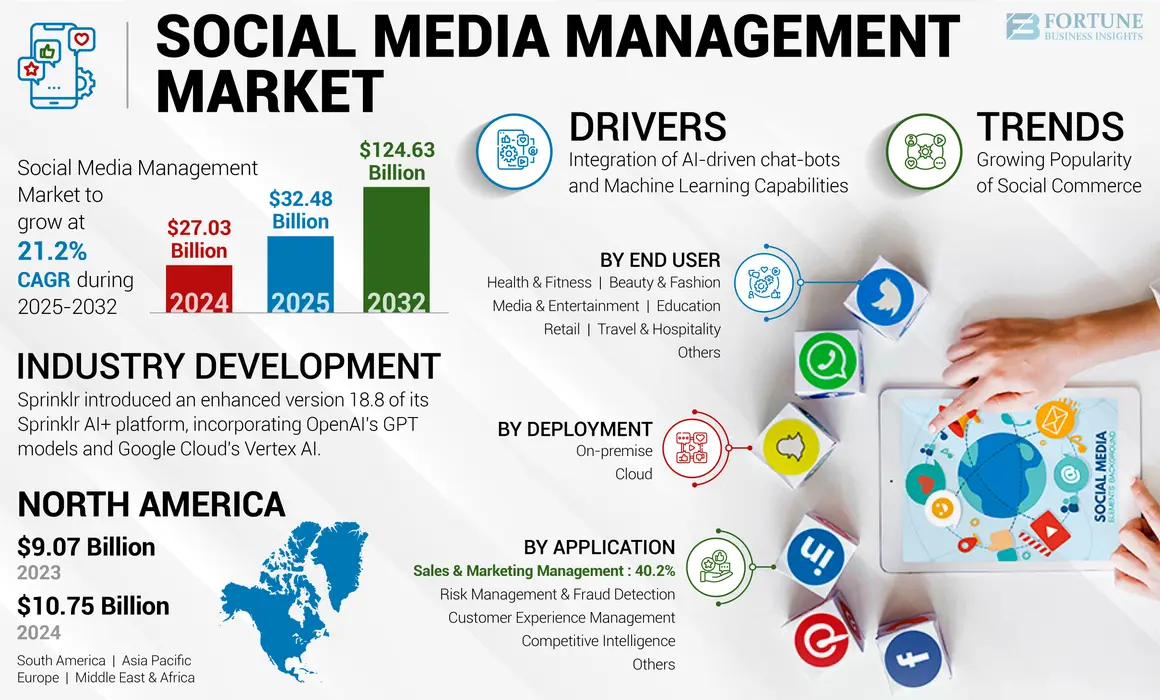
| The worldwide market size of the social media industry was worth $32.48 billion in 2025 and forecasted to hit $124.63 billion by 2032. |
These massive adoption figures mean there is still space for new players. It is especially those that focus on specific communities, niches, or user needs that mainstream apps do not serve well.
2. Users are Turning Away from Generic Experiences
While total user numbers are high, many social media apps face user frustration and dissatisfaction. For example, algorithms often prioritise ads or broad content over meaningful personal connections. Also, many people feel feeds are cluttered with irrelevant posts.
This shift is not just an opinion. It shows up in real usage trends that include how users engage with different types of content and how newer or niche apps attract particular audiences.
3. Revenue Opportunities Are Still Massive
Social media is not just about users. It is also about monetization power.
| Global social media ad spend is forecasted to reach around $275 billion in 2030. This accounts for nearly a third of all digital advertising revenue. |
Social commerce is booming with a growing number of users making purchases inside apps rather than on separate websites. About 61% of users now make purchases directly on social apps. It shows that social networking and e-commerce are converging rapidly.
This means your mobile application has multiple potential revenue paths like ads, subscriptions, in-app purchases, social commerce, and so on. Multiple monetization models spread risk and make your business strategy more resilient.
Well, when it’s about how to create a social media app, you cannot forbid the revenue opportunities it offers. Thus, it should be considered as an important reason here.
Market Gaps in Mainstream Social Media Applications
These frustrations reveal clear opportunities for a new social media application :
- Niche communities: Users want spaces tailored to their interests. For example, fitness, hobbies, or professional networks. You can provide AR VR in social media apps like AR-based city guides or virtual tours.
- Privacy-focused experiences: People are seeking ad-light, safe platforms where data is not exploited.
- Hyper-local engagement: Localized platforms for neighborhoods, cities, or specific regions are still underrepresented.
- Creator-first platform: Many creators feel underserved in terms of monetization.
- Meaningful connections: Users want platforms that foster real interaction instead of passive scrolling.
By targeting these gaps, you can develop a social media app that can stand out from big players, attract loyal users, and create a sustainable business model.
Can a Social Media App Succeed Today?
The social media market may seem saturated, but new apps can still find success when they focus on the right strategies and user needs.
Let’s check out why launching a new social media app in 2026 is still possible :

1. Niche Positioning Matters More Than Ever
Validating your idea at this stage ensures your app addresses real user needs and avoids common pitfalls that many new social media apps encounter.
Popular apps like TikTok or Facebook dominate broad audiences, but users are increasingly moving toward niche communities. Apps that focus on particular interests, professions, or local groups are seeing higher engagement per user compared to general social networks.
For example, a fitness-focused social app may attract fewer users than Instagram, but those users are highly engaged. They spend more time daily and interact with each other very frequently.
2. New Apps Can Attract Users by Solving Real Problems
Although major apps have billions of users, many do not meet all user expectations.
People are frustrated with :
- Irrelevant content in feeds
- Privacy concerns
- Lack of meaningful interactions
A new mobile app that directly addresses these frustrations can capture attention and retain users more effectively than one that simply copies mainstream features.
What are the Types of Social Media Apps?
There is no single type of social media app that fits all users. Different apps serve different purposes, and choosing the right category is the foundation of your app’s success.
As you evaluated the different types of social media apps, let’s get ahead with answering the features to include in a social media app.
Let’s have a look at the following so that you can decide which type of app you want to develop :
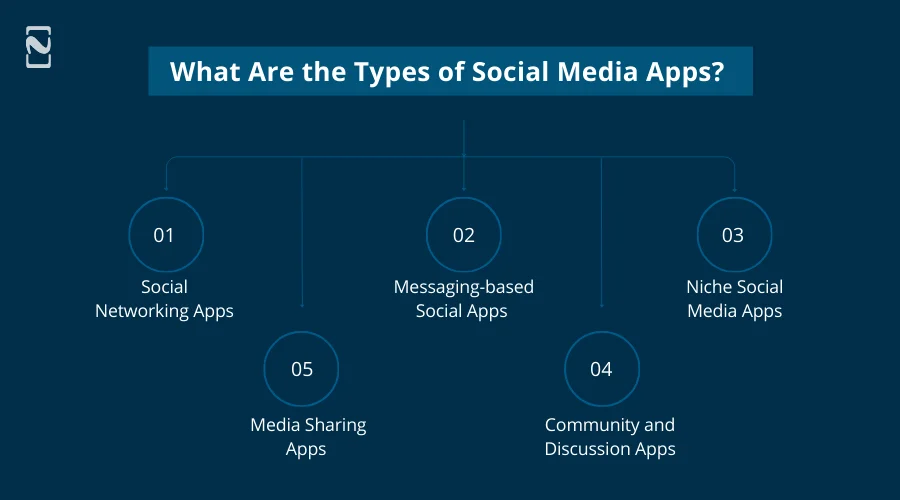
1. Social Networking Apps
These are the most common types of social media apps. They help users connect with friends, family, or professional contacts. For example, apps like Facebook or Instagram allow profile creation, friend requests, status updates, and private messaging.
These apps are best suited for building long-term relationships and large user bases.
Best for: General users, professionals, brands
Core Focus: Connections and communication
2. Media Sharing Apps
Media sharing apps like Instagram and Snapchat are designed for sharing photos, videos, and live content. They are highly visual and focus on creativity and entertainment.
These platforms usually include features like filters, editing tools, reels, and story formats. User engagement mainly depends on content quality and algorithm-based recommendations.
Best for: Creators, influencers, brands
Core focus: Visual content and engagement
3. Messaging-Based Social Apps
Messaging apps like WhatsApp focus on private or group communication. While some are simple chat apps, others include social features like status updates, channels, or communities. Security and speed play a major role in these apps, especially when users share personal information.
Best for: Direct communication
Core focus: Real-time messaging and privacy
4. Community and Discussion Apps
Community and discussion apps like Reddit or Quora bring people together based on shared interests, questions, or topics. Users participate in discussions rather than personal networking. Content moderation and topic organization are vital in such apps to maintain quality conversations.
Best for: Knowledge sharing and niche communities
Core focus: Discussions and engagement
5. Niche Social Media Apps
Niche social media apps are built for a specific audience, like fitness enthusiasts, travelers, gamers, or professionals in a particular industry. Since they serve a focused group, niche apps often have higher engagement and loyalty compared to general platforms.
Best for: Targeted audiences
Core focus: Specialized features and community value
Must-Have Features For Your Social Media App
Creating a social media app includes selecting the right features.
Let’s learn the complete social media app features in the table below:
How to Create a Social Media App?
You can create a social media app by following the given steps:
- Idea Validation & Market Research.
- Planning Features and User Flow.
- Create a UI/UX Design.
- Backend and Frontend Development.
- Test and Launch the App
So, do not skip the step-by-step process to build a social media app, and let’s get into its details:

1. Idea Validation and Market Research
Before you develop a social media app, it is vital to validate your idea to ensure it solves real problems and attracts users. Many apps fail simply because they were never tested with the audience they intended to serve.
Validation helps you save time, reduce costs, and increase chances of success. After this, mobile app market research is critical. You should analyze competitors, study user reviews, and identify trends in your niche.
You can create a social media app after evaluating what the market has to offer, its dynamic audiences, and how you can connect with them.
2. Planning Features and User Flow
Once your idea is validated, it is vital to map out the social media app’s features. You can start with must-have features and later on add the advanced features like AI-powered recommendation, push notification, etc.
After listing features, you must create a user flow diagram showing how people will navigate the app. A clear flow reduces confusion and improves user retention.
Also, don’t forget to prioritize features into MVP and optional enhancements. When you launch with an MVP, it allows you to test the market faster and gather user feedback before scaling with advanced features.
3. Create a UI/UX Design
Mobile app design is critical in social media apps since users spend hours interacting with the interface. A visually appealing and intuitive design improves engagement.
UI focuses on visual elements like buttons, icons, and color schemes. However, UX ensures smooth navigation and easy interactions. Designers typically begin with a mobile app wireframe and interactive prototypes to visualize screens.
This enables users and early testers to offer feedback that reduces costly design changes during social media app development. It is vital to incorporate user-centric design to ensure higher adoption rates from day one.
4. Backend and Frontend Development
To develop a social media app, the frontend and backend are the main parts of it. Once your designs are ready, the dedicated development team begins to code the app. Frontend development handles the app interface, animations, and user interactions.
However, the backend development handles databases, server logic, content management, and security. A strong backend is vital for real-time updates, notifications, and high user traffic.
During social media app development, APIs are integrated to enable features like social login, video streaming, and third-party analytics. Social mobile app security is of the utmost importance. So, it is crucial to implement security measures to protect user data.
| Development Layer | Technologies | Description |
| Frontend (Web) | React.js, Angular, Vue.js | Used to build interactive and responsive user interfaces. |
| Mobile Development | Flutter, React Native, Swift, Kotlin | Frameworks and languages for building iOS and Android apps. |
| Backend | Node.js, Django, Ruby on Rails, Laravel | Handles business logic, APIs, and server-side operations. |
| Database | PostgreSQL, MongoDB, MySQL | Stores user data, posts, messages, and application data. |
| Cloud & Hosting | AWS, Google Cloud, Microsoft Azure | Provides scalable infrastructure, storage, and hosting. |
| Real-Time Communication | WebSockets, Firebase, Socket.io | Enables live chat, notifications, and real-time updates. |
| Media Storage & CDN | Amazon S3, Cloudflare, Firebase Storage | Manages image/video storage and fast content delivery. |
| Authentication & Security | OAuth, Firebase Auth, JWT | Secures user authentication and protects user data. |
| Analytics & Monitoring | Google Analytics, Mixpanel, Firebase Analytics | Tracks user behavior and app performance. |
5. Test and Launch the App
Mobile app testing ensures that the social media app works as intended. So, the QA performs multiple testing methods like functional, usability, performance, and security testing. Continuous testing during development prevents major post-launch issues.
Once testing is complete, your dream app is ready to launch. But the launch is just the beginning. You have to continuously maintain the app to fix bugs, update features, and improve performance.
Also, if you collect user feedback post-launch, it helps to prioritize improvements and plan new features. Connecting with a reputable mobile app maintenance service can help with regular updates, build trust, engagement, and long-term retention.
Well, when you are building a social media app in this era, you cannot ignore AI.
Hence, we have illustrated the role of AI in the following section.
Must-Have Features For Your Social Media App
Creating a social media app includes selecting the right features.
Let’s learn the complete social media app features in the table below:
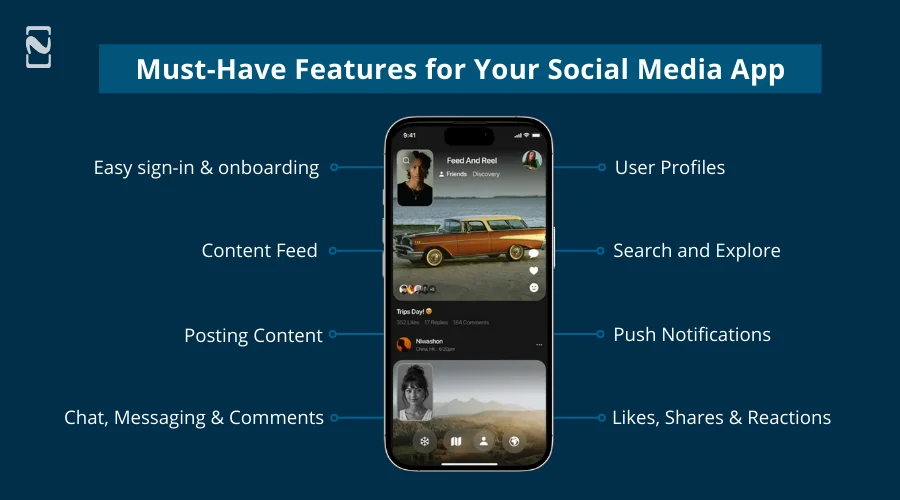
1. Easy sign-in and onboarding
Your social media app should allow users to easily register. You can allow them to sign up with an email, phone number, or through other social media accounts. Once they sign in, give a short tutorial that teaches them how the app works, so they don’t get confused.
2. User Profiles
User profiles allow users to show who they are. For example, their photo, bio, interests, etc., make the social media app feel personal. They should be able to change their information anytime, upload a profile picture, and control what others see about them.
3. Content Feed
The content feed is where users see all the posts from friends, followers, or topics they care about. This feed should be updated in real time and show relevant content first.
4. Search and Explore
Users should be able to look up people, groups, and content quickly. A powerful search bar that shows outcomes instantly makes the app feel easy to use. The explore section can show trending topics, popular posts, and suggested users.
5. Posting Content
Your social media app should allow users to post text, photos, videos, or audio. You can include elements like tags, hashtags, filters, and labels to make posts more interesting. The easier the posting feels, the more users will share their thoughts and creativity.
6. Push Notifications
Push notifications remind users to come back to your app. Whether it’s a new message, comment, like, or trending post, notifications help keep the app alive in users’ minds. Smart notifications make a big difference in engagement.
7. Chat, Messaging & Comments
Communication is the heart of social media. One-on-one chats, group messaging, and comments under posts help people connect. Users enjoy features like emojis, voice notes, and stickers in their conversations.
8. Likes, Shares & Reactions
When users can like, react, or share content, it increases activity. These small actions make people feel noticed and connected. Reactions help the app’s algorithm understand what people enjoy.
| Feature | Description |
| User Profiles | Allows users to create and manage personal profiles. |
| News Feed | Displays posts, updates, and content from connections or communities. |
| Post Creation | Enables users to share text, images, videos, and links. |
| Likes & Reactions | Lets users engage with posts through reactions or likes. |
| Comments | Allows users to discuss and respond to posts. |
| Real-Time Messaging | Supports private and group chats between users. |
| Push Notifications | Notifies users about messages, likes, comments, and updates. |
| Follow/Friend System | Enables users to connect, follow, or add friends. |
| Media Sharing | Allows uploading and sharing photos, videos, and other media. |
| Search Functionality | Helps users find people, content, or communities. |
| Groups & Communities | Enables users to create and join interest-based groups. |
| Privacy & Security Controls | Allows users to manage profile visibility and data protection. |
| Content Moderation | Tools for reporting, filtering, and managing inappropriate content. |
|
Hashtags & Trending Topics |
Helps categorize content and discover trending discussions. |
You should note that the list of features can change depending on the type of social media app.
With the features, now it’s time to learn “how to make a social media app?”
How AI is Transforming Social Media App Development?
AI helps you develop smarter social media apps by boosting engagement, personalization, automation, and insights for better business growth results.
Let’s have a look at the impact of AI :
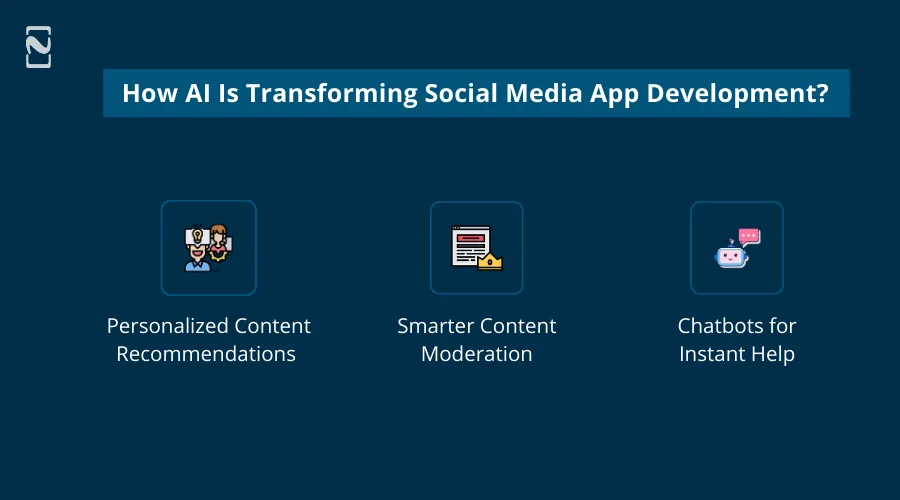
1. Personalized Content Recommendations
Artificial intelligence now controls around 70-80% of what people see in their social media feeds. This means instead of showing random posts, apps can earn what users like and show them content they care about.
For instance, if someone loves cooking videos, AI in social media apps will prioritise similar posts, recipes, or foodie influencers. This keeps users scrolling longer because everything feels relevant and tailored just for them.
Additionally, personalised feeds make users feel more connected to the social media app. Thus, to create a social media app, you need to include AI for improving engagement and loyalty over time.
2. Smarter Content Moderation
About 50% of social media apps now use AI to automatically find spam, fake profiles, or harmful content. AI works faster than humans, flagging inappropriate comments or posts before they spread.
However, humans still review tricky cases, and AI manages the majority that keep communities safer. This not only protects users but also builds trust in the platform.
When you create a social media app, it is important to ensure that a safer environment encourages more people to join and interact.
3. Chatbots For Instant Help
AI-powered chatbots now handle about 40% of customer support requests on social apps. They can answer simple questions instantly, guide users through app features, or help with account issues. This social media trend reduces wait times and improves user satisfaction.
Human teams focus on more complex issues while chatbots manage routine requests. For new users, AI chatbots also act like a mini-tutorial that helps them feel comfortable with the app from day one. This reduces drop-offs and increases user retention.
You should create a social media app by integrating chatbots for instant help. This will not only build the user trust, but also will foster instant solution of user’s issues.
How Much Does It Cost to Build a Social Media App?
The overall cost to build a social media app ranges from $30,000 to $350,000. It also varies depending on the complexity, platform, and the location of your mobile app development team. Most of the work goes into building the backend and frontend of the social media app.
Let’s learn the complete breakdown of costs in the case of social media app development:
| Development Factor | Estimated Cost Range | Description |
| Market Research & Planning | $3,000 – $10,000 | Identifying the target audience, competitors, and product strategy. |
| UI/UX Design | $5,000 – $25,000 | Designing user-friendly interfaces, wireframes, and prototypes. |
| Frontend Development | $10,000 – $70,000 | Building the user interface for web, Android, and iOS platforms. |
| Backend Development | $15,000 – $120,000 | Developing servers, databases, APIs, and core app functionality. |
| Real-Time Features | $5,000 – $40,000 | Implementing chat, live notifications, and activity feeds. |
| Media Upload & Storage | $3,000 – $25,000 | Handling photo/video uploads, compression, and cloud storage. |
| Security & Privacy Features | $3,000 – $20,000 | Data encryption, user authentication, and privacy controls. |
| Social media app Integrations | $2,000 – $15,000 | Social logins, analytics, payment gateways, and APIs. |
| Testing & Quality Assurance | $4,000 – $15,000 | Performance testing, bug fixing, and usability checks. |
| Deployment & Launch | $2,000 – $10,000 | App store submission, hosting setup, and initial release. |
| Maintenance & Updates | $5,000 – $50,000+ | Ongoing improvements, bug fixes, and feature updates. |
| Total Estimated Cost | $30,000 – $350,000+ | Depends on complexity, platforms, features, and the development team. |
You should note that every app is different and thus, its cost can vary according to the selection of features and functionalities.
With this, the mobile app development cost, another crucial parameter to learn is the timeline.
How Do Social Media Apps Make Money?
Social media apps make money through different methods, the first one to consider is advertising, subscription models, and in-app purchases.
Let’s discuss them in detail:
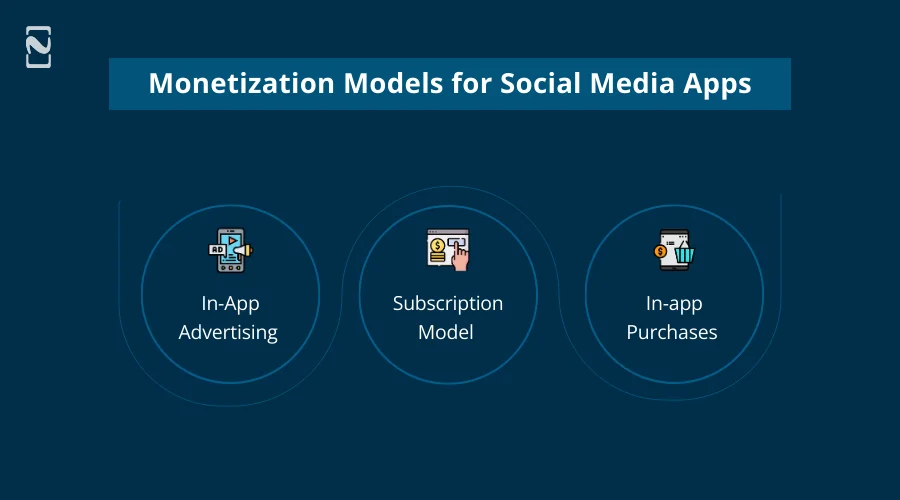
1. In-App Advertising
In-app advertising is one of the easiest ways to start earning from app monetization. Many businesses pay to display their products to your users, either as banners, videos, or posts in feeds.
The key is to make ads relevant and non-intrusive. Users do not like their feed cluttered with random promotions. So, you can show the right ad at the right time, which can help you make more money and keep users engaged longer.
2. Subscription Model
Subscriptions are becoming really popular in social media apps like Netflix or Amazon Prime. Users pay a monthly or yearly fee to access special content or features.
Some examples of premium benefits are no ads, exclusive videos or posts, advanced analytics for creators, and extra customization options. It is great because they create a predictable income and attract users who are willing to pay for better experiences.
3. In-App Purchases
The next monetization strategy you can implement is in-app purchases. They are small and have optional payments inside the app. Users buy items that improve their experiences or show off their personality.
For example, stickers, emojis, virtual gifts for other users, and special badges or profile highlights. This model works best if your app has active users who like to express themselves.
How Much Time Does it Take to Create a Social Media App?
The overall time taken to create a social media app varies from 6 months to 15 months, depending on the different factors such as skills and the location of the developers, complexity of the app, features, launch time, and platform selection.
In the given table, you can check the timeline of building a social media app:
| Development Phase | Timeline | Description |
| Research & Planning | 2–4 Weeks | Define app goals, target audience, features, and product roadmap. |
| UI/UX Design | 4–8 Weeks | Create wireframes, prototypes, and user-friendly interface designs. |
| Frontend Development | 8–16 Weeks | Build the app interface for web and mobile platforms. |
| Backend Development | 10–20 Weeks | Develop servers, databases, APIs, and core functionality. |
| Feature Integration | 4–8 Weeks | Implement social features like messaging, feeds, and notifications. |
| Testing & Quality Assurance | 3–6 Weeks | Conduct performance testing, bug fixes, and usability checks. |
| Deployment & Launch | 2–4 Weeks | Final optimization, app store submission, and public launch. |
| Total Development Timeline | 6 – 15 Months | Varies based on app complexity, features, and team size. |
How to Create a Social Media App: Nimble AppGenie’s Experience
We know that social media app development can feel overwhelming, right from ideation to launch. As a trusted social media app development company, we make this really simple by combining strategy, design, and technology.
Our main focus is on creating smooth navigation, intuitive interfaces, and engaging features for better user retention. One of the best examples of our work is MM Arcade, a gaming and social networking app that mixes fun and competition with social interaction.
MM Arcade: Gaming & Social Networking App Case Study
Client Type: Mobile gaming and entertainment app named MM Arcade.
Challenges: Low user interaction, minimal content participation, and slow prize distribution.
Solutions Implemented :
- Real-time content updates and push notifications
- Gamified challenges with weekly cash prizes
- In-app wallet for instant reward management
- Anonymous voting for fair and private participation
Business Results :
- 40% increase in active users
- 55% higher contest engagement
- 40% Faster prize processing
- Boosted community interaction and retention
Key Takeaway :
MM Arcade successfully blended gaming and social networking, increasing engagement and loyalty while streamlining contest management and reward distribution.

Conclusion
Well, to create a social media app, all you require is the right guidelines and steps. This all begins with conducting the market study, selecting prompt features, designing the app, selecting the tech stack, testing, and deployment.
However, you should evaluate the right features and resources in terms of cost and timeline to convert your idea into success.
Always remember, success is not just about attracting users; it is about keeping them engaged and coming back. So start smart, iterate based on feedback, and build the next-gen app that truly connects people.
FAQs
To build a social media app, you have to follow the roadmap given below :
- Know your target audience.
- Do market research.
- Plan out the core features.
- Choose the right social media tech stack.
- Create the UI/UX design.
- Develop an MVP version.
- Test and launch the app.
- Promote and maintain it.

Niketan Sharma, CTO, Nimble AppGenie, is a tech enthusiast with more than a decade of experience in delivering high-value solutions that allow a brand to penetrate the market easily. With a strong hold on mobile app development, he is actively working to help businesses identify the potential of digital transformation by sharing insightful statistics, guides & blogs.
Table of Contents




No Comments
Comments are closed.