


In a Nutshell:
- A payment gateway is a secure digital bridge that encrypts and transmits payment data between customers and banks.
- You can create your own payment gateway that offers total transaction control, lower long-term costs, and global market expansion.
- Key benefits include faster processing, enhanced security, rich data insights, and additional revenue streams.
- The development process involves 8 steps, beginning from planning and bank partnerships to testing and ongoing support.
- Development cost varies from $20,000 to $250,000+, based on complexity, security requirements, integrations, and team expertise.
- The build timeline ranges from 4 to 18 months, with regulatory approvals being the biggest bottleneck.
- Major challenges include security compliance, technical complexity, real-time fraud detection, and high false positives.
- Partner with Nimble AppGenie and build your own payment gateway in simple steps and under professional guidelines.
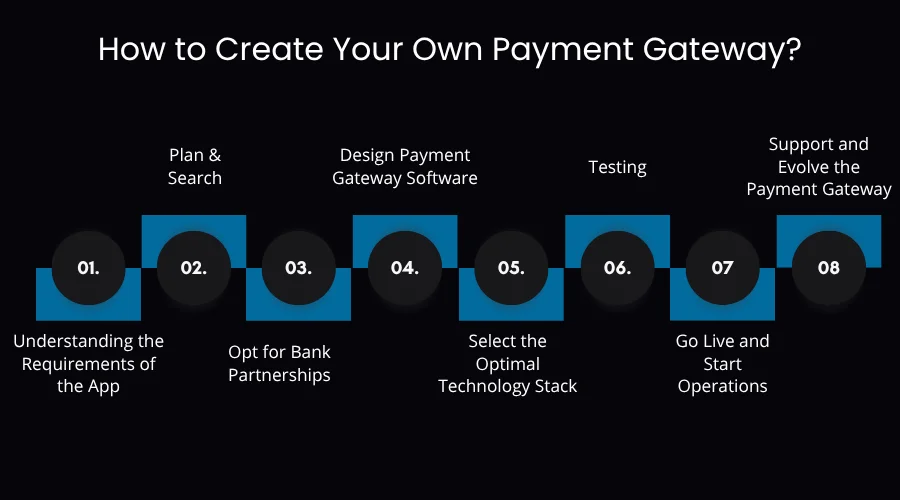
You can create your own payment gateway by understanding the requirements of your app, planning, opting for bank partnerships, designing the payment gateway, selecting the core technologies, testing the app, going live, and then supporting the payment gateway.
Well, this can look complicated, but it isn’t.
With the right team of developers, you can build your payment gateway seamlessly.
In this process of designing and developing, there are several other determinants that you should consider, such as cost and time, reasons, benefits, and challenges.
Here, we have covered it all in this guide to build your own payment gateway from scratch.
Without any ado, let’s begin.
What is a Payment Gateway?
A payment gateway is a technology that serves as an intermediary for online transactions, connecting the customers and businesses with their banks. This technology allows for authorizing credit cards and digital payments.
Basically, it is a digital bridge that transfers the payment information from a user to the bank and then returns a confirmation.
Now, let’s look at its working process and key functions in brief.
How Does a Payment Gateway Work?
- Step 1: The user enters the card details at the checkout page of a website or an app.
- Step 2: The payment gateway encrypts this data for security purposes.
- Step 3: The gateway sends the request to the payment processor and issuing bank.
- Step 4: The bank approves or declines the request.
- Step 5: The Gateway sends the results back to the merchant, and then the transaction completes.
Well, if you are considering a payment gateway and mobile payment technology, then they are not; they can be considered as complementary components, but are not the same.
The payment gateway is a secure bridge, while payment technology is a method through which consumers use this technology for initiating payments.
Now, let’s learn the role of a payment gateway, below:
What’s the Role of a Payment Gateway?
The role of a payment gateway is to:
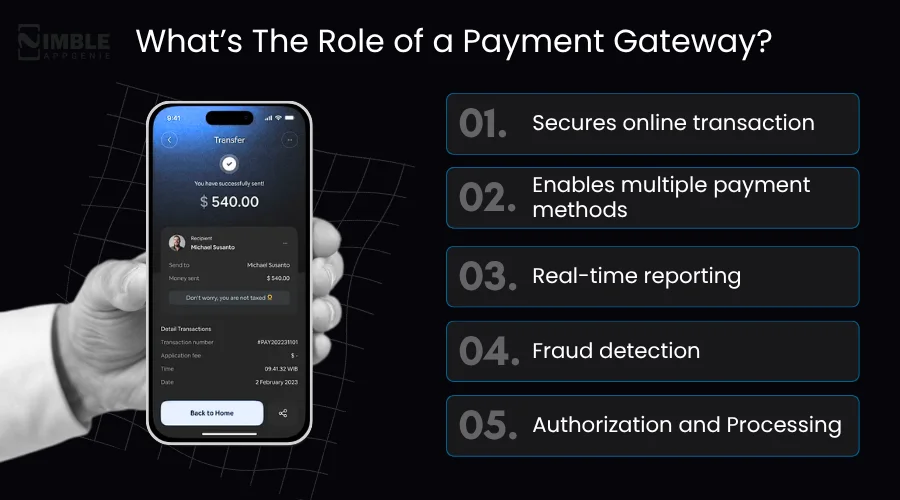
- Secures online transaction
- Enables multiple payment methods
- Real-time reporting
- Fraud detection
- Authorization and Processing
Now, as you are aware of what a payment gateway is, let’s learn why you need one.
Why Create Your Own Payment Gateway?
The major reasons behind creating your own payment gateway are that it offers you total transactional control, a significant reduction in the long-term transaction costs, improves user experience, and offers better market expansion.
Additionally, the market size of payment gateway is estimated at USD 48.17 billion in 2025, that is projected to reach USD 245.71 billion by 2033.
Well, if you are still confused about “can you build your own payment gateway?” then let’s discuss the complete list of reasons here.
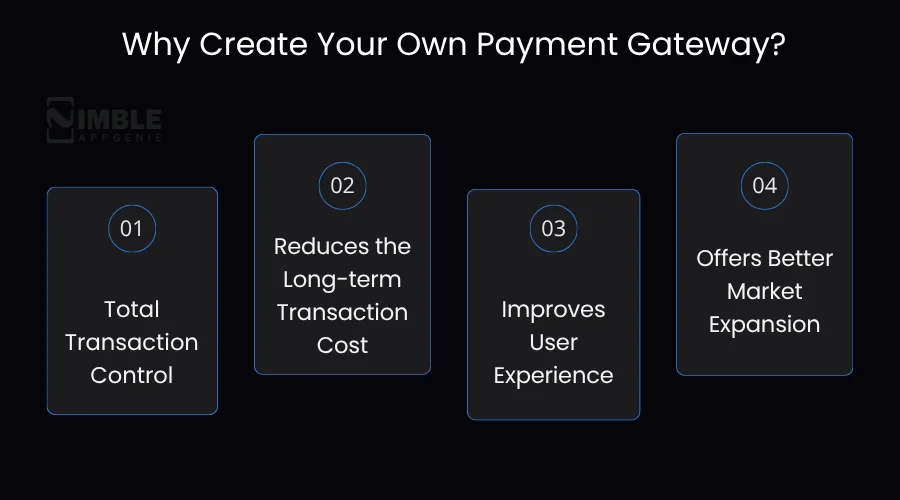
1. Total Transaction Control
Building your own payment gateway can offer you complete control over transactions. It offers total control by acting as a secure intermediary that helps to encrypt secure data, authorises payments, and manages the entire flow of transactions.
This means you can quickly control the issues led by payment gateways, without following a channel or relying on a third party.
2. Reduces the Long-term Transaction Cost
For local businesses or firms looking to start their own venture, investing in a third-party payment gateway integration may seem feasible, but it will increase their costs in the long run.
However, if you create your own payment gateway, it will save long-term costs and reduce the fees charged by third-party gateways.
3. Improves User Experience
A faster-streamed and secure payment gateway will offer users a seamless checkout experience. This can enhance trust among users through encryption and tokenization.
Furthermore, it creates a smooth and error-free transaction flow. When you build a fintech super app or simply a fintech app, ensure that it enhances user experience through its payment gateway channel.
4. Offers Better Market Expansion
When you build your own payment gateway, it will allow businesses to accept global payments, support multiple currencies, and allows to integrate with the diverse payment network.
Additionally, in some of the regions, the payment gateway might not support the local payment currencies. Hence, your own payment gateway will reduce all these issues and help you to increase user satisfaction.
Now, let’s discuss the circumstances under which you should opt for a custom payment gateway in the following section.
When to Opt for a Custom Payment Gateway?
You should opt for a custom payment gateway in the given circumstances:
- You need a payment gateway to support the required payment method, comprising crypto payments and AI-fraud detection.
- If you want to earn an additional source of income, then monetize your payment gateway by allowing other companies to use it for free.
- In case you want a smooth and cost-effective integration with your existing software.
Now, let’s look at the complete list of benefits to build your own payment gateway in the given section.
Benefits of Creating Your Own Payment Gateway
The key benefits of opting for your own payment gateway are quicker processing of transactions, real-time authorization, improved security, and optimized routing.
Let’s discuss all the benefits below:
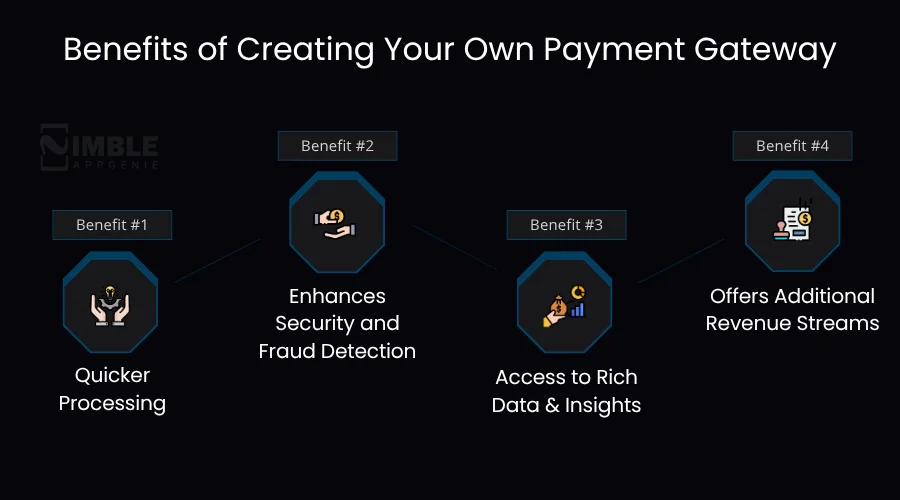
1. Quicker Processing
Through payment gateways, you can connect with the automated processes for handling transactions that are faster than any kind of manual processing.
This further helps to automate the entire transaction flow from encryption to the bank authorization. It is one of the important fintech app features.
2. Enhances Security and Fraud Detection
The payment gateways enhance mobile app security through offersing an integrated security protocols. It ensures socket layer security for the user’s data.
Furthermore, the payment gateway secures the Secure Sockets Layer (SSL) technology and encrypts the data between the customer’s browser and the payment gateway with advanced encryption technology.
3. Access to Rich Data & Insights
Building a payment gateway can offer access to rich data and insights from the users through integrating, governing, and analysing the diverse data sets. It helps to move from raw information to proactive and actionable insights.
Payment gateways capture real-time customer behavior, with preferred methods that allow merchants to optimize and improve the user experience.
4. Offers Additional Revenue Streams
The payment gateway generates additional revenue through offering any value-added services such as premium fraud protection, recurring billing tools, and advanced analytics.
Thus, mobile app monetization is one of the important benefits of creating your own payment gateway in this competitive environment.
Now, as you are clear with the benefits of building your own payment gateway, let’s discover the procedure of building one in the following section.
How to Create Your Own Payment Gateway?
You can build your own payment gateway by:
- Step 1: Understanding the Requirements of the App
- Step 2: Plan & Search
- Step 3: Opt for Bank Partnerships
- Step 4: Design Payment Gateway Software
- Step 5: Select the Optimal Technology Stack
- Step 6: Testing
- Step 7: Go Live and Start Operations
- Step 8: Support and Evolve the Payment Gateway
Let’s study them all in detail below:
Step 1: Understanding the Requirements of the App
- Understand the requirements of the app through gathering, analyzing, and documenting what the app must perform.
- Define the scope of your app, clarifying what the app will do
- Identify the target users and document the functional needs.
- Evaluate the current market, its size, and the number of people leading the market.
- Identify the existing gap in the market.
Step 2: Plan & Search
- Identify what your target audience is, what they want, and how frequently they switch between bank apps and other payment gateways.
- This will help you to evaluate the need of the market, and how they are responding to the present competition.
- And how creating a payment gateway can make a difference.
- You can even hire dedicated mobile app developers who can plan and search on your behalf for building a payment gateway.
Step 3: Opt for Bank Partnerships
- Establish bank partnerships by acting as crucial technology intermediaries for the banks.
- Connect with different banks, financial institutions, and credit card companies to build strong relationships.
- Evaluate the compliance practices in detail to build effective bank partnerships.
- It means that forming partnerships with these institutions is a complex process. However, for an innovative and hardworking entrepreneur, it’s just a piece of cake.
Step 4: Design Payment Gateway Software
- Perform an API design through interacting with the payment gateway and infrastructure.
- You should design the primary mode to initiate and manage the money movement.
- Furthermore, it’s crucial to proceed with the multi-stage payment flow. Learning about the mobile app design guidelines can help here.
- It’s important to proceed with strict adherence to PCI DSS standards and strong encryption for the data set.
- Build a scalable architecture for processing online transactions.
Step 5: Select the Optimal Technology Stack
- Select an optimal mobile app technology stack by balancing project requirements, team expertise, scalability, and cost.
- Here is the table to check out core technologies to use for building a payment gateway:
| Layer | Technology / Tools | Purpose |
| Frontend | React, Angular, Vue.js | Secure and responsive checkout UI |
| Backend | Node.js, Java (Spring Boot), Python (Django) | Handle transactions, APIs, and business logic |
| Database | PostgreSQL, MySQL, MongoDB | Store transaction records, users, and logs |
| Payment Processing | Banking APIs, Card Networks (Visa, Mastercard) | Process and authorize payments |
| Security | SSL/TLS, Tokenization, Encryption (AES, RSA) | Protect sensitive payment data |
| Authentication | OAuth 2.0, JWT, 2FA | Secure user identity and access |
| Compliance | PCI DSS standards | Ensure legal and security compliance |
| Fraud Detection | AI/ML models, rule-based engines | Detect suspicious transactions |
| Cloud & Hosting | AWS, Azure, Google Cloud | Scalable infrastructure |
| Monitoring & Logging | ELK Stack, Prometheus, Grafana | Track performance and detect issues |
| API Layer | REST, GraphQL | Enable integrations with merchants |
Step 6: Testing
- Mobile app testing is an important step when creating your own payment gateway.
- Conduct functional testing to evaluate the operations of transactions with different payment methods and credit/debit cards.
- To test the payment gateway, you should verify the functionality, security, and performance of online transactions for ensuring the authorized payments.
- It’s important to perform security testing, integration testing, performance testing, and user interface testing.
- Perform the test scenarios, such as a successful transaction, a declined payment, handling interruptions, and opting for amount accuracy.
Step 7: Go Live and Start Operations
- Monitor the transaction success rate and latency
- Opt for SLA agreements and support channels
- Perform gradual transactional handling
- Ensures data consistency and integrity
- It includes verifying the channel and starting the operations by ensuring a stable and fast connection.
Step 8: Support and Evolve the Payment Gateway
- Supporting and evolving a payment gateway means maintaining its daily reliability and support.
- Actively track the payment speed and system to prevent downtime and ensure uptime.
- Promptly resolve the errors, failed transactions, and glitches that cause checkout friction.
- Address the user bank and API issues to ensure seamless communication.
Well, in this complete process to create a payment gateway, one of the crucial determinants is the payment processor.
Let’s switch to the next section to learn what a payment processor is and how it is different from a payment gateway.
Payment Gateway Vs Payment Processor
A payment gateway is a customer-facing, secure “front door” that captures and encrypts the payment data on apps and websites. Basically, a payment gateway is a software that transfers the encrypted and tokenized customer data between the merchant’s website and the payment processor.
On the other hand, the payment processor is a third-party service provider that helps the merchants to accept credit/debit card payments through secure data transmission.
Let’s learn about their difference, to help you understand their importance for payment gateway and how these two terms vary.
| Aspect | Payment Gateway | Payment Processor |
| Definition | A technology layer that securely captures, encrypts, and authorizes payment data between the customer and merchant | A financial institution or service that executes the actual movement of money between the customer’s bank and the merchant’s bank |
| Primary Role | Data transmission & authorization | Transaction settlement & fund transfer |
| Function | Acts as a digital POS terminal that validates and forwards payment details | Acts as the middleman between banks, routes, and clears the transaction |
| User Interaction | Directly interacts with the customer (checkout page, payment form) | Operates entirely in the background, invisible to the customer |
| Data Handled | Card/payment details, encryption tokens | Transaction amounts, bank routing, settlement instructions |
| Security Focus | Encryption, tokenization, fraud detection, 3DS authentication | Compliance with banking regulations, interbank security protocols |
| Examples | Razorpay, PayU, CCAvenue, Stripe | Visa, Mastercard, RuPay, NPCI |
| Scope | Front-end of the payment flow | Back-end of the payment flow |
| Who Uses It | Merchants integrate it into their website/app | Banks and financial institutions use it internally |
| Analogy | The door that lets a transaction in | The road that carries the transaction to its destination |
Thus, it can be stated that the payment processor plays a crucial role in building your own payment gateway.
Basically, you cannot think of using a payment gateway alone, without including a payment processor in building a successful payment gateway.
Till now, we have discussed related to the payment gateway, its role, and the working process, now, lets move ahead with the complete cost to make your own payment gateway in the following section.
Read in Detail: Payment Gateway vs Payment Processor
What’s the Cost to Create Your Own Payment Gateway?
The complete cost to make your own payment gateway can vary from $20,000 to $250,000+, depending on the different types of payment methods and transaction protocols followed.
Other important factors influencing the cost to build your own payment gateway are security & compliance, MVP, Integrations, infrastructure & hosting, team expertise & location. Well, these factors are important in the case of mobile app development cost.
Let’s evaluate the complete cost to make your own payment gateway, and its breakdown in the given table:
| Cost Range | Development Stage | What’s Included | Suitable For |
| $20,000 – $40,000 | Basic / MVP | Simple API integration, basic checkout UI, minimal fraud detection, limited payment methods | Early-stage startups testing the concept |
| $40,000 – $70,000 | Starter | Hosted payment page, basic dashboard, webhook support, SSL/TLS encryption, sandbox environment | Small businesses launching a lite gateway |
| $70,000 – $100,000 | Intermediate | Tokenization engine, multi-currency support, merchant onboarding portal, basic analytics, 3DS authentication | Growing fintechs need a stable product |
| $100,000 – $150,000 | Advanced | Fraud detection (ML-based), mobile SDKs (iOS/Android), dispute management, PCI DSS compliance setup, UPI/wallet integration | Mid-size businesses targeting broader markets |
| $150,000 – $200,000 | Enterprise-Ready | Full security audit, real-time monitoring, multi-bank integration, acquiring bank partnerships, scalable cloud infrastructure | Enterprises handling high transaction volumes |
| $200,000 – $250,000 | Full-Scale Production | End-to-end custom infrastructure, proprietary fraud engine, regulatory licensing support, 24/7 ops team, global payment network certification | Large-scale payment platforms competing with Razorpay or Stripe |
Well, apart from the cost, another influencing factor that contributes to make a payment gateway is time.
Let’s evaluate the time to make a payment gateway in the following section.
How Long Does it Take to Build a Payment Gateway?
The time taken to build your own payment gateway from scratch can vary between 4 and 18 months, again depending on the complexity of the application.
This can even impact the total time taken to build your mobile app.
Let’s evaluate the time taken in the table listed below:
| Phase | Duration | Key Activities |
| Planning & Research | 2 – 4 weeks | Market research, business model definition, tech stack selection, and regulatory study |
| Legal & Compliance Setup | 4 – 8 weeks | Business registration, PCI DSS initiation, RBI licensing, KYC/AML policy drafting |
| Bank & Network Partnerships | 4 – 8 weeks | Acquiring bank tie-ups, Visa/Mastercard/RuPay certifications, NPCI (UPI) integration approval |
| Core Infrastructure Development | 8 – 16 weeks | Payment API, encryption layer, tokenization engine, database architecture, fraud detection setup |
| Frontend & Merchant Tools | 4 – 8 weeks | Checkout UI, merchant dashboard, onboarding portal, webhook system, mobile SDKs |
| Security & Compliance Audit | 3 – 6 weeks | Penetration testing, PCI DSS certification, vulnerability assessment, third-party security audit |
| Testing & QA | 3 – 6 weeks | Sandbox testing, end-to-end transaction simulation, load testing, bug fixes |
| Soft Launch & Beta | 2 – 4 weeks | Onboard beta merchants, monitor transactions, fix live issues, and gather feedback |
| Full Production Launch | 2 – 4 weeks | Public rollout, scaling infrastructure, activating support operations, performance monitoring |
Challenges in Building Your Own Payment Gateway
The key challenges that you might face in building your own payment gateway are security and compliance, technical complexity, and regulatory challenges.
Let’s evaluate the complete list of challenges to avoid creating your own payment gateway:
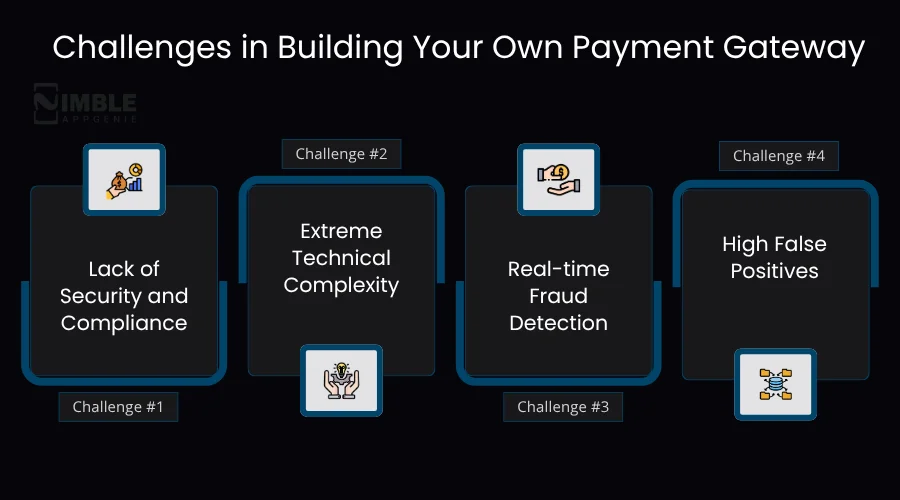
1. Lack of Security and Compliance
A payment gateway is a game of security; without an in-depth security protocol, you cannot ensure that the user’s data is safe. This is also a crucial mobile app development challenge while building your successful app.
This can create a high risk of data breaches, massive financial penalties, and a total loss of consumer trust.
2. Extreme Technical Complexity
When you build a payment gateway, it requires mastery across different advanced domains such as end-to-end encryption, real-time fraud detection, and secure API architecture.
Additionally, a single vulnerability and architectural flaw can compromise thousands of transactions, which makes a zero-error execution non-negotiable and will hamper your brand’s value and goodwill.
3. Real-time Fraud Detection
The real-time fraud detection do challenges the payment gateway development by requiring AI/ML models for analyzing the transactions in milliseconds. You can implement an AI fintech fraud detection system to effectively build the gateway.
Delay in processing the transactions can result in frustration among the users. The key challenges in building real-time fraud detection systems are latency constraints, high false positive rates, massive data volume integration, and resource complexity.
4. High False Positives
High false positives during the payment gateway development act as a crucial aggressive training set that assists the developers in mapping the boundary between fraudulent and legitimate behavior.
Additionally, analyzing the false positives is a challenge as it can damage the customer trust, directly erode revenue, and increase the operational costs with unnecessary manual reviews.
Well, the best practices to overcome these challenges to build your own payment gateway are following security compliances, considering fraud prevention, infrastructure and technical stability, and operational support.
If you are wondering about the right company to develop your payment gateway, then the following section is helpful.
Why Choose Nimble AppGenie as Your Payment Gateway Development Partner?
Partnering with a reputable and trusted company can help you become a leader in this segment.
Well, you do not need to stroll anywhere.
Nimble AppGenie is a leading fintech mobile app development company that is well recognized for delivering a secure and compliant payment gateway. The company ensures seamless cross-platform and scalable integrations for mobile wallets and banking applications.
This company offers a scalable and customized fintech solution that specializes in integrating payment APIs, digital wallets, and even blockchain technology development for seamless transactions.
Here, the key aspects comprise secure eWallet development, cryptocurrency integration, and decentralized technology integration.
The team understands the value of security protocols and regulations. It’s PCI-DSS compliant, deep fintech expertise, and security-first architecture create a secure, scalable, and AI-powered transaction system.
Nimble AppGenie specializes in delivering custom, high-speed, and secure mobile apps across iOS and Android with a focus on quick market entry.
Let’s learn its case study for more.
- Pay by Wallet: it’s a simple currency exchange app, effective for international transactions. This app comprises a secure payment gateway that helps to convert funds to desired currencies by connecting with banks and making transactions smooth.
- MaxPay: MaxPay is a secure payment gateway & wallet that is designed for betting & fantasy apps, and helps to keep the banking details safe. This app uses a payment gateway that connects banks to the users.
- CUT: The app is all about building a customized eWallet app for China & Myanmar. This app uses a payment gateway for opting for a secure transactions.
Conclusion
Building your own payment gateway is a complex yet rewarding endeavor that offers total transaction control, reduced long-term costs, and enhanced user experience. While challenges like security compliance, technical complexity, and real-time fraud detection demand significant expertise and investment, the benefits far outweigh the hurdles for businesses aiming to scale globally.
Careful planning across every phase, from legal compliance and bank partnerships to core development and testing, is essential for success. Partnering with an experienced and trusted mobile app development company can streamline the entire process, ensuring a secure, scalable, and compliant payment gateway tailored to your unique business needs.
FAQs

Niketan Sharma, CTO, Nimble AppGenie, is a tech enthusiast with more than a decade of experience in delivering high-value solutions that allow a brand to penetrate the market easily. With a strong hold on mobile app development, he is actively working to help businesses identify the potential of digital transformation by sharing insightful statistics, guides & blogs.
Table of Contents
No Comments
Comments are closed.