

 Free Consultation
 PCI-DSS Compliant
 GDPR Ready
 ISO 27001
 NDA Protected
 AI Services
 AI App Development
 Generative AI Development
 AI Chatbot Development
 AI Integration Services
 AI Consulting Services
 AI For Fintech
 AI Financial Assistant Solution
 AI Insurance Agent Development
 Tech Stack
 OpenAI / GPT-4
 Claude / Anthropic
 Gemini / Google AI
 Llama / Open Source
 LangChain / LlamaIndex
 Pinecone / Pgvector
 AWS / Azure AI


 Fintech Solution
 Core Fintech
 Fintech App Development
 Neobank App Development
 eWallet App Development
 Lending Software
 Banking Software Development
 BNPL Solution
 BNPL App Development
 Insurance App
 Wealth Management App
 Blockchain Development
 Payroll Software Development
 DeFi App Development
 Crypto Wallet Dev
 Crypto On Ramp Off Ramp
 Crypto Exchange Dev
 Trading Platform Dev
 Payments
 Compliance
 Fintech & Digital Regulations
 Fraud Detection
 Lending Ecosystem
 P2P Lending Platform
 Mortgage Software
 Engagement
 Outsourcing Dev

 Mobile Development
 Mobile App Dev
 iOS App Development
 Android App Development
 React Native
 Flutter Development
 Web Solution
 Node.js Development
 React.js Development
 Angular Development
 App Services
 UI/UX Design
 App Maintenance
 By Stage
 MVP Development
 Industry Solutions
 Healthcare App Dev
 Education App Dev
 Travel App Dev
 Real Estate App Dev
 Logistics Software
 Social Media App

 Hire Mobile Developers
 Hire iPhone Developers
 Hire Android Developers
 Hire React Native Devs
 Hire Flutter Developers
 Hire Web Developers
 Hire Node.js Developers
 Hire Angular Developers
 Hire PHP Developers
 Hire Laravel Developers
 How It Works
 Pre-Vetted Developers
 Ready In 48 Hours
 NDA From Day One
 Replace Guarantee
 Company
 About Us
 Our Work Process
 Portfolio
 Case Studies
 Blog / Insights
 Careers
 Contact Us
 Awards
 Recognition


 Offices


Key Takeaways:
- KYC API is a tool that lets apps verify user identities instantly. The key features are face matching, watchlist screening, and AML screening.
- The best KYC API providers are Trulioo, Persona, Veriff, Jumio, Onfido, Sumsub, ComplyCube, Alloy, Socure, and IDnow.
- KYC API is good for global fintech expansion because it verifies applicant identity, adapts the check to the country, returns enough evidence, and offers automated compliance.
- Nimble AppGenie is the leading API builder and can help you to build your dream API and connect your app with it.
As digital finance expands across borders, businesses need secure, fast, and compliant ways to verify customer identities. A KYC (Know Your Customer) API simplifies this process by automating identity verification through official databases, biometric authentication, document validation, and fraud screening.
Most of the startups and enterprises ask, “Who are the best KYC API providers?”
The best KYC API providers are Trulioo, Persona, Veriff, Jumio, Onfido, Sumsub, ComplyCube, Alloy, and Socure.
Instead of relying on time-consuming manual checks, fintech companies can onboard users in seconds while meeting global compliance requirements.
Whether you’re launching a fintech platform or scaling internationally, choosing the right KYC API can improve customer experience, reduce fraud risks, and streamline regulatory compliance.
This guide covers the list of the best KYC API providers and includes coverage, pricing, and compliance by region.
Let’s begin with the concepts first.
What is a KYC API?
KYC API is a digital tool that lets apps verify user identities instantly. It is an endpoint that verifies a customer’s identity in real time against various authoritative databases, including UIDAI and NSDL.
The key components of a KYC API are to verify user identities instantly, screen for fraud, and automate checks against official databases such as government records and watchlists to replace the slow paper forms.
In the current era, manual KYC processes are no longer sufficient. Businesses need to connect their apps to a payment gateway to automate identity verification, prevent fraud, and comply with the laws.
Key Features of KYC APP:
- Document scanning: Under this
- Face Matching
- Watchlist Screening
- AML/Watchlist Screening
Now, let’s have a check on how KYC APIs work.
How Do KYC APIs Work?

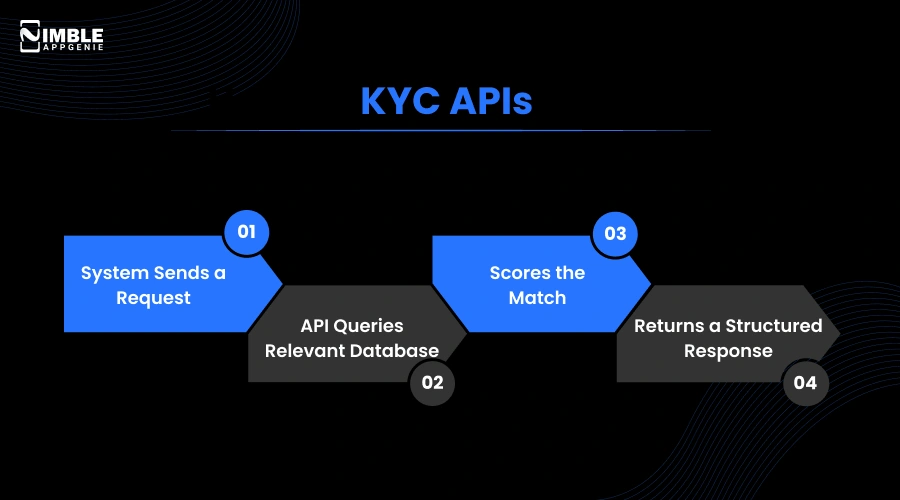
Step 1: System Sends a Request:
The system understands the need for KYC verification and sends the request to a dedicated RESTful endpoint hosted by a third-party KYC provider, an identity verification vendor, or a government database agency.
Step 2: API Queries Relevant Database:
The API queries a relevant database by taking a user-submitted input and translating it into a secure backend query that is further sent to match the third-party records and then returns a score.
Step 3: Score the Match:
The KYC API scores the match by cleaning the data and using specialized algorithms such as token alignment and phonetic matching.
Step 4: Returns a Structured Response:
After matching, the KYC API returns a structured response by parsing the raw data from official documents and then organizing it into the standard format like JSON.
Why KYC API Good for Global Fintech Expansion?
KYC API is good for global fintech expansion because it offers instant cross-border identity verification, automated multi-country regulatory compliance, and scalable fraud prevention.
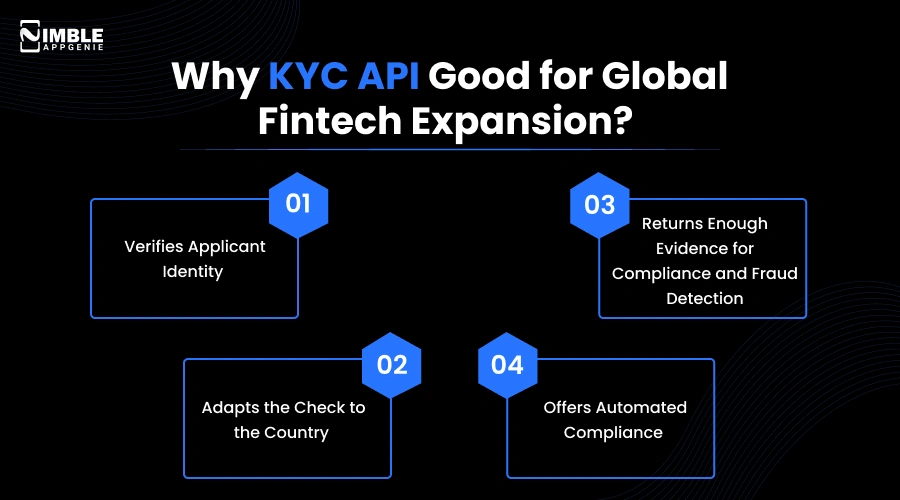
Here are certain reasons why KYC API is good for fintech expansion:
-
Verifies Applicant Identity
A KYC API verifies an applicant’s identity by processing data via document validation, biometric matching, and database cross-referencing.
KYC API is good for global fintech expansion because it securely connects your application to official data sources and then returns a real-time pass or fail result. This results in global fintech expansion.
-
Adapts the Check to the Country
The KYC API adapts its checks to a specific country by dynamically routing requests through regional data sources, adjusting document validation rules, and applying local regulatory compliance standards.
Through the checks, the KYC API handles document scanning, government database checks, and face matching. It further turns the days of paperwork into seconds of digital verification.
-
Returns Enough Evidence for Compliance and Fraud Detection
A good KYC API returns sufficient evidence for compliance and fraud detection by providing structured verification results, extracted field data, and concrete risk flags.
A KYC API is good for global expansion because it returns structured evidence for compliance and fraud detection.
-
Offers Automated Compliance
A KYC API offers automated compliance by using AI to validate documents, match biometrics, and screen global watchlists. The core automated features are document authentication, biometric matching, risk scoring, and continuous monitoring.
This is one of the crucial parameters due to which KYC API offers global fintech expansion.
Here, many startups and enterprises often ask, “What are the best KYC API providers?”
Well, there are many KYC API providers such as Trulioo, Persona, Veriff, Jumio, Onfido, and many others.
Let’s check out the complete list below.
Best KYC API Providers: Coverage, Pricing & Compliance
The best KYC API providers are Trulioo, Persona, Jumio, Veriff, Onfido, ComplyCube, Alloy, Sumsub, Socure, and IDnow.
Given is the list of the best KYC API providers:
1. Trulioo
Trulioo combines state-of-the-art technology and industry expertise across diversified markets worldwide for delivering the highest identity verification assurance that fosters trust in the global digital economy.
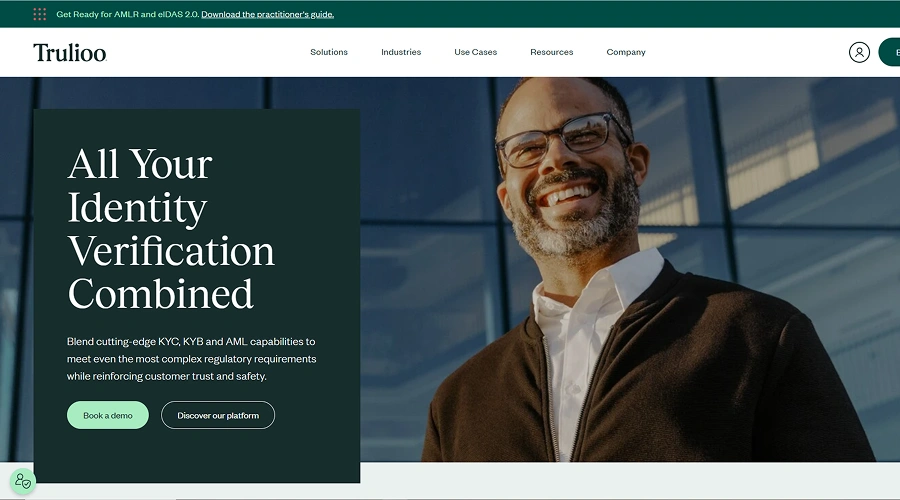
- Coverage: It accesses over 450 data sources and verifies over 5 billion consumers and 700 million business identities.
- Pricing: Trulioo does not have a fixed public price list; here, the software listings suggest a complete base subscription that starts around $99 per month.
- Compliance: Trulioo assists organizations in achieving regulatory compliance through offering effective tools for KYC, KYB, and AML mandates. Trulioo serves in over 195 countries and territories across North America, Latin America, Europe, the Middle East, and the Asia-Pacific (APAC) region.
2. Persona
Persona app compliance with the different guidelines, including GDPR, CCPA, and SOC 2 Type II. This is among the best KYC API providers that future-proof your compliance strategy. Ensure that your business meets shifting compliance requirements without adding any operational overhead.
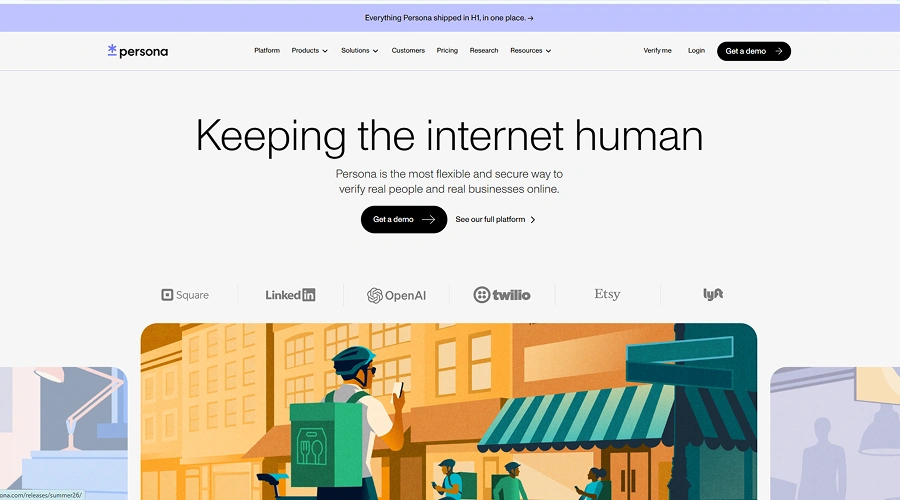
- Coverage: Persona offers global KYC and identity verification coverage across 200+ countries and territories, supporting 20 languages.
- Pricing: Persona offers tiered usage-based pricing starting at $250 per month, and includes 500 free verifications with additional checks that are billed around $1.50 per verification.
- Compliance: Persona offers automated compliance tools and follows stringent global security standards. The app offers highly customizable and rigorous compliance based on the different regions.
3. Veriff
Veriff is the best KYC API provider that protects your business while accelerating growth. This app protects users without killing conversion and meets every compliance standard with speed and accuracy.
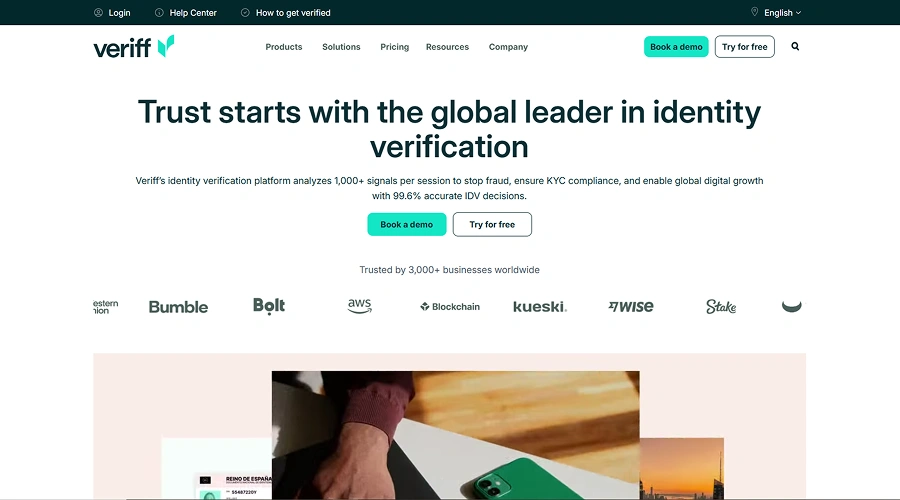
- Coverage: Veriff offers comprehensive global identity verification and KYC coverage for 230+ countries and territories. Here, you support over 12,500 government-issued ID document types in 50 unique languages and dialects.
- Pricing: Here, the price and plans start at a base price of $0.80 per verification with a $49 monthly minimum, scaling up to $1.89 per verification with a $209 monthly minimum.
- Compliance: Veriff supports regulatory compliance and data security through global AML and compliance tools, and third-party structural attestations.
4. Jumio
Jumio is among the best KYC API providers where the identity intelligence moves beyond yes-or-no decisions. It connects signals, adapts to risk, and turns the identity into an actionable insight. The company continuously evaluates identity across interactions and captures changes in behavior and risk, which helps it develop trust.

- Coverage: Jumio covers an end-to-end identity intelligence stack and offers support to more than 500 ID types across 200 countries and territories.
- Pricing: Jumio does not publish the self-serve pricing tiers for its KYC API; instead, the company relies on its custom quotes.
- Compliance: Jumio KYC API adopts a broad range of international compliance frameworks, security certifications, and data privacy regulations.
5. Onfido
Onfido is among the best KYC API providers 2026 that automates customer onboarding and biometric face matching. The company combines AI and human expertise to verify identities and ensure regulatory compliance.
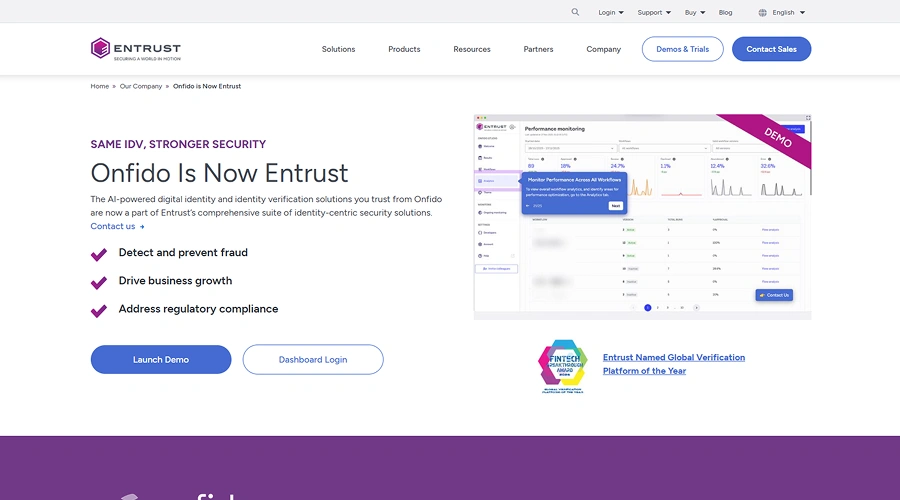
- Coverage: Onfido supports over 2500 document types such as passports, national IDs, driver’s licenses, residence permits, and work permits. This platform serves customers across multiple countries.
- Pricing: The company publishes a fixed, transparent public pricing sheet, and they use a sales-led, custom quote model based on specific verification volume and geography.
- Compliance: Onfido offers robust global regulatory alignment comprising KYC/AML frameworks and follows data privacy rules such as GDPR, and security certifications including ISO27001 and SOC 2 Type II.
6. Sumsub
Sumsub is among the best KYC onboarding API providers, where users can process the applicant data and documents submitted for verification via simple RESTful APIs. The company offers production and sandbox modes that are available via API.sumsub..com
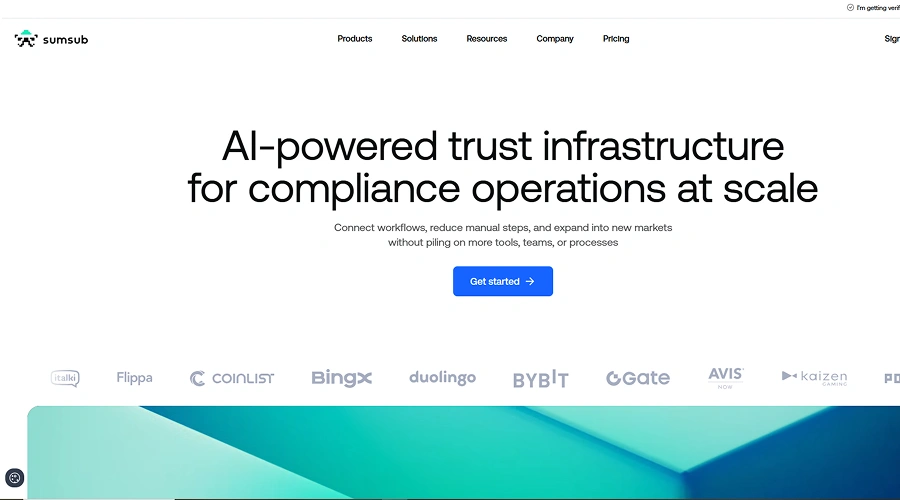
- Coverage: Sumsub’s KYC API covers global identity verification across over 220 countries and territories. The company supports over 14000 document types in more than 50 languages. Since the company was founded, the platform has processed over 200 million documents.
- Pricing: The pricing of Sumsub begins at a basic level of $1.35 per verification, and compliance at $1.85 per verification. For the customized service, this KYC API provider offers customized pricing.
- Compliance: Sumsub’s compliance strategy focuses on a full-cycle, AI-powered trust infrastructure and is based on core compliance pillars such as full-cycle verification, adaptive risk management, and specialized crypto and finance solutions.
7. ComplyCube
ComplyCube is a software platform that assists businesses in verifying user identities, stopping financial crimes, and following legal rules. This KYC API provider offers tools for KYC, AML checks, and fraud prevention.
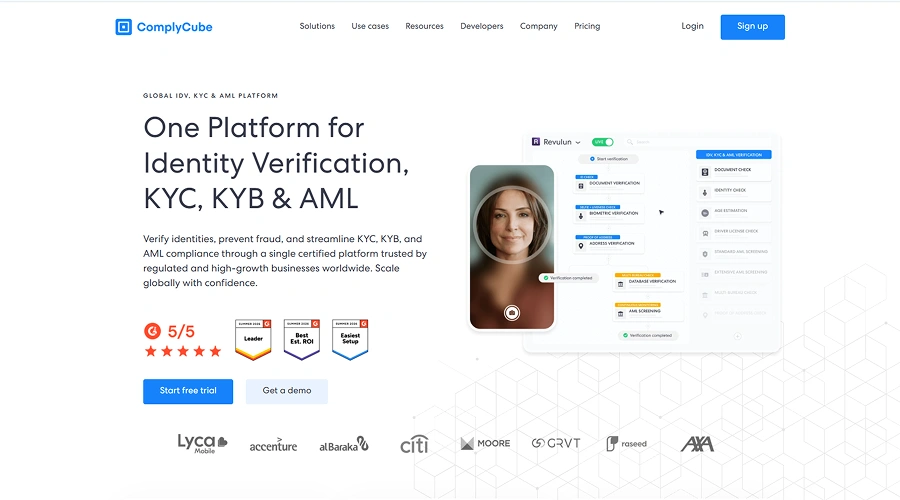
- Coverage: ComplyCube provides extensive global coverage across 220 to 250 countries and territories. This app supports more than 13000 distinct identity document types and multi-bureau checks in over 44 countries.
- Pricing: The starting plan will begin with $99 per month, the core plan is $299 per month, and for growth, they offer customized pricing.
- Compliance: ComplyCube offers global compliance coverage by combining different security frameworks, KYC/AML, KYB, and identity verification across international borders.
8. Alloy
Alloy is among the best KYC API providers that dive deeper into onboarding and offers effective security parameters to end users. The company ensures users have a secure gateway to connect with banks and provides them with confidence in every transaction.
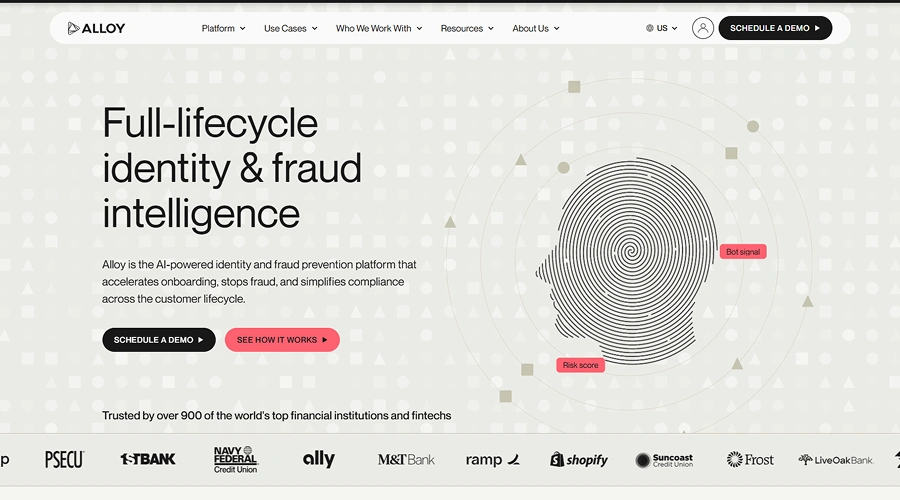
- Coverage: Alloy offers extensive KYC/AML coverage by acting as a single API provider and offering 270 third-party data solution partners. The company spans across 195 global markets.
- Pricing: The pricing models are typically estimated between $30,000 and $80,000+ per year. Here, the pricing depends on the transaction volumes and required data vendor integrations.
- Compliance: Alloy’s identity decisioning platform and APIs assist financial institutions and fintechs in automating the complete scope of KYC, KYB, and AML with an AI assistant that steps in to handle the completed cases. Perpetual compliance moves past static, point-in-time checks by running automated triggers and ongoing portfolio monitoring.
9. Socure
Socure is the leading provider of AI-powered digital identity verification and fraud prevention solutions that are trusted by the largest enterprises and government agencies to build trust and mitigate risk, anytime via customer lifecycle management.
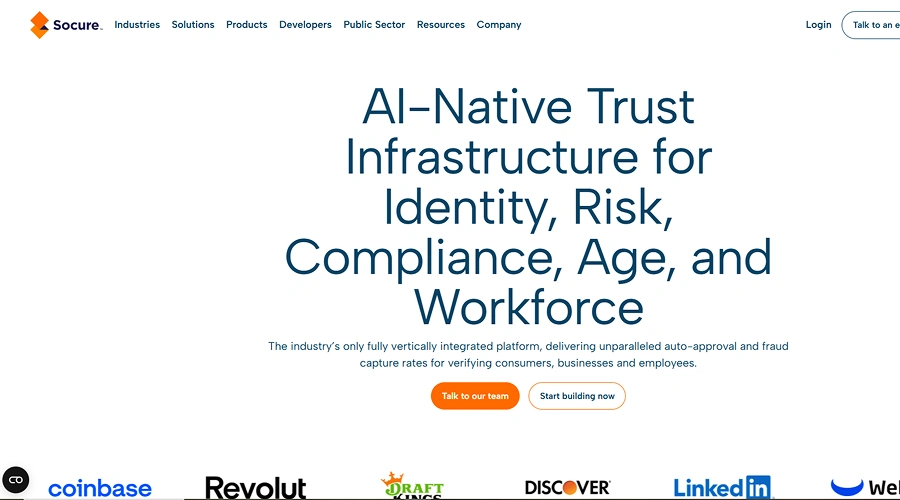
- Coverage: As a KYC API provider, Source covers an end-to-end suite of identity verification, regulatory compliance, and fraud risk assessments consolidated into a single RESTful API. Source covers more than 190 countries globally, offering local and cross-border identity verification, along with fraud prevention services.
- Pricing: Source KYC API provider does not publicly display a fixed or standard price list on its official website. All its prices are customized.
- Compliance: Source offers compliance solutions for KYC, CIP, and global watchlist screening. This framework assists organisations in fulfilling key regulatory mandates such as the Customer Identification Program (CIP), Anti-Money Laundering (AML), along with global sanctions screening.
10. IDnow
IDnow is a leading European platform for digital identity verification, fraud prevention, and electronic signatures. In today’s complex digital economy, trust is not a checkpoint; it’s a continuous advantage. The company delivers scalable, AI-powered identity solutions that help enterprises to stay ahead of fraud.
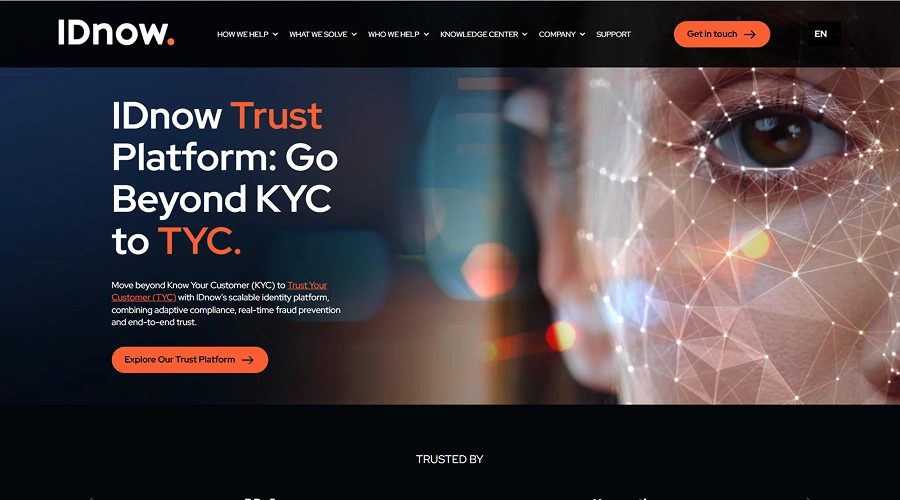
- Coverage: IDnow covers global identity verification, risk intelligence, and digital trust services. IDnow offers global geographic coverage, supporting identity verification documents from 193 to 195 countries worldwide.
- Pricing: KYC API provider costs range from roughly $0.10 to $5+ per check, depending on the depth of features and local data source access.
- Compliance: In today’s fast-evolving environment, compliance is not just a legal box to tick; it is a point that creates a major difference among businesses. With IDnow, you are not just keeping up; you are staying ahead with certified identity verification.
How Nimble AppGenie Offers API Solutions?
Nimble AppGenie offers custom API solutions via core strengths such as REST and GraphQL architecture, etc. Nimble AppGenie is the best Mobile App Development Company that helps businesses build their own APIs and scalable cloud-ready architecture.
The company builds custom digital solutions and offers effective fintech API integration services for fintech startups and firms.

Conclusion
The best KYC API providers are Trulioo, Persona, Veriff, Jumio, Onfido, Sumsub, ComplyCube, Alloy, Socure, and IDnow. These KYC API providers differ due to their coverage, pricing elements, and compliance practices.
KYC APIs are good for global fintech expansion because they verify applicant identity, adapt the check to the country, return evidence for compliance and fraud detection, and offer automated compliance.
FAQs

Niketan Sharma, CTO, Nimble AppGenie, is a tech enthusiast with more than a decade of experience in delivering high-value solutions that allow a brand to penetrate the market easily. With a strong hold on mobile app development, he is actively working to help businesses identify the potential of digital transformation by sharing insightful statistics, guides & blogs.
Table of Contents


No Comments
Comments are closed.