

 Free Consultation
 PCI-DSS Compliant
 GDPR Ready
 ISO 27001
 NDA Protected
 AI Services
 AI App Development
 Generative AI Development
 AI Chatbot Development
 AI Integration Services
 AI Consulting Services
 AI For Fintech
 AI Financial Assistant Solution
 AI Insurance Agent Development
 Tech Stack
 OpenAI / GPT-4
 Claude / Anthropic
 Gemini / Google AI
 Llama / Open Source
 LangChain / LlamaIndex
 Pinecone / Pgvector
 AWS / Azure AI


 Fintech Solution
 Core Fintech
 App Development
 Neobank Solutions
 eWallet Solutions
 Lending Software
 Banking Solutions
 BNPL Solutions
 BNPL Solutions
 Insurance App
 Wealth Management
 Crypto & DeFi
 Blockchain Development
  Payroll Software
 DeFi Solutions
 Crypto Wallet
 Crypto On/Off Ramp
 Crypto Exchange
 Trading Platform
 Payments
 Compliance
 Regulations & Compliance
 Fraud Detection
 Lending Ecosystem
 P2P Lending Platform
 Mortgage Software
 Engagement
 Fintech Outsourcing

 Mobile Development
 Mobile App Dev
 iOS App Development
 Android App Development
 React Native
 Flutter Development
 Web Solution
 Node.js Development
 React.js Development
 Angular Development
 App Services
 UI/UX Design
 App Maintenance
 By Stage
 MVP Development
 Industry Solutions
 Healthcare App Dev
 Education App Dev
 Travel App Dev
 Real Estate App Dev
 Logistics Software
 Social Media App

 Hire Mobile Developers
 Hire iPhone Developers
 Hire Android Developers
 Hire React Native Devs
 Hire Flutter Developers
 Hire Web Developers
 Hire Node.js Developers
 Hire Angular Developers
 Hire PHP Developers
 Hire Laravel Developers
 How It Works
 Pre-Vetted Developers
 Ready In 48 Hours
 NDA From Day One
 Replace Guarantee
 Company
 About Us
 Our Work Process
 Portfolio
 Case Studies
 Blog / Insights
 Careers
 Contact Us
 Awards
 Recognition


 Offices



Application Programming Interfaces, commonly referred to as APIs, are one of the most commonly used technologies in mobile applications.
While there are several APIs used to add a security layer to existing applications, API security is something that a lot of stakeholders underestimate.
The term API Security refers to the process of securing APIs against cyberattacks. Well, an API is the bridge that allows two software programs to communicate with each other. And exchanging crucial information, they are the point hackers attack first.
Hence, paying attention to API security is a must. If you are someone who works with APIs regularly, or are planning to integrate an API into your application, make sure you read this post till the end, as API security is not as simple as your app security.
Wondering how? Well, let’s start by addressing the core differences between app security and API security.
App Security Vs API Security: Addressing the Basics
A mobile app is generally built with a combination of custom-implemented functionalities and APIs.
An API is a bridge between two platforms, giving functionalities or data from one to another without having to build it completely from the ground up.
While the focus of security in mobile apps is on the user’s flexibility and data security, APIs work on keeping the business secure by maintaining secure parameters around the APIs that are being used in the application.
To give you a clearer picture of the solution, below is a table that might help you understand the difference between App Security and API Security.
| General App Security | API Security |
| Focuses on protecting the overall application from a wide range of threats | Focuses on securing the APIs that allow different software applications to communicate with each other |
| Includes implementing secure coding practices, encryption of sensitive data, authentication and access control mechanisms, and regular security audits and testing | Includes implementing access controls to limit who can access the API, using authentication and authorization mechanisms to ensure that only authorized users can use the API, implementing rate limiting to prevent overuse of the API, and encrypting data that is transmitted over the API |
| Protects against unauthorized access, data breaches, and malicious attacks | Specifically focuses on the unique risks posed by API usage |
| Important for protecting software systems from various security threats | Necessary for securing the interactions between different software applications |
| This applies to the overall application and its components | This applies specifically to the APIs and their usage |
| Helps ensure the confidentiality, integrity, and availability of the application | Helps ensure the confidentiality, integrity, and availability of the APIs and the data transmitted over them |
The table gives you a clear understanding of the differences between API and App security. While this means you must pay attention to both, it also means that API security is a threat that has the potential to put all your app’s data at risk.
Which brings us to discussing the core importance of API security. Check out the next section, where we focus on API security and why it is important to pay attention to keeping them secure.
Key Components of API Security: What Makes it Important?
APIs are responsible for transferring important data. For instance, the Open Banking API allows fintech apps like eWallet to access a person’s bank data.
So, in case anyone manages to hack, expose, or compromise the API, it can mean a leak of personal data, financial data, and any other data of a sensitive nature.
This is something that neither a business nor a user wants. And it can end up in a loss of billions, as we see every year.
Therefore, securing the API is of immense importance.
With software and app development growing in popularity, the use of API is also becoming very common. In addition to this, the number of cyber attacks is also increasing.
For that reason, securing APIs is more important than ever. Two core components of API security can help you understand how API security works and where exactly the measures should be implemented.
API Security Management
A big part of keeping your API secure is implementing API Security Management. To achieve this, there are 3 core security schemes that can be implemented.
These are, as mentioned below:
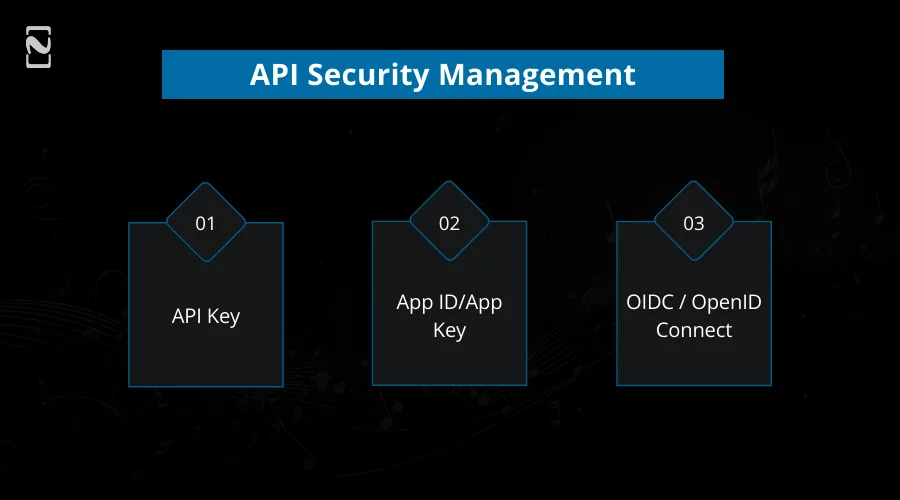
- API Key: This security scheme uses a single token string. For those who aren’t familiar with the term, it is software-based string code that enables unique authentication information. While it is often used, it is not the most effective for user-facing apps. The chances of someone stealing your API key are higher, which is why it is generally preferred to use them in a server-to-server communication.
- App ID/App Key: This is a two-token string method that is often seen in the form of a username and password-based authentication. It works very similarly to how client credentials flow. App Keys generally treat the app as its user, which means it requires the key to be used as a password for access.
- OIDC / OpenID Connect: This method creates an identity layer based on the OAuth Framework. It is used to identify users via their profile information and the authentication server. It is the gold standard for API security, where OAuth 2.0 handles authorization, and OIDC ensures authentication.
While these API security management schemes are effective, they are not the only solutions. There are other API security management layers that you can use. These include API gateway management, Rate Limiting, and Threat Detection.
API Endpoints
One can’t finish the API security discussion without talking about API endpoints.
These are the points of contact and communication between two APIs. In more technical terms, they are URLS and digital locations on which APIs send and receive data.
API Endpoints are highly important as they are the exact location of data exchange. These endpoints serve as the primary attack surface for the attacker. Hence, if it is not secured successfully, it becomes a gateway for data theft instantly.
Knowing about all these components is crucial to implementing API security. Some of you may be wondering why it is so crucial, after all, it is just an API, what damage can it cause, right?
Well, APIs are often the core data handlers in any application and can cause significant damage if left insecure. Check out the next section, where we have mentioned some API breaches that have taken place in the past and recent days. Check them out.
Infamous API Security Breaches
Do businesses often wonder whether investing in API security is really worth it? Well, it is as important as business app development.
There are various examples of large companies losing billions of sensitive data due to their API security breaches.
So, let’s look at some of the most important examples.
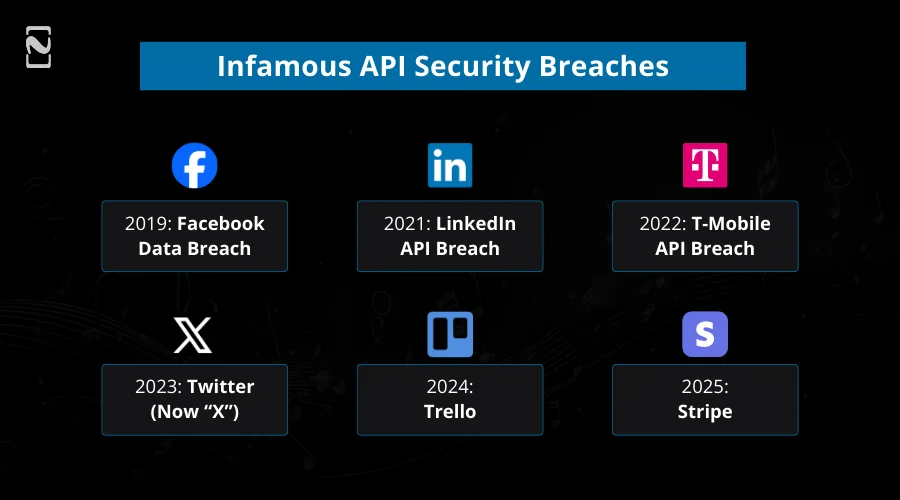
2019: Facebook Data Breach
Facebook is the most popular social media app right now. The platform contains the data of billions of people, including phone numbers, names, and personal messages.
But all of it was lost to a hacker back in 2019. The leak targeted two datasets from third-party Facebook apps.
2021: LinkedIn API Breach
Well, well, who doesn’t know LinkedIn, the popular job search platform? As it turns out, the public API platform used without any authentication was breached in 2021.
The leak was so huge that the platform exposed the data of 92% of its users. In other terms, this means 700 million users.
2022: T-Mobile API Breach
T-Mobile is one of the largest phone service providers in the USA. Despite this, it faced a data breach with one of its APIs just back in 2022. Well, it resulted in the leak of 37 million users’ personal information.
2023: Twitter (Now “X”)
Anonymity and freedom of opinion helped Twitter become one of the most popular platforms for journalists and activists to voice their opinions. However, in 2023, the integrity of more than 200 million users was compromised and was being sold on different hacker platforms.
2024: Trello
A hacker who was interested in user data used a publicly available Trello API to check email addresses corresponding to different accounts. As soon as the API hits a particular profile corresponding to the tried email, it would return the public profile data of the user. This helped the hacker gather a massive user database of 15 million Trello users.
2025: Stripe
The most recent example of a compromised API endpoint, the Stripe API exploit case, cost hundreds of thousands of dollars to the consumers and merchants using Stripe. Hackers identified an old, deprecated API endpoint, leading to a massive vulnerability that they were able to capitalize on.
These were some of the large-scale API breaches that came to light, as the scale was massive. API security breaches and incidents happen regularly. In fact, you will be shocked to know that in 2025, 99% of businesses faced at least one instance of API security breach in one way or another.
This happens when businesses and stakeholders are not paying attention to regular API security threats that must be addressed when implementing an API. If you are unaware of what these threats are, do not worry, as we have listed them below. Check out the next section to learn more!

Top 10 API Security Threats – Risks Identified by OWASP
The list of API breaches might have gotten you a bit concerned about API security.
Well, it is necessary to be concerned, as there are different types of threats that you need to be aware of. Even the biggest of conglomerates are not safe when it comes to API security.
The Open Web Application Security Project is a public service platform that has identified some of the most common vulnerabilities that often lead to API security failure.
Defined in 2026, here’s the complete list of OWASP Top 10 API security vulnerabilities:
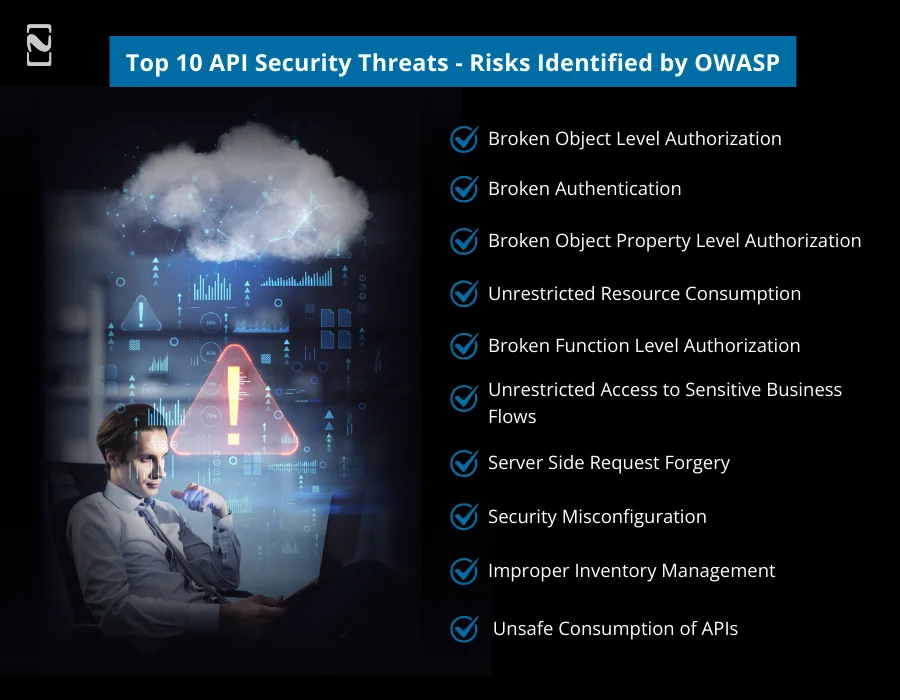
1. Broken Object Level Authorization
2. Broken Authentication
3. Broken Object Property Level Authorization
4. Unrestricted Resource Consumption
5. Broken Function Level Authorization
6. Unrestricted Access to Sensitive Business Flows
7. Server Side Request Forgery
8. Security Misconfiguration
9. Improper Inventory Management
10. Unsafe Consumption of APIs
Based on the vulnerabilities and threats highlighted by OWASP, you must design your API security strategy. With all the information shared so far, it is only understandable to explore the best practices that can help you establish better API security. Check out the next section for more!
How to Secure an API? API Security Best Practices
Keeping API security up to the mark is not rocket science. A highly secure environment can be achieved by implementing some core security practices. Here are some for your API security –
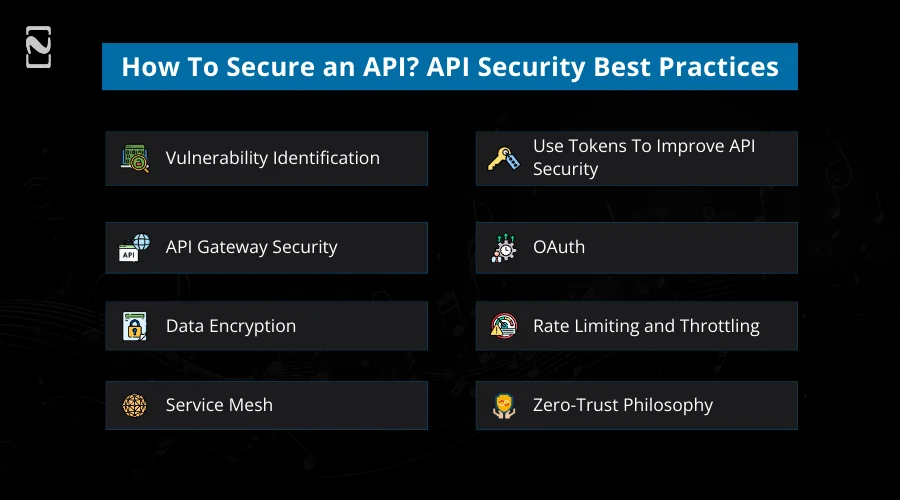
1. Vulnerability Identification
It goes without saying that if you want to secure an API, you first have to identify the potential insecurities
Now, this is easier said than done. And it becomes even harder if the solution is dealing with a large number of APIs.
Furthermore, one has to consider the entire API development lifecycle. As such, all steps from planning through development, testing, staging, and production should be considered.
This is the first thing to consider.
Moving on, let’s look at the next process.
2. Use Tokens to Improve API Security
Once you are done with identifying, it’s time to improve the security system via a technology called a token.
API security tokens work something like this: the token is used to communicate, and it is required to authenticate before passing the information.
These tokens allow controlled access to resources. The reason is that any interacting software that doesn’t have a proper token will be rejected. This is how your tokens improve overall security, thus making it one of the best API security practices.
3. API Gateway Security
Well, we have heard many times the term “API gateway”.
But what is it exactly?
An API Gateway security stands as a gate between the client and the backend services. Thus, it serves as a reverse proxy since it allows traffic to pass and authenticate the same as per predetermined standards.
In this way, the API gateway improves the security of the platform significantly.
4. OAuth
Let us introduce you to one of the most important things in the API security scenario, OAuth. As such, OAuth is a powerful tool for controlling API access.
It is a token-based authentication framework. This enables third parties to access important information without user credential disclosure.
It allows controlled access through authentication and authorization. And for that reason, it’s quite popular among API developers.
5. Data Encryption
Here’s one of the oldest tricks in the book to secure data.
Well, data is sensitive, and one of the oldest ways to secure it is encryption. For those who don’t know, encrypting data makes it unreadable unless you have the code used to encrypt it.
API deals with a lot of data, including (and especially) personally identifiable information (PII). To ensure this data is safe, API security standards require companies to encrypt
So even if someone can get access to the data, they won’t have the code to make it readable.
6. Rate Limiting and Throttling
As we discussed previously, one of the most common types of cyberattacks against APIs is denial of service (DoS) attacks.
To protect the API against this, app and web developers often limit the frequency of API calls. It works well to protect the solution during high traffic, thus driving performance and high-end security.
Moreover, it also helps create a balance between availability and access via user connection regulation. So this is something that you must consider for securing the API.
7. Service Mesh
Service mesh is much like an API gateway. Here’s How: Service mesh technology creates a multi-layer management and control system. This happens when a service request is routed.
As such, service mesh creates the perfect flow of different parts working together, creating a streamlined process between correct authentication, access control, and other security measures.
Today, service mesh has become one of the most common technologies for APU security. Therefore, this is something that you should definitely consider.
8. Zero-Trust Philosophy
It is exactly as it sounds. Zero-trust philosophy assumes that no system is to be trusted, even if it exists within the security perimeter, until proven otherwise.
Therefore, when communicating with the API, they have to authenticate their identity, improving the overall security of the API.
Zero trust philosophy uses technologies such as OAuth 2.0, API keys, and SSL/TLS encryption, i.e., the ones we discussed above.
All of these practices can help you achieve higher standards of API security. However, irrespective of how well you implement these practices, you need to double-check the solution by testing the API security.
Check out the next section, where we have mentioned a few API security testing methods that you can rely on to solidify your API security.
API Security Testing Methods
Once you have implemented the API correctly according to best practices, it’s time to test the API.
As such, API security testing involves a range of techniques designed to identify vulnerabilities in APIs and ensure that they are secure from attacks.
These techniques can help organizations identify and remediate potential security risks in their APIs before they can be exploited by attackers.
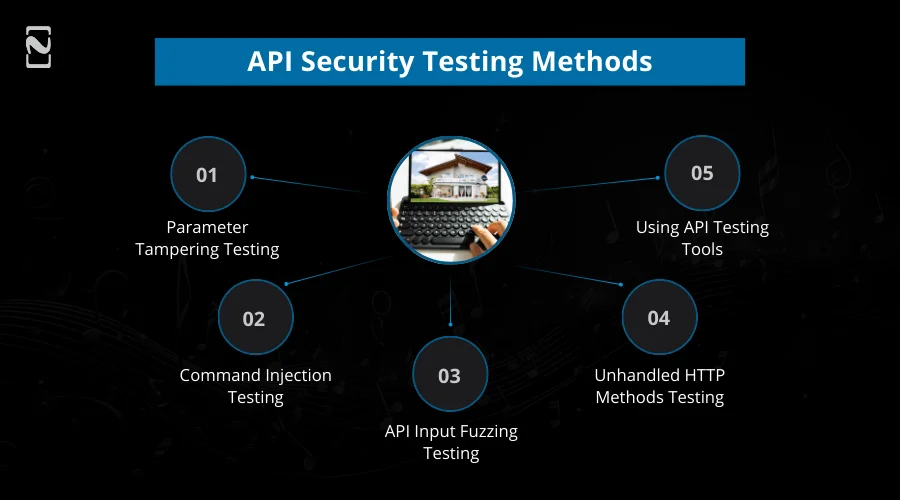
► Parameter Tampering Testing
Being one of the most common, this testing method involves modifying parameters in API requests to check if the API is properly validating and sanitizing input. This can include testing for SQL injection, XSS, and other types of vulnerabilities.
► Command Injection Testing
This is a testing technique that involves injecting malicious commands into API requests to check if the API is properly validating and sanitizing input. This can help to identify vulnerabilities that could allow attackers to execute arbitrary commands on the server hosting the API.
► API Input Fuzzing Testing
Fuzzing Testing technique involves sending malformed or unexpected input to the API to check how it handles errors and exceptions. This can help identify vulnerabilities such as buffer overflows or denial-of-service attacks.
► Unhandled HTTP Methods Testing
This testing technique involves sending HTTP requests using methods that the API is not designed to handle, such as TRACE or DELETE. This can help to identify vulnerabilities in the API’s handling of HTTP requests and responses.
► Using API Testing Tools
To improve API security testing, you can incorporate security testing tools. While popular API testing tools like Swagger and SoapUI do not directly offer a security feature for testing, there are other tools that you can rely on. These include:
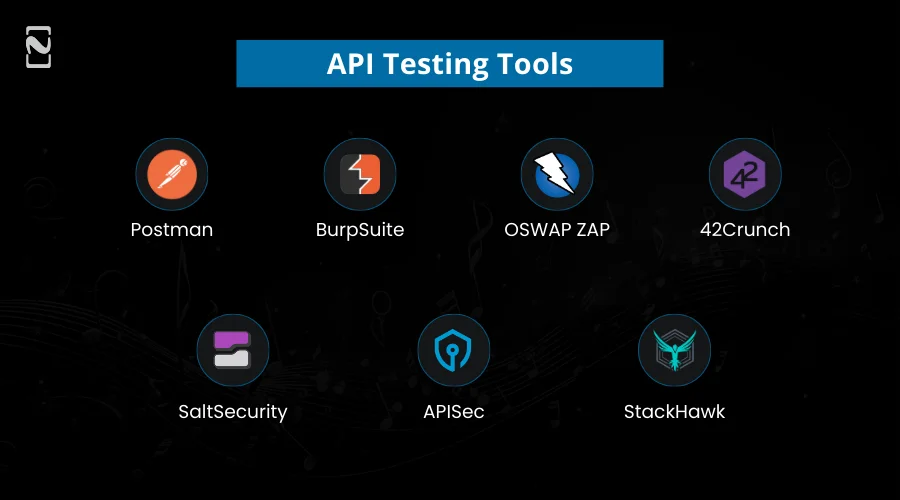
- Postman
- BurpSuite
- OSWAP ZAP
- 42Crunch
- SaltSecurity
- APISec
- StackHawk
Based on these methods and tools, you can easily initiate the API security testing and ensure that the API is free of errors and vulnerabilities. The tools finish the job significantly for you. However, there’s still one thing to be done.
What is it? Well, there’s a proper checklist that you need to follow for finalizing or identifying the solution as secure. Find the checklist below!
API Security Checklist
Securing an API can be difficult and confusing since there are so many steps. And to help you with just that, here’s an API Security checklist that you need to ensure that the API is secure. You can simply check the following factors and quickly answer the related question.
To check and ensure API security, make sure you ask the following questions:
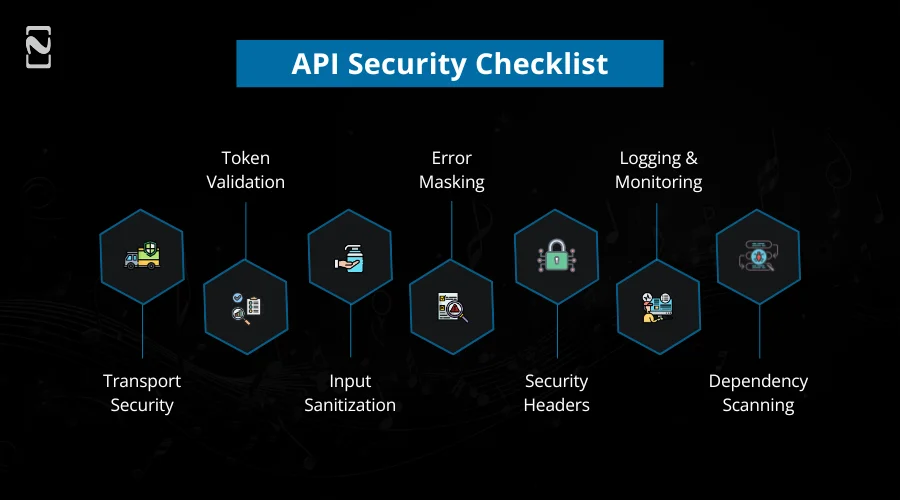
- Transport Security: Is all traffic forced over HTTPS using TLS 1.2 or higher?
- Token Validation: Are JWTs (JSON Web Tokens) validated for signature and expiration?
- Input Sanitization: Is all incoming data stripped of malicious scripts to prevent SQL Injection?
- Error Masking: Do your error messages hide technical details (like stack traces) from hackers?
- Security Headers: Are you using headers like X-Content-Type-Options and Content-Security-Policy?
- Logging & Monitoring: Are you logging “401 Unauthorized” and “403 Forbidden” spikes to catch attackers in real-time?
- Dependency Scanning: Have you checked your third-party libraries for known vulnerabilities (CVEs)?
If all these questions are positive, you need not worry about the API security, as it is already in good shape. Make sure that the API is implemented properly and no loopholes are left. To make things work better, you always have the option of hiring an API integration company.
Conclusion
APIs serve as the bridge between applications and databases. While it simplifies the sharing of data and insights in an app, it also makes it more and more prone to unavoidable vulnerabilities.
A single mistake in creating an API security strategy for your application can practically make or break your app. Hence, it is important to pay attention to the same. In case you are worried about implementing the solution diligently and taking assistance from API integration experts for the same.
With that said, we have reached the end of this post. In case you have any further queries related to API security and how you can achieve the best results, feel free to reach out to our experts for API integration.
Thanks for reading. Good luck!
FAQs
Some best practices for API security include:
- Strong authentication and authorization mechanisms
- Encryption to protect data
- Validating and sanitizing input
- Rate limiting and throttling
- API gateway
- Monitoring and logging API activity
- Assessing the security of the API
API security testing focuses specifically on testing the security of APIs, while traditional web application testing includes testing the security of web applications as a whole. API security testing can involve both manual and automated testing techniques, such as static analysis, dynamic analysis, and penetration testing.
Some common vulnerabilities in APIs include broken authentication and access control, injection attacks, cross-site scripting (XSS), excessive data exposure, and security misconfiguration.
An API gateway is a tool that can be used to manage API traffic and apply security policies, such as authentication, authorization, and rate limiting, to incoming requests. The API gateway can also be used to log and monitor API activity, which can help to detect security incidents in real-time.
Organizations can ensure the security of third-party APIs by conducting a thorough security assessment before integrating the API into their applications. This should include reviewing the API documentation, testing the API for vulnerabilities, and verifying that the API provider has appropriate security controls in place.
API security is particularly important in the context of microservices architecture, as microservices are often interconnected through APIs, and vulnerabilities in one API can have a ripple effect throughout the entire architecture. Implementing strong API security measures can help to mitigate these risks and ensure the overall security of the microservices architecture.

Richard Thomas is the Lead Architect at Nimble AppGenie, where he oversees the design and development of scalable, secure, and high-performance digital solutions. With deep expertise in software architecture, cloud infrastructure, and system integration, he plays a key role in transforming complex business requirements into robust technical frameworks. When he’s not architecting systems, he enjoys exploring emerging technologies and staying ahead of industry trends.
Table of Contents




No Comments
Comments are closed.