

 Free Consultation
 PCI-DSS Compliant
 GDPR Ready
 ISO 27001
 NDA Protected
 AI Services
 AI App Development
 Generative AI Development
 AI Chatbot Development
 AI Integration Services
 AI Consulting Services
 AI For Fintech
 AI Financial Assistant Solution
 AI Insurance Agent Development
 Tech Stack
 OpenAI / GPT-4
 Claude / Anthropic
 Gemini / Google AI
 Llama / Open Source
 LangChain / LlamaIndex
 Pinecone / Pgvector
 AWS / Azure AI


 Fintech Solution
 Core Fintech
 Fintech App Development
 Neobank App Development
 eWallet App Development
 Lending Software
 Banking Software Development
 BNPL Solution
 BNPL App Development
 Insurance App
 Wealth Management App
 Blockchain Development
 Payroll Software Development
 DeFi App Development
 Crypto Wallet Dev
 Crypto On Ramp Off Ramp
 Crypto Exchange Dev
 Trading Platform Dev
 Payments
 Compliance
 Fintech & Digital Regulations
 Fraud Detection
 Lending Ecosystem
 P2P Lending Platform
 Mortgage Software
 Engagement
 Outsourcing Dev

 Mobile Development
 Mobile App Dev
 iOS App Development
 Android App Development
 React Native
 Flutter Development
 Web Solution
 Node.js Development
 React.js Development
 Angular Development
 App Services
 UI/UX Design
 App Maintenance
 By Stage
 MVP Development
 Industry Solutions
 Healthcare App Dev
 Education App Dev
 Travel App Dev
 Real Estate App Dev
 Logistics Software
 Social Media App

 Hire Mobile Developers
 Hire iPhone Developers
 Hire Android Developers
 Hire React Native Devs
 Hire Flutter Developers
 Hire Web Developers
 Hire Node.js Developers
 Hire Angular Developers
 Hire PHP Developers
 Hire Laravel Developers
 How It Works
 Pre-Vetted Developers
 Ready In 48 Hours
 NDA From Day One
 Replace Guarantee
 Company
 About Us
 Our Work Process
 Portfolio
 Case Studies
 Blog / Insights
 Careers
 Contact Us
 Awards
 Recognition


 Offices



Key Takeaways
- AI-powered virtual assistants use NLP, machine learning, and LLMs to understand user intent and deliver real-time, automated responses across financial services.
- They transform financial services through 24/7 customer support, hyper-personalization, operational efficiency, enterprise knowledge assistance, fraud detection, and loan/credit assistance.
- Real-world examples like Erica, OCBC’s voice assistant, Eno, Amelia, and Amex Digital Assistant prove that these tools work at enterprise scale.
- Building a complete AI virtual assistant for financial services costs between $20,000 and $150,000, depending on compliance scope and integration depth.
- Nimble AppGenie builds AI-native, compliance-first virtual assistants with end-to-end development, from discovery to deployment.
- Partnering with the right AI development company determines whether your assistant becomes a growth driver or a compliance liability.
Quietly, the AI-powered virtual assistants are becoming the backbone of financial services. Whether it’s about assisting a customer at 2 A.M, or helping them with a loan approval on Sunday, AI-powered virtual assistants perform a great job.
From Bank of America’s Erica to OCBC, AI-powered assistants are assisting the financial services industry at a broad level. These institutions are enabling banking and financial institutions to deploy smarter, faster, and more personalized digital assistants.
If you are a fintech startup or a financial institution thinking of integrating or building an AI-powered virtual assistant, this is the right time.
In this guide, we will walk you through the concept, functions of AI-powered virtual assistants, real-world examples, and cost.
Without further ado, let’s begin.
What are AI-Powered Virtual Assistants?
AI-powered virtual assistants are software applications that use AI to understand what a person asks, automate tasks, and handle workflows. AI virtual assistants are reshaping the complete business landscape by understanding and responding to human queries and requests.
The effectiveness of an AI-powered assistant depends on its ability to understand the user’s intent and process complicated tasks, and then integrate it seamlessly into an existing small business ecosystem.
If you are the one ready to convert fintech startup ideas into reality, beginning with AI-powered virtual assistants can be effective.
But how does an AI-powered virtual assistant work?
Well, the complete process begins with user input, speech-to-text, natural language processing, and an information retrieval system.
How Does an AI-Powered Virtual Assistant Work?
The working process of an AI-powered virtual assistant begins with user input to response generation.
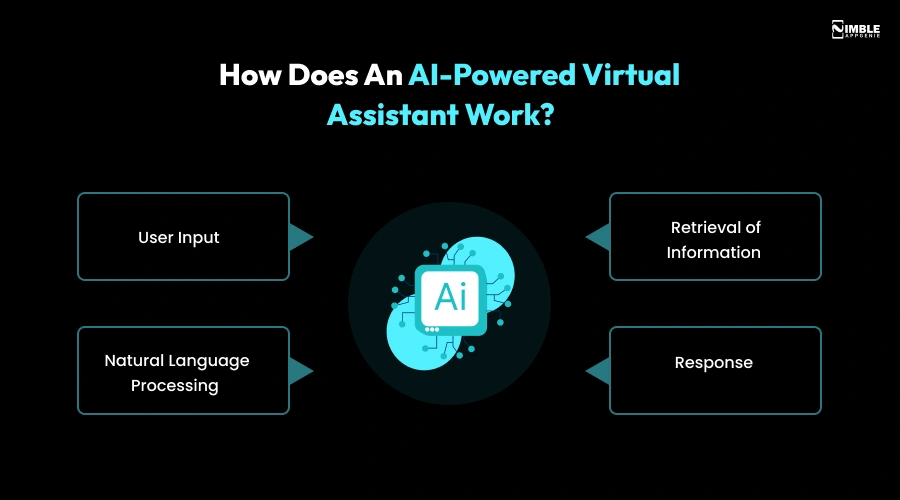
Let’s study the complete process here:
Step 1: User Input
The first step here is when a user approaches the AI-powered virtual assistant; it uses a speech recognition system, natural language processing, and machine learning to accept text and voice input.
Step 2: Natural Language Processing
At this step, once the user inputs the received information, the AI assistant utilizes NLP techniques to understand and interpret the user’s intent. Here, the NLP helps the assistant to analyze the input and understand the real intent of the user.
Step 3: Retrieval of Information
After examining and understanding the user’s intent, the assistant searches its vast database, which contains a wealth of information and knowledge. This step retrieves the relevant information from the user query and then provides real-time information to the user.
Step 4: Response
Now, the user is able to see the relevant information as per the query. It is the final step in the process of delivering the response to the user. This can be in the form of a spoken response, text message, or even an action performed on behalf of the user.
With this working process, you can continue with the key services of how AI-powered virtual assistants are transforming financial services.
Here, many of the fintech startups and enterprises often ask, “What is an AI-powered virtual assistant in financial services?”
The AI-powered virtual assistant in financial services comprises core technologies such as natural language processing (NLP), machine learning (ML), and Large Language Models (LLMs) for interpreting user inputs, managing dialogue context, and improving overall performance.
How Are AI-Powered Virtual Assistants Transforming Financial Services?
The financial services industry is transforming the complete industry experience by using AI-powered virtual assistants. AI technology in financial services uses machine learning, natural language processing, predictive analytics, and even generative AI.
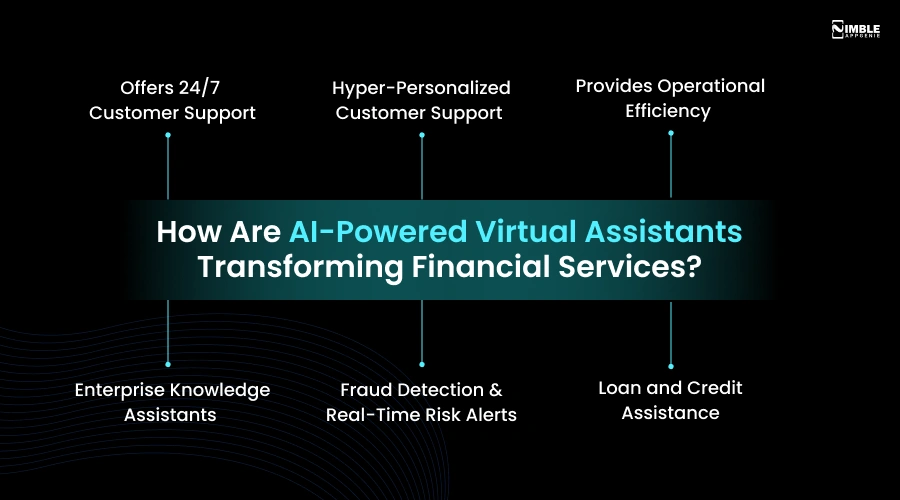
Here’s a detail on why you need to choose AI-powered virtual assistants that are transforming financial services:
-
Offers 24/7 Customer Support
Offering 24/7 customer support means providing round-the-clock help via phone lines, live chat, email, or AI bots. It lets users fix problems or ask questions at any time of day or night.
The AI-powered virtual assistants provide 24/7 customer support by operating continuously without any human sleep cycle or shift gaps.
-
Hyper-Personalized Customer Support
The AI-powered virtual assistants deliver hyper-personalized customer support through analyzing real-time user behavior, past purchase history, and preference data through machine learning.
These AI-powered virtual assistants use natural language processing to adapt their tone, predict individual needs, and even offer tailored communication.
-
Provides Operational Efficiency
Nimble AppGenie is one of the leading AI service providers that offers operational efficiency through integrating artificial intelligence, machine learning, and workflow automation into custom mobile and web apps.
Our company delivers operational efficiency through automating complex workflows, integrating AI-driven compliance, and streamlining the digital onboarding process.
-
Enterprise Knowledge Assistants
The AI-powered virtual assistants act as intelligent knowledge partners that help employees connect to internal company data, documents, and business systems to retrieve complete information and automate workflows.
Here, the core mechanisms comprise the data ingestion pipelines, vector embeddings, retrieval-augmented generation (RAG), and security governance.
-
Fraud Detection & Real-Time Risk Alerts
The real-time fraud detection systems evaluate digital transactions and user options that are prone to fraud. The AI virtual assistants ensure that the data of the users are kept safe and out of reach from cyberattackers.
The AI-powered virtual assistants transform financial services by offering 24/7 customer support and by offering hyper-personalized financial advice.
-
Loan and Credit Assistance
The AI-powered virtual assistants transform financial services by providing instant, 24/7 loan and credit assistance. They pre-qualify borrowers, collect the financial data, and even help to calculate the credit scores.
The key ways AI-powered virtual assistants transform financial services are instant pre-qualification, streamlined applications, personalized offers, 24/7 support, and risk reduction.
Transforming financial services by assisting fintech firms and institutions like you to enable customer satisfaction and their growth.
Now, let’s get ahead with the real-world examples of AI virtual assistants in finance in the following section.
Real-World Examples of AI Virtual Assistants in Finance
Real-world examples of AI virtual assistants in financial services will help you to understand the application of AI-powered virtual assistants in transforming financial services.
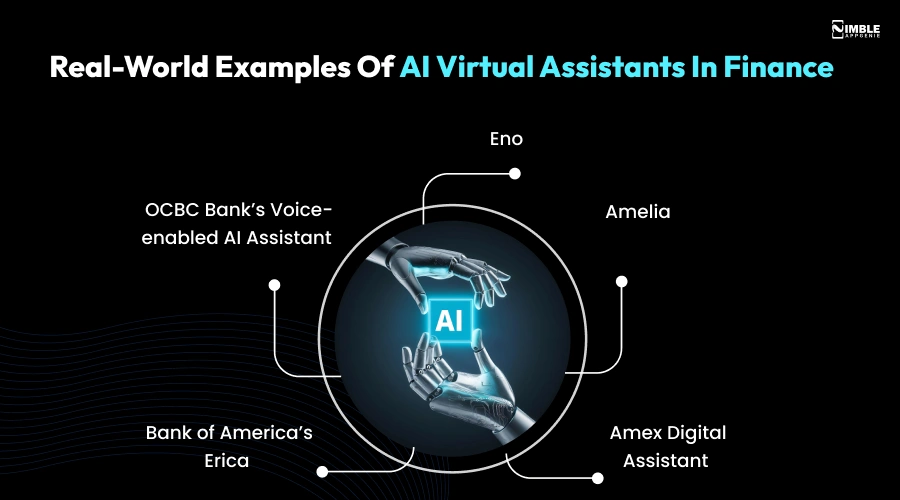
Here is the list of real-world examples of AI virtual assistants in finance:
► Bank of America’s Erica
Erica was launched in 2018 and is the prime example of an AI-powered virtual assistant that has transformed financial services. It helps integrate deeply with the Bank of America’s core banking system. It serves nearly 50 million customers and offers capabilities like account management, transactional tasks, proactive insights, and core-enterprise reach.
► OCBC Bank’s Voice-enabled AI Assistant
OCBC Bank’s voice-enabled AI assistant enables AI tools ranging from banking assistants and mobile app features to modern avatar-driven wealth platforms such as OCBC woW, standing out as a leading financial virtual assistant. Key capabilities include NLP, localized context customization, and direct transaction execution.
► Eno
Eno is the top AI virtual assistant because it uses advanced in-house natural language processing to handle everyday money tasks via text, app chat, and web interfaces. Here, the core capabilities comprise account monitoring and proactive security, and bill payments.
► Amelia
Amelia uses advanced conversational and generative AI for handling complicated multi-step banking tasks, switching context between topics, and then securely integrating with the core financial systems for major global institutions such as BNP Paribas.
► Digital Assistant
American Express stands out in the financial services through combining its American Express Virtual Chat Assistant and generative AI tools with the closed-loop data network. Here, the core capabilities comprise instant account management, travel counselor, and agentic commerce integration.
If you are ready to adopt or create an AI-powered virtual assistant, the next question is related to cost.
How Much Does It Cost to Build an AI Virtual Assistant for Financial Services?
The overall cost to create an AI virtual assistant can vary from $20,000 to $150,000 depending on the requirements of your financial institution and the software developed.
If you are thinking about fintech app development cost or creating an AI-powered virtual assistant, the cost and related factors differ a lot. For every fintech or bank, or any finance app you will develop, the cost and its related factors will depend on your objectives to integrate an AI-powered virtual assistant for financial services.
Let’s look ahead with the complete cost breakdown of how much it costs to create an AI virtual assistant for financial services:
| Development Stage | What’s Included | Estimated Cost |
| Discovery & Strategy | Requirements scoping, use-case mapping, compliance assessment (PCI-DSS/GDPR), LLM selection | $2,000 – $8,000 |
| UI/UX & Conversation Design | Chat/voice flow design, persona design, onboarding journeys | $3,000 – $10,000 |
| Core AI Development | NLP/LLM integration (GPT-4, Claude, Gemini), intent recognition, RAG pipeline setup | $8,000 – $50,000 |
| Backend & API Integration | Core banking API, KYC/AML, payment gateway, transaction data connections | $5,000 – $40,000 |
| Security & Compliance | Encryption, audit logging, explainability layer, regulatory testing | $3,000 – $20,000 |
| Testing, QA & Deployment | Functional testing, security audits, staged rollout | $2,000 – $12,000 |
| Post-Launch Support & Maintenance | Monitoring, model retraining, feature updates, bug fixes | $2,000 – $10,000 |
| Total Cost (Complete Build) | Full assistant, discovery to launch and stabilization | $20,000 – $150,000 |
For a customized AI assistant, you should connect with the top experts.
How Nimble AppGenie Helps You Build an AI-Powered Virtual Assistant?
Nimble AppGenie offers services like creating full-fledged, user-friendly web and mobile apps covering UI/UX, AI integration, backend, and seamless ready-to-deploy workflows.
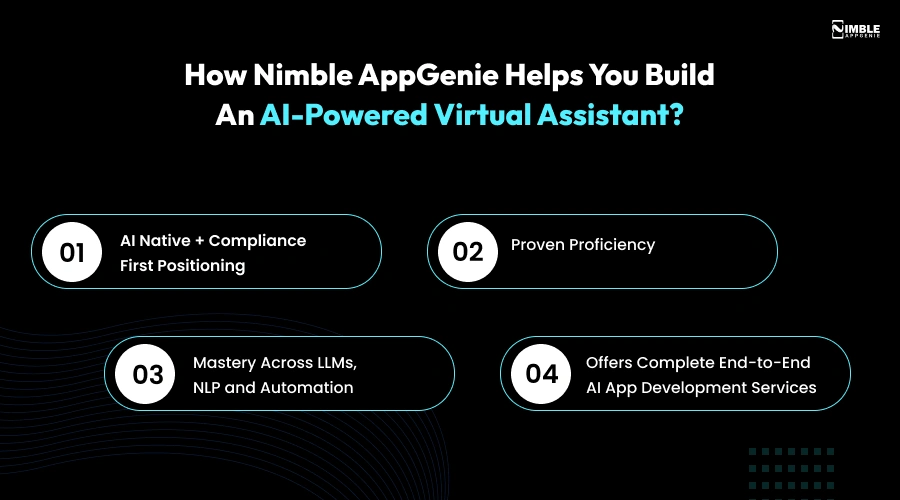
Here’s why you should connect with is the best AI App Development Company:
-
AI Native + Compliance First Positioning
Nimble AppGenie offers AI-native and compliance-first positioning by embedding machine learning models and following strict regulatory practices. The key services include the architectural core of its applications, rather than adding them as a secondary feature.
-
Proven Proficiency
The experts of Nimble AppGenie have proven proficiency in AI-powered services for building intelligent mobile and web applications, harnessing advanced AI technologies for improving the performance of the app.
-
Mastery Across LLMs, NLP and Automation
By leveraging the potential of AI, embracing LLMs, computer vision, NLP, and automation, the experts of Nimble AppGenie develop scalable features that create an influential app experience across diversified industries.
-
Offers Complete End-to-End AI App Development Services
Nimble AppGenie offers comprehensive AI services from consulting, design, and development to integration and even deployment, which lead to measurable outcomes.

Conclusion
AI-powered virtual assistants are transforming the financial services industry by offering 24/7 customer support, hyper-personalized customer satisfaction, operational effectiveness, and enterprise knowledge assistance.
AI-powered virtual assistants are programs that use AI, NLP, and machine learning to understand and respond to the human voice and even text commands. The cost to create an AI-powered assistant can vary depending on the objectives of your software and the complexity of the app.
Connecting with the leading service providers can help these fintech institutes grow and evolve in this competitive market.
FAQs
It’s a software application that uses NLP, machine learning, and LLMs to understand financial queries, interpret user intent, and automate tasks like account management, fraud alerts, and loan assistance in real time.
It follows four steps: capturing user input (voice or text), processing it through NLP to understand intent, retrieving relevant information from its knowledge base, and generating a response or completing an action on the user’s behalf.
Notable examples include Bank of America’s Erica (50M+ users), OCBC’s voice-enabled assistant, Capital One’s Eno, Amelia (used by BNP Paribas), and American Express’s Digital Assistant — each handling millions of banking interactions daily.
A complete, launch-ready AI virtual assistant typically costs between $20,000 and $150,000, depending on compliance requirements, core banking integrations, and whether you’re building a standard, advanced, or enterprise-grade solution.
Yes. AI assistants continuously evaluate transactions and user behavior in real time, flagging anomalies and alerting users or institutions before fraud escalates, something manual review processes simply can’t match in speed.
Look for a provider with AI-native architecture, compliance-first development (PCI-DSS, GDPR), and proven fintech experience. Nimble AppGenie offers end-to-end AI assistant development, from strategy and design to deployment and support.

Niketan Sharma, CTO, Nimble AppGenie, is a tech enthusiast with more than a decade of experience in delivering high-value solutions that allow a brand to penetrate the market easily. With a strong hold on mobile app development, he is actively working to help businesses identify the potential of digital transformation by sharing insightful statistics, guides & blogs.
Table of Contents




No Comments
Comments are closed.