

 Free Consultation
 PCI-DSS Compliant
 GDPR Ready
 ISO 27001
 NDA Protected
 AI Services
 AI App Development
 Generative AI Development
 AI Chatbot Development
 AI Integration Services
 AI Consulting Services
 AI For Fintech
 AI Financial Assistant Solution
 AI Insurance Agent Development
 Tech Stack
 OpenAI / GPT-4
 Claude / Anthropic
 Gemini / Google AI
 Llama / Open Source
 LangChain / LlamaIndex
 Pinecone / Pgvector
 AWS / Azure AI


 Fintech Solution
 Core Fintech
 App Development
 Neobank Solutions
 eWallet Solutions
 Lending Software
 Banking Solutions
 BNPL Solutions
 BNPL Solutions
 Insurance App
 Wealth Management
 Crypto & DeFi
 Blockchain Development
  Payroll Software
 DeFi Solutions
 Crypto Wallet
 Crypto On/Off Ramp
 Crypto Exchange
 Trading Platform
 Payments
 Compliance
 Regulations & Compliance
 Fraud Detection
 Lending Ecosystem
 P2P Lending Platform
 Mortgage Software
 Engagement
 Fintech Outsourcing

 Mobile Development
 Mobile App Dev
 iOS App Development
 Android App Development
 React Native
 Flutter Development
 Web Solution
 Node.js Development
 React.js Development
 Angular Development
 App Services
 UI/UX Design
 App Maintenance
 By Stage
 MVP Development
 Industry Solutions
 Healthcare App Dev
 Education App Dev
 Travel App Dev
 Real Estate App Dev
 Logistics Software
 Social Media App

 Hire Mobile Developers
 Hire iPhone Developers
 Hire Android Developers
 Hire React Native Devs
 Hire Flutter Developers
 Hire Web Developers
 Hire Node.js Developers
 Hire Angular Developers
 Hire PHP Developers
 Hire Laravel Developers
 How It Works
 Pre-Vetted Developers
 Ready In 48 Hours
 NDA From Day One
 Replace Guarantee
 Company
 About Us
 Our Work Process
 Portfolio
 Case Studies
 Blog / Insights
 Careers
 Contact Us
 Awards
 Recognition


 Offices



TL;DR
- Green fintech is financial technology built around environmental, social, and governance (ESG) goals, from carbon-tracking banking apps to sustainable lending platforms.
- ESG reporting software is the specific tool category that helps financial institutions collect, calculate, and disclose ESG data to meet frameworks like the EU’s CSRD and SFDR.
- Regulations are shifting fast in 2026: the EU has narrowed CSRD’s scope, while the US SEC has proposed dropping its federal climate rule, so reporting systems need to be flexible, not built around one fixed framework.
- This guide covers what green fintech and ESG reporting software actually do, the regulations driving demand, key features to look for, and when to build a custom solution vs. buying one off the shelf.
- Nimble AppGenie helps financial services companies design and build ESG reporting and green fintech solutions that integrate with existing banking and compliance systems rather than sitting apart from them.
What Is Green Fintech?
Green fintech is financial technology designed to support environmental sustainability; think of it as lending platforms that score borrowers on climate risk, investment tools that route capital to renewable energy projects, and carbon-footprint tracking built into a banking app.
It stays at the intersection of two forces that usually move separately: financial services and climate-conscious business practice.
The category is not new, but it has expanded fast. What started as a handful of “green” savings accounts and eco-friendly debit cards has transformed into serious infrastructure – sustainability-linked loan platforms, carbon accounting engines, and compliance software that asset managers and banks now acknowledge as core operations tooling rather than a marketing add-on.
How Green Fintech Differs From Traditional Fintech
The technology stack for green fintech looks very similar to other fintech products, like ledgers, dashboards, APIs, and mobile apps. The primary difference is the data layer underneath.
Traditional fintech tracks money movement alongside environmental and social impact data relevant to every transaction, investment, or loan, then maps that data against reporting standards regulators and investors recognize.
That second layer is where most of the complexity and value sit.
Core Categories of Green Fintech
Financial services companies working in this space generally fall into one or more of the buckets:
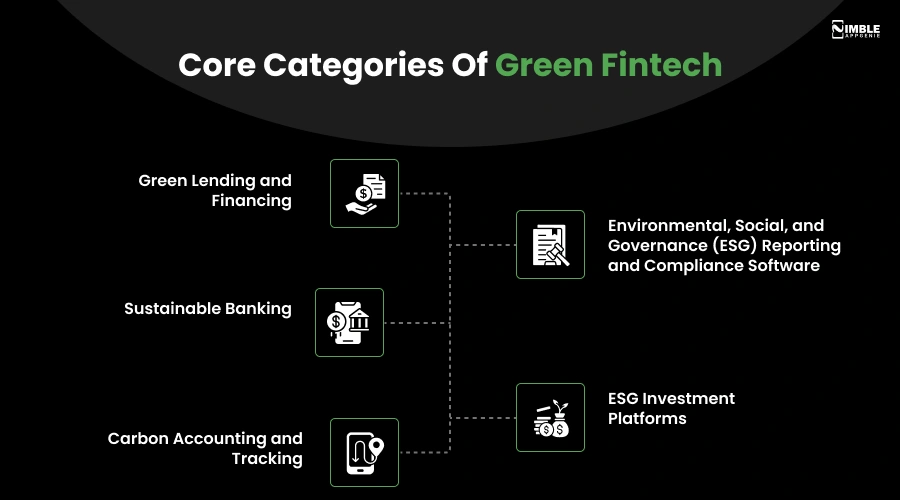
- Green Lending and Financing: Loan origination platforms that factor climate risk into underwriting, or that fund renewable energy and green infrastructure projects.
- Sustainable Banking: Cards, accounts, and lending products that track or reward low-carbon spending and behavior.
- Carbon Accounting and Tracking: Tools that calculate emissions tied to a portfolio, individual transactions, or a supply chain.
- Environmental, Social, and Governance (ESG) Reporting and Compliance Software: The tooling this guide aims at turns raw sustainability data into disclosures regulators and investors can act on.
- ESG Investment Platforms: Asset management tools and robo-advisors that screen investments against ESG criteria.
If you are earlier in the research process and looking for the broader picture of where sustainability fits among other fintech shifts, our breakdown of emerging fintech trends covers it with AI, open banking, and embedded finance.
Why ESG Reporting Has Become Non-Negotiable for Financial Services
ESG reporting has moved from a voluntary sustainability gesture to a regulatory and investor requirement in most major markets. Financial institutions above specific size thresholds now face mandatory disclosure obligations in the EU, rising state-level rules in the US, and increasing pressure from institutional investors who leverage ESG data to screen where they place capital.
In 2026, the tricky part is that the rules are actively moving, not fixed. Getting this wrong in any direction, maybe over-building for a rule that gets scaled back or under-preparing for one that stays, carries real cost.
Regulatory Pressure: CSRD, SFDR, and the EU Taxonomy
The EU’s Corporate Sustainability Reporting Directive (CSRD) is the anchor regulation here, but today it looks different than it did when it was first adopted.
Under the EU’s “Omnibus” simplification package, which entered into force in March 2026, CSRD’s mandatory scope was narrowed to EU entities with more than 1,000 employees and over €450 million in net turnover – a notable reduction from the original thresholds, with the changes applying to financial years beginning on or after January 1, 2027.
That doesn’t mean the reporting load disappeared. Financial institutions still in scope should report against the same cross-cutting European Sustainability Reporting Standards (ESRS) as any other large company, which govern how asset managers disclose the sustainability characteristics of their financial products is under revision, adding another layer institutions need to track.
The practical takeaway: build reporting systems around structured, auditable data collection rather than a single regulation’s exact line items, because the line items are the part most likely to change.
The US Picture: SEC Climate Rule Rollback and State-Level Rules
The regulatory picture in the US has moved in the opposite direction from Europe. The SEC’s 2024 climate disclosure rule was stayed almost immediately after adoption, and in May 2026 the SEC formally proposed to abolish it completely, with the public comment period closing that August.
The SEC has proposed to formally rescind the rule, though the withdrawal isn’t finalized yet, so financial institutions shouldn’t assume it’s gone for good.
State-level rules, most notably California’s Climate Corporate Data Accountability Act (SB 253), still require many large companies doing business in the state to disclose greenhouse gas emissions regardless of what happens federally. Financial institutions operating nationally should track compliance at the state level where federal rules stall.
Investor and Client Demand
Beyond formal mandates, institutional investors increasingly request ESG data as part of standard due diligence, and corporate clients ask their banking and payment partners for sustainability data to support their own disclosure needs.
This creates reporting pressure that exists independently of any single regulation – even a financial institution not directly in scope for SFDR or CSRD usually needs ESG data infrastructure to serve clients who are.
What Is ESG Reporting Software?
ESG reporting software is a category of application that gathers environmental, governance, and social data from across an organization’s operations, standardizes it against popular frameworks (like CSRD’s ESRS, GRI, SFDR, ISSB, or TCFD standards), and produces the disclosures required for regulatory filings, client requests, or investor reports.
For a financial institution, that data usually includes financed emissions, portfolio-level climate risk exposure, and sustainable lending volumes – not only the company’s own office energy use.
The category has expanded quickly: the global ESG reporting software market was valued at approximately $1.3 billion in 2026 and is predicted to approach $2.9-3.8 billion by the early 2030s, according to market research from MarketsandMarkets, driven largely by regulatory mandates and the shift away from manual, spreadsheet-based reporting.
Core Functions of ESG Reporting Software
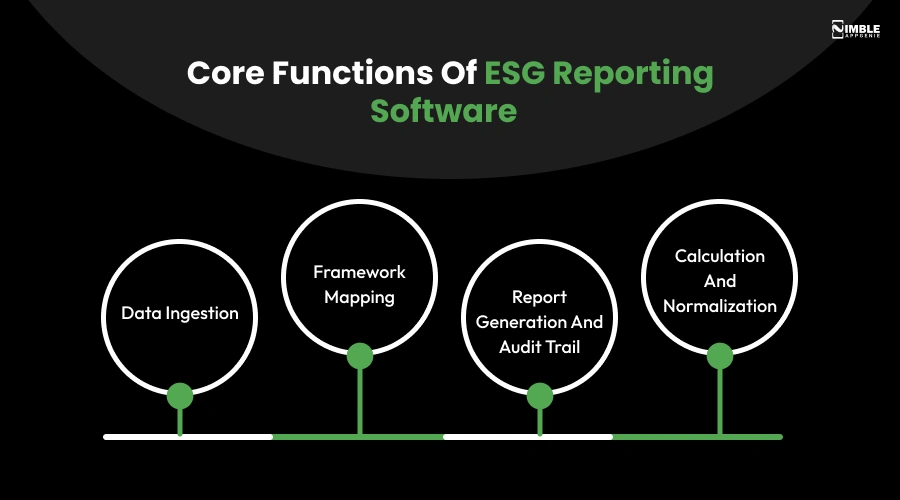
- Data Ingestion: Pulling ESG-relevant data from internal systems (transaction records, loan books, and supply chain data) and external sources.
- Framework Mapping: Aligning calculated metrics against the specific disclosure requirements of CSRD, GRI, SFDR, ISSB, or TCFD, since a single data point usually needs to be reported distinctly depending on the standard.
- Report Generation and Audit Trail: Safeguarding the final disclosure document along with the traceable evidence trail that assurance providers need to sign off on.
- Calculation and Normalization: Converting raw data into standardized metrics, most importantly greenhouse gas emissions across Scope 1 (direct operations), Scope 2 (purchased energy), and Scope 3 (value-chain emissions, including the financed emissions that matter most for banks and lenders).
ESG Reporting Software vs Traditional Spreadsheet-Based Reporting
Once an institution has to produce an auditable trail or report against more than one framework, spreadsheet-based ESG reporting breaks.
It’s because manual processes can’t reliably handle version control, multi-framework mapping, or the scale of transaction-level data financial institutions generate.
| Spreadsheet-Based Reporting | ESG Reporting Software | |
| Data sources | Manually collected, often outdated by reporting time | Automated ingestion from core banking, CRM, and portfolio systems |
| Multi-framework support | Requires rebuilding calculations per framework | Maps once, reports against multiple standards |
| Audit trail | Difficult to trace data lineage | Built-in, timestamped audit trail |
| Scalability | Breaks down with transaction volume | Designed for institutional-scale data |
| Update cycle | Manual rework when regulations change | Configurable rule sets that adapt to regulatory revisions |
Key Features Financial Services Companies Need in ESG Reporting Software
Not all the ESG tools in the market are built keeping the specific data complexity of financial services in mind. The features below matter more for banks, asset managers, and lenders than for a typical corporate sustainability team.
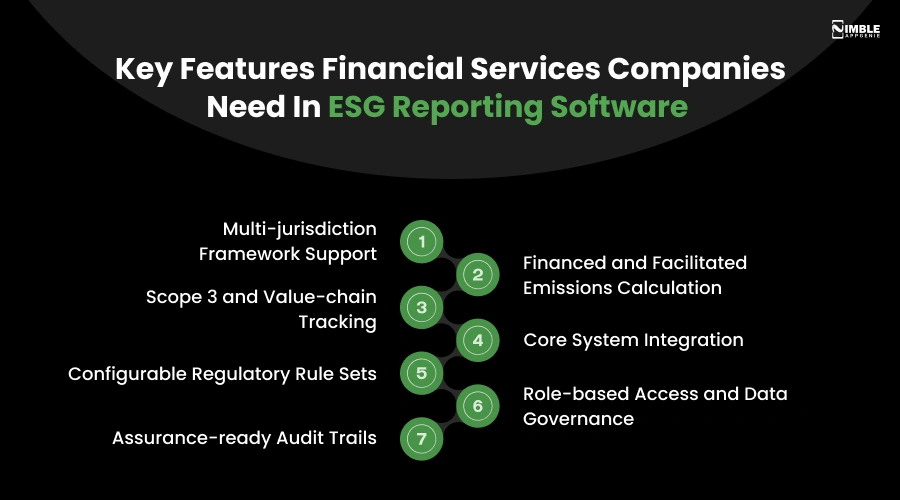
- Multi-jurisdiction Framework Support: SFDR for fund-level disclosures, CSRD/ESRS for EU operations, and flexibility for state-level US rules like SB 253.
- Financed and Facilitated Emissions Calculation: The capability to calculate the carbon footprint tied to a loan book or investment portfolio, not only internal operations, preferably aligned with the Partnership for Carbon Accounting Financials (PCAF) methodology.
- Scope 3 and Value-chain Tracking: Since a financial institution’s largest emissions exposure generally sits in what it lends to and invests in, not its own offices.
- Core System Integration: Direct connections into loan origination systems, portfolio management tools, and core banking platforms rather than manual data exports.
- Configurable Regulatory Rule Sets: As specified, frameworks like CRDR have modified scope in the past two years; hardcoded reporting logic becomes a liability fast.
- Role-based Access and Data Governance: Since ESG data draws from sensitive credit, lending, and portfolio information across departments.
- Assurance-ready Audit Trails: Traceable data lineage that meets the third-party assurance most CSRD-in-scope filings require.
Institutions that already have fraud detection and compliance tooling often find it is more efficient to integrate ESG reporting into that existing compliance data layer than to build a completely separate system from scratch.
How Green Fintech and ESG Reporting Software Work Together
Green fintech products generate the sustainability data; ESG reporting software turns that data into compliant disclosures.
A green lending platform that scores borrowers on climate risk, for example, produces precisely the kind of transaction-level data that financed-emissions calculations need – the reporting software only has to be built to receive it in a usable format.
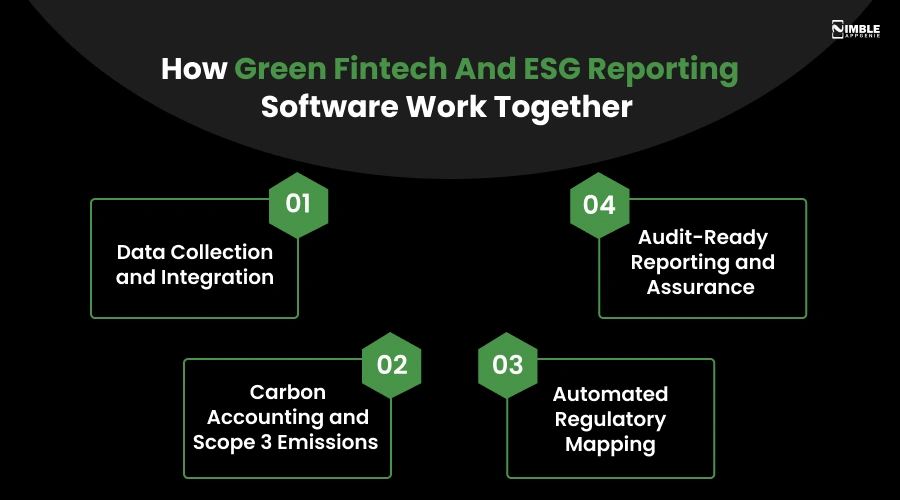
1. Data Collection and Integration
The starting point is almost always integration, not reporting logic. ESG data lives across core banking platforms, loan origination systems, CRM tools, and occasionally third-party ESG data providers.
This is one of the more underestimated parts of such projects – teams that already have strong fintech API integration experience tend to move through this stage faster because the connective work is largely the same discipline as any other financial data pipeline.
2. Carbon Accounting and Scope 3 Emissions
For financial institutions, Scope 3 emissions, particularly financed emissions from lending and investment activity, generally showcase the largest share of total climate impact.
Calculating this precisely requires mapping a portfolio’s holdings against emissions factors by asset class, sector, and geography, then applying a recognized methodology like PCAF so the numbers hold up under external assurance.
3. Automated Regulatory Mapping (CSRD, SFDR, ISSB, GRI, TCFD)
A single underlying metric, such as total financed emissions, generally needs to appear in different formats depending on whether it goes into a CSRD filing or an SFDR filing.
Whether building or buying, the system should calculate the metric once and map it into each framework’s needed format, rather than compelling separate manual calculations for every disclosure.
4. Audit-Ready Reporting and Assurance
CSRD-in-scope reports need limited assurance, which means each disclosed figure needs a traceable path back to its source data. Reporting platforms that don’t create this from the start tend to build painful retrofitting work later, since assurance providers will reject anything they can’t verify independently.
Real-World Applications in Financial Services
ESG and green fintech tooling are used across various parts of a financial institution’s operations, not just in a standalone compliance report:
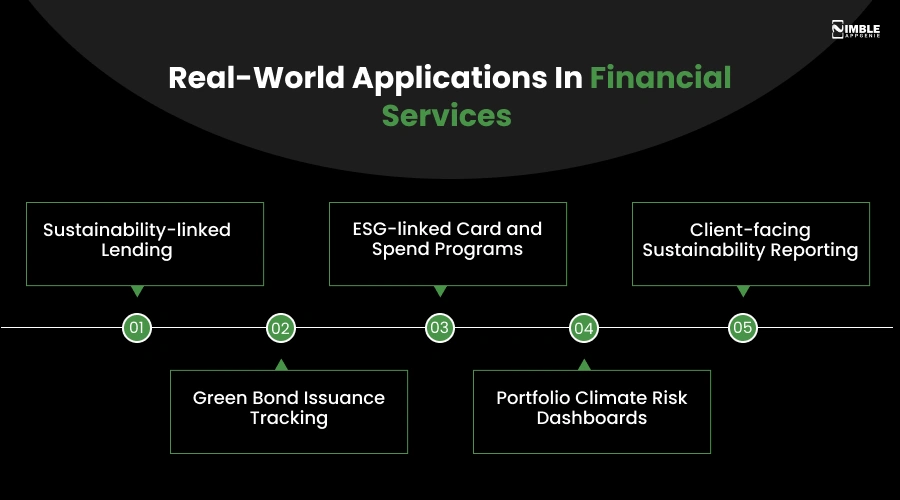
- Sustainability-linked Lending: Adjusting loan terms based on a borrower hitting agreed ESG performance targets, which needs ongoing data tracking rather than a one-time check.
- Green Bond Issuance Tracking: Monitoring use-of-proceeds data to confirm funds raised through green bonds deployed to qualifying projects.
- ESG-linked Card and Spend Programs: Consumer or corporate card products that surface carbon footprint predictions tied to spending categories.
- Portfolio Climate Risk Dashboards: Offering asset managers a live view of transition and physical climate risk exposure across holdings.
- Client-facing Sustainability Reporting: Corporate banking clients increasingly request ESG data from their banking partners to support their own SFDR or CSRD filings.
Build vs Buy: Should You Build Custom ESG Reporting Software?
Off-the-shelf ESG software works perfectly for institutions with clear, single-framework reporting requirements and limited internal data complexity.
Custom development makes more sense once an institution needs to calculate financed emissions across a large portfolio, integrate with proprietary core banking systems, or report across multiple shifting regulatory frameworks simultaneously.
When Off-the-Shelf ESG Software Works
Smaller financial institutions, or those with a narrow reporting scope (say, a single-jurisdiction SFDR product disclosure), are usually well served by established ESG software vendors.
The tradeoff is flexibility – most off-the-shelf platforms are created around a fixed set of frameworks and won’t simply adapt to a proprietary data structure or a regulation neither vendor nor client expected.
When Custom Development Makes Sense
| Factor | Off-the-Shelf | Custom-Built |
| Portfolio complexity | Best for simple, single-entity reporting | Handles multi-asset-class, multi-jurisdiction portfolios |
| Core system integration | Limited to supported connectors | Built to integrate with proprietary banking systems |
| Regulatory flexibility | Fixed to vendor’s supported frameworks | Configurable as frameworks like CSRD continue to shift |
| Data ownership | Data often sits on vendor infrastructure | Full control over data residency and governance |
| Time to launch | Faster initial setup | Longer build, but tailored long-term fit |
| Cost structure | Predictable subscription pricing | Higher upfront investment, lower long-term customization cost |
Institutions already running on a well-defined fintech technology stack usually find custom ESG reporting modules integrate more clearly into their existing architecture than a third-party platform that expects its own data model.
How to Build ESG Reporting Software: Step-by-Step
Building ESG reporting software follows roughly the same discipline as any serious fintech app development project, with sustainability data needs layered on top.
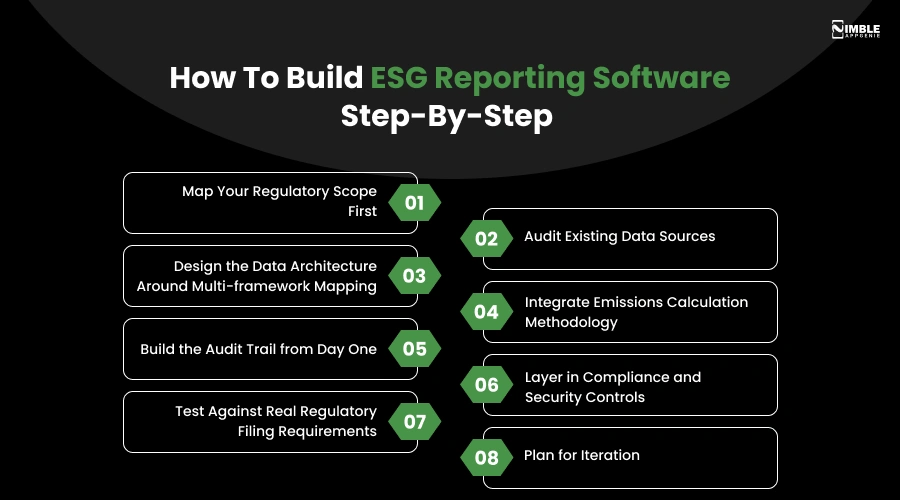
1. Map Your Regulatory Scope First
Confirm exactly which frameworks apply. SFDR, CSRD, state-level US rules, or voluntary standards before designing the data model, as scope changes what data you actually need to collect.
2. Audit Existing Data Sources
Identify what ESG-relevant data already exists in loan origination, core banking, and portfolio systems, and what gaps need new data collection processes.
3. Design the Data Architecture Around Multi-framework Mapping
Build the system to calculate core metrics once and map them into various disclosure formats, despite framework-specific silos.
4. Integrate Emissions Calculation Methodology
Implement a recognized approach like PCAF for financed emissions, so figures hold up under third-party assurance.
5. Build the Audit Trail from Day One
Every data point feeding a disclosure demands a traceable source, calculation method, and timestamp – retrofitting this later is notably more expensive.
6. Layer in Compliance and Security Controls
ESG data draws from sensitive lending and credit information, so the same rigor applied to KYC and AML compliance systems should extend to ESG data governance.
7. Test Against Real Regulatory Filing Requirements
Besides just internal assumptions, you should test against real regulatory filing needs, ideally with input from compliance or assurance specialists before the first live filing.
8. Plan for Iteration
Given how much CSRD’s scope and the SEC’s climate rule have shifted in the past two years, the reporting engine should be created to absorb regulatory modifications without a complete rebuild.
Challenges in Green Fintech and ESG Reporting
Most financial institutions run into a similar set of obstacles, regardless of size:
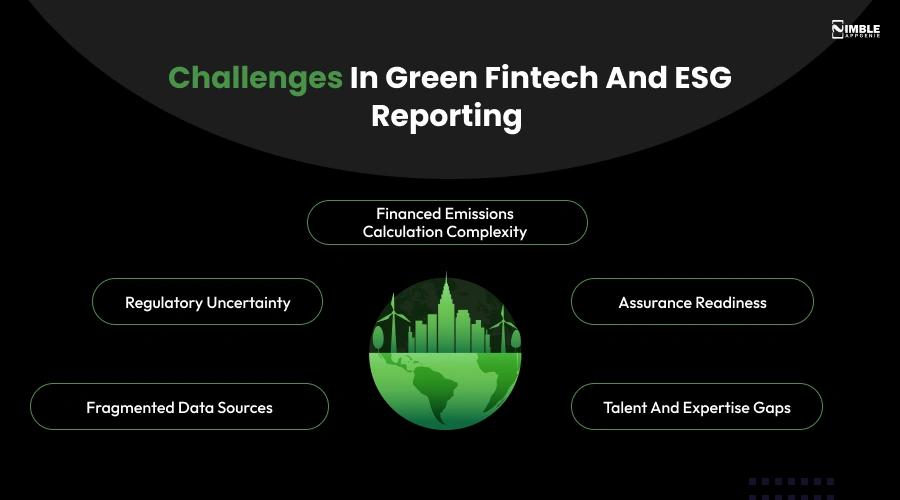
1. Fragmented Data Sources: ESG-relevant data is spread across systems that were never crafted to talk to each other, making integration the most time-consuming part of most projects.
Solution: Start with a data audit before writing any reporting logic – map exactly which systems hold ESG-relevant data (loan origination, CRM, and core banking) and build integration around those sources first, rather than designing the reporting layer and hoping the data lines up later.
2. Regulatory Uncertainty: Building against a moving target, state reporting logic should be configurable, not hardcoded, which adds design complexity upfront.
Solution: Separate the data model from the framework logic. Store raw ESG data in a standardized internal format, then build framework mapping (CSRD, SFDR, TCFD) as a configurable layer on top – so a regulatory change means updating a rule set, not rebuilding the system.
3. Financed Emissions Calculation Complexity: Unlike a company’s direct operational footprint, portfolio-level emissions need sector-specific emissions factors and ongoing data quality management.
Solution: Adopt the PCAF methodology from the start rather than building a proprietary calculation approach – it’s the industry-recognized standard for financed emissions, which also makes the number simpler to defend during assurance.
4. Assurance Readiness: Many institutions discover their data is not traceable enough for third-party assurance just after their first attempted filing.
Solution: Build the audit trail (timestamp, source, calculation method) into the data pipeline from day one, not as a reporting-stage add-on – retrofitting traceability after the fact is far more costly than designing for it upfront.
5. Talent and Expertise Gaps: ESG reporting sits at the intersection of climate science, software engineering, and financial regulations, and few internal teams have deep experience across all three.
Solution: Bring in outside expertise for the parts that are toughest to build in-house fast – either a compliance/assurance specialist to validate reporting logic, or a development partner who has already solved the data architecture problem for other financial institutions.
Why Choose Nimble AppGenie for Green Fintech & ESG Reporting Software Development
Building ESG reporting software is not only a compliance checkbox project, but it also touches core banking data, regulatory frameworks, and portfolio systems that keep shifting underneath you.
Nimble AppGenie brings fintech app development experience across lending, banking, and compliance-heavy platforms, which means the data architecture, security posture, and integration work needed for ESG reporting are not unfamiliar territory.
Our team works with financial institutions to design ESG and green fintech solutions that go beyond a single regulation, connecting cleanly with existing banking software and compliance systems rather than sitting as a bolted-on afterthought.
FAQs
Green fintech is financial technology built to support environmental sustainability goals, including sustainable banking products, green lending platforms, carbon accounting tools, and ESG reporting software used by financial institutions to track and disclose their environmental impact.
ESG reporting software collects environmental, social, and governance data from across an organization, calculates standardized metrics like carbon emissions, and maps that data into the format required by frameworks such as CSRD, SFDR, GRI, TCFD, or ISSB for regulatory or investor disclosure.
It depends on jurisdiction and size. In the EU, CSRD applies mandatorily to entities above 1,000 employees and €450 million in net turnover starting with financial years from January 2027 onward, following the 2026 Omnibus simplification. In the US, the SEC has proposed rescinding its federal climate disclosure rule, though state-level rules like California’s SB 253 still impose obligations on many large companies.
Green fintech is the broader category of sustainability-focused financial technology, including consumer products, lending platforms, and investment tools. ESG reporting software is a specific subset focused on collecting and disclosing sustainability data for regulatory and investor reporting purposes.
Off-the-shelf platforms tend to work for institutions with narrow, single-framework reporting needs. Custom-built software makes more sense for institutions with complex portfolios, proprietary core banking systems, or multi-jurisdiction reporting requirements that need to adapt as regulations like CSRD and SFDR continue to change.
Beyond standard operational data (energy use, office emissions), financial institutions typically need to calculate financed emissions tied to their loan book and investment portfolio, track sustainable lending volumes, and maintain audit-ready records for assurance providers.

Niketan Sharma, CTO, Nimble AppGenie, is a tech enthusiast with more than a decade of experience in delivering high-value solutions that allow a brand to penetrate the market easily. With a strong hold on mobile app development, he is actively working to help businesses identify the potential of digital transformation by sharing insightful statistics, guides & blogs.
Table of Contents




No Comments
Comments are closed.