

 Free Consultation
 PCI-DSS Compliant
 GDPR Ready
 ISO 27001
 NDA Protected
 AI Services
 AI App Development
 Generative AI Development
 AI Chatbot Development
 AI Integration Services
 AI Consulting Services
 AI For Fintech
 AI Financial Assistant Solution
 AI Insurance Agent Development
 Tech Stack
 OpenAI / GPT-4
 Claude / Anthropic
 Gemini / Google AI
 Llama / Open Source
 LangChain / LlamaIndex
 Pinecone / Pgvector
 AWS / Azure AI


 Fintech Solution
 Core Fintech
 App Development
 Neobank Solutions
 eWallet Solutions
 Lending Software
 Banking Solutions
 BNPL Solutions
 BNPL Solutions
 Insurance App
 Wealth Management
 Crypto & DeFi
 Blockchain Development
  Payroll Software
 DeFi Solutions
 Crypto Wallet
 Crypto On/Off Ramp
 Crypto Exchange
 Trading Platform
 Payments
 Compliance
 Regulations & Compliance
 Fraud Detection
 Lending Ecosystem
 P2P Lending Platform
 Mortgage Software
 Engagement
 Fintech Outsourcing

 Mobile Development
 Mobile App Dev
 iOS App Development
 Android App Development
 React Native
 Flutter Development
 Web Solution
 Node.js Development
 React.js Development
 Angular Development
 App Services
 UI/UX Design
 App Maintenance
 By Stage
 MVP Development
 Industry Solutions
 Healthcare App Dev
 Education App Dev
 Travel App Dev
 Real Estate App Dev
 Logistics Software
 Social Media App

 Hire Mobile Developers
 Hire iPhone Developers
 Hire Android Developers
 Hire React Native Devs
 Hire Flutter Developers
 Hire Web Developers
 Hire Node.js Developers
 Hire Angular Developers
 Hire PHP Developers
 Hire Laravel Developers
 How It Works
 Pre-Vetted Developers
 Ready In 48 Hours
 NDA From Day One
 Replace Guarantee
 Company
 About Us
 Our Work Process
 Portfolio
 Case Studies
 Blog / Insights
 Careers
 Contact Us
 Awards
 Recognition


 Offices


TL;DR
To get a token listed on a cryptocurrency exchange, you need to prepare your documentation, verify and audit your smart contract, meet the exchange’s compliance and legal expectations, and apply to exchanges that genuinely fit your project; each exchange reviews and decides independently, and approval is never guaranteed.
- CEX vs DEX: CEX listings are permissioned, slower, and documentation-heavy but reach a larger user base. DEX listings are permissionless and fast but put liquidity and discoverability entirely on you.
- What exchanges check: token utility, tokenomics, team transparency, an audited/verified smart contract, legal and compliance readiness, and real (not inflated) community and trading traction.
- Cost and timeline: vary by exchange, split into exchange fees, preparation/technical costs, and post-listing liquidity costs. DEX listings can go live in hours; CEX review can take weeks to months.
- Listing services: useful for documentation, technical readiness, exchange shortlisting, and application coordination, but no legitimate provider can guarantee an exchange will approve your listing.
- Where Nimble AppGenie fits: not an exchange or listing agency; we handle the technical groundwork (smart contracts, wallets, APIs, blockchain infrastructure) that needs to be solid before you apply, so the listing doesn’t stall on your end.
Your token is live, the contract is deployed, and your community keeps asking one question: where can they actually buy it?
This is the actual difficulty: how to get a token listed on a cryptocurrency exchange – a live token is not automatically tradable, and exchanges don’t add a trading pair only because a project asks.
Most founders underestimate how much preparation happens between “we have a token” and “our token is trading on an exchange.” A deployed smart contract doesn’t give anyone a way to buy or sell your asset – exchanges evaluate tokenomics, documentation, smart contract quality, legal posture, and market readiness before adding a trading pair.
Teams that approach listing as a form to submit tend to get rejected, stall in review, or land on an exchange that doesn’t fit their project.
Blockchain experts at Nimble AppGenie have written this guide for token issuers, product lenders, and Web3 founders who need a realistic, step-by-step view of how crypto exchange listing actually works: what the process looks like, what exchanges check for, what it costs, how long it takes, why applications get rejected, and when it makes sense to bring in a technical partner rather than handling listing preparation entirely in-house.
What Does It Mean to List a Token on a Cryptocurrency Exchange?
Token listing is the process of getting a cryptocurrency added to an exchange’s platform so it can be traded against other assets – generally a stablecoin, Bitcoin, Ethereum, or a major trading pair. Listing is different from launching a token. A token can exist, have holders, and even have a working use case for months before it is tradable anywhere.
There are two basically different paths to listing, and they carry distinct expectations:
- CEX (centralized exchange) listing: Your token goes through an internal review process run by the exchange (Coinbase, Binance, Kraken, KuCoin, OKX, and similar platforms). The exchange decides whether to accept the application, sets the trading pairs, and controls the timeline.
- DEX (decentralized exchange) listing: Your token becomes tradable by creating a liquidity pool on a protocol like Uniswap or PancakeSwap. No gatekeeper approves the listing itself, but price stability, liquidity, and discoverability depend completely on what your team sets up.
Whichever route you take, three things determine whether the listing is actually useful to your project rather than just symbolic:
- Trading Pairs: Which assets your token can be traded against, and on which networks.
- Liquidity: Whether there is enough depth in the trading pair for people to buy or sell without moving the price sharply.
- Market Availability and Discoverability: Whether traders can actually find your token through the exchange’s search, listing pages, and data aggregators, like CoinMarketCap or CoinGecko
Getting listed is the start of a token’s market life, not the end of a checklist.
How Does the Crypto Exchange Listing Process Work?
The crypto exchange listing process moves a project through readiness assessment, application, documentation, due diligence, and launch. At a high level, it looks like this:
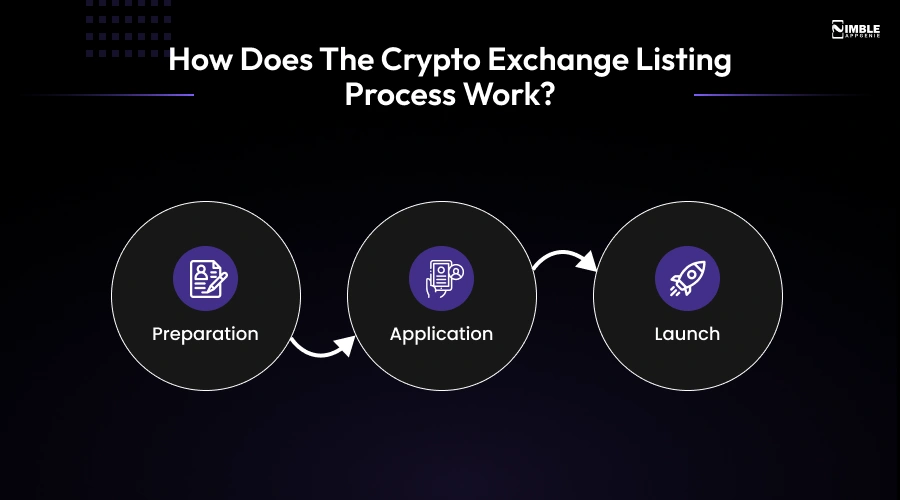
- Preparation → assess project readiness → define listing objectives → research appropriate exchanges → prepare documentation and technical infrastructure.
- Application → submit the application → complete due diligence → address technical/compliance requirements.
- Launch → arrange liquidity and trading infrastructure → coordinate the launch → monitor post-listing activity.
Every exchange runs its own version of this sequence, and requirements, turnaround time, and review depth vary enormously between a global CEX, a DEX liquidity pool, and a regional exchange. The step-by-step section later in this post breaks every stage into what to do, why it matters, and where teams usually go wrong.
CEX vs DEX Token Listing: Which Is Right for Your Project?
None of the models is universally better – the right choice is based on your project’s stage, go-to-market goals, and compliance posture.
| Factor | CEX Listing | DEX Listing |
| Approval requirements | Reviewed and approved by the exchange | No central approver; governed by the protocol |
| Permission model | Permissioned – exchange decides | Permissionless – anyone can create a pool |
| Documentation | Whitepaper, legal opinions, team KYC, audit reports typically expected | Minimal formal documentation required |
| Technical requirements | Contract verification, integration with exchange systems, security audit often expected | Verified, functioning smart contract and sufficient token supply for a pool |
| Liquidity | Often coordinated with the exchange or a market maker | Entirely the project’s responsibility to seed and maintain |
| Costs | Application, technical integration, potential listing or market-making costs | Gas fees and self-funded liquidity provisioning |
| Speed | Can take weeks to months depending on the exchange | Can be live within hours of deploying the pool |
| User base | Access to the exchange’s existing retail and institutional user base | Access to on-chain, DeFi-native users |
| Discoverability | Exchange listing pages, apps, and built-in search | Dependent on aggregators, DEX screeners, and community promotion |
| Risks | Rejection, long review timelines, evolving exchange criteria | Low liquidity, price volatility, impermanent loss exposure |
| Typical fit | Projects seeking credibility, compliance alignment, and broader retail reach | Early-stage or DeFi-native projects prioritizing speed and permissionless access |
Many projects pursue both: a DEX listing to build early trading activity and liquidity data, followed by CEX applications once they have a track record to point to.
What Do Crypto Exchanges Look for Before Listing a Token?
Exchanges look for evidence that a token is safe, legitimate, and expected to sustain healthy trading activity – assessed through project transparency, compliance readiness, technical quality, and real market traction. While individual exchange criteria vary and are set independently by each platform, the recurring evaluation areas include:
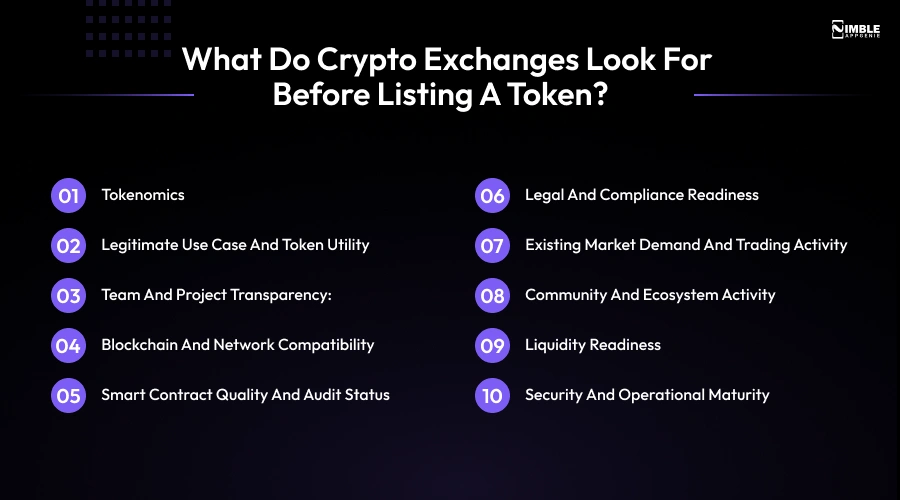
- Tokenomics: Supply, distribution, vesting schedules, and inflation/deflation mechanics that hold up to scrutiny.
- Legitimate Use Case and Token Utility: A clear reason the token exists beyond speculation.
- Team and Project Transparency: Identifiable team members, a credible track record, and constant public information.
- Blockchain and Network Compatibility: Support for the token standard (e.g., ERC-20, BEP-20) and the networks the exchange operates on.
- Smart Contract Quality and Audit Status: Clean, verified code and, in most cases, a completed third-party security audit.
- Legal and Compliance Readiness: Jurisdictional considerations, token classification, and any required KYC/AML documentation.
- Existing Market Demand and Trading Activity: Prior exposure on a DEX, aggregator listings, or another exchange.
- Community and Ecosystem Activity: An active, engaged user base rather than inflated or purchased metrics.
- Liquidity Readiness: A credible plan for maintaining tradable depth after listing.
- Security and Operational Maturity: Evidence the project can operate reliably post-listing.
- Documentation Quality: A whitepaper and supporting materials that are accurate, consistent, and complete.
No single list item ensures approval, and exchanges consider these factors differently. Larger, more established platforms tend to apply more rigorous scrutiny than smaller or regional exchanges.
Crypto Token Listing Requirements Checklist
Use this as a working checklist to gauge readiness before approaching any exchange. Not all the exchanges need all the items – treat this as a complete reference, not a universal mandate.
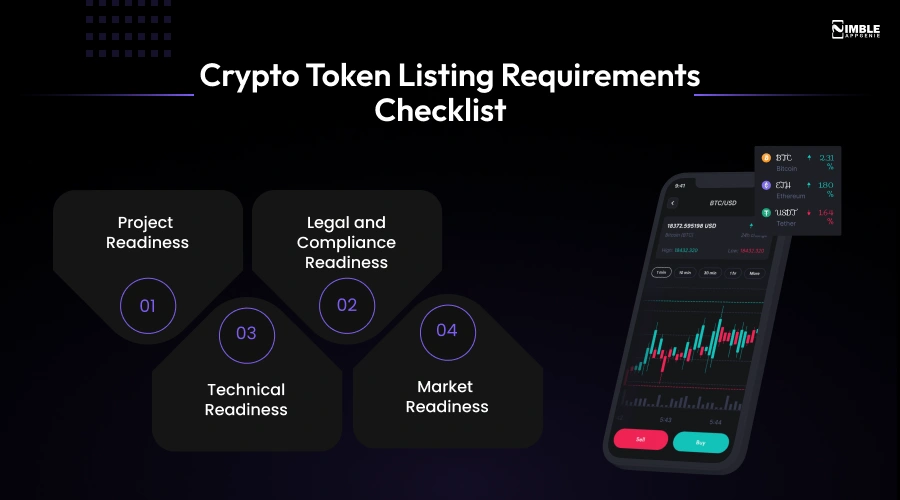
- Project Readiness: Live, functioning project website – Whitepaper or litepaper – Public roadmap – Team information and credentials – Clear statement of token utility – Documented tokenomics (supply, allocation, vesting)
- Legal and Compliance Readiness: Company or entity information, where applicable – Jurisdictional disclosure – Consideration of token classification (utility, security, etc.) – KYC/AML documentation, where the exchange requires it – Legal review of the project’s structure and disclosures
- Technical Readiness: Deployed and verified smart contract – Security audit report, where applicable to the project’s risk profile – Blockchain/network details and token standard – Wallet compatibility confirmation – Technical documentation for integration – Readiness for exchange-side API or system integration
- Market Readiness: Active community across relevant channels – Consistent social presence – Existing trading activity, if any – Liquidity plan or committed liquidity – Holder base and user metrics – Evidence of ecosystem traction
Step-by-Step: How to Get Your Token Listed on a Crypto Exchange
Here, preparation leads to an actual application. Each step below covers what to do, why it matters, mistakes teams generally make, and where outside technical support tends to add the most value.
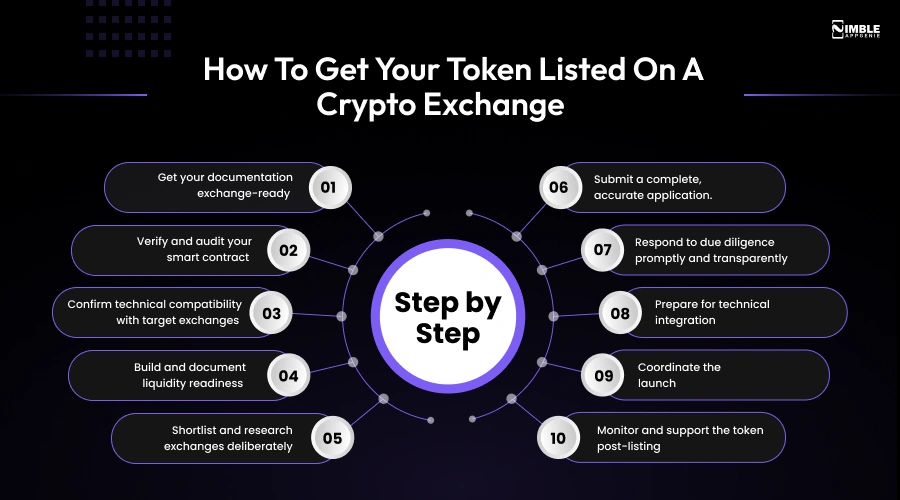
Step 1: Get your documentation exchange-ready
What to do: Consolidate your whitepaper, team bios, tokenomics, and legal disclosures into a single, consistent package.
Why it matters: Exchanges cross-check every document; inconsistencies (unclear vesting teams, different supply figures) are one of the rapid ways to stall a review.
Common mistakes: Treating the whitepaper as a marketing document instead of a due-diligence document.
Where support helps: Structuring documentation to match the format and depth exchanges expect, based on what similar listings have required.
Step 2: Verify and audit your smart contract
What to do: Confirm your contract is verified on the relevant block explorer and, where warranted, has completed a third-party security audit.
Why it matters: Unverified or unaudited contracts are a common reason for immediate rejection, especially on larger exchanges.
Common mistakes: Assuming an internal code review is a substitute for an independent audit.
Where support helps: Smart contract review, coordination with audit providers, and remediation of flagged issues.
Step 3: Confirm technical compatibility with target exchanges
What to do: Validate that your token standard, wallet support, and network align with what each shortlisted exchange requires.
Why it matters: A mismatch here (unsupported network, incompatible token standard) can rule out an exchange entirely, regardless of how robust the rest of the application is.
Common mistake: Applying broadly without first checking network-level compatibility.
Where support helps: Technical readiness assessment and, where required, integration or bridging work to meet a specific exchange’s needs.
Step 4: Build and document liquidity readiness
What to do: Establish a liquidity plan – whether self-funded, DEX-pool-based, or market-maker-supported – before you apply.
Why it matters: Exchanges demand confidence that trading won’t immediately dry up after launch.
Common mistakes: Treating liquidity as something to figure out after approval instead of applying early.
Where support helps: Structuring the technical side of liquidity provisioning and trading infrastructure.
Step 5: Shortlist and research exchanges deliberately
What to do: Compare exchanges by audience fit, listing requirements, trading volume, and reputation – not just size.
Why it matters: Applying to exchanges that don’t fit your project wastes time and can create a pattern of rejections.
Common mistakes: Applying only to top-tier global exchanges and ignoring exchanges that better match the project’s stage or region.
Where support helps: An outside technical partner familiar with multiple exchange environments can realistically help narrow the shortlist.
Step 6: Submit a complete, accurate application.
What to do: Fill out the exchange’s application in full, with consistent data that matches your public documentation.
Why it matters: Incomplete applications are frequently deprioritized and rejected outright.
Common mistake: Rushing the form and leaving compliance-related fields vague.
Where support helps: Reviewing the application against exchange expectations before submission.
Step 7: Respond to due diligence promptly and transparently
What to do: Answer follow-up questions from the exchange’s compliance and technical teams quickly and completely.
Why it matters: Slow or vague responses are read as a risk signal.
Common mistake: Going quiet during review, or providing answers that contradict earlier documentation.
Where support helps: Coordinating technical and compliance responses so that the project speaks with one consistent voice.
Step 8: Prepare for technical integration
What to do: Complete any API integration, wallet support, or infrastructure work the exchange needs before going live.
Why it matters: Technical delays at this stage can push back an otherwise-approved listing.
Common mistakes: Underestimating the engineering effort required for exchange-side integration.
Where support helps: This is core blockchain and API integration work – exactly where a development partner can remove bottlenecks.
Step 9: Coordinate the launch
What to do: Align your community communication, marketing, and trading pair activation with the exchange’s go-live window.
Why it matters: A disorganized launch can undercut the listing’s value itself.
Common mistake: Announcing a listing before the exchange has confirmed the go-live date.
Where support helps: Project management across technical, compliance, and communication workstreams.
Step 10: Monitor and support the token post-listing
What to do: Track liquidity, trading volume, and any technical issues, and stay responsive to the exchange.
Why it matters: Exchanges can delist tokens that show ongoing technical problems or vanishing liquidity.
Common mistake: Treating “listed” as the finish line rather than an ongoing operational responsibility.
Where support helps: Continued technical maintenance and monitoring support.
How to Choose the Right Crypto Exchange for Your Token
The right exchange is not automatically the largest one. Selection is based on the best fit, not prestige alone. Consider:
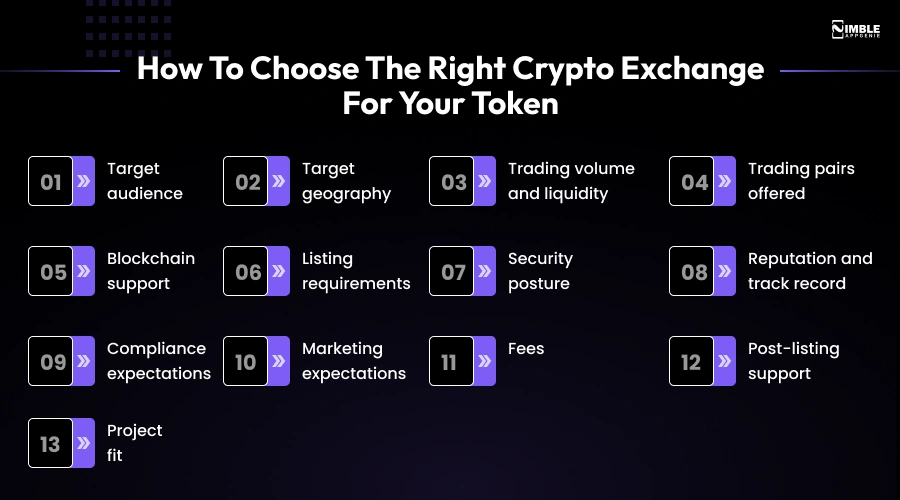
- Target audience: Retail traders, institutional participants, or DeFi-native users
- Target geography: Where your actual or intended user base is concentrated
- Trading volume and liquidity: Whether the exchange can sustain meaningful trading activity for a token at your stage
- Trading pairs offered: Which base assets your token can realistically be paired against
- Blockchain support: Whether the exchange supports your token’s network natively
- Listing requirements: Whether your current readiness level matches what the exchange expects
- Security posture: The exchange’s own security history and practices
- Reputation and track record: How the exchange has handled past listings and delistings
- Compliance expectations: The regulatory standards the exchange applies to listed projects
- Marketing expectations: Whether the exchange expects co-marketing commitments
- Fees: Application, listing, and ongoing costs
- Post-listing support: How much ongoing assistance the exchange provides after go-live
- Project fit: Whether the exchange’s typical listed projects resemble yours
A smaller or regional exchange that meets your project’s stage and audience can often deliver more meaningful trading activity than a top-tier exchange where your token gets lost among thousands of listings.
How Much Does It Cost to List a Token on a Crypto Exchange?
Listing costs vary by listing route, exchange, and project complexity – there’s no fixed, universal fee across the industry. It’s more helpful to think in terms of three separate cost categories:
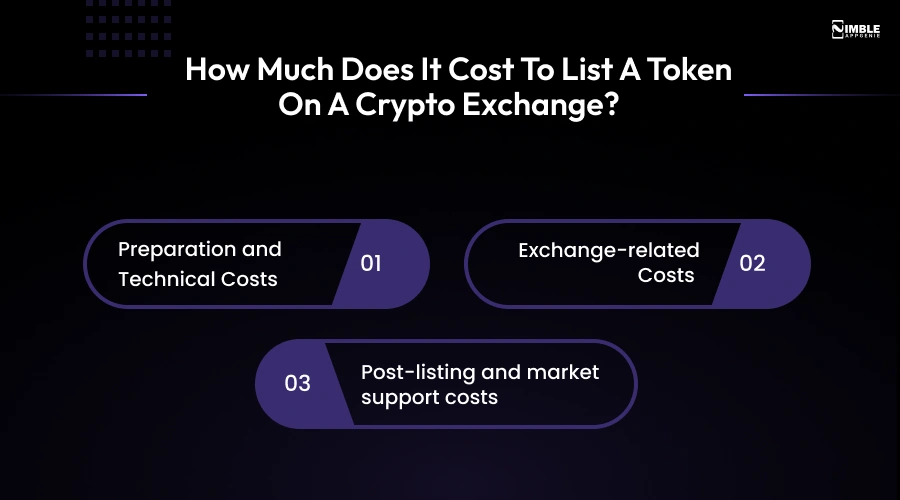
1. Preparation and Technical Costs
This covers the work required before you ever submit an application: security audits, smart contract development or remediation, legal review, documentation preparation, and any exchange-side technical integration. These costs depend heavily on how much groundwork your project has already done.
2. Exchange-related Costs
Some exchanges charge application or listing fees; others don’t charge listed projects directly and instead work on other commercial terms. Fee structures, where they exist, are set independently by each exchange and are prone to change – always confirm current terms directly with the exchange rather than relying on third-party estimates.
3. Post-listing and market-support costs
Ongoing liquidity provisioning, continued compliance monitoring, market-making arrangement (where used), and technical maintenance after the token goes live.
Be careful of any provider presenting a single flat “listing fee” as a universal number – actual costs depend on the specific exchange, the project’s current readiness, and the scope of support required.
How Long Does Crypto Exchange Listing Take?
There’s no fixed timeline – a DEX listing can go live within hours of deploying a liquidity pool, while a CEX listing typically takes a few weeks to several months depending on the exchange’s review depth. Actual duration depends on:
- How ready the project’s documentation and technical infrastructure already are
- Whether legal or compliance issues surface during review
- The depth of the exchange’s review and due diligence process
- How quickly the project responds to exchange follow-up requests
- The complexity of any required technical integrations
- Negotiation and finalization of listing terms
- Coordination of the launch itself
- Testing before go-live
Larger exchanges with multi-stage compliance review tend to sit at the longer end of that range. Projects that arrive with complete, consistent documentation and a technically sound contract generally move through review faster than those addressing gaps mid-process.
Why Token Listing Applications Get Rejected
Underestimating rejection reasons is as helpful as underestimating requirements – it’s where most preventable delays originate.
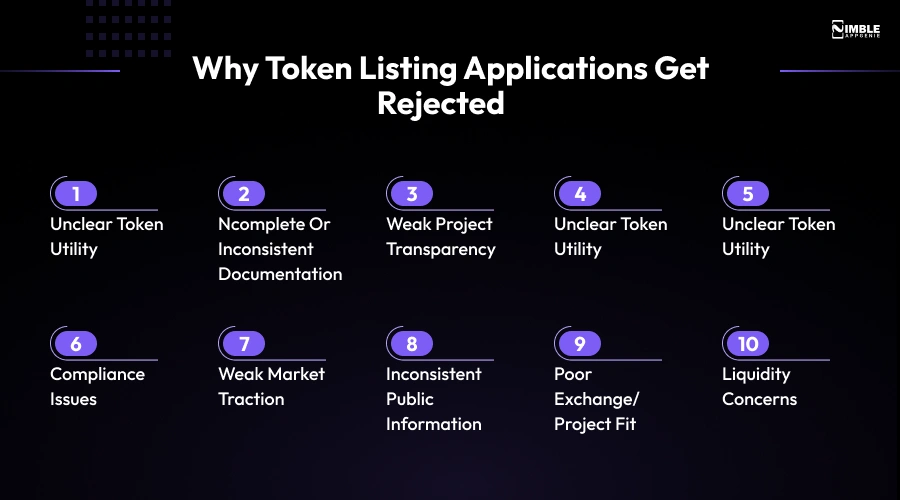
- Unclear Token Utility: No convincing answer to why the token needs to exist.
- Incomplete or Inconsistent Documentation: Figures or claims that don’t match across the whitepaper, application, and website.
- Weak Project Transparency: Anonymous or unverifiable teams, vague company structure.
- Insufficient Overall Readiness: Applying before documentation, audits, or compliance work are complete.
- Technical or Security Concerns: Unverified contracts, unresolved audit findings, or fragile architecture.
- Compliance Issues: Unresolved jurisdictional or classification questions.
- Weak Market Traction: Limited community activity or engagement that looks manufactured.
- Inconsistent Public Information: Social channels, website, and application telling different stories.
- Poor Exchange/Project Fit: Applying to exchanges whose user base or standards don’t match the project.
- Liquidity Concerns: No credible plan for sustaining post-listing trading depth.
Most of these are preventable with earlier preparation, despite a stronger pitch at application time.
Should You Use Crypto Exchange Listing Services?
Professional support is not essential for every project, but it tends to make sense when:
- Documentation needs structuring, editing, and alignment across technical, legal, and marketing materials
- Your team has never been through an exchange listing process before
- Technical integration with exchange systems is more complex than your internal team can absorb alongside other priorities.
- Liquidity planning needs coordination beyond what the founding team has bandwidth for
- You are evaluating several exchanges at once and need a structured comparison.
- Legal and compliance coordination spans multiple jurisdictions
- Founders want to reduce operational friction and keep focus on building the product
- Internal engineering resources are already stretched across the core product
On the other hand, a team with prior listing experience, an in-house legal function, and available engineering capability can usually manage the process internally – particularly for a single, well-scoped DEX or regional CEX listing. The decision should rely on internal capacity and experience, not a default assumption that every project needs an agency.
What Do Crypto Exchange Listing Services Include?
Crypto exchange listing services usually combine exchange research, technical readiness work, documentation support, application handling, and post-listing support. It’s worth understanding what falls under each category, since not every provider covers the same scope:
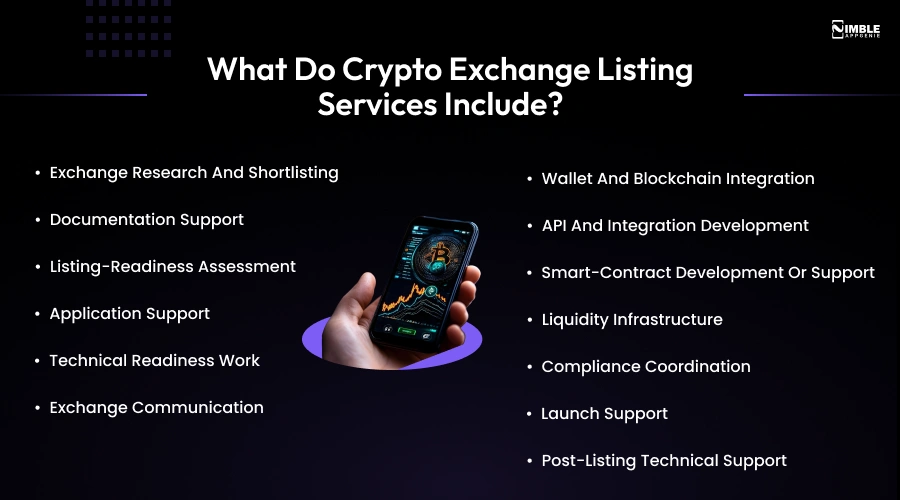
- Exchange Research and Shortlisting: Identifying exchanges that fit the project’s stage, audience, and network.
- Documentation Support: Structuring whitepapers, tokenomics summaries, and legal materials.
- Listing-Readiness Assessment: Auditing documentation, tokenomics, and technical status against typical exchange expectations.
- Application Support: Preparing and reviewing the formal listing submission.
- Technical Readiness Work: Smart contract review, verification, and remediation.
- Exchange Communication: Managing correspondence during due diligence.
- Wallet and Blockchain Integration: Ensuring compatibility across supported networks and wallets.
- API and Integration Development: Building the technical connections an exchange requires.
- Smart-contract Development or Support: Addressing issues surfaced during technical review.
- Liquidity Infrastructure: Setting up the technical side of liquidity provisioning.
- Compliance Coordination: Working alongside legal counsel on classification and jurisdictional questions.
- Launch Support: Coordinating go-live timing and technical readiness.
- Post-Listing Technical Support: Ongoing monitoring and maintenance after the token is live.
It’s essential to isolate technical development services (APIs, smart contracts, infrastructure, wallet integrations) from legal services (jurisdictional and classification advice, which should come from qualified legal counsel) and market activities (market making, liquidity provisioning as a regulated financial service), which typically need specialist, appropriately licensed third parties rather than a software development partner.
How to Choose a Crypto Exchange Listing Service Provider
Not every provider calling itself a crypto listing agency, exchange listing provider, or a listing company offers the same scope of work. Use this list as a due-diligence framework and take it into any sales call as literal questions to ask before signing:
- What exactly is included in the engagement, in writing?
- What technical work is included, and what is out of scope?
- Which exchanges are genuinely relevant to a project like mine?
- Do you support the exchange application process directly, or only advise on it?
- Is liquidity support included, and if so, what does that actually mean?
- How are your exchange relationships or track record verified?
- Is market making included, and is it handled by a licensed specialist?
- What happens if an application is rejected? Is there a revision or reapplication process?
- Are legal and compliance services included, or is that my responsibility?
- Are any outcomes – approval, trading volume, price performance – presented as guaranteed?
- What post-listing support is available?
That last question matters more than it seems. No credible provider can ensure an independent exchange will approve a listing, and any claim of guaranteed approval – specifically for a specific Tier-1 exchange – should be treated as a red flag.
How Nimble AppGenie Can Support Your Crypto Project
Nimble AppGenie is a fintech software development company with dedicated blockchain development capabilities – not an exchange, and not a marketing or listing agency. Our role in the listing journey is closest to our expertise: ensuring your project’s technical foundation is actually ready before it faces an exchange.
That includes:
- Blockchain development to strengthen your token’s underlying architecture and network compatibility.
- Crypto wallet development and wallet-integration support so your token works cleanly across the wallets your users and exchanges expect.
- DeFi application development for projects building liquidity pools, staking, or DEX-facing infrastructure.
- API and integration development to meet exchange-side technical requirements.
- Smart contract development, review, and remediation support ahead of third-party audits.
- General fintech infrastructure work to bring documentation, systems, and security posture in line with what exchanges expect.
We don’t claim to guarantee an exchange listing, negotiate exchange relationships, or promise trading volume; those outcomes sit with the exchanges themselves and, where relevant, with licensed market-making and legal partners. We make sure the technical side of your project isn’t the reason your listing application stalls.
Preparing your token for exchange listing? Get the blockchain, wallet, API, and technical infrastructure support your project needs before moving toward exchange integration. Contact Nimble AppGenie to discuss your project’s technical readiness.
Crypto Exchange Listing Services vs. Doing It In-House
| Factor | Listing Services / Technical Partner | In-House |
| Expertise | Access to teams who have navigated multiple exchange environments | Dependent on internal team’s prior experience |
| Internal resources | Frees up founding team and core engineers | Requires dedicated internal bandwidth |
| Documentation | Structured against exchange-tested formats | Built from scratch, higher risk of gaps |
| Technical support | Dedicated development resources for contracts, APIs, wallets | Limited to whatever the core team can spare |
| Exchange coordination | Often more structured communication during review | Founder or ops lead manages correspondence directly |
| Timeline | Can move faster where preparation gaps are the bottleneck | Can be slower if technical or documentation gaps emerge mid-process |
| Cost considerations | Added service cost, offset by reduced rework and delays | No direct service cost, but higher opportunity cost if resources are stretched |
| Operational complexity | Coordinated across one engagement | Spread across internal legal, engineering, and marketing functions |
| Scalability | Easier to apply to multiple exchanges in parallel | Harder to scale without adding headcount |
| Risk management | Benefit of patterns seen across other listings | Learning primarily from your own project’s experience |
Neither path is inherently superior; the right choice depends on available engineering capacity, internal experience, and how many exchanges you are pursuing at once.
Conclusion
Getting a token listed is not a single event; it’s the outcome of everything that happens before the application: clean documentation, a verified and audited smart contract, a compliance posture that holds up to scrutiny, and a liquidity plan that doesn’t fall apart the moment trading opens.
Projects that treat listing as a form to fill out get rejected or stall. Projects that treat it as a readiness milestone tend to move through review faster and land on exchanges that actually fit their audience.
Whether you pursue a DEX listing for speed, a CEX listing for reach, or both in sequence, the exchange’s decision is always independent; no provider, agency, or partner can guarantee approval, and the projects that succeed are the ones that show up prepared rather than the ones that show up first.
If your team is still closing gaps on the technical side contract verification, wallet compatibility, API integration, or blockchain infrastructure that’s where a development partner adds real value: not by promising a listing outcome, but by making sure your project isn’t the reason the application stalls.
Preparing your token for exchange listing? Talk to Nimble AppGenie about getting your technical foundation exchange-ready.
FAQs
Costs vary by exchange and by how much preparation your project already needs, spanning exchange-related fees, preparation and technical costs, and post-listing liquidity or market-support costs. No single universal listing fee is applicable.
Start by assessing your project’s documentation, smart contract, tokenomics, and compliance readiness against what exchanges typically expect, then research exchanges that fit your project’s stage and audience before submitting a complete application.
Timelines depend on the exchange and your project’s readiness. DEX listings can go live within hours; CEX listings commonly take several weeks to a few months, depending on review depth.
On a DEX, practically yes, given the token and liquidity meet the protocol’s technical conditions. On a CEX, listing is permissioned – the exchange independently reviews and decides whether to accept the application.
Common areas include project documentation, verified and often audited smart contracts, legal and compliance readiness, and demonstrated market traction, though specific requirements vary by exchange.
Neither is universally better. CEX listings offer access to a large, established user base but involve a formal review process; DEX listings are faster and permissionless but place liquidity and discoverability entirely on the project.
No reputable provider can guarantee that an independent exchange will approve a listing. Exchanges make their own decisions based on their own criteria; treat any guarantee of approval, especially for a named Tier-1 exchange, with skepticism.
Some do, some don’t, and fee structures vary by exchange and are subject to change. Confirm current terms directly with each exchange rather than relying on third-party listing-fee estimates.
Typically a verified smart contract, documented tokenomics, wallet compatibility, and for most CEXs a completed security audit, along with any exchange-specific API or integration work.
Many established exchanges expect one, particularly for CEX listings, since it demonstrates the contract has been independently reviewed for security issues. Requirements vary by exchange and by the risk profile of the project.

Niketan Sharma, CTO, Nimble AppGenie, is a tech enthusiast with more than a decade of experience in delivering high-value solutions that allow a brand to penetrate the market easily. With a strong hold on mobile app development, he is actively working to help businesses identify the potential of digital transformation by sharing insightful statistics, guides & blogs.
Table of Contents




No Comments
Comments are closed.