

 Free Consultation
 PCI-DSS Compliant
 GDPR Ready
 ISO 27001
 NDA Protected
 AI Services
 AI App Development
 Generative AI Development
 AI Chatbot Development
 AI Integration Services
 AI Consulting Services
 AI For Fintech
 AI Financial Assistant Solution
 AI Insurance Agent Development
 Tech Stack
 OpenAI / GPT-4
 Claude / Anthropic
 Gemini / Google AI
 Llama / Open Source
 LangChain / LlamaIndex
 Pinecone / Pgvector
 AWS / Azure AI


 Fintech Solution
 Core Fintech
 App Development
 Neobank Solutions
 eWallet Solutions
 Lending Software
 Banking Solutions
 BNPL Solutions
 BNPL Solutions
 Insurance App
 Wealth Management
 Crypto & DeFi
 Blockchain Development
  Payroll Software
 DeFi Solutions
 Crypto Wallet
 Crypto On/Off Ramp
 Crypto Exchange
 Trading Platform
 Payments
 Compliance
 Regulations & Compliance
 Fraud Detection
 Lending Ecosystem
 P2P Lending Platform
 Mortgage Software
 Engagement
 Fintech Outsourcing

 Mobile Development
 Mobile App Dev
 iOS App Development
 Android App Development
 React Native
 Flutter Development
 Web Solution
 Node.js Development
 React.js Development
 Angular Development
 App Services
 UI/UX Design
 App Maintenance
 By Stage
 MVP Development
 Industry Solutions
 Healthcare App Dev
 Education App Dev
 Travel App Dev
 Real Estate App Dev
 Logistics Software
 Social Media App

 Hire Mobile Developers
 Hire iPhone Developers
 Hire Android Developers
 Hire React Native Devs
 Hire Flutter Developers
 Hire Web Developers
 Hire Node.js Developers
 Hire Angular Developers
 Hire PHP Developers
 Hire Laravel Developers
 How It Works
 Pre-Vetted Developers
 Ready In 48 Hours
 NDA From Day One
 Replace Guarantee
 Company
 About Us
 Our Work Process
 Portfolio
 Case Studies
 Blog / Insights
 Careers
 Contact Us
 Awards
 Recognition


 Offices


Key takeaways:
- React Native is typically 15–25% cheaper upfront due to a larger JavaScript talent pool and lower developer hourly rates.
- Flutter often delivers a lower 3-year total cost of ownership due to reduced QA cycles, fewer platform-specific bugs, and more predictable maintenance.
- A typical cross-platform app costs $45,000–$150,000 with either framework; the framework itself is rarely the biggest cost driver.
- Flutter wins for UI-heavy apps like fintech dashboards, consumer apps, multi-platform products. React Native wins when your team already knows JavaScript and needs to ship fast.
- The hidden Flutter app development cost vs React Native cost are third-party library instability (React Native) and Dart talent scarcity (Flutter), which can swing your budget by 10–20%.
- Nimble AppGenie builds custom Flutter and React Native apps for fintech and enterprise clients, with transparent, milestone-based pricing from day one.
Flutter app development cost vs React Native is one of the first questions founders, CTOs, and product teams ask before committing to a framework.
And it is a fair question.
You want to build for iOS and Android. You have a budget. And you need to choose between Flutter and React Native. Both are the best cross-platform frameworks. Both can build the same app. So which framework is cheaper to build?
Here is the short answer: React Native is 15–25% cheaper upfront. Flutter costs less to maintain over 3 years. A typical cross-platform app development cost is around $40,000–$150,000 with either framework.
But the real answer depends on the scope, team size, and what you are building matters far more.
In this guide, we will help you define the difference between Flutter app development cost and React native. Also, how each factor affects the cost, so you can make a clear decision about which framework to choose.
What is Flutter?
Flutter is Google’s open-source UI framework that was released in 2017. It simply uses Dart as its programming language and comes with its own rendering engine.
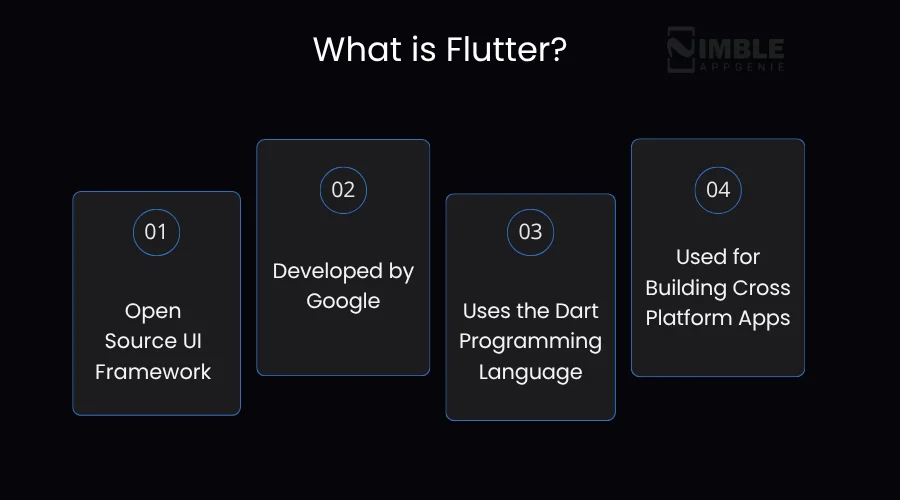
Additionally, Flutter draws every pixel on the screen itself rather than depending on native platform components. This means apps look and behave identically on iOS, Android, web, and desktop from a single codebase.
What is React Native?
React Native is Meta’s open-source framework, released in 2015. It leverages JavaScript, which is one of the most used programming languages, and renders using native platform UI components.
This means a React Native app on iOS looks and feels like a native iOS app, and on Android it behaves like a native Android app.
React Native introduced its new architecture in 2025 that significantly closes the performance gap with Flutter. It commands approximately 35% cross-platform market share.
| Key Difference: Flutter controls the entire UI layer itself. React Native delegates UI rendering to the platform. This architectural distinction is the root cause of almost every cost difference between the two frameworks. |
The Real Cost Drivers: What Makes a Mobile App Expensive?
The biggest drivers in mobile app development cost are app complexity, team geography, design requirements, and backend scope.
The framework itself, Flutter vs React Native for startups, usually accounts for less than 10% of total cost variance. Before comparing Flutter and React Native costs, you need to understand what makes any app expensive. Take a look at the cost drivers:
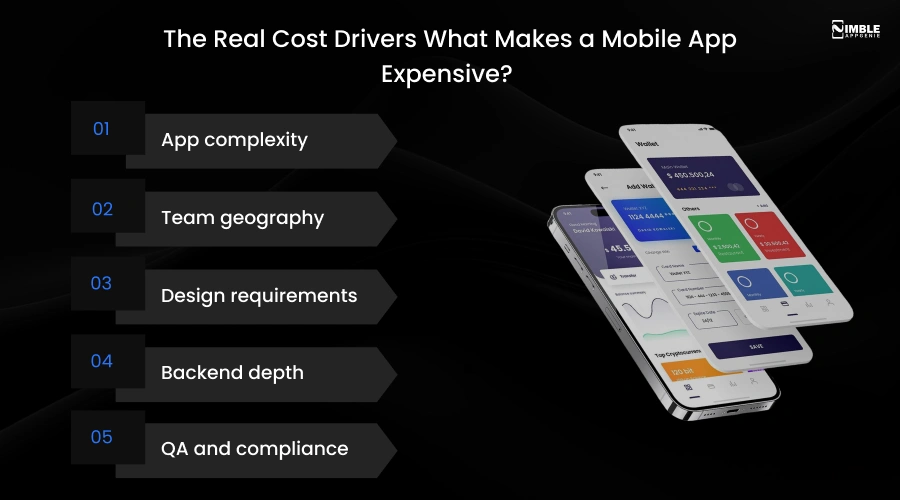
- App complexity: The number of screens, user roles, and features (payments, real-time data, maps, AI) is the biggest variable. A 10-screen MVP costs far less than a 40-screen enterprise app, regardless of framework.
- Team geography: US agencies charge $150-$300/hr. European agencies charge $80-$150/hr. Indian agencies charge $25-$75/hr. Where your team is based can swing total cost by 200-300%.
- Design requirements: Standard Material Design components cost little. Custom animations and branded UI systems cost 2-3x more in design time.
- Backend depth: Most founders budget for the mobile app and forget the backend: admin panels, user roles, dashboards, APIs, analytics, and third-party integrations often match or exceed the frontend cost.
- QA and compliance: Apps in fintech or healthcare need security testing, compliance reviews, and deeper QA. This adds 20-30% to total cost regardless of framework.
Once you account for these factors, the Flutter app development cost vs React Native on any given project is usually 5-25%. Meaningful, but not the dominant variable.

Flutter App Development Cost vs React Native: Side-by-Side
For a mid-complexity mobile app, the Flutter app development costs around $40,000-$150,000 and React Native costs $25,000-$130,000. React Native has a slight cost edge upfront.
Flutter often wins on total costs over three years. Let’s have a look at the cost comparison on all major dimensions for a typical mid-complexity mobile app.
| Cost Factor | Flutter | React Native | Edge |
| MVP (8-12 screens) | $30,000 – $80,000 | $25,000 – $70,000 | React Native |
| Mid-complexity app (15-20 screens) | $40,000 – $150,000 | $35,000 – $130,000 | React Native (slight) |
| Complex app (30+ screens, integrations) | $80,000 – $250,000+ | $70,000 – $220,000+ | React Native (slight) |
| Design cost (custom UI) | Lower – consistent widget system | Moderate – platform-specific tweaks needed | Flutter |
| QA cost | Lower – one rendering engine, fewer device bugs | Moderate – native bridge adds edge cases | Flutter |
| Annual maintenance | $5,000 – $20,000/yr | $8,000 – $30,000/yr | Flutter |
| 3-year TCO (mid-complexity) | $120,000 – $310,000 | $140,000 – $360,000 | Flutter (long-term) |
| Multi-platform (mobile + web + desktop) | Lower – one codebase | Higher – separate builds needed | Flutter |
These ranges assume a mid-market development team in Asia or Eastern Europe. US-based teams will be 2-3x higher on every row.
The gap narrows significantly if your team already knows JavaScript. React Native allows you to reuse skills and move faster. That translates directly into lower development cost.
Flutter Developer Rates vs React Native Developer Rates
The React Native developer cost is $25-$50/hr in Asia and $80-$150/hr in the US. Flutter developers charge $30-$60/hr in Asia and $100-$180/hr in the US.
The 15-25% rate premium for Flutter exists because Dart is less common than JavaScript globally. Let’s take a look at the cost comparison table below.
| Region | React Native Rate | Flutter Rate | Rate Premium (Flutter) |
| South Asia | $25 – $50/hr | $30 – $60/hr | +15 to 25% |
| Eastern Europe | $50 – $100/hr | $60 – $120/hr | +15 to 25% |
| Western Europe | $80 – $150/hr | $90 – $160/hr | +10 to 15% |
| United States | $100 – $180/hr | $120 – $200/hr | +15 to 20% |
| Annual salary (US, 2024) | ~$113,000/yr | ~$107,000 – $125,000/yr | ~10% |
Why is React Native cheaper to hire for?
The cost to hire React Native app developers is very low. JavaScript is used by 67% of all developers. The talent pool is huge. US LinkedIn data shows 6,400+ React Native job postings vs around 1,000 Flutter postings. More supply keeps rates competitive.
Dart, Flutter’s language, is used by roughly 6% of developers. That scarcity adds 7-15% to hourly rates. Also, it makes hiring slower, which is a real cost for startups who need to move fast.
Does Flutter’s higher rate get offset?
Yes, often, Flutter developers build UI faster because the widget system is consistent on platforms. There are no platform-specific tweaks. An experienced Flutter app development company can complete design-heavy screens 20-30% faster.
This closes the rate gap. The Flutter developer hourly rate is quite high compared to React Native. For apps where UI is complex, Flutter’s total development hours can actually come out lower even at higher rates.
Time-to-Market: Which Framework Builds Faster?
React Native is faster to launch for teams with existing JavaScript skills. Simple MVPs can go live in 4-8 weeks. Flutter takes slightly longer upfront but catches up on design-heavy applications. For most mid-complexity apps, the timeline difference is 1-3 weeks.
Time is money. Every week of extra development is another week of burn rate. Here is how the two frameworks compare on delivery speed.
| App Type | React Native | Flutter | Notes |
| Simple MVP (5-8 screens) | 4 – 8 weeks | 5 – 10 weeks | RN faster due to JS familiarity and Expo |
| Mid-complexity (15-20 screens) | 10 – 16 weeks | 10 – 16 weeks | Roughly equal; Flutter gains on UI-heavy apps |
| Complex app (30+ screens) | 16 – 28 weeks | 14 – 26 weeks | Flutter can be faster with custom UI systems |
| Multi-platform (mobile + web + desktop) | Not recommended (separate builds) | 14 – 30 weeks | Flutter’s clear advantage here |
React Native with Expo is the fastest path to a working prototype. Teams that know JavaScript can have a functional MVP running in days. Flutter has a 2-3 week ramp for teams new to Dart.
Once past that, complex UI work is often faster. The widget system removes most platform-specific work.
| Bottom line: If you have a JavaScript team and need to ship fast, React Native wins. If you are developing from scratch and your app is design-driven, Flutter catches up quickly. |
Hidden Flutter App Development Cost vs React Native
The hidden React Native app development cost includes third-party library instability and expensive OTA update infrastructure.
However, the hidden costs of Flutter include Dart talent scarcity and larger app bundle sizes. Both add 10-20% to real project costs if not planned for upfront. Let’s have a look at the hidden Flutter app development cost vs React Native cost.
Hidden Costs of React Native
- Library instability: React Native uses npm, which has 2.1 million packages and no quality scoring. Packages break when iOS or Android updates ship. Teams spend 10-15% of the maintenance budget on library migration.
- OTA update costs: After Microsoft shut down App Center, React Native teams now use Expo EAS or build their own infrastructure. For fintech apps needing monthly security patches, this can cost $25,000+ per year.
- Native module work: Features like Bluetooth LE, NFC, or advanced camera controls often need custom native code for both iOS and Android. This doubles the cost of those specific features.
Hidden Costs of Flutter
- Dart talent scarcity: Finding experienced Flutter developers in many markets takes 3-6 weeks longer. Delayed hiring has a real dollar cost for startups on a timeline.
- Larger app size: Flutter includes its rendering engine in the app binary, adding 4-8 MB. In markets where data costs are high, this affects user acquisition and conversion rates.
- Web SEO limitations: Flutter Web renders to canvas, not HTML. This means your web version cannot rank on Google. If you need a public web presence, you need a separate web build, which adds cost.
- Niche plugin gaps: Some third-party SDKs, older payment gateways, legacy enterprise APIs may not have a Flutter plugin yet. You will need to write custom native code, which takes time.
3-Year Total Cost of Ownership: Flutter app development Cost vs React Native
Flutter’s lower maintenance and QA costs compound over time, making it cheaper in the long run for most business apps. Startups and CTOs who only look at development costs miss the bigger number.
Here is what you are actually committing to over a 3-year product lifecycle.
| TCO Component | Flutter (3-Year) | React Native (3-Year) |
| Initial development | $80,000 – $150,000 | $70,000 – $130,000 |
| Annual QA and bug fixes | $12,000 – $25,000/yr | $18,000 – $35,000/yr |
| OS compatibility updates | $5,000 – $10,000/yr | $8,000 – $15,000/yr |
| Feature additions (Year 2-3) | $40,000 – $80,000 | $45,000 – $90,000 |
| OTA update infrastructure | $4,800 – $9,600/yr | $12,000 – $30,000/yr (Expo EAS) |
| Library migration (3 years) | $2,000 – $8,000 total | $10,000 – $25,000 total |
| Total 3-year TCO | $120,000 – $310,000 | $140,000 – $360,000 |
Flutter’s lower TCO comes from two things. First, its rendering engine is consistent, so there are fewer platform-specific bugs to fix. Second, Dart’s ahead-of-time compilation catches breaking changes at development time, not runtime. That means fewer emergency bug fixes.
For startups with limited runway, React Native for mobile app development is often a cost-effective choice. It also helps businesses launch their apps 4–6 weeks faster.
For many startups, reaching the market early can be more valuable than saving $20,000 over three years. But for established companies developing a product they plan to run for 5+ years, Flutter’s cost advantage compounds.
Which Framework Fits Your App and Industry?
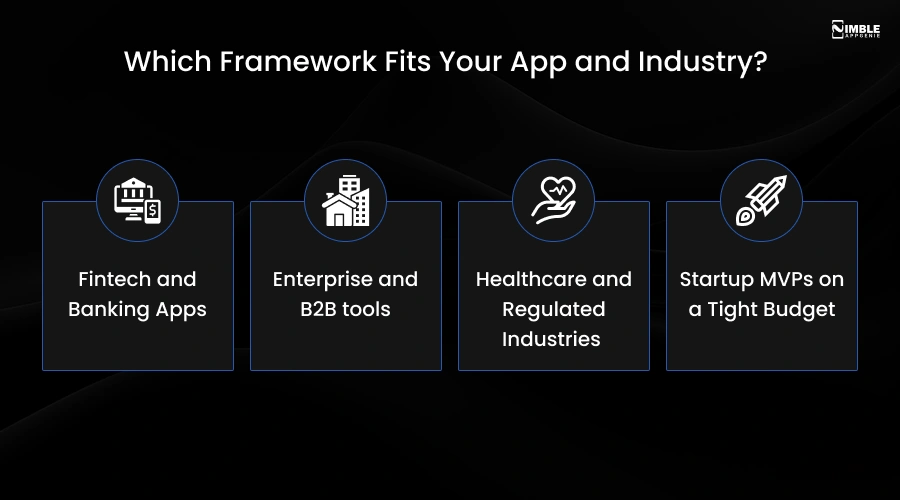
Flutter is recommended for fintech apps, multi-platform products, and design-heavy consumer apps. React Native is better for startups with JavaScript teams, enterprise B2B tools, and apps that share code with an existing React web product. Neither framework is universally cheaper across all use cases.
Let’s now understand how Flutter and React Native compare across the app types and industries that matter to founders and product teams.
1. Fintech and Banking Apps
If you are building a neobank app, payment app, or lending platform, Flutter is the more cost-effective choice over time. Nubank, Google Pay, and BMW all run on Flutter. Why? Financial apps need pixel-perfect, consistent UI on every device.
Flutter’s own rendering engine guarantees that. React Native depends on platform components, which can produce small visual inconsistencies across devices and OS versions.
So, if you are building a payment dashboard, a KYC flow, or an investment platform with custom animations, Flutter is the cheaper and more reliable choice.
2. Enterprise and B2B tools
React Native is usually the better fit. It integrates more naturally with existing JavaScript backend teams and web apps. It allows your team to share patterns and code between web and mobile. This saves around 15-20% of total development cost.
Flutter is gaining ground in enterprise tools that need desktop support, where its multi-platform codebase saves huge cost.
If your enterprise tool needs a consistent experience on Windows, macOS, mobile, and tablet from one codebase, Flutter for enterprise app development is the only option that does this well.
3. Healthcare and Regulated Industries
Flutter is increasingly the preferred choice for healthcare. Its package ecosystem is quality-scored, which reduces supply chain risk. This is the real concern in regulated industries after several npm security incidents in 2023–2024.
Dart’s ahead-of-time compilation catches breaking changes at build time rather than runtime, which reduces emergency patches. For apps where a runtime crash has serious consequences, that reliability difference matters.
4. Startup MVPs on a Tight Budget
For startups that need to validate an idea fast, React Native with Expo is the cheapest path. If your team knows JavaScript, you can have a working prototype in days.
However, you can choose Flutter for MVP Development. If you are starting fresh or your app is visually complex, Flutter’s widget system can actually make the MVP faster and cheaper once the team is up to speed.

Which Is Cheaper Between Flutter and React Native?
React Native is cheaper upfront by 15-25% for most projects. Flutter is cheaper over three years for apps that need consistent UI, low maintenance, and multi-platform support. If your team knows JavaScript, React Native saves money.
If you are building for fintech, premium UI, or long-term platform stability, Flutter saves more over time. You can use this as your decision guide:
Choose React Native if:
- Your team already knows JavaScript or React, you save 3-6 weeks of onboarding, worth $15,000-$30,000 in developer hours.
- You need to ship an MVP fast, React Native with Expo is the fastest way to a working prototype.
- You have an existing React web app, code sharing reduces total cost by 15-20%.
- You are building an enterprise B2B tool that connects to a JavaScript backend stack.
Choose Flutter if:
- Your app is design-heavy or animation-rich; Flutter’s widget system delivers custom UI faster, offsetting the higher developer rate.
- You are thinking 3+ years ahead, Flutter’s total cost of ownership is typically 10-20% lower.
- Your app needs to run on mobile, web, and desktop; Flutter is the only framework that handles all three well from one codebase.
- You are building for fintech, healthcare, or automotive; these industries have standardised on Flutter for a reason.
The numbers at a glance:
| Elements | React Native | Flutter |
| Upfront cost (MVP) | $30,000-$70,000 | $35,000-$80,000 |
| Developer rate | $25-$50/hr | $30-$60/hr |
| Annual maintenance | $8000-$28000 | $5000-$18000 |
| 3-yearr TCP | $140,000-$345,000 | $125,000-$295,000 |
| Best for | JS teams, fast MVPs, B2B tools | Fintech, design-heavy, long-lived products |
Both frameworks cost 30–45% less than building separate native apps for iOS and Android. That saving is more significant than the difference between the two frameworks.
If you are still unsure, the honest answer is this: choose the framework your best available developers already know. Developer productivity matters more than framework architecture in most real-world projects.
How Nimble AppGenie Can Help You Choose the Right Framework?
Nimble AppGenie is a mobile app development company that has built cross-platform apps for fintech companies, enterprise clients, and startups in both Flutter and React Native.
Here’s what sets our approach apart:
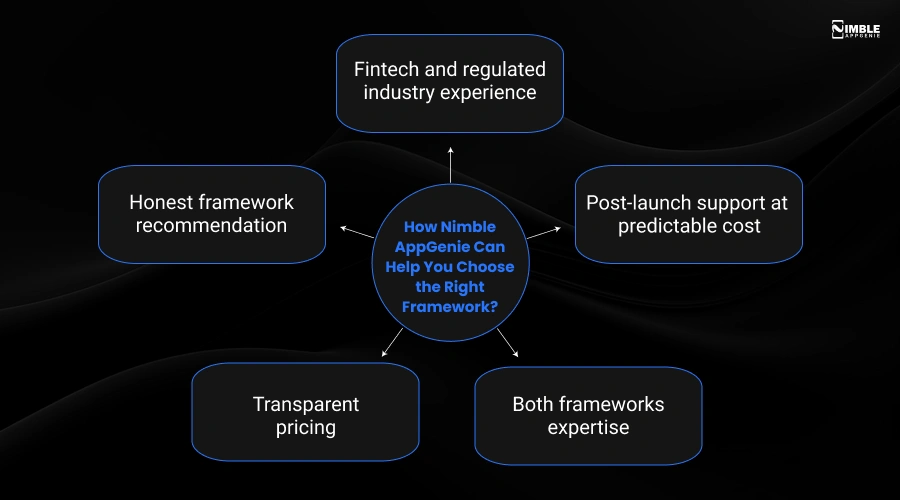
- Honest framework recommendation: We tell you which framework genuinely fits your goals. If React Native is the cheaper and faster path for your situation, we say no. If Flutter serves your long-term TCO better, we explain why with numbers.
- Transparent pricing: Every project starts with a detailed scope and milestone-based cost plan. You know what you are spending before we write a single line of code.
- Both frameworks expertise: Our senior developers are proficient in Flutter and React Native. We have delivered fintech dashboards, healthcare monitoring apps, and enterprise B2B platforms on both frameworks.
- Post-launch support at predictable cost: We offer structured maintenance plans that cover OS updates, security patches, and feature additions.
- Fintech and regulated industry experience: If you are building in fintech, we understand PCI-DSS, GDPR, and what compliance-ready development actually looks like. We build with those requirements from day one.
Whether you are a startup founder with an idea and a limited runway, a CTO making a 5-year platform decision, or a COO trying to estimate next quarter’s budget, we can give you honest, expert guidance grounded in real project experience.

Conclusion
The Flutter app development cost vs React Native cost debate is really a proxy for a more important question: which frameworks align with your team’s strengths, your product’s requirements, and your business’s timeline?
React Native gives you a faster, cheaper path to an MVP. However, Flutter gives you a more consistent, lower-maintenance platform for apps that will scale, need design excellence, or need to run on multiple platforms.
Neither is inherently cheaper. Both frameworks save you 35-40% compared to developing a separate native app. The right choice is the one that fits your reality and not the one that ranks highest in a developer popularity poll.
Thus, if you are planning to build a mobile app with the best framework, it is advisable to consult with a Flutter or a React Native app development company. They know where each framework shines and where it falls short and provide you with the best cost estimate that aligns with your business requirements.
FAQs
To choose between Flutter and React Native as a CTO, you can ask four questions:
- Does your team know JavaScript? If yes, React Native reduces onboarding cost.
- Will your app run on multiple platforms beyond iOS and Android? If yes, Flutter saves a high cost.
- Is this product expected to run for 5+ years? If yes, Flutter’s lower TCO matters.
- How frequently do you need OTA updates? Compare Flutter vs React Native costs at your expected user scale.
If the answers are split, allow the team’s skills and hiring speed to be the tiebreaker.

Madan is the Backend Solutions Architect at Nimble AppGenie, specializing in the design of secure, high-concurrency systems that power complex mobile ecosystems. With deep expertise in server-side logic and database management, he ensures every platform is built with enterprise-grade security. In his free time, he is an avid researcher of emerging technologies; he spends his time deconstructing the latest backend frameworks and reading technical papers to ensure our solutions remain at the absolute forefront of industry innovation.
Table of Contents




No Comments
Comments are closed.