


Key Takeaways:
- Building an MVP first can save 40-60% of your initial budget.
- Cross-platform apps (Flutter/React Native) cut development time and cost by 30-50%.
- Outsourcing to the right team – not just the cheapest – is the smartest cost lever.
- Using third-party APIs (payments, auth, maps) removes the need to build from scratch.
- Agile development prevents scope creep – the #1 hidden cost in app projects.
- Automated testing reduces bug-fix costs and speeds up delivery.
- Open-source frameworks remove licensing costs without hurting quality.
- Simple, clean UI/UX is cheaper to build and better for users.
- Planning maintenance costs upfront prevents expensive surprises post-launch.
- Nimble AppGenie helps businesses build high-quality apps on a budget – transparently, strategically, and on time.
When you search ‘how to reduce mobile app development cost,’ most articles tell you to cut features or hire mobile app developers, the cheapest ones you can find. That’s imperfect advice, and almost always fails.
The truth is: reducing mobile app development cost doesn’t mean spending less everywhere. It says to spend smarter in the right places, at the right time, and with the right development strategy.
If you want a deeper understanding of what actually drives app pricing, this detailed guide on mobile app development cost explains the key factors, hidden expenses, and budgeting considerations businesses should know before starting development.
Whether you are a startup founder looking to validate your mobile app idea on a tight budget or a business owner trying to build a second version of your app without going over budget, this guide is for you.
We have broken down the top 10 proven, practical strategies that help optimize mobile app development costs without sacrificing quality, user experience, or performance. Let’s get started.
Why Do Mobile App Development Costs Become Out of Control?
Before you resolve an issue, you should understand its root cause.
App budgets usually go out of control because of a few key reasons:
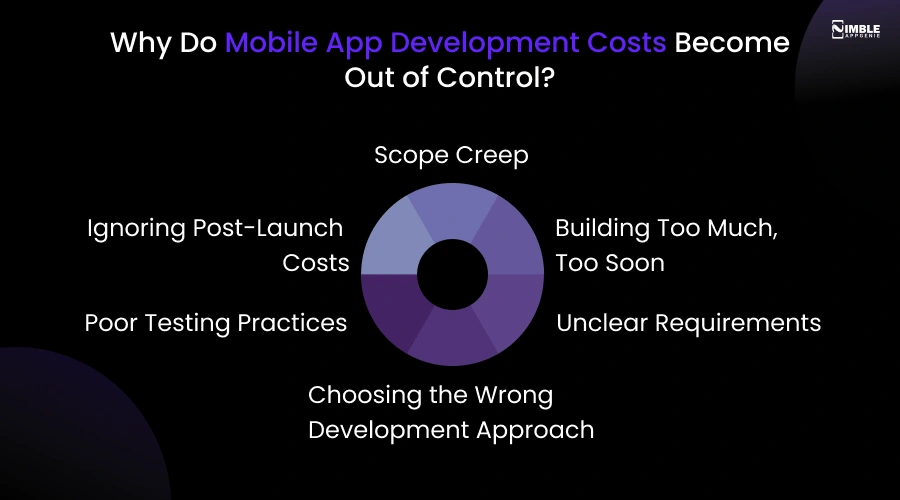
► Scope Creep
You keep adding features mid-development without adjusting your budget or timeline.
► Building Too Much, Too Soon
Most companies try to develop a ‘perfect’ app on the first go. Research consistently reveals that 60-80% of app features are rarely or never used.
► Unclear Requirements
Vague ideas in the beginning result in costly rework later. A change made during planning costs a fraction of what it costs during development.
► Choosing the Wrong Development Approach
Developing native apps for Android and iOS separately when a cross-platform approach would go well.
► Poor Testing Practices
Discovering bugs after launch costs 5-10x more than discovering them during development.
► Ignoring Post-Launch Costs
Many teams forget about updates, ongoing maintenance, and bug fixes in their initial budget.
You can make targeted decisions by understanding these mobile app development cost drivers, removing waste without compromising quality. Let’s know how to do that in the next section.
10 Smart Strategies to Reduce Mobile App Development Cost Without Cutting Quality
Now you might have a question: “What are the strategies to reduce app development cost?”
Let’s have a walk-through of the smart strategies to reduce app development cost:
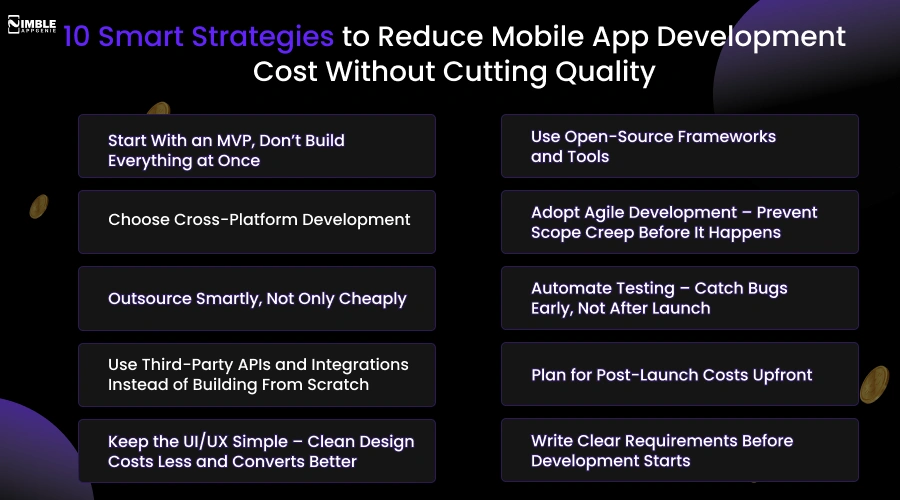
1. Start With an MVP, Don’t Build Everything at Once
This is one of the most effective ways to reduce app development costs without sacrificing quality. An MVP or Minimum Viable Product is a version of your app that includes the core features required to solve the primary user problem.
Working with an experienced MVP development company can help you launch faster, validate your idea with real users, and avoid overspending on unnecessary features early on.
Think of it like this: If you are planning to build a food delivery app, your MVP needs user registration, browsing restaurants, order placement, and payment. It doesn’t need AI recommendations, loyalty points, or in-app chat – at least not on day one.
Why does this matter for cost: As MVP development can save 40-60% of your initial budget. You create less, spend less, and validate your mobile app idea with real users before investing in a full-fledged product. Above all, you don’t waste money building features nobody asked for.
Once you make your MVP live and you start getting feedback from real users, you build another set of features based on analytics, not assumptions.
Quick Win: Build your MVP with Flutter or React Native (cross-platform) to save even more. You get apps for Android and iOS from one codebase, at nearly half the cost of two separate native builds.
Related Read: Flutter for MVP Development – Why It’s the Smart Choice for Startups
2. Choose Cross-Platform Development (Flutter or React Native)
When building a mobile app, one of the biggest decisions you will make is whether to go native (separate builds for Android and iOS) or use cross-platform development (one codebase for both platforms).
Understanding the differences in performance, development cost, scalability, and user experience is critical before you choose. Read this detailed guide on Native vs Cross-Platform app development to understand which approach best fits your business goals.
For most startups, SMBs, and budget-conscious businesses, cross-platform development with Flutter or React Native is the clear winner for optimizing mobile app costs.
Here’s why:
- You write one codebase instead of two, reducing development hours by half.
- You maintain one mobile app instead of two, cutting long-term maintenance costs.
- Cross-platform development can decrease development time and cost by 30-50% compared to creating separate native apps.
- Flutter and React Native both deliver near-native performance, meaning users won’t notice the difference.
Real-World Examples: Companies like Uber Eats, Airbnb, and Alibaba have used cross-platform development to reach millions of users cost-effectively. You don’t always need a native build to deliver a premium experience.
The exception? If your app needs deep device integration (like advanced hardware access or complex AR features), native might be worth the extra investment. For most apps, it’s not essential.
| Related Read: Flutter vs React Native – Which One Is Right for Your App? |
3. Outsource Smartly, Not Only Cheaply
Mobile app development outsourcing is one of the most widespread ways to reduce app development expenses and one of the most misunderstood. The biggest mobile app development mistake most businesses make is that they choose based on price only.
The lowest hourly rate is almost never the lowest mobile app development cost. A developer who charges $20/hour but takes 3x longer, needs constant supervision, and delivers buggy code will cost you far more than a $60/hour developer who delivers clean, scalable code on time.
Smart outsourcing means hiring the right mobile app development team, not only the cheapest one. The success of your app often depends on the developers you choose, their communication process, technical expertise, and ability to understand your business goals. This guide on how to hire app developers breaks down what to look for before making a hiring decision.
Here’s what actually matters:
- Communication: Can they clearly explain what they are building and why? Do they proactively flag issues?
- Process: Do they follow a defined development methodology (like agile)? Do they offer regular demos and updates? A structured workflow helps reduce delays, improve collaboration, and keep your app development on track. Learn more about different agile methodology approaches and how they impact successful app development.
- Portfolio Quality: Have they built apps similar to yours? Can they show live, working products?
- Post-launch Support: Will they help you maintain and update the app after launch?
Outsourcing to a trusted development partner like Nimble AppGenie offers you access to experienced specialists across Android, iOS, Flutter, and React Native without the overhead of hiring full-time in-house staff.
| Related Read: Mobile app development outsourcing – Benefits, Process & Models |
4. Use Third-Party APIs and Integrations Instead of Building From Scratch
Some issues are already solved. Payment processing, authentication, maps, push notifications, SMS verification, and analytics are all well-established tools available as SDKs and APIs. Leveraging these tools through smart API Integration can significantly reduce development time and costs.
Custom-building these systems is one of the biggest budget killers in app development. It extends timelines, increases maintenance overhead, and introduces security risks that proven third-party solutions have already addressed.
Understanding the fundamentals of modern API development also helps businesses make better technical decisions while scaling their applications.
Instead, integrate proven tools like:
- Payments: Stripe, PayPal, Razorpay
- Authentication: Firebase Auth, Auth0
- Maps & Location: Google Maps SDK
- Push Notifications: Firebase Cloud Messaging (FCM)
- Analytics: Mixpanel, Amplitude, Firebase Analytics
This approach allows your team to focus development time and budget on what actually makes your app unique – the experiences and features that your competitors don’t have.
5. Keep the UI/UX Simple – Clean Design Costs Less and Converts Better
There’s a common misconception that a more animated, complex, heavily customized UI means a better user experience. In reality, simple and intuitive interfaces often perform better. A strong UI/UX design strategy focuses on usability, clarity, and smooth navigation rather than unnecessary visual complexity.
Every pixel that deviates from standard platform patterns requires extra QA time, engineering time, and maintenance costs throughout the app’s lifecycle. Overly custom UI is also a source of friction for users as they expect apps to behave in familiar ways. Following proven principles from a modern mobile app design guide helps businesses create apps that are both cost-efficient and user-friendly.
A clean, minimalist app design approach:
- Is easier to test and maintain.
- Reduces development hours by leveraging native UI components where possible.
- Loads rapidly and performs better on lower-end devices.
- Usually converts and retains users better than over-designed, cluttered apps.
The great spot: Simplify visual complexity, not structural quality. Your mobile app security, backend, and data architecture should be powerful. Your UI should be clean, easy to navigate, and intuitive.
6. Use Open-Source Frameworks and Tools
One of the easiest wins for affordable app development solutions is using open-source frameworks and technologies. These tools are reliable, community-tested, and eliminate expensive licensing fees while still supporting scalable app development.
Combining them with professional backend development services can help businesses build high-performance applications without overspending.
The top open-source options teams of professional developers use are:
- Flutter: Google’s UI toolkit for creating natively compiled apps for mobile, web, and desktop from a single codebase.
- React Native: Meta’s framework for building cross-platform apps using JavaScript.
- Node.js: Widely-used JavaScript runtime for backend development.
- PostgreSQL: Enterprise-grade open-source relational database.
- Firebase: Google’s backend-as-a-service platform for authentication, databases, and hosting.
Many businesses also rely on Backend as a Service (BaaS) platforms to accelerate development by reducing the need to build backend infrastructure from scratch.
These tools are accepted widely, actively maintained, and flexible enough for startups, MVPs, and enterprise-grade applications. Leveraging these tools eliminates licensing fees, allowing your teams to focus their budget on development rather than software costs.
7. Adopt Agile Development – Prevent Scope Creep Before It Happens
Scope creep is also a silent budget killer that doesn’t show up on any invoice, but sneaks in as a slight design change, a new feature request, and suddenly your 3-month project becomes a 7-month one.
Following structured agile methodology approaches helps development teams control changes, improve collaboration, and keep projects aligned with timelines and budgets.
Agile development is the best way to prevent this. Below is how it works in practice:
- Sprint Planning: Work is segmented into 2-week sprints with clear, locked deliverables. Nothing is added mid-sprint.
- Regular Demos: Each sprint ends with a live demo, so stakeholders see progress and give early feedback.
- Prioritized Backlog: All new ideas go into a backlog and are ranked by impact. You create what matters most first.
- Transparent Tracking: Everyone – designers, developers, and clients can see exactly what’s been done and what’s next.
The result: More predictable costs, fewer surprises, and a product that’s actually aligned with what your users need. Agile is not about flexibility; it’s about disciplined control.
8. Automate Testing – Catch Bugs Early, Not After Launch
Relying only on manual QA testing at the end of a project is one of the most expensive approaches in app development. When bugs are discovered late, developers often need to revisit code written weeks earlier, making every fix more time-consuming and costly.
Using modern automation testing tools helps teams identify issues earlier and maintain product quality throughout the development cycle.
Automated testing solves this by constantly running test scripts throughout development. Each time a new feature is added, the whole app is retested automatically.
The benefits are important:
- Bugs are immediately caught, while the code is still fresh and easy to fix.
- QA costs stabilize over time instead of surging near launch.
- Regression testing confirms that new features haven’t hurt existing ones.
- Post-launch bug fixes, the most costly kind, become rare.
For a professional mobile app development company, automated testing is not a nice-to-have. It’s integrated into every sprint and considered in the app development process from day one.
9. Plan for Post-Launch Costs Upfront
Many first-time app owners make this mistake, where they budget for development but overlook everything that comes after launch.
Post launch, expenses are real and ongoing. They include:
- Bug Fixes: Even the most meticulously tested apps have bugs. Budget for ongoing fixes.
- OS Updates: Google and Apple regularly release new Android and iOS versions. Your app should be tested and updated to stay compatible.
- Security Patches: Keeping your mobile app secure is non-negotiable and needs regular updates.
- New Features: User feedback will drive a pipeline of enhancements after launch.
- Performance Monitoring: Unmonitored apps can quietly become expensive and slow to run.
A general rule of thumb: Budget 15-20% of your initial mobile app development cost annually for updates and maintenance. This is not a sunk cost; it’s what keeps your app secure, competitive, and growing.
Choosing a mobile app development agency that offers reliable mobile app maintenance services (not just disappears after app delivery) is one of the most cost-effective decisions you can make.
10. Write Clear Requirements Before Development Starts
This one sounds simple, but it’s the base that everything else depends on. Unclear requirements are one of the biggest drivers of overbudget development costs.
When your development team doesn’t have a transparent picture of what they are creating, they make assumptions. Those expectations get reviewed, coded, and presented, and then changed. Each iteration costs money and time.
A proper discovery phase before development includes:
- Defining your application’s core purpose and target audience.
- Documenting every feature, screen, and user flow.
- Creating mobile app wireframes or low-fidelity prototypes for sign-off.
- Identifying all third-party integrations needed.
- Setting a realistic timeline and defining what ‘done’ looks like for every feature.
The discovery phase may feel like an added upfront cost, but it constantly saves far more money during development by avoiding rework, misaligned assumptions, and scope creep.
So, these were the cost-saving strategies for app development, following which you can reduce app development cost without compromising quality.

Bonus Tip: Choose the Right Development Partner – Not Just the Cheapest One
We have said it before, and it is worth saying again: the team you hire matters more than other decisions.
The best app development company is not the one with the lowest rates. They are the ones with the transparent process, the most disciplined scope management, and experts at optimizing development costs without cutting corners.
When evaluating a development partner, look for:
- Clear, itemised pricing – no vague quotes or surprise invoices.
- A portfolio of live, delivered products – not just mockups.
- A structured Agile process with regular demos and sprint reviews.
- Honest advice about what you need and what you don’t.
- Post-launch support is a standard part of their mobile app development services.
Quick Summary: 10 Strategies to Reduce Mobile App Development Cost
| Strategy | Potential Savings |
| Build an MVP first | 40-60% of the initial budget |
| Choose cross-platform development | 30-50% vs. native builds |
| Outsource to the right team | Significant, varies by region |
| Use third-party APIs | Weeks of dev time saved |
| Keep UI/UX simple | Reduces QA and maintenance costs |
| Use open-source frameworks | Removes licensing fees entirely |
| Adopt Agile development | Prevents costly scope creep |
| Automate testing | Reduces bug fix cost by up to 40% |
| Plan post-launch costs upfront | Prevents budget surprises |
| Clear requirements from day one | Avoids expensive rework cycles |
How Nimble AppGenie Helps You Build a Quality App on a Budget?
At Nimble AppGenie, we have been helping startups, SMBs, and enterprises build mobile apps since 2017, and we have witnessed every mistake in the book. Over hundreds of projects, we have developed a process that constantly delivers quality products within budget and timeframe.
Here’s what partnering with us actually looks like:
- Free Discovery Consultation: We start with a no-obligation call to map your objectives, core features, and target audiences before you invest in development.
- Transparent, Itemized Pricing: No vague quotes and no surprise invoices. If the scope changes, we discuss the cost impact with you before making modifications.
- Honest Scope Advice: We tell you exactly what you need, what you don’t, and what the rapid, most cost-effective path to app launch looks like.
- Agile Sprints with Bi-weekly Demos: You always know where your projects stand. No black boxes, no guesswork.
- Post-launch Support Included: We don’t vanish after delivery. We are your long-term technology partner.
We have worked with founders who came to us after burning their $80,000 on another team with nothing to show for it. We have helped small businesses launch their first app at $25,000. We have developed enterprise platforms that require scaling from day one.
Whatever your situation, the discussion starts with understanding your goals and budget – not pitching you a solution you don’t want.
Final Thought
Now, you know how to reduce mobile app development cost without compromising quality with discipline, smart planning, and the right team.
The companies that constantly deliver quality apps within budget are not the ones with the most aggressive feature cuts or the lowest rates. They are the ones who plan with accuracy, validate early, make smart technology choices, and foster lasting partnerships with their development teams.
The 10 ways to lower mobile app development expenses in this guide, from MVP development to automating testing to choosing cross-platform development, are all proven approaches successful apps use at every budget level.
Your app doesn’t have to be costly to be great. It just needs to be built right.
FAQs

Sunil serves as the Lead Android Engineer at Nimble AppGenie, recognized for his expertise in building robust, scalable mobile solutions across diverse industries. From seamless API integrations to optimizing OS-level performance, Sunil focuses on delivering high-speed, secure applications that stand out in a crowded market. Outside of the tech world, Sunil is a fitness enthusiast who enjoys morning runs and finds his peace playing badminton on the weekends.
Table of Contents
No Comments
Comments are closed.