

 Free Consultation
 PCI-DSS Compliant
 GDPR Ready
 ISO 27001
 NDA Protected
 AI Services
 AI App Development
 Generative AI Development
 AI Chatbot Development
 AI Integration Services
 AI Consulting Services
 AI For Fintech
 AI Financial Assistant Solution
 AI Insurance Agent Development
 Tech Stack
 OpenAI / GPT-4
 Claude / Anthropic
 Gemini / Google AI
 Llama / Open Source
 LangChain / LlamaIndex
 Pinecone / Pgvector
 AWS / Azure AI


 Fintech Solution
 Core Fintech
 App Development
 Neobank Solutions
 eWallet Solutions
 Lending Software
 Banking Solutions
 BNPL Solutions
 BNPL Solutions
 Insurance App
 Wealth Management
 Crypto & DeFi
 Blockchain Development
  Payroll Software
 DeFi Solutions
 Crypto Wallet
 Crypto On/Off Ramp
 Crypto Exchange
 Trading Platform
 Payments
 Compliance
 Regulations & Compliance
 Fraud Detection
 Lending Ecosystem
 P2P Lending Platform
 Mortgage Software
 Engagement
 Fintech Outsourcing

 Mobile Development
 Mobile App Dev
 iOS App Development
 Android App Development
 React Native
 Flutter Development
 Web Solution
 Node.js Development
 React.js Development
 Angular Development
 App Services
 UI/UX Design
 App Maintenance
 By Stage
 MVP Development
 Industry Solutions
 Healthcare App Dev
 Education App Dev
 Travel App Dev
 Real Estate App Dev
 Logistics Software
 Social Media App

 Hire Mobile Developers
 Hire iPhone Developers
 Hire Android Developers
 Hire React Native Devs
 Hire Flutter Developers
 Hire Web Developers
 Hire Node.js Developers
 Hire Angular Developers
 Hire PHP Developers
 Hire Laravel Developers
 How It Works
 Pre-Vetted Developers
 Ready In 48 Hours
 NDA From Day One
 Replace Guarantee
 Company
 About Us
 Our Work Process
 Portfolio
 Case Studies
 Blog / Insights
 Careers
 Contact Us
 Awards
 Recognition


 Offices



In a Nutshell:
- Starting a salon booking app business in 2026 is a great opportunity because customers prefer mobile-first booking, and the beauty industry is growing fast.
- To start a salon booking app business, you must choose the right salon app business model, like a single salon, aggregator, or marketplace. Your revenue can come from commissions, subscriptions, featured listings, or ads.
- Before you build a salon appointment app, validate your idea with salon owners, understand real problems like missed bookings, and plan only the features that solve daily operational issues.
- Must-have features for a salon booking app development project include appointment scheduling, secure payments, staff management, notifications, reviews, and an admin dashboard to manage users and revenue.
- The cost to develop a salon booking app can range from $25,000 for an MVP to $200,000+ for a full marketplace app, depending on features, tech stack, and scalability needs.
- To build a profitable salon appointment scheduling app, partnering with Nimble AppGenie can help you plan the right features, control development costs, and launch a high-performing app faster.
Are you losing customers because your salon still depends on phone calls and walk-ins? Do missed appointments, double bookings, and last-minute cancellations affect your revenue every month?
Gen Z and millennials want instant online salon booking. In fact, a Zenoti report shows that over 96% of Gen Z want to book a salon appointment with their smartphone instead of calling. After all, they are today’s target customers.
The global salon services market size is forecasted to reach $510.22 Billion by 2033 with a CAGR of 8.2%. This shift creates a huge opportunity for salon owners or tech startup founders entering the beauty industry who want to start a salon booking app business.
But starting a salon app business needs clear planning, the right features, and a realistic budget. Don’t worry! In this guide, we will walk you through the step-by-step guide to start a salon booking app in 2026.
It includes business models, cost estimates, essential features, and profit potential so you can move forward with confidence.
So, let’s begin!
Why Start a Salon Booking App Business in 2026?
The salon industry is growing really fast, and customers now prefer online booking. If you begin a hair salon appointment app business, it will help you manage appointments, reduce no-shows, and increase revenue.
Let’s take a look at beauty salon statistics and why it is a profitable business opportunity in 2026.
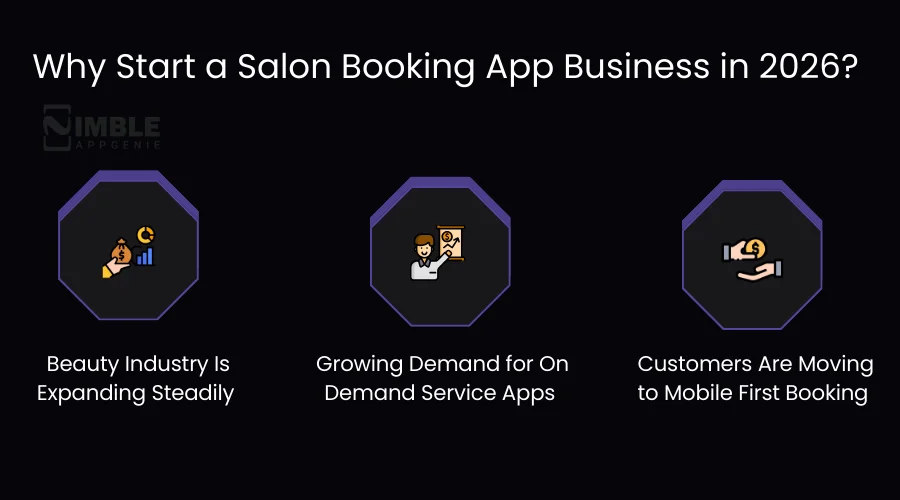
1. Beauty Industry is Expanding Steadily
The worldwide beauty market is forecasted to reach $1,874.3 million by 2030, according to GrandViewResearch. This huge growth includes salon and personal care services, not just products.
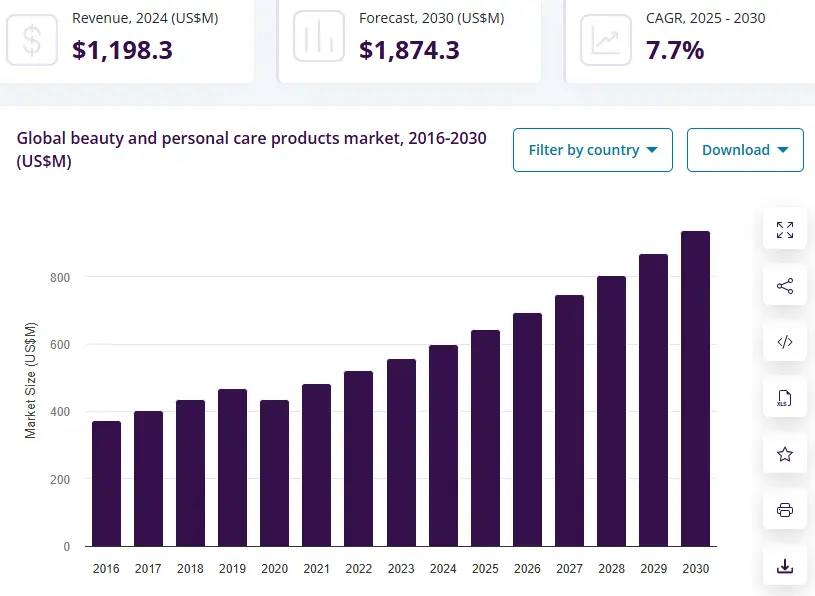
As demand for beauty services rises, salons require better systems to manage customers and bookings. This creates a better opportunity for you to begin a salon booking app startup in a growing industry.
2. Growing Demand for On-Demand Service Apps
Beauty and salon services are part of this shift toward on-demand platforms. Customers want convenience, flexible timing, and easy payments. Current salon app trends show that appointment apps fit directly into this exponentially growing on-demand economy and offer strong revenue potential.
3. Customers are Moving to Mobile-First Booking
Around 97% of aesthetic clinic customers and 80% of salon and spa customers now prefer online appointment booking. This depicts that customers are largely dependent on mobile applications for daily activities that include booking services.
Since people want fast digital solutions instead of phone calls, developing a salon appointment app can match this mobile-first behavior. This makes appointment scheduling simple and very quick.
Understanding the Salon Booking App Business Model
If you want to start a salon appointment app business, it is vital to choose the right business model. It depicts how you can generate revenue, attract salons, and scale your app efficiently.
Below are the top three salon reservation app business models that you can take into consideration.
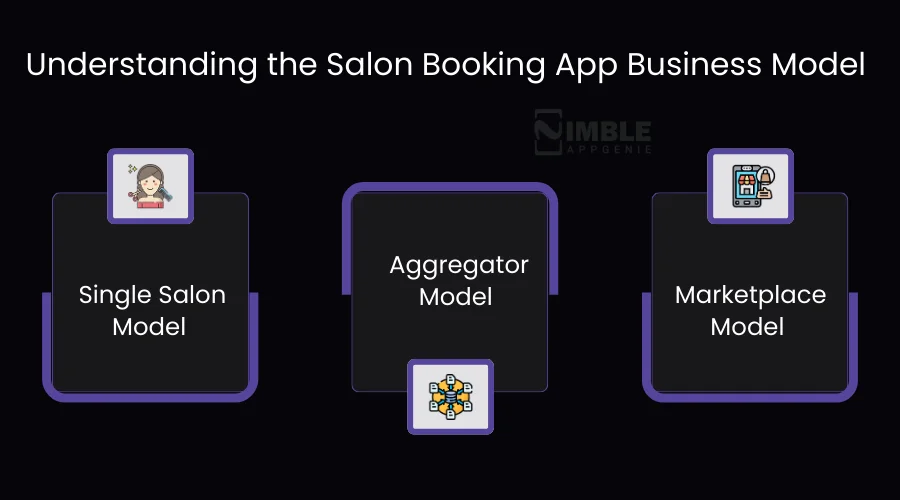
► Single Salon Model
The single salon business model mainly targets one salon or a small chain. You can offer custom salon booking apps for managing appointments, staff, and payments digitally.
However, your salon management app makes money from setup fees or subscription plans paid by the salon. It is really simple, low-risk, and best if you are a local business owner or first-time app founder.
► Aggregator Model
In this aggregator business model, your salon beauty app connects multiple salons under one application. Your target audience can search nearby salons, compare prices, and book appointments within the app.
You can earn income from commissions on bookings, subscription fees, or paid promotions. This business model works best for entrepreneurs who aim for regional reach.
► Marketplace Model
This business model combines multiple salons with advanced features like ratings, reviews, and featured listings. Your target audience gets more options, and your business gets higher online visibility.
Additionally, you can earn money through different salon app monetization models that are mentioned below:
- Commission model – It takes a small percentage from each booking.
- Subscription model – It charges salons a monthly or yearly fee.
- Featured listing model – In this model, salons pay some amount to appear on top.
- Ads & promotions – In this model, salons partner with beauty brands for extra income.
How to Start a Salon Booking App Business?
To commence a salon appointment app business, you need a proper plan, a defined audience, and the right approach. The goal is to solve real salon problems like missed appointments and manual scheduling while creating a profitable app.
Let’s take a look at the step-by-step process for the beauty service booking app.
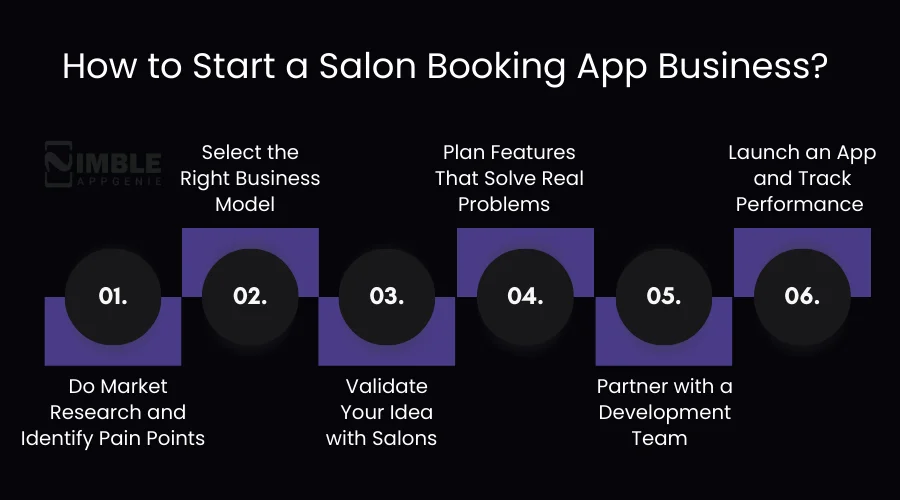
1. Do Market Research and Identify Pain Points
Before you build anything, it is vital to understand the target market. You can talk to salon owners, observe competitors, and analyze customer booking habits.
Now, you have to find out what issues your business faces, like missed appointments, double bookings, or customer retention challenges. Besides, you can check what existing salon apps like Fresha or Booksy lack.
For that, you have to do a SWOT analysis. This market research helps you create a solution that is targeted and highly demanded. When you thoroughly know the target market, it will ensure that your app really solves pain points and attracts customers.
2. Select the Right Business Model
After that, you can decide whether your online salon booking platform will be a single-salon solution, a multi-salon marketplace, or an aggregator platform. Each business model has different revenue paths, like commissions, subscriptions, featured listings, or ads.
You have to align the model with your target market, investment capacity, and growth goals. A clear business model makes sure your salon reservation app generates recurring revenue, attracts salons, and remains scalable. This gives you a good business advantage from day one.
3. Validate Your Idea With Salons
Now, before you develop a salon app, it is vital to test your idea with a small group of salons. This will help you know whether there really is demand. You can create a mobile app wireframe or mockup and share it.
Also, you can ask for feedback on usability and business impact. Besides, you have to know what features they value most and what pricing makes sense.
When you validate an app idea at the start, it reduces risk and ensures your app solves real operational problems. This increases user adoption and loyalty when you launch at scale.
4. Plan Features That Solve Real Problems
Now, you can plan out a feature that is mandatory or a must-have. Make a clear list of core features for users, salons, and admins. Also, you can integrate AI in beauty apps to provide personalized service recommendations for users.
At the start, you can add only must-have features like appointment scheduling, calendars, online payments, etc. When your salon reservation app gets popular and attracts a huge number of users, you can add advanced features like loyalty programs or subscriptions.
You can prioritise features that directly boost your salon’s efficiency and customer experience. This ensures salon appointment app development is focused, cost-effective, and builds a product that users want to use.
5. Partner With a Development Team
Now, how do you turn your salon app idea into a reality? Well, for that, you have to hire a dedicated development team that can bring your idea to life. You can share your business plan and feature list with them so that they can analyze your project needs.
A professional team always makes sure your salon reservation app is reliable and scalable, while you focus on business growth, salon acquisition, and marketing. This approach minimizes risk and allows your app to scale efficiently as more customers join.
6. Launch an App and Track Performance
After that, you can start with a small group of salons and their customers. It is vital to promote the salon booking app through social media, partnerships, and beauty communities.
Additionally, you can provide onboarding support and incentives like discounts or referral rewards. Lastly, you can collect feedback, fix issues, and iterate quickly for smooth performance. You can identify which features drive engagement and which need improvement.
It is vital to continuously track and optimise your app to make it profitable, competitive, and valuable to both salons and customers. This makes it a sustainable business in 2026 and beyond.
Must-Have Features to Build a Salon Booking App
To create a salon reservation app business, you need features that solve your salon business’s day-to-day problems and attract paying customers. The below must-have salon app features are crucial to attract more users, increase bookings, and generate recurring revenue from day one.
Let’s have a look at each panel’s feature table.
➤ User Panel
| Features | Why It Matters |
| Appointment Booking | This allows users to book instantly, which saves time and increases engagement. |
| Service Catalog | It helps users to choose the right services easily. |
| Payment Integration | It enables fast, secure payments for convenience. |
| Push Notifications | It reminds users about appointments to reduce no-shows. |
| Ratings & Reviews | It builds trust and influences new customer decisions. |
| Loyalty & Rewards | It supports repeat bookings and long-term retention. |
| AI Recommendations | It personalizes suggestions that improve the user experience and upsells. |
➤ Salon Panel
| Features | Why It Matters |
| Appointment Management | It organizes bookings and reduces double bookings. |
| Staff Scheduling | It optimises employee availability and shifts. |
| Service Management | It allows salons to update services, prices, and durations. |
| Customer Management | It tracks client history for better service. |
| Payment Tracking | It monitors transactions and revenue accurately. |
| Notifications & Alerts | It updates salons on new bookings or cancellations. |
| Analytics Dashboard | It provides insights to improve operations and increase revenue. |
➤ Admin Panel
| Features | Why It Matters |
| User Management | It controls platform users for security and smooth operations. |
| Salon Management | It approves, monitors, and manages partner salons. |
| Transaction Management | It tracks payments, commissions, and subscriptions efficiently. |
| Content & Offers | It updates promotions, featured listings, and app content. |
| Analytics & Reports | It monitors app performance, revenue, and growth trends. |
| Support & Feedback | It resolves issues and maintains platform credibility. |
| Security Controls | It protects sensitive data and builds user trust. |
Advanced Features to Scale Your Salon Appointment App
These advanced features are not just “nice-to-have”. This is what will make your salon appointment scheduling app stand out and attract paying salons and loyal customers.
Here is a table of advanced features that you should definitely add to your salon reservation app.
| Advanced Features | Why It Matters |
| AI-Powered Recommendations | It suggests personalized services based on customer history, increasing bookings, and upselling premium services. |
| AR Try-On | It allows users to visualize hairstyles, makeup, or nail designs, enhancing engagement and driving more appointments. |
| Subscription Plans | It offers recurring revenue for salons and provides customers with curated service packages, increasing retention. |
| In-App Chat / Messaging | It enables direct communication between salons and customers, improving service quality and reducing confusion. |
| Multi-Location Management | It lets salon chains manage multiple branches from one platform, simplifying operations and reporting. |
| Analytics Dashboard | It provides insights into bookings, revenue, and customer behavior, helping salons optimize services and marketing. |
| Geo-Location & Map Integration | It helps users find nearby salons quickly, increasing app adoption and local bookings. |
| Push Campaigns & Promotions | This allows targeted offers to specific users, boosting engagement and repeat visits. |
| Waitlist & Queue Management | It helps manage high-demand slots efficiently, improving customer satisfaction and revenue. |
| Integration with Loyalty Programs | It rewards frequent customers automatically, encouraging repeat bookings and long-term engagement. |
Tech Stack for Salon Appointment App Development
The tech stack for beauty booking app development is essential and you must choose it wisely. It directly impacts performance, security, scalability, development cost, and long-term business.
The table shows the salon app tech stack for checkout.
| Layer | Technology Options | Why It’s Used |
| Frontend (Mobile App) | Flutter, React Native | It builds Android & iOS apps from a single codebase. |
| Native Option (iOS) | Swift | Best performance for iPhone apps |
| Native Option (Android) | Kotlin | Stable and scalable Android development |
| Backend | Node.js, Django | Handles bookings, users, payments, APIs |
| Database | PostgreSQL, MySQL | Stores users, appointments, and payments |
| Real-Time Updates | Firebase, Socket.io | Instant booking confirmation & notifications |
| Payment Gateway | Stripe, Razorpay, PayPal | Secure online payments |
| Cloud Hosting | AWS, Azure, Google Cloud | App hosting and scalability |
| Authentication | Firebase Auth, OAuth 2.0 | Secure login & user verification |
| Push Notifications | Firebase Cloud Messaging | Booking reminders and updates |
You can adapt this tech stack based on your business model, feature requirements, target users, and budget to build a salon appointment app that fits your growth plans and operational needs.
How Much Does it Cost to Start a Salon Booking App Business in 2026?
The cost to start a salon booking app business in 2026 relies on the type of app, features, and whether you are building a single-salon app or a multi-salon marketplace.
The ballpark estimate to build a salon app can range from $25,000 for an MVP version to beyond $200,000 for a full-fledged app.
Here is a realistic cost breakdown with a table:
| App Complexity | Cost Breakdown |
| Basic MVP salon app | $25,000 – $50,000 |
| Standard salon app | $50,000 – $120,000 |
| Full-fledged salon app | $120,000 – $200,000+ |
♦ Basic Salon App – MVP Version
If you are creating an MVP app for one salon with core features like appointment booking, payments, calendar management, and notifications, the cost to build a salon app usually ranges between $25,000 to $50,000.
This can include:
- User app
- Basic admin panel
- Payment integration
- Basic UI/UX design
It is best suited for small salon owners who want online visibility and growth.
♦ Full-Fledged Salon App
If you plan to develop a marketplace app like Vagaro, where multiple salons can register, manage staff, and pay commission, the cost will increase. Also, it will be a full-fledged salon app, and it will cost you around $50,000 to $200,000.
This includes:
- User panel
- Salon Partner Panel
- Admin dashboard
- Commission system
- Advanced analytics
- Real-time booking system
This business model is ideal for startup founders who want to build a scalable business.
Factors Affecting the Cost to Create a Salon Booking App
Starting a salon app is not the only expense.
You should also budget for:
- Feature integration
- Technology stack
- AI integration
- Maintenance and updates
- Cloud hosting
- Payment gateway charges
- App store fees
All these factors play a vital role in affecting the cost of salon app development. Do not get confused. The smarter strategy is to start with core features, validate demand, and then scale step by step. You can first plan a proper budget, research the market, and then invest carefully.
What are the Challenges to Begin a Salon Booking App Business and Its Possible Solutions?
Now, while starting a salon booking app business sounds easy, the real challenges begin after launch. This comes with real operational and market challenges.
Let’s take a look at the challenges and practical ways to solve them.

► Payment, Refund, and Commission Handling
Handling advance payments, partial refunds, cancellation penalties, and commission deductions is technically complicated. Small calculation errors can cause financial loss or partner dissatisfaction.
How to Fix this :
You can define payment flows clearly, like who receives money first, when a commission is deducted, and how refunds are processed. Also, you can integrate payment gateways and test all scenarios that include failed transactions and partial refunds.
► Managing Multi-Panel Complexity
A salon appointment app is not just one interface. It includes a user app, salon partner dashboard, and admin control panel. It becomes really challenging to coordinate data flow between these panels. Any mismatch in booking status or commission calculator creates disputes.
How to Fix this :
Developers can design a centralized backend where all panels pull data from the same source. Similar to an app like Booksy, you must clearly define user roles, permissions, and commission logic before coding begins.
► Converting Business Logic into a Technical System
Salon operations look really easy on paper, but converting them into a working digital system is complex. Also, handling slot availability, overlapping bookings, staff allocation, buffer time between appointments, and peak-hour scheduling needs strong backend logic. If you do not plan it correctly, you will face double bookings and calendar conflicts.
How to Fix this :
Before you start creating a salon booking app, you need to map out the real salon workflows in detail. Additionally, you can define slot durations, staff assignment rules, cancellation windows, and time buffers. You must design the backend architecture around the booking logic first.
► Building a Real-Time Booking App Without Errors
Real-time availability is crucial. If two users try to book the same slot at the same time and the app fails to sync instantly, it creates trust issues and refund problems
How to Fix this :
You can use real-time database updates and locking mechanisms. This can prevent double booking. Also, proper API, mobile app architecture and stress testing under high traffic are necessary before launch.
Why Choose Nimble AppGenie to Start a Salon Booking App Business?
Starting a salon app business is not just about putting an app on the Play Store or App Store. The real challenge is making an app that you use every day and customers feel comfortable returning again and again.
Many entrepreneurs invest in development, but later face problems like low salon sign-ups, poor customer retention, and unclear revenue flow. As a recognized salon app development company, Nimble AppGenie works with a different approach.
We begin by understanding your target region, competitor analysis, and budget estimation. If you are starting in a particular area, the feature planning will be different. If you want to build a multi-salon marketplace, the structure will change accordingly.
This helps control unnecessary expenses and keeps your business model practical from the beginning. We just avoid adding features that look impressive but do not generate income.
Instead, we focus on what truly matters: a smooth booking process, proper commission tracking, secure payment integration, and easy salon management features. The aim is simple: to launch faster and start getting real bookings without technical confusion.
Therefore, if you want to build a high-performing salon booking app that is ready for real users, it is advisable to choose the right team that truly makes a difference.
♦ Real-Time Case Study: YouSeeStyle – By Nimble AppGenie
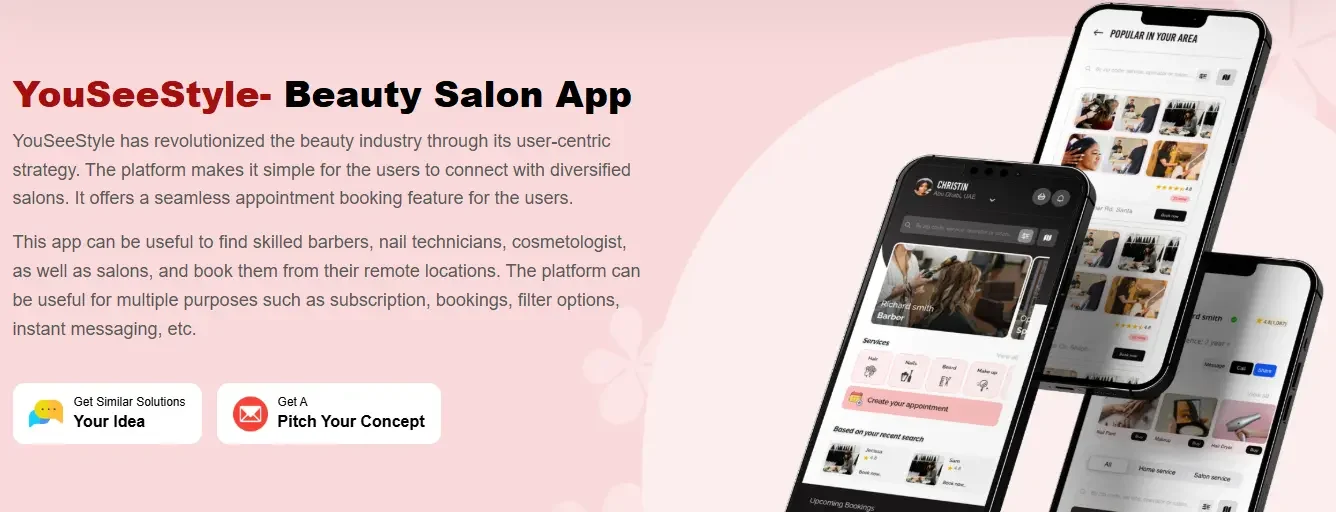
Client: Beauty Service Startup
Project: YouSeeStyle – Salon Booking App
Duration: 2.5–3 Months
Objective: Create an easy-to-use app that connects salons and customers in one place.
The Business Problem :
The salon owner was manually handling bookings, which led to missed appointments and confusion. Customers wanted quick online booking instead of calling and waiting.
There was a clear need for a simple digital platform that could manage appointments, communicate smoothly, and accept contactless payments for salons.
Strategic Approach :
The focus was to keep the app simple and useful. We have created two panels for the customer booking system and salon management dashboard.
Also, we integrated features like appointment booking, chat, push notifications, and multiple payment options. YouSeeStyle was built for both iOS and Android using modern technologies.
Business Outcome :
YouSeeStyle launched successfully within 3 months. The client’s business gained better control over bookings, and customers enjoyed a smooth and quick booking experience. The outcome was a practical salon appointment scheduling app developed for real business growth.

Conclusion
Starting a digital venture in the beauty space is no longer just an idea; it is a real business opportunity. If you want to start a salon booking app business, you need more than just an app idea. You need the right business model, a clear revenue strategy, strong features, and a realistic budget.
If you plan it properly, this type of app can generate a steady income through commissions, subscriptions, and repeat bookings. As the demand for online salon appointments grows, customers now expect more convenience.
All you have to do is take time to validate your idea, define your features, and choose the right development partner. With the right approach, your salon appointment scheduling app can turn into a profitable business.
FAQs

Niketan Sharma, CTO, Nimble AppGenie, is a tech enthusiast with more than a decade of experience in delivering high-value solutions that allow a brand to penetrate the market easily. With a strong hold on mobile app development, he is actively working to help businesses identify the potential of digital transformation by sharing insightful statistics, guides & blogs.
Table of Contents




No Comments
Comments are closed.