

 Free Consultation
 PCI-DSS Compliant
 GDPR Ready
 ISO 27001
 NDA Protected
 AI Services
 AI App Development
 Generative AI Development
 AI Chatbot Development
 AI Integration Services
 AI Consulting Services
 AI For Fintech
 AI Financial Assistant Solution
 AI Insurance Agent Development
 Tech Stack
 OpenAI / GPT-4
 Claude / Anthropic
 Gemini / Google AI
 Llama / Open Source
 LangChain / LlamaIndex
 Pinecone / Pgvector
 AWS / Azure AI


 Fintech Solution
 Core Fintech
 App Development
 Neobank Solutions
 eWallet Solutions
 Lending Software
 Banking Solutions
 BNPL Solutions
 BNPL Solutions
 Insurance App
 Wealth Management
 Crypto & DeFi
 Blockchain Development
  Payroll Software
 DeFi Solutions
 Crypto Wallet
 Crypto On/Off Ramp
 Crypto Exchange
 Trading Platform
 Payments
 Compliance
 Regulations & Compliance
 Fraud Detection
 Lending Ecosystem
 P2P Lending Platform
 Mortgage Software
 Engagement
 Fintech Outsourcing

 Mobile Development
 Mobile App Dev
 iOS App Development
 Android App Development
 React Native
 Flutter Development
 Web Solution
 Node.js Development
 React.js Development
 Angular Development
 App Services
 UI/UX Design
 App Maintenance
 By Stage
 MVP Development
 Industry Solutions
 Healthcare App Dev
 Education App Dev
 Travel App Dev
 Real Estate App Dev
 Logistics Software
 Social Media App

 Hire Mobile Developers
 Hire iPhone Developers
 Hire Android Developers
 Hire React Native Devs
 Hire Flutter Developers
 Hire Web Developers
 Hire Node.js Developers
 Hire Angular Developers
 Hire PHP Developers
 Hire Laravel Developers
 How It Works
 Pre-Vetted Developers
 Ready In 48 Hours
 NDA From Day One
 Replace Guarantee
 Company
 About Us
 Our Work Process
 Portfolio
 Case Studies
 Blog / Insights
 Careers
 Contact Us
 Awards
 Recognition


 Offices



In a Nutshell:
- Creating an investment platform involves developing a regulated, technology-driven product that lets users buy, sell, and manage financial assets through a web or mobile interface.
- The development process covers 9 key stages, from market research and UI/UX design to development, compliance, and deployment.
- Building an investment platform typically costs between $25,000 and $250,000, with an MVP taking 3 to 6 months to develop.
- Every investment platform must comply with regional financial regulations, the SEC and FINRA in the US, the FCA in the UK, MiFID II in the EU, and SEBI in India.
- The global online investment platform market is projected to reach $5.90 billion by 2030, making it one of the fastest-growing segments in fintech.
An investment platform development includes the creation of a regulated, technology-driven product that enables users to buy, sell, and manage financial assets, such as ETFs, stocks, cryptocurrencies, or mutual funds, through a mobile or web interface.
Considering the high level, the process covers eight key stages: market research, value proposition definition, UI/UX design, feature planning, tech stack selection, development, QA testing, and compliant deployment.
Typically, it costs between $25,000 and $250,000 to build an investment platform, depending on the complexity, and demands adherence to financial regulations such as FCA guidelines (UK), SEC rules (US), or MiFID II (EU).
For entrepreneurs, this is a high-growth opportunity; the global online investment platform market is predicted to reach $5.90 billion by 2030, expanding at a CAGR of 13.9%.
With retail investors increasingly self-directing their portfolios via mobile apps, the demand for new and improved platforms consistently rises.
This guide helps you with everything you need to know about how investment platforms work, features you should consider while you create an investment platform, development costs, compliance requirements, and monetization strategies.
Investment Platform Market: Key Stats & Growth Predictions
The fintech market for investment platforms and fintech applications is booming. The rise in the use of smartphones and increased reliance on online platforms has contributed to the growth of investment platforms as a whole.
If we talk specifically about online investment platforms, the growth has been nothing short of a joyride for the users. The industry for online investment platforms generated $2.08 billion in revenue in 2022 and is expected to reach $5.8 billion by 2030.
This means the market is set to grow at a CAGR of 13.9% between 2023 and 2030. Trading is one of the most viable integrations on an investment platform, which directly boosts the opportunities for investors.
The global market size for trading was valued at a solid $8.9 billion in 2021, expected to reach a whopping $18.4 billion by 2031, with a CAGR of 7.8%, which shows the stature of growth that comes along with the business.
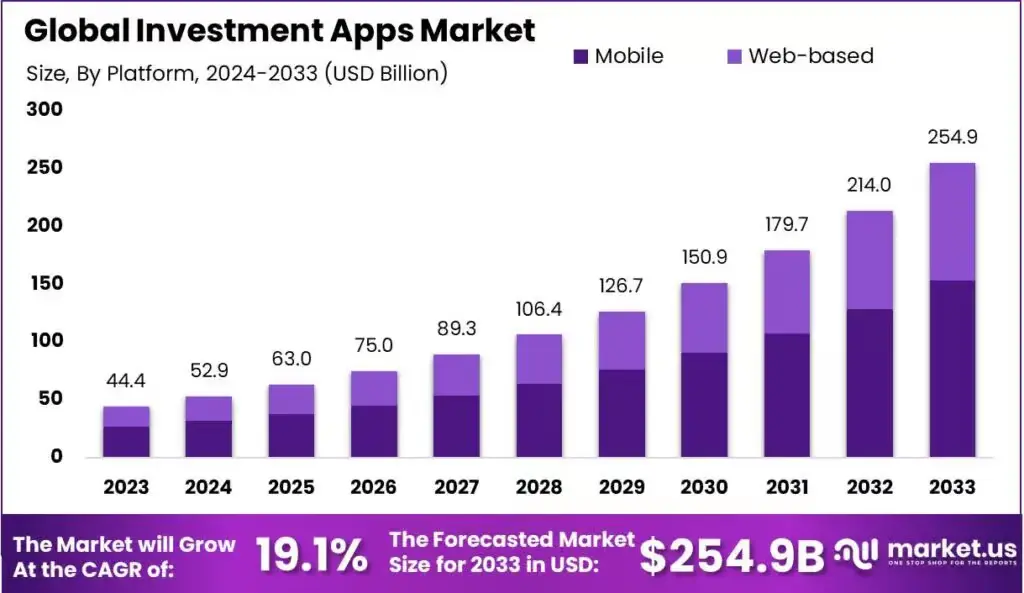
People from across the globe, especially those who are connected with a fintech business in one way or another, are moving towards creating an investment platform of their own. Even for banks and financial institutions, offering trading and investment features has become a vital decision.
What is driving this growth? Three converging trends
- Mobile-First Investing – Through smartphones, anyone can have market access with a bank account that drives a new generation of retail investors who choose apps over traditional brokers.
- Rise of Self-Directed Investing – An increasing number of users are prioritizing managing their portfolios themselves, despite paying for traditional financial advice.
- Emerging Market Expansion – Countries like Brazil, India, and Southeast Asian markets are witnessing first-time investor growth with the rising internet penetration.
To grab the opportunity, entrepreneurs should not only build Robinhood-like or Zerodha-styled platforms, but they should also serve the niches and segments these leaders ignore or miss.
In recent years, niche platforms focusing on fractional real estate, ESG investing, or beginner-friendly cryptocurrency have proven to be robust product-market fit.
How Does an Investment Platform Work?
An investment platform is a well-regulated digital marketplace that connects users to financial assets, like ETFs, stocks, cryptocurrencies, mutual funds, and real estate, and offers them the tools to buy, sell, and track these assets in one place.
Here is how a typical user journey works on an investment platform:
1. Registration & Identity Verification
A user creates an account and completes the KYC (Know Your Customer) verification process, submitting proof of address and government-issued ID.
On every regulated investment platform, this is a legal requirement, not an optional one.
2. Fund Your Account
Post verification, the user links a bank account or leverages a supported payment method for funds deposition. Various platforms use APIs like Stripe or Dwolla for fund transfers and Plaid for bank linking.
3. Discover & Analyze Assets
The user browses all the available investment options, including ETFs, stocks, crypto, or other options based on the platform, and uses in-built tools like price history, charts, and analyst ratings to evaluate them.
4. Place an Order
When the user is set to invest, they place a sell or buy order. This can be a limit order (which executes only when the asset reaches a target price) or a market order (executed promptly at the current price).
5. Track & Manage Portfolio
Post the order execution, the investments are shown in the user’s portfolio dashboard, where they can set alerts, monitor performance, and manage their complete asset allocation over time.
Types of Investment Platforms
Here are some of the most popular types of investment platforms, categorized for clarity:
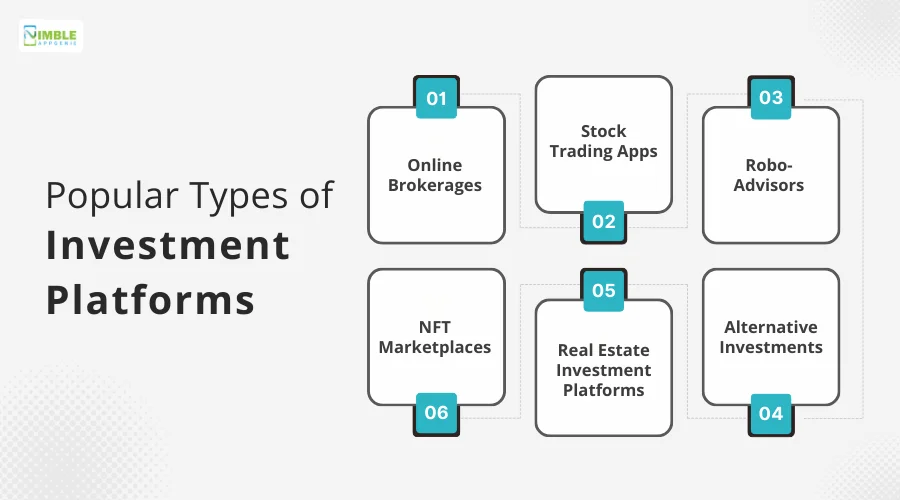
1. Online Brokerages
These platforms focus primarily on brokering your trades. These are reliable middlemen that can help you invest in stocks according to your profile and risk tolerance.
2. Stock Trading Apps
These are some of the most popular choices when it comes to investment platforms, as they allow a user to trade in stocks and other commodities directly. Insights about the trades are available to simplify the process for new users.
3. Robo-Advisors
These are automated investing accounts that use a dedicated algorithm to reduce human intervention and the margin of error.
With advanced robo-advisor platform solutions, they also become more cost-efficient and scalable for both businesses and investors.
4. NFT Marketplaces
With the help of these types of investment platforms, users can manage their digital assets like unique NFTs and more that they can later trade. These platforms are relatively new in the spectrum and are more appealing to people who are interested in investing in art and non-tangible assets.
5. Real Estate Investment Platforms
If you plan to invest in real estate, there are dedicated platforms that can help you do the same. Real estate investment platforms allow you to understand the market closely as it has some serious insights that can help in the long run.
To manage these insights effectively and handle investor communications, many firms leverage skilled virtual professionals. Platforms like Virtual Latinos provide real estate virtual assistants who support data management, reporting, and client coordination.
6. Alternative Investments
These platforms cover trading and investment options that are other than equities, bonds, and other traditional investing options. They generally offer access to hedge funds, private equity, and other private commodities.
Knowing the types, you can easily identify what type of investment platform you want to build.
Some apps often combine multiple platforms in one to target a wider audience. Keep in mind that you need dedicated experts to help you build the desired type of investment platform, as the process requires the necessary expertise.
Key Features of an Investment Platform
What helps the current collection of investment platforms stand apart from each other is the collection of features that they offer.
Features play a crucial role in the overall user experience. It makes the entire platform more valuable and attracts a lot of new users to it.
Some of the features that are available in every investment platform include –
| Investment Platform Features | |
| 1. Onboarding & Credentials | 11. Transaction Management |
| 2. User Profile | 12. Advanced Charting Tools |
| 3. Customer Support | 13. Educational Resources |
| 4. Portfolio Tracking and Reporting | 14. Mobile Compatibility |
| 5. Real-Time Market Data | 15. Order Execution and Management |
| 6. Secure Account Management | 16. Diverse Investment Options |
| 7. AI-Based Predictions | 17. User-Friendly Interface |
| 8. Payment Gateway | 18. Real-time Analytics |
| 9. ROI Calculator | 19. Feed & Notifications |
| 10. Investment Insights | 20. Financial Integrations |
All these features, along with integrated sets of data-fetched fintech APIs, build an investment app that is reliable and convenient for the user.
All of these features, when combined, can surely create an application that enables a user to invest and trade on the platform easily.
However, it is not an easy task to combine them all and build a platform.
Let’s take a closer look at the entire process of building a platform and what it takes to power a well-built investment platform.
Why Create an Investment Platform?
There are several reasons why building an online platform can prove to be vital for your business.
Reason #1 – The Market Is Large and Still Growing
The global investment platform market is on its way to triple in size by 2030. Even with the existence of top investment platforms like Robinhood and Fidelity, notable segments stay underserved; niche asset classes, beginners, and surging markets showcase an open landscape for new platforms with the required focus.
Reason #2 – Multiple Revenue Streams From Day One
Unlike various apps that depend on a single monetization model, investment platforms can generate revenue via subscriptions, transaction fees, interest on cash balances, premium features, and asset management fees simultaneously.
This assortment makes the business model more scalable and resilient.
Reason #3 – High User Retention by Nature
Investing is inherently adhesive. Once a user deposits funds, creates a portfolio, and begins tracking performance on your platform, switching costs are expensive. This offers investment platforms extremely better long-term retention metrics than most consumer app classifications.
Reason #4 – Operational Efficiency at Scale
A well-developed investment platform automates the process that legacy, traditional financial firms manage manually, including client onboarding, order execution, KYC verification, portfolio rebalancing, and reporting.
So, the cost per user decreases with the scaling of your platform, which, in turn, improves margins over time.
How to Create an Investment Platform: A Step-by-Step Process
Every step of building an investment platform carries real business and legal significance.
You should ensure not to skip or rush any one of them, as it can delay go-to-market or give rise to compliance risk further.
Step 1 – Market Research & Competitive Analysis
Before you write a single line of code or hire a developer for this, you should have a clear image of the market you are entering.
First, identify your target investor segment and ask yourself:
Are you developing for first-time retail investors, a niche like ESG (sustainable) investing, crypto, or high-net-worth individuals? Every segment has distinct expectations, feature demands, and risk tolerance.
Similarly, competitive research is important. Analyze what platforms like Betterment, Robinhood, or Public are performing well, and chiefly where they fall short. You can check user reviews on the Google Play and App Store to uncover the unmet needs.
Why this step matters:
Skipping the market research usually creates the wrong product for the wrong audience. A platform developed for active traders looks and operates very differently from one crafted for passive and lasting investors.
Step 2 – Define Your Value Proposition & Business Model
Now, when you understand the market, you should ask yourself: why would someone choose your platform over the ones already available?
Your value proposition could be a target on a particular asset class, like fractional shares, a lower fee structure, AI-driven portfolio recommendations, or top education tools for beginners. Ensure that you keep your niche narrower and clearer to acquire your users easily.
Alongside, define your business model in the early days. Decide whether you will offer a freemium subscription, charge transaction fees, generate revenue through asset management, or a combination?
This will directly impact how you design your platform and what features you will prioritize.
Why this step matters:
Your value proposition is responsible for early downstream decisions – design, features, pricing, and marketing. This way, your development will not be expensive or unfocused.
Step 3 – Understand Regulatory Requirements
Most entrepreneurial guides overlook this step, and you should know that it’s the most essential one for developing investment platforms.
Investment platforms are categorized as financial services products, which indicates they are dependent on strict regulatory supervision based on where you operate and where your users are based.
- United States: You may need to register as a Registered Investment Advisor (RIA) with the SEC, or as a broker-dealer with FINRA, depending on your platform type.
- European Union: Platforms must comply with MiFID II, which controls transparency, reporting, and investor protection.
- United Kingdom: Authorization from the Financial Conduct Authority (FCA) is needed before you can offer investment services.
- India: SEBI (Securities and Exchange Board of India) regulates investment platforms and requires specific registrations for stock broking and advisory services.
Besides licensing, your investment platform will also need to implement KYC (Know Your Customer) and AML (Anti-Money Laundering) processes for user identity verification and financial crime prevention.
Virtually, these are legal requirements in every jurisdiction, not optional.
Why this step matters:
If you launch your product without the right licenses, it can lead to forced shutdown, heavy fines, or personal liability. At this stage, you must engage a fintech-specialized legal advisor that sounds like a worthwhile investment.
Step 4 – Design the UI/UX
Now, as you have defined your market, compliance framework, and niche, it’s time to design what users will see and interact with.
For an entrepreneur-facing investment platform, the design should be simple and fully functional. Most of your early users will likely be casual or first-time investors who are easily discouraged by complex interfaces. So, prioritize intuitive navigation, clean dashboards, and jargon-free language throughout.
Key screens to design at this stage include:
- Onboarding and KYC flow,
- Main portfolio dashboard,
- Asset discovery and search,
- Trade execution screen,
- Transaction history, and
- Account settings.
Use prototyping tools like Figma to test your UX before you start with any development. This saves notable time and costs down the line.
Why this step matters:
Users majorly abandon financial apps after the first session only because of poor UX. Only a well-crafted onboarding flow can significantly boost your activation rate.
Step 5 – Plan Your Core Features
It’s not necessary to build every feature on day one. Entrepreneurs usually make mistakes by launching a fully-featured platform in one go, which increases cost and delays the release.
Instead, separate your features into two tiers:
Phase 1 – MVP (Must-have for launch):
- User registration and KYC verification
- Bank account linking and fund deposits/withdrawals
- Real-time market data and asset pricing
- Order placement (buy/sell)
- Basic portfolio tracking dashboard
- Push notifications and alerts
- Secure login with two-factor authentication
Phase 2 (Post-launch, based on user feedback):
- AI-driven investment recommendations
- Robo-advisor functionality
- Advanced charting and technical analysis tools
- Social or copy-trading features
- Tax reporting and capital gains statements
- Fractional shares
Why this step matters:
Prioritizing features according to the phase keeps your initial build affordable, faster, and lean to market. You can always add features, but you can’t get the money and time back you spent creating something useless for others.
Step 6 – Choose Your Technology Stack
The technology you create decides how secure, scalable, and maintainable your platform will be over time. Reliability and speed are non-negotiable while you develop an investment platform. Even short downtime during market hours can cost your users money and ruin trust.
Key technology decisions include:
- Backend: Node.js, Python (Django/Flask), or Java are popular choices for high-performance financial backends
- Frontend/Mobile: React Native for cross-platform mobile, React.js for web
- Database: PostgreSQL for transactional data; Redis for real-time caching
- Market Data APIs: Alpaca, Polygon.io, or Refinitiv for real-time stock and asset pricing
- Payment & Banking APIs: Plaid for bank account linking; Stripe or Dwolla for fund transfers
- KYC/AML APIs: Jumio, Onfido, or Persona for identity verification
- Cloud Infrastructure: AWS or Google Cloud for scalability and uptime SLAs
Why this step matters:
Choosing the right stack, including well-supported, proven technologies, can justify it as a technical investment.
Step 7 – Development
In this step, you actually build your investment platform.
A specific investment platform development is divided into sprints, with the backend (database, APIs, and integration) created first, followed by frontend (UI screens), and then third-party integrations (market data, KYC, and payments).
For entrepreneurs, here, the key decision is whether to hire an in-house team or engage an experienced app development company.
In-house development offers extra control but demands considerable hiring time and cost. Whereas a trusted app development agency brings expertise in financial app integrations and compliance, and can even move faster.
However, to create an investment platform, it takes anywhere from 3 to 9 months, depending on team size and scope.
Why this step matters:
In the whole step-by-step process to build an investment platform, development covers the largest part of the cost. Before development starts, a clear documentation of features, compliance requirements, and APIs reduces over-project scoping and budget overruns.
Step 8 – Testing & Quality Assurance
Before you make your platform available for end users, you should make it undergo rigorous testing.
The stakes are higher for a financial product than for a typical application – bugs in payment processing, order execution, or portfolio calculations can directly hurt users financially and expose you to legal penalties.
Testing for an investment platform should include:
- Functional testing – Ensures that every feature works as intended.
- Security testing – Penetration testing addresses vulnerabilities before bad players do.
- Performance testing – Check whether your platform can handle high volumes of trades and users simultaneously.
- Compliance testing – Do KYC flows, data storage, and reporting meet regulatory standards?
- User acceptance testing (UAT) – Perform real user testing of the platform in a controlled environment before launch.
Why this step matters:
A financial calculation error or single security breach on a live investment platform can be disastrous legally and reputationally. Be sure, testing is not a cost to cut.
Step 9 – Deployment & Ongoing Maintenance
Launching an investment platform is not the end; actually, it’s the beginning. Post-launch, you should maintain regulatory compliance, renew your licenses, monitor for doubtful activity (AML), and push security updates regularly.
Before going live, ensure you have completed:
- App store submissions (Google Play and iOS App Store) follow their respective financial app guidelines.
- Regulatory approval or licensing confirmation from the applicable authority in your jurisdiction
- A data privacy policy compliant with GDPR, CCPA, or local equivalent
- A customer support system holds the caliber to manage financial disputes and account problems.
Why this step matters:
Regulators audit live platforms. Ongoing compliance is not a one-time checkbox; it’s a fixed operational cost of running an investment business.
Regulatory & Compliance Requirements for Investment Platforms
Regulation is a compulsory thing you must handle after developing an investment platform. Basically, it’s a foundational need that impacts what you can build, who you can help, and how you should operate from day one.
Virtually, in every jurisdiction, investment platforms are categorized as financial service products, which states it’s illegal to operate without the right licenses, even if you choose good technology.
Before you launch, you should know the following aspects:
Licensing Requirements by Region
1. United States
In the US, your platform’s work will decide what type of license you need:
- Broker-Dealer License– Registered with FINRA and the SEC under the Securities Exchange Act of 1934.
You need this license if your investment platform enables the buying and selling of securities on behalf of users.
- Registered Investment Advisor (RIA)– Registered with the SEC if you manage over $100 million in assets, or with state regulators below that threshold.
This license is required if your platform offers portfolio management (with robo-advisors) or investment advice.
- Money Transmitter License (MTL) – Most states need this if your platform moves funds between financial institutions and users.
Apart from this, expect the broker-dealer registration process alone to take 6 to 12 months and cost more than $50,000 in filing and legal fees.
2. United Kingdom
Every investment platform performing in the UK should be authorized by the Financial Conduct Authority (FCA).
A particular permission you require depends on your activities as follows:
- Investment Management – Managing portfolios on behalf of clients
- Arranging Deals in Investments – Facilitating trades without holding client money
- Operating a Multilateral Trading Facility (MTF) – Running a marketplace where users trade with each other
FCA authorization generally takes 6 to 12 months. If you operate without authorization, it will be acknowledged as a criminal offense under the Financial Services and Markets Act 2000 (FSMA).
3. European Union
Investment platforms in the EU should comply with MiFID II (Markets in Financial Instruments Directive), which governs:
- Transparency in pricing and order execution
- Investor classification (retail vs. professional)
- Best execution obligations – proving you get users the best available price
- Detailed transaction reporting to national regulators
Authorization is granted by the national competent authority of the EU member state where you are incorporated (e.g., BaFin in Germany, AMF in France).
4. India
In India, investment platforms fall under the jurisdiction of SEBI (Securities and Exchange Board of India).
Key registrations include:
- Stock Broker Registration – This license is needed to facilitate equity trading on NSE or BSE.
- Investment Advisor Registration – If you are offering personalized investment advice, this license is a must.
- Portfolio Manager Registration – It’s required for platforms handling client portfolios.
SEBI has also presented a regulatory sandbox for fintech startups, which permits limited testing of new investment products before full licensing.
KYC & AML Compliance
Despite jurisdiction, each investment platform is legally needed to implement
KYC (Know Your Customer)
Before a user can deposit funds or place trades, you must verify their identity.
This typically involves:
- Government-issued photo ID verification
- Proof of address
- PAN card or SSN (depending on jurisdiction)
- Source of funds declaration (in some cases)
You can automate KYC by leveraging third-party APIs, such as Onfido, Jumio, or Persona, that use AI-powered facial recognition and document scanning for user verification in minutes.
AML (Anti-Money Laundering)
Your investment platform should observe transactions for suspicious activity and report to the applicable financial intelligence unit.
This includes:
- Transaction monitoring for unusual patterns
- Screening users against global sanctions lists (OFAC, UN, EU)
- Filing Suspicious Activity Reports (SARs) when needed
- Maintaining records of each transaction for a minimum of 5 years in most jurisdictions
If you fail to implement enough AML controls, it can lead to fines of millions of dollars.
Data Privacy & Security Compliance
Investment platforms accumulate and process highly sensitive financial and personal data that activate additional regulatory obligations:
- GDPR (EU/UK) – It demands explicit user consent for data collection, the right to data deletion, and mandatory breach notification within 72 hours.
- CCPA (California, US) – This provides users the right to know what data is gathered and opt out of its sale.
- IT Act & DPDP Act (India) – India’s Digital Personal Data Protection Act governs how platforms collect, store, and process user data.
From a security perspective, your investment platform should implement two-factor authentication (2FA), SSL/TLS encryption, end-to-end encryption for sensitive transactions, and undergo frequent third-party penetration testing.
Quick Possible Consequences of Violations
| Violation | Potential Consequence |
| Operating without a license | Criminal prosecution, forced shutdown |
| Inadequate KYC/AML | Fines up to millions of dollars, license revocation |
| Data breach without GDPR notification | Fines up to 4% of global annual turnover |
| Misleading investment advice | Civil liability, investor lawsuits |
The Bottom Line: Your budget should include expenses for legal counsel and compliance infrastructure from day one. It’s cheaper to create compliance into your investment platform than to add it later after being knocked by regulators.
How Much Does it Cost to Create an Investment Platform?
Building an investment platform is a significant but predictable investment. Costs vary based on your team’s location, feature scope, and compliance requirements.
Here is a realistic breakdown of what each stage typically costs.
Here is a complete breakdown of the entire cost of creating a fintech app specifically for investments.
| Cost Category | Estimated Cost Range |
| 1. Market Research | $2,000 – $10,000 |
| 2. UI/UX Design | $5,000 – $20,000 |
| 3. Backend Development | $10,000 – $100,000 |
| 4. Frontend Development | $8,000 – $50,000 |
| 5. Security & Compliance | $5,000 – $25,000 |
| 6. Testing & Quality Assurance | $3,000 – $15,000 |
| 7. Cloud Hosting & Services | $500 – $5,000/month |
| 8. Third-Party Services | $1,000 – $10,000 |
| 9. Marketing & Launch | $5,000 – $50,000 |
How Does an Investment Platform Make Money?
The majority of legacy investment bankers, firms, and advisors are moving towards an investment platform in search of better earnings and revenue.
Not only does an investment platform boost your reach to a wider user base, but it also contributes to your net revenue. But how?
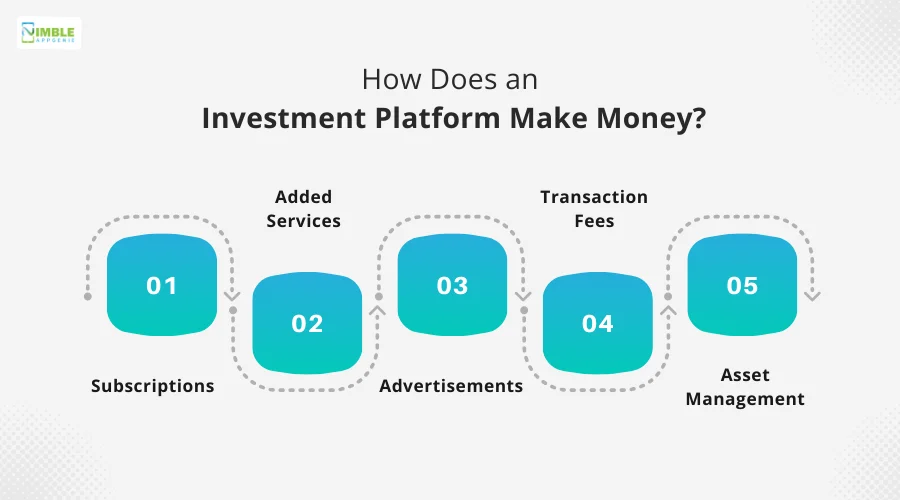
Well, different fintech app monetization strategies can be integrated into an investment platform. These include –
1. Subscriptions
You can offer subscriptions for added perks to the users of your platform. These perks can include priority access to stock, better customer support, predictive analytics, and more.
2. Added Services
You can introduce several add-ons to your platform that help a user get more insights. They can help connect them with investing experts to guide them, financial consulting, and more, in exchange for a fee.
3. Advertisements
For any application that has a significant number of users, advertisements offer a great way to make money. You can even opt for affiliate advertising for better returns.
4. Transaction Fees
With an integrated payment gateway, you can simplify investing directly for the user, and to facilitate these transactions, you can charge a minimal fee. Based on the number of transactions you have, you can easily generate a substantial income.
5. Asset Management
Offering to manage the assets of your users can also help you generate revenue. It is a widely popular practice for investment platforms and is a great way to monetize them.
Other than these, value-added services, interest on cash balances, and internal product partnerships also play crucial roles in the overall monetization of the app.
Keep in mind that to make money with an investment platform, you need high volumes of users to be active on your platform. This means the quality of the tech and experts you use plays a crucial role.
Popular Investment Platforms and What Makes Them Work
Despite listing all the investment platforms available, here are the five major ones that represent the best of distinct investment platform models and the unique decisions that made them successful.
1. Robinhood (Stock Trading App)
Robinhood empowered retail investing by removing commission fees completely, a move that compelled the whole industry to follow suit.
Its minimalist, mobile-first design diminished the blockage for first-time investors and drew regulatory scrutiny for gamification.
The Lesson: Simplicity and user-friendliness boost adoption, but compliance can’t be an afterthought.
2. Betterment (Robo-Advisor)
Betterment created a loyal user base by eliminating the investing complexity; now the users set an objective and risk tolerance, and the algorithm manages everything else.
Its tax-loss harvesting feature and low annual management fee become powerful distinguishers in an overcrowded market.
3. Coinbase (Crypto Platform)
Coinbase ruled by making cryptocurrency accessible to mainstream users, prioritizing a clean UX and regulatory compliance over the features that more experienced crypto traders wanted.
In licensing, the early investment gave it a first-mover benefit when regulators started contracting.
4. Fundrise (Real Estate Investment)
Fundrise unfolded real estate investing to non-accredited investors through fractional ownership, an asset class previously only available to institutional or wealthy investors.
It exhibits how eliminating a traditional barrier to entry can drive a totally new user base.
How Can Nimble AppGenie Help You Create an Investment Platform?
Reading here might have gotten you interested in building your own investment platform. If you plan to replicate the success of the aforementioned popular platforms, then the first thing you need to do is find a fintech application development company that aligns with your idea, understands the intricacies of your vision, and helps you build a solid investment platform.
With decades of experience and highly qualified developers, Nimble AppGenie offers the finest development services that not only can customize things as per requirements but also take the initiative to guide you through the process.
You can easily connect with our developers and share your vision related to how you want your investment platform to be, and they will surely bring it to life. Connect today and let them take the matter into their own hands!
Conclusion
The idea of investment platform development as a business can certainly yield better profits in the long run.
The market is ripe and users are highly involved in managing their investments by themselves. This makes it just the right time to invest in an app of your own.
If we talk about the development cost of an investment platform, it certainly depends on your vision and the partner that you find for the job.
The features and the capabilities of an investment app is a territory that is yet to be explored and if all goes well, your investment platform has the potential to skyrocket.
However, it is crucial today that you make your move and hire an investment app development company that can help you bring your idea to life.
With that said, we have reached the end of this guide. Hope it gives you all the necessary information and helps you create an investment platform of your own.
Thanks for reading, good luck!
FAQs

Niketan Sharma, CTO, Nimble AppGenie, is a tech enthusiast with more than a decade of experience in delivering high-value solutions that allow a brand to penetrate the market easily. With a strong hold on mobile app development, he is actively working to help businesses identify the potential of digital transformation by sharing insightful statistics, guides & blogs.
Table of Contents




No Comments
Comments are closed.