

 Free Consultation
 PCI-DSS Compliant
 GDPR Ready
 ISO 27001
 NDA Protected
 AI Services
 AI App Development
 Generative AI Development
 AI Chatbot Development
 AI Integration Services
 AI Consulting Services
 AI For Fintech
 AI Financial Assistant Solution
 AI Insurance Agent Development
 Tech Stack
 OpenAI / GPT-4
 Claude / Anthropic
 Gemini / Google AI
 Llama / Open Source
 LangChain / LlamaIndex
 Pinecone / Pgvector
 AWS / Azure AI


 Fintech Solution
 Core Fintech
 Fintech App Development
 Neobank App Development
 eWallet App Development
 Lending Software
 Banking Software Development
 BNPL Solution
 BNPL App Development
 Insurance App
 Wealth Management App
 Blockchain Development
 Payroll Software Development
 DeFi App Development
 Crypto Wallet Dev
 Crypto On Ramp Off Ramp
 Crypto Exchange Dev
 Trading Platform Dev
 Payments
 Compliance
 Fintech & Digital Regulations
 Fraud Detection
 Lending Ecosystem
 P2P Lending Platform
 Mortgage Software
 Engagement
 Outsourcing Dev

 Mobile Development
 Mobile App Dev
 iOS App Development
 Android App Development
 React Native
 Flutter Development
 Web Solution
 Node.js Development
 React.js Development
 Angular Development
 App Services
 UI/UX Design
 App Maintenance
 By Stage
 MVP Development
 Industry Solutions
 Healthcare App Dev
 Education App Dev
 Travel App Dev
 Real Estate App Dev
 Logistics Software
 Social Media App

 Hire Mobile Developers
 Hire iPhone Developers
 Hire Android Developers
 Hire React Native Devs
 Hire Flutter Developers
 Hire Web Developers
 Hire Node.js Developers
 Hire Angular Developers
 Hire PHP Developers
 Hire Laravel Developers
 How It Works
 Pre-Vetted Developers
 Ready In 48 Hours
 NDA From Day One
 Replace Guarantee
 Company
 About Us
 Our Work Process
 Portfolio
 Case Studies
 Blog / Insights
 Careers
 Contact Us
 Awards
 Recognition


 Offices



In a Nutshell:
- Building a restaurant reservation app like OpenTable is a strong business idea because the market is growing fast. Millions of people now prefer booking tables online, and this shift is creating steady demand for restaurant reservation app development.
- To develop a restaurant reservation app like OpenTable, you need simple but important features like real-time booking, reminders, waitlists, and customer tracking. Adding AI-based suggestions can improve user experience and increase repeat bookings.
- The cost to build a restaurant reservation app like Opentable depends on features and complexity. A basic app can start lower, but a full app with AI, live data sync, and multi-restaurant support will need a higher budget.
- Restaurant booking app like OpenTable make money through subscriptions, ads, booking fees, and partnerships. If done right, it can become a long-term revenue source for both app owners and restaurants.
- The challenges to create an app like Opentable are Handling Real-Time Data, Reducing no-shows, Building trust on both sides, and Competing with giant apps.
OpenTable is not just a reservation app anymore. It is a gold standard of dining. “Let me check OpenTable” has become as natural as picking up the menu itself.
So, here is the real question: What would it mean for your business if diners said the same about your platform? And what would it take to develop a restaurant reservation app like OpenTable that earns that level of daily trust and loyalty?
Here is the reality:
- OpenTable seats fill 1.9 billion per year in more than 60,000+ restaurants globally, and that number keeps climbing.
- The worldwide market size of the restaurant reservation system is forecasted to reach $873 million by 2034 with a CAGR of 9.2%.
For restaurant owners, food-tech entrepreneurs, hotel & hospitality managers, and restaurant chain operators, this growth is a clear signal to invest in restaurant reservation app development.
Businesses that build an app like OpenTable are not just solving a booking issue. They are stepping into a proven, high-demand, revenue-generating ecosystem that diners already love and trust.
In this blog, we will walk you through everything from features, tech stack, development cost, to monetization, so you can build a bespoke table booking app.
So, let’s begin!
What is an OpenTable App?
OpenTable is a restaurant reservation app that allows users to search, discover, and instantly book restaurant tables through a smartphone. OpenTable is one of the best restaurant reservation apps in USA.
Users can browse restaurant menus, read verified diner reviews, check real-time table availability, earn Dining Rewards points on every reservation, and get automated reminders so they never miss a booking.
On the other side, restaurants use the OpenTable app to manage their entire front-of-house operation. For instance, incoming reservations, waitlists, table assignments, guest history, and no-show tracking, all from one place.
| App | Availability | Downloads | Rating |
| OpenTable | iOS & Android | 10M + | 4.9/5 |
Why Build A Restaurant Reservation App Like OpenTable? – Market Research and Analysis
The timing could not be better for entering this restaurant reservation market.
Let’s take a look at the market statistics:
- The online restaurant reservation system is valued at $2.68 Billion in 2026, and it is projected to reach $6.46 Billion by 2035.
- The worldwide market size of dine-out space is forecasted to reach $1.18 trillion between 2024 and 2029 with a CAGR of 10%.
- North America leads with more than 45% share, followed by Europe at ~30% and Asia-Pacific at ~20%. This growth is powered by online dining experiences.
- Around 26% of restaurant operators now use AI in restaurant apps. 56% of Americans now choose a restaurant online, and 20% of Americans use AI tools to find and choose a restaurant.
The market is still not fully saturated in regional and niche segments. Many restaurants are still not using advanced reservation systems. This creates a huge opportunity for you to invest in restaurant reservation app development like OpenTable with AI-driven features and better UI.
♦ Provides Better Market Analytics
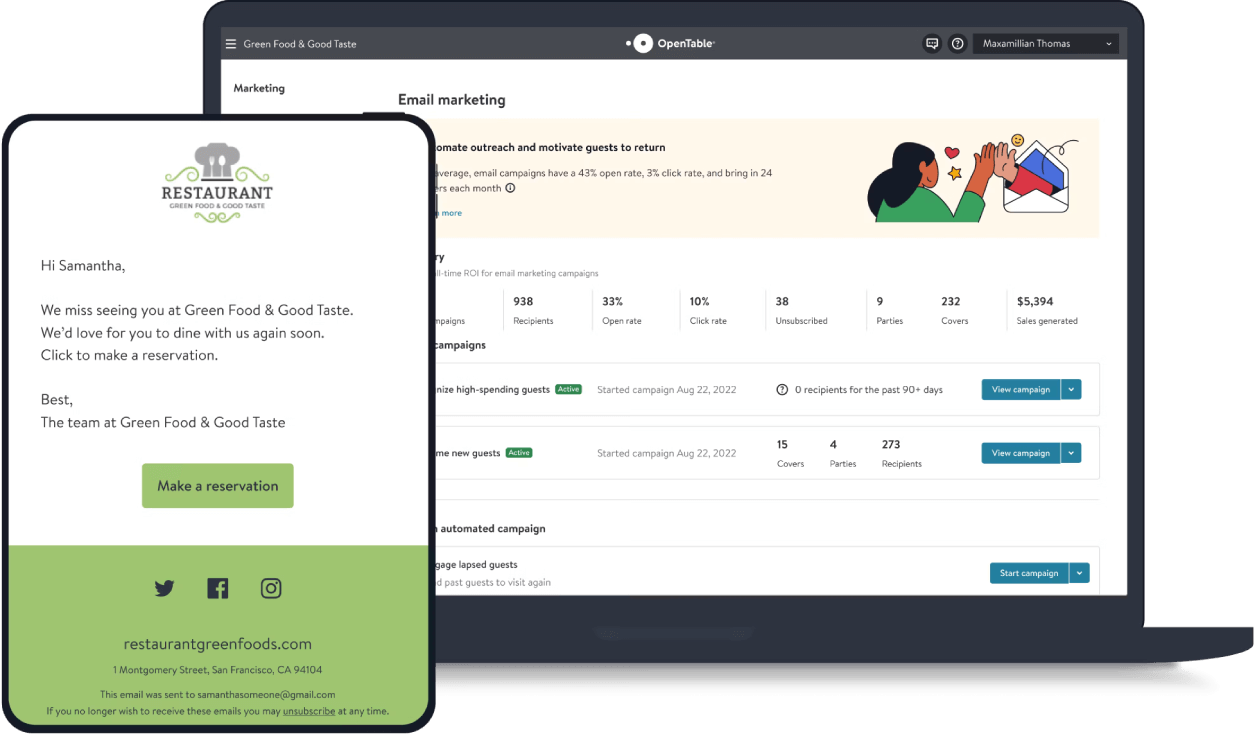
Effective reservation apps provide restaurants with effective insights related to the market and a peek into what the customers want from them.
The apps also provide restaurants with data to help them understand popular dining times, repeat customer rates, and average time spent per table.
With great market analytics, the data can be useful for informing restaurants about the current market demand. It also assists the customers in making marketing strategies to assist the restaurants in meeting the customers’ demands successfully.
♦ Enhancing Restaurant Revenue
A restaurant reservation app is used for managing the reservation table. This results in maximizing table turnover by reducing no-shows.
Also, some apps offer premium features to customers, along with partnerships enabling restaurants to upsell or cross-sell to their customers.
Before building an app like OpenTable, restaurants struggled to build revenue from empty tables. With this app, restaurants can schedule table bookings by targeting the right customers.
♦ Enhanced Customer Experience
With an app that ensures restaurants have a managed seating arrangement. It also helps to improve the customer experience, as with less waiting time, your customers can develop trust in the services of the restaurants.
It improves convenience and personalization, along with customer feedback, as well as reviews after their dining experience. To create a restaurant reservation app like OpenTable, you should ensure that it increases and builds customers’ trust in the restaurant.
Key Features For a Restaurant Reservation App Development Like OpenTable
The key features to add in a restaurant booking app similar to OpenTable are:
- Instant reservation booking
- Automated confirmation & reminder
- Waitlist management
- Gust profile & preference tracking
- Table & floor management
- Multi-location management
- Dining rewards & loyalty programs
- Restaurant discovery
- Analytics and reporting
- Push notifications
- POS system integrations
These are some of the must-have features that are essential for a restaurant mobile app. If you integrate them in your app, it can help you stand out from the crowded market.
Along with that, you also have to add the advanced restaurant app features to optimise table turnover, reduce no-shows via automation, and boost guest appearance through personalization.
The table below showcases the must-have features and why they matter to add them.
| Features | Why It Matters |
| Real-Time Table Availability | Diners see live table slots instantly — no back-and-forth calls, no double bookings. |
| Instant Reservation Booking | Allows diners to confirm a table in under 60 seconds, reducing drop-offs. |
| Automated Confirmation & Reminder | Sends booking confirmations and pre-visit reminders to significantly cut no-shows. |
| Waitlist Management | Automatically fills cancelled slots and notifies waiting diners in real time. |
| Guest Profile & Preference Tracking | Stores diner history, preferences, and special requests for a personalized experience. |
| Table & Floor Management | Gives restaurant staff a visual layout to manage seating, turns, and capacity efficiently. |
| Multi-Location Management | Allows restaurant chain operators to manage all locations from one single dashboard. |
| In-App Reviews & Ratings | Builds trust with verified diner reviews that help restaurants improve and attract new guests. |
| Dining Rewards & Loyalty Program | Keeps diners coming back by rewarding every reservation with redeemable points. |
| Restaurant Discovery & Search | Let’s diners filter by cuisine, location, price, availability, and ratings. |
| Analytics & Reporting Dashboard | Gives restaurant owners actionable data on bookings, peak hours, no-shows, and revenue trends. |
| Push Notifications & Alerts | Keeps both diners and restaurants informed about booking updates, offers, and changes. |
| POS System Integration | Connects reservations directly with billing and order management for smoother operations. |
| AI-Powered Recommendations | Suggests restaurants to diners based on past behavior, preferences, and location. |
How to Build a Restaurant Reservation App Like OpenTable?
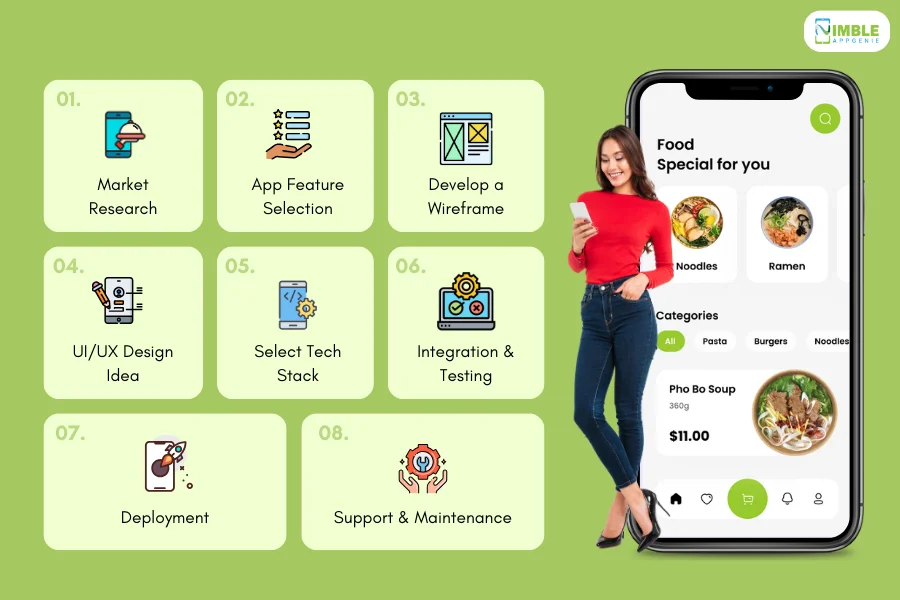
To develop an app like OpenTable, you need to follow a clear roadmap that includes:
- Do market research
- Plan features list
- Develop a wireframe
- Create a UI/UX design
- Choose the tech stack
- Test and launch the app
Below are the step-by-step OpenTable-like restaurant booking app development process that you must follow for a successful app.
Let’s have a look:
1. Perform Market Research With Competitive Analysis
Market research is the first step to building a restaurant reservation app. For this, you need to perform a thorough analysis of the market to know more about the actual condition of the market. It can help you take your time and dig deeper to learn and know everything about how to build an app.
With competitor analysis, you can identify the current strategies your competitors use to retain customers. You can also apply personalized problem-solving techniques to adopt efficient market research.
2. Decide on the App Features and Functionalities
List all the core features that your app can offer, including restaurant research, user profiles, reservation booking, reviews, and ratings.
Identifying with the competitor analysis, what can be the unique selling point that you can offer to your targeted customers, irrespective of the available competition?
Moreover, define the list of what customers want with your app. Here, you can prioritize the features that are important for performing the initial launch. Build a restaurant-finding app like OpenTable after evaluating the app features that you want to add.
3. Develop a Wireframe
Now it’s time to develop a wireframe for your app. This can assist you in deciding on a whole framework to design your app. Creating a mobile app wireframe can help develop an idea of how your restaurant reservation app will appear.
With the assistance of the wireframe, your app designers can define a blueprint before developing an actual app for you. You can’t develop a restaurant reservation app like OpenTable without contacting the app developers.
4. UI/UX Design Idea
For implementing an idea successfully, the key is to visualize the idea about how it will appear in the near future. UI/UX design can assist you in identifying the front end of your app. To deliver the designs, it is crucial to follow architecture, visual design, prototype building, and more.
It can assist you in designing an app based on customers’ demands. A good UI/UX helps businesses build consumer confidence and also makes them use the application effectively.
5. Select the Appropriate Tech Stack
The next step is to select the right tech for your app design. Here, you need to select the backend infrastructure for the app that comprises servers, APIs, databases, and cloud services.
Develop APIs for handling user authentication, reservation booking, reviews, and notifications, etc. Mobile app development companies know how to deal with it.
| Component | Technology Stack |
| Front-End | React Native (for cross-platform development) |
| Swift (for iOS) | |
| Kotlin (for Android) | |
| Back-End | Node.js |
| Express.js | |
| Database | MongoDB (NoSQL) |
| PostgreSQL (SQL) | |
| Authentication | JSON Web Tokens (JWT) |
| OAuth 2.0 | |
| Real-time Updates | WebSockets |
| Socket.IO (library for real-time communication) | |
| Payment Processing | Stripe |
| PayPal | |
| Geolocation | Google Maps API |
| Mapbox API | |
| Notifications | Firebase Cloud Messaging (FCM) |
| OneSignal | |
| Analytics | Google Analytics |
| Mixpanel | |
| Testing Frameworks | Jest (for unit testing) |
| Detox (for end-to-end testing) | |
| Deployment | Docker |
| Kubernetes | |
| AWS (Amazon Web Services) | |
| Google Cloud Platform (GCP) | |
| Version Control | Git |
The above table represents the type of tech stack that can be used for developing an app for a restaurant reservation.
Here, it is important to implement robust security measures to protect user data and ensure compliance with privacy regulations. You can check with the mobile app tech stack guide to know more.
6. Integration and Testing
In this step, the app developer should be able to integrate the entire tech stack and UI/UX design. Ensure seamless communication as well as functionality through performing integration. With testing of the app, you can identify the functional errors that the app faces.
Performing effective testing in recognizing and fixing bugs, identifying usability issues, and performance bottlenecks is evident. Mobile app testing can be useful for gathering feedback and for making necessary improvements.
7. Platform Deployment and Launch of the App
This is the phase for the final launch of the app. Here, your app is prepared to launch on the platforms, including the Google Play Store and the Apple App Store. You can also develop compelling app descriptions along with promotional materials to attract users.
Decide the platform compatibility here, and need to fix all the compatibility issues if they exist. Understand your target users and then launch the app accordingly. Moreover, you also need to know the compatibility of your app, hire iOS app developers, and know the details.
8. Support and Maintenance
App support and maintenance is a never-ending process. You need to be aware of the current market statistics and the recent trends to update your app based on the current technological framework. Provide ongoing support to address user inquiries and technical issues, along with feedback.
Do release regular updates along with enhancements based on user feedback, technological advancements, and market trends. Make the app agile to update it based on regular technological advancements.
How Much Does it Cost to Develop a Restaurant Reservation App Like OpenTable?
The cost to develop an app like OpenTable can range between $25,000-$200,000 or more, depending on app complexity, feature set, and integrations. A basic app with core booking features sits at the lower end.
But a full-fledged app like OpenTable with real-time sync, AI recommendations, and multi-restaurant support increases your budget. Basically, the cost to develop a restaurant app like OpenTable varies depending on your project requirements.
Let’s take a look at the breakdown of the estimated cost to develop a restaurant reservation app like OpenTable.
| Cost Elements | What’s Included | Estimated Cost |
| UI/UX Design | App layout, user flow, booking screens | $3,000–$15,000 |
| Frontend Development | User app (iOS/Android) | $8,000–$40,000 |
| Backend Development | Server, database, booking system | $10,000–$60,000 |
| Core Features | Table booking, search, filters, and login | $5,000–$25,000 |
| Advanced Features | Payments, live availability, alerts | $10,000–$30,000 |
| Admin Panel | Manage restaurants, bookings, and users | $4,000–$15,000 |
| Maintenance (Yearly) | Updates, bug fixes, server | $2,000–$5,000 |
These are just the rough estimates. It is vital to first do proper planning, research, and plan a budget, and then do the investment. Moreover, if you want to know the actual OpenTable app development cost, it is best to consult with an experienced development firm.
♦ What Factors Affect Restaurant Reservation App Development like OpenTable?
Factors that affect the cost to build a restaurant reservation app like OpenTable are:
- App complexity
- Restaurant app design
- Platform choice
- Development team size
- Third-party integrations
- Security requirements
- Maintenance and updates
How to Monetize a Restaurant Reservation App Like OpenTable?
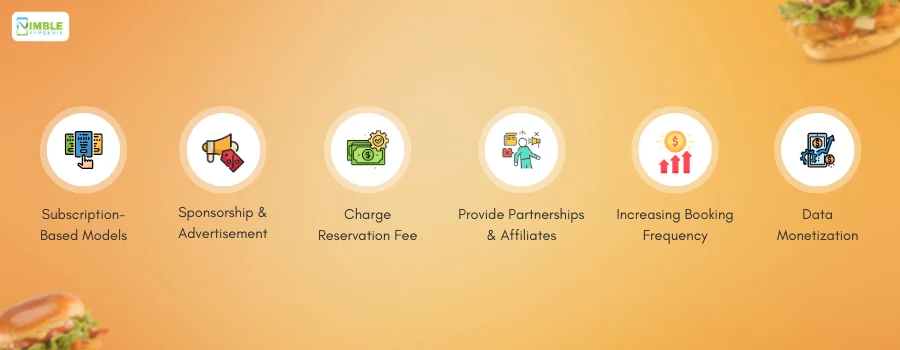
You can monetize a restaurant booking app like OpenTable through:
- Subscription-Based Models
- Sponsorship and Advertisement
- Charge Reservation Fee
- Provide Partnerships And Affiliates
- Increase Booking Frequency
These app monetization models can help you generate a huge revenue while keeping the app useful for both users and restaurant owners.
Let’s understand them in detail.
➤ Subscription-Based Models
You can make money through your app with the help of subscription-based models. Adding pro features to the app, including waitlist management and floor plan management, can result in enhancing your revenue and growth.
Moreover, you can also provide premium features to the restaurants by charging them for these features. These premium features might provide the restaurants with enhanced visibility in the search results, promotional tools, and priority customer support.
➤ Sponsorship and Advertisement
To enhance the listing of the app, you can use advertisements as a strategy to earn revenue. However, you need to note that excess advertising within the app can impact the user’s ability to navigate. Thus, you should be aware of the advertisement strategy adopted by the brand.
Here, you can ask the restaurants to promote them through advertisements, banner ads, and sponsored listings. This can result in increasing the revenue of both the restaurants and your app.
➤ Charge Reservation Fee
Charge the customers a reservation fee for every table they book through your app. You can also offer premium packages to the customers and any add-on service, including priority seating, and special request handling for a fee.
Create an app like OpenTable that includes charges for providing reservation guarantees, exclusive services, value-added services, and protection against security and fraud to the customers.
➤ Provide Partnerships And Affiliates
Form partnerships with businesses working in the hospitality sector, including hotels, event organizers, and travel agencies, to cross-promote services or to offer bundled packages.
Also, you can earn referral fees along with commissions for driving traffic and bookings to partner businesses through the app.
With affiliate marketing, the promotion of the partner restaurants is simple. After partnering with restaurants, hotels, and other dining-related businesses, the app services can be promoted.
➤ Increase Booking Frequency
Provide the restaurant with a premium feature to enhance the booking frequency of the app. You can assist restaurants in promoting their brand by placing their rank at the top of the customer preference list.
Build a restaurant booking app like OpenTable by identifying the change in booking frequency through a reservation app in the market. This can create awareness among the customers about the brand and can also help your app earn extra revenue.
As a restaurant reservation app, you can make suggestions for your linked restaurant to enhance its customer base and charge extra for the same.
➤ Data Monetization
Connecting the app with the targeted audience offers you a large database. After analyzing this data, you can provide insights into the restaurants related to customer behavior and their most preferred restaurant or slot timings.
Using the customer’s data responsibly, you can also create customized marketing campaigns for your connected restaurants. With customized marketing campaigns, you can charge your customers extra fees.
Challenges to Develop a Restaurant Reservation App Like OpenTable and Its Possible Solutions
The challenges to build a restaurant reservation app like OpenTable are:
- Handling Real-Time Data
- Reducing no-shows
- Building trust on both sides
- Competing with giant apps
These are the ground-level challenges that will hit you during development. Let’s now check out them and see how you can actually deal with them.
► Handling Real-Time Data Without Errors
Just think of two customers booking the same table at the exact same second. Without proper real-time sync, your restaurant reservation app will confirm both. This happens more than you think, and it kills user trust fast.
How to fix it :
You can use real-time database technology like Firebase or WebSockets that updates availability the moment a booking is made.
► Reducing No-Shows Without Frustrating Diners
No-shows are the silent revenue killers for every restaurant. A restaurant blocks a table for two hours, the customer never shows up, and that revenue is just gone. If your app cannot control this, restaurants will stop trusting it.
How to fix it :
You can build a simple automated reminder flow. A confirmation message right after booking, a reminder the day before, and an easy cancel button. When someone cancels, your waitlist fills that slot automatically.
► Building Trust on Both Sides — Users and Restaurants
A reservation app only works when both customers and restaurant owners fully trust it. Customers care about their data and booking security. Restaurant owners care about reliability and not losing control of their floor on a busy Saturday night.
How to fix it :
For customers, you can use strong data encryption and a clear privacy policy go a long way. For restaurant owners, a clean dashboard, zero downtime, and actual human support when things go wrong makes all the difference.
► Competing in an Already Crowded Market
OpenTable has been around since 1998. Resy, Yelp, and Eat App are right behind it. If you walk into this market without something genuinely different, it is a tough sell for investors, for restaurants, and for customers.
How to fix it :
Do not copy the OpenTable feature for your app. That race is already lost. Instead, you can find the gap, an underserved city, a cuisine category nobody is focusing on, or a feature that existing table booking apps have completely ignored.
Why Choose Nimble AppGenie to Build a Restaurant Reservation App?
Do you think that creating an app like OpenTable is a feasible amount? It is. Are you confused about how to initiate the app development? No need to panic.
Creating an app with all the required features and market analysis is a simple and easy task until you don’t have the right team to build your app.
Nimble AppGenie is a Restaurant app development company that can assist you in building a Restaurant booking app like OpenTable. All you need to do is contact us. We have already done it before and are happy to serve you.
Case Study: Tawlety Built by Nimble AppGenie
Client:
A food-tech startup came to us with a simple but smart idea. They want to build a table booking app where people can book a restaurant table from their phone instead of showing up and waiting around.
Business Requirements:
They want a single app that can work on both the Android and iOS platform. The same smooth experience for every user, regardless of what phone they’re holding.
Challenges We Faced:
Tables fill up fast. It is quite challenging to show live availability across multiple restaurants without making the app slow or confusing. That is the part that needed real thinking.
Solutions We Offered:
Our developers use technologies like Java for Android, Swift 4 for iPhone, PHP on the backend, MySQL for the data, and Adobe XD for the design. It is visually appealing and intuitive just the way it should be.
The Results:
Tawlety launched and did exactly what it was built for. Customers can now easily book a table, skip the wait, and enjoy the food.
Conclusion
Before we end, let’s conclude what we have already stated. The growing demand for restaurant table reservations has created a golden opportunity for you to have your business in this field.
Yes, you should develop your own app like OpenTable. You can establish your app in the growing demand of restaurants to have an effective table management system.
Moreover, you can have a private dining option, along with providing rewards to your app users with every booking. This will help you to promote the app effectively. The right process to create an app is sufficient to create an app.
Other than this, some of the strategies that you can adopt to earn revenue can be data monetization, providing subsequent partnerships, and more. Finally, yes, it’s feasible to build a restaurant reservation system.
Hey! What are you thinking of? Don’t you want an app that says it’s all about your dream restaurant reservation app?
FAQ
Perform market research and competitive analysis. Define app features and functionalities. Develop wireframes and UI/UX design. Select an appropriate tech stack (frontend, backend, database, etc.). Integrate and test the app thoroughly. Deploy your app on platforms like Google Play Store and Apple App Store. Provide ongoing support and maintenance.
OpenTable’s popularity stems from its simplicity in registration, attractive search functionality, easy reservation process, option for private dining, customized recommendations, seat preference options, and its reward system for users.
Developing a restaurant reservation app allows for predictable seat arrangement, reduced clutter for restaurants, better market analytics, increased restaurant revenue, and enhanced customer experience.
Monetization models may include subscription-based models, sponsorship and advertisement, reservation fees, partnerships and affiliates, increasing booking frequency, and data monetization.
The cost of building an app like OpenTable varies from $15,000 to $70,000, depending on the complexity of the app.
Key features include simple registration, an attractive search box, an easy reservation process, private dining options, customized recommendations, seat preference, and a user reward system.

Niketan Sharma, CTO, Nimble AppGenie, is a tech enthusiast with more than a decade of experience in delivering high-value solutions that allow a brand to penetrate the market easily. With a strong hold on mobile app development, he is actively working to help businesses identify the potential of digital transformation by sharing insightful statistics, guides & blogs.
Table of Contents




No Comments
Comments are closed.