

 Free Consultation
 PCI-DSS Compliant
 GDPR Ready
 ISO 27001
 NDA Protected
 AI Services
 AI App Development
 Generative AI Development
 AI Chatbot Development
 AI Integration Services
 AI Consulting Services
 AI For Fintech
 AI Financial Assistant Solution
 AI Insurance Agent Development
 Tech Stack
 OpenAI / GPT-4
 Claude / Anthropic
 Gemini / Google AI
 Llama / Open Source
 LangChain / LlamaIndex
 Pinecone / Pgvector
 AWS / Azure AI


 Fintech Solution
 Core Fintech
 Fintech App Development
 Neobank App Development
 eWallet App Development
 Lending Software
 Banking Software Development
 BNPL Solution
 BNPL App Development
 Insurance App
 Wealth Management App
 Blockchain Development
 Payroll Software Development
 DeFi App Development
 Crypto Wallet Dev
 Crypto On Ramp Off Ramp
 Crypto Exchange Dev
 Trading Platform Dev
 Payments
 Compliance
 Fintech & Digital Regulations
 Fraud Detection
 Lending Ecosystem
 P2P Lending Platform
 Mortgage Software
 Engagement
 Outsourcing Dev

 Mobile Development
 Mobile App Dev
 iOS App Development
 Android App Development
 React Native
 Flutter Development
 Web Solution
 Node.js Development
 React.js Development
 Angular Development
 App Services
 UI/UX Design
 App Maintenance
 By Stage
 MVP Development
 Industry Solutions
 Healthcare App Dev
 Education App Dev
 Travel App Dev
 Real Estate App Dev
 Logistics Software
 Social Media App

 Hire Mobile Developers
 Hire iPhone Developers
 Hire Android Developers
 Hire React Native Devs
 Hire Flutter Developers
 Hire Web Developers
 Hire Node.js Developers
 Hire Angular Developers
 Hire PHP Developers
 Hire Laravel Developers
 How It Works
 Pre-Vetted Developers
 Ready In 48 Hours
 NDA From Day One
 Replace Guarantee
 Company
 About Us
 Our Work Process
 Portfolio
 Case Studies
 Blog / Insights
 Careers
 Contact Us
 Awards
 Recognition


 Offices



TL;DR
- A multi-bank cash management platform offers a treasury team one live view of cash sitting across every bank the company uses, instead of logging into five or six separate portals.
- The average enterprise banks with 5 to 6 financial institutions and manages 40+ accounts; that fragmentation is the reason this platform category exists.
- The build has four layers: bank connectivity, ERP/TMS integration, data normalization, and compliance. Each one is a separate point of failure.
- Cost ranges from $40,000 for an MVP to $400,000+ for a full enterprise rollout, depending on how many banks, currencies, and ERPs you connect.
- Nimble AppGenie helps enterprise finance teams build multi-bank cash platforms that plug into existing ERPs instead of forcing a rip-and-replace.
“How do I get one view of my company’s cash when it’s spread across six different banks?” That’s the question many CFOs and treasury teams search for when looking to build a multi-bank cash management platform. If your team logs into five or six banking portals every morning just to understand the company’s actual cash position, you already know the problem this guide addresses.
This is not a sales page for a finished product. It’s a build guide from fintech experts at Nimble AppGenie – written for financial leaders deciding whether to buy an off-the-shelf treasury tool or build connectivity that’s actually tailored to your own banks, ERP, and entity structure.
Let’s walk through what a multi-bank cash management platform for enterprises actually is, the architecture behind it, what it costs to build at each tier, and where most projects go wrong.
40+ bank accounts are managed by the average enterprise.
5-6 average banking relationships per enterprise.
What Is a Multi-Bank Cash Management Platform?
A multi-bank cash management platform is software that connects to every bank account a company holds across currencies, countries, and institutions. It presents a single consolidated, real-time cash position. It pulls balance and transaction data via APIs, EBICS, SWIFT, or host-to-host connections, normalizes it into a single format, and feeds it into your ERP or treasury management system (TMS).
This is distinct from a full TMS. A TMS is the whole operating system for treasury – cash management, investment management, debt tracking, FX hedging, and reporting all in one suite.
A multi-bank cash management platform is narrow: it solves the specific, painful problem of cash visibility and bank connectivity, and it can sit underneath a TMS, directly feed an ERP, or run as a standalone dashboard.
It’s also not the same as consumer-facing open banking. If you want the wider picture of how open banking works and where it’s regulated, our open banking guide covers that. This piece focuses particularly on the enterprise, multi-entity version of the problem: getting your own company’s cash data out of your banks and into your systems.
Why Enterprises Are Building This Now
Three things are pushing this up the priority list for finance teams in 2026:
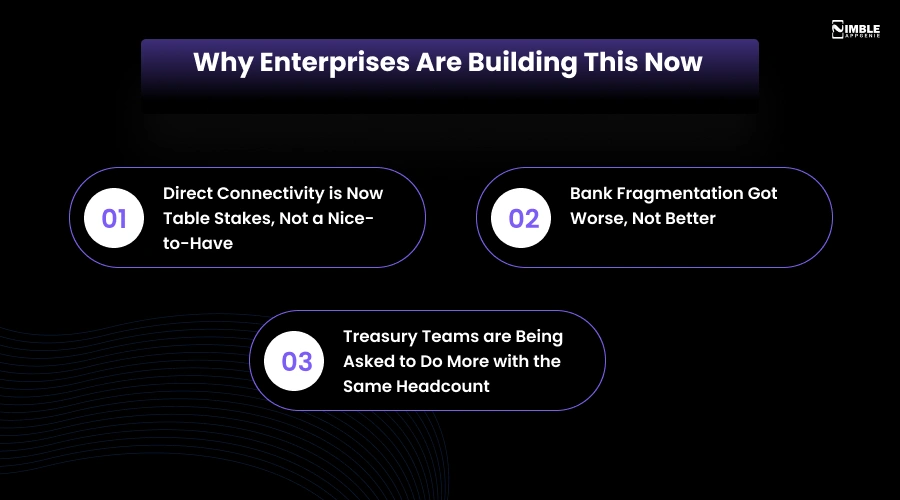
- Direct Connectivity is Now Table Stakes, Not a Nice-to-Have
J.P. Morgan’s 2026 payments research found that 88% of finance professionals say direct bank connectivity is highly beneficial and 85% say they would consider switching banks just to get direct ERP-to-bank connectivity. - Bank Fragmentation Got Worse, Not Better
Companies spread banking relationships across multiple institutions to reduce counterparty risk – especially after the regional banking stress of recent years. More banks means more portals, more file formats, and more manual reconciliation. - Treasury Teams are Being Asked to Do More with the Same Headcount
Deloitte’s 2024 Global Corporate Treasury Survey found that 49% of treasury organizations now prioritize building a scalable treasury function, up from 39% just two years earlier, and manual, portal-by-portal cash tracking doesn’t scale.
Note: The average enterprise treasurer spends around a quarter of their week just moving money and chasing bank relationships. That’s not treasury strategy; that’s data entry with extra steps.
Treasurers are moving beyond optimizing liquidity in isolation. They’re optimizing the entire receivable-to-payable flow with customer experience at the center. This shift will shape the next generation of finance,” – Ethan Tandowsky, CFO, Adyen.

Architecture: The 4 Layers of a Multi-Bank Cash Management Platform
Every genuine multi-bank cash platform is built on four layers. Treat each one as its own point of failure – a weak layer anywhere breaks the whole system.
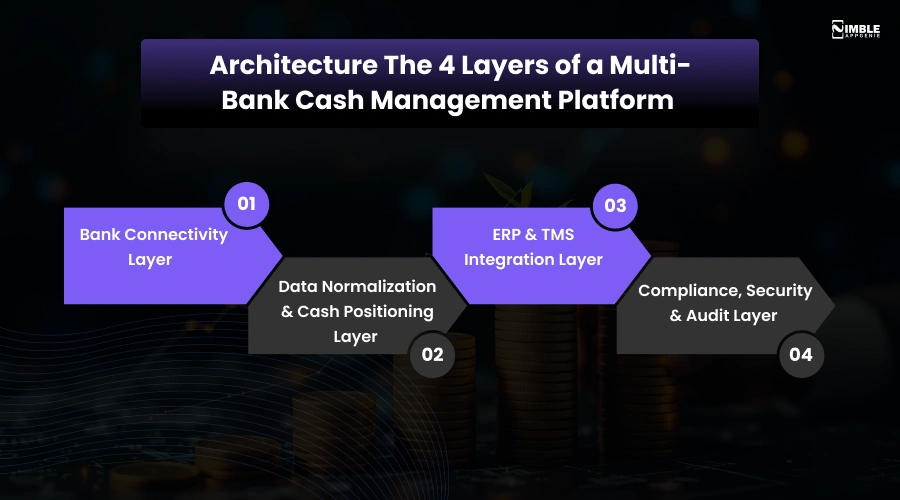
1. Bank Connectivity Layer
This is where you connect to each bank: direct APIs where the bank offers them, SWIFT for cross-border coverage, EBICS for Germany, Switzerland, Austria, and France, and host-to-host SFTP for banks that still only batch file transfer. Most enterprise platforms end up using a mix of all four, since not every bank offers the same connection method.
2. Data Normalization & Cash Positioning Layer
Every bank sends data in a different format – BAI2, MT940, CAMT.053, or a proprietary JSON schema. This layer parses all of it into one consistent structure, then rolls it up into a real-time cash position by entity, account, and currency.
3. ERP & TMS Integration Layer
Cash data is only useful once it reaches the system; finance actually works in Oracle Fusion, SAP S/4HANA, Microsoft Dynamics, NetSuite, or a dedicated TMS like Kyriba. This layer pushes normalized cash data to those systems automatically, instead of someone exporting a CSV every morning.
4. Compliance, Security & Audit Layer
Bank credentials, encryption, consent management, and a full audit trail live here. Every connection needs authorization controls and a record of who accessed what, and when – this is the layer regulators and auditors will ask about first.
Features of an Enterprise Multi-Bank Cash Management Platform
Here’s a quick description of multi-bank cash management platform features for enterprises:
| Feature | Description |
| Multi-Bank Aggregation | Connects to every bank account across institutions and pulls balances and transactions into one place. |
| Real-Time Cash Positioning | Shows live cash by entity, currency, and account, instead of yesterday’s end-of-day statement. |
| Multi-Currency & Multi-Entity Support | Rolls up cash across subsidiaries and currencies, with FX built-in conversion for group-level reporting. |
| ERP & TMS Sync | Pushes normalized cash data directly into SAP, Oracle, NetSuite, Dynamics, or your existing TMS. |
| Cash Flow Forecasting | Projects short-term liquidity needs using historical transaction patterns and scheduled payments. |
| Payment Initiation & Approval Workflows | Lets the treasury initiate and approve payments directly from the platform, with multi-level sign-off. |
| Reconciliation Engine | Automatically matches bank transactions against your books, flagging exceptions for manual review. |
| Audit Trail & Access Controls | Logs every connection, login, and data pull for compliance and internal audit requirements. |
| Custom Dashboards & Reporting | Board-ready cash reports by entity, region, or currency, exportable on demand. |
How to Build a Multi-Bank Cash Management Platform
Building a multi-bank cash forecasting platform that inherits the error management platform takes six steps: map your banks, choose your connectivity method per bank, build the normalization engine, connect your ERP, layer in compliance, and pilot before full rollout.
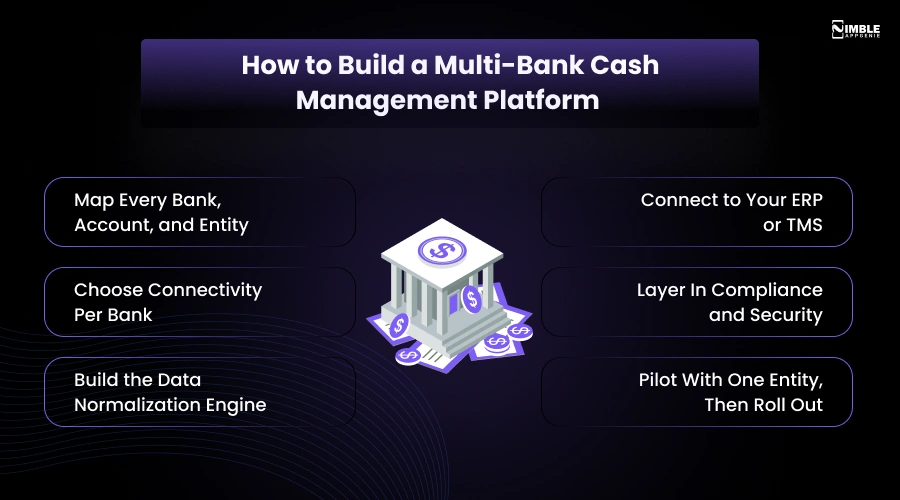
1. Map Every Bank, Account, and Entity
Before writing any code, list every bank, account, currency, and legal entity you need visibility into. This map determines every architecture decision that follows – the connectivity methods you need, the currencies you support, and the ERP entities you will map data against.
2. Choose Connectivity Per Bank
Not every bank offers the same connection type. Some offer modern REST APIs, others only support SWIFT or EBICS, and some smaller regional banks still depend on host-to-host file transfer. Decide bank-to-bank; don’t assume one method covers your whole list.
3. Build the Data Normalization Engine
This is the layer that turns five different file formats into one clean data model. Get this wrong and every downstream feature – cash positioning, reconciliation, and forecasting – inherits the error.
4. Connect to Your ERP or TMS
Build the integration that pushes normalized cash data into the system your finance team already works in. This is usually where projects run over budget – legacy ERP connectors are rarely plug-and-play.
5. Layer In Compliance and Security
Add consent management, encryption in transit and at rest, role-based access controls, and a full audit log. Build this in from day one – retrofitting compliance after launch is far more expensive.
6. Pilot With One Entity, Then Roll Out
Launch with one legal entity or region first. Watch for reconciliation errors and connectivity drops before you scale to your full bank list – problems are far cheaper to fix at this stage than after a full rollout.
Build vs. Buy: Should You Build Your Own Platform?
Most finance teams shouldn’t build every layer from scratch. Bank connectivity to smaller or regional banks is rarely worth building in-house.
| Layer | Build In-House If | Buy / Partner If |
| Bank connectivity | You bank primarily with 2–3 tier-one banks with strong APIs | Your bank list includes regional or smaller institutions with limited API coverage |
| Data normalization | You need custom logic for a specific reporting structure | Standard normalization covers your reporting needs |
| ERP integration | This is where you actually differentiate for your finance team | You use a standard ERP with existing connector options |
| Compliance & audit | You have in-house security and compliance engineering | You want SOC 2 and audit-readiness handled by a partner from day one |
How Much Does It Cost to Build a Multi-Bank Cash Management Platform?
Multi-bank cash management platform development cost depends mainly on how many banks you connect, how many entities and currencies you support, and how many ERP systems need to sync.
| Tier | What’s Included | Price Range | Timeline |
| MVP | Single entity, 2–3 bank connections, basic dashboard, CSV/API export | $40,000–$80,000 | 8–12 weeks |
| Mid-Market | Multi-entity, 5–10 banks, one ERP connector, cash positioning & basic forecasting | $80,000–$180,000 | 3–5 months |
| Enterprise | Multi-entity, multi-currency, 15+ banks, SWIFT/EBICS/H2H, multiple ERP connectors, AI forecasting, full audit trail | $180,000–$400,000+ | 6–12 months |
Legacy ERP integration is the line item most teams underestimate. Connecting a modern platform to an older SAP or Oracle instance usually adds $20,000 to $60,000 and extra weeks to any tier above MVP – budget for it upfront, not as a surprise mid-project.

Compliance and Regulation You Can’t Skip
Three things are essential here: consent and authorization, regional banking regulations, and data security standards.
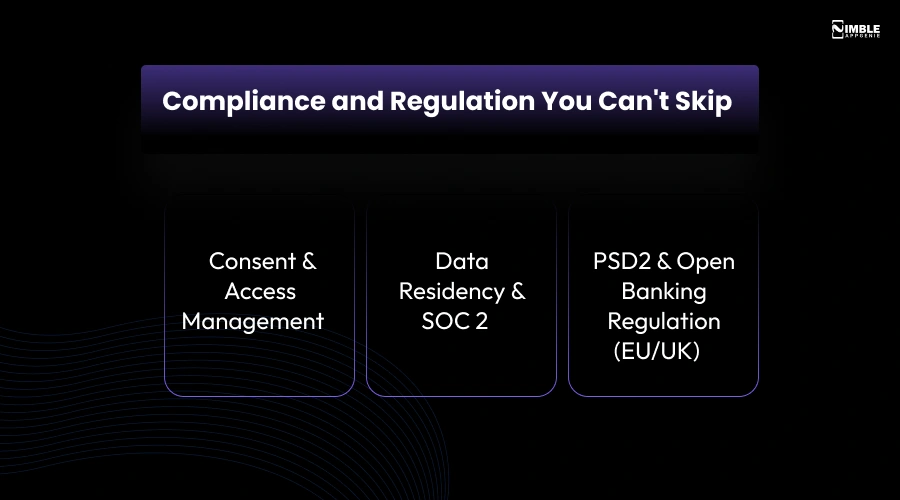
1. Consent & Access Management
Every bank connection requires explicit authorization, with clear scope over what data is pulled and how long access lasts. So, build revocation into the system from day one.
2. Data Residency & SOC 2
Financial data usually has to reside within a specific jurisdiction. SOC 2 Type II certification is close to a baseline expectation for any platform handling enterprise banking data today. So, plan your hosting and audit strategy around it early, not after your first enterprise client asks for it.
3. PSD2 & Open Banking Regulation (EU/UK)
If you operate in Europe or the UK, PSD2 and the UK’s Open Banking framework set rules for how banks should expose account data through APIs, and what security standards (like Strong Customer Authentication) apply.
For more on regulatory groundwork specific to fintech builds, see our guides on KYC and AML compliance for fintech and money transmitter licensing.
Challenges and Solutions in Building This Platform
When you build a multi-bank cash management platform, some challenges will come your way that you need to confront. Here are the major ones with suitable solutions.
| Challenge | Solution |
| Smaller banks don’t offer modern APIs | Build fallback support for SWIFT, EBICS, or host-to-host file transfer instead of assuming every bank supports REST APIs. |
| Legacy ERP integration takes longer than planned | Scope ERP connectors early and budget separately – this is consistently the most underestimated line item. |
| Reconciliation breaks silently | Build exception alerts into the reconciliation engine so mismatches surface immediately, not at month-end close. |
| Compliance gets treated as a later phase. | Build consent management, encryption, and audit logging into the architecture from the first sprint, not after launch. |
| Multi-currency rollups are inaccurate. | Use a dedicated FX rate service with clear timestamping, rather than static daily rates, for group-level reporting. |
How Nimble AppGenie Builds Multi-Bank Cash Management Platforms
Nimble AppGenie builds enterprise cash management platforms across all four layers: data normalization, bank connectivity, ERP integration, and compliance – as one connected system, not a patchwork of vendors.
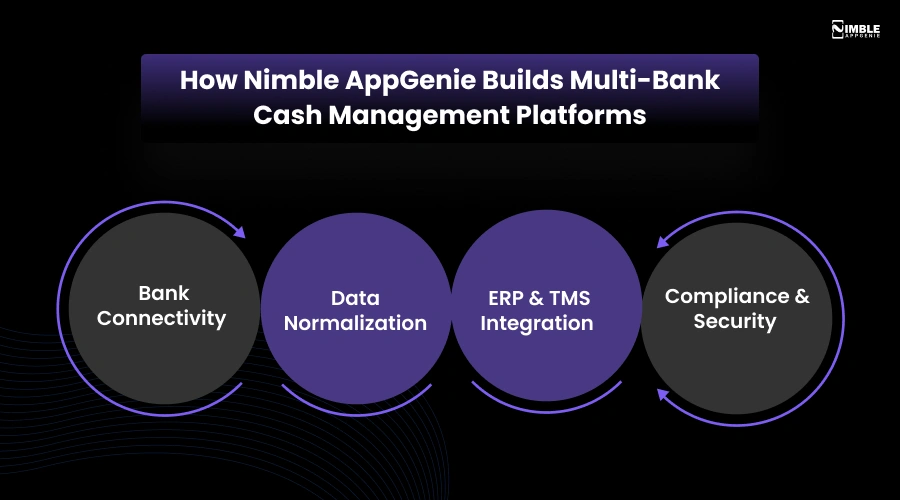
1. Bank Connectivity
Direct API, SWIFT, EBICS, and host-to-host integrations, built around your actual bank list.
2. Data Normalization
Custom parsing engines for BAI2, MT940, CAMT.053, and proprietary bank formats.
3. ERP & TMS Integration
Connection for SAP, NetSuite, Oracle, Microsoft Dynamics, and leading treasury management systems.
4. Compliance & Security
Consent management, role-based access, encryption, and SOC 2-ready audit trails from day one.
Nimble AppGenie is ISO 9001:2015 certified, has delivered 350+ fintech and enterprise software projects, and has built dedicated banking software and fintech API integration platforms for clients managing complex, multi-bank treasury operations.
Conclusion
A multi-bank cash management platform is not a luxury for large enterprises anymore – it’s what separates a treasury team that knows its cash position in real time from one that’s still stitching together bank portals and spreadsheets. The build itself is not one product; it’s four layers, and the smart move is usually to build the ERP integration layer yourself, since that’s where you actually differentiate, and lean on proven connectivity methods for the rest.
If you are evaluating this for your finance team, start by mapping your actual bank list and entity structure, then bring in a partner who has built this exact stack before. Get in touch with Nimble AppGenie to scope your multi-bank cash management platform.
FAQs

Richard Thomas is the Lead Architect at Nimble AppGenie, where he oversees the design and development of scalable, secure, and high-performance digital solutions. With deep expertise in software architecture, cloud infrastructure, and system integration, he plays a key role in transforming complex business requirements into robust technical frameworks. When he’s not architecting systems, he enjoys exploring emerging technologies and staying ahead of industry trends.
Table of Contents




No Comments
Comments are closed.