


Key Takeaways:
- An educational app is designed to facilitate learning and to multiply the educational outcomes.
- The total cost to develop an educational app varies from $25,000 to $350,000. This cost can vary depending on different factors such as the complexity of the app, the design of the app, technologies, and various other determinants.
- Apart from this, there are other factors impacting the overall cost to build an educational app, such as content creation, scalability cost, app store fees, and other determinants.
- The time taken to develop an educational app can vary from 2 to 6 months.
- The monetization strategies used to cover the cost to make an educational app vary from a subscription plan, advertising, and in-app purchases.
- A leading app development company as Nimble AppGenie can be helpful in building your next educational platform.
The overall cost to build an educational app varies from $25,000 to $350,000. This cost varies depending on diversified factors such as technologies, app design, complexity of apps, and many other factors.
We have all seen a shift from offline to online mode. This conversion has impacted the education and learning industry. Increased screen time has reduced the interest in reading and learning via books. So why not make education fun through an app?
Well, if you are an investor or an entrepreneur with a revolutionary idea, then it’s time to come ahead.
“The next great educational platform won’t be remembered for its features; it will be remembered for the lives it refused to leave behind.”
But one of the questions that might trouble you is “ how much does it cost to build an educational app?”
Hence, in this guide, we’ll walk you through current stats, average cost, types of educational apps, popular educational apps, factors impacting the overall cost, and time taken.
All You Need to Know About the Current Educational App Market
Before you evaluate the complete cost to make an educational app, let’s explore the complete market stats in this section.
Learning about the top trends in the educational industry will help you to move ahead successfully.
Let’s know them all here.
- Revenue within the online education market is expected to increase by US$221.71 billion in 2026.
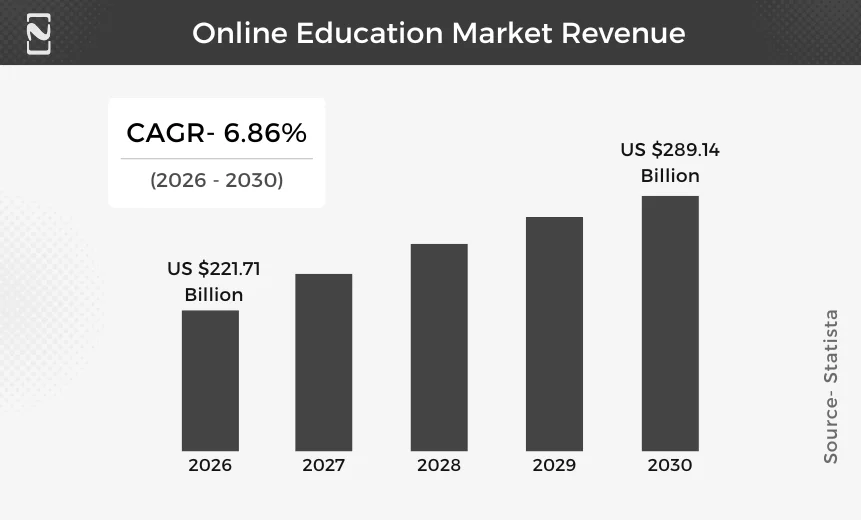
- The number of users is projected to be 1.2 billion by 2030, and revenue is expected to grow by US$289.14 billion in 2030.
Have a read over the educational apps now.
- Based on the report, Duolingo was the most popular learning app with over 500 million downloads as of 2026.
- The global educational app market is expected to grow by 6.08 billion from 2025 to 2029.
- Khan Academy Kids was the most downloaded app for children in the U.S., with 10 million downloads as of 2026.
What is the Average Cost to Build an Educational App?
On average, the cost to build an educational app can vary from $25,000 to $300,000. This cost can vary depending on the complexity of the app, design of the app, technology selection, and many other drivers.
The selection of developers based on their skills does impact the overall cost to make an educational app.
Along with this, the factors such as live video streaming, AR/VR, content management system, data compliance, and privacy can enhance the overall cost to make an educational app.
Let’s explore the complete cost breakdown to make an educational app:
| Step | Features | Cost Range |
| Initial Development | UI/UX Design, Content Management, User Authentication, Learning Content | $5K – $100K |
| Enhancement and Engagement | Gamification, Progress Tracking, and Communication Tools | $5K – $50K |
| Platform and Integration | Platform Support and API Integration | $10K – $80K |
| Quality Assurance | Testing & QA, Maintenance & Updates | $5K – $70K |
For your customized app, you can evaluate the complete cost by hiring mobile app developers.
Now, let’s look forward to the complete factors in detail:
Factors that Affect the Cost to Build an Educational App
Diversified factors impacting the total cost to create an educational app are frontend development, UI/UX design, backend development, features, testing, deployment & hosting, and maintenance and updates.
Let’s have a look at a glance:
| Cost Driver | Estimated Range | Description |
| UI/UX Design | $2,000 – $30,000 | App layout, user experience, prototyping |
| Frontend Development | $5,000 – $80,000 | User-facing interface (iOS, Android, web) |
| Backend Development | $8,000 – $100,000 | Servers, databases, APIs |
| Features & Integrations | $3,000 – $50,000 | Messaging, media upload, third-party tools |
| Testing & QA | $2,000 – $20,000 | Bug fixes, performance testing |
| Deployment & Hosting | $1,000 – $10,000 | Cloud services, app store setup |
| Maintenance & Updates | $4,000 – $30,000 | Ongoing improvements and support |
Now, let’s learn all these factors and their impacts on the total educational app development cost in detail:
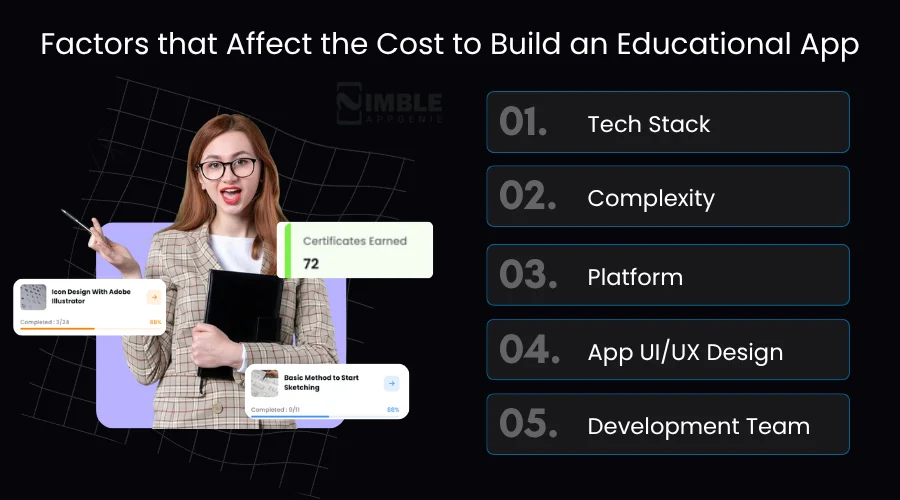
1. Tech Stack
Technology that can impact the development of an app is technology. The cost of developing an education app is impacted by the languages selected, frontend, backend, and a lot more.
Certain technology platforms contain a higher preliminary cost, although they are futuristic platforms that ensure that the application doesn’t go obsolete in the future.
| Technology Stack | Description | Cost Estimation |
| Frontend: React Native | Cross-platform development framework for building mobile apps with JavaScript and React. | $25,000 – $100,000 |
| Backend: Node.js (Express) | Server-side framework for building scalable and fast web applications using JavaScript. | |
| Database: MongoDB | NoSQL database for storing flexible, JSON-like documents with dynamic schemas. | |
| Frontend: Flutter | Cross-platform development framework for building mobile apps with Dart and Flutter. | $50,000 – $150,000 |
| Backend: Firebase | Mobile and web application development platform with cloud-hosted backend services. | |
| Database: Firestore | Flexible, scalable database for storing and syncing data for client- and server-side development. | |
| Frontend: Angular | Frontend framework for building single-page web applications with TypeScript and Angular. | $100,000 – $250,000 |
| Backend: Django | High-level Python web framework for rapid development and clean, pragmatic design. | |
| Database: PostgreSQL | An open-source relational database system known for its reliability, robustness, and performance. | |
| Frontend: Vue.js | Progressive JavaScript framework for building interactive user interfaces and single-page applications. | $150,000 – $300,000 |
| Backend: Ruby on Rails | Full-stack web application framework using Ruby for back-end, HTML, CSS, and JavaScript for front-end. | |
| Database: MySQL | A popular open-source relational database management system known for its ease of use and scalability. |
You can check this guide to select a suitable tech stack for an app.
2. Complexity
More features in an app invite more complexity. Additionally, it will incur more time and resources to develop an app. The cost to create an educational app is impacted by complex features including real-time chat, geolocation, and augmented reality.
The given table will help you to decide the type of cost and complexity in app development.
| Complexity Level | Description | Cost Estimation |
| Low Complexity | Basic features, minimal design, simple functionality | $20,000 – $80,000 |
| Medium Complexity | Moderate features, custom design, and some integration | $80,000 – $150,000 |
| High Complexity | Advanced features, custom design, extensive integration | $150,000 – $300,000+ |
3. Platform
On which platform do you think your app will work better? The answer can be based on your target audience. Selecting the right platform for mobile apps directly affects the development cost and can be a wide issue.
This can be addressed by hiring Android developers and iOS developers. You can also check the table below to identify the right platform with the cost.
| Platform | Description | Cost Estimation |
| Web | A web-based app accessible via browsers on desktop and mobile devices. | $20,000 – $150,000 |
| iOS (Apple) | Native apps developed specifically for iOS devices, such as iPhones and iPads, are available on the Apple App Store. | $40,000 – $250,000 |
| Android | Native apps developed specifically for Android devices are available on the Google Play Store. | $30,000 – $250,000 |
| Cross-Platform | Develop once and deploy everywhere using frameworks like React Native or Flutter, compatible with both iOS and Android. | $50,000 – $300,000 |
4. App UI/UX Design
With an engaging user interface design, the user experience can be speed up. It can help to engage new users and can increase the loyalty of the customers towards the app. Additionally, it offers a competitive advantage in retaining users.
An effective UI/UX design has a high correlation with the company’s growth.
| UI/UX Design Level | Description | Cost Estimation |
| Basic | Standard UI elements, simple layouts, minimal graphics, and straightforward navigation. | $5,000 – $15,000 |
| Moderate | Custom UI elements, improved layout, enhanced graphics, intuitive navigation, and some interactivity. | $15,000 – $40,000 |
| Advanced | Highly customized UI, rich graphics, interactive elements, animations, immersive experiences, and branding. | $40,000 -$100,000 |
5. Development Team
Selecting the development team is one of the important activities to be considered. The expertise and skills of the mobile app development company with domain knowledge can deliver effective services for developing an app.
Additionally, the flexibility of the development team to adapt to the changing requirements with unexpected challenges is the most crucial phenomenon for the project’s success. The table below can provide you with a clear view.
| Development Team | Description | Location | Cost Estimation |
| Freelancers | Individual developers or small teams working on a contract basis offer flexibility but potentially varying quality. | Global | $25,000 – $150,000 |
| Boutique Agency | Small to medium-sized agencies provide personalized service, often with specialized expertise and attention to detail. | Regional | $100,000 – $250,000 |
| In-house Team | Hiring and managing an internal team of developers, designers, and project managers, offering full control and continuity. | Local | $150,000 – $350,000 |
Apart from this, there are many other factors to consider such as AI in educational apps, security of the app, content creation, scalability, and others. Let’s look at the table below to know more.
| Hidden / Additional Factor | Description |
| Content Creation | Developing lessons, videos, quizzes, and materials |
| Licensing & Copyrights | Fees for using third-party content or resources |
| Compliance & Regulations | Meeting data privacy laws (e.g., COPPA, GDPR) |
| Scalability Costs | Infrastructure upgrades as user base grows |
| App Store Fees | Apple/Google developer accounts and commissions |
| Marketing & User Acquisition | Ads, promotions, influencer partnerships |
| Analytics & Tracking Tools | User behavior monitoring and performance tools |
| Localization & Translation | Adapting content for different languages/regions |
| Customer Support | Help desks, chat support, and user assistance |
| Security Enhancements | Data protection, encryption, and fraud prevention |
Now, let’s check out the different types of educational apps and their cost structure in the following section.

Types of Educational Apps and Their Costs
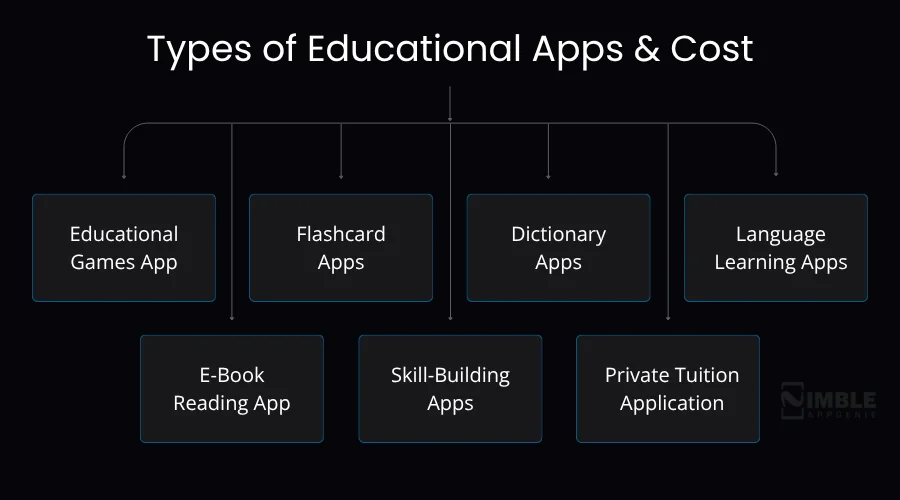
The overall educational app development cost varies based on the different types of educational apps and their functionality. For educational game apps, the cost can be high due to their gaming APIs, while the cost to build an e-book reading app can be low due to its functionality attribute.
Let’s figure out the complete types of educational apps along with their cost.
1. Educational Games App
An educational app built with a game application is one of the most important and interesting educational app ideas. Such apps are designed to make education more engaging as well as entertaining by using game elements, including rewards, challenges, and competition.
These apps engage a larger number of students and help them to learn more interactively. The average cost to build an educational app for games can be $50,000 to $200,000.
2. Flashcard Apps
Flashcard apps are the simplest way of education and learning for candidates who are preparing for competitive exams. With the assistance of such apps, students can take notes of all the essential topics that are related to the specific subject.
These apps are designed to help students to make customized flashcards and share them with friends. It can cost $20,000 to $80,000 to develop such an app.
3. Dictionary Apps
Dictionary apps are useful for students of every age group. It is useful for teachers as well. This kind of app is created based on education.
Such apps make it simple for people to search for a word without carrying dictionaries with them. Investing in these apps can help your users with word searches. You can make such an app in the range of $20,000 to $100,000.
4. Language Learning Apps
These apps are built to learn multiple languages or a particular new language. You can create an app like Babbel to enhance proficiency with the help of interactive lessons, grammar exercises, and speaking practice.
Such apps can be effective in learning vocabulary and setting phrases along with grammar to keep the conversation ongoing. Language learning apps can be built for $50,000 to $200,000.
5. E-Book Reading App
E-book reading apps are built to help users to read and learn diverse books online easily. Here, the additional download module can be included in the app or can also be charged extra through which the users have an option to save the book or PDF offline.
The development cost of an e-learning app can be $40,000 to $150,000. You can also develop an audiobook application if you are interested in making such apps.
6. Skill-Building Apps
Skill-building apps are created and designed to assist users in improving and mastering a specific skill. Edtech app development cost to make such app can be $50,000 to $200,000.
To make such apps, you need to identify the skills that will help your users to improve their overall professional impression, serving users the benefit of your educational app. Such apps also help the user to enhance their skills in order to build their profile.
7. Private Tuition Application
During the pandemic, when the offline classes were almost closed. Parents have started to provide online services to fulfill the educational needs of their children.
These apps are effective for parents and students to connect with the best tutors via an online education platform. The overall cost to build an education app for private tuition can be $40,000 to $120,000.
Popular Educational Apps and the Cost to Develop Them
Learning about the popular educational apps and their costs will encourage you to identify how much it took for them to make history.
Hence, here is the list of the top educational apps to learn from:

1. Duolingo
Duolingo is by far the most popular app for learning to speak a new language. The app contains a game-like exercise along with a user-friendly interface that has massive popularity among people of all ages.
The mission of the company is to make education free, fun, and available to all. It is designed to feel like a game and scientifically proven to be effective. The cost to create an app like Duolingo can range from $30,000 to $200,000.
2. Khan Academy
Khan Academy is an app that is based on a non-profit educational organization to provide free online courses in different subjects comprised of science, math, history, and economics.
The app offers a wide range of practice exercises and instructional videos to help users master the project. Khan Academy has been developed in a range of $20,000 to $150,000.
Also Read: How to Develop an App Like Khan Academy?
3. Udemy
Udemy is the most popular resource that offers thousands of online courses. The course is developed by individual instructors on the subject matter of the user’s choice.
Create an e-learning platform like Udemy, where students can post questions on the cover page that can be answered by the instructor. Users can buy courses on a pre-course basis and are also able to purchase a monthly subscription. The cost of building an education app is $50,000 to $180,000.
4. Coursera
Coursera is an online learning platform that features courses, certificate programs, degrees, and tutorials. This platform is developed to offer courses from top universities, along with organizations around the world.
It is a platform developed with a vision of providing life-transforming learning experiences to learners. The cost to develop a Coursera-like app can range from $40,000 to $200,000.
5. edX
edX is an online learning app that offers high-quality courses from the world’s best universities. The app is popularly known for the Massive Open Online Courses (MOOCs). It is a profitable online application focused on managing a variety of offerings.
A major focus of the platform is to manage different offerings comprising elite brand boot camps. Here the user of the app can also find the top courses from some famous universities including Oxford and Harvard. The cost of the educational app is $60,000 to $200,000.
Well, there are certain money-making sources to consider when it comes to covering the cost invested for building an educational app. The following section deals with the same:
How Do Educational Apps Make Money?
Educational apps make money through different strategies, such as in-app purchases, in-app advertising, subscription plans, and many others.
Let’s discuss the complete list of educational apps’ monetization strategies below:
| Monetization Driver | Description (Educational App Context) |
| Subscription Model | Monthly/annual fee for access to courses, lessons, and quizzes |
| Freemium Model | Free basic lessons, with paid access to advanced content |
| In-App Purchases | Purchase individual courses, practice tests, or study packs |
| Advertisements | Show ads between lessons or in free learning modules |
| One-Time Purchase | Pay once to unlock a full course or complete curriculum |
| Certification Fees | Charge for exams and verified certificates of completion |
| Affiliate Marketing | Recommend books, tools, or courses and earn commissions |
| Corporate Licensing | Provide paid access to schools, universities, or companies |
How Much Time Does It Take to Build an Educational App?
The average time to build an educational app can vary from 2 to 6 months, depending on the type of app, size of the app, skills of the developers, and complexity of the app.
Let’s evaluate the given table for the timeline:
| Development Phase | Time Estimate |
| Planning and Research | 1-2 months |
| Design | 1-2 months |
| Development | 2-6 months |
| Content Creation | Ongoing |
| Testing and QA | 1-2 months |
| Deployment and Launch | 1-2 weeks |
| Post-launch Support | Ongoing |
Why Create Your Own Educational App with Nimble AppGenie?
In the whole blog, we have mentioned that an app development team plays an important role in making your app stand out from the competition in the educational app industry.
Are you facing issues in selecting an app development company?
Nimble AppGenie is the best educational app development company that can assist you in launching an educational app under a reasonable process.
You can select us as we have already done it before. Check out our case studies that say it all. GLU is one of the examples of our work.

Conclusion
The cost of building an education app is reasonable, so you can invest in the app successfully. Other than this, the educational apps can earn money via subscription plans, advertising, and sponsorship.
Moreover, to achieve success in the educational app industry, you should consider the factors that impact the cost to build an educational app, including complexity, app platform, and UI/UX interface.
FAQs

Madan is the Backend Solutions Architect at Nimble AppGenie, specializing in the design of secure, high-concurrency systems that power complex mobile ecosystems. With deep expertise in server-side logic and database management, he ensures every platform is built with enterprise-grade security. In his free time, he is an avid researcher of emerging technologies; he spends his time deconstructing the latest backend frameworks and reading technical papers to ensure our solutions remain at the absolute forefront of industry innovation.
Table of Contents
No Comments
Comments are closed.