Free Consultation
 PCI-DSS Compliant
 GDPR Ready
 ISO 27001
 NDA Protected
 AI Services
 AI App Development
 Generative AI Development
 AI Chatbot Development
 AI Integration Services
 AI For Fintech
 AI Financial Assistant Solution
 AI Insurance Agent Development
 Tech Stack
 OpenAI / GPT-4
 Claude / Anthropic
 Gemini / Google AI
 Llama / Open Source
 LangChain / LlamaIndex
 Pinecone / Pgvector
 AWS / Azure AI


 Fintech Solution
 Core Fintech
 Fintech App Development
 Neobank App Development
 eWallet App Development
 Payment Integration
 Lending Software
 BNPL Solution
 BNPL App Development
 Insurance App
 Investment App Dev
 Wealth Management App
 Crypto & DeFi
 DeFi App Development
 Crypto Wallet Dev
 Crypto Exchange Dev
 Trading Platform Dev
 Payments
 Compliance
 RegTech App Dev
 Fraud Detection
 Lending Ecosystem
 P2P Lending Platform
 Mortgage Lending
 Engagement
 Outsourcing Dev


 Mobile Development
 Mobile App Dev
 iOS App Development
 Android App Development
 React Native
 Flutter Development
 Web Development
 Node.js Development
 React.js Development
 Angular Development
 PHP / Laravel
 App Services
 UI/UX Design
 App Maintenance
 By Stage
 MVP Development
 Industry Solutions
 Healthcare App Dev
 Education App Dev
 Travel App Dev
 Real Estate App Dev
 Logistics Software
 Social Media App


 Hire Mobile Developers
 Hire iPhone Developers
 Hire Android Developers
 Hire React Native Devs
 Hire Flutter Developers
 Hire Web Developers
 Hire Node.js Developers
 Hire Angular Developers
 Hire PHP Developers
 Hire Laravel Developers
 How It Works
 Pre-Vetted Developers
 Ready In 48 Hours
 NDA From Day One
 Replace Guarantee

 Company
 About Us
 Portfolio
 Case Studies
 Blog / Insights
 Careers
 Contact Us
 Recognition


 Offices


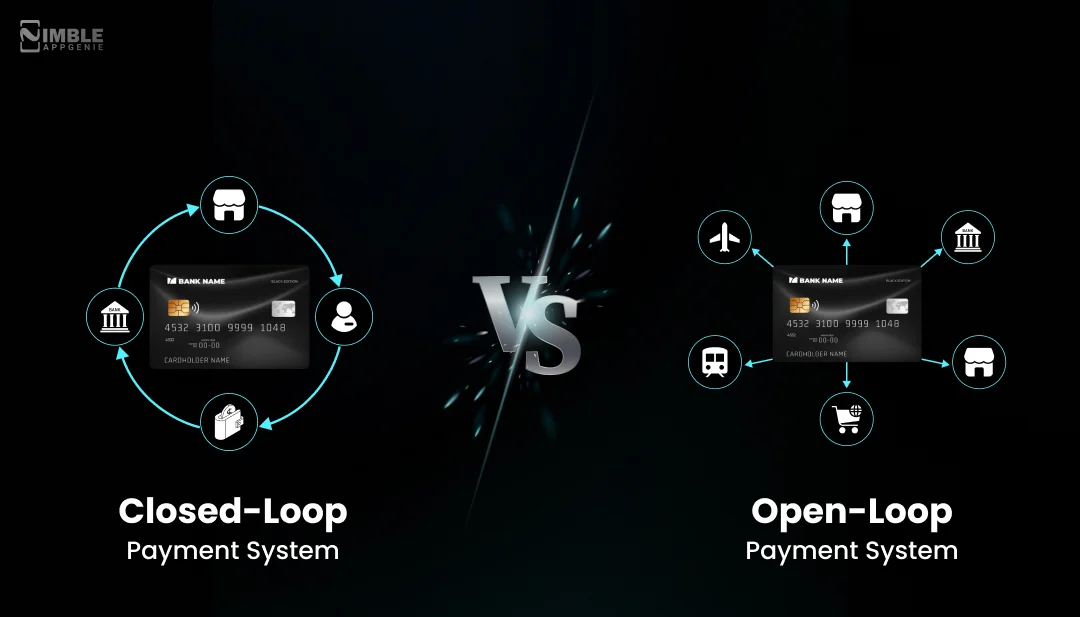
| Quick Answer: A closed-loop payment system works only within one company’s ecosystem (like a Starbucks card), whereas an open-loop system works across participating banks and merchants (like a Visa card) – the right choice depends on whether you want control and loyalty, or reach and flexibility. |
TL;DR
- Closed-loop systems trade reach for control: deep customer data, lower fees, and loyalty-program flexibility – but only within your ecosystem.
- Open-loop systems trade control for reach: faster time-to-market and wider acceptance, but higher per-transaction fees and less direct customer data.
- A common myth worth correcting: closed-loop is not simply “more secure” than open-loop – it has a smaller fraud exposure surface, whereas open-loop networks run more sophisticated, heavily audited fraud infrastructure at scale.
- Closed-loop transactions settle immediately because they are just an internal ledger update; open-loop transactions authorize instantly but go through separate interbank clearing.
- Nimble AppGenie builds closed-loop and open-loop payment infrastructure and can help you decide which one actually fits your business model.
Gone are the days when your customers depend on cash transactions. Cash use has reduced steadily as debit cards, credit cards, and digital payment methods have taken over; most businesses now have to choose a payment system, not just accept one.
That’s not always a simple choice. Closed-loop and open-loop payment systems are the two core classifications of functioning payment systems, and most businesses find it genuinely hard to pick between them.
Nimble AppGenie created this guide to compare both directly – real examples, differences, a step-by-step decision process, and a couple of common misconceptions worth correcting before you commit to either.
What Is a Closed-Loop Payment System?
A closed-loop payment system is an internal financial structure that limits transactions to a specific network or ecosystem – the payment method and funds can only be used at one business.
These systems are best for businesses building a loyal, repeat customer base. Closed-loop payment systems are a good fit if you want a loyalty program for regular customers or an internal ecosystem enabling smooth payments and added perks.
The clearest example of a closed-loop payment system is the Starbucks Rewards app – users can spend the funds added to it only at Starbucks, not anywhere else. (See the full data below.)
What Is an Open-Loop Payment System?
An open-loop payment system offers a universal payment option used by many businesses and services. Neither participant in the transaction needs to be part of the same financial institution, network, or ecosystem.
This way, a business can accept payments from any customer regardless of their bank, seamlessly across cashless payments, cards, and more. Banks and payment processors use open-loop systems that run on shared networks, enabling instant authorization across institutions.
Shared payment networks like Mastercard, Visa, and American Express allow transactions to reach a merchant’s account directly, regardless of which financial institution the customer banks with.
Key Terms
- Interchange Fee: A fee paid between banks on an open-loop card transaction, which is why open-loop fees run higher.
- Ecosystem: The closed network or single business where a closed-loop balance can be spent.
- Settlement: The formal transfer of funds between accounts, different from authorization (which can happen immediately even when settlement takes longer).
How Big Are Closed-Loop and Open-Loop Payments, Really?
Both models are typically large, supported by verifiable numbers rather than vague claims of popularity:
- Gift cards, the quintessential closed-loop product, are one of the most popular holiday gifts in 2025, with 43% of shoppers planning to buy them and total gift-card spending reaching $29.1 billion. (Source: National Retail Federation.)
- Starbucks’ rewards wallet reached 35.5 million active U.S. members in Q1 FY2026 – an all-time high for the program. (Source: Starbucks Q1 FY2026.)
- The global contactless payment market is predicted to reach $164.15 billion by 2030, growing at 19.1% CAGR. (Source: Grand View Research.)
- The global real-time payments market was projected at $23.02 billion in 2023 and is estimated to reach $193.08 billion by 2030, at a 35.5% CAGR (Source: Grand View Research)
Neither model is a niche choice; both are large, growing markets, which is exactly why the decision comes down to fit, regardless of the size.
What Is the Difference Between Closed-Loop and Open-Loop?
The key difference is where the payment can be used and who controls the transaction. Closed-loop payments work within a specific merchant or provider’s ecosystem, while open-loop payments use shared networks such as Visa or Mastercard and can be used across participating merchants.
Both payment systems provide a smooth transaction experience, but the distinction matters for choosing the right one. Here’s what the comparison is based on:
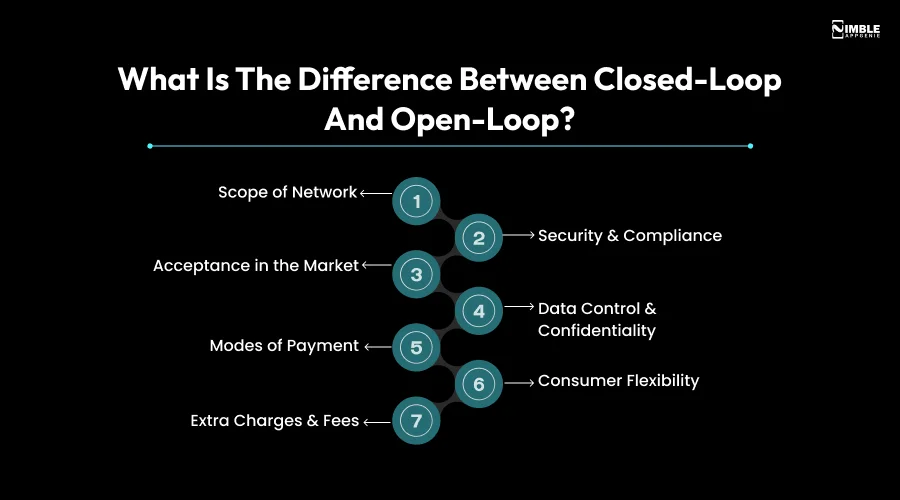
- Scope of Network: The scope of payment network usage in the transaction processing system.
- Security & Compliance: What’s needed to ensure proper eWallet security for everyone involved.
- Acceptance in the Market: How broadly the payment system is accepted.
- Data Control & Confidentiality: Who controls access to transaction data, and how.
- Modes of Payment: App, card, coupon, or another method.
- Consumer Flexibility: How easily customers can use the system every day.
- Extra Charges & Fees: The transaction costs tied to each system.
| Closed-Loop Payment System | Open-Loop Payment System | |
| Scope of Network | Restricted to a specific network or ecosystem. | Accepted across a wide range of networks. |
| Acceptance in the Market | Limited, dedicated to a single merchant. | Accepted among different merchants on the same shared network. |
| Security & Compliance | Smaller fraud exposure surface, limited to the merchant’s own security standards. | Broader fraud exposure, but backed by more sophisticated network-level fraud detection and compliance infrastructure. |
| Data Control & Confidentiality | Full control for the merchant, enabling detailed loyalty-program insight. | Less direct control, but maintains strong transparency standards. |
| Modes of Payment | A dedicated proprietary card or app, usable only within that one system. | Standard bank-issued cards, usable across multiple merchants. |
| Extra Charges & Fees | Comparatively lower transaction fees. | Higher transaction fees, since multiple entities (issuing bank, network, acquirer) are involved. |
| Consumer Flexibility | Customers may need to carry multiple separate payment modes. | A single card works across all participating merchants. |
| Settlement Speed | Instant — it’s just an internal ledger update within one business. | Authorization is instant, but formal settlement goes through separate interbank clearing. |

How Do You Choose a Payment System for Your Business?
Choose a payment system based on your customer reach, transaction costs, implementation requirements, level of control, security needs, and business model.
Open-loop systems are generally suited to broad payment acceptance, while closed-loop systems work well for controlled ecosystems such as branded wallets, gift cards, and loyalty programs. If you are still unsure, here is a step-by-step way to decide:
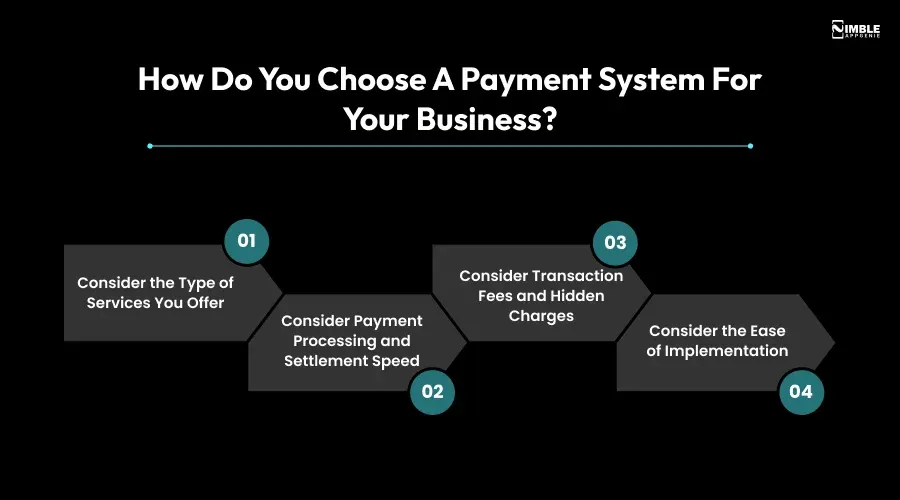
Step 1: Consider the Type of Services You Offer
If your business is based on a specific, repeat-visiting niche, closed-loop can work well. If you serve more new customers than repeat ones, open-loop is generally the best fit.
Step 2: Consider Payment Processing and Settlement Speed
A closed-loop transaction settles immediately, as it’s just an internal balance update within your system – no external bank is involved. An open-loop transaction also authorizes instantly, but formal transfer of funds between the customer’s bank and yours goes through a separate, slightly slower clearing process behind the scenes.
Step 3: Consider Transaction Fees and Hidden Charges
With a steady, loyal consumer base, a closed-loop system keeps transaction charges minimal since it is a merchant-exclusive arrangement. Open-loop transaction charges run higher as multiple external parties (issuing bank, card network, acquirer) all take a cut.
Step 4: Consider the Ease of Implementation
A custom closed-loop system needs to be built and your team trained to use it. An open-loop system generally only needs a payment terminal – the supporting financial institution handles the rest.
Beyond these four factors, flexibility, user experience, and security all deserve a closer look before you commit either way.

How Can Nimble AppGenie Help You Create a Seamless Payment Experience?
Nimble AppGenie builds tailored payment infrastructure for each model – open-loop, closed-loop, and hybrid – scoped to the client’s business requirements rather than a standard template.
With robust payment mechanisms and eWallet app development services, Nimble AppGenie has built 350+ solutions, including both closed-loop and open-loop payment systems to meet your requirements. Our developers deeply analyze your business needs and recommend the solution that genuinely fits, not the one that’s easiest to sell.
Conclusion
The core difference between closed-loop and open-loop payment systems is the environment they operate in – one is control and loyalty within your ecosystem; the other is reach and flexibility across everyone else’s.
Both models have real benefits and real tradeoffs. Whichever you choose, build the right eWallet app features from day one rather than retrofitting them after launch. Nimble AppGenie has shipped 350+ payment solutions across both models – the decision process above reflects the same scoping logic the team uses before recommending a direction to any client.

FAQs
Consider factors like business type, implementation requirements, transaction costs, scalability, and customer reach before choosing a payment system. Nimble AppGenie helps businesses evaluate these considerations when deciding between open-loop and closed-loop payment models.
A closed-loop system limits transactions to a specific business or ecosystem, while an open-loop system operates across shared payment networks and participating merchants. Closed-loop systems can also give businesses greater control over customer data and loyalty programs. Nimble AppGenie builds payment solutions around these different requirements, depending on the business model and use case.
The right choice depends on the business model and customer needs. Open-loop payments can be a practical option for businesses that want to accept widely used bank-issued cards; closed-loop payments can be useful for businesses focused on loyalty, stored value, or a controlled customer ecosystem. Nimble AppGenie can help businesses choose and develop the payment infrastructure that fits their specific requirements.
Yes. Businesses can accept open-loop payments for general purchases while offering a closed-loop gift card, loyalty wallet, or stored-value system alongside them. Nimble AppGenie can develop both payment models, allowing businesses to combine broad payment acceptance with their own branded payment ecosystem.
Not necessarily. Closed-loop systems have a more limited transaction environment, which can reduce certain forms of exposure, while established open-loop networks typically provide extensive fraud detection, authentication, and dispute-management infrastructure. Security depends on the payment system’s architecture, controls, and implementation. Nimble AppGenie can build payment solutions with security requirements considered across both open-loop and closed-loop models.

Niketan Sharma, CTO, Nimble AppGenie, is a tech enthusiast with more than a decade of experience in delivering high-value solutions that allow a brand to penetrate the market easily. With a strong hold on mobile app development, he is actively working to help businesses identify the potential of digital transformation by sharing insightful statistics, guides & blogs.