

 Free Consultation
 PCI-DSS Compliant
 GDPR Ready
 ISO 27001
 NDA Protected
 AI Services
 AI App Development
 Generative AI Development
 AI Chatbot Development
 AI Integration Services
 AI Consulting Services
 AI For Fintech
 AI Financial Assistant Solution
 AI Insurance Agent Development
 Tech Stack
 OpenAI / GPT-4
 Claude / Anthropic
 Gemini / Google AI
 Llama / Open Source
 LangChain / LlamaIndex
 Pinecone / Pgvector
 AWS / Azure AI


 Fintech Solution
 Core Fintech
 App Development
 Neobank Solutions
 eWallet Solutions
 Lending Software
 Banking Solutions
 BNPL Solutions
 BNPL Solutions
 Insurance App
 Wealth Management
 Crypto & DeFi
 Blockchain Development
  Payroll Software
 DeFi Solutions
 Crypto Wallet
 Crypto On/Off Ramp
 Crypto Exchange
 Trading Platform
 Payments
 Compliance
 Regulations & Compliance
 Fraud Detection
 Lending Ecosystem
 P2P Lending Platform
 Mortgage Software
 Engagement
 Fintech Outsourcing

 Mobile Development
 Mobile App Dev
 iOS App Development
 Android App Development
 React Native
 Flutter Development
 Web Solution
 Node.js Development
 React.js Development
 Angular Development
 App Services
 UI/UX Design
 App Maintenance
 By Stage
 MVP Development
 Industry Solutions
 Healthcare App Dev
 Education App Dev
 Travel App Dev
 Real Estate App Dev
 Logistics Software
 Social Media App

 Hire Mobile Developers
 Hire iPhone Developers
 Hire Android Developers
 Hire React Native Devs
 Hire Flutter Developers
 Hire Web Developers
 Hire Node.js Developers
 Hire Angular Developers
 Hire PHP Developers
 Hire Laravel Developers
 How It Works
 Pre-Vetted Developers
 Ready In 48 Hours
 NDA From Day One
 Replace Guarantee
 Company
 About Us
 Our Work Process
 Portfolio
 Case Studies
 Blog / Insights
 Careers
 Contact Us
 Awards
 Recognition


 Offices


Key Takeaways:
- Robinhood is the leading trading platform enabling users to create their own trading account and trade with even small capital.
- Fintech firms and enterprises can build an app like Robinhood by complying with the regulations, selecting the right features, designing for trust, and selecting an effective tech stack. Testing the app and then launching it.
- Increasing interest amount, growing financial knowledge, and earning revenue are the key reasons to invest in the app.
- Top features to include are account onboarding, order placement, security and fraud prevention, and portfolio management.
- The challenges to overcome are building trust, complying with regulations, and fees and charges complexity.
- Partnering with a leading company like Nimble AppGenie can help you transform your business idea into success.
As per the CTO of Nimble AppGenie, Stock trading should not be a privilege of extremely wealthy people; users with small capital should have a chance to trade and earn income.
That’s where the experts at Nimble AppGenie build an app like Robinhood for fintech startups and entrepreneurs who dare to enter the industry and create a revolution.
Robinhood has made history with over 1 crore downloads, encouraging people to trade even with small capital. And you can bring the next idea to make a stock trading app more user-friendly and extraordinary to match the growing AI era and the need of users to generate extra cash flow.
Here, most of the fintech startups and entrepreneurs often ask, “How to build an app like Robinhood?”
To build an app like Robinhood, you need to assess the objective of your app and target users’ needs, select the right design, select the tech stack, test, and then launch it with continuous maintenance.
The engineers at Nimble AppGenie know well how to develop an app like Robinhood to make the next revolution.
Hence, in this guide to create an app like Robinhood, we will walk you through the concept, features, reasons, steps, tech stack, the use of AI, challenges, and much more. It will help you get one step closer to your success.
Let’s get ahead with the complete guide on building a stock trading app like Robinhood.
What is a Robinhood App?
The Robinhood app is a mobile and web-based financial platform that lets people trade stocks, exchange-traded funds (EFTs), and cryptocurrencies without paying traditional commission fees.
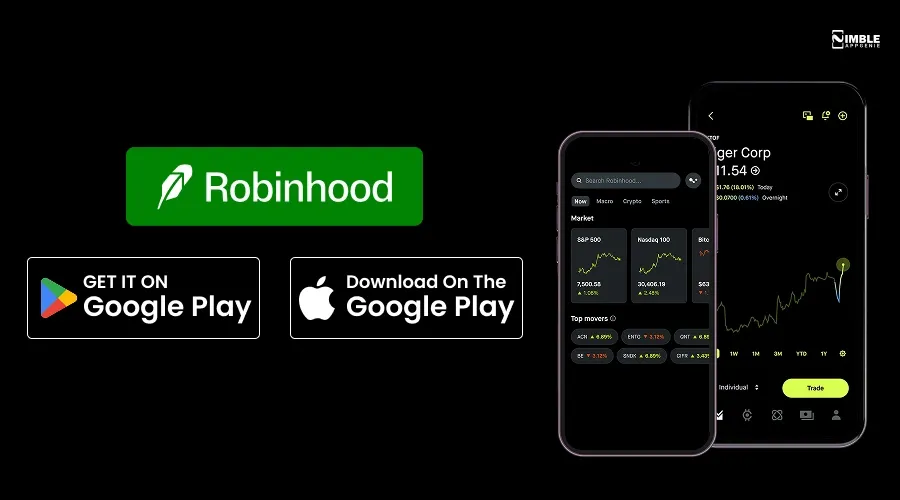
The app helps users to turn their money their way and identifies trends for their investing and trading strategies with technical indicators such as moving average, relative strength index, and more.
If you are not aware of how of does it works, let’s evaluate this too in the given section.
How Does a Robinhood App Work?
Before you know the development process to create an app like Robinhood, you should know how it works:
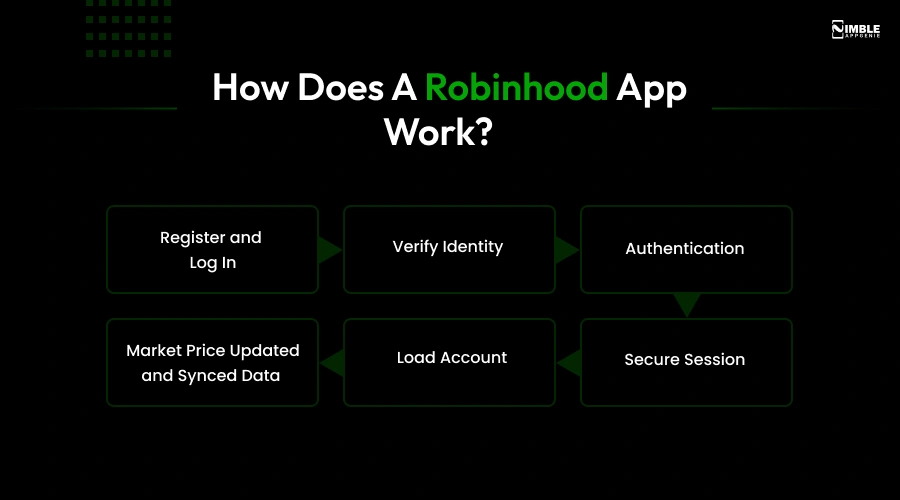
Step 1: Register and Log In
After downloading and installing the app, users register with their email address and phone number.
Step 2: Verify Identity
Now, users complete a two-factor authentication process by entering details and performing KYC.
Step 3: Authentication
The app validates the user’s login, and the account is created.
Step 4: Secure Session
Now a secure user session is created via encrypted transport layers and through token-based authentication.
Step 5: Load Account
The user loads or adds the details related to the bank account, or opens a demat account.
Step 6: Market Price Updated and Synced Data
At this step, the app displays the current price of stocks as per the current market data, and it is shown on the dashboard. Now, users can trade and invest as per their preferences.
Whether it’s about sending agents to the market, agentic trading, crypto trading, or the use of intuitive trading tools, Robinhood does it all.
Here, the app also offers technical analysis and uses tools to enable users to effectively carry out trades.
What’s the Need to Create a Stock Trading App Like Robinhood?
You should create a stock trading app like Robinhood because of the growing market and growing interest of users in having an additional source of income, and many more.
Let’s discover the complete list of reasons to build a stock trading app like Robinhood:
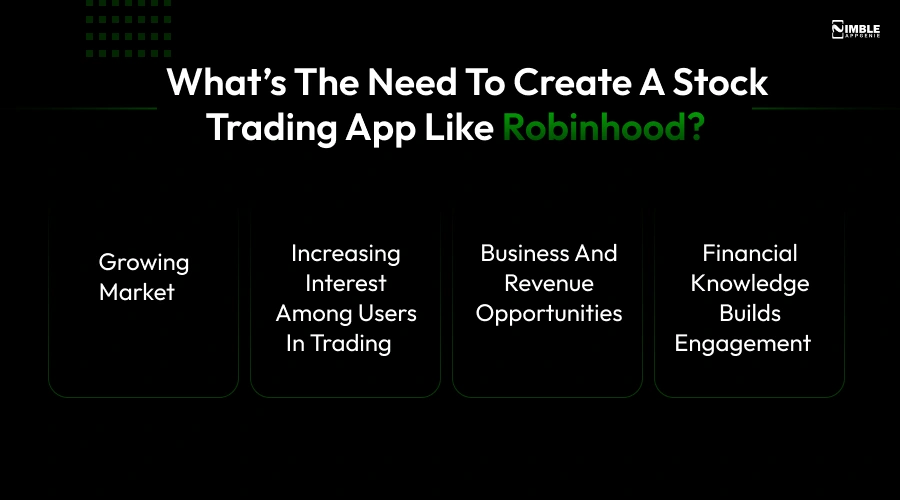
1. Growing Market
The global stock trading app market is projected to grow from $3.5 billion in 2025 to $6.0 billion by 2035. This growth is driven by growing smartphone penetration, rising interest in personal finance, and increasing user engagement in the financial markets.
However, the global online trading platform market size was valued at USD 10.82 billion in 2025 and is expected to grow to USD 18.50 billion by 2034, during the forecasted period.
But why is this growth estimated under market research?
Well, due to the increasing interest among users in trading.
2. Increasing Interest Among Users in Trading
The need and urge to earn an extra income is always within humans, and with the growing financial needs and inflation, trading is attracting many of the youths in the market.
People have high smartphone penetration; financial knowledge is not far from their reach; it just requires a few clicks.
Now, people want more control over their finance; they not only want to work themself, but they also want their money to work for them, rather than keeping it in their savings accounts.
What other reason do you want to build an app like Robinhood?
Revenue? Let’s have a look.
3. Business and Revenue Opportunities
The Robinhood market revenue for the quarter ending March 31, 2026, was $1.067B, which is 15.1% higher year over year. This is the major reason “why build an app like Robinhood only”
While Webull stands at a revenue of $0.6313B, the SoFi trading app income is reported as $167 million.
Also Read: “How to Develop an App Like WeBull?”
That’s why the developers of Nimble AppGenie are focusing on “how to develop a stock trading platform like Robinhood in 2026”.
4. Financial Knowledge Builds Engagement
Another important landscape is financial knowledge. As per the CTO of Nimble AppGenie, fintech firms might have the learnings of fintech, but to make it a practical application, you need to be in the market.
In this era of 2026, gaining financial knowledge is not far away; hence, you can create personal goals.
But “Is it too late to build a trading app like Robinhood?”
Well, “no,” as per the engineers at Nimble AppGenie, a leading fintech app development company in 2026; this is the right time. With the growing interest of users in trading and capital gains, it is not too late to create a trading app like Robinhood.
Now, let’s get ahead with the features to include in an app like Robinhood in the following section.
Features to Include in an App Like Robinhood
The key features to include in an app like Robinhood comprise:
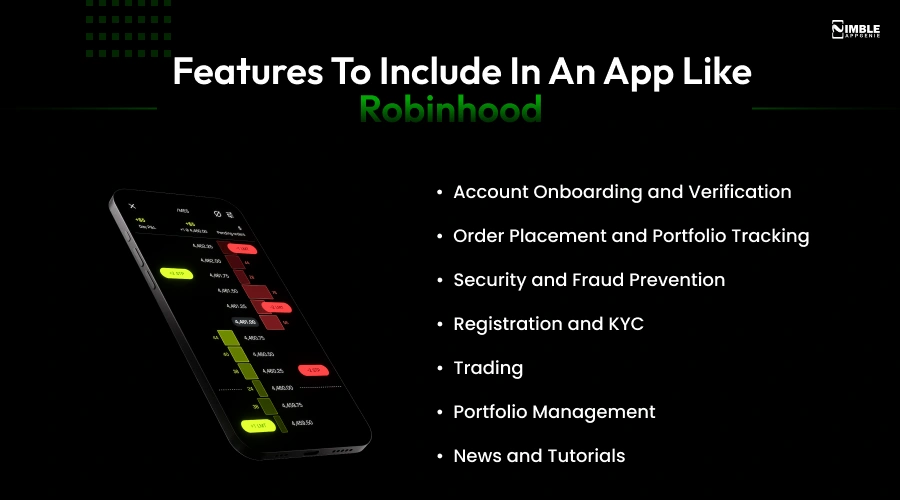
1] Account Onboarding and Verification
Account onboarding and verification is the process of registering new users and collecting their personal or business data, and further checking their identity.
2] Order Placement and Portfolio Tracking
The order placement and portfolio tracking in Robinhood covers order execution and monitoring capabilities in a unified trading dashboard.
3] Security and Fraud Prevention
The security and fraud prevention covers user authentication, real-time transaction monitoring, and data tokenization.
4] Registration and KYC
The registration and KYC (Know Your Customer) features cover the complete process of onboarding a user as well as verifying their legal identity.
5] Trading
The trading feature in an app like Robinhood covers order execution and multi-asset support. Trading acts as a bridge that connects user decisions to live financial exchanges.
6] Portfolio Management
Order replacement and portfolio tracking are the major and core features for a stock trading app like Robinhood.
7] News and Tutorials
The news and tutorial features for a trading platform like Robinhood comprise a financial digest and contextual asset-linked news feeds.
Now is the time to use these features and build an app like Robinhood.
How to Build an App Like Robinhood?
You can create a stock trading app by opting for a complete series of steps beginning with market research, adding features, selecting the design and tech stack, and then launching the app in the market.
Now, let’s get started with the steps to create an app like Robinhood:
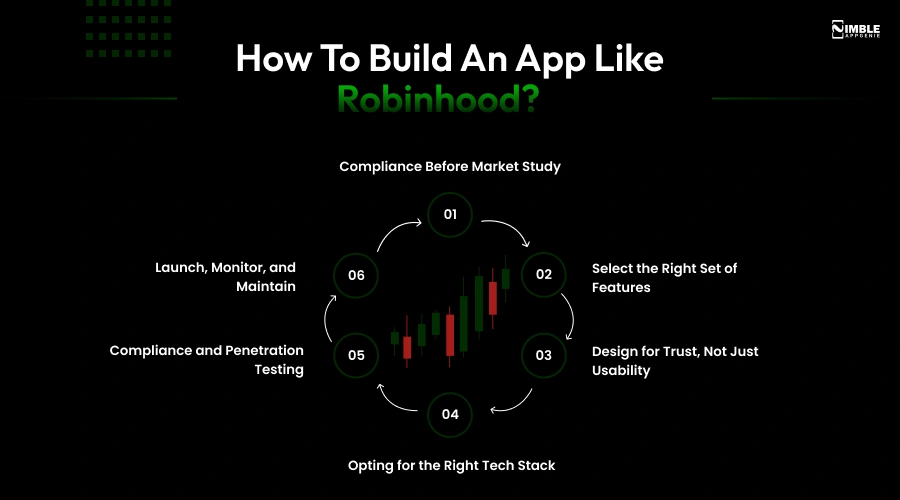
Step 1: Compliance Before Market Study
To create an app like Robinhood, you should first consider focusing on KYC/AML, data privacy, and payment security. Here, the key compliances comprises of PCI-DSS, GDPR, local privacy laws, and PSD2. This is the first step: build an app like Robinhood, where you should perform an in-depth study related to:
- What are the key compliance requirements for performing market research?
- What’s the purpose of your app?
- Who are your competitors in this field?
- What are your competitors doing?
- What are the expectations of the target audience with respect to your app?
If you are looking for a company that can help you to conduct the market research for you, the engineers at Nimble AppGenie are experts in this field.
Here, AI plays an important role by automating competitor tracking and predicting market trends, automating competitor tracking, and by analysing user review sentiment.
Step 2: Select the Right Set of Features
Now, you should select the right set of features such as real-time market data, solid portfolio management, security and compliance, and engagement and onboarding.
- Real-time market data
- Security and fraud prevention
- Registration and KYC
- Account onboarding and verification
After selecting the right features as per the requirements of the app like Robinhood, you should include the technical tools such as Apache Kafka, Alpaca, or Apex fintech.
Step 3: Design for Trust, Not Just Usability
Design the app based on your requirements. Here you should create a portfolio and wireframe, targeting:
- Simplicity, ease of use, and transparency
- Minimalistic layout
- Opt for universal color coding
- Include consistent language and brand consistency
- Biometric logging and low-latency pipelines
The app blends simple visual elements with a high-performance backend routing that makes investing look and feel approachable.
You can use AI to design a stock trading platform like Robinhood by enabling predictive market analysis, natural language interfaces, and via adaptive risk management.
Step 4: Opting for the Right Tech Stack
Now, in this step, you should opt for the right mobile app tech stack helpful to build an app like Robinhood.
Here is the list of tech stack to include for creating an app like Robinhood:
| Layer | Recommended Technologies |
| Frontend (Web) | React, Next.js, TypeScript |
| Mobile App | Flutter or React Native |
| Backend | Node.js (NestJS/Express) or Java (Spring Boot) |
| API | REST + GraphQL |
| Database | PostgreSQL, Redis |
| Real-Time Data | WebSockets, Apache Kafka |
| Authentication & Security | OAuth 2.0, JWT, MFA, Biometric Authentication |
| Cloud & Hosting | AWS (EC2, ECS, Lambda, S3, RDS) |
| Payments & Trading | Plaid, Stripe, Broker/Exchange APIs |
| DevOps & CI/CD | Docker, Kubernetes, GitHub Actions, Terraform |
| Monitoring & Analytics | Prometheus, Grafana, ELK Stack, Datadog |
| Notifications | Firebase Cloud Messaging (FCM), Twilio, SendGrid |
Here, AI plays an important role during architecture by speeding up design, improving safety, and saving money.
Step 5: Compliance and Penetration Testing
In this step, you should test the complete app following the right set of steps. Security and compliance are hard gates; you cannot launch without them. It comprises a multi-layered approach focusing on security, accuracy, and performance across the app. This is what you need to follow:
- Opt for functional testing.
- Performance and load testing.
- Enable security and compliance testing.
- Test for PCI-DSS and penetration testing.
To build an app like Robinhood, you should opt for real-time synchronisation and high-concurrency load handling, and strict regulatory compliance.
Additionally, you should opt for certifications such as ISO/IEC 27001, SOC 2 Type II, PCI DSS, and ISO/IEC 27701.
AI helps in compliance and penetration testing through prioritising risks and generating audit-ready evidence.
Step 6: Launch, Monitor, and Maintain
It’s time to launch your app like Robinhood on diversified platforms, including the App Store and Play Store. Here, you should track the client-side performance, real-time data pipelines, and the backend system using specialized observability tools.
This is what you need to do:
- Securing legal moats
- Mandatory onboarding plus
- Opting for mobile app maintenance
AI is transforming the launch, monitoring, and maintenance part through predictive maintenance and automated issue detection and resolution, and via real-time monitoring.
While building an app like Robinhood, you might come across different challenges to make an app like Robinhood.
In the next section, let’s examine such challenges.
Challenges to Make an App Like Robinhood
When you create a trading app, it comprises building security and trust among the users, complying with the regulations, understanding market volatility, and understanding fees as well as charges.
Here is the complete list of challenges to make an app like Robinhood:
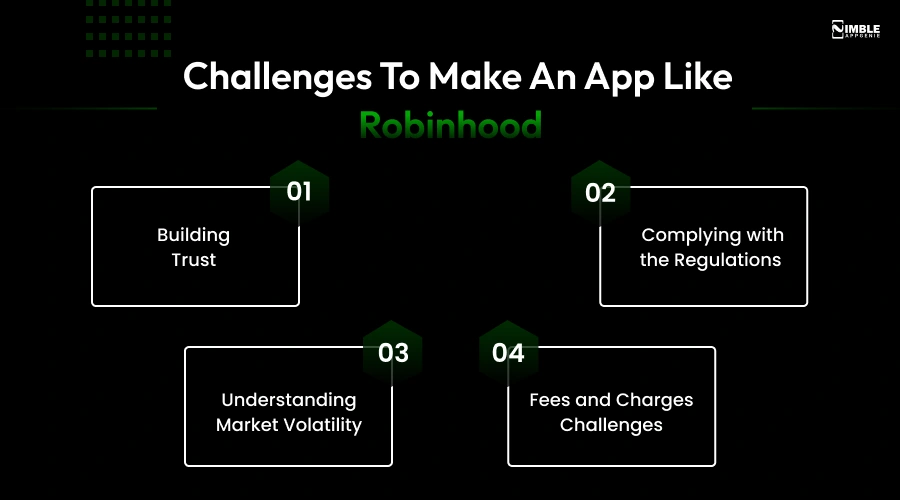
► Building Trust
When you launch your app like Robinhood in the market, in the beginning years, you will face issues related to building trust. You need to put in high resources to gain the users’ trust.
You might face challenges because financial apps handle users’ life savings, and the app requires sensitive information from users for its functionality.
► Complying with the Regulations
One of the major challenges that you should consider is complying with the regulations that require adherence to major financial authorities such as the SEC, KYC/AML, and FINRA.
You can face challenges related to government licensing, user verification, and gamification scrutiny. This mobile app challenge can be resolved by identifying and complying with fintech regulations.
► Understanding Market Volatility
The market is more volatile than you think; it is driven by uncertainty, economic laws, and investor feelings. In most of the cases, the higher volatility, the riskier the security.
In the securities market, volatility is associated with big price swings, for example, when the stock market rises and falls more than 1%. It is called a volatile market.
► Fees and Charges Challenges
Making the user understand the fee structure is a major challenge to creating an app like Robinhood. Here you need to make the users understand how the fees differ from time to time.
Here, one of the concerns is that the fees differ because matching a zero-commission model requires high user volume, alternative backend income sources, and expensive data infrastructure.
You can mitigate the challenges by following key practices such as:
- Opting for KYC/AML integration
- Adhering to the regional governing laws, such as SEC/FINRA
- Using technical analysis to understand market volatility
- Making the charges even to help users.
Now, going with the challenges, you might ask, what are the money-making policies to opt for creating an app like Robinhood?
Monetization strategies comprise subscription prices, payment for order flow, net interest income, interchange fees, and Robinhood Gold.
Another crucial question that many fintech startups and enterprises ask is “ What’s the cost to build an app like Robinhood?”
The overall cost varies based on different parameters such as the complexity of the app, third-party integrations, testing and quality assurance, third-party integrations, and backend development.
Let’s understand it all in depth in the following section.
What’s the Cost to Build an App Like Robinhood?
The cost to build an app like Robinhood varies from $30,000 to $100,000+. This cost varies depending on different factors such as the complexity of the app, the features of the app, compliance requirements for the trading app, and many other factors.
Here is the complete breakdown of how much it costs to build an app like Robinhood:
| Cost Factor | Estimated Cost (USD) | Impact on Cost |
| UI/UX Design | $3,000–$10,000 | Custom designs increase cost. |
| User Authentication & Security | $2,000–$8,000 | Advanced security raises costs. |
| Trading Engine & Order Management | $8,000–$25,000 | Core feature with high cost. |
| Portfolio & Watchlist Management | $3,000–$8,000 | Adds backend complexity. |
| Real-Time Market Data Integration | $3,000–$10,000 | Live APIs increase expenses. |
| Payment Gateway & Banking Integration | $2,000–$8,000 | Secure integrations add cost. |
| Backend Development & APIs | $5,000–$15,000 | Scalability affects pricing. |
| Admin Panel & Analytics | $2,000–$6,000 | Extra management features. |
| Testing, QA & Deployment | $2,000–$7,000 | Ensures app quality. |
| Maintenance & Support (Annual) | $3,000–$15,000+ | Ongoing operational cost. |
| Estimated Total Development Cost | $30,000–$100,000+ | Varies by scope and complexity. |
When it comes to the overall fintech app development cost, it typically ranges from $20,000 to $300,000, based on factors such as your type of software, complexity, and the skills of developers.
Now, let’s examine the monetization cost parameters in the following section.
How to Monetize an App Similar to Robinhood?
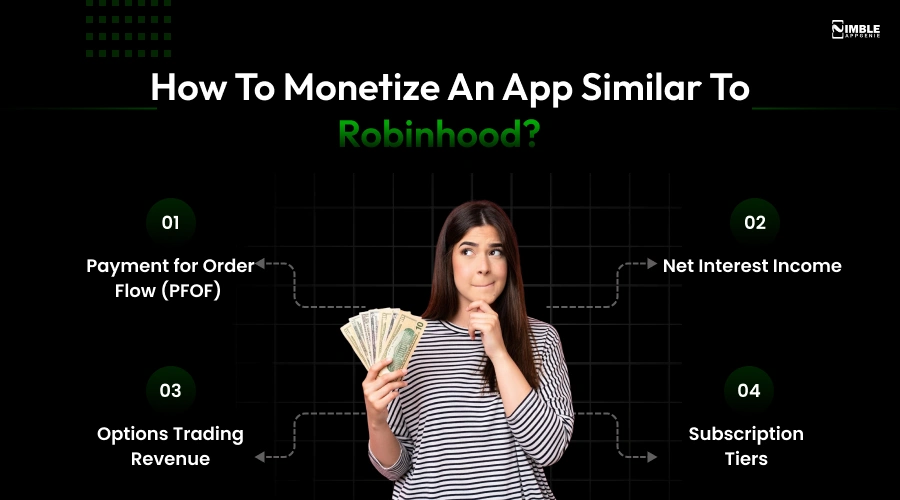
You can monetize an app like Robinhood through payment for order flow, net interest income, and many more.
Let’s examine the complete list of monetization strategies below:
-
Payment for Order Flow (PFOF)
It is a key monetization strategy because it allows retail brokerages to replace the traditional, user-facing trading commissions with a massive and high- revenue stream.
It is a compensation that the broker receives for directing orders; hence, your app can receive a complete commission for directing fractional orders.
-
Net Interest Income
Net interest income is the key money-making source where the trading app earns interest on user cash balances and margin loss, minus any interest paid out to the customers.
Your app can earn the complete interest income that represents the interest payments your app might receive on every trade or transaction. This is the recurring income of trading apps like Robinhood.
-
Options Trading Revenue
Another revenue-earning source for the app, like Robinhood. The biggest single contributor to revenue for Robinhood in one quarter alone is options trading.
This is the largest revenue due to wider bid-ask spreads, high retail trading volume, and lucrative payments for the order flow.
-
Subscription Tiers
You can charge a monthly fee for upgraded features like professional research, higher instant deposits, and even lower margin rates.
It is a key strategy for trading apps that provides predictable monthly revenue and offsets free basic trades. This is a key money-making model for fintech apps.
Why Partner with Nimble AppGenie to Create an App Like Robinhood?
You should partner with Nimble AppGenie to build an app like Robinhood because, as a fintech expert, we offer end-to-end fintech software solutions for every startup, bank, fintech, and enterprise.
The key services that our team provides are eWallet development, crypto app development, payment software development, and lending software development.
Here’s why you need to partner with Nimble AppGenie:
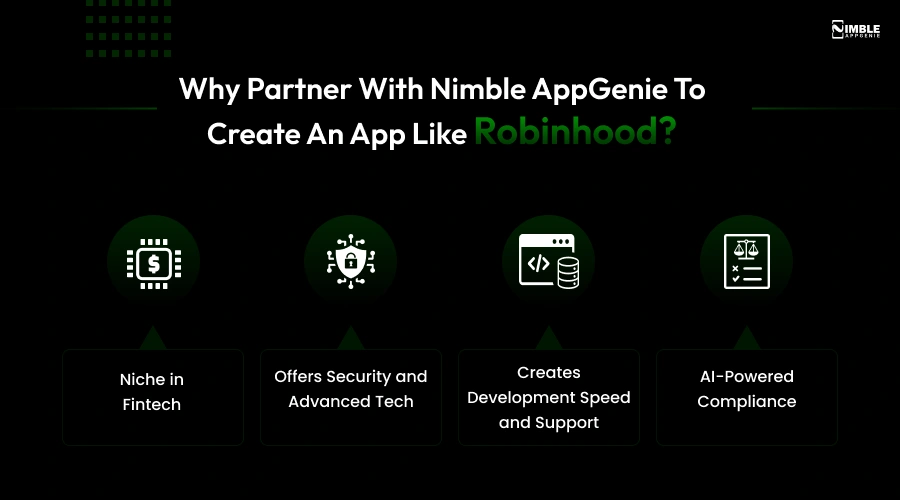
1. Niche in Fintech
Nimble AppGenie offers diversified services including investment and wealth, crypto & DeFi, lending ecosystem, and offers compliance and intelligence services.
2. Offers Security and Advanced Tech
The team of Nimble AppGenie offers PCI-DSS-compliant, GDPR ready compliances, ISO 27001, and offers a certificate of NDA after handling fintech software to the business.
3. Creates Development Speed and Support
The experts at Nimble AppGenie offer full-stack fintech services and offer complete speed and support through end-to-end product lifecycles and AI-assisted automation, along with modular cloud architecture.
4. AI-Powered Compliance
Nimble AppGenie is the top AI app development company offering wide services through AI integration, backend engineering, and by offering ready-to-deploy workflows. We offer diversified services, including AI app UI/UX services, maintenance and support, and by offering API development.
Conclusion
Robinhood is among the top trading apps that offer a competitive platform to users for trading and using their own money to trade. Over this platform, users can trade in equity, options, and even in cryptocurrencies.
With the growing demand for Robinhood-like apps, it’s a great opportunity to build one. Startups and fintech businesses should begin with market research and, by following the compliance requirements, can launch the app in the competitive marketplace.
The key strategies to monetize the app include payment for order flow, net interest income, subscription tiers, and options trading revenue. You can partner with a leading company, such as Nimble AppGenie, to make your app a reality.
FAQs
A Robinhood app is a mobile and web-based trading platform that lets users trade stocks, ETFs, and cryptocurrencies without paying traditional commission fees.
The stock trading app market is projected to grow from $3.5 billion in 2025 to $6.0 billion by 2035, driven by rising smartphone use and growing user interest in earning extra income through trading.
Core features include account onboarding and KYC verification, real-time order placement and portfolio tracking, multi-asset trading, and built-in security and fraud prevention.
They earn through payment for order flow, net interest income on cash and margin balances, options trading revenue, and premium subscription tiers like Robinhood Gold.
The main challenges are earning user trust with sensitive financial data, meeting SEC/FINRA/KYC-AML compliance, navigating market volatility, and structuring transparent fees.
The cost to build an app like Robinhood can vary between $30,000 and $100,000+. This cost can further vary depending on different factors such as features, complexity of the app, design, compliance, platform devices, testing, ongoing maintenance, and updates.
Nimble AppGenie offers end-to-end fintech development, including compliance-ready architecture (PCI-DSS, ISO 27001, GDPR), AI-powered engineering, and full-stack support from MVP to enterprise scale.

Niketan Sharma, CTO, Nimble AppGenie, is a tech enthusiast with more than a decade of experience in delivering high-value solutions that allow a brand to penetrate the market easily. With a strong hold on mobile app development, he is actively working to help businesses identify the potential of digital transformation by sharing insightful statistics, guides & blogs.
Table of Contents




No Comments
Comments are closed.