

 Free Consultation
 PCI-DSS Compliant
 GDPR Ready
 ISO 27001
 NDA Protected
 AI Services
 AI App Development
 Generative AI Development
 AI Chatbot Development
 AI Integration Services
 AI Consulting Services
 AI For Fintech
 AI Financial Assistant Solution
 AI Insurance Agent Development
 Tech Stack
 OpenAI / GPT-4
 Claude / Anthropic
 Gemini / Google AI
 Llama / Open Source
 LangChain / LlamaIndex
 Pinecone / Pgvector
 AWS / Azure AI


 Fintech Solution
 Core Fintech
 App Development
 Neobank Solutions
 eWallet Solutions
 Lending Software
 Banking Solutions
 BNPL Solutions
 BNPL Solutions
 Insurance App
 Wealth Management
 Crypto & DeFi
 Blockchain Development
  Payroll Software
 DeFi Solutions
 Crypto Wallet
 Crypto On/Off Ramp
 Crypto Exchange
 Trading Platform
 Payments
 Compliance
 Regulations & Compliance
 Fraud Detection
 Lending Ecosystem
 P2P Lending Platform
 Mortgage Software
 Engagement
 Fintech Outsourcing

 Mobile Development
 Mobile App Dev
 iOS App Development
 Android App Development
 React Native
 Flutter Development
 Web Solution
 Node.js Development
 React.js Development
 Angular Development
 App Services
 UI/UX Design
 App Maintenance
 By Stage
 MVP Development
 Industry Solutions
 Healthcare App Dev
 Education App Dev
 Travel App Dev
 Real Estate App Dev
 Logistics Software
 Social Media App

 Hire Mobile Developers
 Hire iPhone Developers
 Hire Android Developers
 Hire React Native Devs
 Hire Flutter Developers
 Hire Web Developers
 Hire Node.js Developers
 Hire Angular Developers
 Hire PHP Developers
 Hire Laravel Developers
 How It Works
 Pre-Vetted Developers
 Ready In 48 Hours
 NDA From Day One
 Replace Guarantee
 Company
 About Us
 Our Work Process
 Portfolio
 Case Studies
 Blog / Insights
 Careers
 Contact Us
 Awards
 Recognition


 Offices



Key Takeaways:
- Serverless architecture lets fintech teams run code without managing servers – you only pay for what runs.
- It cuts infrastructure costs and lets apps scale automatically during payment or trading spikes.
- Banks and fintech apps use it for fraud detection, payment processing, KYC checks, and lending decisions.
- It’s not right for every workload – long-running jobs and ultra-low-latency trading still need dedicated servers.
- Nimble AppGenie helps fintech companies design, build, and secure serverless architecture that fits their compliance needs and budget.
“Is serverless architecture good for fintech apps?” CTOs and fintech founders building lending, banking, and payment products usually ask such questions among the most searched.
Serverless architecture eliminates the need to manage servers, allowing fintech teams to focus on features rather than infrastructure. Here is what it actually means for your business, where it works, and where it doesn’t.
In this plain-English guide, Nimble AppGenie‘s expert breaks down real fintech use cases, benefits, how to decide if serverless is right for your next development, and how banks, neobanks, and payment platforms use serverless architecture to cut costs, ship faster, and scale without touching a single server.
| Reviewed by the Nimble AppGenie Cloud & Fintech Engineering Team – architects who have built serverless payment, lending, and wallet backends for banks and fintech startups. |
What is Serverless Architecture?
Serverless architecture is a cloud model where you write and deploy code, and the cloud provider runs it only when needed. Still, there’s a server involved, but you don’t manage it. AWS, Microsoft Azure, and Google handle provisioning, scaling, and patching for you.
Your code runs as small, independent functions that respond to events. A payment gets submitted, a function processes it. A user uploads a document, a function scans it. When there’s no event, nothing runs, and you pay nothing for idle time.
This matters for fintech because financial traffic is rarely steady. A lending app may witness a burst of applications on payday and near silence overnight. Serverless architecture scales for both without you having to touch a config file.
Serverless vs. Traditional Server Architecture
The chief difference between server and serverless architecture comes down to who owns the operational work.
| Traditional Server Architecture | Serverless Architecture |
| You provision and pay for servers 24/7, even when idle | You pay only when your code actually runs |
| Your team patches, monitors, and scales infrastructure | The cloud provider handles scaling and patching |
| Scaling for traffic spikes needs manual planning | Scales automatically, function by function |
| Better for constant, predictable, high-volume workloads | Better for event-driven, bursty, or unpredictable workloads |
Neither model is universally “better”. Most mature fintech platforms end up running a mix, which Nimble AppGenie’s fintech team will cover below.
Why Fintech Companies Are Adopting Serverless Architecture
Fintech runs on uncertain, high-stakes traffic – a market event, a fraud spike, and a viral BNPL promotion. Traditional infrastructure means paying for peak capability all year to survive one busy week. Serverless architecture flips that math.
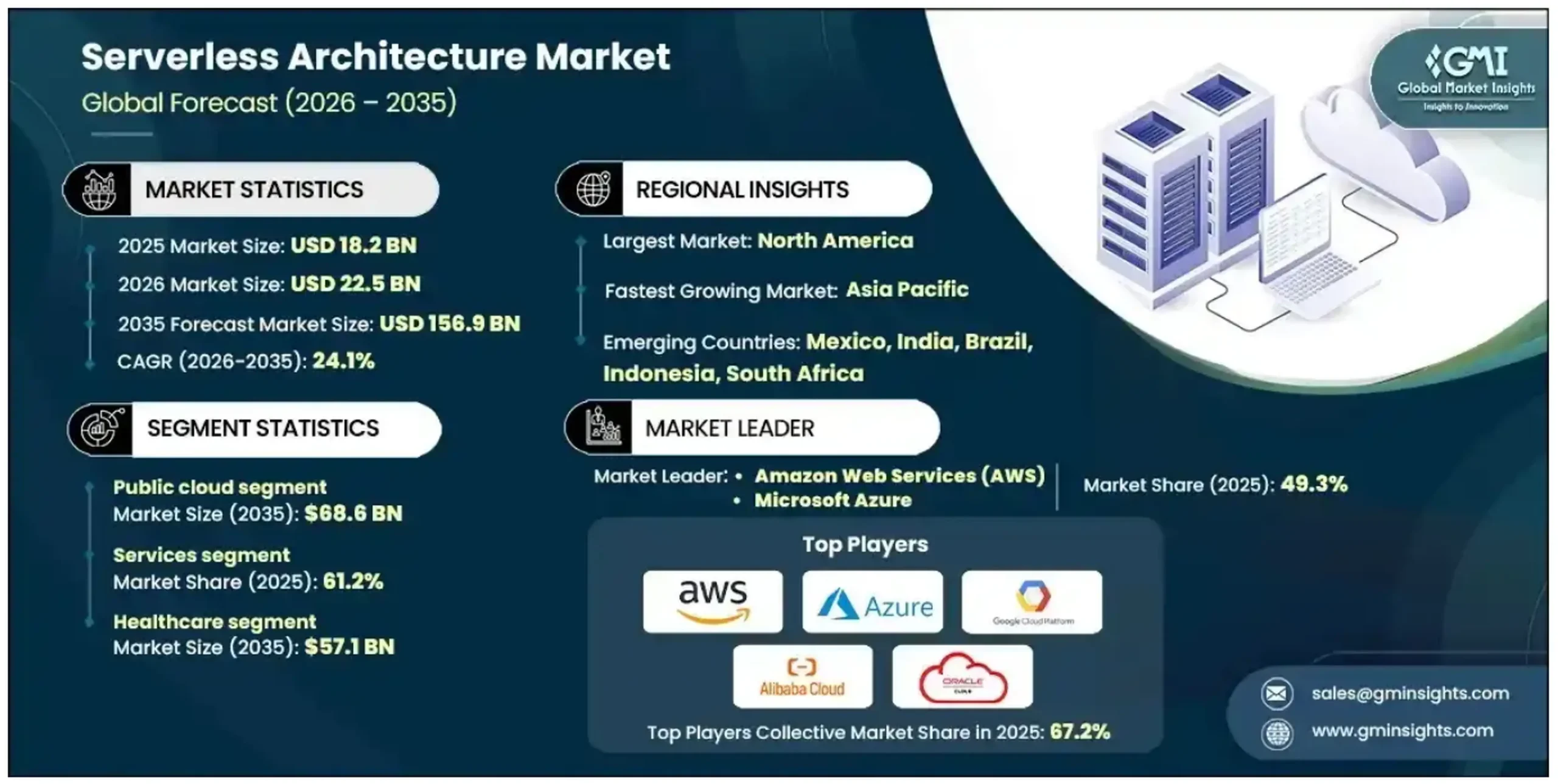
- The global serverless architecture market was valued at $18.2 billion in 2025 and is expected to reach $156.9 billion by 2035, growing at a 24.1% CAGR, driven largely by cloud-native and event-driven adoption in finance and other data-heavy industries.
Source: Global Market Insights
- A CIO.com analysis found serverless computing can cut infrastructure costs by roughly 35%, lift developer productivity by 25%, and shrink time-to-market by 15% for financial services firms moving off legacy, on-prem systems.
Source: CIO.com
Regulation is a second driver. Compliance frameworks like PCI DSS and SOC 2 already push fintech teams toward cloud-native, well-monitored infrastructure – serverless platforms come with much of that logging and access control built in, out of the box.
Pros and Cons of Serverless Architecture in Fintech
Let’s get deeper to learn the key benefits of serverless architecture in fintech, followed by the cons:
➤ Pros of Serverless Architecture in Fintech
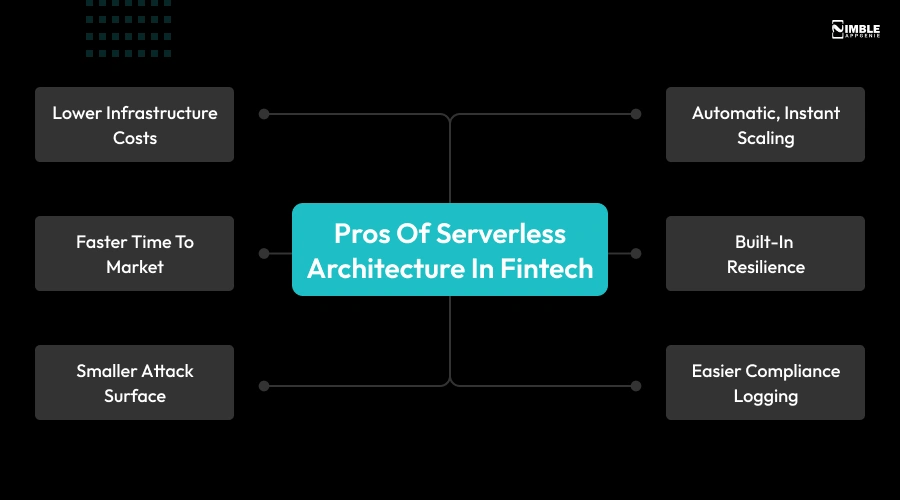
1. Lower Infrastructure Costs
You pay per execution, not per server-hour. For a fintech app with uneven traffic, this alone can significantly cut cloud expenses compared to always-on servers sized for peak load.
2. Faster Time to Market
Developers ship features without managing infrastructure. New payment flows, KYC steps, and fraud rules can go live in days rather than weeks.
3. Smaller Attack Surface
With no persistent servers to patch, there are fewer long-lived targets for attackers – though your code and configuration should still be secured carefully (more on this below)
4. Automatic, Instant Scaling
When transaction volumes spike – a flash sale, payday, or a market swing – functions scale out immediately. No war-room scramble to add capacity.
5. Built-in Resilience
Functions run in isolated, managed environments across multiple availability zones. One failing component doesn’t take down the entire app.
6. Easier Compliance Logging
Cloud providers log each function invocation by default, which helps fintech teams build the audit trails regulators expect for PCI DSS, GDPR, and SOC 2 reviews.
After covering the pros in detail, let’s know the cons that the benefits pages don’t always tell you: the real trade-offs.
➤ Cons of Serverless Architecture in Fintech
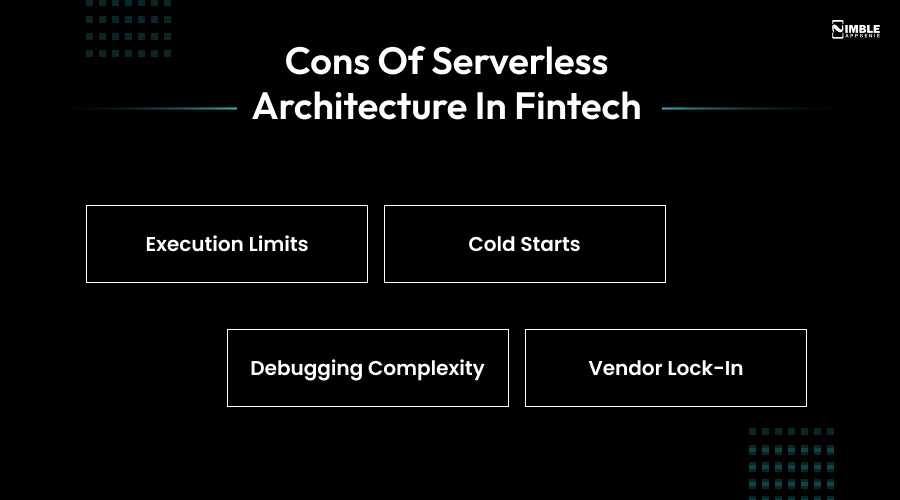
1. Execution Limits
Most platforms cap function run-time, so long processes need a distinct approach.
2. Cold Starts
A function that hasn’t run recently can take a moment to “wake up,” adding latency.
3. Debugging Complexity
Tracing an issue across various small functions takes the right tooling and experience.
4. Vendor Lock-In
Functions are usually tightly tied to one cloud provider’s tools.
Real-World Fintech Use Cases of Serverless Architecture
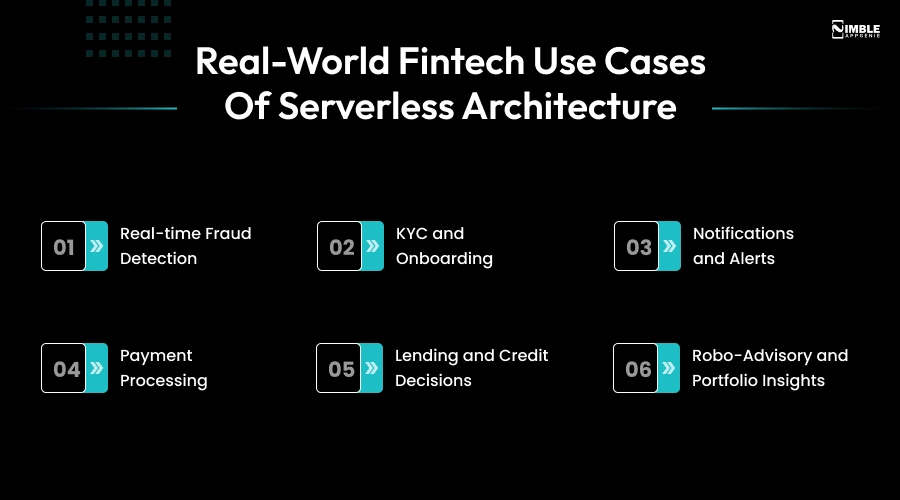
1. Real-time Fraud Detection
A function analyzes transactions the moment they occur, flagging unusual patterns instantly, instead of in a nightly batch job.
2. KYC and Onboarding
Document uploads trigger functions that run identity checks, route flagged cases to human review, and verify data against third-party APIs.
3. Notifications and Alerts
Balance alerts, payment confirmations, and fraud warnings are classic event-driven jobs -exactly what serverless was created for.
4. Payment Processing
A function validates, processes, and logs a payment in milliseconds, then scales down to zero the second the transaction is done.
5. Lending and Credit Decisions
Loan applications trigger a chain of functions that handle risk models, pull credit data, and return a decision in seconds without a dedicated server sitting idle between applications.
6. Robo-Advisory and Portfolio Insights
Functions can run scheduled or triggered analysis on market data and portfolios, delivering recommendations without a consistently running compute cluster.
| Serverless computing streamlines payment processing by providing low-latency environments – a function can validate, process, and log a transaction in milliseconds. |
Explore Lending Software Development →
See Fintech API Integration Services →

Fintech Companies Adopting Serverless Architecture
Chime, the mobile-first challenger bank, runs its backend on serverless functions through AWS Lambda despite managing its own servers – a big part of how it stays lean while scaling to millions of users.
Many neobanks and payment platforms follow a similar pattern: serverless functions for event-driven tasks like notifications, fraud checks, and onboarding, and microservices for structure.
This adoption is part of a wider cloud shift. About 64% of US enterprises have implemented serverless platforms in some form, and almost 49% report boosted developer productivity after adoption.
Source: SNS Insider
Real-world Example:
FICO Runs Loan Decisions on Serverless
FICO, the company behind widely used credit-scoring and decision-management software, runs its Decision Management Suite entirely on AWS Lambda. When a loan application comes in, it moves through an API gateway, triggers a Lambda function to execute the decision, then triggers a second function to update the data store with no servers provisioned in between. Moving off its previous on-premises setup allows FICO to cut operational costs and spend less time on infrastructure management.
Source: AWS – FICO Lambda Case Study
Serverless Architecture vs. Microservices in Fintech
These two terms get confused often, but they answer different questions.
Microservices is about how you split an application into independent, single-purpose services. Serverless is about how those services run.
Nimble AppGenie’s experts clear it up below:
| Serverless Architecture | Microservices Architecture |
| Functions run on-demand, billed per execution | Services run continuously on containers or servers |
| Scaling and infrastructure fully managed by the cloud provider | Your team manages scaling, deployment, and orchestration |
| Best for event-driven, bursty tasks | Best for complex, always-on business logic |
| Execution time capped (usually 15 minutes) | No execution time limit |
In practice, most fintech platforms use both: microservices for core banking logic that should run consistently, and serverless functions for event-driven jobs layered around them.
When Should Fintech Companies Use Serverless Architecture?
Good Fit: Payment webhooks, fraud detection and notifications, KYC document processing, and MVP launches where speed to market matters more than fine-grained infrastructure control.
Think Twice: High-frequency trading engines demanding sub-millisecond, always-on execution; workloads that run constantly at predictable high volume (where dedicated servers can be cheaper); long-running batch jobs over the platform’s time limit.
How to Build Serverless Architecture for a Fintech App
Let’s now understand the steps to build serverless architecture for a fintech app:
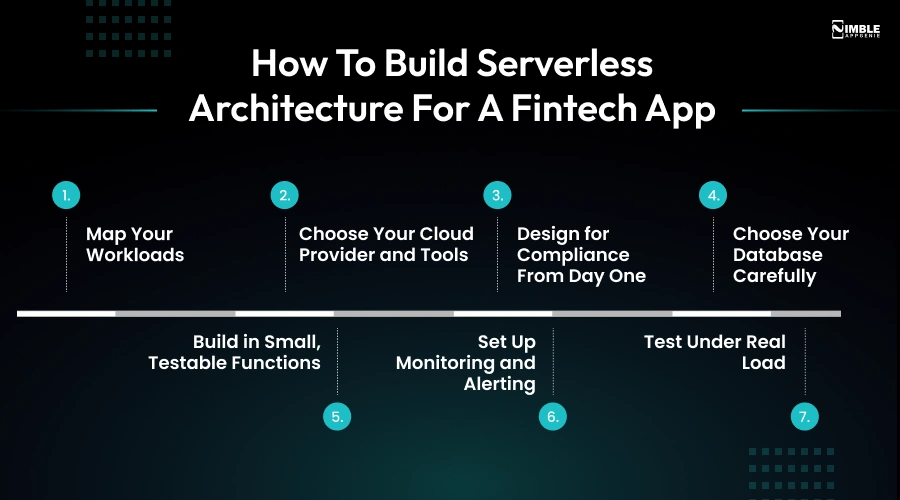
1. Map Your Workloads
List which parts of your app are event-driven (payments, KYC, alerts) versus continuous (core ledger logic).
2. Choose Your Cloud Provider and Tools
Azure Functions, AWS, and Google Cloud Functions are the main options, each with distinct pricing and integrations.
3. Design for Compliance From Day One
Build encryption, audit logging, and access controls into the architecture, not as an afterthought.
4. Choose Your Database Carefully
Serverless functions pair best with managed, auto-scaling databases (like Aurora Serverless or DynamoDB). So, your data layer doesn’t become the bottleneck.
5. Build in Small, Testable Functions
Each function should perform one job well, making it seamless to monitor, secure, and debug.
6. Set Up Monitoring and Alerting
Track cold starts, execution costs, and error rates from the start, not after something breaks.
7. Test Under Real Load
Simulate transaction spikes before launch so scaling behavior is verified, not assumed.
Read: Fintech App Architecture Guide →
Read: Web Application Architecture Explained →
Read: Building a Secure Fintech App →
Build Your Serverless Fintech Architecture with Nimble AppGenie
Nimble AppGenie designs and builds fintech applications on secure, scalable serverless architecture, from BNPL platforms and digital wallets to lending engines and neobank backends.
Our team plans the architecture, picks the right cloud stack, and builds in compliance from the first sprint, so you are not retrofitting security later.
♦ What We Build
Custom serverless backends for lending, payments, banking apps, and wallets.
♦ Compliance
PCI DSS, data protection, and KYC standards built into the architecture.
♦ Stack
Azure Functions, AWS Lambda, and serverless databases matched to your workload.
♦ Outcome
Lower cloud spend, faster releases, and infrastructure that scales with you.
If you are evaluating serverless architecture for a new fintech product or planning to migrate an existing one, our fintech app development team can map the right approach for your budget and compliance requirements.

Conclusion
Is serverless architecture right for your fintech product? Serverless architecture won’t fit every workload, but for most fintech products – fraud detection, payment processing, lending decisions, notifications, and KYC – it cuts costs, paces releases, and scales without the operational weight of handling servers.
The right move is rarely “all serverless” or “no serverless”. It’s knowing which parts of your app benefit from it and creating an architecture that mixes both where it makes sense.
FAQs

Niketan Sharma, CTO, Nimble AppGenie, is a tech enthusiast with more than a decade of experience in delivering high-value solutions that allow a brand to penetrate the market easily. With a strong hold on mobile app development, he is actively working to help businesses identify the potential of digital transformation by sharing insightful statistics, guides & blogs.
Table of Contents




No Comments
Comments are closed.