

 Free Consultation
 PCI-DSS Compliant
 GDPR Ready
 ISO 27001
 NDA Protected
 AI Services
 AI App Development
 Generative AI Development
 AI Chatbot Development
 AI Integration Services
 AI Consulting Services
 AI For Fintech
 AI Financial Assistant Solution
 AI Insurance Agent Development
 Tech Stack
 OpenAI / GPT-4
 Claude / Anthropic
 Gemini / Google AI
 Llama / Open Source
 LangChain / LlamaIndex
 Pinecone / Pgvector
 AWS / Azure AI


 Fintech Solution
 Core Fintech
 App Development
 Neobank Solutions
 eWallet Solutions
 Lending Software
 Banking Solutions
 BNPL Solutions
 BNPL Solutions
 Insurance App
 Wealth Management
 Crypto & DeFi
 Blockchain Development
  Payroll Software
 DeFi Solutions
 Crypto Wallet
 Crypto On/Off Ramp
 Crypto Exchange
 Trading Platform
 Payments
 Compliance
 Regulations & Compliance
 Fraud Detection
 Lending Ecosystem
 P2P Lending Platform
 Mortgage Software
 Engagement
 Fintech Outsourcing

 Mobile Development
 Mobile App Dev
 iOS App Development
 Android App Development
 React Native
 Flutter Development
 Web Solution
 Node.js Development
 React.js Development
 Angular Development
 App Services
 UI/UX Design
 App Maintenance
 By Stage
 MVP Development
 Industry Solutions
 Healthcare App Dev
 Education App Dev
 Travel App Dev
 Real Estate App Dev
 Logistics Software
 Social Media App

 Hire Mobile Developers
 Hire iPhone Developers
 Hire Android Developers
 Hire React Native Devs
 Hire Flutter Developers
 Hire Web Developers
 Hire Node.js Developers
 Hire Angular Developers
 Hire PHP Developers
 Hire Laravel Developers
 How It Works
 Pre-Vetted Developers
 Ready In 48 Hours
 NDA From Day One
 Replace Guarantee
 Company
 About Us
 Our Work Process
 Portfolio
 Case Studies
 Blog / Insights
 Careers
 Contact Us
 Awards
 Recognition


 Offices



In a Nutshell:
- Competitor analysis helps identify market gaps and build a strong app strategy.
- Understanding user behavior and feedback ensures a user-centric approach.
- Benchmarking competitors improves positioning and performance decisions.
- Techniques like SWOT and Michael Porter frameworks strengthen analysis.
- The process of mobile app competitor analysis includes profiling competitors, market analysis, positioning, features, UX, monetization, and marketing evaluation.
- Nimble AppGenie helps deliver expert insights and can perform a complete market app competitor analysis for your project.
Considering starting a venture with a mobile app?
Well, the first and foremost step to select here is performing a complete mobile app competitor analysis.
This is all about going through a complete process that starts with profiling the current competition, performing market analysis, analysing app positioning, calculating the monetization techniques, and using the right competitor analysis tools.
It can help you as a business analyst and investor to frame a complete report of results and then make decisions for planning behalf of this result.
But, there are several other elements that you should know along with the steps to mobile app competitor analysis, such as analyzing the key techniques to perform competitive analysis, and timings.
Worry not!
In this guide to mobile app competitor analysis, we have covered it all, from steps to techniques.
Now, let’s begin without any delay.
What is a Competitive Analysis in Terms of Mobile Apps?
A competitive analysis for the mobile apps can be determined as a complete strategic analysis of your competitors, their strengths and weaknesses, marketing tactics, as well as their position in the market.
Think of it as the first domino that sets everything in motion when you step ahead to convert your idea into reality.
The key components of competitive analysis are the identification of your competitors, the evaluation of products and services, and performing a SWOT analysis.
To create a mobile app, it is essential to first conduct a complete market analysis of your prospective app. This will help you to identify the target audiences, their changing behavior, and the market gap. And competitive analysis is a small part of this whole market analysis for building an integrated app with strategic planning.
Why Perform a Mobile App Competitor Analysis?
The key reasons to perform a complete market analysis are that it helps to understand and identify the market gaps, user expectations, and is even helpful to evaluate your business mistakes.
| Michael Porter: “ The essence of strategy is choosing what not to do.” |
You should well understand that the purpose of competitor analysis is all about defining the boundaries as it is related to tracking rivals.
There are several reasons to conduct a complete competitor analysis:
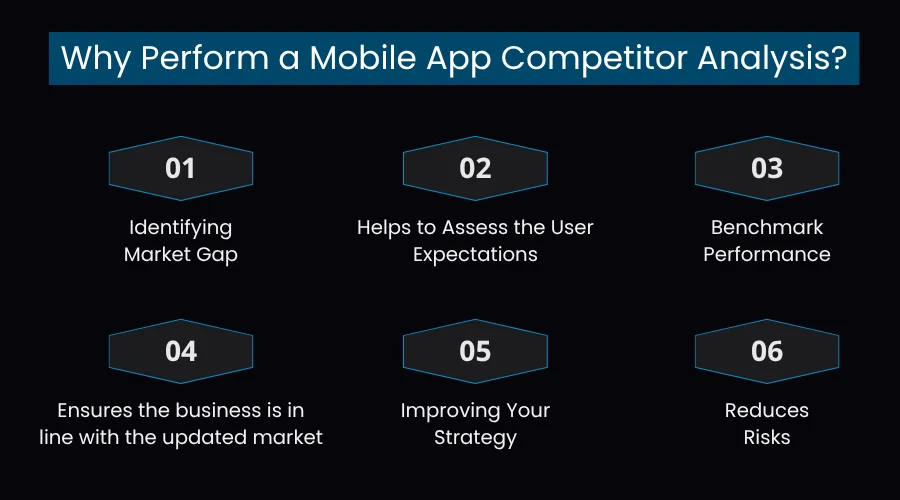
► Identifying Market Gap
When you perform a complete competitor analysis, you get to know about the current demand in the market and what your competitors are failing to fulfill.
Hence, it helps you to explore the current requirements of your business through identifying what the users are currently seeking as a product to resolve their problems.
► Helps to Assess the User Expectations
It is all about shifting your view from marketing to a user-centric approach. Here, you should ensure that your marketing strategies, messages, and customer service interactions are transparent.
With the help of competitor analysis, you can identify the prospective needs of your customers and can evaluate what they are actually looking for to resolve their issues.
► Benchmark Performance
Benchmarking performance in the competitor analysis is all about identifying your position and rank in comparison to the competitors.
The key aspects of the benchmarking are metric-driven comparison, goal setting, and identifying the gaps that exist in the present market.
► Keeps Your Business Market-Ready
If you already own a business and avoid market updates, then this can bring sustainability issues for your app. It further helps to track evolving customer expectations, and your product is capable enough to fulfill them.
When you perform a complete competitor analysis, it helps you to assess your position in this competitive landscape.
► Improving Your Strategy
Along with identifying the market gaps, performing mobile app competitor analysis can assist in improving your mobile strategy by analysing faults and mistakes.
This step can assist you in performing a SWOT analysis and identifying key rivals. Here, you can evaluate your business’s strengths and weaknesses and further plan your strategy accordingly.
► Reduces Risks
Through competitor analysis, you can evaluate what are the prospective risks that might impact your business sustainability.
Via mobile app competitors analysis, you can estimate the next move of competitors and can change your business strategy accordingly.
Now, as you are aware of competitor analysis, let’s get ahead with how to perform a complete competitor analysis for your mobile app.

How to Perform Competitor Analysis For Your Mobile App?
You can conduct a complete competitor analysis for your targeted mobile app by following a dedicated process.
Let’s check out the steps below:
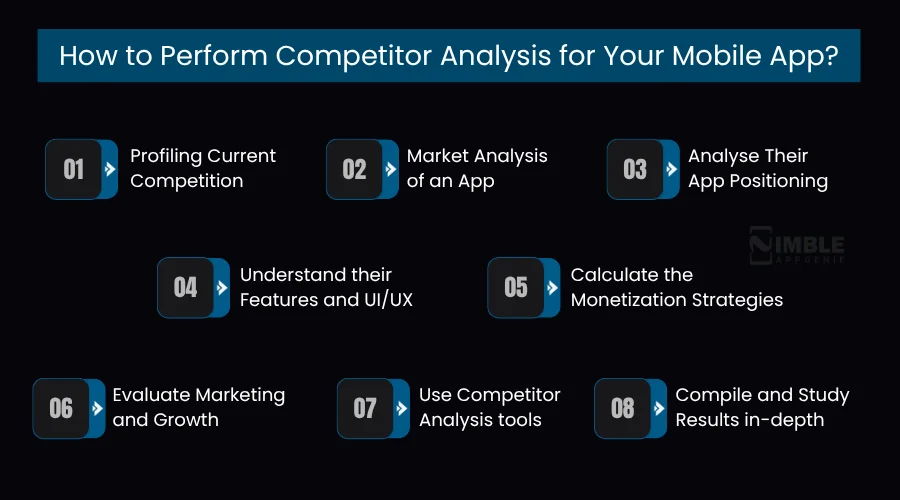
1. Profiling Current Competition
This is your first step towards mobile app competition analysis and systematically gathering, analyzing, and recording key details about the market rivals for understanding the products and strategies.
Here is how to perform profiling of the current competition:
- Identifying direct and indirect competitors
- Gathering data for the profile
- Analysing the strengths and weaknesses
- Compare and Benchmarking
2. Market Analysis of an App
It is all about understanding your current mobile app and its landscape. Identify the target competitors of your app. Here, you evaluate the requirements of the target audience and what kind of market it will cover.
Here’s how you can opt for market analysis:
- Define the target audience
- Identify what issue your app will solve
- Analyzing user reviews in terms of your app
- Set the purpose of your app via market analysis
3. Analyse Their App Positioning
Now, as you know who your competitors are, evaluate their app positioning in the market. Map the market niche and even value proposition through examining the app store/Play Store listings.
Here’s how you can opt for app positioning:
- Measuring their brand performance
- Evaluating their user retention rate
- Mapping their market niche
- Examining the value proposition of App Store/Play Store
4. Understand their Features and UI/UX
You need to understand the core features of competitors’ apps. It will provide you with a complete picture of how they are able to attract users. You can download their app and use it for a while to know the user interface and experience completely.
- Analyze their app store/Google Play listings
- Understand and evaluate all their features
- Analyze sentiments within each category
- Compare results against your app
5. Calculate the Monetization Strategies
Now, in this step of mobile app competitor analysis, you should calculate the overall mobile app monetization strategies of your competitors.
It will help you understand how these competitors’ apps interact with the users and engage them in the long-run.
- Perform a manual audit
- Use Analytical tools for estimating subscription plans
- Search for diversified monetization frameworks used
- Analyze the diversified Ad formats of their app
6. Evaluate Marketing and Growth
The key aspects of evaluating marketing and growth are acquisition and activation metrics. Here, you need to assess the marketing channels such as SEO, social media, ads, and even customer acquisition tactics.
You can evaluate the following points:
- Opt for the ASO strategy
- User acquisition & marketing channels
- User sentiment & retention
- Aligns KPIs and conversion rates
7. Use Competitor Analysis Tools
In this step, you should use the competitors analysis tools, define goals, assess the budget, and select tools.
Here, the key tools that you can select are Semrush, Similarweb, Ahrefs, Appbot, App Radar, Hotjar, Crunchbase, and Sensor Tower.
- Perform SWOT analysis
- Gather data and monitor continuously
- Calculate the competitors’ app’s response
- Structure data for insights
8. Compile and Study Results in-Depth
Now, it’s time to perform a complete mobile app competitor analysis by compiling the mobile app and studying its results in-depth.
Here, a deep-dive study requires a structured approach that can organise data into actionable frameworks.
- Comprehensive, in-depth competitor analysis
- Check for keyword optimization
- Monitor competitors’ advertising
- Identify the market opportunities via user feedback
You should create a comprehensive table, stating what is working in your case and what is working in the competitor’s case. This is a significant aspect, where you can move beyond the simple data collection to interpreting patterns and creating effective strategies.
Now, let’s learn about the key components and elements required to perform a comprehensive competitor analysis.
What are the Key Competitor Analysis Techniques For Your Mobile App?
The key competitor analysis techniques for the mobile app are SWOT analysis, Porter’s five forces, growth share matrix, perpetual mapping, and strategic growth analysis. When you opt for a complete mobile app competitor analysis, it is essential to go for effective techniques.
Let’s discuss them all here in detail.
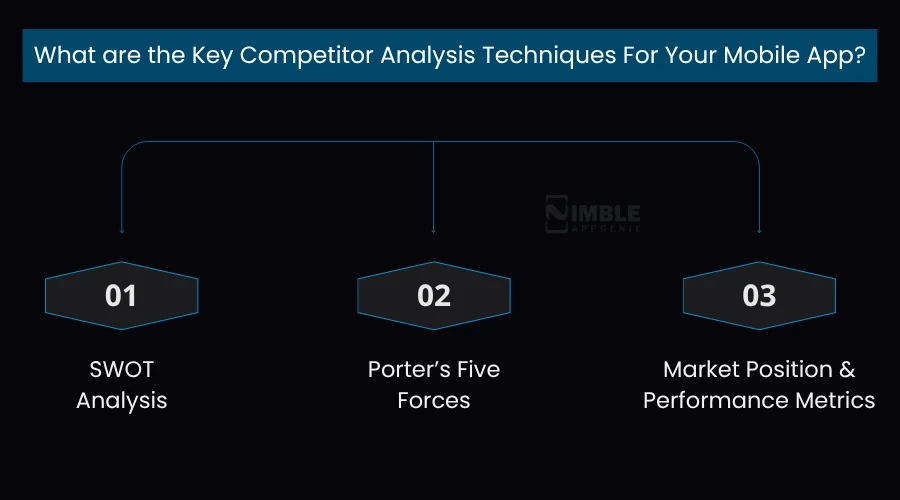
♦ SWOT Analysis
A mobile app SWOT analysis to evaluate the internal and external strengths of your business. Here, you should identify what the strong features of your app are, what the weak features are, and how many additional features your app can include.
You should conduct a SWOT analysis not only to examine the strengths and weaknesses of competitors but also for your business.
♦ Porter’s Five Forces
This is to be performed for your industry, whether it’s fintech, healthcare, fantasy app, or any other on-demand apps. It is a mobile app competitor analysis technique that should be conducted for assessing industry attractiveness and for identifying the structural risks.
For mobile apps, you can successfully evaluate the competitors’ strengths, along with how easy it is for mobile apps to enter your market, and the bargaining power of buyers and sellers.
♦ Market Position and Performance Metrics
Through analysis of market position and performance metrics, you can include crucial information about potential customers, their habits, and even their behaviors. It is all about evaluating the regional & category rankings.
This is all about performing visibility, footprint, value proposition, and user sentiment & reviews. Here, the mobile app competitor analysis is all about critically identifying what is happening in the market and which app owns what position in your industry.
You can hire mobile app developers if you feel confusing to implement and adding it to your app.
Now, let’s get ahead with the complete time taken for performing an overall competitor analysis.
How Much Time Does It Take to Conduct Mobile App Competitor Analysis?
Performing the complete competitor analysis can take 1-2 weeks, depending on different factors such as the complexity of your app idea and project, and the skills of the developers.
Let’s check out the given table stating the timeline to conduct a mobile app competitor analysis:
| Activity | Estimated Time |
| Identify competitors | 1–2 days |
| Analyze features & UX | 2–3 days |
| Review ratings & user feedback | 2–3 days |
| Study marketing & monetization | 2–3 days |
| Compile insights & strategy | 1–2 days |
| Total Duration | 1–2 weeks |
This competitive analysis time can impact the overall time taken to build a mobile app.
Well, if you are confused about the mobile app competitor analysis, connecting with the right team can help.
Partner With Nimble AppGenie For Mobile App Competitor Analysis
Connect with the leading mobile app development company, Nimble AppGenie. Our team discusses all the essential elements with you related to your project. It helps us to understand your idea in-depth and to evaluate what you actually want to serve.
With us, you can leave your first step of market research, and we will handle the rest. We can deliver AI-powered insights, customized benchmarking, and a feature of gap identification for helping businesses to outperform rivals.
The popular ways in which Nimble AppGenie can assist in competitor analysis are customized benchmarking, feature gap identification, and identifying how you can lead ahead in this competitive landscape.
We understand your app and value your idea. Not only this, we can create a complete app, converting your potential app idea into success with the integration of the latest technologies.
Conclusion
Mobile app competitor analysis is a crucial step in transforming an app idea into a successful product. It helps businesses understand market trends, user expectations, and competitor strategies while identifying gaps and opportunities.
By following a structured approach beginning from profiling competitors to evaluating features, monetization, and marketing, you can make informed decisions and reduce risks.
Techniques like SWOT analysis and Michael Porter’s strategic thinking further strengthen your planning. Ultimately, competitor analysis is not about copying others but about creating a unique value proposition that sets your app apart and ensures long-term growth in a competitive market.
FAQs

Sunil serves as the Lead Android Engineer at Nimble AppGenie, recognized for his expertise in building robust, scalable mobile solutions across diverse industries. From seamless API integrations to optimizing OS-level performance, Sunil focuses on delivering high-speed, secure applications that stand out in a crowded market. Outside of the tech world, Sunil is a fitness enthusiast who enjoys morning runs and finds his peace playing badminton on the weekends.
Table of Contents




No Comments
Comments are closed.