

 Free Consultation
 PCI-DSS Compliant
 GDPR Ready
 ISO 27001
 NDA Protected
 AI Services
 AI App Development
 Generative AI Development
 AI Chatbot Development
 AI Integration Services
 AI Consulting Services
 AI For Fintech
 AI Financial Assistant Solution
 AI Insurance Agent Development
 Tech Stack
 OpenAI / GPT-4
 Claude / Anthropic
 Gemini / Google AI
 Llama / Open Source
 LangChain / LlamaIndex
 Pinecone / Pgvector
 AWS / Azure AI


 Fintech Solution
 Core Fintech
 App Development
 Neobank Solutions
 eWallet Solutions
 Lending Software
 Banking Solutions
 BNPL Solutions
 BNPL Solutions
 Insurance App
 Wealth Management
 Crypto & DeFi
 Blockchain Development
  Payroll Software
 DeFi Solutions
 Crypto Wallet
 Crypto On/Off Ramp
 Crypto Exchange
 Trading Platform
 Payments
 Compliance
 Regulations & Compliance
 Fraud Detection
 Lending Ecosystem
 P2P Lending Platform
 Mortgage Software
 Engagement
 Fintech Outsourcing

 Mobile Development
 Mobile App Dev
 iOS App Development
 Android App Development
 React Native
 Flutter Development
 Web Solution
 Node.js Development
 React.js Development
 Angular Development
 App Services
 UI/UX Design
 App Maintenance
 By Stage
 MVP Development
 Industry Solutions
 Healthcare App Dev
 Education App Dev
 Travel App Dev
 Real Estate App Dev
 Logistics Software
 Social Media App

 Hire Mobile Developers
 Hire iPhone Developers
 Hire Android Developers
 Hire React Native Devs
 Hire Flutter Developers
 Hire Web Developers
 Hire Node.js Developers
 Hire Angular Developers
 Hire PHP Developers
 Hire Laravel Developers
 How It Works
 Pre-Vetted Developers
 Ready In 48 Hours
 NDA From Day One
 Replace Guarantee
 Company
 About Us
 Our Work Process
 Portfolio
 Case Studies
 Blog / Insights
 Careers
 Contact Us
 Awards
 Recognition


 Offices



Key Takeaways:
- Hevy is a growing app that focuses on strength training and weight-lifting workouts.
- To replicate the success of Hevy, you must focus on high retention, which can be achieved through gamification and social media integration.
- Give your fitness app the tool-first approach to ensure that it meets the purpose.
- Follow a 7-step thorough app development process to recreate a fitness app like Hevy.
- The average cost to build an app like Hevy can range anywhere from $25,000 to $250,000.
- Nimble AppGenie can help you overcome all the challenges and leverage the benefits of building an app like Hevy in 2026.
Fitness apps today are not just an additional solution, but an essential part of every user’s active lifestyle. With various types of fitness regimes available on the market, it can often be challenging for users to determine which application is most suitable for them.
And, even in these confusing times for the user, if an application is able to create an impact and convert first-time users into paid subscribers, it is truly a case study to follow. One such application is Hevy, which is truly a testament to the current market.
Businesses planning to enter the market often wonder how to build a fitness app like Hevy. If you are planning to follow in Hevy’s footsteps and want to replicate its success, it is important to have enough insights into building an app like Hevy.
In this post, we will try to dissect how Hevy works, what goes into building an app like Hevy, and everything you need to know.
So without further ado, let’s get started!
What is Hevy App? An Overview
Officially launched in November 2019, Hevy is a fitness workout tracker app founded by Guillem Ros and Desmond McNamee.
Specifically designed for weightlifting and strength training, Hevy focuses heavily on users who want to create custom workout routines, log their workout sets, and access analytics to better track their progress and become a part of a social fitness community.
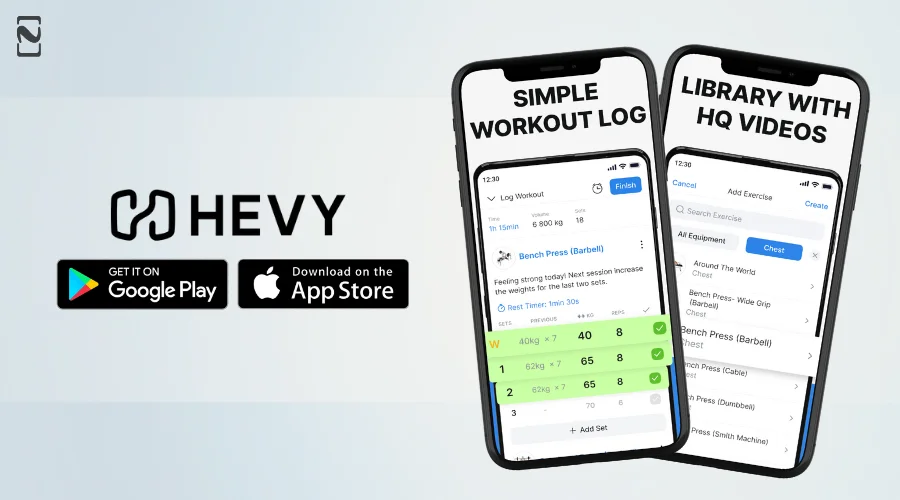
All of it is possible thanks to Hevy’s added features and functionalities. The app is available on both Android & iOS platforms, with a dedicated iPad app.
The application can also be used on Apple Watch, making it a perfect companion for workout analysis, allowing the app to record accurate heart rate during the workout.
The application is super efficient in tracking lifts and has definitely created an identity of its own in just 7 years.
Users & Market Statistics for Hevy App
The Hevy app has more than 10 million users. The application is certainly growing exponentially, as by late 2023, the number of users was reported to be 1.5 million.
The growth is clearly visible. Not to mention, Hevy is one of the dominating players taking advantage of the rapidly growing fitness market.
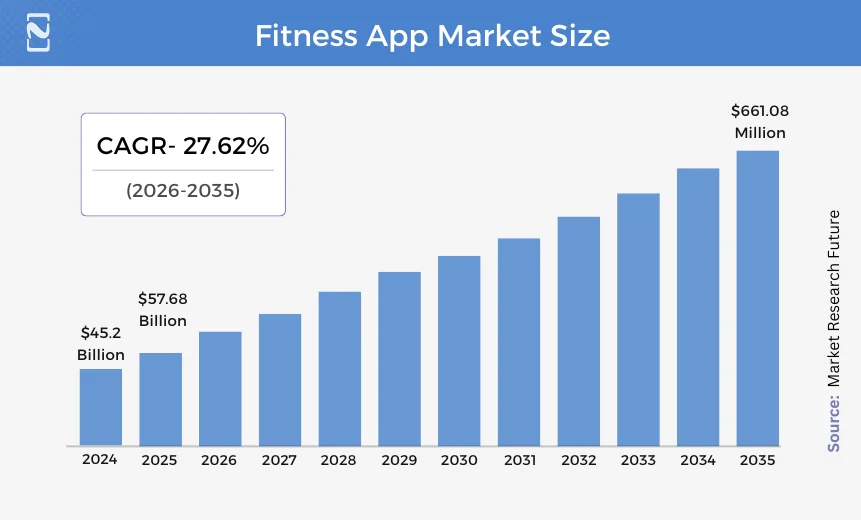
If we talk about the entire fitness app market, the current valuation was estimated at $57.68bn (2025) and is expected to touch $661.08bn by 2035, making it a growing market to enter with an app like Hevy to generate profits.
But the real question remains: how? How to create a fitness app like Hevy?
Well, with all the core information you need out of the way, let us get started on the steps to build a Hevy-like app.
How to Build an App Like Hevy? Stepwise Guide
First things first, building an app like Hevy may not be easy if you do not have an understanding of what you are getting into. The fitness app development process varies significantly for different types of apps.
You have fitness trackers, health management, diet and nutrition, and much more. When deciding that you want to replicate the Hevy app’s success, you have already eliminated other options, which often is the reason for confusion.
So, to start your journey towards building an app like Hevy, you need to follow the below given steps.
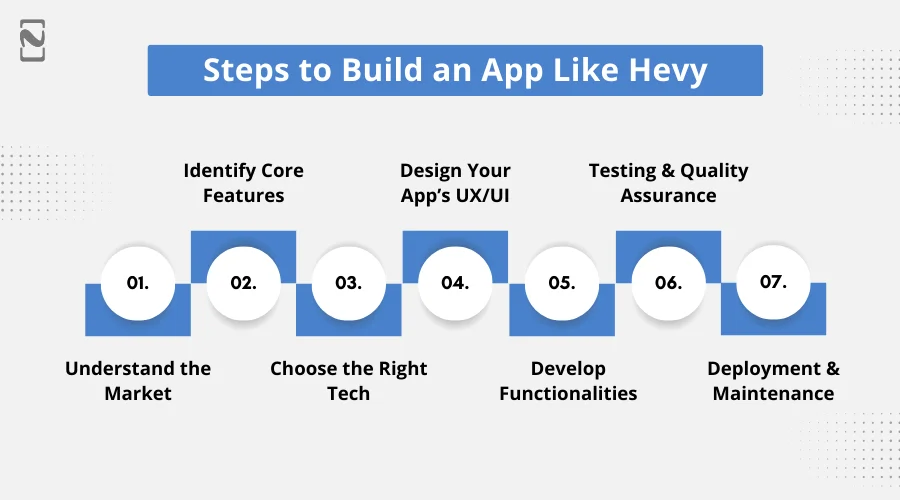
Step 1: Understand the Market
With the success of the Hevy app, you already have an understanding of how a valid workout app works. Now, in this step, you need to understand the market.
Identify the key players in the market and understand their weaknesses and strengths. This will help you do things better and be on top of the latest fitness app trends.
Step 2: Identify Core Features
For any fitness tracking and strength training app, one of the key factors that can make or break it is its features.
If the Hevy app is your inspiration, you must have features that align with its functionalities while ensuring that you do not miss out on creating a unique experience for the user, making it at par or a notch further than the Hevy app.
Some of the key features to include in your fitness app, like Hevy, are:
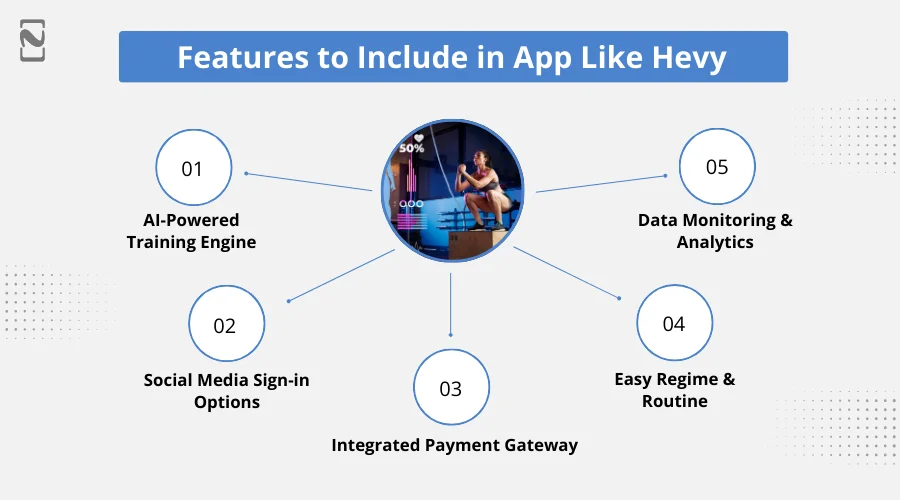
- AI-Powered Training Engine
- Social Media Sign-in Options
- Integrated Payment Gateway
- Easy Regime & Routine
- Data Monitoring & Analytics
The list of features is definitely a huge one when it comes to a fitness app. You need to have a solid understanding of your application and how you want to position it.
Step 3: Choose the Right Tech
To implement every feature efficiently, you need to choose the right tech stack. From your backend solutions to design elements, each component requires a dedicated technology, and to ensure that all the elements are developed to their best efficiency, you must choose the fitness app tech stack diligently.
Key technologies used in building a workout tracker app like Hevy:
- Frontend: React Native, MobX/Zustand, Firebase Firestore.
- Languages: Node.js, Go.
- API Architecture: GraphQL or REST API with Express.
- Security: Clerk or Auth0
- Database: PostgreSQL
- Wearable Integration: Apple HealthKit, Google Health Connect.
Other than these, advanced tech for Predictive Models, Computer Vision, and Visualization solutions are also some basic tools that must be used.
Step 4: Design Your App’s UX/UI
The next thing you need to do after you have decided on what tech to use is to design your application. Creating the wireframe is the first step, as it allows you to roughly draft the user experience and interface.
After you have identified how the interface will look and what the flow of your functionalities will be, simply start finalising the design. This is the step where your fitness app takes shape. Make sure you are not missing out on any of the necessary elements.
Step 5: Develop Functionalities
With every element designed and defined, it is now time to add features and bring them to life. This is the step where you write code and ensure that all the functionalities are developed.
The code is written and executed as required by the functionality. This is also where all the integrations are done. Hence, this is the most time-consuming step in the entire process of building a fitness app like Hevy. The more functionalities are to be written, the more time it will take.
Step 6: Testing & Quality Assurance
The purpose of building and testing your app is to ensure that the performance of your app is never compromised. After you have written code for multiple functionalities, each line of code must be revisited and tested for compatibility.
A dedicated team of quality assurance professionals is required to ensure that there are no loopholes in the functionality or the features that have been developed. If something is found to be buggy or has functionality errors, it is sent back to developers for rectification.
Both manual and automated testing play an important role; make sure that you give testing and quality assurance steps enough time for the best results and app performance.
Step 7: Deployment & Maintenance
When the quality assurance team has approved the final solution, it is time for the DevOps team to start the deployment. The final build is created and shared with you to validate. The final build is then subjected to all the necessary guidelines and requirements of different platforms.
Once all of that is clear, they are shared with the stores and accordingly published for public use. The deployment process is not exactly over, as it also includes maintenance. If there are issues with the app after the app is published, the team takes care of the issues and ensures that maintenance is provided.
With all these steps out of the way, you will have a solid Hevy-like app ready for you. In case you are worried about spending a lot of time on these steps, you can build an MVP that helps you validate your approach. Talking about spending, let us take a look at the cost of building an app like Hevy in the next section.
How Much Does it Cost to Develop an App Like Hevy?
On average, the cost to develop a fitness app like Hevy ranges between $25,000 and $250,000.
All the steps shared above require highly experienced professionals and several different resources. And understandably, all of it comes at a cost. To create an app like Hevy, you must have an understanding of how much it would cost.
Different factors affect the budget range for developing the application. Here are the factors that you should consider:
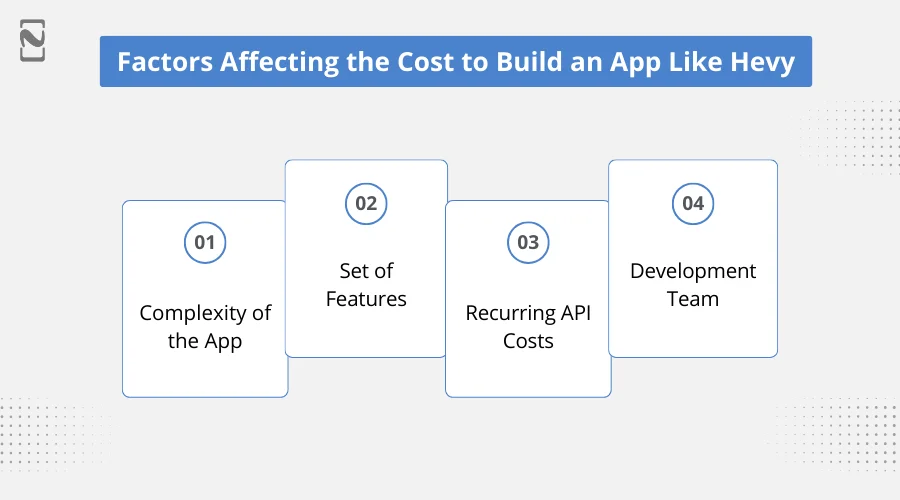
- Complexity of the App: The number of functionalities and layers required to reach the outcome.
- Set of Features: How many advanced and must-have features are included, along with their internal complexities.
- Recurring API Costs: When integrations are done using APIs, there are recurring costs that the business has to bear.
- Development Team: Multiple factors, such as how big the team is, where it is working from (location), and what are the additional resources the team requires, play a crucial role in defining the cost of development.
With all these factors directly impacting the cost of building an app like Hevy, you need to ensure that all the decisions you make are reliable and in the best interest of keeping your app development under the decided budget.
How Does a Fitness App Like Hevy Make Money?
The previous section shows how much you need to invest in developing an app like Hevy. And this one talks about how you earn from it. Monetization is a key aspect of publishing an app.
When we talk about an app like Hevy, it is definitely one of the best examples of how a fitness app should make money.
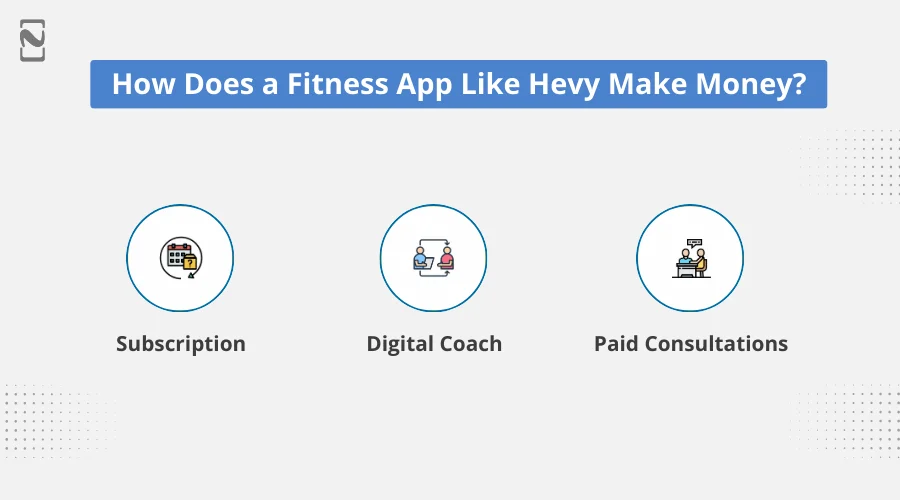
Here are some of the popular monetization strategies for an app like Hevy.
-
Subscription
Selling monthly subscriptions for extra features and additional services is the most common monetization strategy used by fitness apps like Hevy.
It helps the platform convert everyday users into long-term users while improving the overall experience of the users through added features, ease of access, and much more.
-
Digital Coach
Several fitness enthusiasts are willing to pay for a digital coach who guides them through the workout.
This is a great way to monetize your fitness app as it not only delivers value to the users but can also help your app generate revenue while improving your user retention, as the more people interact with their digital coach, the more they use your app.
-
Paid Consultations
Not everyone wants to have a digital coach for every workout. However, you can always add in-app purchases of paid consultations directly through your app. This allows a user to be more involved and opens new possibilities for someone who doesn’t want to spend much but is also interested in staying healthy.
Since the core of the Hevy fitness app is that it follows a no-add policy for engaged workouts, it does not use in-app ads. However, you can go for an in-app purchase or ads in your solution if you want an additional stream of income.
What are the Benefits of Building an App Like Hevy?
Building an app like Hevy not only gives you an entry into the growing market but also offers different benefits. These benefits make it super valuable from both a performance as well business perspective.
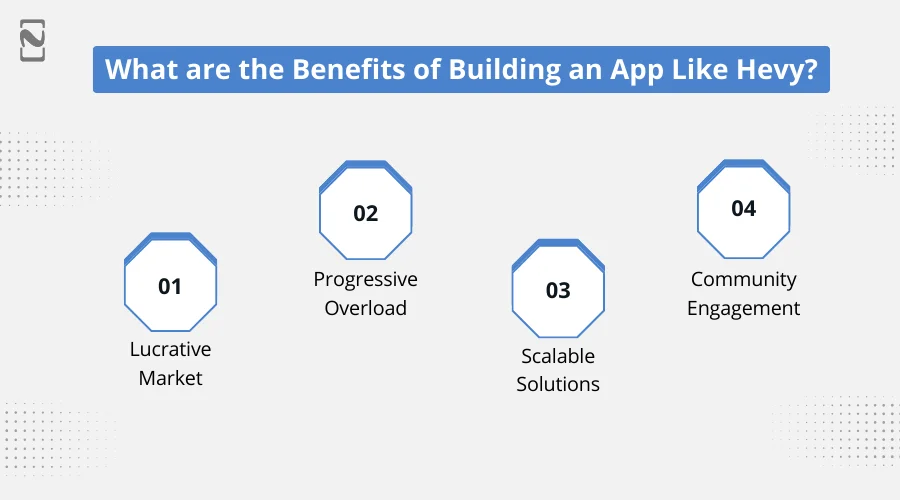
Here are some of the benefits you get when you develop an app like Hevy:
1] Lucrative Market
More than 60% of fitness app users have replaced their offline discussions and consultations with digital solutions. The current market is opening up new possibilities every day for new fitness apps like Hevy. That is clearly visible through the current market numbers and trends.
2] Progressive Overload
With every user logging their progress daily for months, the app goes through a progressive overload of data. While it means handling more user data, it is actually a benefit that improves user retention.
How? Think of it this way: when a user has logged 6-12 months of their workout, the cost of them switching and again creating enough data to track progress on another app is high. Which means they stick to your app for longer.
3] Scalable Solutions
Fitness apps have found immense success in scaling their services into different businesses. While it appears that a workout app or a tracking app is limited only to that, there are different verticals into which a fitness app can enter and establish its presence.
The scalability of the solution is highly beneficial as it offers direct access to potential businesses.
4] Community Engagement
Fitness apps like Hevy benefit highly from their communities. Users across the app like to share their progress through the app, and when they do, they automatically push your application’s name to a new audience.
The social factor works effectively as a marketing tool for the brands, which is a huge benefit in today’s market. The benefits make the entire deal sweeter for the business. Because you can earn from your app while exercising all the benefits, the idea of implementing a solution seems foolproof.
However, that is definitely not the case. Several challenges may cause hindrance in the overall process.
What are these challenges? Let’s find out in the next section!
What are the Common Challenges in Building an App Like Hevy?
It is not easy to replicate the exact success of any app. Hevy is one of the most popular solutions in fitness tracking. However, in order to become the best, several challenges must be faced and overcome.
Here are some common challenges you might face when implementing an app like Hevy:
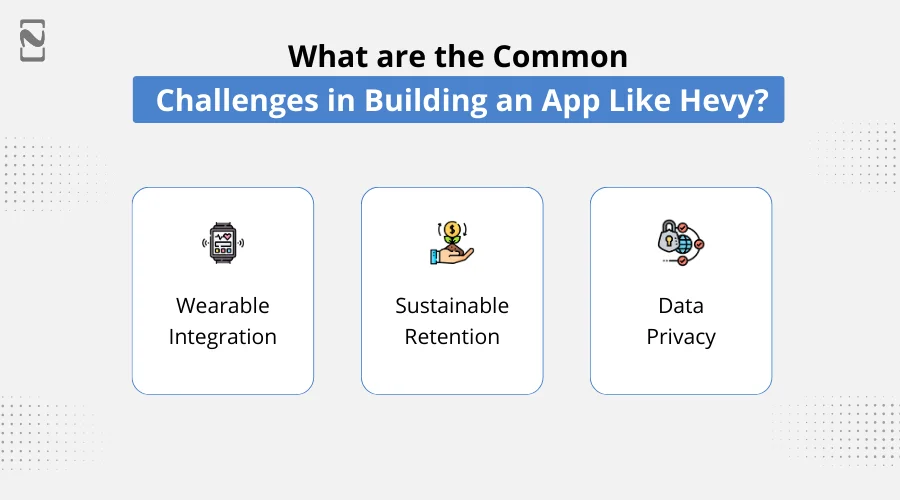
► Wearable Integration
Challenge: Choosing which wearable to support can become challenging as the devices are endless. With all the big players, be it Apple, Google, Samsung, and Xiaomi, launching their own wearable devices, it can become quite difficult for YouTube to support them all.
Solution: Hence, we recommend you start with support for devices that use Apple HealthKit and Google Health Connect, as this will reduce the effort and expense while enabling you to be compatible with the majority of wearables.
► Sustainable Retention
Challenge: While users logging their fitness data plays a crucial role in improving retention, the first few months become more crucial for creating sustainable retention. That is because the app may face a higher churn rate, which is not allowing more users to be in their 6th or 7th month of using the app.
Solution: Adding social sharing and gamifying the application with timelines and objectives can help in making the user retention. It is only about how you keep your user engaged in the early days. Push notifications and workout reminders are also a way to keep them going.
► Data Privacy
Challenge: With millions of users working out, lifting, and sharing their data with your app, it can become difficult to maintain data privacy. Especially when you are dealing with health-sensitive data, as the compliance and regulations become stricter.
Solution: The application you develop must be built with all the compliances in mind. Make sure end-to-end encryption is put in place, along with the provision of the right to be forgotten embedded in the app.
While the challenges do seem a bit daunting, there is nothing that cannot be resolved by an experienced fitness app development company. To ensure that you can achieve the best form of workout tracker app like Hevy, it is crucial to find a solid team that understands your requirements and delivers on your expectations.
Wondering who can help you achieve that? Well, we have got you covered. Check out the next section for more.
Who Can Help You Build a Fitness App Like Hevy?
Nimble AppGenie is a reliable name when you want to make an app like Hevy.
With years of hands-on experience and understanding of building an app after following the footsteps of an already existing app.
That is because while it seems easy to build an application that has already been tried and tested, replicating the results can be highly difficult. That is because you need someone who has a deep understanding and has worked on a similar solution.
At Nimble AppGenie, you can find highly qualified developers and analysts who can help you finish the project on time while ensuring that all your expectations are met and the application is developed accordingly.
For further information on how Nimble AppGenie can help you create a fitness app like Hevy for your business, simply fill out the form given below, and one of our experts will reach out to you.
Connect now and get started with your journey!
Conclusion
A fitness app can definitely be a game-changer for your business if your aim is to enter a market that is ever evolving and offers high retention rates.
Ideally, going for an app that has already been thriving makes more sense, as it has already been done, and the proof of concept has been achieved.
For many businesses, the plan to build a fitness app like Hevy can be a great initiative. With the help of well-defined steps of app development processes, and additional decisions like how you want to monetize it.
The overall cost to develop an app like Hevy can range from $25,000 to $250,000, due to different factors. However, what matters the most is how you execute the development process.
Hopefully, all the sections shared in the post give you enough insights into how to build a workout tracker app like Hevy. Thanks for reading. Good Luck!
FAQs
The overall cost to develop an app like Hevy can range from $25,000 to $250,000, due to different factors.

Niketan Sharma, CTO, Nimble AppGenie, is a tech enthusiast with more than a decade of experience in delivering high-value solutions that allow a brand to penetrate the market easily. With a strong hold on mobile app development, he is actively working to help businesses identify the potential of digital transformation by sharing insightful statistics, guides & blogs.
Table of Contents




No Comments
Comments are closed.