

 Free Consultation
 PCI-DSS Compliant
 GDPR Ready
 ISO 27001
 NDA Protected
 AI Services
 AI App Development
 Generative AI Development
 AI Chatbot Development
 AI Integration Services
 AI Consulting Services
 AI For Fintech
 AI Financial Assistant Solution
 AI Insurance Agent Development
 Tech Stack
 OpenAI / GPT-4
 Claude / Anthropic
 Gemini / Google AI
 Llama / Open Source
 LangChain / LlamaIndex
 Pinecone / Pgvector
 AWS / Azure AI


 Fintech Solution
 Core Fintech
 App Development
 Neobank Solutions
 eWallet Solutions
 Lending Software
 Banking Solutions
 BNPL Solutions
 BNPL Solutions
 Insurance App
 Wealth Management
 Crypto & DeFi
 Blockchain Development
  Payroll Software
 DeFi Solutions
 Crypto Wallet
 Crypto On/Off Ramp
 Crypto Exchange
 Trading Platform
 Payments
 Compliance
 Regulations & Compliance
 Fraud Detection
 Lending Ecosystem
 P2P Lending Platform
 Mortgage Software
 Engagement
 Fintech Outsourcing

 Mobile Development
 Mobile App Dev
 iOS App Development
 Android App Development
 React Native
 Flutter Development
 Web Solution
 Node.js Development
 React.js Development
 Angular Development
 App Services
 UI/UX Design
 App Maintenance
 By Stage
 MVP Development
 Industry Solutions
 Healthcare App Dev
 Education App Dev
 Travel App Dev
 Real Estate App Dev
 Logistics Software
 Social Media App

 Hire Mobile Developers
 Hire iPhone Developers
 Hire Android Developers
 Hire React Native Devs
 Hire Flutter Developers
 Hire Web Developers
 Hire Node.js Developers
 Hire Angular Developers
 Hire PHP Developers
 Hire Laravel Developers
 How It Works
 Pre-Vetted Developers
 Ready In 48 Hours
 NDA From Day One
 Replace Guarantee
 Company
 About Us
 Our Work Process
 Portfolio
 Case Studies
 Blog / Insights
 Careers
 Contact Us
 Awards
 Recognition


 Offices



Choosing the right tech stack for social media app development is a tricky process. There are so many factors to consider and decisions to make before deciding to develop your social media application on your own.
Therefore, considering your demands and needs, we analyzed organizations, entrepreneurs, and all those who are struggling to find the right tech stack for their next social media app.
Here, you will find all your answers, from tech stack concepts, its fundamentals, particular techniques for social media, cost, factors impacting it, and more.
What is a Tech Stack? An Overview
Before we understand how to choose the perfect tech stack for a social media platform, let’s consider what it is. The tech stack is made up of programming languages, frameworks, platforms, and tools that you can use to run an app.
It can be described as a combination of hardware and software that is used to build an application. Additionally, the tech stack can be considered a layered structure that contributes to the functioning and development of the app.
Whether it’s for iOS or Android apps, the following layers are considered for developing them.
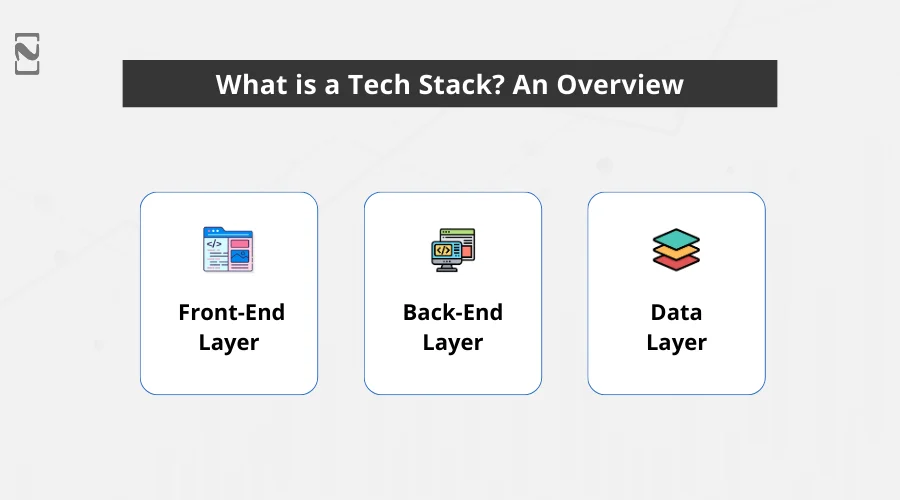
1. Front-End Layer
Under this layer, user interface (UI) and user experience (UX) are considered important parameters. It can be identified as a layer that is utilized by the users to communicate with the brand. This can be determined by frameworks, databases, and technologies used for direct interaction with the brand.
2. Back-End Layer
This layer comprises the logic as well as the business functionality of the application. Additionally, it includes server-side programming languages such as Java, Ruby, and Python, along with Node.js, and backend frameworks such as Rails, Django, and others.
Under this layer, you may find data processing, database operations, server-side validation, and integration with different services.
3. Data Layer
The data layer is an essential component of the tech stack. A database is an essential component that stores and manages data used by applications. It is a behind-the-scenes structure that websites, as well as mobile apps, tap into for timely and consistent visitor data.
This layer provides a functional as well as procedural means for transferring data between network entities. Well, we understand that you need to learn them all in detail.
Fundamentals of Tech Stack For Social Media Apps
Before you learn to identify the suitable tech stack for social media apps, let’s go in-depth and check out the basics. What are the basics of the tech stack?
Here’s a list to follow :
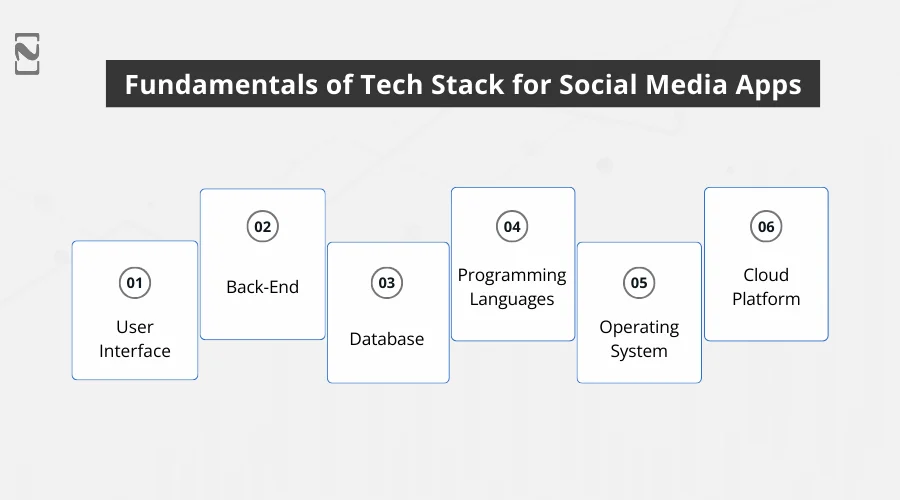
♦ User Interface
This might seem like a component only for app design, but it’s an important part of the tech stack too. Here, the markup languages such as CSS and HTML, and frameworks including Bootstrap or Tailwind, depend on the user interface and styling needs.
It is the point where the user interacts with the program or application. Thus, it should be effective for serving multiple users’ needs and creating brand engagement.
♦ Back-End
The backend components of the tech stack comprise many components, such as servers, databases, frameworks, and operating systems.
This can be determined as the inner workings of a website that are not visible to the end user. It is a server-side environment where different programming languages, frameworks, and databases, such as MySQL, MongoDB, Oracle, etc, are considered.
♦ Database
The database comprises technologies useful for both the user interface as well as underlying logic. This is a platform where the data is stored, retrieved, and manipulated within a mobile app.
A database can be defined as an organized collection of data that can be accessed, managed, and updated. You will find that a database for web apps is different from that for mobile applications.
The selection of a database can depend on multiple factors such as the type of data, team expertise, and app requirements.
♦ Programming Languages
Based on the platforms and targeted apps’ size as well as features, the programming languages differ.
For iOS, you can use Swift and Objective-C, while for Android apps, suitable programming languages include Kotlin and Java. Whereas, for cross-platform apps, you can implement various programming languages such as react native, Flutter, and Xamarin.
Also Read: Best Choices for Programming Languages for a Beginner
♦ Operating System
Mobile operating systems such as iOS and Android facilitate development tools for running applications. There are multiple technologies to be considered, such as the iOS SDK or the Android SDK.
This is the interface through which runtimes, servers, web frameworks, as well as other software components of the technology stack, can access computing power as well as resources.
♦ Cloud Platform
In the current era, cloud computing platforms such as Google Cloud, AWS, and Azure offer a variety of services that are suited for developing mobile applications.
Cloud app development solutions provide developers with secure, scalable, and cost-effective ways of managing data. The tech stack includes cloud platforms that have revolutionized mobile app scalability.
Other than these, there are various tools required in the tech stack depending on the type of app, its complexity scale, and features such as IDEs, Git, SVN, and build tools such as Gradle and Maven.
After learning about the basics, let’s understand the tech stack for social media apps in the following section.
Tech Stack For Social Media App Development
A tech stack for social media applications can differ based on the type of app. Along with this, it will be a mix of frameworks, programming languages, libraries, and tools that are designed to meet the needs of creating a networking platform.
Here’s a table to enhance your awareness of selecting the ideal tech stack for social media apps.
| Component | Key Technologies | Use Cases | Advantages | Features |
| Front-end | React, Angular, Vue.js, HTML, CSS, JavaScript | User interface, user interactions, content rendering | Reusable components, efficient updates, and cross-platform compatibility | Virtual DOM, data binding, component-based architecture |
| Back-end | Node.js, Python (Django, Flask), Ruby on Rails, Java (Spring), PHP | Server-side logic, data processing, API development | Scalability, performance, and community support | Asynchronous programming, ORM frameworks, RESTful APIs |
| Database | MySQL, PostgreSQL, MongoDB, Redis | Data storage, retrieval, and manipulation | Performance, reliability, scalability | Relational and NoSQL data models, indexing, and query optimization |
| Programming
Languages |
JavaScript, Python, Ruby, Java | Application development and logic implementation | Versatility, community support, and extensive libraries | Object-oriented programming, functional programming, and dynamic typing |
| Operating
System |
Linux (Ubuntu, CentOS), macOS, Windows | Server infrastructure and application deployment | Performance, security, stability | Multitasking, process management, and file systems |
| Cloud
Platform |
AWS, Azure, GCP | Scalability, reliability, cost-efficiency | On-demand resources, global infrastructure, managed services | Virtual machines, storage, networking, and databases |
| Additional
Tools |
Git, Docker, Kubernetes, Jenkins | Version control, containerization, and deployment automation | Collaboration, efficiency, reliability | Branching, merging, container orchestration, continuous integration/delivery |
| Content Delivery Network (CDN) | Cloudflare, Akamai, Fastly | Content distribution, caching, and performance optimization | Reduced latency, improved user experience, and global reach | Edge servers, caching mechanisms, and load balancing |
| Search Engine Optimization (SEO) | Yoast SEO, SEMrush, Ahrefs | Improve search engine visibility, organic traffic | Increased user acquisition and brand awareness | Keyword research, on-page optimization, and link building |
| Analytics Tools | Google Analytics, Mixpanel, and Amplitude | User behavior tracking, data analysis, and performance measurement | Data-driven decision-making, user insights | Event tracking, user segmentation, A/B testing |
| Messaging and Notifications | Twilio, SendGrid, Firebase Cloud Messaging | Real-time communication and notifications | Engagement, user retention | SMS, email, push notifications, in-app messaging |
| Social Authentication | OAuth 2.0, OpenID Connect | User login and authorization | Simplified user experience and security | Single sign-on, delegated authentication |
| Machine
Learning |
TensorFlow, PyTorch, Scikit-learn | Recommendation systems, content moderation, personalized experiences | Enhanced user engagement, improved content relevance | Natural language processing, image recognition, predictive analytics |
| Caching | Redis, Memcached | Storing frequently accessed data in memory | Improved performance and reduced database load | In-memory data storage and fast retrieval |
| Mobile App Security | Web Application Firewall (WAF), Intrusion Detection System (IDS), encryption | Protecting user data and preventing attacks | Data security, compliance | Malicious traffic filtering, threat detection, and data encryption |
Now, let’s consider the type of tech stack based on different platforms, such as iOS, Android, and Hybrid, below.
► iOS Tech Stack For Social Media App
Deciding on the right tech stack for an iOS app is not a difficult task anymore.
You can check out the table below to learn more.
| Component | Key Technologies | Use Cases | Advantages | Features |
| Programming
Language |
Swift | App development | Modern, safe, performant | Type safety, options, closures |
| IDE | Xcode | App development, debugging, testing | Integrated environment, code editing, and simulator | Interface Builder, code completion, and debugging tools |
| UI Framework | SwiftUI | Declarative UI development | Simplified UI creation, reactive programming | Declarative syntax, data flow, and dynamic type |
| Libraries | Alamofire, Kingfisher, SDWebImage | Network requests, image loading | Efficient network operations, image caching | RESTful API integration, asynchronous image loading, and image processing |
You can hire iOS app developers to get more detailed information to decide on the social media tech stack.
► Android Tech Stack for Social Media App
In the case of an Android app, you should consider the target users as Android users and decide the tech stack accordingly.
The following table can be helpful here.
| Component | Key Technologies | Use Cases | Advantages | Features |
| Programming
Language |
Kotlin, Java | App Development | Modern syntax, interoperability with Java | Type safety, null safety, concise code |
| IDE | Android Studio | App development, debugging, testing | Integrated environment, code editing, and emulator | Layout editor, code completion, and debugging tools |
| UI Framework | Jetpack Compose | Declarative UI development | Simplified UI creation, reactive programming | Composable functions, theming, and state management |
| Libraries | Retrofit, Glide, OkHttp | Network requests, image loading, and HTTP client | Efficient network operations, image caching, and custom HTTP clients | RESTful API integration, asynchronous image loading, and HTTP request customization |
You can hire Android app developers to get more information.
► Hybrid Tech Stack For Social Media App
Hybrid app development for social media applications is a single application that is compatible with all types of mobile platforms, such as Android, iOS, and Windows.
Let’s check out the table below for a selection of its social media tech stack.
| Component | Key Technologies | Use Cases | Advantages | Features |
| Framework | React Native, Ionic, Flutter | Cross-platform app development | Code reusability, faster development, shared codebase | Native-like performance, component libraries, hot reload |
| Programming
Language |
JavaScript (React Native, Ionic), Dart (Flutter) | App development | Popular languages, a large community | Declarative UI, reactive programming, asynchronous operations |
| Tools | Expo, Capacitor | App development, deployment | Simplified development workflow, platform-specific features | CLI tools, cloud build, native integrations |
Considering these tables, you can decide on the right type of tech stack for your next social media app.
Use of AI/ML in Modern Tech Stack For Social Media Apps
While the technologies mentioned above are enough to help you decide on the final tech stack for your social media app, several advanced technologies can take your app to the next level.
You see, gone are the days when users only wanted a platform to interact with others; social media platforms are a one-stop shop for everything, from discovering new music to finding the best-fitting product.
One of the key reasons why it is so is the level of personalization that these apps provide. Clearly, these recommendations and personalization are not achieved just by your regular tech stack for a social media app.
Instead, you need some advanced technologies for the same. Artificial intelligence and Machine learning are the central forces that drive highly personalized experiences on any social media platform.
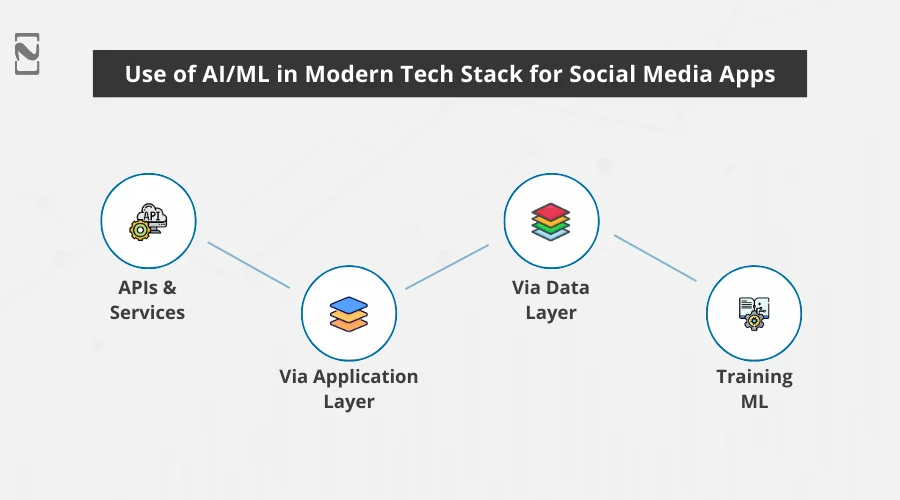
All of these features may seem a bit complicated; however, it is these experiences that make a social media platform interesting and worth using for a user. Now you may be wondering how one integrates AI and ML into a social media app tech stack. Well, it takes different approaches.
Here are some for your reference –
-
APIs & Services
Various APIs and services like OpenAI, Google Gemini, ML.NET with PyTorch allow you to integrate AI capabilities into your platforms.
-
Via Application Layer
AI and ML can be integrated into front-end and back-end code that can be used to deliver personalized features to your social media app.
-
Via Data Layer
In your tech stack for a social media app, you can focus on a data layer to collect user interactions and content data to implement personalization.
-
Training ML
To ensure that your application leverages AI and ML into your application, you train neural networks and other ML models using the data from the Data Layer.
With the help of AI and ML, you can easily add features like personalized feeds, content moderation for user safety, and creator assistance with generative AI, and smart discovery algorithms for better visibility and engagement on the platform.
Famous Platforms & Their Diverse Tech Stacks
When talking about different aspects of a social media tech stack, analyzing the current players who are dominating the market can never go wrong.
You see, people find social media apps to be convenient due to their selection of features and ease of access.
However, from a technical point of view, it is the tech stack behind the curtains that makes it all possible.
Hence, when you are planning to enter the market with a social media platform of your own, it is crucial to learn what the best social media app tech stacks look like.
Here are some of the popular platforms and their diverse tech stacks that they use –
➤ Facebook (Meta)
One of the oldest social media platforms, Facebook, has more than 3 billion users, the largest of any other social media platform.
The application uses both legacy and modern technologies to keep it ahead of the competition.
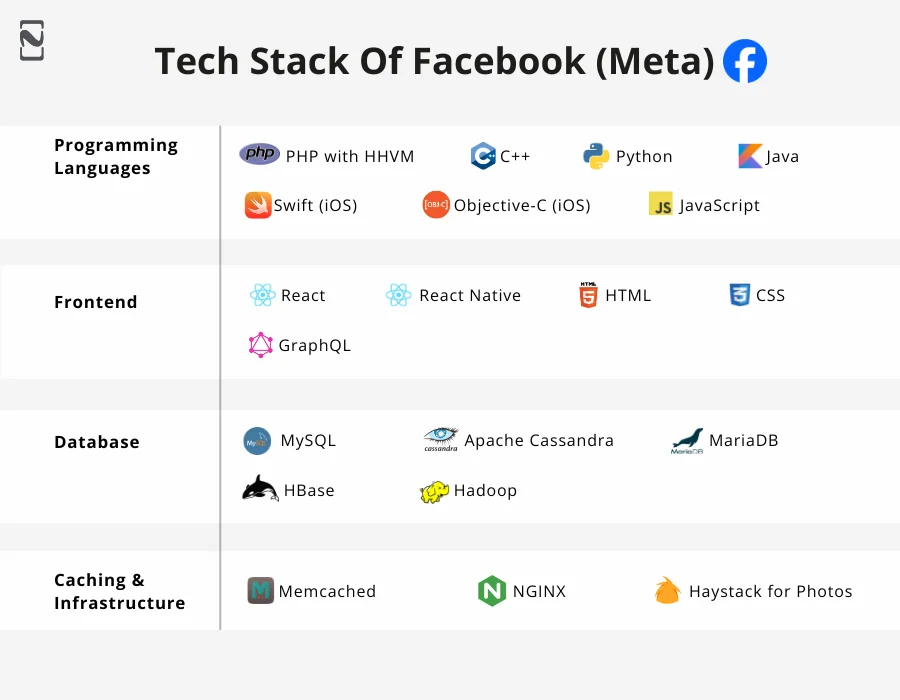
Here’s a quick sneak peek into Facebook’s tech stack –
- Programming Languages: PHP with HHVM, C++, Python, Java, Swift (iOS), Objective-C (iOS), and JavaScript.
- Frontend: React, React Native, HTML, CSS. GraphQL
- Databases: MySQL, Apache Cassandra, MariaDB, HBase, and Hadoop.
- Caching & Infrastructure: Memcached, NGINX, Haystack for Photos.
➤ Instagram (Meta)
With the number of users right at par with Facebook, Instagram is another highly popular social media platform used by approximately 3 billion people.
The number of users clearly indicates the stature of the platform, as it engages almost half the population of the world.
Several technologies go into creating a platform like that.
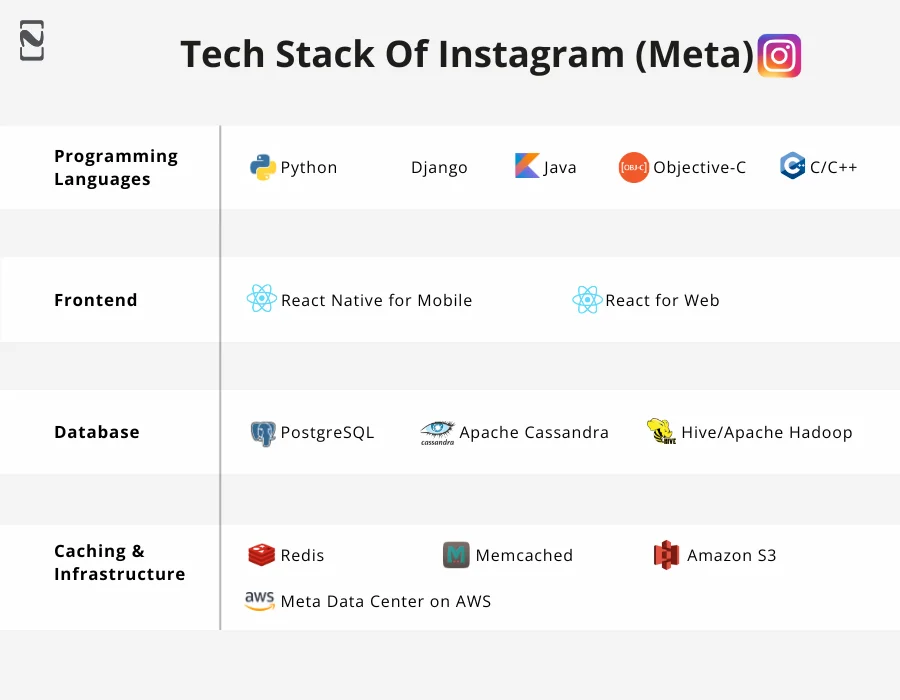
Check out the Instagram tech stack below –
- Programming Languages: Python, Django, JavaScript, Java, Objective-C, C/C++.
- Frontend: React Native for Mobile, React for Web
- Databases: PostgreSQL, Apache Cassandra, Hive/Apache Hadoop.
- Caching & Infrastructure: Redis, Memcached, Amazon S3, Meta Data Center on AWS.
➤ X (formerly Twitter)
With the recent change of ownership, Twitter turned into X, which certainly helped the platform in gathering a lot of hype and new audiences.
The platform is one of the most popular social media apps, used by 550 million+ users around the globe.
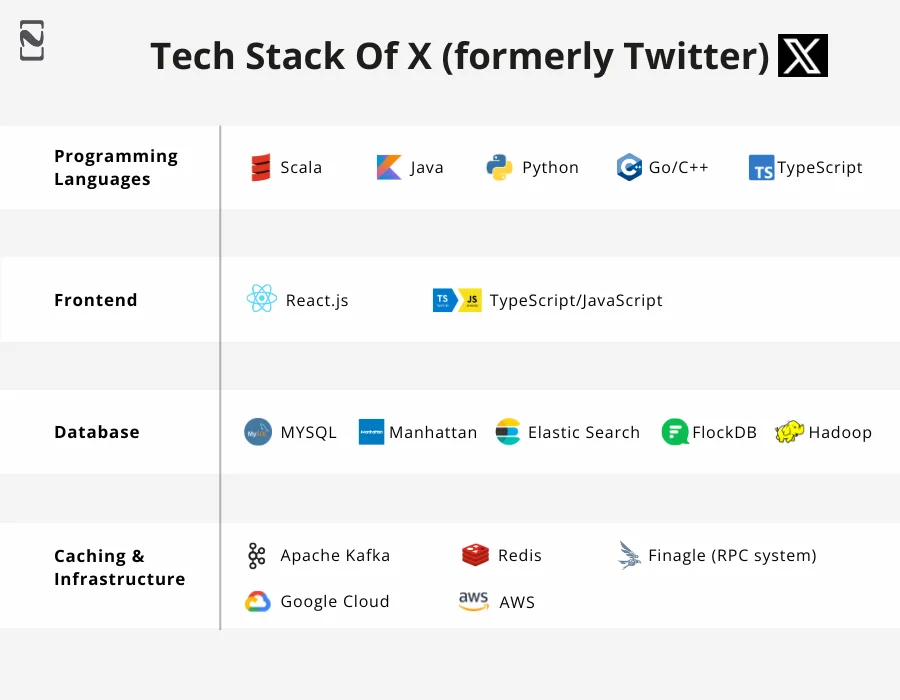
Check out how the platform can offer these features with such excellence by checking the tech stack for X mentioned below –
- Programming Languages: Scala, Java, Python, Go/C++, TypeScript
- Frontend: React.js, TypeScript/JavaScript.
- Database: MYSQL, Manhattan, Elastic Search, FlockDB, and Hadoop.
- Caching & Infrastructure: Apache Kafka, Redis, Memcached, Finagle (RPC system), Google Cloud, and AWS.
➤ Snapchat
Used mostly by GenZ & Millennials, Snapchat is a quick communication social media platform that leverages your smartphone camera, allowing users to share snaps that are highly secure and cannot be traced or retrieved back (unless the necessary settings are made).
With 900 million+ users, it is one of the most profitable social media platforms in the market today.
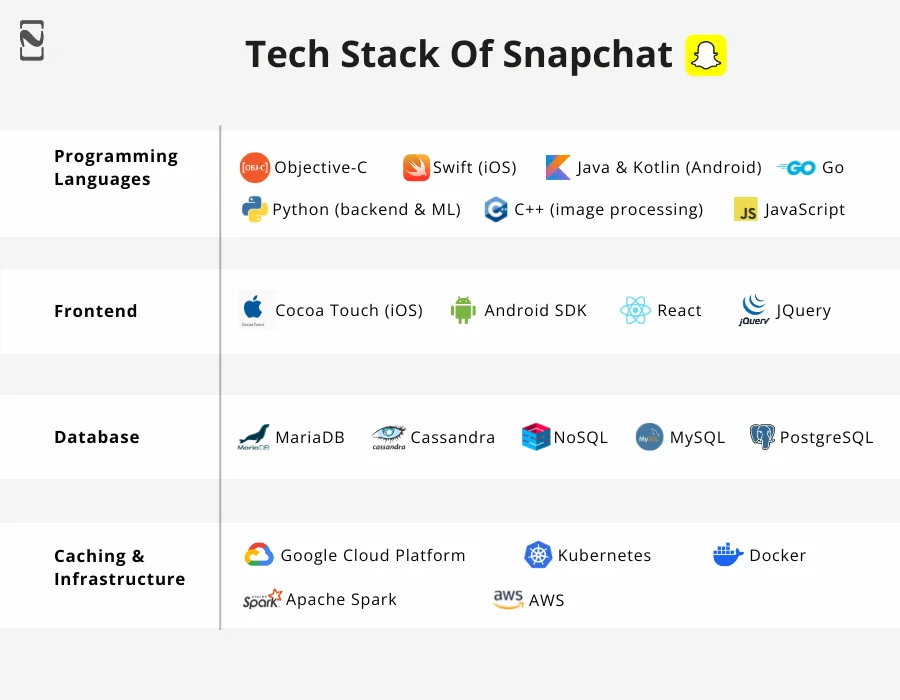
Here’s the tech stack that powers Snapchat –
- Programming Languages: Objective-C & Swift (iOS), Java & Kotlin (Android), Python (backend and ML), C++ (image processing), JavaScript, and Go.
- Frontend: Cocoa Touch (iOS), Android SDK (Android), React, JQuery.
- Database: MariaDB, Cassandra, NoSQL, MySQL. PostgreSQL.
- Caching & Infrastructure: Google Cloud Platform, Kubernetes, Docker, Apache Spark, AWS.
While there are several other technologies that they may be using to deploy new features, this is the base on which the entire platform is built and deployed.
You might have observed that all these top social media platforms have distinct tech stacks. They are diverse as they have been chosen according to the requirements.
Which brings us to the next section, where we will discuss why choosing the right tech stack for social media app development is crucial.
Why is the Selection of the Right Tech Stack for a Social Media App Important?
Learning about the tech stack for social media apps isn’t significant if you are unaware of its importance. Choosing a suitable tech stack is not only a technical decision, but it’s a strategic one.
Here’s a list of reasons why you need to select the best tech stack for a social media app :
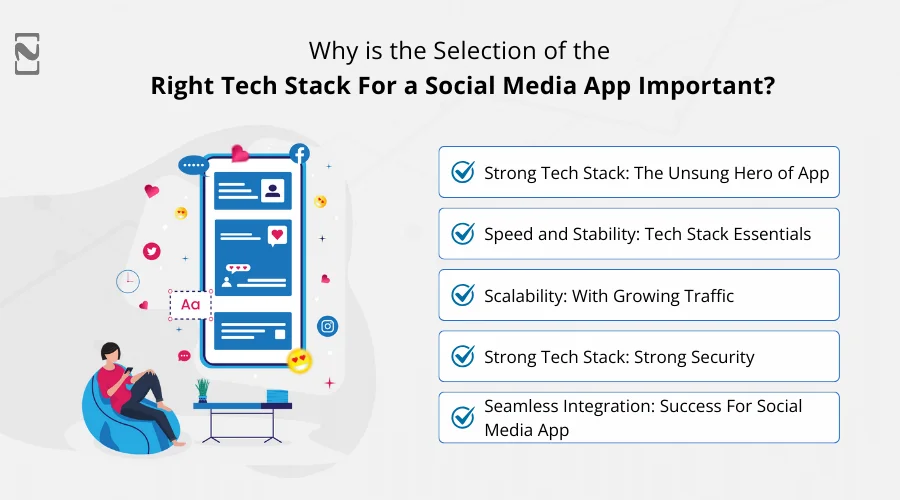
♦ Strong Tech Stack: The Unsung Hero of App
The right tech stack selection acts as a backbone for your app. Social media apps are all about how they attract and engage users for a long duration. With a strong tech stack, your social media app will be able to remove any obstacles to the app’s performance.
This leads to app performance optimization. Users seek a social media app that values their existence and provides them with a smooth experience. With a strong tech stack, users’ journeys can be simplified.
♦ Speed and Stability: Tech Stack Essentials
You should be aware of what the users expect from a social media app; it’s all about quick response and stability. A slow response can encourage the user to shift to another social media app in one go. While they check out the reels or share photos and videos, it should work smoothly and quickly.
Hence, a strong tech stack will provide all these solutions. It optimizes the software’s speed and ensures that users can proceed with chats, scrolling, or uploading reels without facing any crashes.
♦ Scalability: With Growing Traffic
A social media app that is able to expand and work based on the growing traffic and users’ preferences can stand out among the competition. The major aim of your social media app is to scale up when many people approach it or download it.
Selecting a strong tech stack is scalable, which means it’s easy to handle loads of users as well as additional functions or features that are added later.
♦ Strong Tech Stack: Strong Security
Users’ data privacy and security are important components while developing a social media app.
Hence, a robust tech stack comes into play. The right technology provides security against cyber threats. By prioritizing robust security practices within social media apps, you can select your ideal tech stack.
♦ Seamless Integration: Success For Social Media App
When users can share content and effectively perform all essential tasks without switching apps, such as payments, sharing on other social media networks, etc. A strong tech stack behind it.
A suitable tech stack enables third-party integration and APIs to increase users’ experience while making payments or sharing content through other channels on social media.
This is the most important role of a strong tech stack within social media apps. Well, as you learned about the need to have a strong tech stack for your social media app, it’s time to know some of the factors impacting the same.
Yes, you read it right. Multiple factors can impact your selection criteria for the tech stack for social media apps.
How to Choose an Ideal Tech Stack For Social Media Apps
To choose the ideal tech stack for your social media apps, it’s vital to know the factors and elements impacting the selection process.
Here’s a list to check out :
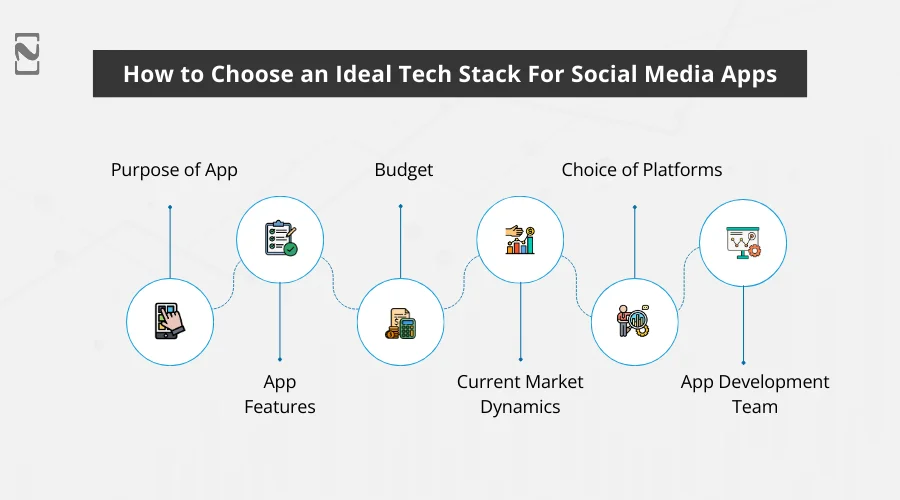
➤ Purpose of App
You should know the type of social media app and its purpose to launch in the market. Without understanding the aim of the app, you cannot select a suitable tech stack, right?
Thus, before starting the social media app business, check for the target users, market, and their changing demands. This is the most important factor that might change your opinion of selecting a tech stack.
➤ App Features
The functionalities and social media app features should be analyzed before selecting the right tech stack. You can segregate the core and advanced features and then select the tech stack accordingly.
The suitable tech stack for your target users can only be selected after identifying prominent features for the same. Thus, you should be aware of such features and then go for building the right tech stack.
➤ Budget
A decision over the cost of mobile app development impacts the selection of the tech stack and its implementation process in the case of social media.
Advanced tech stack solutions require you to invest a high cost. Thus, if you keep a small budget for implementing a suitable tech stack, your social media app must cover advanced technical solutions.
➤ Current Market Dynamics
The changing market demand and users’ preferences for the features within the social media app can affect the tech stack selection process. An inclination towards video content over social media apps and competitors’ strategies is among the most important factors to consider.
You should keep an eye on competitors’ strategies and current market preferences, as it will assist in selecting the latest tech stack suitable for your social media app.
➤ Choice of Platforms
The type of platform you select to launch a social media app has an impact on the tech stack. As we have already discussed for different types of platforms, the selection of certain tech stacks plays a vital role.
For iOS, you need to go for Swift and Xcode, for Android- Kotlin and Java, while for hybrid- React Native, Flutter, etc.
➤ App Development Team
The tech stack depends on how your selected app development team takes it. Hire mobile app developers who provide you with the right guidance on the tech stack selection and implement it accordingly.
You should have a team that understands the project requirements and then implements the tech stack accordingly. Additionally, the team should provide custom tech stack solutions as every app development process is unique.
These factors can also help you with the process of choosing the right tech stack solution for your next social media app.
Let Nimble AppGenie Simplify Selection of Tech Stack For Social Media App
With all that information covered, you might have gained clarity that it is not easy to identify the right tech stack for a social media app. However, in case all of it is quite complicated for you to make the right decision, do not worry, we are here to help!
At Nimble AppGenie, we not only offer social media app development services, but we also offer guidance on what you choose and why you should choose it.
All our experts are well-equipped to implement a custom tech stack for a social media app, making your application stand out from the competition.
All you have to do is reach out, share your ideas/requirements, and the rest will be done by our experts. Connect today and forget your confusion about choosing the right tech stack for a social media app.
Conclusion
You cannot expect an app without a tech stack, but selecting the right one is where the game begins. Before approaching the right tech stack, you should be aware of the basics, such as operations, programming language, database, front-end, and back-end elements.
There are different types of tech stacks for every platform; thus, you are required to select the platform, the purpose of the app, the development team, the budget, and the features, as they all impact selecting the ideal tech stack for social media apps.
Apart from these, reasons to select the right tech stack and cost should be considered before moving forward with your idea. Hopefully, the information shared in this post about the tech stack for a social media app gives you clarity. That will be all for this post. Thanks for reading, good luck!
FAQs
The primary components of a tech stack include:
- Front-end: User interface and user experience (UI/UX).
- Back-end: Server-side logic, data processing, and business functionality.
- Data layer: Data storage, retrieval, and management.
- Programming languages: Languages like Swift, Java, Python, and JavaScript.
- Operating system: iOS or Android.
- Cloud platform: AWS, Azure, or GCP.
- Additional tools: IDEs, version control, and build tools.
A well-chosen tech stack can:
- Improve performance: Ensure fast load times and responsiveness.
- Enhance scalability: Handle increasing user traffic and data.
- Strengthen security: Protect user data and prevent attacks.
- Enable seamless integration: Integrate with third-party services.
- Optimize user experience: Provide a smooth and intuitive interface.
Key factors include:
- App purpose: Understand the specific goals and features of your app.
- Target audience: Consider the preferences and demographics of your users.
- Budget: Determine your financial constraints.
- Development team expertise: Assess your team’s skills and experience.
- Time-to-market: Consider the desired launch date.
- Scalability: Plan for future growth and an increased user base.
- iOS: Typically uses Swift or Objective-C, Xcode, and SwiftUI.
- Android: Uses Kotlin or Java, Android Studio, and Jetpack Compose.
- Hybrid: Leverages frameworks like React Native, Ionic, or Flutter, along with JavaScript or Dart.

Niketan Sharma, CTO, Nimble AppGenie, is a tech enthusiast with more than a decade of experience in delivering high-value solutions that allow a brand to penetrate the market easily. With a strong hold on mobile app development, he is actively working to help businesses identify the potential of digital transformation by sharing insightful statistics, guides & blogs.
Table of Contents




No Comments
Comments are closed.