

 Free Consultation
 PCI-DSS Compliant
 GDPR Ready
 ISO 27001
 NDA Protected
 AI Services
 AI App Development
 Generative AI Development
 AI Chatbot Development
 AI Integration Services
 AI Consulting Services
 AI For Fintech
 AI Financial Assistant Solution
 AI Insurance Agent Development
 Tech Stack
 OpenAI / GPT-4
 Claude / Anthropic
 Gemini / Google AI
 Llama / Open Source
 LangChain / LlamaIndex
 Pinecone / Pgvector
 AWS / Azure AI


 Fintech Solution
 Core Fintech
 App Development
 Neobank Solutions
 eWallet Solutions
 Lending Software
 Banking Solutions
 BNPL Solutions
 BNPL Solutions
 Insurance App
 Wealth Management
 Crypto & DeFi
 Blockchain Development
  Payroll Software
 DeFi Solutions
 Crypto Wallet
 Crypto On/Off Ramp
 Crypto Exchange
 Trading Platform
 Payments
 Compliance
 Regulations & Compliance
 Fraud Detection
 Lending Ecosystem
 P2P Lending Platform
 Mortgage Software
 Engagement
 Fintech Outsourcing

 Mobile Development
 Mobile App Dev
 iOS App Development
 Android App Development
 React Native
 Flutter Development
 Web Solution
 Node.js Development
 React.js Development
 Angular Development
 App Services
 UI/UX Design
 App Maintenance
 By Stage
 MVP Development
 Industry Solutions
 Healthcare App Dev
 Education App Dev
 Travel App Dev
 Real Estate App Dev
 Logistics Software
 Social Media App

 Hire Mobile Developers
 Hire iPhone Developers
 Hire Android Developers
 Hire React Native Devs
 Hire Flutter Developers
 Hire Web Developers
 Hire Node.js Developers
 Hire Angular Developers
 Hire PHP Developers
 Hire Laravel Developers
 How It Works
 Pre-Vetted Developers
 Ready In 48 Hours
 NDA From Day One
 Replace Guarantee
 Company
 About Us
 Our Work Process
 Portfolio
 Case Studies
 Blog / Insights
 Careers
 Contact Us
 Awards
 Recognition


 Offices



Development approaches play a crucial role in bringing a mobile app idea to life. One of the most critical factors that businesses worry about is the time it will take to complete the project or the duration of the mobile app development process.
Estimating the project timeline is crucial for both businesses and developers as it gives them an edge in planning ahead. Agile development methodology is one of the most preferred approaches that allows developers to work together and reduce delays in deploying the final output.
Agile teams are generally a group of cross-functional resources who prefer working in sync, supporting each other while working within the Scrum framework. The approach promotes quick action and reaction to changes, making the overall process efficient.
However, since the resources are cross-functional, it can be difficult to identify how much time will be spent on developing the application. This is where Agile Estimation Techniques come into the picture.
In this post, let us explore the best Agile Estimation techniques and answer some of the key questions, like what these techniques are. How do they work? And more importantly, what are the benefits of implementing them?
So without further ado, let’s get started!
What is Agile Estimation?
In simple words, Agile Estimation is the process of identifying the probable time it would take to complete a project using Agile methodology. It is an iterative and collaborative process that aims to provide a realistic estimation of work based on available information and the team’s collective knowledge.
You see, when you have multiple resources who can work on individual tasks and can help each other when they have achieved their primary objective, you do not have enough clarity to identify the exact time it would take to complete the task.
Not to forget, several factors like complexity, time, risk involved, uncertainty, and relative size need to be considered when estimating the time.
Estimation is more of a collaborative process that Agile Teams take up, and it is certainly a dynamic process, as any member can update the estimation as per the data available at the time.
Agile Estimation needs the involvement of all the team members, as it is the resource that uncovers hidden complexities when working on the project.
Keeping these complexities in mind can certainly help in establishing the estimate.
What is the Importance of Running Agile Estimations?
When we talk about running estimations with the Agile software development methodology, we only feel that it is to identify an estimated timeline for the project completion.
What we do not realize is that running an estimation also helps in achieving several different objectives, the top being bringing the team together. Developing an app or working on a software project can often yield challenges such as changing priorities, hidden project complexities.
Agile Estimation can help in navigating these challenges easily, while ensuring that the timeline for development is predictable. With improved predictability, Agile Estimation allows your team to improve the delivery of the final product while simplifying the release plan for good.
If we talk about the importance of Agile Estimation for the team, it can be a game-changer, considering it eliminates miscommunication and helps in fostering an environment where consensus is a priority and discussions are promoted to ensure that workloads and responsibilities are managed realistically.
All in all, Agile Estimation can improve team collaboration and alignment. It gives you an idea of what the ideal pace to pursue your project and how the best efficiency can be achieved without compromising on work-life balance.
How to Achieve Efficient Agile Estimation?
Knowing how impactful Agile estimation can be, you are wondering how it can be achieved successfully. The complications in estimating the time required for project completion are extremely tricky and cannot be simply achieved by meetings and discussions.
There are different approaches to development and project management, and the estimation certainly depends on what approach you take.
Generally, Agile Estimation takes the “Bottom Up” approach where the team spends time making schedules, plans, mapping out tasks, and deliverables. This helps the team break down each task and estimate the development cost and development time.
Now, when we talk about achieving efficiency in the overall process, while ensuring that the deadline for the project is known to all, it is important to have an estimated timeline. And to achieve the same, there are several Agile Estimation Techniques that you can deploy.
These techniques are nothing but ways that help in identifying the estimated time, along with the effort and resources required to complete a project with an Agile approach. In the next section, let’s take a look at all the Agile Estimation techniques you can use to maximise the estimation effectiveness.
Related Read: SDLC vs Agile Development
What are Agile Estimation Techniques?
When implementing agile estimation, you can follow multiple techniques that can simplify the job for you. Before we jump into the techniques, it is crucial to understand the units that these techniques use.
You see, when implying any Agile estimation, you will have multiple units that you must know, as these are used to denote the estimations, for instance, story points, which are completed during the development phase, called a sprint.
For a better understanding of different units of agile estimation techniques, let’s take a closer look at them to understand how they work:
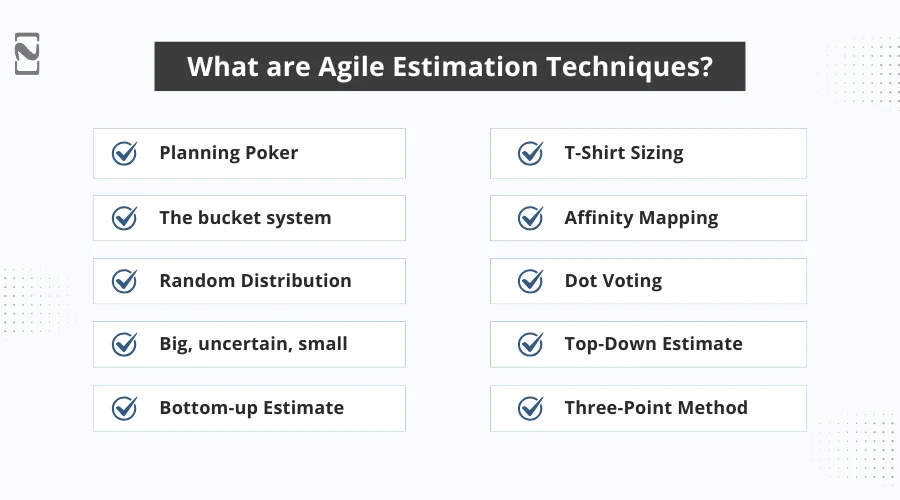
1] Planning Poker

The first and most common Agile Estimation technique is Planning Poker. The way it works is that the entire team plays a game of poker where instead of betting money, team members estimate the effort or complexity of a task.
Each team member is given a set of cards with numbers representing relative sizes based on the playing card value. The more is the value of the cards, the more complex the task is, according to the member.
For every task, every team member shows a card based on what they feel is the complexity of the task at hand. When the cards shown do not match between the teams, discussions begin.
The team discusses the task and then simultaneously reveals their chosen card. If there’s a wide discrepancy, the team discusses the reasons behind their estimates and repeats the process until a consensus is reached.
This technique brings the fun and excitement of a poker game to estimation, fostering collaboration and shared understanding
2] T-Shirt Sizing
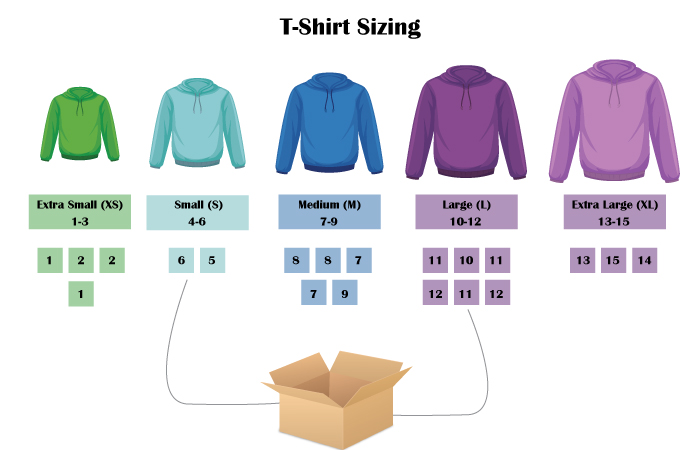
Another interesting approach to Agile Estimation is the T-Shirt Sizing technique.
In this agile estimation technique, tasks are named as different sizes of t-shirts: extra small (XS), small (S), medium (M), large (L), and extra large (XL) based on how complex the task is.
Team members assign a t-shirt size to each task based on their understanding of the effort required, complexity, and other relevant factors.
For instance, if the task is simple, it would be termed as XS, and if it is too complex and time-consuming, it will fall under XL. Any complexity between these two will fall as per the complexity.
Moreover, this technique provides a quick and intuitive way to gauge the relative size of tasks without getting too caught up in specific numbers.
3] The Bucket System
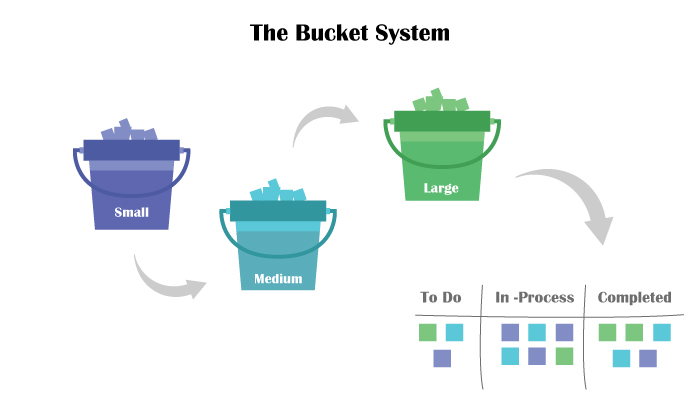
The bucket system is quite interesting. It basically helps in categorizing the tasks based on their complexity. Imagine this: a set of buckets labeled with different sizes or levels of effort, such as small, medium, and large.
Then the team places tasks into the appropriate buckets based on their estimated effort. In addition to this, the agile estimation technique allows for a rough categorization of tasks, making it easier to prioritize and allocate resources.
The buckets can be adjusted to match the team’s specific needs, providing a flexible and adaptable estimation approach. This also enables project managers to identify complex tasks and assign them to the team members as per their experience and expertise.
4] Affinity Mapping

This technique is a collaborative brainstorming exercise combined with estimation. Team members write down their estimates for different tasks on sticky notes. They then group similar estimates on a wall or board, creating clusters or affinity groups.
The technique revolves around mapping all the tasks and estimating the time it will take to achieve the completion status.
Through discussion and collaboration, the team can refine and consolidate the estimates within each group. Affinity mapping promotes transparency and shared decision-making, as the team collectively reaches a consensus on the estimates.
5] Random Distribution
Random distribution is one of the complex techniques, but it is definitely effective when it comes to yielding results.
This technique introduces an element of randomness to estimation. The team members write their estimates for each task on slips of paper and place them face down in a container.
The slips are then shuffled, and each team member randomly selects an estimate for each task. This approach encourages diverse perspectives and helps prevent bias or anchoring effects that can arise from influencing each other’s estimates.
Based on these perspectives and inputs from the members, finding the most accurate estimate becomes easy.
6] Dot Voting
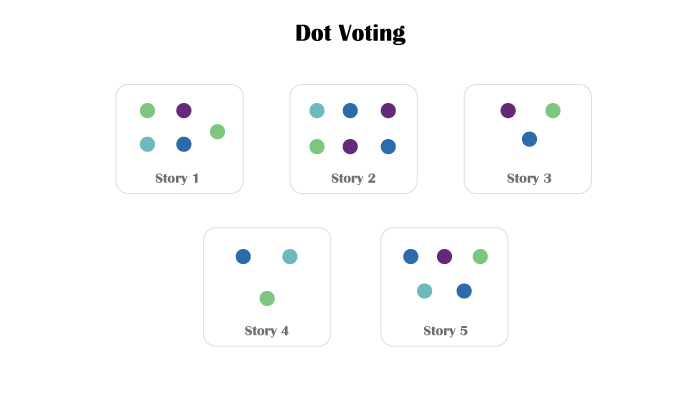
This agile estimation technique is both effective and complex at the same time. The way this works is that you create a wall covered in sticky notes, each representing a task. Each team member is given a certain number of dot stickers or markers.
Each member places their dots on the sticky notes representing the tasks they believe require the most effort or are the most critical.
This voting process allows the team to quickly identify tasks of higher importance or complexity, enabling effective prioritization and resource allocation.
The one with the most dots is considered complex and is accordingly shared among the members, giving the right estimation for the users.
7] Big, Uncertain, Small
This technique categorizes tasks into three main buckets: big, uncertain, and small.
The team collectively discusses each task and determines whether it falls into the big category (requiring significant effort and complexity), the uncertain category (with unclear or unknown requirements), or the small category (relatively simple).
This approach emphasizes the need for open communication and shared understanding while facilitating a high-level estimation of the work involved.
8] Top-Down Estimate
This estimation technique starts with an overall project estimate and then breaks it down into smaller components.
The team begins by estimating the effort and complexity of the entire project as a whole.
They then allocate percentages or fractions of the total estimate to different features or tasks based on their perceived importance or complexity.
This top-down approach provides a high-level view of the project and helps guide subsequent estimations at a more granular level.
9] Bottom-up Estimate
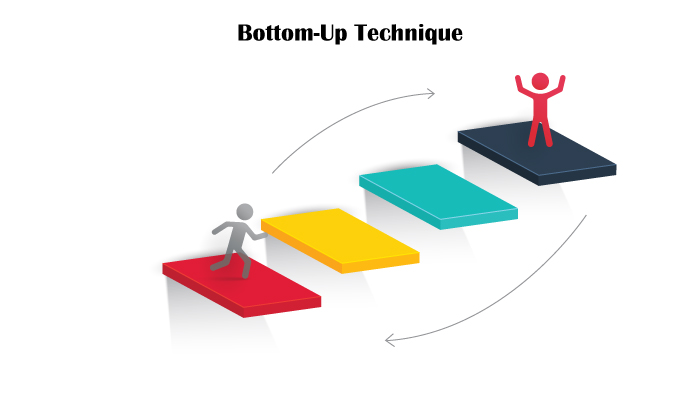
In contrast to the top-down approach, the bottom-up estimation technique focuses on breaking the project down into individual tasks or user stories.
Each task is estimated independently, considering effort, complexity, dependencies, and risks.
These individual estimates are then aggregated to obtain an overall estimate for the project.
The bottom-up approach encourages a detailed analysis of the work involved and promotes accurate estimations at a task level.
10] Three-Point Method
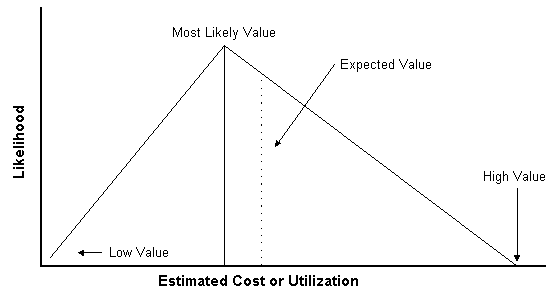
This method involves estimating tasks using three values: the most optimistic estimate (best-case scenario), the most pessimistic estimate (worst-case scenario), and the most likely estimate (realistic scenario).
Team members provide input by discussing and agreeing upon these three values for each task.
The estimates are then calculated using a weighted average or another appropriate method.
The three-point method helps account for uncertainties and risks, providing a more nuanced and reliable estimation.
How to Choose the Best Agile Estimation Technique for Your Project?
Now that you are familiar with different techniques and how they are implemented, you may be wondering how to choose the best one for your project.
Irrespective of how impactful these techniques appear, you can only opt for one for the sake of clarity. When deciding on the technique, you must pay attention to your project needs and the type of project you are working on.
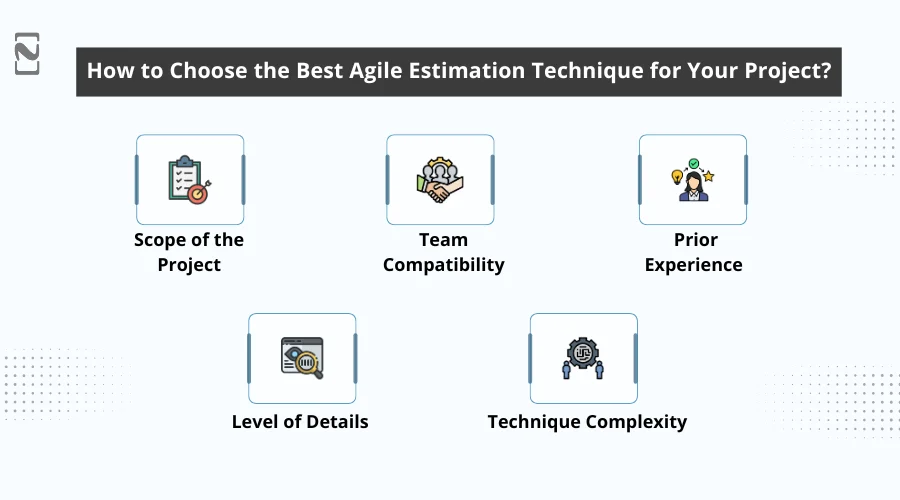
Here are some of the factors that you should keep in mind before choosing the right Agile Estimation Technique:
-
Scope of the Project
When choosing the right estimation technique, the first thing you need to do is understand the scope of the project. What exactly is the objective that you want to achieve? If the project is well-defined with limited tasks, you can go for Planning Poker.
Creating story points can simplify the project. On the other hand, if the project involves multiple options, you can go for T-shirt sizing as it is easy to classify tasks as required.
-
Team Compatibility
Before choosing an estimation technique for your project, you must identify the compatibility of your team. It is important to understand that not all members of the team may be on board for these activities or voicing their ideas.
You need to identify the collaboration styles and understand the level of understanding among your team. Choosing an Agile Estimation Strategy can help you develop better team compatibility, too; however, the members should participate for it to happen.
-
Prior Experience
If your team has already been a part of an estimation discussion before, it can surely help you identify what type of strategy they prefer. It also helps you understand the effectiveness of previously deployed strategies.
Check the history of estimations and identify what strategy got you the best and most accurate estimate for the project. This helps in making the right decisions without worrying about the success rate of the strategy.
-
Level of Details
Another key factor to consider when selecting the Agile estimation technique is understanding the level of detail you have about the project, or the level of detail you need about it.
You see, project estimations often fail due to the use of vague items, values, or entities. Hence, identify the level of vagueness in the project and then choose an Agile estimation method that gives clarity.
-
Technique Complexity
When choosing a solution, always consider its complexity and identify if your team will be able to keep up with the same.
For instance, creating story points can simplify the estimation process, but it can also get complicated to track them all. Similarly, dot voting can be another complex method for a team that is not familiar with the Agile Estimation Technique.
Making the decision becomes much easier when you have clarity on the objective. And when you have addressed all the mentioned factors, you will get enough understanding of what kind of Agile Estimation Technique is suitable for your project.
Ideally, you need experience to identify what kind of approach you need. Businesses generally leave it to the experts who are more skilled in mobile app development to decide the correct approach. All that matters in the end is the satisfaction of all the stakeholders in the process.
Hence, choosing the right team and asking the right questions can help you achieve the best results. One such right question is, who can help me with Agile development? If you, too, have the same question, then read the next section where you might find the answer!
Nimble AppGenie: Simplifying Agile Development Process
Taking the Agile approach towards mobile app development is certainly a good idea when you have found the right team. At Nimble AppGenie, we have some of the best mobile app developers who have enough experience to give you the best outcomes, including an estimated timeline for when they can deliver the final output.
We highly recommend that you hire an experienced agile development team from a mobile app development company instead of struggling with an in-house development, as it is more cost-effective and delivers better solutions. Our experts can help you understand Agile methodologies so that you can decide the course of action.
With Nimble AppGenie, the command is in your hands as you decide the time-to-market, and our professionals deliver. So what’s stopping you from winning the market? Connect with us today!

Conclusion
The idea of choosing an Agile Estimation Technique arises when you are using an Agile approach to completing a project. The first prerequisite is to have an Agile team that can work together.
Since the team members have multiple roles to play, identifying the exact number of resources deployed on the task and how much time it will take becomes difficult to estimate.
Agile Estimation allows you to understand the probability of finishing the task within the time decided, as it allows you to identify the post-deployment path. Hopefully, the techniques shared in the post will help you identify the right approach for your project. Choose the one that fits all the factors for your project.
Keep in mind that the team also matters when choosing the estimation technique. With that said, we have reached the end of this post. That will be all for this one. Thanks for reading.
Good luck!
FAQs
Agile estimation is the process of determining the effort or size of work items in Agile software development. It helps teams plan, prioritize, and allocate resources effectively.
Agile estimation provides valuable information for project planning, resource allocation, and setting realistic expectations. It helps teams prioritize work, identify dependencies, and manage scope effectively.
Some common Agile estimation techniques include Planning Poker, T-shirt sizing, Affinity mapping, Bucket system, and Dot voting. These techniques encourage team collaboration and relative sizing of work items.
Agile estimates are not meant to be precise predictions but rather provide a relative understanding of effort and complexity. The accuracy of estimates improves over time as the team gains experience and uses historical data to refine their estimations.
Agile estimation techniques are more focused on relative sizing and prioritization rather than fixed dates. However, teams can use velocity and historical data to forecast and make informed decisions about meeting project deadlines.

Richard Thomas is the Lead Architect at Nimble AppGenie, where he oversees the design and development of scalable, secure, and high-performance digital solutions. With deep expertise in software architecture, cloud infrastructure, and system integration, he plays a key role in transforming complex business requirements into robust technical frameworks. When he’s not architecting systems, he enjoys exploring emerging technologies and staying ahead of industry trends.
Table of Contents




No Comments
Comments are closed.