


Have you ever wondered why, despite good ideas and hard work, most startups never become successful? Well, because the reality is harsh. As per Failory, almost 90% of startups fail.
Many never reach stability, many run out of funding, others lose users, and many collapse. One main reason is 34% of startup failures trace back to “no market need.”
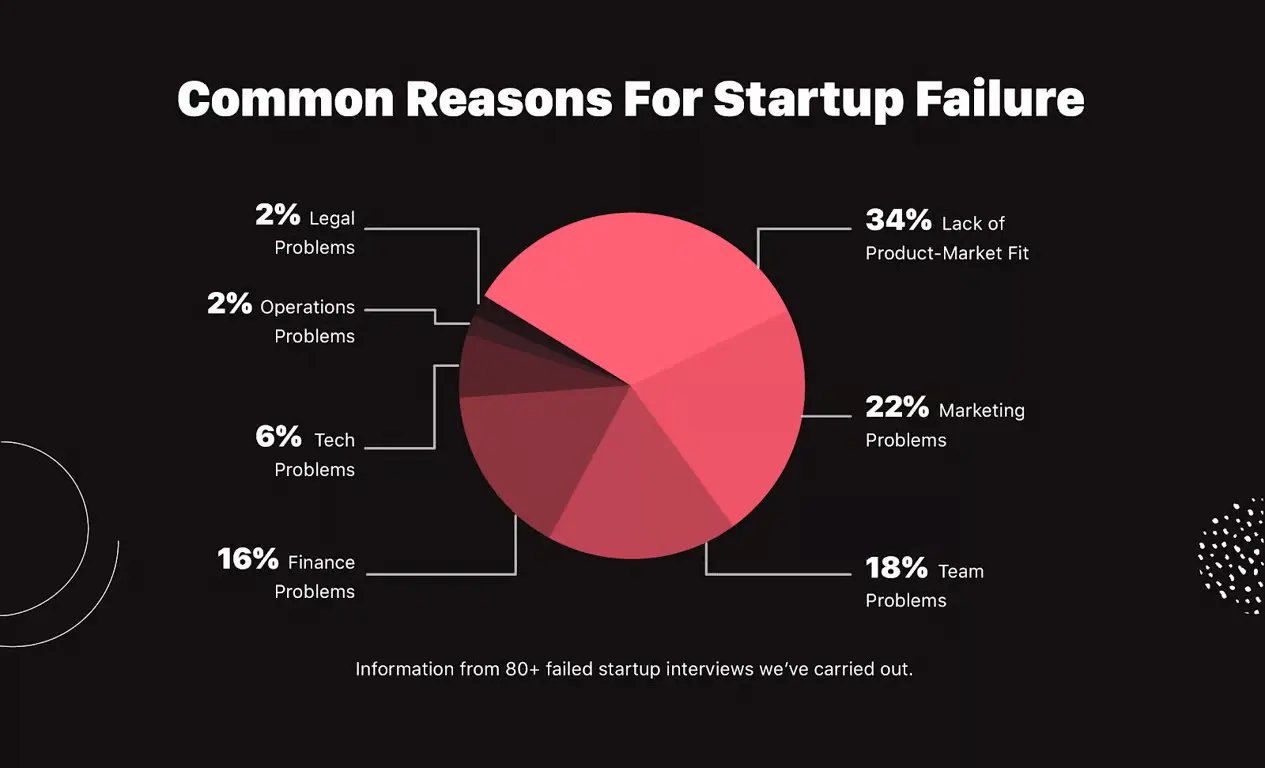
In other words, founders build features they think are cool, but users do not really need them. If you go ahead and build a full-featured app right away, that’s a heavy bet. You invest time, money, energy, and still, the odds are stacked against you.
But what if you could turn that risk into a smart experiment? What if you could test your idea before going all-in? With the MVP approach, you can launch quickly and start testing user responses without heavy investment.
For founders like you, who want to build an MVP app, it is a smart and strategic first move. Thus, in this guide, you will get a complete roadmap from idea to MVP, validation, iteration, and also show you how to avoid the pitfalls that cause most startups to fail.
So, let’s begin!
What Exactly is an MVP?
An MVP stands for minimum viable product. It simply means a working version of your app that covers only the most important, must-have features that are enough for people to use it, test it, and give feedback.
MVP is not your final version. It is not your perfect polished app. But it is your first usable version built with purpose and strategy. Basically, MVP is to validate your app idea.
Why is it called “Minimum” and “Viable”?
It is because:
- Minimum: You can include only the core problem-solving features and nothing extra.
- Viable: It must still be usable and not just a broken test or mobile app idea on paper.
So yes, a mobile app can be simple, but it should still provide value.
What is the Difference Between a Prototype and an MVP?
A prototype is like a rough sketch or model of your mobile app. It shows how things might look or flow, but it usually doesn’t actually work. You can click around, but it’s not a real app yet.
However, an MVP is the first working version of your app. It has just the core features required to solve the main problem. This way, real users can try it, give feedback, and you can see if your idea actually works in the real world.
Let’s thoroughly understand this to remember:
- Prototype = How it looks
- MVP = How it works
What does MVP mean to Business Owners?
Business owners do not see a minimum viable product as a mere experiment. For them, it’s about getting the most impact with the least investment. They want to create a product that customers will actually use, enjoy, and pay for. It’s not just something that proves a concept.
That’s why every decision revolves around the two critical elements of an MVP: minimum viable product. Additionally, the main motive is not to develop the perfect product right away.
The goal is to launch smart, attract real users, and start generating revenue, not to invest too much in unnecessary features. To do this well, you need to choose the right tech stack. This helps your first version of the product work properly.
A well-planned MVP helps business owners in the following ways:
- Only core features that keep your costs really low.
- Feedback guides improvements in the right direction.
- Early presence allows the product to gain traction and build credibility.
- By focusing on essentials, unnecessary investments are avoided.
Besides, a minimum viable product is not about testing your creativity; it’s a strategy to build something real, useful, and profitable. When it comes to a mobile app, knowing how to choose the right app development company can make all the difference between a product that just exists and one that customers actually love.
MVP App vs Full App: A Quick Comparison
Before we build an MVP app, let’s quickly take a look at the MVP vs full app comparison.
| Feature Type | MVP | Full App |
| Core functionality | Included | Included |
| Extra features | Not included | Included |
| UI/Design | Simple and clean | Fully polished |
| Speed to market | Fast | Slow |
| Costs | Low-moderate | High |
| Purpose | Validate the idea and learn | Scale and optimize |
So, the minimum viable product is your starting point and not your finish line.
Why an MVP Matters: Benefits of Building a Minimum Viable Product
Now that you understand what an MVP really is, the next question is: why should we build an MVP app? Well, it is because developing a minimum viable product helps you reduce risk, save resources, and validate your idea with real users. So, here are the other advantages you will gain.
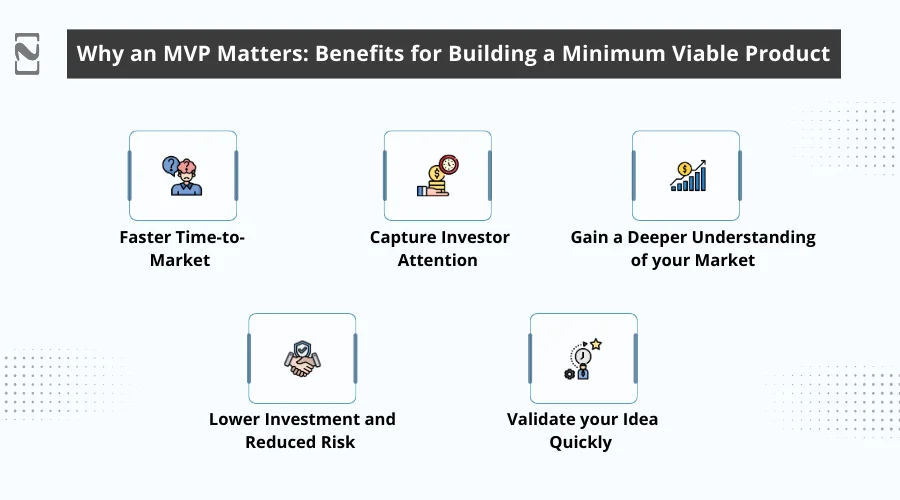
1. Faster Time-to-Market
When you build only the core features, your product reaches the market much faster. Instead of spending 6-18 months developing everything, it is best to launch an MVP app in 6-12 weeks (of course, depending on complexity).
This gives you an advantage, especially if:
- Your idea is time-sensitive
- The market is evolving quickly
- Competitors are building similar solutions
Being first does not always win. But being early helps you learn faster.
2. Capturing Investor Attention
Rather than only describing what you plan to build, you can demonstrate it through an MVP that people can actually use. When investors see real users interacting with your product, they become far more confident in your vision.
This also reassures them that you understand why MVP fails in many startups and that you’re avoiding those mistakes by validating early.
3. Gain a Deeper Understanding of your Market
MVP app development forces you to find your users’ challenges and observe how existing solutions try to solve them. In doing this, you often find opportunities that you might have overlooked if you jumped straight into building a complete product.
This level of research and discovery can reveal hidden problems, unmet needs, or market gaps that give you a competitive edge.
4. Lower Investment and Reduced Risk
Creating a full-fledged product requires a huge budget, more time, and more development cycles. But a minimum viable product helps you:
- Skip unnecessary features
- Avoid overspending early on
- Test whether people want this product
This approach also prevents you from wasting resources on mobile app design elements that users might not even need in the early stages.
Instead of investing a huge amount in the first release, you might spend $15,000-$50,000 for an MVP. However, it varies depending on the complexity, features, and tech stack. This keeps the startup financially healthy before funding.
5. Validate Your Idea Quickly
A minimum viable product centers on only the most important features, which means you avoid pouring time and money into something untested.
You can launch sooner, gather real feedback, and see how people respond to your idea in the real world. This approach helps you make smarter decisions before committing to a full product build.
What are the Business Benefits of Agile MVP Development?
Before we jump into how to build an MVP app, there’s one thing worth talking about: Agile. This is a common way dedicated development teams work today, and it makes minimum viable product development simple. So what’s the deal with it?
Basically, Agile means you’re always updating the product. You don’t have to wait for one huge phase to finish. You can fix the design, add new features, and improve all at the same time. Let’s take a look at what agile usually looks like when you and your team follow it:
- Keep a simple list of all the features you want in the MVP
- Every two weeks, you pick the most important things to work on
- Every two weeks, you check what went well and what didn’t
- You get a small chunk of the product delivered at the end of each cycle
- You try to work a little better and faster after every cycle
Many big brands like Google and Gamble use an agile methodology approach because it works and brings real business value. So when you use it for an MVP, you get things like launching sooner, building something people want.
Besides, they want continuous progress without long pauses, better results for your time and budget. Agile is not just for minimum viable products. It really helps with any digital product. Customers get something useful, and business owners get a product they can keep growing.
Steps to Build an MVP App
Once you have validated your idea and decided to move ahead, the actual MVP development process can begin.
The goal at this stage is not to build everything, but to build just enough to launch, learn, and improve. Below, we will guide you through all the steps to build an MVP app so that you can be prepared for challenges.
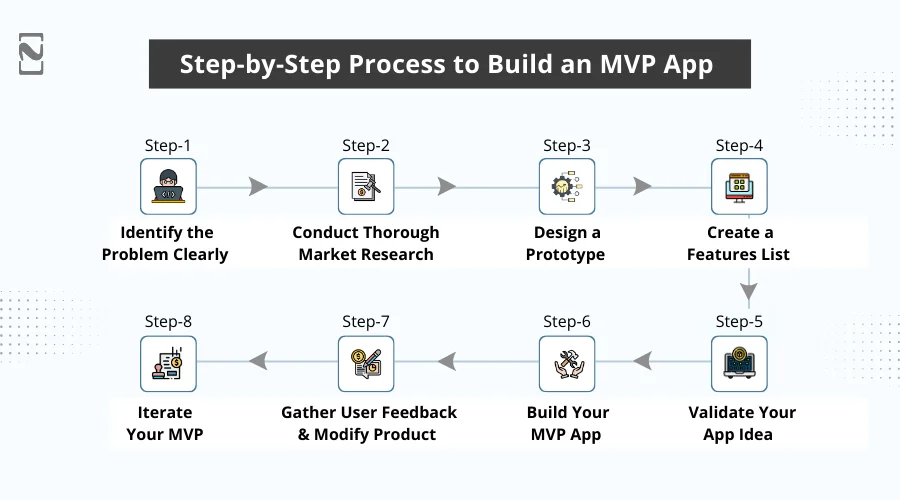
Step 1: Identify the Problem Clearly
Before you create an MVP app, you must clearly understand the problem you’re trying to solve. Once the problem is clear, the solution becomes very easy to design.
Although this sounds simple, finding the right problem often requires effort. You can take a look at the common ways to find real problems:
You Know the Industry Well
If you have thorough knowledge, you very frequently notice challenges others do not see. For example, in real estate, you might realize that many sellers struggle because their listing photos don’t attract buyers.
You’re Unhappy with Existing Options
Improvement starts with curiosity and questioning the status quo. When something feels outdated or inefficient, it might open the door to a new opportunity.
Someone mentions a Problem to you
If someone tells you about an issue they face, don’t assume it applies to everyone. Just check whether the problem is real, widespread, and important enough that people want a solution.
| The goal is simple: Validate the idea before you build an app. This helps you avoid wasting time, energy, and money. |
Step 2: Conduct Thorough Market Research
Once you’re confident the problem is real, the next step is to perform mobile app market research.
As you know, many startups fail because their product doesn’t solve a meaningful need. To avoid that, you must research thoroughly. Here’s what this stage includes:
Look at your Competitors
Firstly, you have to find out what competitors provide, what they charge, and what they lack. This helps you see where you can add value.
Define who your Product is for
Now, clarify your target audience, what their pain points are, and what they expect. This makes sure you’re developing with the right audience in mind.
Estimate how big the Market is
You have to make sure that there is a huge market for your solution. The best idea still fails if the market is too small.
| Tip: Good research also prevents financial mistakes. This is another major reason startups shut down early. |
Step 3: Design a Prototype
You might be thinking, Why do you need both a prototype and an MVP? The difference is really simple.
A prototype is a visual representation of your idea. But a minimum viable product is the first basic working version. A prototype helps you:
- See how the product will look.
- Validate user flow and experience.
- Collect user feedback before development.
But prototypes come in many forms. For example,
- Rough sketches and Paper layouts
- Mobile app wireframe
- Simple clickable models
Anything that tells how the product will function can help you visualize. However, if you skip the mobile app prototyping stage, it can lead to major mistakes later. History has shown that products built without early validation often struggle when they reach users.
| Did you know: The Color app failed because it launched without testing whether users actually wanted this behavior. |
Step 4: Create a Features List
Once the problem is clear, research is done, and your prototype reviewed, it’s time to decide which features you want in the MVP. It is vital to prioritize features because a minimum viable product includes only the essentials.
But if you add too many features at the start, it can create confusion, and your MVP progress will slow down. However, choosing which features to come first can be quite difficult, but below are multiple models that will help you:
MoSCoW model
It goes like must-haves, then should-haves, could-haves, and lastly won’t-haves.
Impact-Effort
You can compare the value, meaning revenue potential, with the effort required, meaning hours to develop.
ICE
You can prioritize features based on their Impact, Confidence (how sure you are about the impact), and Ease (how simple it is to create).
Besides, do not forget story mapping, which is vital for MVP planning. You show the user’s journey as a line from left to right.
Then, you list the features above and below it, with the most important ones at the top. This will give you a clear visual guide to which features are necessary for the MVP and which can wait for later.
| Tip: Story maps are very helpful for staying focused and avoiding unnecessary features. |
Step 5: Validate Your App Idea
Are you not sure whether your app idea is worth the investment? No worries! Before mobile app developers write code, you can test whether people are genuinely interested.
This step will help you validate demand, improve your idea, and avoid creating something no one wants. You can validate your idea in the following ways:
Landing Page MVP
First, you create a simple page that describes your product’s value and add a button for early sign-ups. Now track how many people interact with it to measure interest.
Concierge MVP
In this, you can deliver the service manually to early users. This helps you learn directly from them before you automate anything.
Wizard-of-Oz MVP
Now, users believe the product is fully functional, but behind the scenes, you’re doing the work manually. This tests real demand without the full app development.
Early sign-ups or pre-orders
If people are willing to commit before the product exists, that’s a strong signal.
Demo videos or simple mockups
A short video or interactive prototype can explain your idea and gather feedback.
| The main idea: You don’t require a fully-finished app to prove interest. Just validate your idea early to avoid costly mistakes later. |
Step 6: Build Your MVP App
Once you’ve finalized the feature set, it’s time to build an MVP app. Just remember that you have to focus on the must-have features; the main task is for your product to succeed. During the MVP app development process, your goal has to be to create an MVP that is:
- Clean and simple
- Stable and reliable
- Polished enough that users understand its value
But you have to avoid adding extra features or some complex ones. A real MVP helps you deliver value fast and gather feedback early.
Always remember that different minimum viable product types have different development time frames and scopes. So the process can vary depending on your strategy.
Step 7: Gather User Feedback and Modify Product
Once your MVP is developed, it’s vital to collect feedback from real users just after that. This will help you avoid unnecessary features that do not matter. It’s crucial to make sure you’re developing an app that people really require.
Additionally, you can use traditional methods like interviews, surveys, or simple conversations to understand user expectations. These direct insights help you identify what your audience values most.
However, if you want more structured input, you can use some already available feedback tools. It helps you gather suggestions and comments from multiple channels in just one place.
The sooner you start listening to users, the faster you can modify your MVP. Their feedback helps you understand which features require more attention and helps you shape the product roadmap.
Once your MVP is released, it is vital to keep track of important factors like:
- Average revenue per user
- Long-term customer value
- Percentage of users who stop using the product
These numbers help you know where the product is succeeding and where it requires modifications.
Step 8: Iterate on Your MVP
Before you release new updates, make sure you have a good system for getting feedback and planning what to build next. These steps will help you stay on track and keep improving your product.
Once your MVP is in users’ hands, keep making changes. Ask people what they think, test new ideas, and fix or improve things as you go. You can also take assistance from an app maintenance support and services provider.
This constant cycle is what helps you build a product people truly enjoy. And remember that research doesn’t stop once you start developing. It continues throughout the whole minimum viable product process.
How Much Does it Cost to Develop an MVP App?
The cost to build an MVP app can range between $25,000-$50,000 or more. However, this cost can vary depending on the product vision, feature set, design expectations, and technical stack. There is no universal figure, but the above cost is a realistic range that many startups fall into.
The more refined and production-ready the MVP needs to be, the higher the investment. Let’s look at the MVP app development cost breakdown to help you set the budget.
| MVP Tier | What It Usually Includes | Estimated Cost |
| Basic MVP | One core feature, simple workflow, basic UI, and limited integrations | $15,000-$25,000 |
| Standard MVP | Multiple essential features, strong UX, backend, payments, or API integrations | $25,000-$40,000 |
| High-Complexity MVP | Real-time features, advanced logic, AI automation, polished UX, multi-platform | $40,000-$50,000+ |
These numbers reflect the cost to develop an MVP app that feels functional and intentional. However, it is possible to develop something cheaper, it usually comes with trade-offs in usability, reliability, and long-term scalability.
What Impacts the MVP App Development Cost?
Multiple factors influence where your MVP lands in this range:

- Number of core features
- Design requirements
- Platform choice (Android, iOS, Both)
- Integrations with external APIs
- Infrastructure and scalability expectations
MVPs today need to be simple, but they also need to feel usable. Rushed or low-quality development often fails not because of the ideas, but because the experience does not meet basic user expectations.
Mistakes to Avoid While Developing an MVP App
When you make your first MVP app, it’s really easy to go off track. It is not because the idea is wrong, but because the process feels new and uncertain.
Every founder makes mistakes in the beginning, but there are a few patterns that come up again and again. If you avoid these early, you will save yourself a lot of time, stress, and cost. So, let’s have a look at the common mistakes to avoid while developing an MVP app.
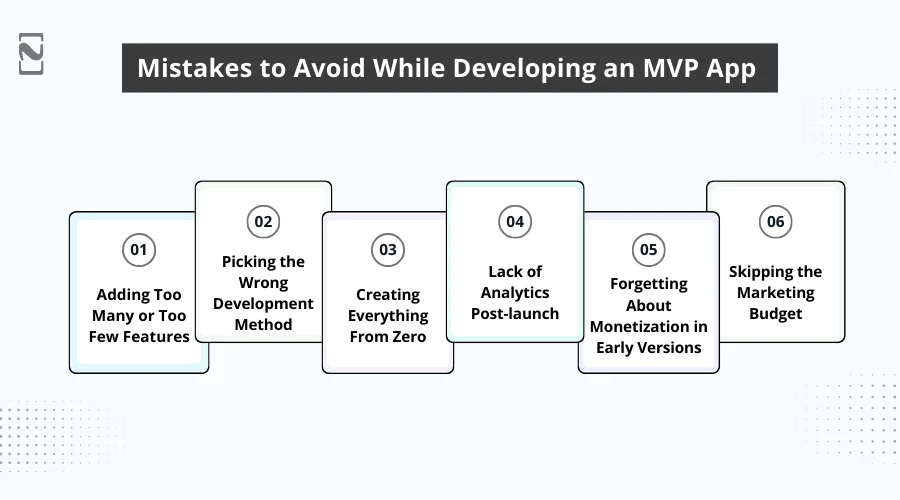
► Adding Too Many or Too Few Features
Try not to overload your MVP with too many features, but also don’t make it too empty. Every feature should matter and help your product bring value. It’s easy to get excited when early builds come to life. But new ideas should always be checked for cost, launch timing, and ROI.
Instead of integrating new advanced features in the middle of development, you can swap them with old ones or save them for later if they would not improve ROI.
► Picking the Wrong Development Method
Agile and lean are best for MVP app development. A fixed-price method can lock you into strict deadlines and budgets, which often leads to a product that doesn’t fully fit user needs.
MVPs are full of assumptions, and agile helps you test and update them as you go. It is vital to make sure your mobile app development team uses agile and keeps you updated throughout the project.
► Creating Everything From Zero
You don’t have to build every feature manually. There are lots of ready-made tools. SDKs, libraries, and APIs. This allows you to add features like chat or maps much faster. Instead, you can use safe and trusted third-party tools to speed up development.
► Lack of Analytics Post-launch
After launching the MVP, you need to track how it performs. Things like user growth, activity, or subscriptions. To do that, the app must be connected to analytics tools from the start. You can set up your app with an analytics service before launch.
► Forgetting About Monetization in Early Versions
If you’re planning to treat your MVP like a real product, it needs a clear way to earn money from day one. Users don’t care if something is just an MVP.
They see a finished product. It is vital to plan your app monetization model during the discovery stage, and subscription-based apps often show better results.
► Skipping the Marketing Budget
A common mistake is spending everything on development and leaving nothing for marketing. New apps appear every day, and without visibility, even a great product can go unnoticed. So, it is best that you plan your marketing spending before MVP work begins.
Why Making a Minimum Viable Product With Nimble AppGenie is the Best Idea?
Choosing who builds your MVP is just as important as the idea itself. When you work with Nimble AppGenie, you are not only hiring developers, you are working with a team that understands what early-stage products really need.
We don’t just start coding. We can help you validate the idea, define the right features, and plan the best way to launch. Since Nimble AppGenie is a trusted MVP app development company, we know how to keep things simple without lowering the quality.
The goal is to develop a version that users can use and give feedback on, not an unfinished product. Additionally, we work in small, clear steps, so you will always know what is happening and can make the changes along the way.
So, if you want an MVP development service, feel free to book a free consultation with us.

Conclusion
At last, if you build an MVP app, it’s not about cutting corners or releasing something unfinished. It is about learning fast and moving in the right direction with confidence. Instead of spending months developing every feature you can think of.
MVP helps you focus on what truly matters, which is solving one real issue for real users. Once you launch, the feedback you get becomes the greatest advantage.
It shows what to improve, what to add later, and sometimes what to remove completely. That is the real value of an MVP. It helps you build an MVP based on evidence, not assumptions.
Thus, if you have an idea, starting with an MVP is one of the best steps you can take. It is vital to keep focused, launch early, listen to users, and improve as you go. That’s how great products and great startups are built.
FAQs

Niketan Sharma, CTO, Nimble AppGenie, is a tech enthusiast with more than a decade of experience in delivering high-value solutions that allow a brand to penetrate the market easily. With a strong hold on mobile app development, he is actively working to help businesses identify the potential of digital transformation by sharing insightful statistics, guides & blogs.
Table of Contents
No Comments
Comments are closed.