Free Consultation
 PCI-DSS Compliant
 GDPR Ready
 ISO 27001
 NDA Protected
 AI Services
 AI App Development
 Generative AI Development
 AI Chatbot Development
 AI Integration Services
 AI For Fintech
 AI Financial Assistant Solution
 AI Insurance Agent Development
 Tech Stack
 OpenAI / GPT-4
 Claude / Anthropic
 Gemini / Google AI
 Llama / Open Source
 LangChain / LlamaIndex
 Pinecone / Pgvector
 AWS / Azure AI


 Fintech Solution
 Core Fintech
 Fintech App Development
 Neobank App Development
 eWallet App Development
 Payment Integration
 Lending Software
 BNPL Solution
 BNPL App Development
 Insurance App
 Investment App Dev
 Wealth Management App
 Crypto & DeFi
 DeFi App Development
 Crypto Wallet Dev
 Crypto Exchange Dev
 Trading Platform Dev
 Payments
 Compliance
 RegTech App Dev
 Fraud Detection
 Lending Ecosystem
 P2P Lending Platform
 Mortgage Lending
 Engagement
 Outsourcing Dev


 Mobile Development
 Mobile App Dev
 iOS App Development
 Android App Development
 React Native
 Flutter Development
 Web Development
 Node.js Development
 React.js Development
 Angular Development
 PHP / Laravel
 App Services
 UI/UX Design
 App Maintenance
 By Stage
 MVP Development
 Industry Solutions
 Healthcare App Dev
 Education App Dev
 Travel App Dev
 Real Estate App Dev
 Logistics Software
 Social Media App


 Hire Mobile Developers
 Hire iPhone Developers
 Hire Android Developers
 Hire React Native Devs
 Hire Flutter Developers
 Hire Web Developers
 Hire Node.js Developers
 Hire Angular Developers
 Hire PHP Developers
 Hire Laravel Developers
 How It Works
 Pre-Vetted Developers
 Ready In 48 Hours
 NDA From Day One
 Replace Guarantee

 Company
 About Us
 Portfolio
 Case Studies
 Blog / Insights
 Careers
 Contact Us
 Recognition


 Offices


Short Answer:
Start with a modular monolith for your core ledger and payments, then add event-driven patterns only when they earn their cost: fraud checks, notifications, analytics, reconciliation, and high-volume ingestion. Going fully event-driven from day one adds consistency and operational overhead most early fintechs don’t need. Going fully monolithic eventually restricts scaling and team autonomy. The hybrid path wins for most fintech teams.
If you are planning fintech app development, the backend decision shapes everything after launch: how safely you move money, how fast you ship, and how much your cloud bill and on-call rota impact. This guide offers a practical way to decide between an event-driven and a monolith-first backend, without the hype.
What Is a Monolith-First Backend in Fintech?
A monolith-first backend keeps core fintech functions, such as payments, accounts, KYC, ledger, and notifications, in one application with one main database. This helps teams launch faster and manage transactions easily; it can also split into separate services as the business grows.
A monolith doesn’t have to be messy. A modular monolith runs as one application but keeps each function (KYC, payments, lending, compliance, and ledger) separate. Each module communicates through defined interfaces instead of accessing another module’s database tables. This keeps domain ownership clear and makes it easier to separate modules into services later, without adding network calls or complex transactions between them.
Martin Fowler’s widely cited “Monolith First” advice supports this approach. He observed that almost all successful microservice stories started with a monolith that was later split, and that microservices carry a “premium” that slows small teams down. He also notes that even experienced architects find it challenging to draw stable service boundaries at the start (Martin Fowler).
What Is an Event-Driven Backend in Fintech?
An event-driven backend lets services communicate by publishing and subscribing to events, like “PaymentInitiated” or “KYCApproved,” through a broker like Apache Kafka or Amazon EventBridge. Producers don’t call consumers directly, reducing coupling and allowing services to scale independently.
The benefit is simple: you publish data once; multiple services can subscribe instead of connecting individually. AWS shares a real-world example from iFood, where the finance team split a slow monolith into three domain services linked through events. This reduced latency and boosted performance through asynchronous communication (AWS for Industries).
The trade-off is eventual consistency. A balance, fraud flag, or notification may take a moment to reflect the latest action. This works perfectly for many workflows but can be risky when you need an instant update.
Event-Driven vs Monolith-First: Side-by-Side Comparison
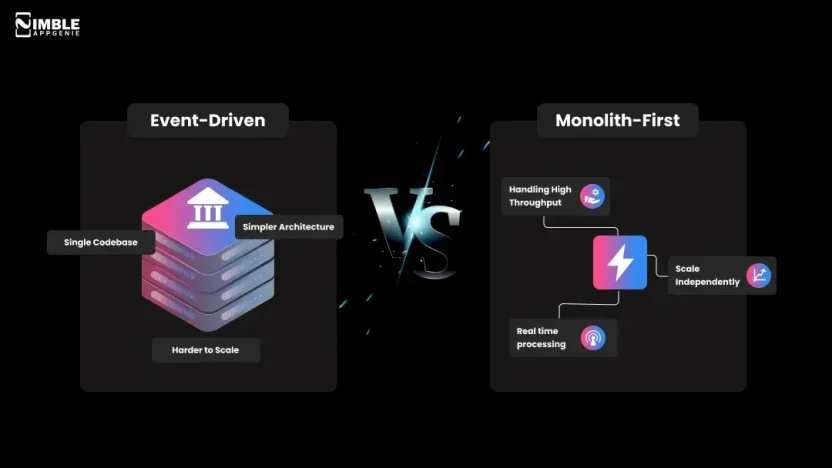
Monolith-first wins on atomic money movement, simplicity, and speed to market. Event-driven wins on fault isolation, independent scaling, and team autonomy. Neither is universally better; the right choice depends on your stage, compliance load, transaction volume, and team size.
| Factor | Monolith-First (Modular) | Event-Driven |
| Time to first release | Faster; one codebase and pipeline | Slower; broker, schemas and tracing first |
| Ledger consistency | Strong; one ACID transaction | Needs sagas, outbox and idempotency |
| Scaling | Scales the whole app | Scales hot services independently |
| Fault isolation | Weaker; one bad module can hurt all | Stronger; failures contained per service |
| Operations | Lower overhead | Higher: brokers, retries, dead-letter queues |
| Debugging | Single stack trace | Requires distributed tracing |
| Best for | MVPs, early growth, small teams | High volume, many teams, async workflows |
When Should a Fintech Choose Monolith-First?
Choose monolith-first when your team is small, your product is still changing, and your core flows (debit, credit, hold, and settle) should stay strictly consistent. While you validate the business, you iterate faster and fail less.
1. Early-Stage Products and MVPs
Before product-market fit, your domain boundaries are still assumptions. Splitting services too early turns those assumptions into costly-to-change network contracts. A modular monolith lets you adjust boundaries easily as you learn. If you are validating an idea, our MVP development approach follows the same logic.
2. Money Movement That Must Be Atomic
Debiting one account and crediting another should happen together or fail. In a monolith with one shared database, a standard ACID transaction manages this automatically. You don’t need extra logic or reconciliation to keep both balances in sync. With separate services and databases, you have to build this guarantee yourself.
When Does an Event-Driven Backend Make Sense for Fintech?
Adopt an event-driven approach when a specific workload needs stronger isolation, independent scaling, or reliable background processing. Common examples include fraud scoring, peak-load payment processing, notifications, KYC workflows, and audit streams.
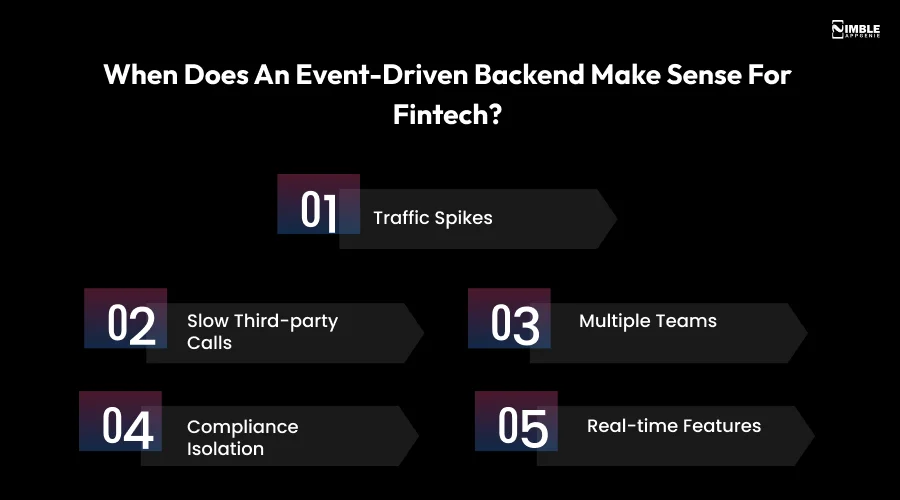
- Traffic Spikes: Payday or trading-hours bursts that overload shared database writes.\
- Slow Third-party Calls: KYC, bank APIs, and card networks that shouldn’t block users.
- Multiple Teams: Merge conflicts and release coupling slow delivery.
- Compliance Isolation: PII-heavy services that need a smaller blast radius.
- Real-time Features: Live balances, fraud signals, and alerts.
Look for measurable hurdles, such as database write conflicts during peak load and a slow dependency delaying user requests. If you can’t identify a clear problem, the added cost of managing a message broker, schemas, and tracing may not be worth it yet.
The Hybrid Path: Modular Monolith with Event-Driven Seams
A practical fintech backend is a modular monolith that publishes domain events at its boundaries. This keeps ledger transactions atomic while allowing you to move individual modules into separate services later without rewriting their business logic.
Fowler describes this as a common real-world approach: start with a monolith and gradually move services out from the edges while keeping the main core in place (Martin Fowler). In fintech, KYC, fraud scoring, and notifications are usually the first candidates because their performance, scaling, and compliance needs differ from those of the ledger.
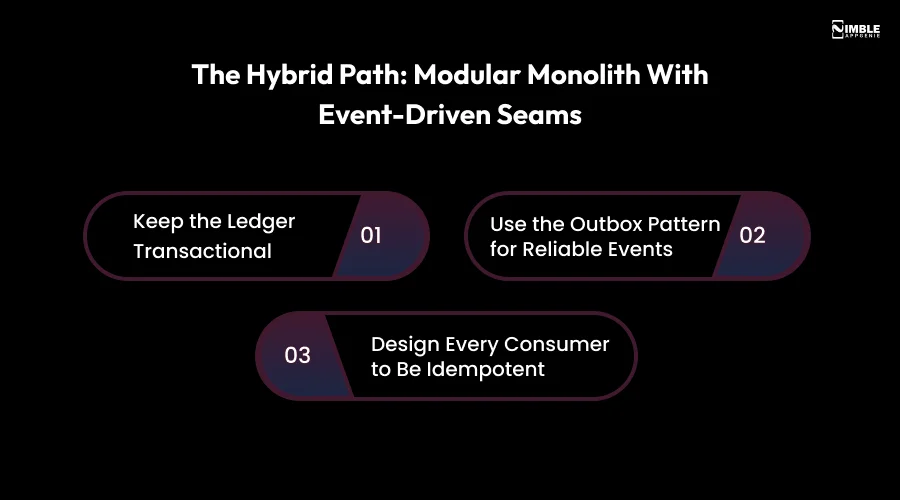
1. Keep the Ledger Transactional
Treat a relational database such as PostgreSQL as the source of truth for ledger entries and balances, and use double-entry rules to enforce invariants. The event stream should describe what happened, not replace the record.
2. Use the Outbox Pattern for Reliable Events
The outbox pattern saves both the database change and its event in an outbox table within a single transaction. A separate worker then sends the event to the message broker. This prevents a common failure where the database update succeeds, but the event is never sent. It also avoids the need for two-phase commit. However, the worker may publish the same event more than once, so consumers should handle duplicates (microservices.io).
3. Design Every Consumer to Be Idempotent
Kafka consumers commonly use at-least-once delivery, meaning they may receive the same event more than once. Use idempotency keys and processed-event tables so a duplicate never posts a second ledger entry or a second charge. Stripe’s API is a good model: a retried request with the same key returns the original result instead of repeating the operation. For multi-step flows across services, a saga with compensating actions (release the hold, reverse the debt) handles failures.
How Do Compliance and Security Affect the Choice?
Compliance favors clear boundaries and strong audit trails; both architectures can deliver. What matters is access control, auditability, incident reporting, and resilience testing, not the pattern itself.
In the EU, the Digital Operational Resilience Act (DORA) has been in force since 12 January 2025. It requires financial entities to manage ICT risk, report major ICT incidents, test resilience, and oversee third-party providers (DLA Piper). Event streams can provide immutable audit logs and traceability; however, they also add more components to manage, increase third-party risks, and expand incident reporting scope. Check your own obligations with legal counsel; our overview of fintech regulations is a starting point.
From a security perspective, smaller services can limit the breach impact, while a monolith offers a single perimeter to secure. Whichever approach you choose, plan for encryption, least-privilege access, and continuous monitoring. You can also use AI fraud detection as an event consumer to identify suspicious activity.
Migration Roadmap: From Monolith to Event-Driven, Step by Step
Migrate gradually. Start by defining clear boundaries, then add events within the monolith. Extract one module at a time and measure the results. Avoid a complete rewrite, as it can slow feature delivery and increase risk.
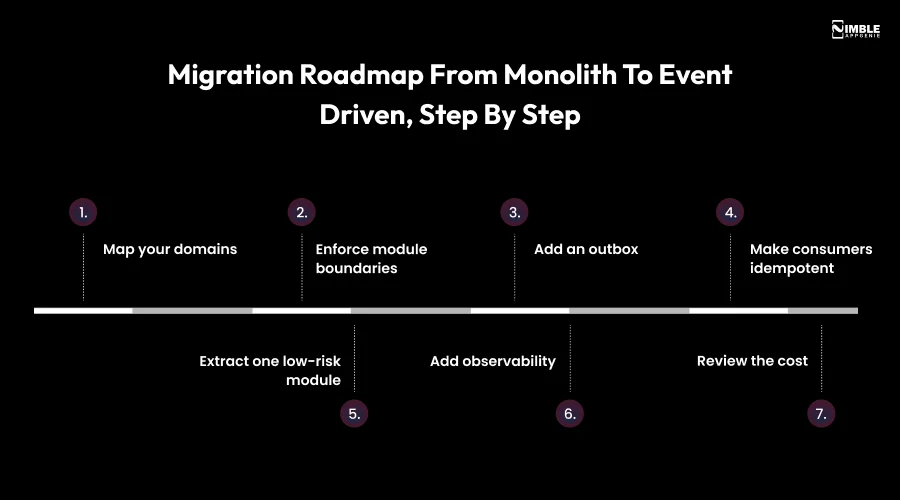
- Map your domains: Run event-storming sessions to find bounded contexts (iFood used this to find its three domains).
- Enforce module boundaries in code with no cross-module table access.
- Add an outbox and publish domain events from inside the monolith.
- Make consumers idempotent and add retries and dead-letter queues.
- Extract one low-risk module, such as notifications; then a high-value one, such as KYC.
- Add observability: Distributed tracing, lag monitoring, and reconciliation jobs.
- Review the cost: If a split hurts more than it helps, consolidate.
The last step is real. Amazon Prime Video reported cutting infrastructure costs by over 90% after moving one video-monitoring service from distributed components to a single-process design (DevClass). It was a streaming tool, not a payments system, and it was one service rather than a whole platform, so use it as a lesson in questioning complexity, not as a rule.
Common Mistakes Fintech Teams Make
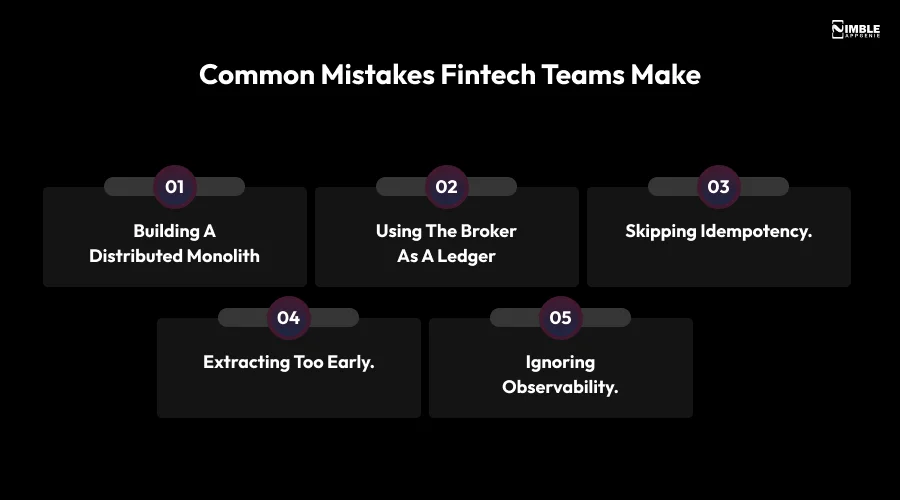
- Building a distributed monolith. Services that call each other synchronously and share a database give you microservice costs with monolith coupling.
- Using the broker as a ledger. Events are a log of change; the transactional database stays authoritative.
- Skipping idempotency. Retries without keys cause duplicate charges.
- Extracting too early. Boundaries drawn before understanding the domain are costly to redraw.
- Ignoring observability. Async systems fail quietly without tracing and alerts.
Quick Decision Checklist
If most answers below are “no,” stay with a modular monolith. If most are “yes,” invest in event-driven for those modules.
- Do you have more than one team shipping to the same codebase weekly?
- Does one module need 10x the capacity of the rest at peak?
- Do external API delays block user-facing requests?
- Do regulators or partners require isolating a data domain?
- Do you already have people who can operate a broker in production?
Conclusion: Start Simple, Split with Evidence
For most fintech companies, a modular monolith with clear domain boundaries, an outbox pattern, and idempotent consumers is a practical starting point. Add event-driven services only when performance metrics show a clear need. This keeps transactions reliable today while leaving room to scale as the business grows.
Planning a neobank, eWallet, or lending platform? Explore how we built a multi-currency wallet in the Swap Africa case study or learn more about our fintech API integration work.
FAQs

Niketan Sharma, CTO, Nimble AppGenie, is a tech enthusiast with more than a decade of experience in delivering high-value solutions that allow a brand to penetrate the market easily. With a strong hold on mobile app development, he is actively working to help businesses identify the potential of digital transformation by sharing insightful statistics, guides & blogs.