

 Free Consultation
 PCI-DSS Compliant
 GDPR Ready
 ISO 27001
 NDA Protected
 AI Services
 AI App Development
 Generative AI Development
 AI Chatbot Development
 AI Integration Services
 AI Consulting Services
 AI For Fintech
 AI Financial Assistant Solution
 AI Insurance Agent Development
 Tech Stack
 OpenAI / GPT-4
 Claude / Anthropic
 Gemini / Google AI
 Llama / Open Source
 LangChain / LlamaIndex
 Pinecone / Pgvector
 AWS / Azure AI


 Fintech Solution
 Core Fintech
 App Development
 Neobank Solutions
 eWallet Solutions
 Lending Software
 Banking Solutions
 BNPL Solutions
 BNPL Solutions
 Insurance App
 Wealth Management
 Crypto & DeFi
 Blockchain Development
  Payroll Software
 DeFi Solutions
 Crypto Wallet
 Crypto On/Off Ramp
 Crypto Exchange
 Trading Platform
 Payments
 Compliance
 Regulations & Compliance
 Fraud Detection
 Lending Ecosystem
 P2P Lending Platform
 Mortgage Software
 Engagement
 Fintech Outsourcing

 Mobile Development
 Mobile App Dev
 iOS App Development
 Android App Development
 React Native
 Flutter Development
 Web Solution
 Node.js Development
 React.js Development
 Angular Development
 App Services
 UI/UX Design
 App Maintenance
 By Stage
 MVP Development
 Industry Solutions
 Healthcare App Dev
 Education App Dev
 Travel App Dev
 Real Estate App Dev
 Logistics Software
 Social Media App

 Hire Mobile Developers
 Hire iPhone Developers
 Hire Android Developers
 Hire React Native Devs
 Hire Flutter Developers
 Hire Web Developers
 Hire Node.js Developers
 Hire Angular Developers
 Hire PHP Developers
 Hire Laravel Developers
 How It Works
 Pre-Vetted Developers
 Ready In 48 Hours
 NDA From Day One
 Replace Guarantee
 Company
 About Us
 Our Work Process
 Portfolio
 Case Studies
 Blog / Insights
 Careers
 Contact Us
 Awards
 Recognition


 Offices


Key Takeaways:
- GDPR applies to any app with EU users, and fines reach €20 million or 4% of global annual revenue.
- India’s DPDP Act is now in active enforcement. Full compliance is required by May 2027.
- CCPA/CPRA mobile app data privacy compliance gives users the right to opt out of data sales, and yes, it applies to your app if you have California users.
- Brazil’s LGPD, China’s PIPL, Thailand’s PDPA, and 10+ other global laws may apply to your app based on where your users live.
- Consent is the #1 compliance issue globally. It must be specific, informed, freely given, and easy to withdraw.
- Privacy by Design means building data protection into your app from day one, not as a legal patch after launch.
- Third-party SDKs are your responsibility; if they violate privacy laws, you get fined.
- App stores have their own privacy rules. Apple and Google can remove your app for non-compliance.
When most app founders and developers think about app development, mobile app data privacy compliance is usually near the bottom of the list. You are thinking about features, design, and speed. Maybe the App Store review process. Privacy? That feels like a legal department problem.
But here is the truth in 2026. Data privacy is everyone’s issue, and the consequences of getting it wrong are very real. TikTok was fined €530 million by GDPR regulators in 2025 for routing EU user data to China. Meta has paid over €1.2 billion in GDPR penalties.
Thousands of apps have been removed from the App Store and Google Play for non-compliance. And now, India’s DPDP Act, Brazil’s LGPD, California’s CCPA, China’s PIPL, and more than a dozen other laws globally are actively being enforced.
For a mobile app, this means one thing. If your app collects user data, and almost every app does, you need to know which privacy laws apply to you and what they require.
The good news? Compliance does not have to be that complicated. This guide breaks down everything you need to know about global mobile application data privacy compliance in 2026, with a checklist you can use today.
So, let’s begin!
The Global Privacy Landscape in 2026: A Quick Map
Nowadays, the world is no longer a place where privacy laws existed only in Europe. As we are in the first quarter of 2026, every major economy has its own data protection rules. Many of them apply to mobile applications beyond their borders.
We have created a table of the major mobile app data privacy compliance requirements you may require to comply with. Let’s take a look:
| Law | Region | Max. Penalty | Who It Covers | Key Requirements |
| GDPR | European Union | €20M / 4% global revenue | Any app with EU users | Explicit consent, data rights, 72hr breach notice |
| DPDP Act | India | ₹250 crore (~$30M) | Any app with Indian users | Consent, grievance officer, children’s data protection |
| CCPA / CPRA | California, USA | $7,500 per violation | Apps serving California residents | Right to opt out of data sales, transparency |
| LGPD | Brazil | 2% of Brazil’s revenue | Apps serving Brazilian users | Consent, data subject rights, DPO appointment |
| PIPL | China | ¥50M / 5% of revenue | Apps serving Chinese users | Consent, data localization, cross-border restrictions |
| PDPA | Thailand | Up to THB 5M | Apps with Thai users | Purpose limitation, consent, breach notification |
| POPIA | South Africa | ZAR 10M | Apps with South African users | Data minimization, consent, information officer |
| PIPEDA | Canada | CAD 100,000 | Apps with Canadian users | Consent, transparency, and data security safeguards |
| APP Act | Australia | AUD 50M+ | Apps with Australian users | Privacy by design, notifiable data breach scheme |
| APPI | Japan | Up to JPY 100M | Apps with Japanese users | Consent, data handling policies, breach notification |
| KVKK | Turkey | Up to TRY 1M | Apps with Turkish users | Explicit consent, data localization requirements |
The single most vital point to understand from this table is that most of these laws have extraterritorial reach. In simple words, they apply to your application based on where your target audience is and not where your company is registered.
GDPR: The Law That Set the Global Standard
GDPR is a general data protection regulation, a European data privacy and security law. Let’s get to know about GDPR compliance for mobile apps in detail.
Does GDPR Apply to Your App?
GDPR compliance was approved by the European Union in 2018 and has since become the world’s most influential privacy law. Here is the part that most of the developers miss.
| As per GDPR compliance guidelines, it does not just apply to EU-based companies. It applies to any mobile app or website that is used by people living in the EU, regardless of where the app company is located. |
So, if someone in Germany, France, or Spain downloads your mobile app, no matter if you are a startup in New York or a company in Sydney, GDPR applies to you.
What Counts as Personal Data Under GDPR?
Under GDPR compliance, personal data is almost anything that can identify a person, directly or indirectly. For mobile applications, this covers:
- Name, email address, contact number
- Device ID, IP address, advertising ID
- GPS location data
- Biometric authentication data
- Health and fitness data
- In-app behavioural data
- Payment and financial information
What Are the 7 GDPR Principles?
Everything in GDPR is created on 7 core principles:
- Lawfulness, fairness, transparency: It tells users what you collect and why.
- Purpose limitation: Only use data for the particular reason you collected it.
- Data minimization: It collects only what you actually need.
- Accuracy: It keeps user data correct and up to date.
- Storage limitation: It does not hold onto data longer than necessary.
- Integrity and Confidentiality: It protects data with appropriate security measures.
- Accountability: Be able to demonstrate and prove your compliance.
Consent: The #1 GDPR Mistake Mobile Apps Make
The valid GDPR permission is not a default checkbox, a buried clause in your Terms of Service, or a single “Accept All” button that covers everything. It must be:
- Freely given: The users must be able to say no and still use core app features.
- Specific: The separate consent for analytics, marketing, and advertising.
- Informed: the users must understand exactly what they are agreeing to.
- Unambiguous: A clear, affirmative action as I agree.
- Withdrawal: The users must be able to change their minds just as easily as they gave consent.
Bundled consent, one big checkbox that covers everything, is one of the most common reasons apps get GDPR fines. If your mobile app does this, it is vital to fix it before regulators notice.
GDPR Fines in 2026
GDPR fines for mobile apps in 2026 are not really theoretical. Since 2018, more than €7.1 billion, with over €1.2 billion issued in 2025 alone, in total penalties have been issued.
The maximum fine per violation is €20 million or 4% of your company’s global annual revenue, whichever is higher. Besides, small mobile applications have faced five and six-figure fines for consent violations.
India’s DPDP Act: The Law Every App Developer Needs to Know
India’s DPDP Act, or Digital Personal Data Protection Act as signed into law in August 2023 and is now being implemented in phases. It is India’s first in-depth federal data privacy law, modeled closely on GDPR, but with some vital differences.
With more than 700 million smartphone users in India and one of the world’s largest growing mobile app markets, this aw matters enormously for any mobile app developer targeting Indian users.
What is the DPDP Act for mobile apps?
Just like GDPR, the India DPDP Act mobile app has extraterritorial reach. An app that collects or processes data of users located in India must comply, regardless of where the app company is based.
If you are a startup in Bangalore or a company in Silicon Valley, if Indian users download and use your mobile app, the DPDP Act applies to you.
DPDP Enforcement Timeline
The DPDP Act is being rolled out in three phases. Let’s see what you need to know:
| Phase | Date | What Happens |
| Phase 1 | November 13, 2025 | The Data Protection Board of India (DPBI) was established. Active now. |
| Phase 2 | November 13, 2026 | Consent Manager registration opens – prepare your consent flow. |
| Phase 3 | May 13, 2027 | Full enforcement: consent, breach notifications, user rights, security. |
2026 is your preparation window. Full enforcement arrives in May 2027. The companies that begin now will be ready. The ones who wait will be scrambling and potentially facing fines up to $250 crore, which is more than $30 million.
Key Obligations for Mobile Apps Under DPDP
- Obtain valid consent: Free, specific, informed, and unambiguous, just like GDPR.
- Provide clear privacy notices: In simple language, including regional Indian languages where applicable.
- Honor user rights: Right to access, correct, and erase personal data.
- Report data breaches within 72 hours: Notify the DPBI and affected users.
- Appoint a Grievance Officer: Users must be able to raise complaints and get a resolution.
- Special protection for children’s data: Verifiable parental consent required for users under 18.
DPDP vs GDPR: Side-by-Side Comparison
Take a look at the table below of the difference between GDPR and DPDP Act for a better understanding.
| Feature | GDPR (European Union) | DPDP Act (India) |
| Controller name | Data Controller | Data Fiduciary |
| User name | Data Subject | Data Principal |
| Enforcement body | National DPAs (ICO, CNIL, etc.) | Data Protection Board of India |
| Unique concept | Data Protection Officer (DPO) | Consent Manager |
| Sensitive data | Explicitly defined categories | Not separately defined |
| Legal bases | Multiple (consent, legitimate interest, etc.) | Primarily consent-based |
| Max penalty | €20M or 4% global revenue | ₹250 crore (~$30M USD) |
| Children’s age | Under 16 (varies by member state) | Under 18 |
| Cross-border transfer | SCCs, adequacy decisions | Govt whitelist (to be notified) |
| Breach notification | 72 hours to DPA | 72 hours to DPBI + affected users |
CCPA and CPRA (California, USA): The American Privacy Standard
The California Consumer Privacy Act (CCPA) and its amendment, the California Privacy Rights Act (CPRA), are California’s flagship data privacy laws. They apply to any for-profit business that does business in California and meets at least one of these thresholds:
- Annual gross revenue over $25 million
- Buys, sells, or receives personal data of 100,000+ consumers or households annually
- Earns 50%+ of annual revenue from selling or sharing consumers’ personal information
If your company does not depend on the USA, if California residents use your app, and you meet these criteria, the CCPA mobile app compliance applies to you.
Key CCPA Rights for Mobile App Users
- Right to know: What data you collect, why, and who you share it with.
- Right to delete: Request that you delete their data.
- Right to opt out: If the ‘sale’ or ‘sharing’ of their personal information.
- Right to correct: Inaccurate personal information.
- Right to limit: The use of sensitive personal information.
- Right to non-discrimination: You cannot charge higher prices or offer worse service to users who exercise their rights.
CCPA vs GDPR: Major Differences
Now that you have a clear understanding of both the security and compliance for digital lending apps, fintech apps, or others, it is best to see the major difference between CCPA and GDPR.
| Feature | GDPR (EU) | CCPA/CPRA (California) |
| Who it protects | All EU residents | California residents |
| Consent model | Opt-in required | Opt-out model (some opt-in for minors) |
| Data sales | No explicit provision | Right to opt out of data sales |
| Right to delete | Yes | Yes |
| Data portability | Yes | Yes |
| Max fine | €20M or 4% global revenue | Businesses with $25M+ revenue or 100K+ users |
The important difference is that CCPA is largely opt-out. Users have to actively ask you to stop selling their data. GDPR is opt-in. You need permission before you do anything.
COPPA: If Your Mobile App Serves Children
If your mobile app is directed at children under 13 in the USA, the Children’s Online Privacy Protection Act or COPPA applies. It needs:
- Verifiable parental consent before collecting any data from children
- A clearly written privacy policy with specific required disclosures
- Parents’ ability to review, correct, and delete their child’s data
- Restrictions on data retention and third-party disclosure
COPPA violations can result in fines of up to $51,744 per violation, and regulators take children’s privacy very seriously.
Brazil’s LGPD: The Latin American Privacy Framework
Brazil’s Lei Geral de Proteção de Dados, which is also called LGPD, is Brazil’s in-depth data protection law, closely modeled on GDPR. It applies to any firm that processes personal data of individuals in Brazil, no matter if the company is based outside Brazil.
Additionally, Brazil has more than 185 million internet users and is one of the world’s most engaged mobile app markets. For any app with a Latin American user base, LGPD mobile app data privacy compliance is non-negotiable.
Key LGPD Requirements for Mobile Apps
- 10 legal bases for processing, such as consent, legitimate interest, and legal obligation.
- Data subject rights include access, correction, deletion, data portability, and objection.
- Appointment of a Data Protection Officer (DPO) for larger organizations.
- Data breach notification to the Brazilian National Data Protection Authority (ANPD) and affected individuals.
- Privacy impact assessments for high-risk processing.
- Fines up to 2% of revenue in Brazil, capped at R$50 million, or in dollars, it is more than $10 million per violation.
China’s PIPL: The World’s Strictest Data Localization Law
China’s Personal Information Protection Law came into effect in November 2021. It is one of the most comprehensive and restrictive data privacy laws in the whole world. Any mobile app that processes data of Chinese users, or provides goods and services to people in China, must comply.
What Makes PIPL Unique?
- Data localization: Your sensitive personal information and important data must be stored on servers within China.
- Cross-border transfer restrictions: transferring data out of China needs a government security assessment, standard contract, or certification.
- Consent-based by default, with specific categories requiring separate, explicit consent.
- Extra rules for important internet platform operators ike apps with very large user bases.
- Fines up to ¥50 million or 5% of annual revenue, and potential app bans.
| Important: If your app has Chinese users, you almost certainly need data infrastructure inside China. This is not optional; it is a hard technical requirement under PIPL. |
Asia-Pacific Laws: A Region That Is Moving Really Fast
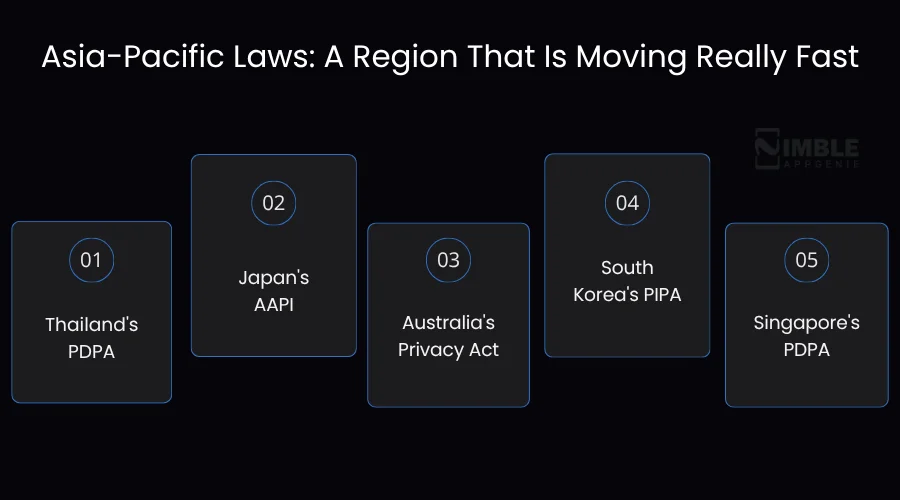
Asia-Pacific countries are rapidly updating their laws to keep up with new technology. Each country has its own rules, so you must stay careful, know local laws, and adjust fast to avoid problems and grow smoothly. Below is the Asia-Pacific compliance.
-
Thailand’s PDPA
Thailand’s Personal Data Protection Act has been fully enforced since 2022. It is closely modeled on GDPR and applies to any organization that collects, uses, or discloses personal data of individuals in Thailand.
The major requirements are consent, a privacy notice, data subject rights, and breach notification. The fines go up to THB 5 million, which is around $140,000 approx.
-
Japan’s AAPI
Japan’s Act on the Protection of Personal Information (APPI) was significantly updated in 2022. It needs consent for sensitive data, mandatory breach notifications, and proper handling policies.
Mobile applications with large Japanese user bases face additional obligations, and fines were substantially increased in the 2022 amendments.
-
Australia’s Privacy Act
Australia’s Privacy Act (1988), reformed through the Privacy Legislation Amendment Act, covers any organization with an annual turnover of more than AUD 3 million that collects personal information of Australians.
The Notifiable Data Breach scheme requires reporting serious data breaches to the Office of the Australian Information Commissioner and affected individuals. Penalties were dramatically increased and can now reach AUD 50 million or more for serious or repeated violations.
-
South Korea’s PIPA
South Korea’s Personal Information Protection Act is one of Asia’s strictest privacy laws. It needs explicit consent for collection, strict limits on third-party sharing, data localization for some categories, and breach push notification within 24 hours. Non-compliance can result in criminal penalties in addition to fines.
-
Singapore’s PDPA
Singapore’s Personal Data Protection Act governs the collection, use, and disclosure of personal data by private sector firms. It needs a designated Data Protection Officer, a written data breach response plan, and notification to the PDPC within 3 days for major benefits. Fines can reach SGD 1 million.
Africa and the Middle East: Emerging Privacy Markets
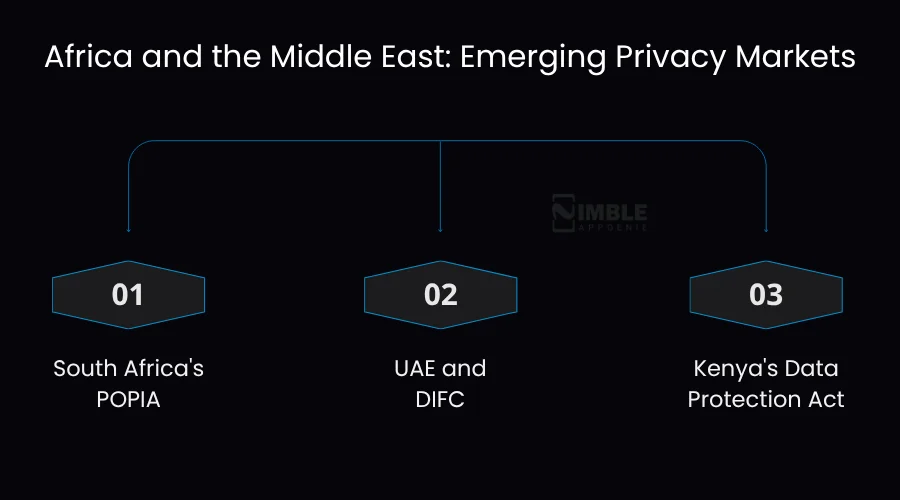
Below are the emerging privacy markets in Africa and the Middle East. It is growing, and new data laws are pushing businesses to focus more on user safety, trust, and better handling of personal information. Let’s have a look at the app privacy compliances below.
-
South Africa’s POPIA
South Africa’s Protection of Personal Information Act has been enforced since July 2021. It covers any organization that processes personal information of data subjects in South Africa.
The major requirements are lawful processing, consent, notification of breaches to the Information Regulator, and affected individuals. Also, the appointment of an Information Officer. The maximum fines reach ZAR 10 million or more than $530,000.
-
UAE and DIFC
The UAE has a federal data protection law, which is Federal Decree Law No. 45 of 2021, alongside jurisdiction-specific regimes. The Dubai International Financial Centre has its own data protection law closely aligned with GDPR.
The mobile applications targeting UAE users, particularly fintech security apps operating with DIFC, need to know both levels of regulations.
-
Kenya’s Data Protection Act
Kenya enacted its data protection act in 2019. This makes it one of Africa’s early movers on privacy legislation. It covers any firm that processes personal data of individuals in Kenya.
Also, it needs consent, data subject rights, security safeguards, and breach notifications. As African app markets grow very fast, Kenyan and broader African compliance will become increasingly crucial.
What Are the Mobile App Store Privacy Requirements?
Mobile app stores have set some basic privacy rules that every app must follow before launch. These rules help protect user data and build trust. Let’s understand what these requirements are and why they matter.
Apple’s Privacy Requirements
Apple needs every app in the App Store to include:
- A privacy Nutrition Level that declares every type of data your app collects, whether it links to identity, or it tracks users across apps.
- App Tracking Transparency that explicit permission before tracking users on third-party apps and websites.
- A clearly accessible privacy policy is linked in your App Store listing.
Misrepresenting your iOS mobile app’s data practices in the Privacy Nutrition Level, or claiming you do not collect when you do, can result in rejection or removal.
Google Play’s Privacy Requirements
Google Play needs a Data Safety section for every app that declares:
- What data does your app collect?
- Whether data is shared with third parties.
- Whether data can be deleted on user request.
- Mobile app security practices in place to protect the data.
Apps on the Play Store are actively reviewed by Google for compliance and can remove mobile applications that violate its data safety policies. This is separate from legal requirements like GDPR.
The Global Mobile App Data Privacy Compliance Checklist for 2026
You can use this checklist whether you develop a mobile app from scratch or audit an existing one. Each item applies to multiple global regulations. Let’s have a look:
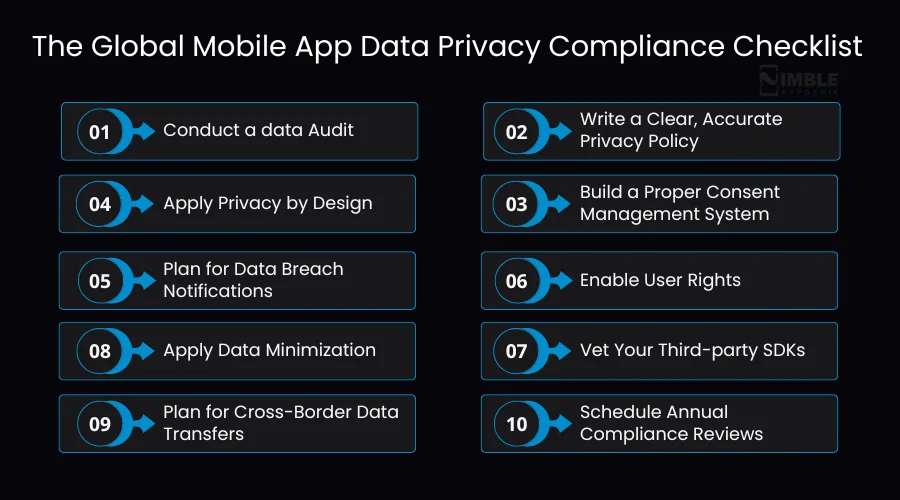
1. Conduct a data Audit
You can map every piece of data your mobile app collects. Where does it come from? Where does it go? Who can access it? Which third-party SDKs receive it? This data map is the foundation for everything else, and regulations will ask for it during an investigation.
2. Write a Clear, Accurate Privacy Policy
Your Privacy Policy must reflect what your mobile app actually does, not a generic template copied from the internet.
It must explain what data you collect, why you collect it, how you store it, who you share it with, and how user can exercise their rights. You should write it in easy language that your users can actually understand.
3. Build a Proper Consent Management System
You need a consent mechanism that meets the standards of the strictest law that applies to you. That means separate, granular consent for different data uses, analytics, advertising, and personalization, with easy withdrawal at any time.
Under GDPR and DPDP mobile app data privacy compliances, users must be able to say no and still use your app’s core features.
4. Apply Privacy by Design
Privacy by design means creating data protection into your mobile app architecture from day one, not adding it later as a patch. You can only collect data you genuinely need.
Do not stress it indefinitely. You have to make privacy-protective settings the default, not something users have to dig through settings menus to find.
5. Plan for Data Breach Notifications
Under GDPR, DPDP, Australia’s Privacy Act, Singapore’s PDPA, and many other laws, you must notify regulators within 72 hours of discovering a breach.
You have a documented breach response plan ready before you need it. Just know who to notify, what information to include, and how to communicate with affected users.
6. Enable User Rights
Every major privacy law provides users the right over their data. Your app must make it possible for users to. For example, access the data you hold about them, correct inaccurate data, delete their data, and transfer their data to another service.
These need to be developed into your mobile application, not handled manually by emailing a legal team.
7. Vet Your Third-party SDKs
Every analytics SDK, advertising library, social login plugin, and crash reporting system you use is your legal responsibility. If those SDKs collect data without valid consent, or send it to a server in non-compliant jurisdictions.
You are the one who faces the fine, not the SDK vendor. You just review every third-party API integration before you ship.
8. Apply Data Minimization
Before you collect any piece of data, ask do we actually need this? If the honest answer is not really, do not collect it. Also, less data means less risk, lower storage costs, and a smaller compliance burden. This principle is needed under GDPR, DPDP, LGPD, and most other major global data privacy laws 2026.
9. Plan for Cross-Border Data Transfers
If your mobile app stores EU user data on US servers, or transfers Indian user data to infrastructure outside India, you need a legal mechanism to do so. Under GDPR, this means Standard Contractual Clauses or adequacy decisions.
Under PIPL, Chinese data may need to stay in China. Also, under DPDP, cross-border transfer rules are still being finalized, but restrictions are coming.
10. Schedule Annual Compliance Reviews
The global data privacy laws 2026 change. Your mobile app changes. New features collect new data. New SDKs get added. Laws get updated. Schedule a proper compliance review at least once a year, and whenever you make a major change to how your app manages data.
Common Mistakes App Developers Make And How to Avoid Them
Even well-intentioned, dedicated development teams regularly make these common mistakes. If any of these sound familiar to you, it is vital to fix them now. Let’s take a look at the common mistakes you should avoid making and their possible solutions.
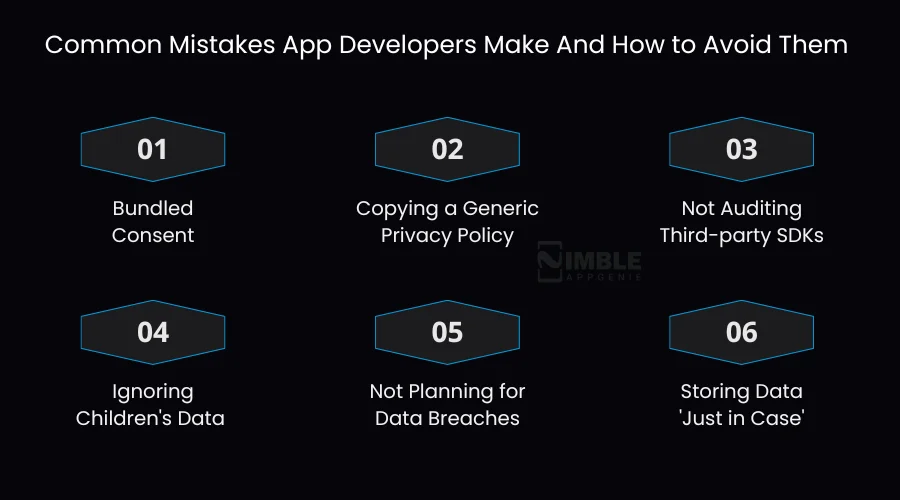
1. Bundled Consent
One “Accept All” checkbox that covers analytics, advertising, and personalization simultaneously is not valid consent under GDPR, DPDP, or CCPA.
Solution:
You must break consent down by purpose, with a separate toggle for each category.
2. Copying a Generic Privacy Policy
A template privacy policy that does not accurately reflect your mobile app’s actual data practices is worse than useless; it creates legal liability.
Solution:
Your policy must describe what your mobile application actually does.
3. Not Auditing Third-party SDKs
Most applications use between 5 and 20 SDKs. Each may send data to its own servers in multiple jurisdictions.
Solution:
If those SDKs fire before consent is obtained, that is your compliance failure, not the SDK vendor’s.
4. Ignoring Children’s Data
If there is any realistic chance children will use your app, if it was not designed for them, you need age-gating and special consent flows for younger users.
Solution:
GDPR, DPDP, COPPA, and many other laws have strict rules around children’s data.
5. Not Planning for Data Breaches
Breach notification timelines are strict, 72 hours under GDPR and DPDP, 24 hours under South Korea’s PIPA, and 3 days under Singapore’s PDPA.
Solution:
If you discover a breach on a Friday night and don’t have a plan, you will miss the deadline.
6. Storing Data ‘Just in Case’
Keeping user data indefinitely ‘because it might be useful later’ is a violation of storage limitation principles under GDPR, LGPD, and DPDP.
Solution:
You can set automatic data deletion schedules and stick to them.
How Nimble AppGenie Can Help Build a Privacy-Compliant Mobile App?
At Nimble AppGenie, we do not just develop mobile applications. We develop PCI compliance for fintech apps, fantasy apps, e-wallet apps, and others that are ready for the world, including its laws.
No matter if your app targets users in Europe, India, the USA, or all of the above, our mobile app development team understands the particular technical and legal requirements of every major global privacy framework.
We create mobile app data privacy compliance from day one, and not as an afterthought.
| What We Do | How It Helps You |
| Privacy by Design Architecture | Build data protection into your application from day one, not as a patch later. |
| Multi-jurisdiction Compliance | One team covers GDPR, DPDP, CCPA, LGPD, PIPL, and more simultaneously. |
| Consent management integration | Granular, regulation-specific consent flows with proper logging. |
| Data security architecture | AES-256 encryption, TLS L3, role-based access, secure storage. |
| Third-party SDK vetting | We audit every SDK you use before it touches your users’ data. |
| Breach Response Planning | 72-hour notification workflows built into your app infrastructure |
| App Store Compliance | Apple Privacy Labels & Google Data Safety sections accurately completed. |
| Ongoing Compliance Support | Quarterly reviews as laws evolve, so you never fall behind. |
Choose Nimble AppGenie for Privacy-Compliant App Development:
- We have created custom mobile apps in fintech, healthcare, e-commerce, and enterprise sectors, all with compliance requirements built in from architecture to app store submission.
- We understand that GDPR, DPDP, CCPA, and LGPD are not the same law, and we build the right compliance flows for each region your app targets.
- We treat your compliance obligations as a product feature, not a legal checkbox. This results in apps that users trust and regulators approve.
- Our ongoing support means your mobile app stays compliant as laws change, not just at launch.
Conclusion
The laws are here. They are being enforced. The fines are real, and they are growing. But mobile app data privacy compliance is also one of the most powerful trust signals your app can have.
Mobile apps that get privacy right earn genuine user loyalty. They do not get pulled from app stores. They can operate globally without legal risk. And they are ahead of the competitors who are still treating privacy as someone else’s problem.
If your users are in Frankfurt, California, Sydney, or all of the above, there is a privacy law that applies to your app. GDPR set the global standard. India’s DPDP Act is the new force in the world’s largest mobile market.
You do not have to figure this out alone. You should consult with the mobile app development company that has expertise in creating privacy-compliant apps across industries.
FAQs
Privacy by design means developing data protection into your app’s architecture from the very beginning, not adding it as a patch after the fact. It means only collecting data you need, which makes privacy the default state. Also, it ensures that users have full control over their data, and documenting your privacy practices throughout development.
Apple needs a privacy nutrition label for every app, declaring what data is collected and how it is used. Google Play needs a data safety section with similar declarations. Both platforms can reject or remove apps that misrepresent their data practices. These are platforms needed on top of legal requirements like GDPR and CCPA.

Madan is the Backend Solutions Architect at Nimble AppGenie, specializing in the design of secure, high-concurrency systems that power complex mobile ecosystems. With deep expertise in server-side logic and database management, he ensures every platform is built with enterprise-grade security. In his free time, he is an avid researcher of emerging technologies; he spends his time deconstructing the latest backend frameworks and reading technical papers to ensure our solutions remain at the absolute forefront of industry innovation.
Table of Contents




No Comments
Comments are closed.