

 Free Consultation
 PCI-DSS Compliant
 GDPR Ready
 ISO 27001
 NDA Protected
 AI Services
 AI App Development
 Generative AI Development
 AI Chatbot Development
 AI Integration Services
 AI Consulting Services
 AI For Fintech
 AI Financial Assistant Solution
 AI Insurance Agent Development
 Tech Stack
 OpenAI / GPT-4
 Claude / Anthropic
 Gemini / Google AI
 Llama / Open Source
 LangChain / LlamaIndex
 Pinecone / Pgvector
 AWS / Azure AI


 Fintech Solution
 Core Fintech
 App Development
 Neobank Solutions
 eWallet Solutions
 Lending Software
 Banking Solutions
 BNPL Solutions
 BNPL Solutions
 Insurance App
 Wealth Management
 Crypto & DeFi
 Blockchain Development
  Payroll Software
 DeFi Solutions
 Crypto Wallet
 Crypto On/Off Ramp
 Crypto Exchange
 Trading Platform
 Payments
 Compliance
 Regulations & Compliance
 Fraud Detection
 Lending Ecosystem
 P2P Lending Platform
 Mortgage Software
 Engagement
 Fintech Outsourcing

 Mobile Development
 Mobile App Dev
 iOS App Development
 Android App Development
 React Native
 Flutter Development
 Web Solution
 Node.js Development
 React.js Development
 Angular Development
 App Services
 UI/UX Design
 App Maintenance
 By Stage
 MVP Development
 Industry Solutions
 Healthcare App Dev
 Education App Dev
 Travel App Dev
 Real Estate App Dev
 Logistics Software
 Social Media App

 Hire Mobile Developers
 Hire iPhone Developers
 Hire Android Developers
 Hire React Native Devs
 Hire Flutter Developers
 Hire Web Developers
 Hire Node.js Developers
 Hire Angular Developers
 Hire PHP Developers
 Hire Laravel Developers
 How It Works
 Pre-Vetted Developers
 Ready In 48 Hours
 NDA From Day One
 Replace Guarantee
 Company
 About Us
 Our Work Process
 Portfolio
 Case Studies
 Blog / Insights
 Careers
 Contact Us
 Awards
 Recognition


 Offices



Key Takeaways:
- HSBC-like mobile banking app provides fast, secure, and user-friendly digital banking experience for personal and business users.
- Must-have features of an HSBC-like app are account overview, fund transfers, bill payments, card management, and push notifications to ensure smooth day-to-day banking.
- Advanced mobile banking app AI features like chatbots, personalized financial insights, smart budgeting, and investment tracking boost user engagement and retention.
- To build an app like HSBC, strong security with biometric authentication, multi-factor login, encryption, and fraud detection is required.
- AI-driven mobile banking app like HSBC, helps analyze spending, detect fraud, and provide personalized recommendations for smarter financial decisions.
- The cost to develop an app like HSBC ranges from $25,000 to $250,000+ depending on features, AI integrations, and platform selection.
- Mobile banking apps like HSBC make money through transaction fees, premium subscriptions, loans, and foreign exchange margins.
- The challenges to create an app like HSBC are security & data protection, regulatory compliance, fraud detection, and high transaction load.
In 2026, users expect mobile banking to be fast, secure, and smart. But many apps still struggle to meet these demands, leaving customers frustrated with slow transfers, cluttered interfaces, or a lack of personalized insights.
With over 2.8 billion mobile banking users globally and digital payments growing 12% annually, there’s huge potential for apps that combine reliability with intelligence.
HSBC has set a good benchmark in this space that offers seamless transactions, intuitive design and AI-driven features to boost the user experience.
To capture similar success, businesses now aim to build an app like HSBC, integrating essential banking functions with AI platforms. These features not only improve user satisfaction but also drive retention and engagement.
So, if you are a bank, fintech startup, or entrepreneur thinking about how to build a mobile banking app like HSBC, then this guide is your roadmap.
It will walk you through the HSBC-like mobile banking app solution process that covers key and advanced features, cost, monetization model, challenges & solutions for a robust banking solution.
So, let’s begin!
What is the HSBC App?
The HSBC app is a mobile banking app that allows users to check balances, transfer funds, pay bills, manage cards, and receive secure notifications. It offers a fast, convenient, and safe way to access banking services anytime on a mobile phone.
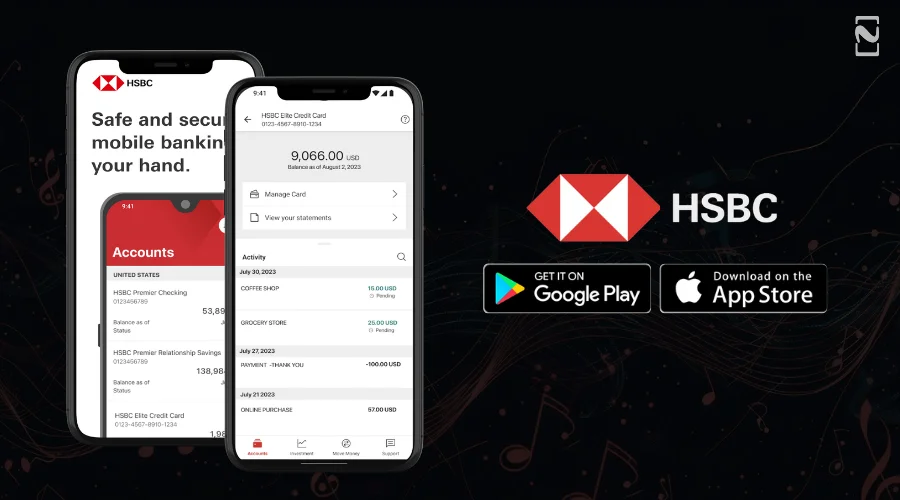
Additionally, HSBC is designed for both personal and business banking, offering a digital alternative to visiting a branch. It ensures high security, convenience, and control over your finances, which is why HSBC customers widely use it.
How Does the HSBC App Work?
Users can use the HSBC app in the following steps:
- Check account balances and transaction history instantly.
- Transfer money between accounts or to other banks, including international transfers.
- Pay bills and manage recurring payments from the app.
- Manage credit and debit cards, including activating, blocking, or tracking spending.
- Receive alerts and notifications for transactions, security, or account updates.
- Log in securely using biometric options like fingerprint, face recognition, or PIN codes.
Market Research & Analysis?
In 2026, mobile banking is the future. People want to manage their money quickly, safely, and from anywhere. That’s why building a mobile banking app like HSBC’s is a smart move for banks and fintech startups.
Let’s have a look at the mobile banking statistics given below.
Market Statistics and Insights
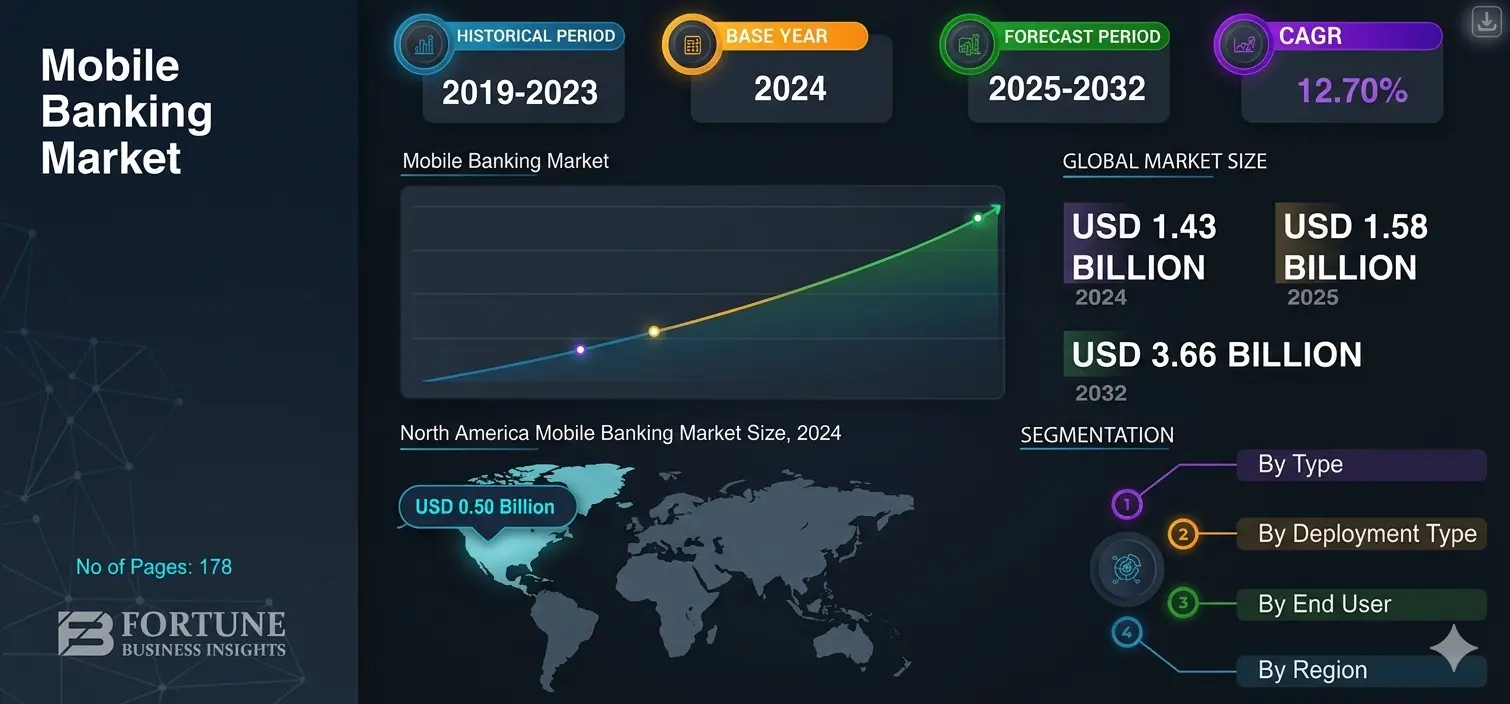
- According to Fortune Business Insights, the market size of mobile banking is forecasted to reach 3.66 billion by 2032, exhibiting a CAGR of 12.70%.
- Over 63% of Gen Z and 67% of Millennials worldwide use mobile banking applications, according to a report by the American Bankers Association (ABA).
- More than 50% of people prefer biometric logins, and 64% use facial recognition for mobile banking.
- North America is the most popular worldwide mobile banking market shareholder and is forecasted to grow 10.5 % CAGR.

Reasons to Build a Mobile Banking App Like HSBC
• Meet Customer Expectations
People now want fast banking that is secure on their phones. A mobile banking app like HSBC allows users to check balances, transfer money, and pay bills without visiting a branch. If your app meets these expectations, it can boost customer satisfaction and build trust in your brand.
• Increase Engagement
AI in banking apps keeps users engaged with features like spending insights, personalized notifications, and AI-powered suggestions. These applications help users track their money, make smarter financial decisions, and return to the app regularly, increasing loyalty.
• Expand Reach
When you build an app like HSBC, it assists banks in serving customers anywhere in the world. You do not need to open new branches or hire extra staff, yet your services become available to more people. This also makes it easier to attract younger customers who prefer digital banking.
Thus, making an app like HSBC is profitable because it increases user retention, opens new revenue streams, reduces operational costs, and strengthens brand authority in the banking market.
Key Features for a Digital Banking App Like HSBC
An HSBC mobile banking app requires key features to meet customer expectations, ensure security, and provide a seamless banking experience. These must-have features form the foundation of your online banking app. Below is a table of mobile banking app features that you can consider when you make an app like HSBC.
| Features | Why It Matters |
| Account Overview & Dashboard | It shows users all account balances, recent transactions, and spending insights in one place. |
| Fund Transfers | It allows users to move money between accounts or to other banks quickly. It saves time and adds convenience for day-to-day banking. |
| Bill Payments & Recurring Payments | It enables users to pay for utilities, credit cards, or subscriptions directly from the app. Reduces missed payments and improves financial management. |
| Credit & Debit Card Management | Users can activate, block, or monitor cards instantly. Adds security and control over spending. |
| Biometric Authentication | It ensures secure login without relying on passwords. Builds trust and improves app security. |
| Push Notifications & Alerts | It sends real-time alerts for transactions, security updates, and offers. Keeps users informed and engaged. |
| Spending Analytics & Insights | It provides visual reports of income, expenses, and trends. Helps users manage budgets and make informed financial decisions. |
| Loan & Investment Management | It allows users to track loans, credit, and investments in one place. Improves user convenience and engagement with financial products. |
| AI-Powered Chatbots / Assistance | It offers instant support and answers financial queries. Enhances customer service and reduces dependency on human agents. |
| Secure API & Payment Gateway Integration | It ensures safe transactions and compatibility with banks or third-party services. Mobile payment integration is critical for trust and reliability in digital banking. |
| Mobile Check Deposit | It allows users to deposit checks via smartphone camera. Saves time and reduces branch visits. |
| Multi-Language Support | It makes the app accessible to a broader audience. Improves user adoption in different regions. |
Advanced Features to Make a Mobile Banking App Like HSBC
Advanced features to make an app like HSBC are AI insights, personalized offers, virtual cards, fraud alerts, and chatbots. When you add these features to your digital banking solutions, it can boost user experience, improve security, and increase digital banking adoption.
Let’s have a look at the table below of the advanced features.
| Advanced Features | Why It Matters |
| Personalized Financial Insights | It uses AI to analyze spending, savings, and investment patterns that help users make smarter financial decisions and increase app engagement. |
| AI-Powered Chatbot / Virtual Assistant | It provides instant support for queries, transactions, or guidance that reduces wait time and improves customer experience. |
| Smart Budgeting & Expense Tracking | It automatically categorizes expenses and tracks budgets that help users manage money efficiently and stay financially disciplined. |
| Investment Portfolio Management | It allows users to monitor stocks, mutual funds, or other investments within the app. It adds convenience and encourages long-term engagement. |
| Open Banking & Third-Party Integration | It connects with other banks or fintech services through API banking integration. It expands functionality and provides users with more options. |
| Personalized Offers & Rewards | It sends tailored discounts, offers, or rewards based on user behavior that increases engagement and loyalty. |
| Voice Banking | It allows users to perform banking tasks using voice commands that add convenience and accessibility. |
| Digital Card Issuance | Users can generate temporary or virtual cards instantly. Improves security and flexibility for online purchases. |
| Cross-Border Payments & Currency Exchange | It enables international transfers with competitive exchange rates that attract global customers and business users. |
How to Build an App Like HSBC?
Developing an app like HSBC includes defining the app’s purpose, planning security, designing features, developing an MVP, and testing before launch, so your app meets real user needs.
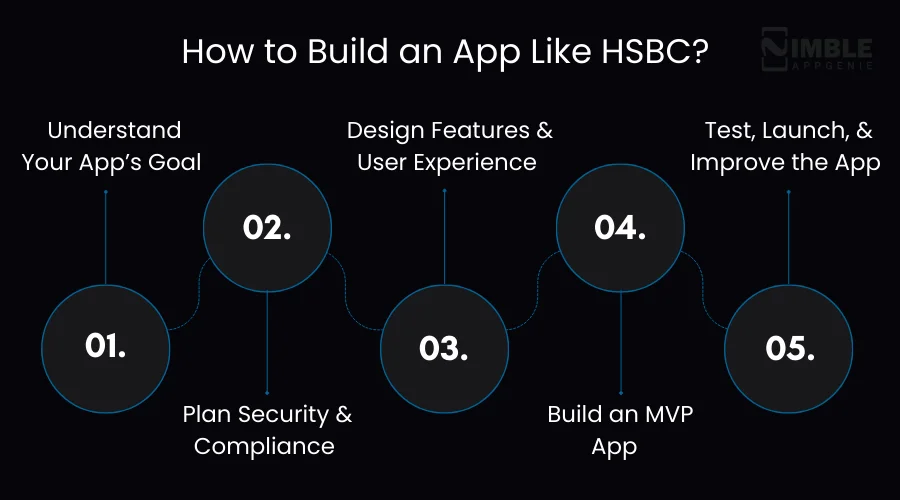
Below is the step-by-step process of an app development like HSBC that you must follow.
Step 1: Understand Your App’s Goal
Before you create a mobile banking app like HSBC’s, be clear about what your app will do. A banking app like HSBC’s is not just about checking balances. It helps users transfer money, pay bills, manage cards, and track spending.
Additionally, you should find out who your target audience is and what their pain points are. Knowing these helps you prioritize the right core features from the start.
Questions businesses usually ask:
- What core services should the app offer first?
- Who will be the primary users—retail, business, or both?
- What frustrations do users have with existing banking apps?
Once you define the goal clearly, it sets a clear foundation to build an app like HSBC that people will use every day.
Step 2: Plan Security and Compliance
Now, security and banking app compliance is the backbone of any online banking app. It is vital to thoroughly know KYC regulations, data protection rules, and transaction encryption standards.
Besides, you can plan out secure login, fraud detection, and safe money transfers from the beginning, rather than adding them later in the app.
Questions businesses usually ask:
- How will users verify their identity safely during signup?
- What measures protect sensitive data from breaches?
- Are all regional banking regulations being followed?
When you focus on mobile banking app security, it makes sure users trust your HSBC-like app and keeping yourself compliant with legal requirements.
Step 3: Design Features and User Experience
Next, you can plan how users will interact with your digital banking app. One thing you can do is to add only the must-have features at the start. It can help you save money and control your budget.
Additionally, you can make a mobile banking app design simple so users can complete tasks in a few taps. Also, a clean and visually appealing interface boosts user satisfaction and retention.
Questions businesses usually ask:
- What should appear on the home dashboard first?
- How can users transfer money in the fewest steps?
- Which design choices will make the app easy to use daily?
When you design an intuitive app, it keeps users engaged and makes complex banking tasks feel simple.
Step 4: Build an MVP App
Do not develop a full-fledged app in the beginning. You can build an MVP app with the core features like secure login, account balance, transaction history, and basic transfers.
Developing an MVP version can help you test the idea and understand whether there really is a demand for your idea. After that, you can test it with real users to see what works and what needs improvement.
Questions businesses usually ask:
- Which features are vital for the MVP launch?
- How quickly can the MVP be built and tested?
- What feedback will guide the next development stage?
An MVP built with a dedicated development team allows you to launch faster, learn from real users, and reduce risks.
Step 5: Test, Launch, and Improve the App
After the MVP version is successfully built, you can test it thoroughly for security, performance, and errors. Also, you can check it on every device. Once it is tested, you can launch the app.
Additionally, do not forget to monitor how users interact with the app, collect feedback, fix issues, and gradually add advanced features like savings tools, loans, or budgeting options.
Questions businesses usually ask:
- Are transactions fast and error-free?
- Does the app perform well across all devices?
- What features should be added next to improve user experience?
It is best to continue testing and updates to keep your HSBC-like mobile banking app secure, efficient, and useful for users over time.
Tech Stack for HSBC-like Banking App Development
To build an app like HSBC, you can use a combination of native mobile frameworks, secure backend systems, cloud infrastructure, banking APIs, databases, AI analytics, and fraud detection tools. Together, these technologies make your banking app safe, giving users a smooth digital banking experience.
Take a look at the table below for the mobile banking app tech stack.
| Component | Technologies |
| Mobile Frontend | Swift (iOS), Kotlin (Android), React Native, Flutter |
| Backend / Core Banking | Java Spring Boot, .NET Core, Golang, Oracle FLEXCUBE Core Banking |
| Database / Storage | Oracle Database, PostgreSQL, Redis, Cassandra |
| Cloud / Infrastructure | AWS (EC2, S3), Microsoft Azure, Google Cloud Platform, Kubernetes, Docker |
| Payments & Banking APIs | Visa Direct, Mastercard APIs, Plaid, TrueLayer |
| Security & Authentication | OAuth 2.0, SAML 2.0, HSM, PKI, AES-256 Encryption, Biometric APIs |
| Push Notifications & Messaging | Firebase Cloud Messaging, Twilio, OneSignal |
| Analytics & AI | Snowflake, Tableau, Power BI, TensorFlow, PyTorch |
| Fraud Detection & Risk Management | FICO Falcon Fraud Manager, SAS Risk Management, Darktrace |
| DevOps / CI-CD | Jenkins, GitLab CI, Docker, Kubernetes, Terraform |
How Much Does It Cost to Build a Mobile Banking App Like HSBC?
The cost to build an app like HSBC can range between $25,000-$250,000 or more, depending on app complexity, features, tech stack, security requirements, and platform choice. Basically, the final HSBC app development cost depends on the project requirements.
Let’s take a look at the breakdown of the estimated cost to develop a mobile banking app like HSBC based on complexity.
| App Type | Estimated Cost | Key Features |
| Basic MVP version | $25,000-$50,000 | Account login, balance check, transaction history, and simple money transfer. |
| A mid-level banking app like HSBC | $50,000-$100,000 | Bill payments, card management, push notifications, and improved security features. |
| An advanced banking app like HSBC | $100,000-$200,000 | Advanced security, fraud detection, analytics, banking system integrations, and financial tools. |
| AI-powered mobile banking app | $200,000-$250,000+ | AI-powered chatbot, voice banking, digital card issuance, personalized offers, and AI fraud detection. |
Quick Cost Overview
Typical price ranges for banking apps like HSBC include:
- Basic HSBC-like banking app: $25,000 – $50,000
- Mid-level HSBC-like banking app: $50,000 – $100,000
- Advanced HSBC-like banking app: $100,000 – $200,000
- AI-powered HSBC-like banking app: $200,000 – $250,000+
These estimates may change depending on the project scope, security needs, and custom features you add to the application. So, it is vital to first properly do market research and then make a budget. This can help control the budget and development time.
Factors Affecting the Cost to Develop an App like HSBC
The actual cost to develop a banking app depends on many factors that influence the development time and technical complexity.
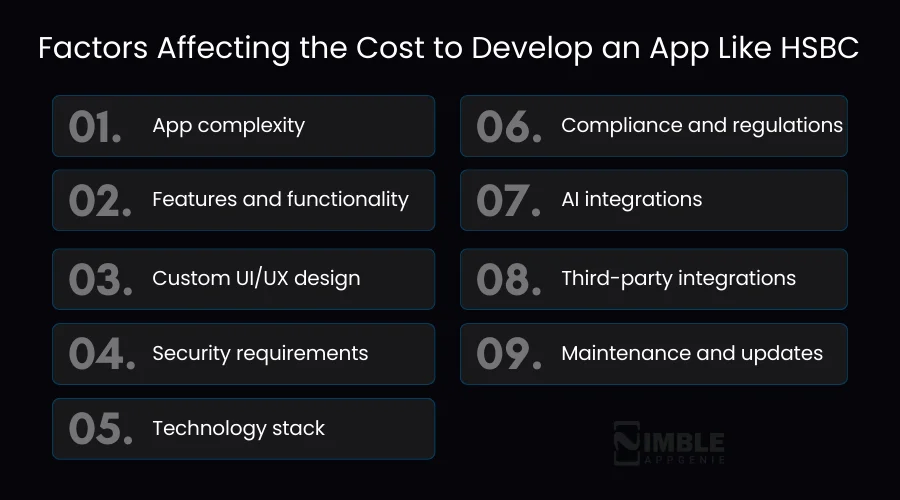
Take a look:
- App complexity – basic banking features vs advanced financial tools
- Features and functionality – payments, transfers, card controls, analytics
- Custom UI/UX design – personalized dashboards and smooth user experience
- Security requirements – encryption, biometric authentication, fraud monitoring
- Technology stack – native development, cross-platform frameworks, backend architecture
- Compliance and regulations – financial regulations such as PCI-DSS, PSD2, or GDPR
- AI integrations – chatbots, predictive analytics, smart spending insights
- Third-party integrations – payment gateways like Square, banking APIs, KYC services
- Maintenance and updates – ongoing upgrades, security patches, and feature improvements
How to Monetize a Mobile Banking App Like HSBC?
Mobile banking apps like HSBC generate revenue through transaction fees, premium subscriptions, and financial partnerships. These monetization models explain how banking apps make money while delivering secure digital banking services.
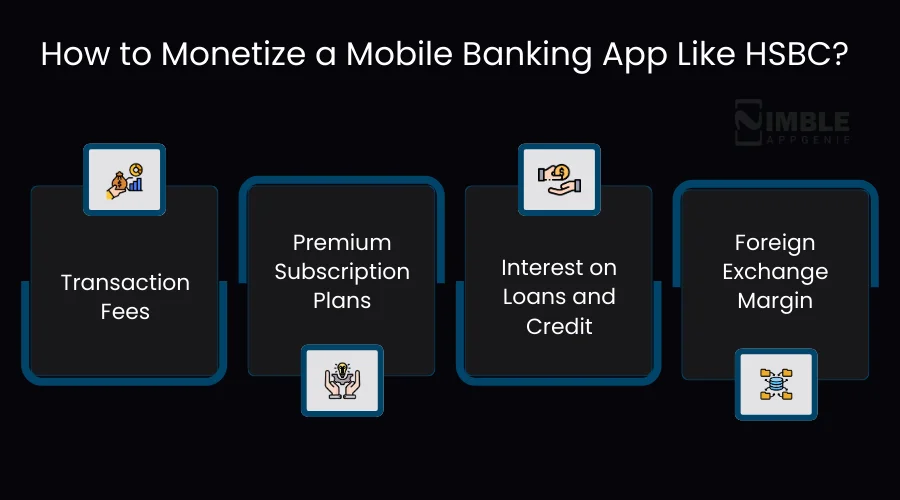
Let’s have a look at the ways to monetize your HSBC-like app.
1. Transaction Fees
Transaction fees are the most common way a mobile banking app like HSBC earns money. You can charge a small fee from the users when they do any money transaction. For example, international transfers, instant payments, or currency exchange.
Why it works:
Users want speed and convenience. Rather than going to the bank, they can complete transactions in seconds through the app. This makes the fee acceptable for your users.
2. Premium Subscription Plans
Your app can also earn money through premium subscription plans. You can provide a free version with core banking features. Users who want extra services can upgrade to a paid plan that may include higher transfer limits, advanced budgeting tools, financial insights, or priority support.
Why it works:
Many users are willing to pay for better financial features and added convenience. This model also creates a recurring monthly revenue stream for digital banking apps.
3. Interest on Loans and Credit
Another way to make money is through interest on loans and credit services. You can provide financial products like personal loans, credit cards, or overdraft facilities. Sometimes it is enabled through Banking as a Service platforms that help you integrate lending services into your app.
When users borrow money through these services, they repay the amount along with interest over time. This interest becomes a source of income for your app.
Why it works:
Many users prefer applying for loans or credit directly from their banking app. It is because the process is faster and more convenient than visiting a physical branch. This makes digital lending a good revenue stream for banking apps.
4. Foreign Exchange Margin
Foreign exchange margin is another revenue source for your HSBC-like app. When users convert money from one currency to another, your app applies a small margin on the exchange rate. This margin is the difference between the market exchange rate and the rate offered to the user.
Why it works:
International transfers, travel payments, and global online purchases often require currency conversion. Since many users rely on their banking apps for these transactions, the app can earn revenue from these exchange margins.
With the right mix of payment services, lending features, and financial partnerships, you can build an app like HSBC that delivers real value to users while generating consistent revenue.
What Are the Challenges in Building an App Like HSBC & How to Solve Them?
The challenges you might face while creating an app like HSBC are security & data protection, digital payment regulations, security compliance, fraud detection, high transaction load, legacy system integrations, and app performance.
| Challenges | Why It Matters | Solutions |
| Security & Data Protection | Banking apps handle sensitive user and transaction data. Any breach can cause financial loss and loss of trust. | You can use encryption, biometric login, and multi-factor authentication to protect user data. |
| Regulatory Compliance | Financial apps must follow strict banking rules and regulations in different countries. | You can follow KYC, AML, and data protection regulations with the help of legal and compliance experts. |
| Fraud Detection | Online banking apps are common targets for fraud and suspicious transactions. | You can use AI-based fraud monitoring and real-time alerts to detect unusual activity. |
| High Transaction Load | Banking apps must handle thousands or millions of transactions daily without failure. | You can build the app on a cloud infrastructure to support high traffic. |
| Legacy System Integration | Many banks still run on old core banking systems that are difficult to connect with modern apps. | You can use secure APIs and middleware to connect the mobile app with existing systems. |
| App Performance | Slow apps lead to poor reviews and user drop-off. | You can optimize backend systems and perform regular performance testing. |
Once these challenges are addressed, you can shift the focus from solving technical and security issues to creating better digital experiences. This is where the real opportunity begins. Technologies like AI can help mobile banking apps like HSBC offer smarter services, faster transactions, and more personalized financial insights.
Why Choose Nimble AppGenie to Develop an App Like HSBC?
If you want to build an app like HSBC, you need a partner who understands mobile banking inside out. Nimble AppGenie is a recognized banking software development company that combines deep technical expertise with real-world experience in secure financial apps.
With 8+ years of proven experience in creating a custom mobile banking app, we focus on banking solutions that allow users to transfer money, pay bills, manage accounts, and track spending seamlessly, while keeping security and reliability at the core.
From account management and transaction tracking to peer-to-peer apps, our experts build every type of fintech mobile app with the latest technologies that meet real user needs while ensuring regulatory compliance and top-level security.
Why Nimble AppGenie stands out:
- Proven expertise in banking apps
- Security-first approach
- Intuitive user experience
- Full-cycle development support
With Nimble AppGenie as your fintech app development partner, you can confidently develop a custom, user-friendly, and high-performing app like HSBC that is ready to serve real users from day one. Are you ready for a robust banking solution?
Get in touch with us now!
Conclusion
Building an app like HSBC in 2026 is all about making banking simple, safe, and smart for your users. From checking balances and sending money to managing cards and getting personalized financial insights, the right features make everyday banking easier.
With the right team, you can build an app like HSBC that keeps users coming back and handles complex tasks behind the scenes. A well-built core banking solution doesn’t just serve customers; it earns their trust, saves time, and opens new ways to grow in the digital banking world.
Your competitors are already using AI to transform mobile banking. Don’t fall behind; start creating your smart banking app today. Contact us now to see how we can bring your vision to life!
FAQs

Niketan Sharma, CTO, Nimble AppGenie, is a tech enthusiast with more than a decade of experience in delivering high-value solutions that allow a brand to penetrate the market easily. With a strong hold on mobile app development, he is actively working to help businesses identify the potential of digital transformation by sharing insightful statistics, guides & blogs.
Table of Contents




No Comments
Comments are closed.