

 Free Consultation
 PCI-DSS Compliant
 GDPR Ready
 ISO 27001
 NDA Protected
 AI Services
 AI App Development
 Generative AI Development
 AI Chatbot Development
 AI Integration Services
 AI Consulting Services
 AI For Fintech
 AI Financial Assistant Solution
 AI Insurance Agent Development
 Tech Stack
 OpenAI / GPT-4
 Claude / Anthropic
 Gemini / Google AI
 Llama / Open Source
 LangChain / LlamaIndex
 Pinecone / Pgvector
 AWS / Azure AI


 Fintech Solution
 Core Fintech
 App Development
 Neobank Solutions
 eWallet Solutions
 Lending Software
 Banking Solutions
 BNPL Solutions
 BNPL Solutions
 Insurance App
 Wealth Management
 Crypto & DeFi
 Blockchain Development
  Payroll Software
 DeFi Solutions
 Crypto Wallet
 Crypto On/Off Ramp
 Crypto Exchange
 Trading Platform
 Payments
 Compliance
 Regulations & Compliance
 Fraud Detection
 Lending Ecosystem
 P2P Lending Platform
 Mortgage Software
 Engagement
 Fintech Outsourcing

 Mobile Development
 Mobile App Dev
 iOS App Development
 Android App Development
 React Native
 Flutter Development
 Web Solution
 Node.js Development
 React.js Development
 Angular Development
 App Services
 UI/UX Design
 App Maintenance
 By Stage
 MVP Development
 Industry Solutions
 Healthcare App Dev
 Education App Dev
 Travel App Dev
 Real Estate App Dev
 Logistics Software
 Social Media App

 Hire Mobile Developers
 Hire iPhone Developers
 Hire Android Developers
 Hire React Native Devs
 Hire Flutter Developers
 Hire Web Developers
 Hire Node.js Developers
 Hire Angular Developers
 Hire PHP Developers
 Hire Laravel Developers
 How It Works
 Pre-Vetted Developers
 Ready In 48 Hours
 NDA From Day One
 Replace Guarantee
 Company
 About Us
 Our Work Process
 Portfolio
 Case Studies
 Blog / Insights
 Careers
 Contact Us
 Awards
 Recognition


 Offices



In a Nutshell:
- AI real estate software development cost in 2026 ranges from $35,000 to $350,000+, based on the features you choose, AI complexity, and scalability needs.
- The AI real estate MVP development cost is lower, while enterprise AI real estate software requires a higher investment.
- Key cost drivers include AI models, MLS integration, data pipelines, and compliance.
- Hidden costs like AI training, cloud infrastructure, and post-launch optimization impact budgets.
- Choosing the right AI real estate software development company, Nimble AppGenie, reduces long-term costs.
Traditional real estate businesses manually document processing and compliance, struggle with fragmented data management, subjective property valuation, slow lead generation, and bear visualization challenges, leading to increased human errors, inaccurate valuations, increased agents’ loads, and missed opportunities because of delayed response times. This increased the demand for digital transformation in real estate industry, which helps automate processes, provides precision in price predictions, and allows interactive exploration remotely.
Therefore, realtors, property aggregators, and real estate startups are increasingly looking to integrate AI in real estate businesses or build real estate software.
By 2029, AI in real estate market valuation is predicted to surge and reach $975.24 billion at a CAGR of 34.1%.
Before you plan to develop, you should have a complete understanding of AI real estate software pricing. Budgeting in AI real estate website development is essential to prevent unexpected financial surprises.
What is AI Real Estate Software Development Cost in 2026?
Developing AI real estate software costs range from $35,000 to $350,000+; the figure can fluctuate depending on distinct factors, like complexity, scalability, features, regions, and more.
This post gives a complete breakdown of AI real estate software development cost by feature, region, and type. It also unveils hidden costs that contribute to the cost to build AI real estate software and steps to reduce them.
Let’s get started!
Why is it the Best Time to Invest in AI Real Estate Software?
Now, AI in real estate has become a core driver of performance, efficiency, and revenue growth, rather than an experimental pilot.
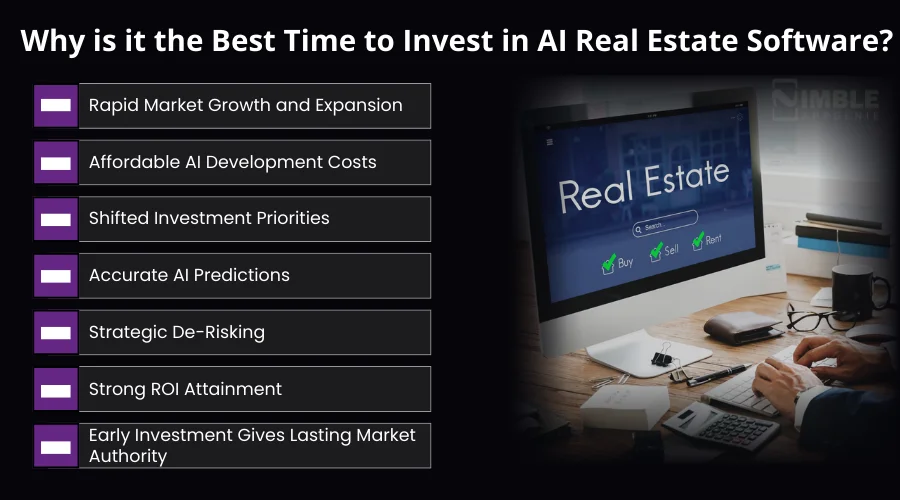
Let’s discover more facts and figures to know how profitable it is to create AI in real estate software now.
1. Rapid Market Growth and Expansion
Soon, you will witness AI in real estate market surging at a staggering CAGR of 34.4% by 2029 and will reach $988.59 billion.
Per the latest records, 90% of real estate companies are testing AI solutions, which shows the adoption is at an extreme level.
A key driver augmenting the expansion is the increasing adoption of IoT devices in the industry.
2. Affordable AI Development Costs
Cloud AI platforms, pre-trained models, and reusable Real estate software architectures have reduced uncertainty and risk. This is making AI real estate software ROI-driven and more affordable.
3. Shifted Investment Priorities
Earlier, tools just focused on reducing costs, but this year, investors’ priority is competitive edge and revenue.
AI-assisted analysis in real estate is enhancing ROI predictability by around 20%. An increasing number of users are leveraging real estate investing apps to access the property market with minimum investments.
4. Accurate AI Predictions
Whether it’s property history, market intelligence, MLS access, or behavioral data, all are well structured and enough to strengthen AI predictions and automation.
5. Strategic De-Risking
AI-powered Automated Valuation Models (AVMs) hold the caliber to diminish pricing errors by up to 30% and mitigate analysis time by 50%.
6. Strong ROI Attainment
As AI reduces manual jobs, accelerates lead qualification, boosts conversion rates, and improves pricing precision, AI software delivers a measurable business impact.
7. Early Investment Gives Lasting Market Authority
Investing now will help real estate businesses establish learning models, accumulate data, and foster brand trust that helps attain a long-term competitive edge, where late adopters are found struggling.
So, what’s the point in holding up? Come ahead with a plan and connect with an AI software development company to know the AI-powered real estate software development cost.
How Much Does AI Real Estate Software Development Cost in 2026? A Quick Answer
AI real estate software development costs generally range between $35,000 and $350,000+, based on software complexity, data integrations, AI capabilities, and scalability requirements.
A quick review of the AI real estate software pricing:
| Software Type | Estimated Cost Range (2026) |
| Basic AI Real Estate Software | $35,000 – $60,000 |
| MVP AI Real Estate Platform | $60,000 – $90,000 |
| Mid-Level AI Real Estate Software | $90,000 – $150,000 |
| Enterprise AI Real Estate Software | $180,000 – $350,000+ |
Pro Tip: Final AI real estate software pricing depends chiefly on AI model complexity, cloud infrastructure, MLS integrations, data volume, and post-launch optimization requirements. Ensure considering these.
AI Real Estate Software Development Cost Breakdown by Features
Depending on the core and advanced abilities incorporated in the platform, the AI real estate platform development cost varies.
We have curated the tables of AI-powered real estate software features separately, per the level of your software, with their estimated cost impact.
1. Core AI-Powered Real Estate Software Features & Cost Impact
| Core Features | Description | Cost Impact (2026) |
| User Authentication & Profiles | Secure login, role-based access for buyers, sellers, and agents | $4,000 – $7,000 |
| Property Listings Management | Add, edit, categorize, and manage property listings | $5,000 – $9,000 |
| Advanced Property Search | Filters, map view, and location-based search | $6,000 – $12,000 |
| MLS Integration | Real-time property data synchronization | $7,000 – $14,000 |
| Admin Dashboard | Platform control, analytics, and moderation | $5,000 – $8,000 |
| Basic AI Recommendations | Rule-based or light ML suggestions | $5,000 – $10,000 |
Core Features Cost Contribution: Around 40-50% of the total AI real estate software development cost.
2. Advanced AI Features & Cost Impact
| Advanced AI Features | Description | Cost Impact (2026) |
| Predictive Property Valuation | Machine learning models for price forecasting | $12,000 – $25,000 |
| AI Chatbots (NLP) | Automated buyer & seller interactions | $8,000 – $18,000 |
| Intelligent Property Matching | Personalized recommendations using ML | $10,000 – $22,000 |
| Lead Scoring & Predictive Analytics | AI-driven lead quality insights | $8,000 – $15,000 |
| Computer Vision | Image recognition & auto-tagging | $12,000 – $28,000 |
| Voice & NLP Search | Natural language & voice-based queries | $7,000 – $14,000 |
| Fraud Detection | AI-based anomaly detection | $9,000 – $18,000 |
Advanced Features Cost Contribution: Around 50-60% of the total real estate AI development cost.
3. AI Models Used in Real Estate Software & Their Cost Impact
In real estate software, different AI models directly influence development complexity, scalability, accuracy, and overall cost.
Your choice of model will determine the intelligence level of your platform and the upfront investment.
Below is a breakdown of AI models used in real estate software and their cost impact.
AI Model Cost Contribution
| AI Model Complexity | Estimated Cost Contribution |
| Basic ML Models | 15-25% of the total development cost |
| NLP Models | 20-30% of the total development cost |
| Computer Vision Models | 25-40% of the total development cost |
| Advanced AI Models | 30-45% of the total development cost |
Key Insight: You can build simple machine learning real estate software leveraging pre-trained models, while platforms that depend on deep learning and computer vision notably increase real estate AI development cost because of training, data processing, and infrastructure needs.
MVP vs Enterprise AI Real Estate Software Cost Comparison
The AI real estate MVP development cost is lower than full-scale platforms, which makes MVPs an ideal choice for startups and early-stage validation.
On the other hand, enterprise real estate software development demands higher investment as it focuses on advanced AI, scalability, and lasting operational efficiency, but provides robust ROI.
AI Real Estate MVP vs Enterprise Cost Comparison
| Factors | AI Real Estate MVP | Enterprise AI Real Estate Software |
| Primary Goal | Validate idea & market fit | Scale operations & market leadership |
| Estimated Development Cost | $35,000 – $70,000 | $180,000 – $350,000+ |
| Core Features | Listings, search, basic AI | Full-featured platform |
| AI Capabilities | Rule-based or ML-lite | Advanced ML, NLP, CV |
| Data Volume Handling | Limited | High-volume, real-time |
| Scalability | Basic | Enterprise-grade |
| Security & Compliance | Standard | Advanced & compliant |
| Development Timeline | 2-3 months | 5-8 months |
| Maintenance Cost | Low | Medium – High |
Key Insight: If you want faster time-to-market, an AI real estate MVP is the best option, while enterprise real estate software development is ideal for attaining automation, scalability, and a competitive edge.
Hidden Costs in AI Real Estate Software Development
Most businesses consider visible factors when they estimate the cost to build an AI real estate solution.
But various hidden factors also demand attention that quietly contribute to the pricing and affect AI software scalability, accuracy, and long-term ROI.
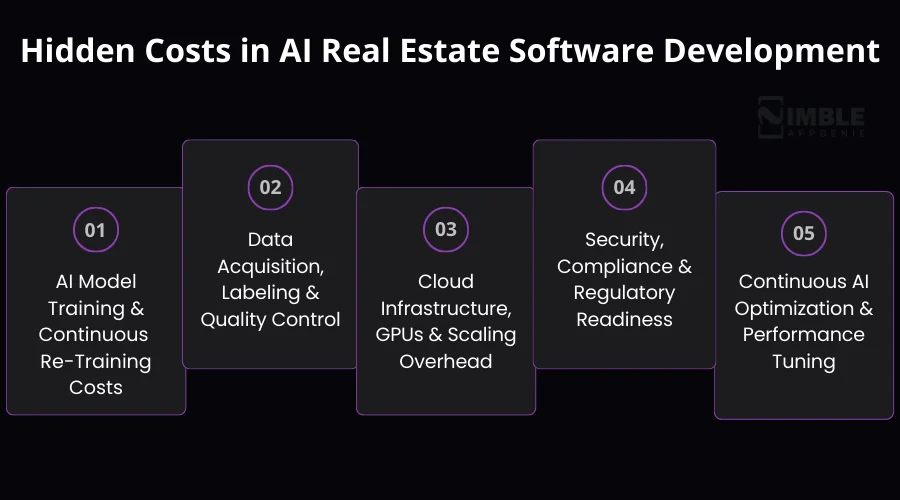
Let’s discuss the hidden cost drivers:
1. AI Model Training & Continuous Re-Training Costs
AI models can’t be left alone post-development, as real estate data changes continuously, like buyer behavior, pricing trends, and market demands.
You need to re-train ongoing model to:
- Maintain prediction accuracy,
- Adapt to new market patterns, and
- Stay away from model drift.
This raises recurring expenses relevant to data processing, AI engineering efforts, and resource computation.
Estimated Cost Range: $5,000 – $25,000 / year
2. Data Acquisition, Labeling & Quality Control
AI precision relies on well-structured, clean, and related data.
Hidden costs come from:
- Licensing MLS and third-party datasets,
- Labeling images and transaction data, and
- Cleaning inconsistent property records.
If your data quality is poor, it increases development cost and time. Thus, data preparation is the most underrated expense in real estate AI projects.
Estimated Cost Range: $4,000 – $20,000
3. Cloud Infrastructure, GPUs & Scaling Overhead
AI workload needs specialized infrastructure, which increases the pricing.
- GPU instances for training and inference,
- Real-time data pipelines, and
- Scalable storage for large property datasets.
No doubt, cloud platforms arrive with a flexibility trait. But the growing data volume and user activity increase AI real estate app development costs, especially for AI-based features like predictive analytics and image recognition.
Estimated Cost Range: $6,000 – $30,000 / year
4. Security, Compliance & Regulatory Readiness
AI real estate platforms manage sensitive user and financial data. Ahead of basic security, the hidden expenses that block the development include:
- Data encryption and access controls
- Ongoing security testing and monitoring
- Compliance audits and documentation
Consider these for fostering trust, enterprise adoption, and safety.
Estimated Cost Range: $3,000 – $15,000
5. Continuous AI Optimization & Performance Tuning
After software launch, AI systems need routine fine-tuning to improve. It includes:
- Recommendation relevance
- Response speed
- Prediction accuracy
It incorporates updating algorithms, monitoring model performance, and refining data pipelines. This creates ongoing operational costs that affect user experience and platform quality directly.
Estimated Cost Range: $4,000 – $18,000 / year
Various businesses prefer planning only for development and overlook post-launch AI expenses.
So remember to consider hidden costs also, which can add about 25-40% over time to the total real estate AI development cost.

Development Timeline & Cost Correlation
As you already know, the AI real estate software development process includes various phases, each affecting the timeline and overall AI real estate platform development cost.
You should understand this correlation for better budget planning, resource allocation, and accurate ROI prediction.
AI Real Estate Development Timeline & Cost Table (2026)
| Development Phase | Key Activities | Typical Duration | Cost Impact (Estimated) |
| Discovery & Planning | Requirement analysis, market research, and architecture planning | 2-4 weeks | Low – $3,000-$7,000 |
| UI/UX Design | Wireframes, prototypes, and user flow design | 3-5 weeks | Medium – $5,000-$12,000 |
| Backend Development | Database setup, server-side logic, and APIs | 4-8 weeks | Medium – $10,000-$25,000 |
| AI/ML Model Development | Training models, predictive analytics, and recommendation engines real estate | 6-12 weeks | High – $15,000-$50,000 |
| Frontend Development | Interface, dashboards, search, and property listings | 4-6 weeks | Medium – $8,000-$20,000 |
| Integration & Testing | MLS/API integration, AI validation, QA, and bug fixes | 3-6 weeks | Medium – $7,000-$18,000 |
| Deployment & Launch | Cloud setup, security audit, and production release | 1-2 weeks | Low – $3,000-$8,000 |
| Post-Launch Optimization | AI retraining, bug fixes, and performance tuning | Ongoing | Medium – $5,000-$15,000 per year |
Key Insights:
- Considering every phase, the AI model development cost is the highest and time-consuming.
- Core frontend and backend development are crucial for platform stability and have moderate costs.
- AI retraining and ongoing optimization are recurring investments that need budgeting for precise recommendations and predictions.
- So, the total AI real estate development timeline for an MVP is 12 to 16 weeks, and for an enterprise-grade solution, it is 5 to 8 months.
Region-Wise AI Real Estate Software Development Cost
The AI real estate software development cost varies with the changing region.
The reasons behind are the different labor rates, infrastructure costs, expertise availability, and operational overhead.
Scan a quick snapshot for the USA, Europe, and India.
| Region | Hourly Development Rate | Estimated Project Cost (MVP) | Estimated Project Cost (Enterprise) |
| USA | $120 – $180 | $70,000 – $100,000 | $250,000 – $350,000+ |
| Europe | $80 – $140 | $55,000 – $90,000 | $200,000 – $320,000 |
| India | $30 – $60 | $35,000 – $60,000 | $150,000 – $280,000 |
Key Insights: Regional differences affect project timelines, budgeting, and team composition. So, your choice of location should be aligned with your business priorities.
Other Key Factors Affecting AI Real Estate Software Development Cost
This section will unveil the remaining key factors impacting AI real estate software development cost that shouldn’t be missed.
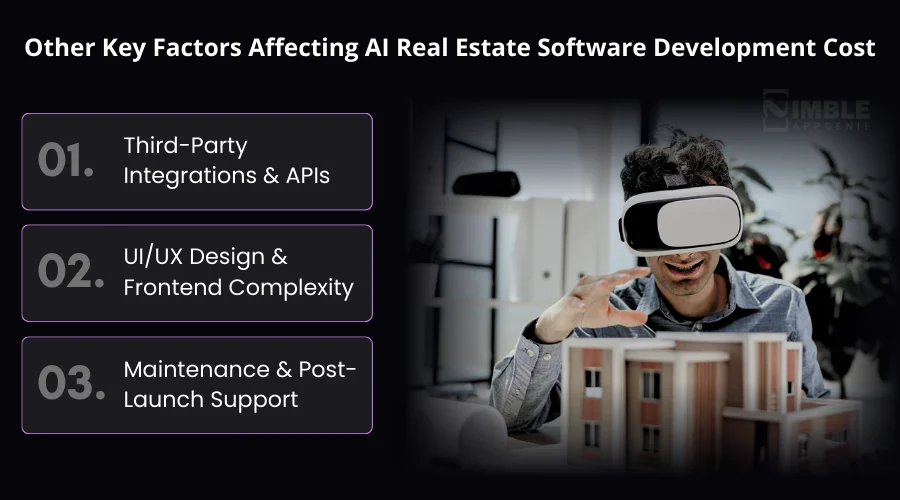
1. Third-Party Integrations & APIs
Integrating AI real estate software with MLS, analytics tools, CRM, systems, and payment gateways increases cost and time.
Estimated Cost Range: $5,000 – $20,000 (depending on the number and complexity of integrations.)
2. UI/UX Design & Frontend Complexity
Interactive, custom, and responsive designs that enhance user experiences for sellers, buyers, and agents can significantly impact cost.
Estimated Cost Range: $8,000 – $18,000 (for medium complexity); $20,000+ (for enterprise-grade interactive dashboards)
3. Maintenance & Post-Launch Support
Even after complete AI real estate software development, your solution needs continuous monitoring, regular feature upgrades, and bug fixes. Consistent support ensures AI accuracy and platform stability.
Estimated Cost Range: $5,000 – $15,000 per year (for MVP); $15,000 – $40,000 per year (for enterprise AI platforms)
Emerging technologies like blockchain in property management also enhance data security, transaction transparency, and trust in AI-driven real estate ecosystems. If you are planning to add it, just be ready to witness the surge in the AI real estate software development cost.
Additionally, Costs may also vary depending on whether the project involves real estate agent website development or a broader AI-driven platform.
Quick Summary Table: All Cost Factors (2026)
Have a swift review of the factors impacting the software development cost.
| Factors | Estimated Cost Range (MVP) | Estimated Cost Range (Enterprise) |
| Type of Software (MVP vs Enterprise) | $35,000 – $70,000 | $180,000 – $350,000+ |
| Core & Advanced Features | $35,000 – $120,000 | $150,000 – $350,000+ |
| AI Models | $15,000 – $50,000 | $50,000 – $120,000+ |
| Development Timeline | $40,000 – $70,000 | $180,000 – $350,000+ |
| Region-Wise Cost | $35,000 – $60,000 (India) | $250,000 – $350,000+ (USA/Europe) |
| Hidden Costs | $15,000 – $40,000 | $40,000 – $100,000+ |
| Third-Party Integrations & APIs | $5,000 – $15,000 | $10,000 – $25,000 |
| UI/UX Design & Frontend | $8,000 – $18,000 | $20,000 – $50,000 |
| Maintenance & Post-Launch Support | $5,000 – $15,000 / year | $15,000 – $40,000 / year |
How to Reduce AI Real Estate Software Development Cost
Well, it can be expensive for some to build AI-powered real estate software, especially for startups and small businesses.
But, did you know, even then, you can reap the advantage of custom real estate AI solutions. All you need to do is carefully plan and smartly strategize to reduce AI development costs.
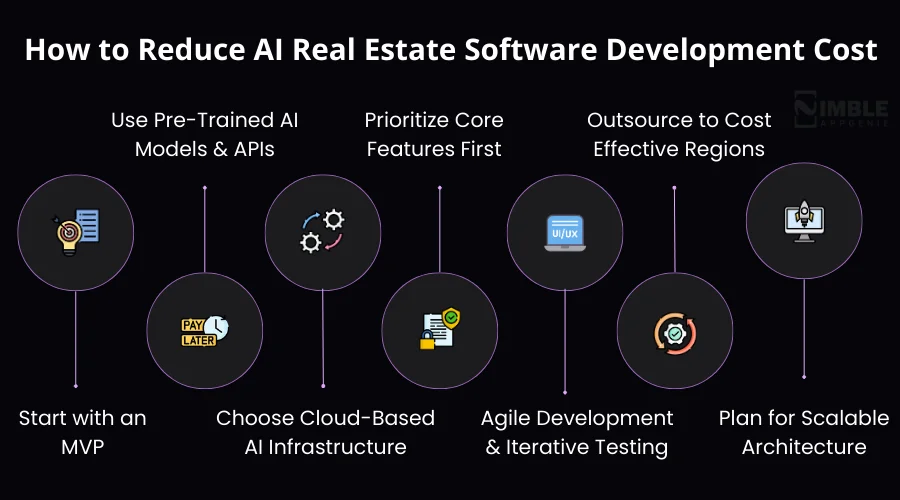
A well-crafted AI real estate development strategy can help you maximize ROI while regulating your budgets.
1. Start with an MVP
You should begin with the development of a minimum viable product with only key features.
Thus, you can:
- Validate your business data,
- Diminish initial AI model complexity, and
- Accumulate user data for feature improvements ahead.
Cost Impact: 30-50% reduced development cost compared to creating a full-fledged enterprise solution.
2. Use Pre-Trained AI Models & APIs
Go for pre-trained models for:
- Recommendation engines,
- Predictive pricing, and
- NLP chatbots.
Thus, you don’t have to build AI from scratch, leading to diminished development time and reduced cloud/GPU costs.
Cost Impact: $10,000 – $30,000 cost savings, depending on AI complexity.
3. Choose Cloud-Based AI Infrastructure
Avoid investing in costly on-premise servers. Cloud infrastructure cost for AI software is affordable, like Azure, AWS, and Google Cloud.
You can reap the rewards of:
- Easier deployment and scalability,
- Pay-as-you-scale pricing, and
- Access to GPU instances only when required.
Cost Impact: 20-40% reduction in infrastructure cost with well-maintained performance.
4. Prioritize Core Features First
You should focus on features first that maximize user impact. Incorporate advanced AI features later, until the initial launch.
Cost Impact: 25-35% cut in upfront AI feature costs
5. Agile Development & Iterative Testing
Go for Agile development that:
- Allows early testing and feedback,
- Optimizes resource allocation, and
- Keep you away from costly rework.
Cost Impact: Prevents $5,000 – $15,000 saving, sidestepping avoidable development errors.
6. Outsource to Cost-Effective Regions
Hire AI real estate developers from cost-efficient regions, like India or Eastern Europe, to mitigate overall development cost without compromising quality.
Cost Impact: 40-60% drop in labor costs compared to Western Europe and the US.
7. Plan for Scalable Architecture
You should build scalable systems to keep expensive re-engineering labor away from the start to handle growing data and users.
Cost Impact: Avoids $10,000 – $30,000+ unexpected upgrade costs.

Some Popular Real Estate Websites & Their Estimated Development Cost
Following the latest real estate technology trends, most of the businesses have become giants and are ruling the fierce market.
Let’s understand the estimated investment of the leading real estate platforms to know valuable standards while you plan your custom AI real estate software development.
Well‑Known AI and Real Estate Platforms
| Platform | Key Features | Estimated Development Cost (2026) |
| Zillow | AI‑powered Zestimate property valuation, smart search, and personalized recommendations | $100,000 – $150,000+ |
| Redfin | Predictive pricing, real‑time data analytics, and AI recommendations | $120,000 – $150,000+ |
| Realtor.com | Behavior‑based suggestions, AI chatbots for real estate, and trend analysis | $90,000 – $150,000+ |
| Trulia | Neighborhood insights, AI‑driven filters, and lifestyle recommendations | $110,000 – $150,000+ |
| Opendoor | Instant offers, dynamic pricing algorithms, and automated tools | $80,000 – $150,000+ |
| Compass | Agent tools, predictive analytics, and client tracking features | $100,000 – $130,000+ |
These benchmarks will help you choose the apt feature set and budget level while you stay competitive with top platforms.
Point to be Noted: Real Estate Website Cost ≠ Platform Value
A basic real estate website with search, listings, and IDX/MLS feed might cost $15,000 - $100,000+, depending on sophistication.
Giants like Zillow and Redfin include AI, predictive analytics, massive databases, and personalization engines, which justify their higher investment ranges.
Use-Case Wise AI Real Estate Website Development Cost
In the real estate industry, different use cases demand distinct levels of AI features, sophistication, and infrastructure, which directly affect AI real estate software development cost.
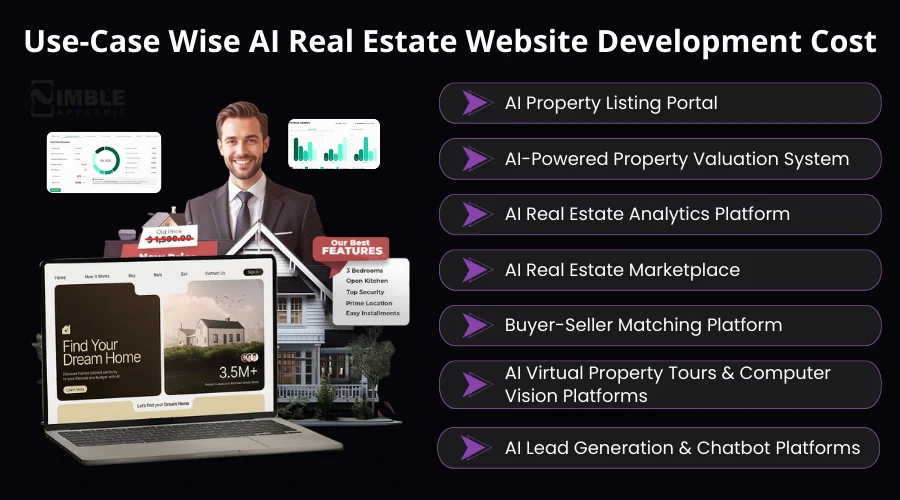
Here, we will check out the common real estate use cases with estimated cost and drivers.
1. AI Property Listing Portal
Includes: AI-powered search, smart filters, basic recommendation engines, listing management, and user dashboards.
Cost is moderate because:
- It utilizes lightweight or rule-based ML recommendations,
- Demands limited data processing, and
- Minimal AI training needs.
Cost Drivers: Search optimization, basic personalization. and listing scalability.
Estimated Cost: MVP: $35,000 – $60,000; Enterprise: $150,000 – $220,000
2. AI-Powered Property Valuation System
Includes: Automated price estimation, comparable property analysis, and valuation accuracy optimization.
It’s expensive because of:
- Machine learning models that are trained on large datasets,
- High precision requirements, and
- Regular model retraining.
Cost Drivers: Data acquisition, model training, validation, and monitoring.
Estimated Cost: MVP: $60,000 – $90,000; Enterprise: $200,000 – $300,000
3. AI Real Estate Analytics Platform
Includes: Real estate market trend analysis, price forecasting, dashboards, historical data processing, and predictive insights. AI-driven insights are increasingly used in construction management software to track project progress, predict delays, and optimize resource planning.
The cost increases because:
- It needs structured historical datasets.
- Leverages regression models and time-series forecasting, and
- Constant data updates.
Cost Drivers: Analytics dashboards, data pipelines, and AI model tuning.
Estimated Cost: MVP: $50,000 – $80,000; Enterprise: $180,000 – $250,000
4. AI Real Estate Marketplace
Includes: Multi-user roles (buyers, sellers, agents), MLS/IDX integration, transaction workflows, and AI insights.
It costs more because of:
- Complex workflows,
- Several integrations, and
- High scalability and security needs.
Cost Drivers: API integrations, backend complexity, and access control systems.
Estimated Cost: MVP: $55,000 – $95,000; Enterprise: $200,000 – $320,000
5. Buyer-Seller Matching Platform
Includes: AI-driven personalization, behavioral tracking, smart recommendations, and lead scoring.
The cost varies as:
- It needs user behavior modeling,
- AI recommendation engines, and
- Real-time personalization logic
Cost Drivers: User data processing, recommendation algorithms, and performance optimization.
Estimated Cost: MVP: $50,000 – $85,000; Enterprise: $180,000 – $300,000
6. AI Virtual Property Tours & Computer Vision Platforms
Includes: 3D tours, AR/VR, image recognition, video analysis, and spatial mapping.
It’s expensive because:
- GPU-heavy infrastructure,
- Computer vision models, and
- High development and testing effort.
Cost Drivers: AI model training, cloud GPU usage, and multimedia processing.
Estimated Cost: MVP: $70,000 – $120,000; Enterprise: $250,000 – $350,000+
7. AI Lead Generation & Chatbot Platforms
Includes: NLP-powered chatbots, automated lead qualification, and CRM integration.
Cost is balanced because:
- It utilizes pre-trained NLP models,
- High business value, and
- Moderate AI complexity.
Cost Drivers: Conversation design, real estate CRM software integrations, and lead scoring logic.
Estimated Cost: MVP: $45,000 – $75,000; Enterprise: $180,000 – $280,000
Key Insight: So, you can’t define AI real estate website development cost just by technology; it’s also driven by your business use case and AI depth.
Simply put, AI & ML can help in business growth by automating lead qualification, optimizing property pricing, enhancing user personalization, and enabling predictive insights across real estate platforms. So, make the most of the latest technology.
Why Choose Nimble AppGenie for AI Real Estate Software Development?
When you look for a software development company to build proptech AI solutions, you should consider distinct factors as mentioned below:
- AI & PropTech experience
- Proven real estate case studies
- Data security & compliance
- Post-launch support
- Team of AI experts
If you are also looking for a trusted AI real estate software development company that maintains a team of expert developers and delivers custom AI solutions and measurable ROI, choose Nimble AppGenie as your ideal tech partner.
Key Reasons to Choose Nimble AppGenie
- Specialized AI Real Estate Expertise
- Experienced AI Real Estate Software Developers
- Custom-Built AI Solutions (No One-Size-Fits-All)
- End-to-End Real Estate AI Development Services
- Cost-Optimized Development Without Quality Compromise
- Flexible Engagement & Hiring Models
- Security, Compliance & Enterprise Readiness
Real Case Study: AI Real Estate Software Development
Client: Mid-sized US-based real estate brokerage & property marketplace (Residential + commercial listings | NDA protected)
Business Requirement:
The client needed a custom AI-powered real estate platform to:
- Streamline property price estimation
- Diminish manual workload for agents
- mprove buyer-property matching
- Increase qualified leads.
Client’s Challenges:
- Inconsistent and manual property valuation
- No personalization for investors and buyers
- Delayed agent follow-ups and low lead quality
- Difficulty in list scaling during peak traffic
Solutions We Offered:
Our team of dedicated AI developers created a custom AI real estate software solution with:
- AI-based property valuation engine
- NLP-powered chatbot for lead qualification
- Personalized property recommendation system
- Cloud-native, scalable architecture
- Admin & agent analytics dashboard
Development Timeline: 22 weeks
Total Project Cost: $95.000 – $130,000
Results Attained:
- 25% drop in agent response time
- 32% increase in qualified lead conversion
- 20% boosted engagement on property listings
- Improved pricing accuracy and rapid deal closures
Business Impact: The client successfully launched an AI-driven real estate platform that improved user experience, enhanced operational efficiency, and delivered quantifiable outcomes within a few months of deployment.
We also help businesses create a real estate app that delivers AI-powered search, smart recommendations, and seamless user experiences. Besides, our team also helps businesses build IDX real estate websites tailored for scalable property listings and lead generation.

Conclusion
As we discussed in this guide, the AI real estate software cost depends on numerous factors, including AI models, use case, development timeline, region, feature complexity, and hidden operational costs.
Additionally, costs may also vary depending on whether the project involves real estate agent website development, which is high in demand, or a broader AI-driven platform.
Businesses that begin with an MVP development, choose the right AI architecture, and plan for lasting scalability can reduce risks while boosting ROI.
Here, the key takeaway is simple: create a strategy besides just choosing technology.
Invest wisely in AI today to deliver better customer experiences, enable rapid decision-making, and gain a sustainable competitive edge in the fierce real estate market.
Modern platforms increasingly fuse the potential of AI with immersive experiences, making it easier to create a real estate virtual tour app, which is also gaining attraction nowadays, that boosts buyer engagement and reduces property viewing time.
Whether you are a brokerage, startup, or enterprise, partnering with a top-tier AI development team like Nimble AppGenie ensures the development of scalable, cost-efficient, and next-gen solutions.
FAQ’s

Niketan Sharma, CTO, Nimble AppGenie, is a tech enthusiast with more than a decade of experience in delivering high-value solutions that allow a brand to penetrate the market easily. With a strong hold on mobile app development, he is actively working to help businesses identify the potential of digital transformation by sharing insightful statistics, guides & blogs.
Table of Contents




No Comments
Comments are closed.