

 Free Consultation
 PCI-DSS Compliant
 GDPR Ready
 ISO 27001
 NDA Protected
 AI Services
 AI App Development
 Generative AI Development
 AI Chatbot Development
 AI Integration Services
 AI Consulting Services
 AI For Fintech
 AI Financial Assistant Solution
 AI Insurance Agent Development
 Tech Stack
 OpenAI / GPT-4
 Claude / Anthropic
 Gemini / Google AI
 Llama / Open Source
 LangChain / LlamaIndex
 Pinecone / Pgvector
 AWS / Azure AI


 Fintech Solution
 Core Fintech
 App Development
 Neobank Solutions
 eWallet Solutions
 Lending Software
 Banking Solutions
 BNPL Solutions
 BNPL Solutions
 Insurance App
 Wealth Management
 Crypto & DeFi
 Blockchain Development
  Payroll Software
 DeFi Solutions
 Crypto Wallet
 Crypto On/Off Ramp
 Crypto Exchange
 Trading Platform
 Payments
 Compliance
 Regulations & Compliance
 Fraud Detection
 Lending Ecosystem
 P2P Lending Platform
 Mortgage Software
 Engagement
 Fintech Outsourcing

 Mobile Development
 Mobile App Dev
 iOS App Development
 Android App Development
 React Native
 Flutter Development
 Web Solution
 Node.js Development
 React.js Development
 Angular Development
 App Services
 UI/UX Design
 App Maintenance
 By Stage
 MVP Development
 Industry Solutions
 Healthcare App Dev
 Education App Dev
 Travel App Dev
 Real Estate App Dev
 Logistics Software
 Social Media App

 Hire Mobile Developers
 Hire iPhone Developers
 Hire Android Developers
 Hire React Native Devs
 Hire Flutter Developers
 Hire Web Developers
 Hire Node.js Developers
 Hire Angular Developers
 Hire PHP Developers
 Hire Laravel Developers
 How It Works
 Pre-Vetted Developers
 Ready In 48 Hours
 NDA From Day One
 Replace Guarantee
 Company
 About Us
 Our Work Process
 Portfolio
 Case Studies
 Blog / Insights
 Careers
 Contact Us
 Awards
 Recognition


 Offices



In a Nutshell:
- Insurance app development cost relies on multiple factors, such as app features, platform (iOS, Android, or both), UI/UX complexity, and compliance requirements, making early cost planning indispensable.
- The cost to develop an insurance app increases with advanced functionalities like AI-powered chatbots, automated claims processing, and third-party API integrations. On average, the cost to develop an insurance app ranges from $25,000 to $250,000, based on the complexity, features, and other factors.
- Businesses looking for accurate budgeting should consider a detailed insurance app cost breakdown based on development region, team size, and project timeline.
- Opting for an MVP can notably reduce the average cost of insurance app development, allowing startups to validate ideas before investing in full-scale solutions.
- Partnering with the right insurance app development company, Nimble AppGenie, helps ensure cost-efficient development, regulatory compliance, and long-term scalability.
Whether you are an insurer, startup, or Insurtech business, before you build an insurance app, you should get a complete and relevant understanding.
The first and the most critical questions that come to most minds is: how much does it cost to build an insurance app?
Let you know, the cost to develop an insurance app can vary chiefly based on technology stack, features, and compliance requirements.
In 2026, the user expectations are going to rise that increase regulatory demands and make precise cost estimation more important.
This guide puts forth an insurance app cost breakdown, factors influencing the development cost, types of insurance apps you can build with the cost estimates, key features, cost estimates based on app complexity, and the best ways to optimize your insurance app development cost in 2026.
Let’s get started!
Overview of the Insurance App Market
The insurance app market has always been a growing one. This is because people are becoming more and more aware of the power of insurance and hence are always on the lookout for the best deals.
If we talk about the insurance app market, it has seen immense growth over the years, making it more and more prominent and relevant for users and opening new doors for businesses working in the fintech industry.
The digitization of insurance has surely made it more accessible to a wider audience, allowing Gen Z to take more interest.
This raises the demand for insurance services, making it a lucrative field for investors and entrepreneurs.
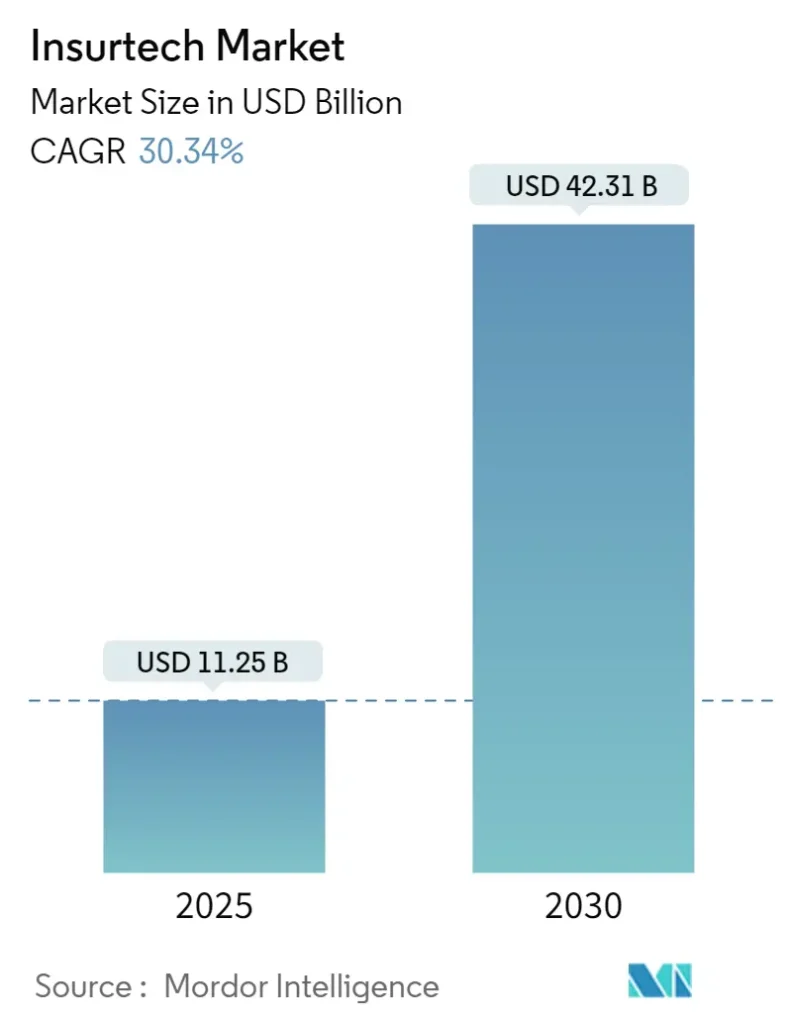
The market size as of 2025 is set at $11.25 billion, and the market size is expected to reach $42.31 billion by 2030 with a CAGR of 30.34%.
In this post, let us take a deeper dive into development and understand the costs associated with the process.
We will also try to answer all the questions related to development and how you can.
Factors Influencing the Cost to Develop an Insurance App
Various technical and business factors impact the cost to develop an insurance app, including app features, development complexity, platform selection, and regulatory compliance.
Understanding these cost drivers helps plan budgets more precisely and avoid unexpected expenses during insurance app development.
When talking about the cost of developing an insurance app, you should keep the following factors in mind.
Building your own digital insurance platform or an insurance app can surely help you grow as a business, thanks to the growth in Insurtech that allows the creation of insurance solutions supported by technology for a continued growth trajectory.
While technology has certainly made it easier for the insurance business to thrive, it is not that easy.
If you are planning to take advantage of this growing field of business, you should be aware of the different factors that affect the cost of developing an insurtech app.
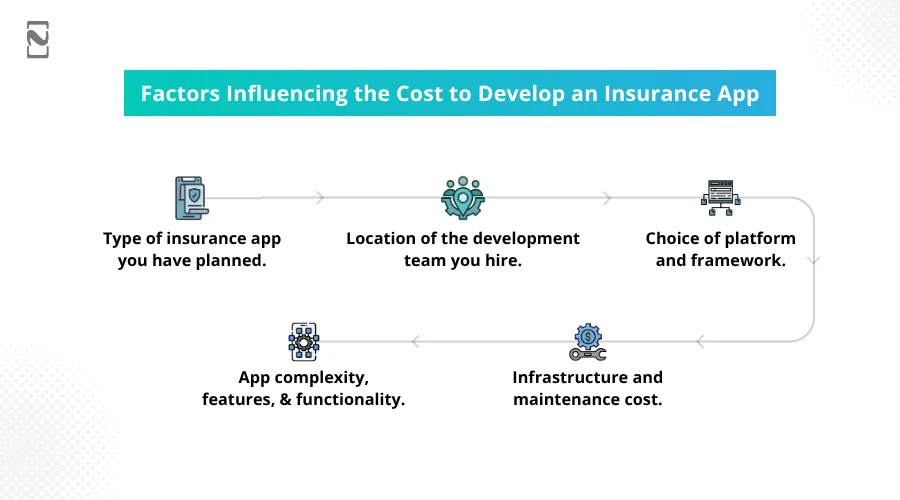
These factors include:
- Type of insurance app you have planned.
- Location of the app development team you hire.
- Choice of platform and framework.
- App complexity, features, & functionality.
- Infrastructure and maintenance costs.
The cost of developing an insurance app revolves around the tech you choose, the domain you plan, and the team of experts you hire.
All of these decisions define the course of development, along with how much it is going to cost.
The most crucial decision among all these factors is finding the right guidance and development partners.
Types of Insurance Apps You Can Develop
To meet specific business and user needs, different types of insurance apps are crafted, such as claims processing, policy management, and customer engagement. Every app type varies in complexity and functionality, which directly contributes to the insurance app development cost and overall development approach.
Now that you know about the factors, let’s start dissecting those factors, starting with the types of insurance applications that you can choose from.
The current insurance app market offers lucrative opportunities in various industry sectors.
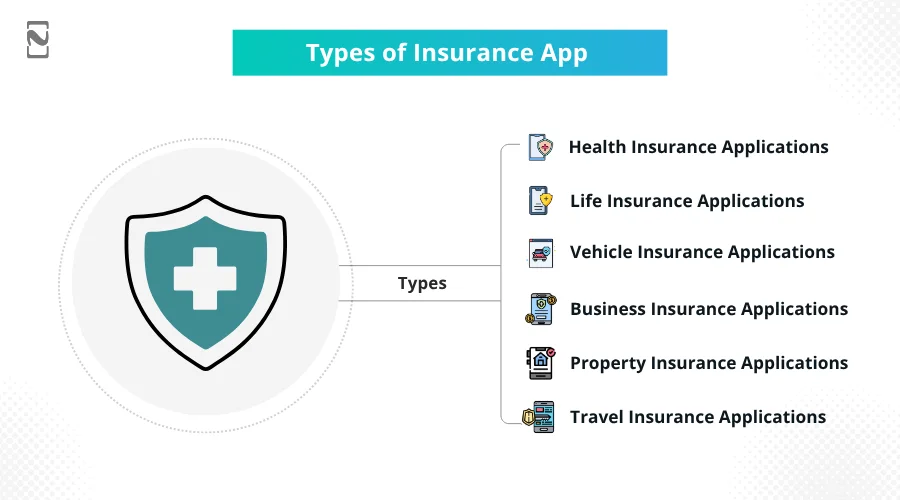
These include:
♦ Health Insurance Applications
One of the most popular types of insurance applications, health insurance apps can be found on almost every working professional’s smartphone.
When you develop a health insurance app, it’s essential to design it in such a way that everything from choosing a payment plan to identifying covered expenses can be done seamlessly through the application. This ensures a user-friendly experience for policyholders.
Development Cost Estimate: $15,000-$150,000
♦ Life Insurance Applications
These are common insurance applications that allow a user to manage their life insurance plans.
People find it highly useful as these apps simplify routine processes like premiums, upcoming payments, reviewing of terms and conditions, interest calculation, etc.
Development Cost Estimate: $25,000-$200,000
♦ Vehicle Insurance Applications
Simplifying the process of getting your vehicle insured, these apps work as digital middlemen between vehicle insurance providers and consumers.
A user can get their vehicle insured simply through the app, without having to visit an agency physically. Things like filing a claim, uploading pictures, etc., can be done through these apps easily.
Development Cost Estimate: $10,000-$170,000
♦ Business Insurance Applications
These applications play a crucial role in the corporate structure in preventing businesses from going bankrupt in times of distress or a mishap.
Business owners can easily choose the right policy as per their business size and requirements.
Connecting with the right expert can help you identify how a business insurance app is developed and how it simplifies the job.
Development Cost Estimate: $25,000-$200,000
♦ Property Insurance Applications
With the help of a property insurance application, a user gets the ease to find appropriate policies to protect their personal properties, such as their homes, flats, jewels, artworks, etc.
The services that these applications offer are highly attractive to the users, making them popular among a wider range of audiences.
Development Cost Estimate: $15,000-$150,000
♦ Travel Insurance Applications
Travel insurance apps have found their way into every traveler’s itinerary through booking applications and portals.
People traveling around the globe can easily check for their respective insurance policies, protecting themselves, their luggage, and other aspects of their travel.
Development Cost Estimate: $5,000-$100,000
With so many verticals to explore, insurance technology surely is one of the fastest-growing fields. You can choose any and accordingly plan your approach for development.
Ensure that you research all of these and make an informed decision. Based on this choice, there will be different costs to build an insurance app that you will have to bear.
Choosing the type of app and the vertical of insurance you plan to tap sets the tone in terms of features you need, the development expertise required, and the budget it would take.
Key Features That Impact Insurance App Development Cost
The insurance mobile app development cost is majorly affected by the complexity and number of features, embracing policy management, user authentication, claims processing, and third-party integrations.
Besides, advanced functionalities, like AI-driven automation, improved security measures, and real-time analytics, further increase development effort and complete cost.
One of the most important factors that affects the cost of building an insurance app is the type of features and functionalities you need in your app.
While discussing features for insurance applications, some are essential in every sector of insurance technology.
Then, some added advanced features elevate the user experience to the next level and help you stand out from the competition.
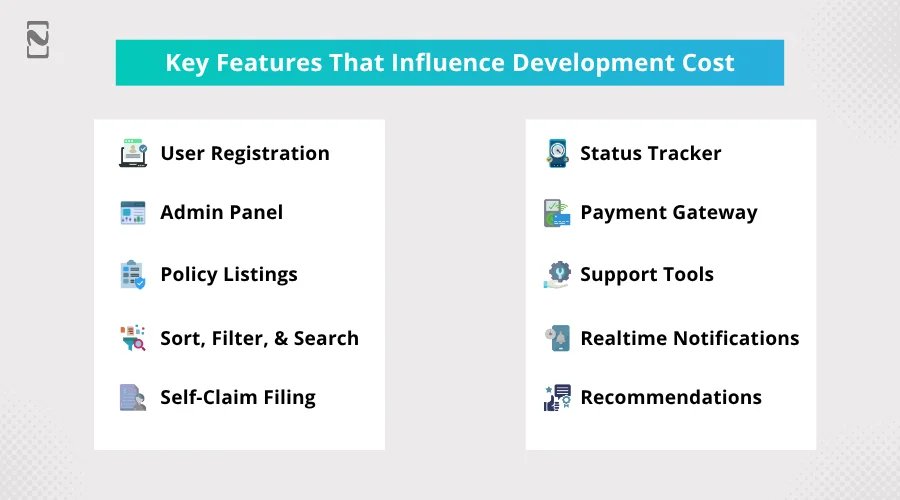
Here is a list of features that influence the development cost of insurance applications for your reference:
1. User Registration
A single page to help them sign up with their basic information and create user credentials for logging into their account later.
2. Admin Panel
This is the panel where your user’s profile is visible. This holds all the information about the user, along with their policy details and transaction history. To the user, it serves as a profile section.
3. Policy Listings
This is the section where all the policies that your company offers are listed. You can even become an insurance aggregator, allowing a user to access multiple policies in the same domain.
4. Sort, Filter, & Search
People looking for a specific policy under a specific budget can easily use these features. This allows sorting the listed policies based on budget, duration, etc.
5. Self-Claim Filing
Claim forms and self-claiming options are another feature that is always integrated to give users flexibility in drafting claims and filing them on their own.
This is a must-have feature for any insurance app.
6. Status Tracker
Once a user has filed a claim, they should be able to identify its current status, whether it is being considered, approved, or denied.
7. Payment Gateway
An integrated payment gateway allows a user to pay for insurance services right from the application. This makes payments for renewals, premiums, and buying new policies much easier.
8. Support Tools
There are several ways an insurance application can implement support for any application. Features like chat, calling, chatbots, live interactions, and more.
9. Real-time Notifications
Insurance applications also include real-time notifications and reminders to ensure that you never miss a premium and are aware of any updates in your policy or app.
10. Recommendations
Personalized recommendations are another feature that many insurance apps integrate.
Based on your search data and what you have already mentioned in your requirements, the app starts recommending policies and add-ons.
Technology Stack & Development Approach for Insurance App Development
The choice of tech stack and development approach plays a significant role in determining insurance app development cost.
Factors such as cloud infrastructure, native vs cross-platform development, security frameworks, and third-party APIs directly influence development time, sustainable maintenance expenses, and scalability.
All of these features are necessary for almost every vertical of the insurance industry you choose. To integrate all these features, you need a tech stack that can be used to develop them.
Technologies are the basic building blocks of any application, and understandably, they have a crucial role in deciding the overall insurance development cost.
Different technologies are required to develop an insurance app.
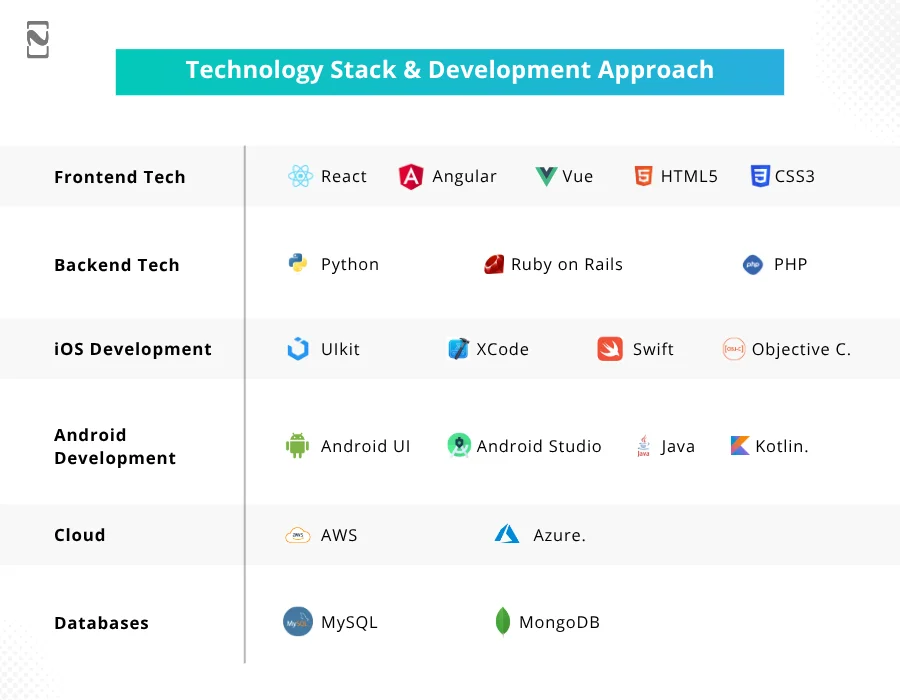
Here are some technologies you will require to design different modules of your insurance application:
► Frontend & Backend Technologies
Frontend technologies help you build the interface of your application. On the other hand, the backend is more complex as it is used to design all the functionalities.
- Frontend Tech: React, Angular, Vue, HTML5, CSS3.
- Backend Tech: Python, Ruby on Rails, PHP.
► Native vs. Cross-Platform Development
Another thing that you need to consider while choosing the technology for your application is what type of development you plan to approach.
If you are going to release the application only for Android devices or only for iOS devices, you can choose the respective native development technologies, whereas if you want to enter both markets, you can opt for cross-platform development.
Technologies for respective development approach:
- iOS Development: UIKit, XCode, Swift, Objective-C.
- Android Development: Android UI, Android Studio, Java, and Kotlin.
► Cloud Services & Database Management
To support your application’s cloud and database management requirements, you can go for the following technology options:
- Cloud: AWS, Azure.
- Databases: MySQL, MongoDB
With all these technologies powering the app, you can expect the application to perform well and get the job done for you.
These technologies take up a major chunk of development cost, as they serve as the basic tools that are used to build your solution.
Development Team Structure & Insurance App Cost Breakdown
The insurance app development cost is closely related to the team structure and expertise needed. Generally, a team includes UI/UX designers, project managers, frontend and backend developers, QA testers, and sometimes AI specialists to include advanced features.
Every role contributes to the comprehensive cost, which fluctuates based on hourly rates, project duration, and team size.
Understanding this insurance app cost breakdown helps businesses avoid unexpected expenses and plan budgets effectively.
One of the key factors that affects the cost to create an insurance app is the team that you choose.
Different internal and external factors can help you save costs and get the best app development services on a budget.
These factors include:
➤ In-House vs. Outsourcing Development
If we talk about going for an in-house development approach, it might cost you on the higher side as you have to build your team, hire people on a payroll, and look after them even after the work is done.
On the other hand, you can simply hire a company that provides app development services and already has a team to deploy for your projects.
If we talk about the cost:
- Hiring new employees and building an in-house team might cost you: $50,000-$100,000.
- Outsourcing your work to an experienced app development firm might cost you: $25-$45/hour.
Now, while you can imagine how many hours’ worth of money you’ll be spending just on the team.
Keep in mind that this does not include the cost of resources, machines, and subscriptions to tools that you will need to build the application.
➤ Estimated Cost by Region (USA, Europe, Asia)
The location of the team you hire is extremely important. That is because geological factors such as currency exchange rates, availability of resources, and cost of resources vary from region to region.
This is also the reason why you can see the difference between a project estimate from a European firm and the same from an Asian development company.
Here’s a quick cost breakdown by region:
- Hourly Rates in US: $50-$100
- Hourly Rates in Europe: $40-$90
- Hourly Rates in Asia: $20-$60
These rate ranges define everything from what an iOS professional to the cost of hiring an Android developer in these regions.
If you are looking to save money on the cost of developing an insurance app, you now know which region to choose for hiring developers.
Cost Estimation Based on App Complexity
Now that you are familiar with almost every factor that affects the cost to develop an insurance app, let us take a look at different cost estimations.
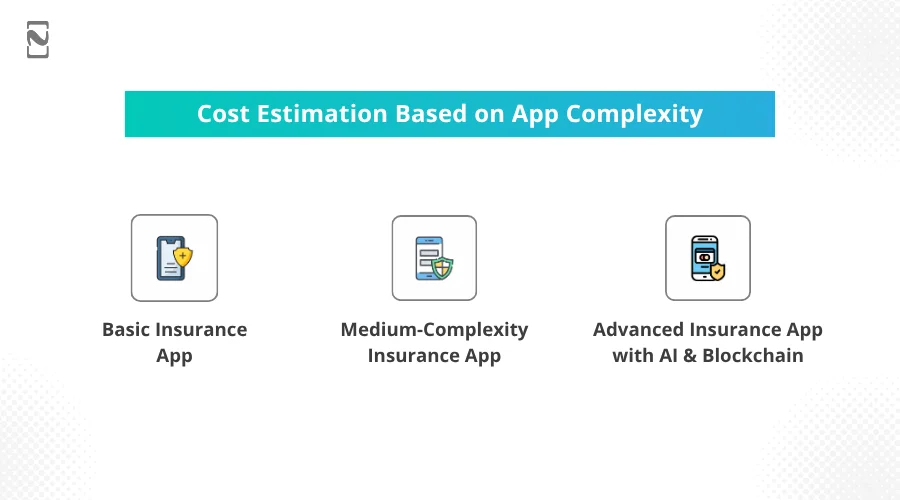
You see, based on the choices you make, you will end up with either of the following tiers of applications:
► Basic Insurance App (Cost & Timeline)
If you go for a basic application that simply allows a user to complete basic tasks such as browsing plans and filing claims, it might take somewhere between 3 to 6 months and cost you somewhere between $25,000-$60,000.
► Medium-Complexity Insurance App (Cost & Timeline)
A medium complexity application comes with all the basic features and offers additional features such as internal payment gateways, data fetching, video and photo galleries, etc.
Since it has added functionalities to be developed, it will take 6-9 months and cost anywhere around $70,000-$120,000.
► Advanced Insurance App with AI & Blockchain (Cost & Timeline)
Advanced insurance applications use the latest technologies, such as AI in insurance, machine learning, blockchain, etc., and understandably cost more.
The application has all types of advanced features, be it an AI chatbot, blockchain-based security, encryption, personalization tools, etc.
Developing a full-fledged advanced insurance app might take 9-15 months, depending on the tech you choose, and the cost might range between $130,000-$250,000.
| Type of App | Time to Develop | Cost of Development |
| Basic Application | 3-6 months | $25,000 – $60,000 |
| Medium App | 6-9 months | $70,000 – $120,000 |
| Advanced App | 9-15 months | $130,000 – $250,000. |
Based on what fits your requirements and how much you can invest, you can opt for the application.
This classification can help you understand the investment you are looking at and help you plan the course of action accordingly.
How to Optimize Insurance App Development Cost
Businesses can reduce the cost to develop an insurance app simply by prioritizing core features, beginning with an MVP, working with an experienced insurance app development company, and choosing the right technology stack. Strategic planning and step-by-step development help regulate expenses while ensuring quality and scalability.
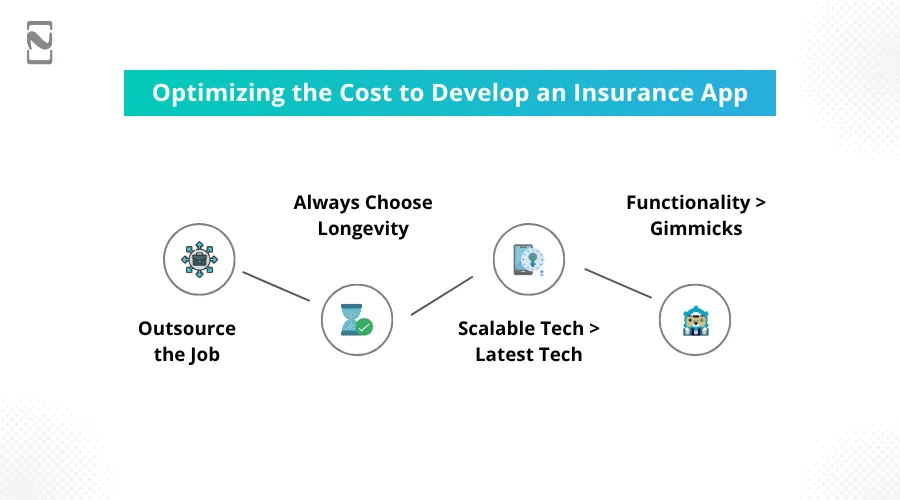
Then check out the following tips that might help you out:
1. Outsource the Job
Outsourcing third-party IT services can help you save a lot of resources.
You see, hiring a team of developers and paying them for a full-time role is significantly higher than hiring an outsourced development service provider that charges you a simple fee and gets the job done.
2. Always Choose Longevity
While deciding on your application features, make sure you keep the focus on longevity and opt for sustainable features.
This also means that you should choose a design that stays relevant in the long run and becomes the identity of your application in the long run.
3. Scalable Tech > Latest Tech
There are a lot of technologies that keep emerging now and then. However, you should be aware that not every technology or tech trend is here to stay.
You need to choose tech that is scalable and can be modified as the number of users increases on your platform.
A scalable technology is always better than something that is emerging, as you might not be aware of what the future holds for the same.
4. Functionality > Gimmicks
Make sure your application offers features that are useful and add to the convenience of the user experience.
You don’t want to clutter your application with unnecessary animations and gimmicky features that make your app slow. Keep only the selected features that are functional and get the job done.
Other than this, choosing a good and affordable development service can also help you optimize the cost to a great extent.
If you are wondering where to find a service that is pocket-friendly and does not compromise your application’s performance, then Nimble AppGenie is what you need.
Why Choose Nimble AppGenie for Your Insurance App Development
At Nimble AppGenie, our team delivers custom insurance app development solutions that fuse regulatory compliance, advanced technology, and cost-efficiency.
Our experienced developers, UI/UX designers, and QA experts ensure the delivery of scalable and feature-packed solutions that improve user experience.
By utilizing AI, cloud-based solutions, and automation, we help businesses launch user-centric insurance apps without going beyond the budget.
Real-Time Case Study: Health Insurance App Development
Client: Leading Health Insurance Provider
Project: AI-Powered Policy Management & Claims Processing App
Duration: 14 Weeks
Team Involved: Project Manager, UI/UX Designers, Frontend & Backend Developers, QA Testers, AI
Key Features:
- Automated claim verification
- Policy tracking & management
- Push notifications for updates
- AI-driven customer support
Results Obtained:
- 35% reduction in manual claim processing time.
- Scalable, secure, and fully compliant mobile app
- Improved customer engagement and satisfaction
- Optimized development cost through phased delivery
Outcome: The client launched a high-quality insurance app successfully at a cost-effective range that automated operations and improved user experience.
Conclusion
Understanding the insurance app development cost is important for better business planning to go digital in 2026. Costs vary based on technology stack, features, regulatory needs, and team structure.
By focusing on crucial functionalities, utilizing phased development, and partnering with an experienced insurance app development company, like Nimble AppGenie, businesses can create cost-efficient apps.
Investing in the right strategy optimizes expenses and ensures the delivery of a future-ready insurance solution that meets user expectations and increases ROI.
FAQs

Niketan Sharma, CTO, Nimble AppGenie, is a tech enthusiast with more than a decade of experience in delivering high-value solutions that allow a brand to penetrate the market easily. With a strong hold on mobile app development, he is actively working to help businesses identify the potential of digital transformation by sharing insightful statistics, guides & blogs.
Table of Contents




No Comments
Comments are closed.