

 Free Consultation
 PCI-DSS Compliant
 GDPR Ready
 ISO 27001
 NDA Protected
 AI Services
 AI App Development
 Generative AI Development
 AI Chatbot Development
 AI Integration Services
 AI Consulting Services
 AI For Fintech
 AI Financial Assistant Solution
 AI Insurance Agent Development
 Tech Stack
 OpenAI / GPT-4
 Claude / Anthropic
 Gemini / Google AI
 Llama / Open Source
 LangChain / LlamaIndex
 Pinecone / Pgvector
 AWS / Azure AI


 Fintech Solution
 Core Fintech
 App Development
 Neobank Solutions
 eWallet Solutions
 Lending Software
 Banking Solutions
 BNPL Solutions
 BNPL Solutions
 Insurance App
 Wealth Management
 Crypto & DeFi
 Blockchain Development
  Payroll Software
 DeFi Solutions
 Crypto Wallet
 Crypto On/Off Ramp
 Crypto Exchange
 Trading Platform
 Payments
 Compliance
 Regulations & Compliance
 Fraud Detection
 Lending Ecosystem
 P2P Lending Platform
 Mortgage Software
 Engagement
 Fintech Outsourcing

 Mobile Development
 Mobile App Dev
 iOS App Development
 Android App Development
 React Native
 Flutter Development
 Web Solution
 Node.js Development
 React.js Development
 Angular Development
 App Services
 UI/UX Design
 App Maintenance
 By Stage
 MVP Development
 Industry Solutions
 Healthcare App Dev
 Education App Dev
 Travel App Dev
 Real Estate App Dev
 Logistics Software
 Social Media App

 Hire Mobile Developers
 Hire iPhone Developers
 Hire Android Developers
 Hire React Native Devs
 Hire Flutter Developers
 Hire Web Developers
 Hire Node.js Developers
 Hire Angular Developers
 Hire PHP Developers
 Hire Laravel Developers
 How It Works
 Pre-Vetted Developers
 Ready In 48 Hours
 NDA From Day One
 Replace Guarantee
 Company
 About Us
 Our Work Process
 Portfolio
 Case Studies
 Blog / Insights
 Careers
 Contact Us
 Awards
 Recognition


 Offices


Key Takeaways:
- Legacy apps silently drain budgets. Gartner reports that up to 80% of IT spend goes toward maintaining outdated systems, leaving little room for innovation.
- App modernization updates existing software (code, infrastructure, and architecture) without dumping the business logic you have already built.
- The 6 R’s framework – Rehost, Replatform, Refactor, Repurchase, Retire, Retain- gives every app in your portfolio a clear strategic path.
- Costs range from $10K for a simple rehost to $2M+ for a full enterprise transformation, with most projects hitting ROI in 18-36 months.
- Top 2026 drivers: AI-assisted modernization, FinOps integration, security-first architecture, and edge-cloud hybrid design.
- The cost of not modernizing is steeper: legacy maintenance runs 3-5x more annually than a modernized equivalent, before accounting for breach and downtime costs.
- Nimble AppGenie offers end-to-end modernization – from 6R portfolio audits to microservices, cloud migration, and post-launch DevOps enablement – with a free assessment to get you started.
Your legacy app is costing you quietly without even letting you know. Every failed deployment, every slow load, every security patch that takes weeks instead of hours – it all adds up.
According to Gartner research, organizations spend 60-80% of their IT budgets maintaining legacy systems, leaving limited resources for innovation.
In 2026, the hard truth is that the gap between businesses shifting to modern, cloud-native software and those adhering to legacy systems is no longer a technology void; it’s a competitive survival gap.
This guide breaks down everything you need to know about app modernization: what it is, real costs, the six proven strategies, measurable ROI, and how to choose the right path. Whether you are a CTO, IT director, or product manager, you will leave with a transparent action plan.
What is App Modernization?
App modernization is the practice of updating legacy software systems to follow modern technology standards, business needs, and cloud infrastructure without discarding the core business logic. The strategies include rehosting, rearchitecting, and refactoring to improve mobile app security, scalability, developer agility, and cost-efficiency.
Unlike developing a new app from scratch, modernization protects your existing investment – the years of business workflows, data, and rules, while depleting the technical debt, degrading the performance.
Typically, app modernization involves adopting technologies such as microservices architecture, cloud computing, API-first design, and containerization to make applications more flexible and future-ready.
Rather than a complete rebuild, it is a strategic upgrade that keeps what works and replaces outdated components.
The goal is to achieve:
- Stronger security
- Lower maintenance costs
- Faster performance
- On-demand scalability
♦ App Modernization vs Rebuilding From Scratch
The rebuild debate is real. Here’s how to think about it:
| Factor | Modernization | Rebuild from Scratch |
| Cost | Lower (30–60% cheaper) | Higher upfront |
| Risk | Lower – existing logic retained | Higher – everything rebuilt |
| Speed | Faster to the first improvement | Longer, full project cycle |
| Business continuity | Maintained throughout | Major disruption risk |
| Best For | Apps with solid business logic | Outdated or deeply broken core |
A Quick History: From Monolithic to Cloud Native
Monolithic architectures ruled through the 1900s and 2000s with single, tightly-coupled codebases that were easy to deploy but challenging to scale. As the cloud came to play, service-oriented architecture (SOA) surfaced as a bridge.
By 2015, containers (Docker and Kubernetes) and microservices had grown as the new standard, allowing teams to deploy independently, recover rapidly from failure, and scale components individually.
Today in 2026, cloud-native, AI-augmented architectures define modern software. Legacy applications created before this era face growing risk.
Why Businesses Need App Modernization in 2026?
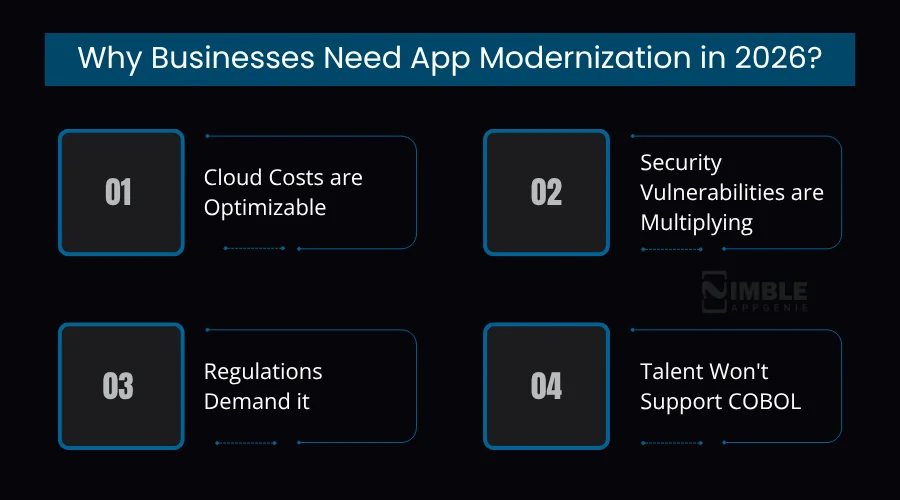
Major reasons why organizations should choose legacy app modernization are to boost performance, cut costs, and outshine competitors in 2026.
Below are more aspects that make legacy systems a liability:
► Cloud Costs are Optimizable
Organizations that modernize before scaling witness 30-40% infrastructure cost reductions. Those that only ‘lift and shift’ without optimization usually see costs spike instead.
► Security Vulnerabilities are Multiplying
Unpatched legacy stacks are the #1 entry point for enterprise data breaches. With growing cyber threats, running outdated frameworks is not only slow, but it’s also dangerous.
► Regulations Demand it
GDPR, PCI-DSS, HIPAA, and emerging AI governance laws are becoming incompatible with legacy architecture. Modernization is not optional when compliance is non-negotiable.
► Talent Won’t Support COBOL
It’s increasingly becoming challenging to find engineers fluent in legacy stacks and expensive above that. Modern mobile app developers need to work with modern tools, and your caliber to hire and retain the top engineering talent depends on it.
| Forrester surveyed 79% of respondents who admitted that their core systems’ performance distinguishes their firms in the broad insurance marketplaces, and another 62% acknowledge that their core system modernization initiatives are an important component of their digital business strategies. |
What are the Types of App Modernization? (The 6 R’s Framework)
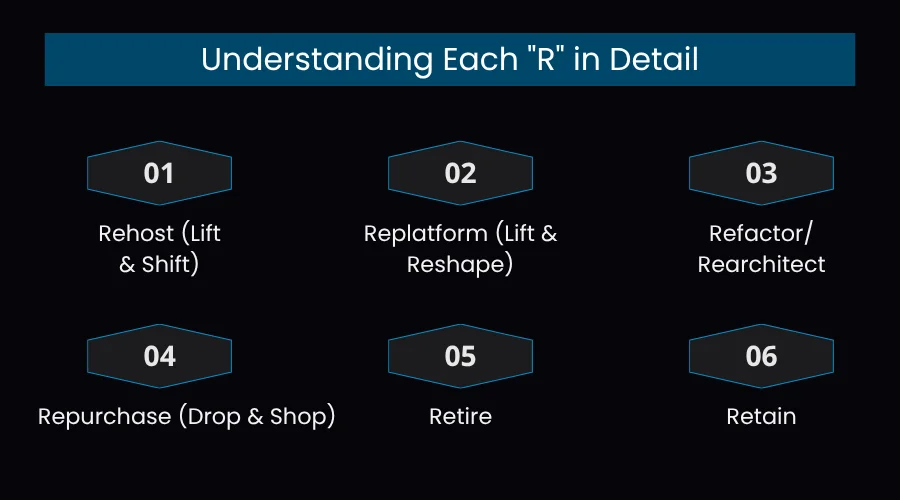
Originally developed by AWS and widely adopted across industries, the 6 R’s framework, the type of app modernization, offers you a structured way to categorize each application in your portfolio.
Below is the Quick-Reference Table:
| Strategy | Also Called | What Happens | Best For | Complexity |
| Rehost | Lift & Shift | Move the app to the cloud as-is | Quick migration wins | Low |
| Replatform | Lift & Reshape | Minor optimizations before cloud move | Cost savings + modest gains | Medium |
| Refactor | Re-architect | Redesign code for cloud-native patterns | Scalability & performance | High |
| Repurchase | Drop & Shop | Replace with SaaS product | CRM, HR, commodity tools | Medium |
| Retire | Decommission | Shut down unused apps | Reducing tech debt | Low |
| Retain | Revisit Later | Keep as-is for now | Mission-critical stable apps | None |
♦ Understanding Each “R” in Detail
1. Rehost (Lift & Shift)
Move your app to the cloud without modifying the architecture. It’s the lowest-risk and fastest option.
You get cloud cost advantages (pay-as-you-go, managed infra) with minimal disruption. Best as a first step when speed matters more than optimization.
2. Replatform (Lift & Reshape)
Make focused improvements during migration, like swapping a self-managed database for Google Cloud SQL and Amazon RDS.
You are not altering the core code, but you are shedding operational overhead. A perfect middle ground for apps that are stable but inefficient.
3. Refactor/Rearchitect
The most transformative choice. You break the monolith into microservices, redesign for cloud-native patterns, propose CI/CD pipelines, and adopt API-first design.
It’s costly and time-intensive, but delivers the biggest long-term scalability and performance gains. Ideal for high-traffic, high-growth applications.
4. Repurchase (Drop & Shop)
Sometimes the best mobile app modernization strategy is replacing a custom-built system with a best-in-class SaaS product. HR? Workday. CRM? Salesforce. Finance? NetSuite. If the tool is not your competitive differentiator, purchase despite building.
5. Retire
Run your application portfolio audit, and you will usually find 10-20% of apps that have been superseded or no longer used. Shutting them down diminishes your attack surface, engineering distraction, and licensing costs.
6. Retain
Some applications should not be touched yet – too risky, too complex, or along with a planned replacement on the roadmap. Retain is an intentional decision, not postponement. Schedule a formal review of the data and move on.
What are the Key Benefits of App Modernization?
Modernization is not only a technical upgrade, but a business growth switch that benefits from reducing IT costs, speeding agile deployment cycle, and improving security.
Below is the data that says about app modernization benefits:
| Benefit | Impact | Example Metric |
| Lower Operating Costs | Reduce infra & maintenance spend | Up to 30% cost reduction (Gartner) |
| Faster Time-to-Market | Ship features in days, not months | 2x deployment speed (Forrester) |
| Improved Security | Patch vulnerabilities at scale | 72% fewer breaches post-modernization |
| Better Scalability | Handle traffic spikes without a crash | Auto-scaling with Kubernetes |
| Enhanced UX | Modern, responsive interfaces | 25% increase in user satisfaction |
| Regulatory Compliance | Meet GDPR, HIPAA, PCI DSS | Audit-ready architecture |
Ahead of the numbers, there’s a compounding impact: modern apps let you adopt AI/ML capabilities, low-code automation, and real-time analytics – powers that are almost impossible to add to legacy stacks.
Companies that choose app/software modernization services also report significant improvement in developer experience. Shorter feedback loops, faster onboarding, and independent deployments mean your engineering team spends extra time creating value and less time controlling incidents.
What are the Top App Modernization Trends Shaping 2026?
Mobile app modernization trends in 2026 focus on AI-driven automation, improved agility, and cloud-native architectures via low-code/no-code platforms and microservices.
The top inclusions are:
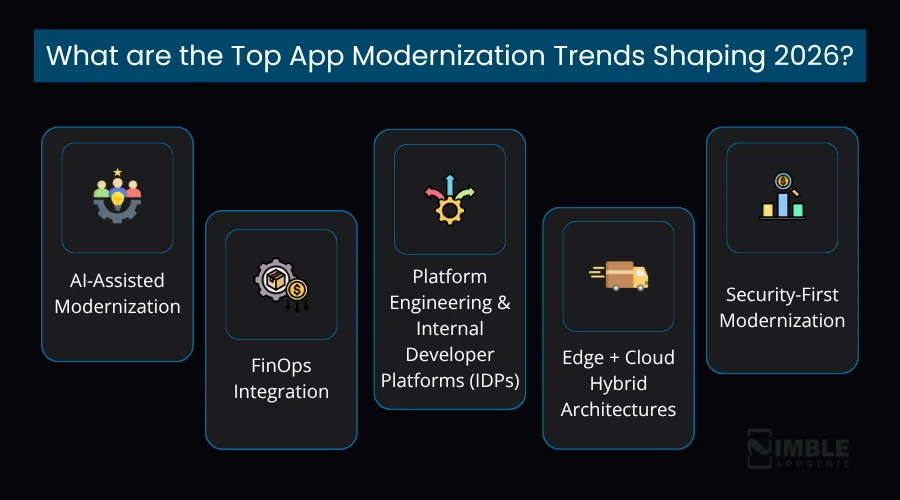
1. AI-Assisted Modernization
Now, AI code analysis tools scan legacy codebases, recognize refactoring opportunities, generate documentation, and even recommend migration paths. What once demanded weeks of architect time now takes hours. Platforms like AWS Transform, Google Gemini Code Assist, and GitHub Copilot are modifying the economics of app modernization projects.
2. FinOps Integration
Cloud cost management is now the top-class concern in modernization projects. Companies are embedding FinOps practices – cost allocation, tagging, and rightsizing into the modernization process rather than testing it as an afterthought.
3. Platform Engineering & Internal Developer Platforms (IDPs)
Enterprise teams are creating Internal Developer Platforms to standardize how applications get deployed, scaled, and monitored. This mitigates the per-app modernization cost and allows mobile app development teams to self-serve infrastructure without waiting on ops.
4. Edge + Cloud Hybrid Architectures
As real-time processing and IoT demands grow, modernized apps are being crafted to run workloads at the edge (near users and devices) while handling orchestration in the cloud. This needs a basically different architecture than legacy centralized systems.
5. Security-First Modernization
Secrets management, zero-trust architecture, and automated vulnerability scanning are not created by default in CI/CD pipelines. Modernization is more and more the trigger for a complete security posture upgrade, not only a tech refresh.
How Much Does App Modernization Cost?
App modernization costs vary immensely – from $10,000 for a simple rehost to millions for a complete enterprise transformation. What are the key drivers?
► Key Cost Factors Impacting App Modernization Cost
- Number of apps in the portfolio
- Application complexity and codebase size (application integrations, lines of code, and dependencies)
- Cloud provider and licensing costs
- Chosen application modernization strategies (rehost vs. rearchitect)
- Internal team bandwidth vs. external partner engagement
- Data migration complexity and compliance needs
- Geographic and regulatory constraints
► Cost Ranges by Modernization Type
| Modernization Type | Typical Cost Range | Timeline | Complexity |
| Rehost (Lift & Shift) | $10K – $50K | 2–6 weeks | Low |
| Replatform | $30K – $150K | 1–4 months | Medium |
| Refactor / Re-architect | $100K – $500K+ | 3–12 months | High |
| Full Modernization Program | $200K – $2M+ | 6–24 months | Very High |
| Mobile App Modernization | $25K – $200K | 2–6 months | Medium |
► ROI Framing: Cost of Modernization vs. Cost of NOT Modernizing
Decision makers often avoid this question: What does it cost to do nothing?
Legacy applications notably elevate operational costs by collecting technical debt and inefficiencies. According to International Data Corporation, technical debt can consume 20 to 40% of development time, restricting innovation and delaying delivery.
When combined with security risks, where the average data breach costs around $4.45 million, according to IBM, with developer productivity degrading and delayed feature delivery, the financial effect becomes considerable.
Above all, modernization is not only about cost-cutting, but organizations that modernize efficiently can reach up to 3x increased digital revenue growth, making the ROI case definite.
A typical modernization project pays in 18-36 months through lower support costs, reduced infrastructure spend, and increased engineering velocity. That’s before accounting for revenue gains.
How to Choose the Right App Modernization Strategy?
The right app modernization strategy depends on four dimensions: your business objectives, risk tolerance, technical constraints, and available budget and timeline.
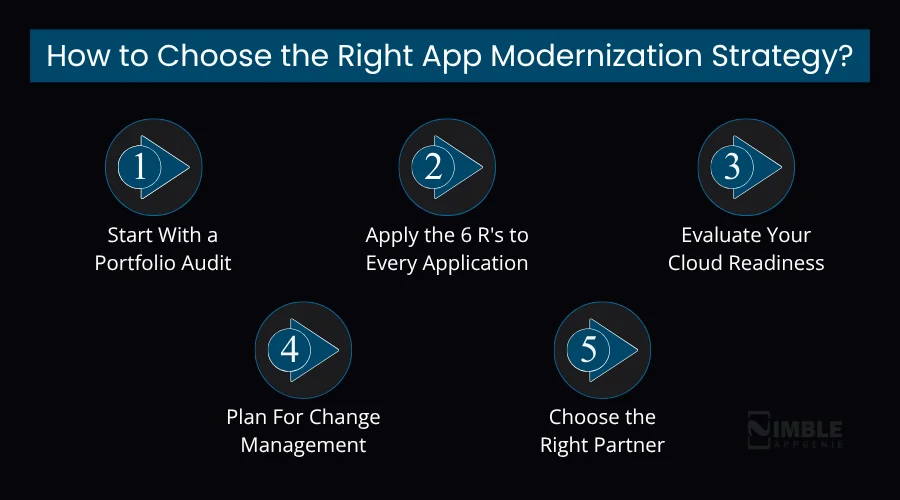
♦ Start With a Portfolio Audit
Map all your applications by user volume, business criticality, maintenance cost, and technical debt level. This offers you a prioritized modernization queue, not only a wish list.
♦ Apply the 6 R’s to Every Application
Avoid picking one strategy for everything. For example, during app modernization for fintech, the platform’s core transactions engine demands refactoring, its internal HR app only requires replatforming, and the internal reporting tool crafted in 2008 might be a candidate for retirement.
♦ Evaluate Your Cloud Readiness
Some organizations demand a “cloud foundation” sprint before starting application-level modernization – establishing VPCs, logging, security baselines, and IAM frameworks. Overlooking this step is one of the chief reasons projects run over budget.
♦ Plan For Change Management
Technology is usually the simpler half of modernization. Your projects may encounter unexpected friction while you get your development teams, business users, and operations on new workflows, deployment, and tooling.
♦ Choose the Right Partner
The chances are rare when an internal team has both the expertise and bandwidth. A specialized app modernization partner reduces risks, brings proven playbooks, and paces time-to-value.
App Modernization Checklist
Before you start your app modernization project, share this app modernization checklist across your finance, engineering, and product teams.
| Action Item | Why It Matters |
| Audit current application performance | Identify pain points and bottlenecks |
| Catalogue technical debt | List outdated frameworks, dependencies, and EOL tech |
| Define modernization goals | Speed, cost, scale, compliance – rank your priorities |
| Choose the right 6R strategy | Match strategy to app complexity and business goals |
| Assess cloud readiness | Evaluate infra, security, and data migration needs |
| Plan for data migration | Schema changes, backups, and a rollback plan |
| Set KPIs and success metrics | Uptime, deployment frequency, cost per transaction |
| Involve stakeholders early | Engineering, finance, compliance, end-users |
| Start with a pilot app | Prove the model before scaling across the portfolio |
| Partner with a modernization expert | Internal bandwidth is rarely enough |
Why Choose Nimble AppGenie For App Modernization?
We have modernized applications across healthcare, fintech, enterprise SaaS, and retail, and have learned what distinguishes successful transformations from expensive mistakes.
Below is what we bring to each engagement:
- Proven 6R assessment methodology customized to your industry and risk profile.
- Agile delivery model – start with a pilot, then scale with confidence.
- Full-stack modernization capabilities: microservices, cloud app modernization services, mobile app modernization, API development (you can learn about it by exploring our API Development Guide), and security tightening.
- Dedicated architects with experience on Azure, AWS, and GCP.
- Post-modernization support and DevOps team enablement.
- Transparent pricing and milestone-based delivery – no black-box engagements.
Besides modernizing the code, we modernize your team’s caliber to ship confidently, move faster, and scale without fear.
Conclusion
App modernization in 2026 is the baseline cost of staying ahead of the curve. Legacy systems are silently eroding your margins, delaying your teams, and making your business prone to security and compliance risk.
The good news: you don’t have to get everything done once and for all. Start with a portfolio audit. Apply the 6 R’s to prioritize smartly. Choose one or two impactful applications and verify the model, and then scale.
The businesses winning in 2026 are those that modernized two years earlier and the ones starting today. The gap between these two edges closes more swiftly than you would expect with the right partner and the right plan.
Nimble AppGenie, a trusted mobile app development company, is set to help you close the gap.
FAQs

Sunil serves as the Lead Android Engineer at Nimble AppGenie, recognized for his expertise in building robust, scalable mobile solutions across diverse industries. From seamless API integrations to optimizing OS-level performance, Sunil focuses on delivering high-speed, secure applications that stand out in a crowded market. Outside of the tech world, Sunil is a fitness enthusiast who enjoys morning runs and finds his peace playing badminton on the weekends.
Table of Contents




No Comments
Comments are closed.