


Building a super app is certainly lucrative, but it is not everyone’s cup of tea, as a brand needs to take care of several factors when it comes to choosing the right super app design. One wrong move and the entire idea of creating a simplified experience can go south.
While choosing the correct set of features that are useful for the user is important, creating a super app design that is simple to use and doesn’t complicate the experience is also a must-have. But not every new application is able to gaze at that gap.
This is also the reason why you may come across statistics like 90% of new users unsubscribing or moving away from an app or platform in the very first week. The stats seem crushing if you plan to go for super app development. However, that happens when your app is not meeting user expectations
In this post, let us take a look at ways you can improve your super app design by focusing on user experience and architecture. We will also take a look at ways you can improve user retention through a well-crafted super-app.
Without further ado, let’s get started!
Understanding the Benefits of Super App Design
Super apps have become a lot more popular over the years, thanks to the multitude of services and features that they offer.
For any user, it becomes super convenient to select their favorite food place, book a cab, and pay for both from the same app, rather than juggling between multiple apps for the same task.
When you plan to build a super app, it is very important to have a solid design strategy. That is because your super app design is responsible for multiple benefits for both you and your users. Let’s take a look at them below:
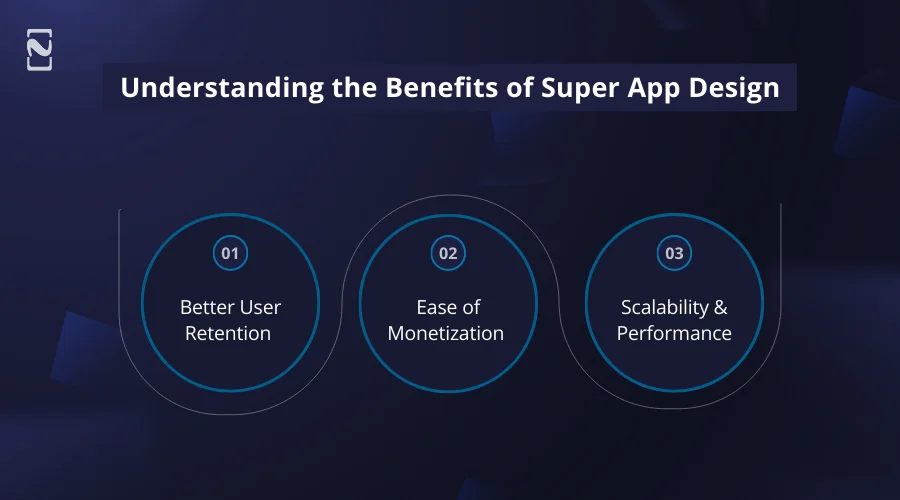
1. Better User Retention
Super app design allows you to create an experience that makes your user return to your application. When the application is welcoming and easy to use, a user tends to spend more time on it.
Not to mention, when you have a super app, it can basically replace multiple apps, and that is exactly what a user wants.
2. Ease of Monetization
With a super app already offering multiple things in a single package, it can get quite cluttered if the design is not appropriate. In that clutter, super apps often do not have enough space for monetization through ads.
However, with the help of intelligent super app design, you can curate a solution that makes it easy for you to introduce ad spaces and other ways to monetize your super app.
3. Scalability & Performance
You may be wondering what the connection is between the performance of a super app and its design. Well, when you have a well-laid-out design for your super app, you can define the functionalities to leverage the design and be more efficient with the performance.
As far as scalability is concerned, a well-designed app can be scaled easily. You see, good design remains good, be it today or tomorrow. This means scaling your app with the latest technology becomes super easy.
However, none of this can be guaranteed if the super app design is not on par. You need to have a solid understanding of super app UX principles in order to achieve a super app design that simplifies your users’ experience but also makes the super app more practical and usable.
Let’s take a look at the necessary super app design principles in the next section.
Core UX/UI Design Principles for a Great Super App
A great super app is made of two things:
- Types of services it consolidates
- The convenience it offers through UX/UI.
While the consolidation of services is generally based on the existing business model, the conveniences of UX/UI are still in your hands when building a super app. To ensure that you have a solid application, you need to keep the following principles of super app design –
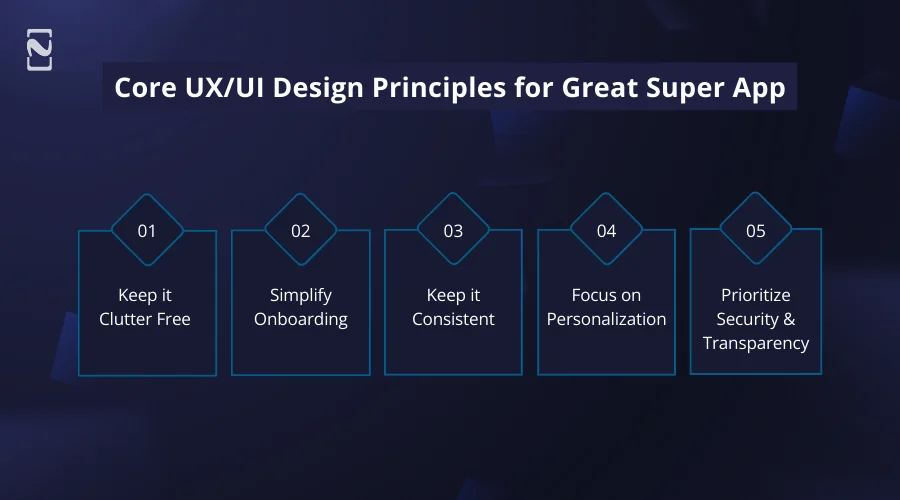
Principle #1: Keep it Clutter Free
The first thing you should take care of when designing a super app is the cluttering of features. You see, adding multiple services in a single interface makes it quite difficult to accommodate all the features in a simplified solution.
This is where most super app designers end up cluttering the experience by giving a user a lot more to handle, driving them away from the app.
Ideally, you should pay attention to delivering a simplified and de-cluttered super app design that might offer some additional navigational steps but keeps the clarity intact. This way, you not only have a user-friendly interface, but also have room for scaling the app with additional features.
Principle #2: Simplify Onboarding
Super apps are generally used by a user to reduce the hassle of logging in to different apps for services. However, this gives an additional job to the super app designing team, as now you have to create an onboarding experience that doesn’t take a lot of time to finish and yet introduces all the services included in the app.
This is one of the core issues that decides if a user will stay on the platform or not. The rule generally applies to all types of apps, but plays a crucial role in super apps, as the stakes are comparatively higher.
The attention span of users has reduced over the years, which directly impacts your onboarding complexities, too. The core focus of this principle revolves around reducing friction during the signup process.
Principle #3: Keep it Consistent
When you have a super app, you have different services in a single interface. As a brand, all the services that you integrate want to have some sort of unique or standout properties that give it an identity in the market.
However, from the user perspective, creating different brand languages or different buttons for different services in the same super app is a bad choice. You need to have a consistent user experience. By consistent, we mean that all your basic navigation and action buttons should remain in the same space on the screen.
For instance, if you have a payment and cab application integrated in a super app, make sure the pay button and book now button fall in the same region of the screen, as it gives a more consistent experience to the user.
Principle #4: Focus on Personalization
When you build a super app for different types of users, you cannot offer a single home screen because their purposes vary significantly.
Hence, paying attention to creating a personalized solution that not only recommends products but also automatically understands user preferences and offers services that they generally use. This way, you not only create a personalized experience, but also catch the attention of the user for longer.
Training machine learning algorithms or using AI in super apps is certainly a great way to implement personalization. Try using a context-aware user interface that identifies user patterns and, accordingly, can offer personalized notifications and offers to keep the user engaged.
Principle #5: Prioritize Security & Transparency
When building a super app, you must understand that these apps not only offer multiple services at once but also handle sensitive user information.
While convenience is paramount in a super app, security often takes the backseat, which makes it less desirable for users. If you are planning a super app, make sure the design has all the assuring features that help a user trust your application to be secure.
The idea of security is not limited only to encryption and safety features, but it is also based on how reassuring and clear your application is in handling sensitive information. For instance, giving your user a clear pricing without any hidden charges is one of the things you can start with.
Offer them features to toggle privacy as they see fit. Offering flexibility never goes out of style!
With all these principles working for you, the super app design automatically becomes simpler. Implementing these principles is definitely a great way to make the most of your super app.
Real-Life Examples of Great Super App Designs
Achieving the right super app design is not something that hasn’t been done before. There are several existing applications that have made a mark in the super app market. In case you are living under a rock, Asian super apps already seem to have cracked the code to a solid super app design.
Some of the core solutions that define a good super app design are –

-
WeChat
Despite having millions of mini programs, WeChat’s design remains remarkably clean. Its success lies in invisible complexity. For instance, the core UI never changes from four simple tabs: Chats, Contacts, Discover, and Me. Mini-Programs. These are lightweight apps that load instantly within the WeChat browser.
They don’t require an app store download, keeping the main interface clutter-free. Instead of scattering financial tools, the app tucks them into a dedicated “Services” grid. It uses a standardized icon set so that third-party services (like rail booking or utilities) feel like native parts of the app.
-
Grab
Grab, one of Asia’s leading super apps, is often cited for its dynamic home screen that changes based on what you need at that exact moment. Anticipatory Design.
Grab uses AI to reorder its home screen icons. If you open the app at 12:00 PM, “Food” moves to the top; if you open it at 6:00 PM in a business district, “Car” or “Transport” becomes prominent.
It uses a clean, rounded tile layout to separate distinct categories like Finance, Delivery, and Transport. Regardless of the service (booking a ride vs. ordering a burger), the brand’s signature green and specific typography remain constant, building deep user trust.
-
Gojek
Gojek is famous for its playful, conversational UI and its focus on the “human” behind the service. With over 20 services, Gojek uses color-coded categories (e.g., Red for GoFood, Blue for GoCar) to help users navigate through color recognition.
Gojek integrates a loyalty program directly into the UX with progress bars and badges, simplifying switching between different services and making it feel like a rewarding journey.
One of its greatest design feats is having a single, universal payment bar at the top of every service screen. It removes the friction that a user may feel when making payments.
Now the principles shared earlier can help you achieve similar results so that your users enjoy your application. However, if we talk from the business point of view, there are certain things you need to consider implementing in your application.

Super App Design Considerations for Beginners
Creating a complex super app from the ground up can be really difficult. If you are just getting started with your super app, you certainly need a way to simplify your journey. And what better than an app teaching you how to manage it?
Well, to simplify things, when you are designing your super app, you can consider the following design choices that can help you understand your user better, along with ways to improve in the long run. Also, before you jump into the process, keep these considerations in the back of your mind.
Here are some things to consider when working with the super app design and development process:
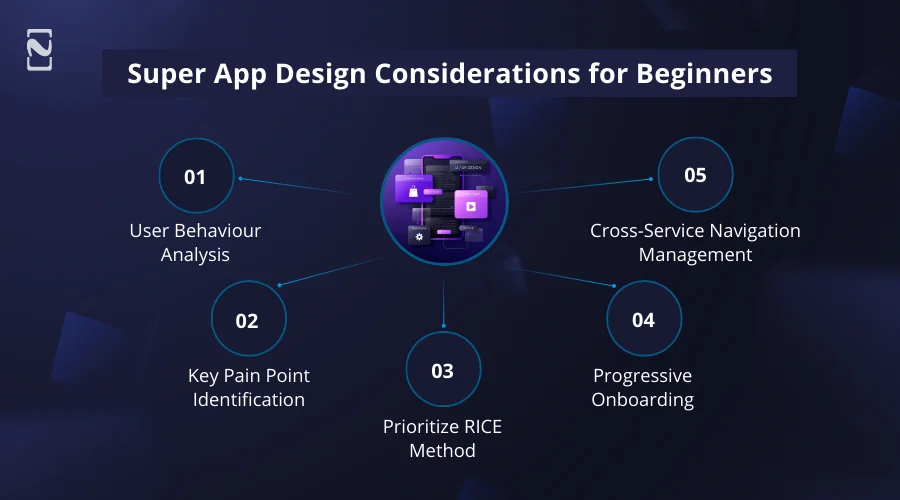
► User Behaviour Analysis
Consider your user tendencies and how you want to shape them. This will give you enough insights into what the next best step is for your super app design.
► Key Pain Point Identification
When designing a super app, keep the user’s pain points in mind. These points can easily be identified by analyzing the existing super apps and going through user forums.
► Prioritize the RICE Method
When defining your super app design strategy, make sure you consider RICE, designing features and user experiences that boost your Reach, enhance the Impact of your solution, give your user a sense of Confidence when joining the app, and reduce the Effort of resources in the process.
► Progressive Onboarding
Focus on offering a progressive onboarding experience that simplifies the solution and gets the user directly to the service they want without having to go through a lot of login/signup steps.
► Cross-Service Navigation Management
If you want to simplify the solution for the masses, you need to create a solid cross-service navigation system that simplifies the process and makes it more intuitive for the user to switch between services easily.
These simple considerations can change the way you manage your super app. The impact of super app design is certainly massive in building the app.
In case you are worried about the solution or how to find a super app design partner, hiring a mobile app development company like Nimble AppGenie might get the job done for you.
You see, design often becomes a complicated step when pursued as an individual task.
On the other hand, if you can create a strategy for the entire process, from ideation to execution of the app, and let a single team handle it, the process can be simplified drastically.
Hiring a super app design expert individually might cost more than delegating the task to a company that offers both UX/UI design for super apps and development experts, which can be the best step you can take to resolve all the possible issues.

Conclusion
Drafting a super app design strategy before entering the market can prove to be of great help, provided you have the resources to execute it. The benefits of building a well-designed and defined super app are highly motivating, especially in today’s competitive market.
If you’re unsure which cheat sheet to use to master super app design, implementing these principles can greatly help.
Keep in mind that while implementing these principles, you also have to be considerate about a few things, like behavioural analysis of user preferences for better understanding. Before you implement the principles, it is suggested that you offer a direct solution that identifies the impact of the features you have introduced.
Hope you find all the information helpful in deciding on your super app design. That will be all for this post. Thanks for reading, good luck!
FAQs
There are 5 core UX/UI principles that are used in super app design. They are as follows:
- Keep it clutter-free
- Simplify onboarding
- Keep it Consistent
- Focus on personalization
- Prioritize Security & Transparency

Niketan Sharma, CTO, Nimble AppGenie, is a tech enthusiast with more than a decade of experience in delivering high-value solutions that allow a brand to penetrate the market easily. With a strong hold on mobile app development, he is actively working to help businesses identify the potential of digital transformation by sharing insightful statistics, guides & blogs.
Table of Contents
No Comments
Comments are closed.