


Every business eventually faces the same decision: “Should we build our own in-house team or outsource work?” Well, it is not an easy choice, and both sides have clear benefits.
In-house development gives you control and direct communication, while outsourcing offers flexibility and often faster results.
According to Deloitte’s Global Outsourcing Survey, around 75% of executives said their IT services are outsourced.
These numbers show that outsourcing has become a common and effective strategy.
Yet many growing companies still prefer to keep major functions internal to maintain quality and control.
The real question is not just about cost, it is about what works best for your goals and team culture.
So in this blog, we will discuss both sides, in-house vs outsourcing, so you can find the approach that fits your business best.
So, let’s begin!
What is In-House Development?
In-house development means that your company manages all the work internally. Your own employees design, write code, test, and launch the app.
Everything happens under your supervision. The biggest advantage? Your team knows your business inside out.
They understand your project requirements, your goals, and the way you like things done. Another best part about this is full control.
You can track progress daily, make changes immediately, and ensure the quality meets your expectations.
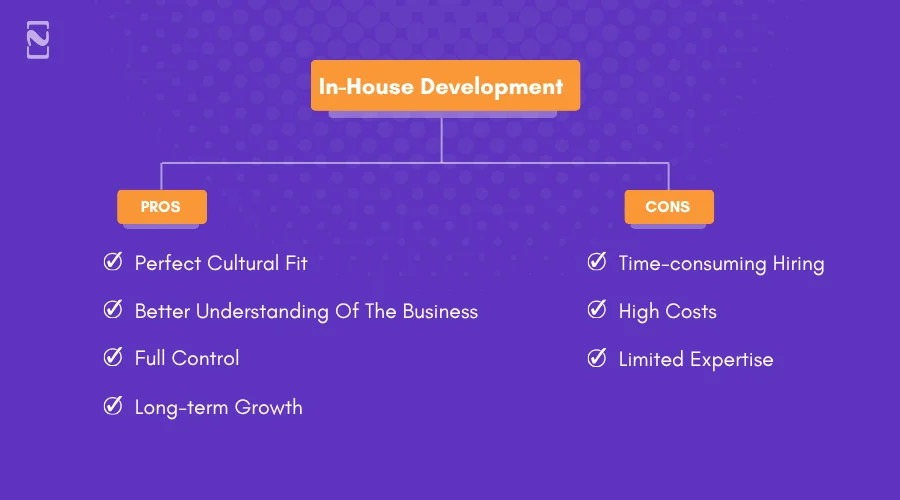
Pros of In-House Development
-
Perfect cultural fit
When you hire an app developer internally, you can choose people who share your company’s values.
They fit into your team naturally. This makes communication seamless and teamwork effortless.
-
Better understanding of the business
Your in-house team works with you every day. They understand your processes, goals, and challenges.
This allows them to make better decisions that truly align with your business requirements.
-
Full control
With an in-house team, you call the shots. You decide priorities, monitor progress, and maintain quality.
-
Long-term growth
An in-house team grows with your company. Over time, they learn more about your products, services, users, and business goals, which makes them more efficient and productive.
Cons of In-House Development
-
Time-consuming hiring
Finding the right dedicated development team can take weeks or months. Training them to work the way your company wants adds extra time.
-
High costs
Hiring an internal team can be really expensive for you. Beyond salaries, you need to think about perks, office space, equipment, and training.
-
Limited expertise
Your in-house team may not have all the skills you need for cutting-edge technologies you need like AI, blockchain, or complex mobile applications.
So, while in-house development gives you control, it also demands more resources and patience.
What is Outsourcing?
Outsourcing means hiring an external development team or an IT outsourcing partner to manage your project.
Businesses often outsource to save money, access professional skills, and complete projects faster.
Outsourcing can take different forms. For example, offshore, nearshore, and project-based outsourcing.
The main benefit of outsourcing? You get experts without hiring full-time employees.
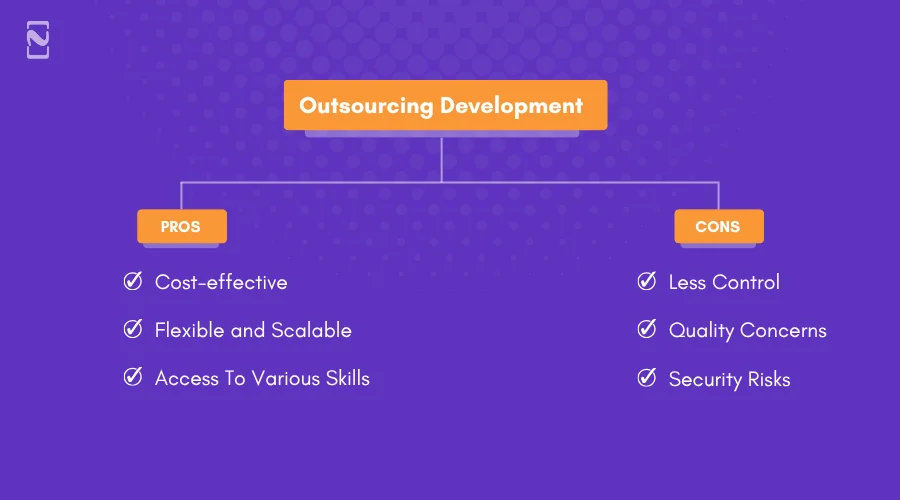
Pros of Outsourcing Development
-
Cost-effective
Outsourcing really saves your money. You pay for the work done, not salaries, benefits, or office space. Additionally, you avoid recruitment and training costs.
-
Flexible and scalable
Do you need a team for a three-month project? Done. Need another team for six months? Easy. Mobile app development outsourcing gives you flexibility without long-term commitment.
-
Access to various skills
Outsourcing teams often have experience that your in-house team may lack. They can handle complex projects very efficiently.
Cons of Outsourcing Development
-
Less control
You don’t manage the team every day. You will need clear communication and progress tracking to maintain quality.
-
Quality concerns
Standards may fluctuate depending on your company and the outpaced team. You can set clear expectations and monitor progress frequently.
-
Security risks
If you share the sensitive information with the outsourced team, it can be riskier for you.
So, it is vital to select reliable partners and implement strong security measures.

Why Do Businesses Outsource Their Projects?
Now that you understand what outsourcing means, let’s see why so many businesses choose this approach.
The biggest reason is cost savings. Building an in-house team often requires a huge investment.
Outsourcing helps companies cut these costs by working with skilled experts on specific projects and paying only for the work they need.
Another reason businesses outsource is to access specialized skills. Instead of spending months hiring and training new employees, businesses can quickly hire developers or software experts from different parts of the world.
This allows them to bring in fresh ideas and new technologies whenever required. This is the reason why businesses opt for outsourcing their projects.
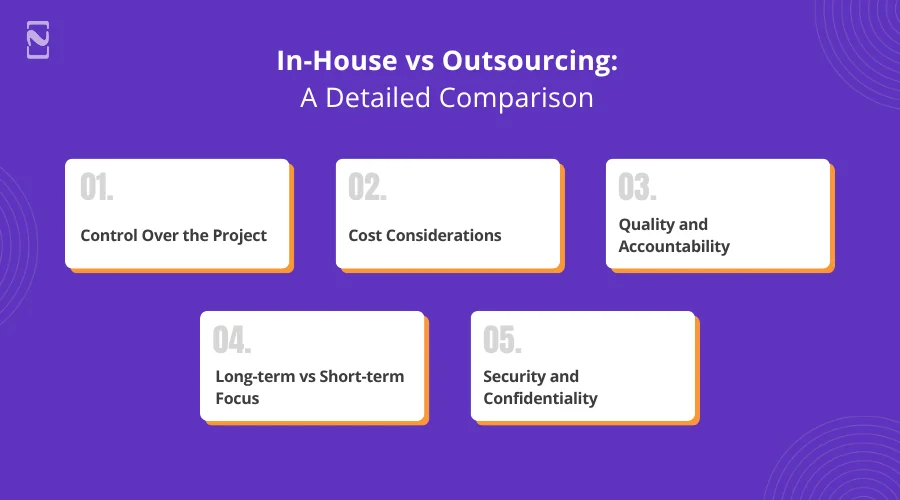
In-House vs Outsourcing: A Detailed Comparison
Deciding between in-house vs outsourcing is one of the most important choices a business can make.
Both approaches have their own benefits and drawbacks, and the right choice depends on your company’s goals, budget, and long-term plans.
Let’s understand which option may work best for our business.
1. Control Over the Project
When it comes to in-house development, you have complete control over every aspect of the project.
You can directly oversee your team, make real-time changes, and ensure everything aligns perfectly with your company’s goals.
On the other hand, outsourcing gives control to an external development team. When you can provide requirements and feedback, the daily execution is managed by the outsourcing partner.
This means you might have to depend on regular updates and daily communication.
Takeaway: If maintaining full control is your top priority, in-house might be the better option. But if flexibility and speed are more vital, outsourcing is the best.
2. Cost Considerations
In-house teams tend to be more expensive. Hiring, training, and retaining employees include salaries, benefits, infrastructure, software, and hardware costs.
Over time, these expenses can add up for small and medium businesses.
However, outsourcing is generally cost-effective. Companies can hire Android app developers for a particular Android project or for a fixed duration, often paying less than it would cost to maintain a full-time in-house team.
Takeaway: If your budget is limited or you want to reduce financial risk, outsourcing can be a smart choice.
3. Quality and Accountability
In-house teams usually understand your company culture, vision, and standards. It often results in top-quality output because the team is fully invested in your project.
However, outsourcing can deliver top-notch results, it requires clear communication, defined expectations, and regular monitoring.
Some outsourcing partnerships may face challenges in maintaining quality if the team is not fully aligned with your goals.
Takeaway: Both models can provide outstanding results, but in-house teams are naturally aligned with your vision, while outsourcing requires extra effort in coordination.
4. Long-term vs. Short-term Focus
In-house development is a long-term investment. Once your team is trained and familiar with your projects, they become a valuable, permanent asset.
Outsourcing is more suitable for short-term or project-based needs. It allows you to bring in expertise when you need it and reduces your ongoing commitment.
Takeaway: You should consider your project timeline and business goals. Long-term growth favors in-house, while temporary projects favor outsourcing.
5. Security and Confidentiality
In-house development keeps sensitive data within your company, which reduces the risk of leaks or breaches.
Outsourcing involves sharing data with an external partner, which can pose mobile app security risks if proper safeguards are not in place.
However, with strong contracts, NDAs, and trusted partners, outsourcing can also be safe.
Takeaway: For highly confidential projects, in-house development may feel safer, but outsourcing can also work with the right precautions.
In-House vs Outsourcing: A Comparison Table
Once you know the detailed comparison of in-house vs outsourcing, let’s now crisp it and understand with the following comparison table.
| Aspects | In-house development | Outsourcing development |
| Control | Full control over the project | Limited control requires communication |
| Cost | Higher salaries | Cost-effective |
| Talent | Limited to local hires | Access to global experts |
| Flexibility | Less flexible | Highly flexible and scalable |
| Time to market | Slower to start | Faster execution |
| Quality | Aligned with company vision | Needs proper monitoring |
| Security | Higher | Depends on partner reliability |
| Commitment | Long-term | Short-term or project-based |
Which One is Best for Your Business: In-House vs Outsourcing?
Now that you have seen how in-house vs outsourcing differ, the big question is: which one should you choose for your business? Well, the answer depends on your objectives, project type, and how much control or flexibility you need.
Both options can work great; you just need to know when to choose which.
So let’s break it down.
1. Choose in-house development when:
- If your project is something your business will continue to improve on over the years, like a core product or platform, an in-house team makes more sense.
- In-house development gives you complete control over how the project runs. You can monitor daily progress, make instant changes, and ensure the team works exactly the way you want.
- If your business handles sensitive customer data, it’s best to keep things in-house and hire programmers you can directly manage and trust.
- Hiring and training an internal team takes time and resources. If you can invest in both, building your own team can be a strong long-term asset.
2. Choose Outsourcing When:
- If you want to start your project quickly, outsourcing is your best option. External teams are ready to go and can deliver results faster.
- Outsourcing saves money on hiring, training, etc. You only pay for the work you need, making it perfect for startups.
- If your project lasts only a few months, hiring full-time employees might not make sense.
- When your project involves programming languages and the latest technologies that your in-house team is not familiar with, outsourcing allows you to hire experts for that particular work.
Outsource Your Mobile App Development With Nimble AppGenie!
Choosing the right team to build a mobile app can make all the difference.
At Nimble AppGenie, we have earned the trust of giant brands since we focus on developing visually appealing and user-friendly mobile apps.
Our expert developers work on both native and cross-platform apps that ensure smooth performance on any device.
Additionally, we know time zones can be tricky, so our team adjusts its hours to stay connected with clients and keep communication easy.
Security is also a top priority, with strong systems to protect the project. With experience in AI, we deliver innovative solutions customized to your requirements.
If you want to choose the right mobile app development company, reach out for a free consultation today!
Frequently Asked Questions

Niketan Sharma, CTO, Nimble AppGenie, is a tech enthusiast with more than a decade of experience in delivering high-value solutions that allow a brand to penetrate the market easily. With a strong hold on mobile app development, he is actively working to help businesses identify the potential of digital transformation by sharing insightful statistics, guides & blogs.
Table of Contents
No Comments
Comments are closed.