


IoT isn’t just a tech buzzword. It’s changing the way mobile apps work and how businesses connect with their customers. Today, apps can do more than just display information.
When mobile apps are paired with IoT devices, they can collect real-time data, respond to user needs instantly, and create personal experiences. For businesses, this opens up huge opportunities.
IoT-powered apps can help you understand your customers better, streamline operations, and even create entirely new services. From connected wearables to smart home devices, the rise of IoT is changing expectations, and apps are at the center of it all.
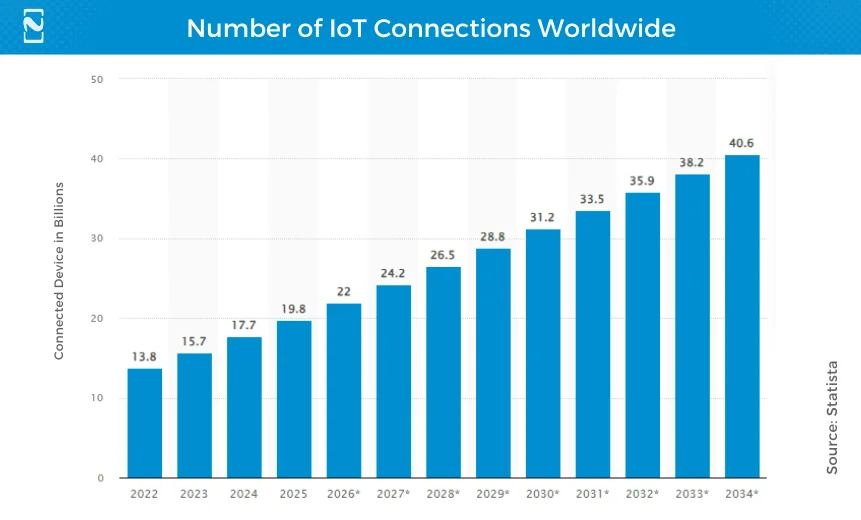
According to Statista, the number of IoT devices worldwide is expected to pass 31 billion by 2030. That means more devices to connect with, more insights to gather, and more ways for businesses to innovate and stay ahead.
In this blog, we’ll discuss the real impact of IoT on mobile app development and what it means for businesses today.
So, let’s begin!
What is IoT?
IoT means the Internet of Things. It is a network of devices connected to the internet that can collect and share data with sensors or software. Devices included are wearable fitness trackers, smart home appliances, industrial sensors, and connected vehicles.
These devices can be connected through multiple technologies like wifi, cellular data, or Bluetooth. In simple terms, IoT allows devices to talk to each other and to mobile apps. This creates a seamless ecosystem that makes life smarter and more efficient.
Why is IoT Important for Mobile Apps?
Mobile applications act as a bridge between users and IoT devices. So, let’s understand why this connection matters.
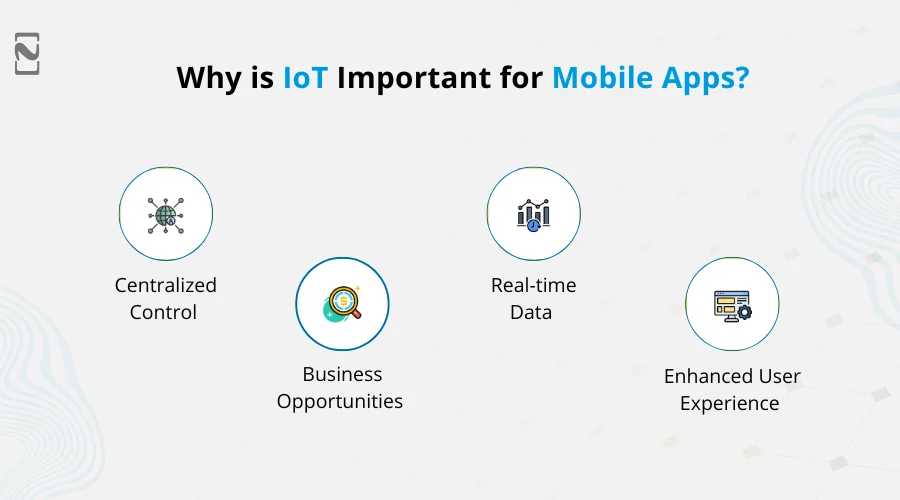
1. Centralized Control
Mobile applications allow users to monitor and control multiple IoT devices from one place. For example, you can control your home security, lighting, and thermostat from a single application.
2. Business Opportunities
IoT-driven mobile applications open new revenue streams for businesses. From subscription models for smart services to data-driven insights, the opportunities are huge. So, if you are planning application integration with IoT technology, now is the best time to grab this opportunity.
3. Real-time Data
IoT devices generate massive amounts of data. Mobile applications collect this data and present it in meaningful ways. This helps users make informed decisions instantly.
4. Enhanced User Experience
IoT provides personalization. Your mobile app can adapt based on user behavior, preferences, and real-time information from connected devices.
For example, fitness apps connected to wearable devices not only track users’ steps and heart rate but also provide personalized recommendations.
It also offers alerts for abnormal readings and integration with other health platforms. This kind of interactivity is only possible when you integrate apps with IoT.
How is IoT Impacting Mobile App Development?
If you thought mobile apps were just about swiping and clicking, you’d have to think again. With IoT, apps are becoming smarter, more interactive, and way more useful.
Let’s take a look at how IoT is impacting smart mobile app development.
-
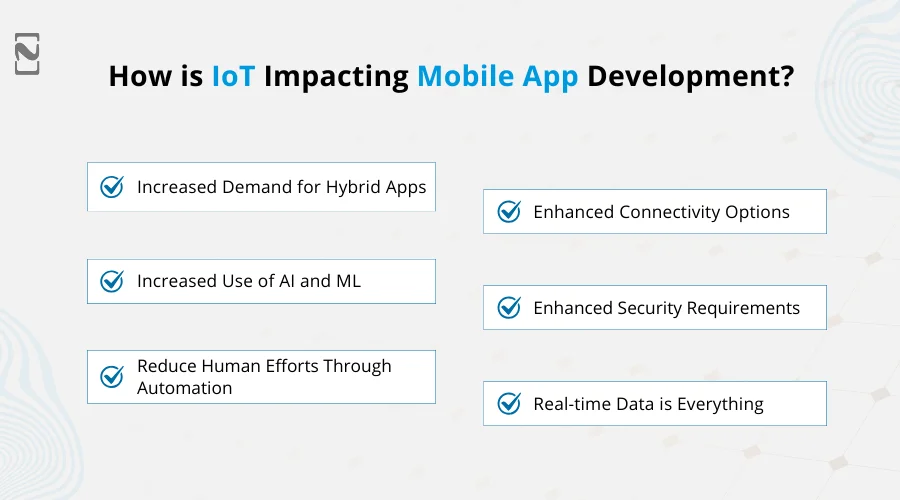
Increased Demand for Hybrid Apps
Internet of Things mobile apps work on multiple devices and platforms. This has made hybrid apps really popular. Hybrid frameworks like Flutter and React Native allow developers to write a single codebase that runs on both Android and iOS.
This also saves time and costs while maintaining consistency. With the number of connected IoT devices forecasted to hit $50 billion by 2035, businesses are increasingly planning to develop hybrid apps.
Moreover, hybrid apps help developers roll out updates faster, reduce maintenance overhead, and provide a uniform user experience across multiple devices. This ensures compatibility in this vast IoT ecosystem.
-
Enhanced Connectivity Options
Another key impact of IoT technology on mobile apps is the need for advanced connectivity. IoT mobile applications depend on various communication methods like WiFi, Bluetooth, NFC, 5G, and low-power networks.
This helps in connecting mobile apps with various devices. This requires mobile apps to manage seamless transitions between networks and maintain stable communication.
In 2024, more than 4 billion IoT devices were connected through cellular networks. This shows the growing demand for multi-network support in mobile app development.
Therefore, mobile app developers need to add backup systems and error-handling features so that the mobile app runs error-free. They also use adaptive protocols so apps can stay connected even when network conditions change.
-
Increased Use of AI and ML
Nowadays, mobile applications depend on AI and ML to analyze them. It is because IoT devices generate a huge amount of data. This allows anomaly detection, personalized suggestions, predictive maintenance, and automation.
Developers now must combine IoT data streams with AI algorithms to predict user behavior, optimize device performance, and deliver personalized experiences that feel intelligent and seamless, adding significant value to the overall user experience.
-
Enhanced Security Requirements
Since many devices are interconnected, IoT mobile apps face higher security risks. They manage sensitive personal data, location information, and home security controls.
Due to this, developers now focus on encryption, secure APIs, multi-factor authentication, and security updates in app maintenance. According to JumpCloud, more than 50% of IoT devices have critical vulnerabilities that attackers can exploit.
Mobile apps include continuous real-time data monitoring, threat detection, and user-friendly permission management to protect both devices and networks.
-
Reduce Human Efforts Through Automation
The impact of IoT on mobile app development is also seen in automation. Apps now allow users to control devices and automate daily tasks, from switching on lights to monitoring home security, to reduce human effort.
Now, mobile apps smartly operate in the background and take actions themselves. As of 2023, over 60% of households in multiple countries use IoT devices for automation. This provides that reducing effort is a key expectation for modern apps.
Developers focus on creating customizable automation rules, smart notifications, and predictive triggers that respond to user behavior.
-
Real-time Data is Everything
IoT devices are constantly sending data like heart rates from wearables, temperature from sensors, or traffic updates from cars. Mobile applications collect this data and show it in real time.
This means your app is not just showing static information. It is alive, updating constantly, and helping users to make instant decisions. For example, a health app can give you a reminder if your heart rate increases or if you need a hydration reminder.
Industries that Leverage IoT in Mobile Applications
IoT has grown very quickly, and today it’s really difficult to find any industry that has not been touched by this IoT technology.
But some industries have used IoT in smarter ways to improve their processes and create new ways to earn revenue. Let’s take a closer look at the industries that leverage IoT mobile applications.
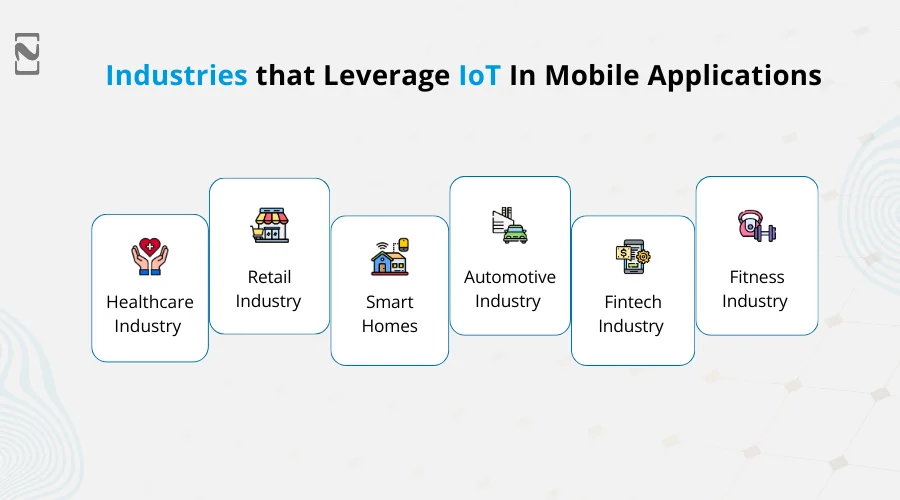
1] Healthcare Industry
IoT has completely changed the healthcare industry. Patient monitoring has become really easy and more accurate. For instance, wearable fitness technology helps monitor heart rate, blood pressure, sleep patterns, and oxygen levels.
Hospitals also use IoT-enabled devices to track patients, manage medical equipment, and monitor medicine supplies. For example, smart insulin pumps automatically deliver doses based on blood sugar readings.
Telemedicine apps connected to IoT devices allow doctors to check on patients remotely. This means patients get faster care, better health insights, and personalized treatment plans.
| Did you know: The global market size of IoT in healthcare is forecasted to reach $289.2 billion by 2028. This shows that there is a huge potential for developing IoT healthcare mobile apps. |
2] Retail Industry
Shopping is no longer just walking through aisles. It now has experience shaped by IoT. Smart shelves know when stock is low, and supply chains are tracked in real time to prevent delays. For example, when you enter a store, you get a notification in the app about a sale on your favorite shoes.
All this is because of IoT-enabled apps. It helps retailers to understand customers better and make the shopping experience really simple. It is best for buyers, efficient for stores, and provides data-driven insights that make everyone’s life easier.
| Did you know: As per Fortune Business Insights, the worldwide market size of IoT in the retail industry is projected to hit $350.85 billion by 2032. |
3] Smart Homes
IoT is turning homes into smart spaces. Just think, you walk in, and your lights automatically turn on, your coffee brews, and the temperature is set according to your preference. This is how smart home mobile app development works.
Smart security cameras and door locks keep your home safe. Connected fridges remind you when milk is running low or suggest recipes. IoT-based mobile applications allow you to control everything from anywhere.
It is a convenience mixed with safety, energy efficiency, and a touch of luxury. IoT is making homes not just places to live, but spaces that truly understand and adapt to your lifestyle.
| Did you know: The worldwide market size of the IoT smart home app market is projected to grow to $947.24 billion, according to SkyQuest Technology Consulting. |
4] Automotive Industry
Another sector that has benefited from IoT and mobile technologies is the automotive industry. Today’s cars are not just vehicles. They are connected gadgets on wheels. When you integrate IoT in mobile app development, you can monitor fuel, tire pressure, and traffic in real-time.
Let’s take an example. You get app suggestions for the fastest route to your destination, or your car automatically schedules a service when needed.
Some apps even warn you about a flat tire before it happens. With IoT sensors, you can even build the best parking app that helps users find available parking spots instantly.
EVs or autonomous vehicles can track battery life or navigate safely. But how? All because of IoT integration in mobile apps. Fleet operators can also track delivery trucks, optimize routes, and monitor packages. IoT is making everything very convenient.
| Did you know: A report by Grand View Research shows that the market size of IoT in the automotive industry is projected to reach USD 379.05 billion by 2030. |
5] Fintech Industry
The fintech industry is growing faster than ever, and IoT is playing a big part in that change. With the integration of IoT in fintech, financial services are becoming smarter and more personalized.
Banks can use IoT devices to monitor ATMs, detect suspicious activity instantly, or offer customers real-time alerts. Wearables like smartwatches now allow people to make payments or check their balance on the go.
The technology allows users to pay through connected devices like fitness bands or home assistants. Altogether, IoT helps the fintech industry improve security, reduce fraud, and give users more convenient ways to manage money.
| Did you know: As per Mordor Intelligence, the global market size of IoT in the fintech industry is forecasted to grow $108.92 billion by 2030. |
6] Fitness Industry
The fitness industry is growing fast with IoT, when combined with a mobile app like MyFitnessPal, Peloton, etc. Smartwatches, fitness bands, and connected gym machines send real-time data like steps, heart rate, and calories to mobile apps.
This IoT in mobile app development turns the data into easy progress charts, reminders, and personalized workout plans. With IoT fitness and wearable apps, users get a more interactive and motivating fitness experience, making goals easier to achieve.
| Did you know: As per Grand View Research, the IoT wearable devices market size is projected to hit $37.37 billion by 2030. |
Challenges and Possible Solutions in IoT App Development
The IoT industry is booming, but developing IoT applications is not as easy as connecting a few devices and pushing data to the cloud.
Every successful IoT solution faces many challenges during the development process. So, below are the crucial IoT app development challenges and their possible solutions.
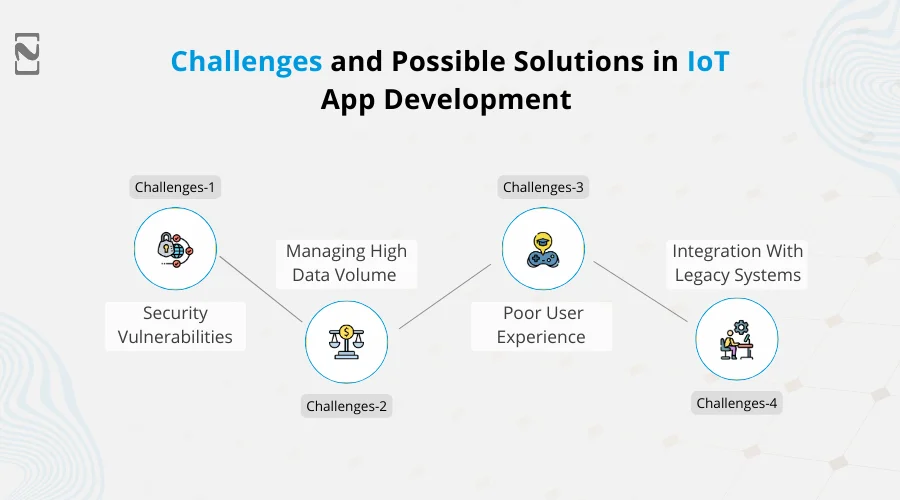
► Security Vulnerabilities
Mobile app security is one of the biggest challenges of IoT mobile app development. With devices constantly exchanging data, even a small gap can expose an entire network.
Solution:
You can start with a security-first approach. Developers can use strong encryption, multi-factor authentication, secure boot processes, and regular firmware updates. However, if you run frequent security audits, it can help in finding the issue before hackers do.
► Managing High Data Volume
As you know, IoT devices generate huge amounts of data. And this too in real time. If not managed properly, this can lead to storage issues, time delays, and your app will shut down.
Solution:
So, it is vital to adopt cloud and edge computing strategies. A dedicated development team can process essential data at the edge to reduce load and send only crucial information to the cloud. Besides, they can use scalable databases optimized for time-series data.
► Poor User Experience
Despite the complexity behind the scenes, users always want a simple and easy-to-use IoT mobile application. If your app has confusing interfaces, it can quickly lead to user frustration.
Solution:
The best way to resolve this is by focusing on simple and clean mobile app design, easy onboarding, and fast device pairing. It is vital to perform regular usability tests that can help identify friction points in advance.
► Integration With Legacy Systems
In today’s high-tech era, every business wants to connect its new IoT solutions with existing systems that were not designed with IoT. This can create compatibility issues and information barriers.
Solution:
Developers can integrate middleware or API security layers that translate data between existing and new systems. Developers should gradually integrate IoT into mobile apps with the help of an API. This ensures a seamless transition without stopping existing operations.
Future Trends of IoT in Mobile App Development
The role of IoT in mobile app development is growing every day. With the number of connected IoT devices expected to grow to 39 billion by 2030, mobile apps will become more important than ever for controlling and interacting with these devices.
So, if you are developing an IoT-based app for the future, here is what you need to know.
-
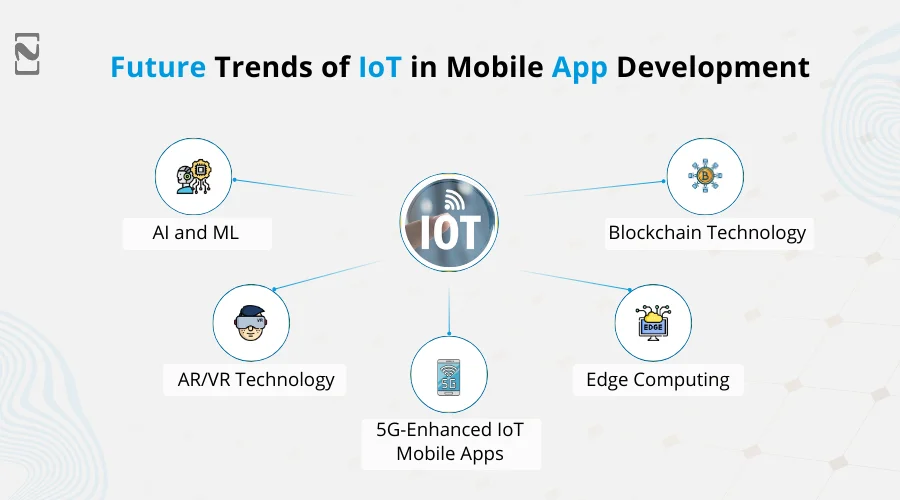
AI and ML
In the near future, AI will make IoT in mobile apps smarter and more predictive. Mobile apps will not respond; they will anticipate users’ needs. For instance, a smart home application could adjust your lights, thermostat, or coffee machine automatically based on your daily routine.
AI in fitness apps will offer personalized workout plans and health tips in real time. AI will make IoT mobile apps feel smarter and user-friendly than ever.
-
AR/VR Technology
The future of IoT in mobile applications is moving toward immersive experiences, and VR and AR payments in e-wallets are becoming a reality. Just think about using AR to see virtual products in your room and instantly pay for them through your digital wallet.
You can also make purchases in a virtual store by using VR. By integrating IoT, these mobile apps can track your behavior, personalize offers, and make transactions faster, safer, and more interactive than ever.
-
5G-Enhanced IoT Mobile Apps
With 5G already rolling out worldwide, its impact on IoT in mobile app development is huge. The 5G impacts on mobile apps means they can handle large amounts of data from connected devices instantly.
For example, smart cars can get real-time traffic updates, and healthcare applications can send live notifications. As 5G coverage grows, IoT mobile apps will become more responsive, interactive, and seamless for users.
-
Edge Computing
Edge computing is a key trend for IoT in mobile app development. By processing data closer to the device instead of the cloud, apps will respond almost instantly. For instance, autonomous cars or smart security systems will react to events in real time.
This trend will make IoT mobile apps faster, more reliable, and less dependent on internet speed. This improves important apps in healthcare, transportation, and smart homes.
-
Blockchain Technology
As IoT apps become more popular, security will be a major focus. Blockchain will play a big role in keeping IoT data safe and secure. You can also build a blockchain app with IoT technology for better security.
Digital wallets, smart contracts, and health apps can use blockchain to prevent tampering and ensure secure communication between devices. Mobile app development with IoT will depend more on blockchain to give users confidence that their sensitive data is protected.
Why Choose Nimble AppGenie to Build an IoT-based Mobile App?
If you want to build an IoT-based mobile app, choosing the right team makes all the difference. Nimble AppGenie is a trusted mobile app development company that helps businesses bring smart, connected apps to life.
Our main focus is on understanding your goals, designing easy-to-use interfaces, and integrating the latest IoT technologies. With 8+ years of experience, we can create robust mobile apps that make life easier for users, automate everyday tasks, and explore new opportunities.
Nimble AppGenie doesn’t just build apps; we work with you to turn ideas into real, functional solutions that provide real value to your audience.
Conclusion
The Internet of Things is growing fast. With more smart devices everywhere, businesses have a great opportunity to create robust, next-gen IoT-based mobile applications.
By developing mobile apps that work seamlessly with these devices, you can give users smarter and more convenient experiences in their daily lives.
Moreover, IoT also opens up new opportunities for innovation and business growth. It allows businesses to try fresh ideas and solve real problems. Working with IoT isn’t just about technology. It’s a way to build a mobile app that truly helps people and stands out in the market.
FAQs
The time to make an IoT-based application depends on how complex your project requirements are. A simple IoT-based app can take 3-5 months, while a complex app can go beyond 9 months.
The cost to develop IoT-based mobile app can range between $50,000-$250,000. However, costs can rise due to extra features, multi-device support, backend infrastructure, security, and thorough testing requirements.
Samsung SmartThings, Philips Hue, Fitbit, Apple Health, and Tesla are some of the best examples of IoT-based mobile apps.
Yes. AI and ML help analyze data, predict user behavior, optimize device performance, and enhance automation.
Not all apps, but yeah, some can. Developers can implement offline modes, caching, or fallback logic to maintain usability during connectivity drops.
Yes. AI and ML help analyze data, predict user behavior, optimize device performance, and enhance automation.

Niketan Sharma, CTO, Nimble AppGenie, is a tech enthusiast with more than a decade of experience in delivering high-value solutions that allow a brand to penetrate the market easily. With a strong hold on mobile app development, he is actively working to help businesses identify the potential of digital transformation by sharing insightful statistics, guides & blogs.
Table of Contents
No Comments
Comments are closed.