


If someone told you a few years ago that an app could compose music, mimic instruments, and create a song from text prompts, you would have probably laughed it off. Music composition has always felt like a deeply human process.
But today, apps like Music AI, Suno, and Udio have completely changed the scenario. Businesses are now asking a big question: “How can we develop an app like Music AI?”
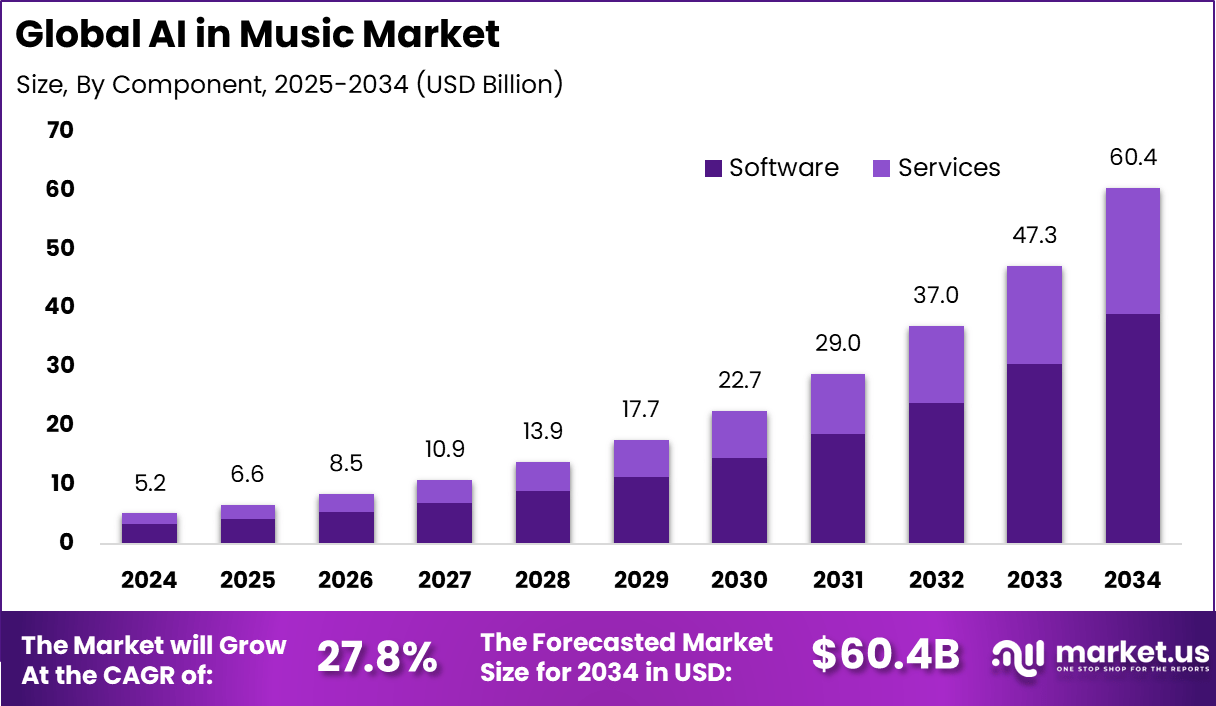
As per Market.us, the worldwide market size of AI in music is forecasted to reach $60.44 billion by 2034. The demand is really huge, the opportunity is even bigger, and the technology is changing faster.
No matter if you are a startup founder or a tech entrepreneur, developing an AI lyric generator app like Music AI can take your business to greater heights. But the process is not as simple as connecting to an API or adding a few features. It requires a clear roadmap.
Thus, this blog gives you a complete, step-by-step guide to building an AI-powered song lyric generator app similar to Music AI. You will get an insight into the market opportunity, essential features, monetization strategies, tech stack, and the cost to develop an AI music app.
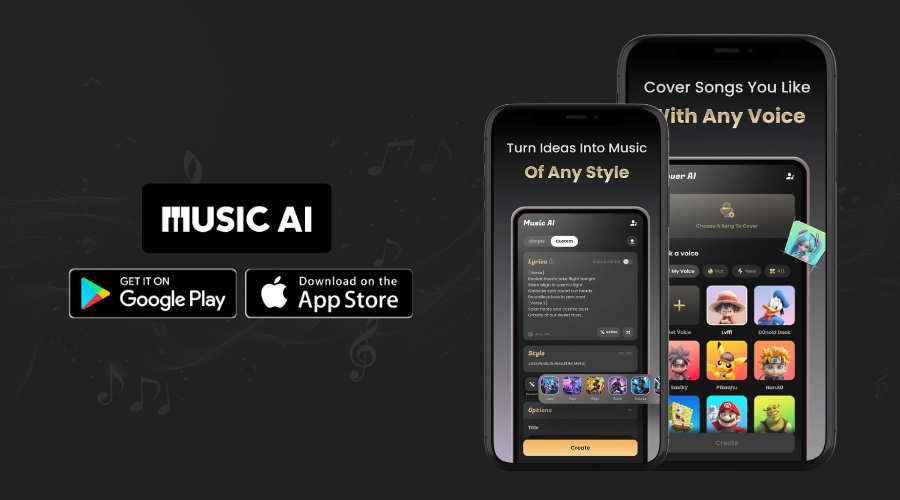
| App | Availability | Downloads | Rating |
| Music AI | iOS & Android | 1M + | 4.7/5 |
Market Overview: Why are Apps Like Music AI Booming?
Every popular product starts with understanding the market. And right now, the AI in music market is exploding.
► AI Music Market Stats that Show How Big the Opportunity is
- More than 60% of content creators leverage AI tools at least once a week for beats, lyrics, or mixing.
- Platforms like Suno and Boomy have created millions of AI-generated tracks without any human composer.
- On TikTok, Instagram Reels, and YouTube Shorts, over 40% of trending sounds now use AI-created or AI-modified audio.
The trend is clear. AI-generated music is becoming mainstream and not just a cool concept.
► Who Uses Apps Like Music AI?
AI music creation is not just for professionals. Your potential user base can be:
- New creators experimenting with music or influencers who need background music
- Podcasters and YouTubers
- Students learning music
- Content creators who need copyright-free tracks
- Small businesses producing promotional videos
- Brands creating custom audio identities
- Game developers require affordable music
This gives your AI song lyric generator app a wide and active audience.
► Why this Market is so Profitable?
As you know, producing music manually can be really expensive. AI removes the cost of instruments, studio time, and professionals. Users are willing to pay for fast and copyright-free music. Additionally, subscription models allow recurring revenue.
In short, an AI music generator app is the perfect blend of creativity + technology + recurring income. So, if you are investing in AI music generator app development, then this can be really profitable for you.
How Does the Music AI App Work?
Before you jump into Music AI app development, it is crucial to understand how a Music AI app works behind the scenes. You do not need to be a machine learning expert, just enough to understand the structure.
Let’s break it down :
- You start by giving the Music AI app something like text, your voice, or a small melody.
- The AI tries to understand what kind of music you want, like mood and style.
- It uses what it has learned from lots of songs to figure out the right sounds and rhythm.
- The Music AI app then creates new music or improves the tune you shared.
- It adds instruments, adjusts beats, and shapes the song to match your idea.
- When it’s done, it plays the music for you so you can save it, share it, or edit it again.
Key Features to Include in an App Like Music AI
When you are developing an AI generator app like Music AI, it is vital to integrate features that users need and will love. These music app features make your app not just a novelty, but a fully-fledged music-creation platform.
So, below are the core features you must take into consideration for a Music AI-like app :
| Features | Descriptions |
| Text-To-Music | Users can simply type in a prompt like “a melancholic piano melody with soft strings” and the AI generates a complete song. |
| Melody-Only Mode | Users can generate just a simple melody, which creators can later refine or layer with other instruments. |
| Beat Generation | Your app can provide drum patterns, rhythmic loops, and so on. |
| Harmony and Chord Suggestions | Based on the melody or user input, the Music AI-like app recommends harmonic progressions. |
| Genre Selection | Your app allows users to choose genres like pop, jazz, classical, EDM, and hip-hop. Etc. |
| Mood Selection | Users can easily choose moods to influence the kind of music generated. |
| Tempo Control | Your app can provide the option to set the speed of the track. |
| AI vocals | Users can generate singing or humming based on text or melody. Voice models might simulate a human voice with lyrics. |
| Voice Styling | Users can change the voice tone, gender, pitch, and emotional style. |
| Lyrics-To-Music | Users can type in lyrics, and AI composes a backing track and melody that fits. |
| Multi-Track Editor | A basic DAW interface in-app where users can tweak or layer the generation. |
Tech Stack Required to Develop an App Like Music AI
To build a robust app like Music AI, you will need to choose the right mobile app tech stack.
Here is a quick breakdown of the technology stack you can use to develop the app :
| Backend and AI Development | |
| AI & ML Frameworks | TensorFlow, PyTorch, Hugging Face Transformers, diffusion models. |
| Pre-trained Models | OpenAI’s Music LLM, MIDI datasets, NSynth |
| Model Training Infrastructure | GPU, TPU instances, data pipelines |
| APIs and Microservices | RESTful, GraphQL, host generative model |
| Frontend Development | |
| Mobile Frameworks | React Native, Flutter, Swift |
| Web Interface | React.js, Vue.js |
| Audio UI/Library | Tone.js, Web Audio API, AVFoundation |
| Cloud and DevOps | |
| Cloud Providers | AWS, Google Cloud, Microsoft Azure |
| Storage | S3 or Cloud storage buckets |
| Database | NoSQL and SQL |
| Compute | GPU-enabled instances |
Step-by-Step Process to Develop an App Like Music AI
Now that you have a tech stack and features, what else is required to develop an app like Music AI? Well, a proper and clear roadmap is crucial for developing an AI lyric generator app similar to Music AI to stand out.
So, below is the step-by-step process you should follow :
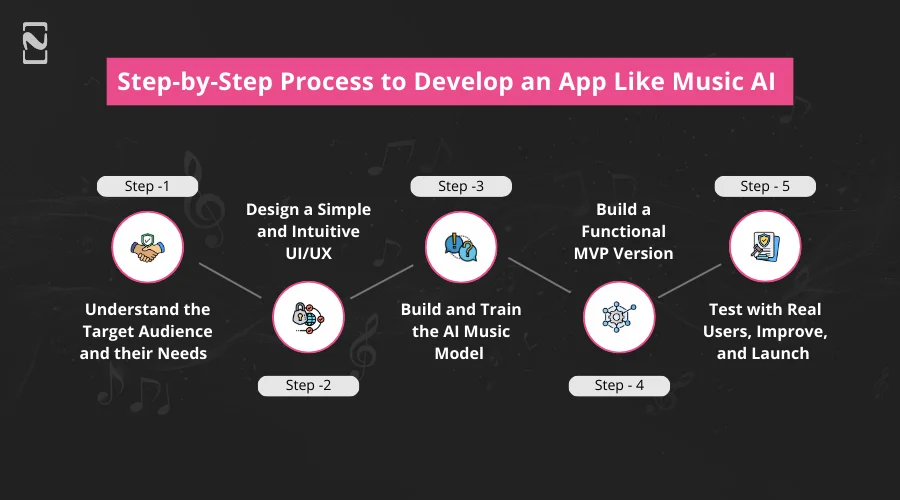
♦ Understand the Target Audience and their Needs
First, you should spend time understanding who you are building the Music AI-like app for and what problem you want to solve. Different users want different things. For example, creators need quick beats, influencers want royalty-free background tracks, and beginners look for simple tools.
Besides, you can talk to potential users, do mobile app market research by studying what competitors are doing, and find gaps no one is solving well. This step helps you design a Music AI-like app that feels instantly useful instead of overwhelming.
♦ Design a Simple and Intuitive UI/UX
Once you know what users need, you can start shaping how they will move inside the AI song generator app. Just keep the journey really simple. For example, users can type a prompt, generate music, edit, and export.
Now sketch rough screens, plan the layout, and focus on making the experience beginner-friendly. Always remember, users should never feel confused about where to click or how to use a feature.
A good music app design makes users feel confident, even if they have never made music before. This step is about creating the personality and flow of your Music AI-like app, long before the technical work begins.
♦ Build and Train the AI Music Model
This is the heart of the entire app. Based on users’ needs, decide what your AI music generator app, like Music AI, should generate. For example, modules, beats, vocals, full songs, or background scores.
Now collect high-quality datasets, clean them properly, and train AI models so they learn patterns of rhythm, harmony, and musical structure. Testing is very important. Generate music repeatedly, listen for quality, tweak the model, and repeat the process.
The goal is not to create perfect compositions but to make the output feel natural, pleasant, and relevant to the prompt. This step to develop an app like Music AI takes time, but it is what makes your app feel magical to users.
♦ Build a Functional MVP Version
Now it is time to merge the design, backend, AI models, and user features into a working version of your Music AI-like app. However, focus only on the must-have features for the first release. Avoid building dozens of complex features in the first version of the app.
The goal of the MVP is to allow users to try the app quickly and give feedback. When you build an MVP app, just make sure the app runs smoothly, handles AI generation without lag, and offers a pleasant experience on every device. This is your first version of the app.
♦ Test With Real Users, Improve, and Launch
Before you launch the app publicly, you need honest feedback from real people. You can invite creators, beginners, and music enthusiasts to try your AI app for music creation. Just ask them what feels confusing, what they wish existed, and what they love.
Do not defend the product; listen deeply. You can use this feedback to fix issues, improve the AI’s music quality, simplify the UI, and polish rough errors.
Once the app feels seamless and stable, you can prepare your launch strategy. Launching is not the end. This is the beginning of continuous improvements and enhancements.
Monetization Strategies For An AI Lyrics Generator Like Music AI
Creating an AI song generator app like Music AI is great, but the real question is – How do music apps make money?
The good news is that Music AI has many income sources. You are not limited to just subscriptions. You can earn from creators, professionals, businesses, and large brands.
Below is the breakdown of the monetization models :
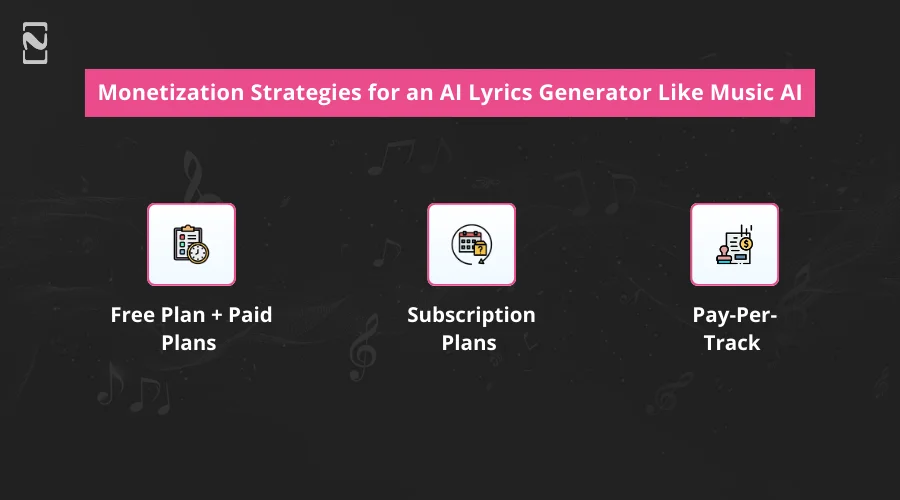
➤ Free Plan + Paid Plans
This is the most popular and beginner-friendly way to make money. You can just allow people to try the AI music generator app like Music AI for free, but limit certain things like:
- Number of daily music generations
- Audio quality
- Length of music tracks
- Commercial usage rights
Users get a taste of how outstanding the app is and upgrade because they want more freedom. This app monetization model works extremely well for creative tools because once users get used to the output, they do not want to stop.
➤ Subscription Plans
Subscriptions are the main revenue driver for most AI apps. You can provide monthly or yearly plans.
Some common examples are :
- Basic plan – limited generations, for personal use only
- Pro plan – unlimited generations, higher-quality music, commercial rights.
- Enterprise plan – custom features for studios, agencies, or creators.
This gives you predictable, recurring revenue and helps your business stay stable over time.
➤ Pay-Per-Track
Some users do not want to buy a subscription. They just want a single track for a project. This AI music app monetization strategy allows them to pay only when required. It is simple and convenient for occasional users like freelancers or hobby creators who do not use it frequently.
Cost Breakdown of Music AI App Development
The cost to develop an app like Music AI can range from $20,000 to $150,000 and more. But this cost is really just a ballpark estimate. The cost depends on features, AI complexity, team location, and whether you build from scratch or use APIs. But here is a realistic, industry-backed estimate.
Most of your budget goes into the invisible part, the AI model that listens, understands prompts, and produces music people want to use. That’s why the AI music app development cost varies so much.
Estimated Cost to Develop an App Like Music AI
| Music AI Complexity Level | Cost Breakdown |
| Simple | $20,000 – $50,000 |
| Mid-Level | $50,000 – $100,000 |
| Highly Complex | $100,000 – $150,000 + |
If your goal is to launch a simple version of a Music AI-like app, you are looking at around $20,000 to $50,000. This is usually enough to get early users and valuable feedback on whether real creators find your app helpful.
A more capable version, the kind that produces smoother tracks, offers multiple moods, saves user projects, and usually costs from $50,000 to $100,000. At this stage, you are not just launching an app; you are developing a reliable creative assistant.
But if you are aiming for the level of Music AI, Suno, or Mubert, the investment changes dramatically. Training custom models, adding AI vocals, and running everything on high-performance GPU servers pushes the budget $100,000 to $150,000 and beyond.
No matter the version, remember. The real expense continues after launch, as server usage, model tuning, and updates keep shaping your app’s quality every single day.
Challenges in Developing an App Like Music AI and Their Solutions
Every great product comes with its own set of challenges, and Music AI-like app development is no different. But here is some good news. Music app challenges have their own solutions.
So, let’s have a look at them :
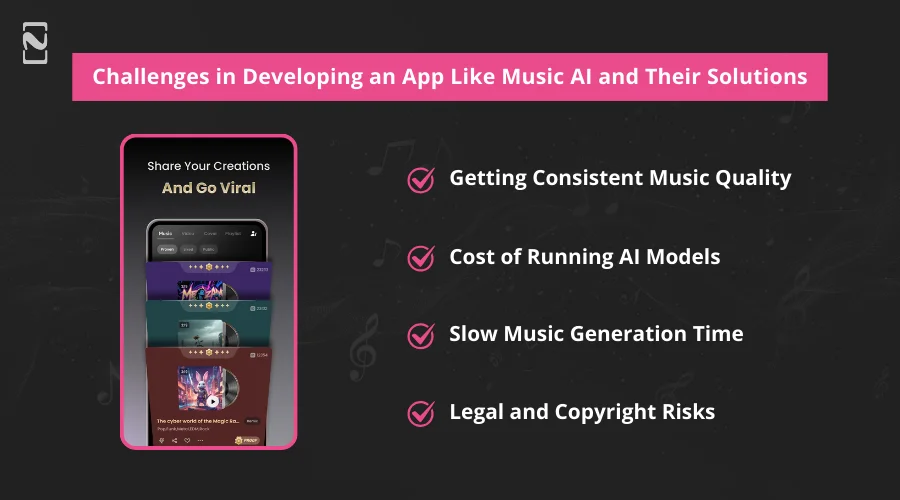
► Getting Consistent Music Quality
One of the first struggles you will face while developing an app like Music AI is ensuring the AI produces music that sounds natural, clear, and emotionally on point. Sometimes the AI creates great tracks, while other times the rhythm feels off.
Solution :
You improve consistency over time by fine-tuning your model, adding more training data, and adjusting how the prompts are processed. User feedback also plays a big role in identifying what the AI needs to learn next.
► Cost of Running AI Models
High-quality audio models depend on GPU servers, and these servers are expensive. If many users generate music at the same time, your costs can shoot up.
Solution :
You can start with an MVP for a Music AI-like app so your usage stays manageable. Also, you can optimize your model, compress audio generations, or use hybrid hosting. It means a mix of your own servers and the cloud. This keeps costs predictable.
► Slow Music Generation Time
Users do not want to wait minutes for a song. If the generation takes too long, users lose interest in your app, like Music AI.
Solution :
Developers can use optimised model versions, caching techniques, and efficient prompt handling. Over time, your AI gets faster as your team learns what slows it down.
► Legal and Copyright Risks
AI-generated music lives in a gray area. You must ensure users know what rights they get and what is allowed.
Solution :
Be very clear with listening. Most AI lyrics generation apps like Music AI give users royalty-free and commercial use rights. Transparent terms protect both your app and the user.
Why Choose Nimble AppGenie to Develop an App Like Music AI?
Nimble AppGenie, an experienced music streaming app development company that focuses on creating AI music generation apps. We are the best choice for developing a Music AI-like app since we understand both technology and creativity.
Our team has extensive experience with AI tools and technologies and fast performance apps, which is exactly what an AI music app requires. We do not just develop AI apps; we give you the right assistance to choose features, design a seamless performance, and make sure everything works well on the backend.
What makes Nimble AppGenie stand out from others is clear communication, a modern design approach, and end-to-end support. With us, you get the right development partner who can turn your dream AI music generation app idea into a reality.
Conclusion: Are You Ready to Make the Next Music AI?
The music world is changing very dramatically. The reason is AI. It is shaping a future where anyone can create music in minutes. AI music generation apps like Music AI, Suno, and Mubert have shown what is possible. But the real opportunity lies ahead.
There is still room for fresh mobile app ideas for AI music generation apps. If you have followed this guide to develop an app like Music AI from the start, you now understand it clearly. The process may look huge, but you do not have to develop everything at once.
Start small, test your idea, and improve along the way. The AI music industry is growing fast, and this is the right time to create your own version. Are you ready to start? Get in touch with us now!
FAQs

Niketan Sharma, CTO, Nimble AppGenie, is a tech enthusiast with more than a decade of experience in delivering high-value solutions that allow a brand to penetrate the market easily. With a strong hold on mobile app development, he is actively working to help businesses identify the potential of digital transformation by sharing insightful statistics, guides & blogs.
Table of Contents
No Comments
Comments are closed.