

 Free Consultation
 PCI-DSS Compliant
 GDPR Ready
 ISO 27001
 NDA Protected
 AI Services
 AI App Development
 Generative AI Development
 AI Chatbot Development
 AI Integration Services
 AI Consulting Services
 AI For Fintech
 AI Financial Assistant Solution
 AI Insurance Agent Development
 Tech Stack
 OpenAI / GPT-4
 Claude / Anthropic
 Gemini / Google AI
 Llama / Open Source
 LangChain / LlamaIndex
 Pinecone / Pgvector
 AWS / Azure AI


 Fintech Solution
 Core Fintech
 App Development
 Neobank Solutions
 eWallet Solutions
 Lending Software
 Banking Solutions
 BNPL Solutions
 BNPL Solutions
 Insurance App
 Wealth Management
 Crypto & DeFi
 Blockchain Development
  Payroll Software
 DeFi Solutions
 Crypto Wallet
 Crypto On/Off Ramp
 Crypto Exchange
 Trading Platform
 Payments
 Compliance
 Regulations & Compliance
 Fraud Detection
 Lending Ecosystem
 P2P Lending Platform
 Mortgage Software
 Engagement
 Fintech Outsourcing

 Mobile Development
 Mobile App Dev
 iOS App Development
 Android App Development
 React Native
 Flutter Development
 Web Solution
 Node.js Development
 React.js Development
 Angular Development
 App Services
 UI/UX Design
 App Maintenance
 By Stage
 MVP Development
 Industry Solutions
 Healthcare App Dev
 Education App Dev
 Travel App Dev
 Real Estate App Dev
 Logistics Software
 Social Media App

 Hire Mobile Developers
 Hire iPhone Developers
 Hire Android Developers
 Hire React Native Devs
 Hire Flutter Developers
 Hire Web Developers
 Hire Node.js Developers
 Hire Angular Developers
 Hire PHP Developers
 Hire Laravel Developers
 How It Works
 Pre-Vetted Developers
 Ready In 48 Hours
 NDA From Day One
 Replace Guarantee
 Company
 About Us
 Our Work Process
 Portfolio
 Case Studies
 Blog / Insights
 Careers
 Contact Us
 Awards
 Recognition


 Offices



TL;DR
- To build AI tax filing apps, you should use OCR, ML, and NLP to automate document reading, deduction suggestions, compliance monitoring, and filing.
- Must-have AI features: document scanning, deduction engine, anomaly detection, NLP chatbot, predictive tax planning.
- Core tech stack: React Native, Python/FastAPI, TensorFlow, AWS Textract, GPT-4o, IRS MeF API
- Biggest technical hurdle: IRS MeF integration; start registration Day 1, and budget 4–8 weeks for this alone.
- Cost ranges from $40K–$80K for an MVP to $500K+ for enterprise agentic filing systems.
- Compliance non-negotiables: IRS MeF, SOC 2 Type II, GDPR/CCPA, IRS Publication 4557.
- Annual maintenance is not optional – budget 15–20% of the build cost every year for tax law updates.
- Nimble AppGenie builds compliance-first AI fintech apps – if you are scoping an AI tax filing project, talk to our team before you finalize your budget.
Building an AI tax filing app in 2026 is one of the most commercially compelling opportunities in fintech and one of the most technically complex to get right.
Every year, Americans collectively spend around 6.5 billion hours dealing with taxes. The tools evolved, paper forms turned into desktop software, which then moved online. But the experience?
Still painful for most people. AI is finally changing that, not just automating calculations, but reading W-2s from a photo, spotting deductions your accountant would miss, and in the most advanced 2026 implementations, filing your return almost entirely on its own.
The market reflects this shift: The North American automated tax software market was valued at roughly $7.46 billion in 2024 and is projected to grow steadily through 2031 at a compound annual growth rate (CAGR) of 7.1%.
Globally, the tax management software market is expected to jump from $22.97 billion in 2026 to $56.02 billion by 2034.
This guide is for fintech founders, accounting software companies, and enterprise compliance teams looking to build an AI tax filing app in this rapidly evolving space.
We will break down the AI use cases that actually deliver value, the tech stack behind modern tax platforms, the IRS and compliance requirements most articles ignore, and what it realistically costs to build AI-powered tax software in 2026.
Why Build an AI Tax Filing App in 2026?
AI tax filing app development is a high-opportunity endeavor driven by tax systems’ move toward automated, real-time compliance powered by AI and smart rules.
Traditional rule-based tax software has reached its limits. It can only apply a fixed set of rules to structured data, but it breaks down as soon as it encounters anything that is unstructured, ambiguous, or new.
A freelancer with multiple income streams and a home office deduction can easily overwhelm a static rule-based system. AI systems, however, can handle these scenarios far more effectively.
By 2026, modern taxpayers will look for software that goes well beyond calculating numbers. They want the app to read their documents, flag errors before submission, recommend deductions, and guide them through complex scenarios in a conversational way. Rule-based systems can’t deliver this experience.
Three Types of Businesses Building AI Tax Apps Right Now
- Fintech startups are adding tax filing features to current financial platforms (budgeting apps, BNPL, and wallets). Explore the most viable fintech startup ideas for 2026 to see where AI tax filing fits in the broader market opportunity.
- Accounting firms expect AI-powered workflow automation to serve more clients without hiring more resources.
- Enterprise is creating internal compliance solutions for multi-jurisdictional tax obligations.
The market opportunity is still wide open. size of the opportunity, incumbents (TurboTax, H&R Block) are integrating AI in fintech platforms. A purpose-built AI-first tax app developed today has a real competitive edge.
What Makes an AI Tax Filing App Different From Traditional Tax Software?
Well, speed is not the only difference. Fundamentally, it’s a different approach to how the software understands your financial life.
Traditional tax software begins with a blank form and asks you to fill it out. An AI-powered app starts with your financial documents and crafts a picture.
Here’s how the two approaches compare across six key dimensions:
| Dimension | Traditional Tax Software | AI-Powered Tax App |
| Data Entry | Manual – you type every number | Automatic – OCR reads your documents |
| Compliance Updates | Annual patches, manual process | Real-time AI monitoring of IRS rule changes |
| Error Detection | Basic validation (math checks) | ML anomaly detection, audit risk scoring |
| Deduction Suggestions | Checkbox-based, generic lists | Personalized ML engine based on your profile |
| User Experience | Form-filling, intimidating, linear | Conversational AI, guided, adaptive |
| Scalability | Limited by rule complexity | Scales with data, improves over time |
Core AI Use Cases in Tax Filing App Development
At this point, most guides go generic. But we will be specific about what AI really does in a modern tax filing software and how each use case is implemented.
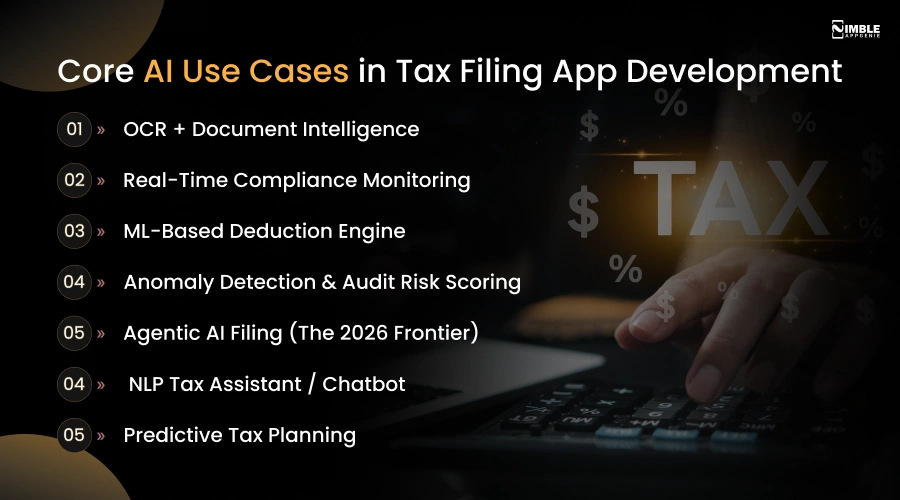
1. OCR + Document Intelligence
When a user photographs their W-2 or uploads a PDF 1099, the app should extract structured data from an unstructured document. That’s OCR combined with NLP.
At the OCR layer, tools like AWS textract or Google Vision API extract text from images with ultimate precision, even from low-quality scans or handwritten forms. The NLP layer then interprets text by understanding that “Box 1 Wages” on a W-2 maps to a particular field in IRS Form 1040, even if the document format differs between employers.
The result: a user snaps a photo of each tax document they receive, and the app auto-populates the whole return with zero manual entry.
Building this layer right requires deep AI engineering capability — see how we approach AI app development.
2. Real-Time Compliance Monitoring
Tax law changes consistently. Standard deduction amounts, credit eligibility rules, and bracket thresholds are updated every year, sometimes mid-year via IRS guidance or state legislation.
Traditional tax software patches this annually. AI can monitor Federal Register updates, IRS publications, and state tax authority feeds in real time, automatically updating filing logic.
This strength is especially crucial for enterprise compliance teams filing in multiple jurisdictions, where staying current manually is actually impossible.
3. ML-Based Deduction Engine
This feature generates the most user value and the most competitive differentiation. A well-trained deduction engine smoothly analyzes a user’s financial profile (profession, income sources, prior year data, and location) and identifies eligible deductions they don’t know to claim.
For a freelance graphic designer in California, the engine might identify Adobe Creative Cloud as a business expense, identify home office deductions, the QBI deduction, and mileage to client meetings – all from bank transaction data, without the user categorizing anything manually.
The ML pipeline needs labeled training data from historical tax returns (anonymized). Thus, this feature is challenging to replicate without domain-specific datasets.
4. Anomaly Detection & Audit Risk Scoring
Before we submit a return, an AI model scans it for patterns that statistically correlate with IRS audit triggers, such as unusually high charitable deductions, excessive round-number business expenses, income, and inconsistencies between W-2 income and bank deposits.
The models assign an audit risk score and flag particular items for review. The key UX issue here is calibration: too many false positives irritate users, and with too few features and flags, it loses its value.
The best implementations tell why something was flagged and allow the user to offer context.
5. Agentic AI Filing (The 2026 Frontier)
This is where the category is heading. Agentic AI systems connect to investment platforms, bank accounts, and payroll providers via API, collect all relevant financial data automatically, pre-populate the whole return, and submit it, with the user reviewing and approving in the last step rather than participating throughout.
Early versions of this are running in 2026. The technical complexity is important (OAuth integrations, data consent, and edge case handling), but it showcases the natural endpoint of the AI tax filing journey.
Agentic filing follows the same autonomous workflow architecture already running in financial services today.
6. NLP Tax Assistant / Chatbot
Tax law is not simple, and users have questions at each step. Instead of hold-time phone support or FAQ pages, an NLP -powered assistant manages questions conversationally. “Can I deduct my home internet if I work from home? or “What is the deadline to file for an extension?”
GPT-based models fine-tuned on IRS publications, revenue rulings, and tax court decisions can handle the majority of questions with high accuracy. The real challenge is grounding the model’s answers in authoritative sources – an inaccurate or hallucinating tax chatbot creates major liability risks.
The conversational AI in fintech is a proven pattern – here’s how NLP chatbots are already deployed across financial services.
7. Predictive Tax Planning
The highest-value use case runs throughout the year, not just during tax season. A predictive planning engine analyzes current income, spending patterns, and investments to project tax liability and recommend actions: make a charitable donation before year-end, contribute more to a 401(k), and time a capital gain realization strategically.
This transforms a tax app into a year-round planning tool, extensively increasing retention and lifetime value.
| Implementing these AI use cases requires the right integration architecture from day one. Explore our AI integration services to see how we approach OCR pipelines, NLP model deployment, and agentic AI workflows in production fintech environments. |

Must-Have Features of an AI Tax Filing App
AI tax filing app features generally fall into two categories: what the tax apps need to function, and what AI strengthens on top of that base.
Core Features (Required for Any Tax App)
- User onboarding and KYC identity verification. Getting KYC right in a tax app follows the same framework as any regulated fintech product – read our KYC and AML compliance guide.
- Multi-form support: 1040, W-2, 1099-NEC, 1099-INT, Schedule C, Schedule D, and state equivalents
- IRS e-file integration via the Modernized e-File (MeF) system
- Secure, encrypted document storage
- Real-time refund status tracking via IRS and state APIs
- Multi-state filing support (critical for remote workers and businesses)
- Payment gateway integration for tax payments and software fees
AI-Enhanced Features (Your Competitive Differentiation)
- OCR document scanning with automatic field population
- AI deduction maximizer personalized to the user profile
- Smart error detection with plain-English explanations
- Audit risk scoring with specific item flagging
- NLP chatbot for conversational tax guidance
- Predictive tax planning dashboard (year-round engagement)
- Automated compliance updates when laws change
- Personalized filing recommendations by user segment: gig worker, freelancer, SMB owner, W-2 employee
| The anomaly detection and audit risk scoring features described above use the same ML pipeline we prefer creating for financial fraud detection. |
AI Tech Stack for Tax Filing App Development
Most guides either skip the technology stack completely or list generic options.
Below is a practical tech stack for an AI tax filing app in 2026, with explanations of why every choice matters specifically for this domain.
| Layer | Recommended Technologies | Why It Matters for Tax |
| Frontend (Mobile) | React Native | Single codebase for iOS and Android; fast iteration; camera access for OCR document scanning |
| Frontend (Web) | React.js | Component-based architecture is ideal for complex multi-step filing flows |
| Backend | Node.js / Python (FastAPI) | Python’s ML ecosystem integrates naturally; FastAPI provides async performance for API-heavy workflows |
| AI/ML Framework | TensorFlow, PyTorch, OpenAI API | TensorFlow/PyTorch for custom model training; OpenAI API for NLP chatbot and document understanding |
| OCR Engine | Google Vision API, AWS Textract | Textract has native W-2/1099 schema recognition; Vision API excels on general documents |
| NLP / LLM | GPT-4o, spaCy, BERT | GPT for conversational assistant; spaCy/BERT for entity extraction from financial documents |
| Database | PostgreSQL + MongoDB + Redis | PostgreSQL for structured tax data; MongoDB for variable document structures; Redis for session caching |
| Cloud Platform | AWS / GCP / Azure | AWS preferred for Textract integration; GCP for ML pipeline tooling; Azure for enterprise Microsoft environments |
| IRS Integration | IRS MeF (Modernized e-File) API | The only IRS-approved path for e-filing requires EFIN registration and specific XML schema compliance |
| Security | AES-256, OAuth 2.0, MFA | IRS Publication 4557 mandates specific security controls; encryption at rest and in transit is non-negotiable |
| Compliance Framework | SOC 2 Type II, GDPR, CCPA | Required for enterprise sales; SOC 2 audit takes 6-12 months to complete, so plan early |
| Model Explainability | SHAP, LIME | Regulators increasingly require AI decisions to be auditable; black-box models create compliance risk. |
One consideration various teams miss: model explainability.
When your AI recommends a deduction or flags an anomaly, users and regulators need to understand why.
LIME (Local Interpretable Model-agnostic Explanations) and SHAP (Shapley Additive exPlanations) are standard tools for making ML model outputs auditable. Build explainability from the beginning; integrating later is painful.
For a broader view of how these technologies work together in production fintech systems, read our guide on AI in fintech.
How to Build an AI Tax Filing App – Step-by-Step Process
In fintech, one of the most complex development projects is building a tax filing app. Here’s the process broken into concrete steps, sequentially.
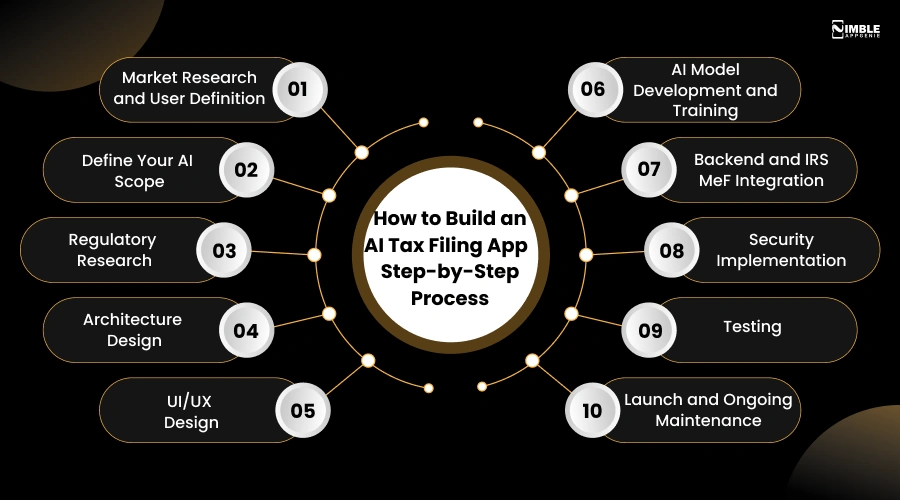
Step 1: Market Research and User Definition
Who are your real users? Individual filers have very distinct needs from SMB owners, enterprise compliance teams, or gig workers.
Your AI training data, deduction engine focus, form coverage, and UX design all change notably based on this answer. Choose a primary segment for your MVP and craft everything around it.
Step 2: Define Your AI Scope
Not every feature is equally complex or equally valuable to build. For MVP, aim at OCR document scanning and basic deduction suggestions; these deliver instant, visible value and build user trust.
Save predictive planning and autonomous filing agents for Phase 2, once you have actual user data to train on.
Step 3: Regulatory Research
Before writing a line of code, understand what you have to operate legally:
- Electronic Filing Identification Number (EFIN) from the IRS.
- IRS MeF (Modernized e-File) program registration is required before you can file returns electronically.
- If handling tax payments: FinCEN registration and potential money transmitter licensing.
- State e-file program registrations: each state has different requirements.
- Data privacy compliance requirements include GDPR for European users, CCPA for California, and state-level equivalents.
Step 4: Architecture Design
Before your models, design your data pipeline. Tax data flows from document ingestion (OCR), to extraction (NLP), to calculation (rules engine + ML), to submission (MeF API). Every stage has particular data schema requirements.
Your AI model architecture needs to follow this pipeline, not go before it.
Design for compliance initially: audit trails, access controls, and data retention policies are easier to build than to screw up.
Step 5: UI/UX Design
Filing taxes is mentally overwhelming for many users. Your design job is to diminish that intimidation, not just to make the interface visually appealing.
Best practices include plain-English labels (not IRS jargon), progressive disclosure (show one step at a time, AI assistance offered proactively, and inline explanations for complex fields, not buried in a help menu.
Step 6: AI Model Development and Training
OCR model: fine-tune on a dataset of diverse tax documents (print quality, different fonts, and scan angles). Deduction engine: train on labeled historical returns with features including filing status, profession, location, income level, and expense categories.
NLP chatbot: fine-tune a base model on revenue rulings and IRS publications, with retrieval-augmented generation (RAG) to ground answers in existing authoritative sources.
The NLP and predictive model architecture used here is nearly identical to AI in lending, worth reading if your app serves gig workers or SMB owners.
Step 7: Backend and IRS MeF Integration
IRS MeF integration is the most technically complex step in the whole project. MeF needs specific XML schema compliance, acknowledgement handling, digital signature implementation, and error code interpretation.
Expect to spend 4-8 weeks on this integration alone, embracing the IRS testing and approval process. There is no shortcut – the IRS is meticulous about scheme validation, and rejections are common during initial integration.
Step 8: Security Implementation
Essential security controls include: TLS 1.3 in transit, AES-256 encryption at rest, OAuth 2.0 for all API authentication, role-based access control, multi-factor authentication for all user accounts, regular penetration testing, and comprehensive audit logging.
IRS Publication 4557 offers specific security requirements – treat it as a checklist, not optional reading.
Step 9: Testing
Tax apps need four distinct testing tracks: security testing (vulnerability scanning, penetration testing), functional testing (does the match work), UAT with real taxpayers across your target user segments, and compliance testing (does every form meet IRS schema requirements).
Don’t skip the compliance testing track – MeF rejections in production are much more disruptive.
Step 10: Launch and Ongoing Maintenance
Tax law updates annually and sometimes mid-year. Create a compliance update cycle in your operating model before launch.
Your AI models demand retraining when rules change. Your form templates need updating when the IRS schemes update. Budget 15-20% of your initial build cost per year for ongoing maintenance, or your app will become non-compliant within 12 months.
IRS Compliance & Security Requirements
IRS compliance failures may prove to be legal liability, not only a bad user experience.
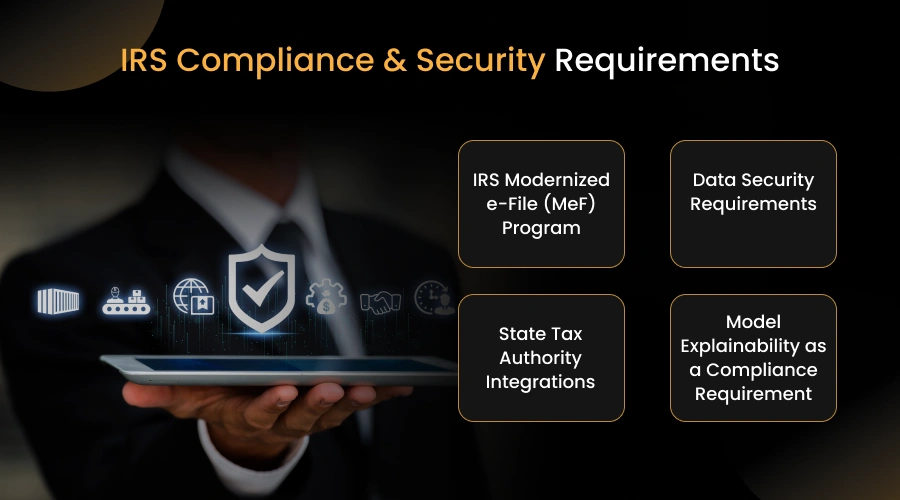
1. IRS Modernized e-File (MeF) Program
MeF is the IRS’s system for processing electronically submitted tax returns. It is the only IRS-approved pathway for e-filing.
To participate, you should register as an Authorized IRS e-file Provider, obtain an EFIN (Electronic Filing Identification Number), and pass IRS suitability testing before you can submit live returns.
The technical requirements are precise: returns need to be submitted as XML documents conforming to IRS-defined schemas (which change every year).
The MeF system validates these schemas rigorously and returns detailed error codes for any non-conformance. Create a powerful error code interpretation layer in your integration; it will be a great help for your support team.
2. Data Security Requirements
Particular compliance requirements for tax apps embrace:
- IRS Publication 4557: Protecting taxpayer data, specific security controls needed for all IRS e-file providers
- SOC 2 Type II Certification: Needed for enterprise customers and increasingly needed by individual users.
- GDPR Compliance If You Have European Users: It includes data residency, breach notification requirements, and the right to deletion.
- CCPA Compliance for California Users: Similar data rights framework.
3. State Tax Authority Integrations
If you support multi-state filing, every state has a specific e-file program, schema requirements, and approval process. Some states utilize a consortium-based approach (Federation of Tax Administrators), which eases integration.
Others need direct relationships. Complexity and cost scale with the number of states you support; consider this in your architecture planning and cost estimates.
4. Model Explainability as a Compliance Requirement
This is a surging need that will only become more crucial. When your AI recommends a deduction, auto-populates a field, or flags an audit risk, regulators and users increasingly need to understand the basis for that decision.
Black-box models that can’t explain their reasoning create both user trust issues and regulatory risk. Create explainability in your ML pipeline from day one, utilizing tools like LIME or SHAP.
| IRS compliance shares significant overlap with the regulatory framework for lending products – data handling, audit trails, and federal API integrations are common to both. If you’re building across both verticals, our loan origination software development piece covers the parallel compliance requirements in detail. |
Cost to Build an AI Tax Filing App
Cost ranges differ notably based on AI sophistication, team location, and state coverage. Below is a transparent breakdown of what to expect across three build tiers:
| App Type | AI Features Included | Timeline | Estimated Cost Range |
| Basic MVP | OCR document scanning + IRS e-file + basic deduction engine + NLP chatbot | 3-5 months | $40,000 – $80,000 |
| Mid-Level Platform | Full AI feature set + multi-state filing + advanced anomaly detection + predictive planning | 6-9 months | $90,000 – $180,000 |
| Enterprise / Agentic AI | Autonomous filing agents + compliance engine + third-party financial integrations + white-label options | 10-14 months | $200,000 – $500,000+ |
For cost benchmarking across adjacent fintech products, see how BNPL app development costs compare, which is useful if you’re building across multiple verticals.
Key Cost Drivers
- AI Model Development and Training: Custom ML models (anomaly detection, deduction engine) need labeled training data and specialized ML engineers, usually the largest single cost category.
- State Tax Authority Integration: Each additional state adds $3,000-$8,000 in integration cost based on their API maturity.
- IRS MeF Integration: 4-8 weeks of expert engineering time, plus IRS approval process; budget $15,000-$40,000 for just this component.
- Security and Compliance Implementation: SOC 2 audit preparation alone costs $30,000-$80,000, including external auditor fees.
- Annual Maintenance: Tax law changes need model retraining and form updates; budget 15-20% of initial build cost per year.
These ranges expect a competent offshore and onshore development team. US-based teams usually run 40-60% higher.
Leveraging a specialized fintech development partner who has accomplished similar integrations before can notably reduce total cost and compress the timeline – the IRS MeF integration learning curve is steep.
Challenges in AI Tax Filing App Development with Solutions
Projects usually fail when teams ignore risks or underestimate hurdles; identifying issues early allows you to plan properly and finish the work.
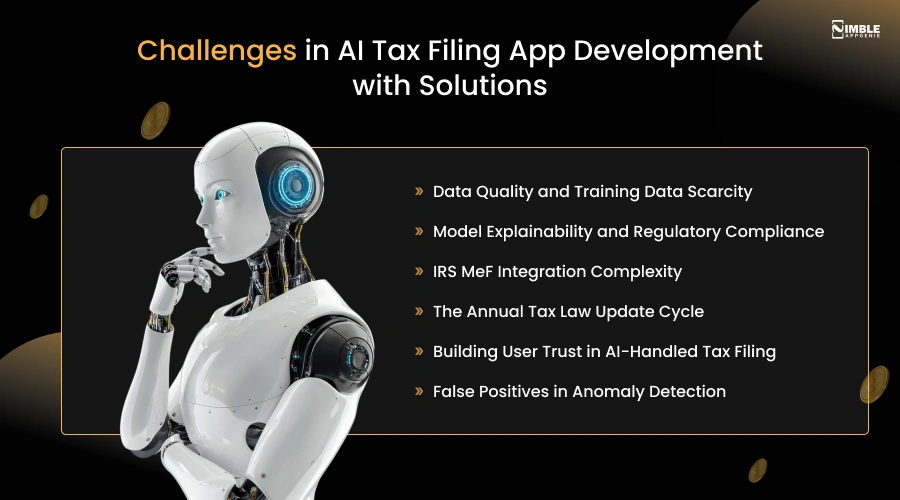
Challenge 1: Data Quality and Training Data Scarcity
AI models for tax applications require large, clean, and labeled datasets of financial documents and historical returns. This data is both scarce and highly sensitive (creating legal and ethical constraints). Only a few organizations have the volume of AI training needed.
The Solution: Utilize the combination of strategic partnerships and synthetic data generation. Partnership with accounting firms or tax preparers with proper data-use agreements can provide real labeled samples for fine-tuning.
Synthetic data tools can produce realistic 1099s, W-2s, and Schedule C documents at scale without privacy risk. Start model training in parallel with regulatory approvals to avoid a delayed launch.
The data pipeline requirements here closely mirror those for predictive analytics in finance, the same architecture, different domain.
Challenge 2: Model Explainability and Regulatory Compliance
As regulators increase scrutiny of AI in financial services, the capability to explain AI decisions is shifting from nice-to-have to needed. Tax advice from an uninterpretable black-box model creates user trust issues and regulatory risk.
The Solution: Integrate SHAP (Shapley Additive exPlanations) or LIME into your ML pipeline from the start; upgrading explainability is significantly tougher.
For every AI-generated recommendation or flag, emerge with a plain-English reason in the UI: ‘We suggested this deduction because 73% of freelance designers in your income bracket claim it.’ This satisfies both regulatory audit requirements and builds user confidence simultaneously.
Challenge 3: IRS MeF Integration Complexity
MeF API has rigid schema requirements, and the IRS is demanding non-conformance. Schema validation errors return detailed error codes, but interpreting them needs extreme familiarity with IRS documentation. Teams doing this for the first time constantly underestimate the time needed.
The Solution: Before writing a single line of code, start the IRS registration and EFIN application process on Day 1 of the project. Create a dedicated error code interpretation layer in your backend that maps MeF rejection code to Plain-English developer messages.
Utilize a development partner who has completed at least one MeF integration earlier, or budget an extra 6-8 weeks and a possible buffer for a first-time team.
Challenge 4: The Annual Tax Law Update Cycle
Tax laws change annually, sometimes mid-year via IRS guidance. Your AI models encode assumptions about current tax law, so when rules are modified, models need retraining, compliance documentation needs revision, and form templates need updating – all before January 1.
The Solution: Create the annual update cycle into your operating model before launch, not later. Assign a dedicated compliance engineer to be responsible for monitoring IRS publications, state tax authority releases year-round, and Federal Register notices.
Craft your rule engine with a configuration layer separate from your ML models, so threshold updates and tax rate can be deployed without complete model retraining. Budget 15-20% of your initial build cost per year for this maintenance cycle.
Challenge 5: Building User Trust in AI-Handled Tax Filing
People are legitimately cautious about AI handling their taxes. One wrong figure can lead to penalties, an IRS audit, or interest. Overcoming this skepticism claim is as much a product challenge as a technical one.
The Solution: Craft transparency at each touchpoint. Show users the source document behind each auto-populated field. Explain deduction recommendations in plain English with a confidence percentage.
Make human review the last step; never submit without explicit user approval. Provide a clear accuracy guarantee and audit support policy. Trust is built through repeated transparency, not just a single reassuring message.
Challenge 6: False Positives in Anomaly Detection
Overly aggressive anomaly detection, warning users about audit risk when risk is low, or flagging legitimate deductions as suspicious, frustrates users and hampers trust in the AI. Too few flags, however, make the feature far less useful.
The Solution: Calibrate your model utilizing precision-recall tradeoff analysis across diverse user segments – a freelancer’s expense profile looks very different from a W-2 employee’s. Run UAT, particularly focused on false positive rates, before launch.
In the UI, frame flags as questions despite accusations: ‘Your charitable deductions are higher than average for your income level. Do you have documentation ready?’ allows users to confirm legitimacy without feeling accused.
This is the same ML pipeline behind AI fraud detection in fintech; the architecture transfers directly to tax audit risk scoring.
Why Partner With Nimble AppGenie
Building an AI tax filing app successfully needs three capabilities that rarely exist in one team:
- AI/ML development capability,
- Fintech compliance expertise, and
- Deep IRS integration experience.
Nimble AppGenie, a leading fintech app development company, has delivered AI-powered fintech applications across BNPL, eWallet, fraud detection, and lending, including systems with GDPR, IRS, and CCPA compliance needs.
Our AI fraud detection systems use the same ML anomaly detection pipeline that empowers deduction engines and audit risk scoring in tax applications.
We work end-to-end from technical architecture to product launch, with a compliance-first approach that treats SOC 2 readiness, MeF registration, and data security as design needs, not afterthoughts.
If you are planning to build an AI tax filing app in 2026, whether an MVP to validate the market or an enterprise compliance platform, our team would be happy to discuss your project.

Our Approach to AI Tax Filing App Development
What we do bring is a fintech AI development methodology that maps directly to this space. We have built ML pipelines for anomaly detection, architected real-time decision engines, integrated compliance frameworks across GDPR and PCI DSS, and shipped financial products across the US, UK, and Middle East markets.
The components that make an AI tax filing app work, document intelligence, deduction modeling, compliance-by-design architecture, and IRS API integration, are extensions of what we already build in fintech, not a leap into the unknown.
If you are an early mover in this space looking for a development partner who will be honest about what they know, direct about what they are learning, and fully committed to getting the IRS MeF integration right the first time, that’s exactly the kind of engagement we are looking for.
We want to help shape the next generation of AI tax platforms. Explore our AI development capabilities or contact us directly to scope your project.
FAQs

Niketan Sharma, CTO, Nimble AppGenie, is a tech enthusiast with more than a decade of experience in delivering high-value solutions that allow a brand to penetrate the market easily. With a strong hold on mobile app development, he is actively working to help businesses identify the potential of digital transformation by sharing insightful statistics, guides & blogs.
Table of Contents




No Comments
Comments are closed.